The National Banking Acts (NBA) constituted a central pillar of the Republican's “revolutionary” political economic agenda.Footnote 1 Partly motivated by wartime fiscal exigencies, the NBA established a “sound” uniform currency, issued by federally chartered and regulated banks but ultimately backed by U.S. government bonds. Moreover, it mandated a reserve hierarchy that consolidated New York's position as a national banking-money center.
From the perspective of the New York money market, Margaret Myers questioned whether the NBA ushered in fundamental or more evolutionary changes to the American banking system. The original 1863 Currency Act, she observed, “bore a striking resemblance to the New York Free Banking Law.”Footnote 2 While acknowledging the benefits of a common national currency, she downplayed its ultimate impact because of the “steady trend away from bank notes to deposit[s].” Moreover, she insisted, the NBA only reinforced the existing concentration of bankers' balances in New York, which derived from its nodal position as the national jobbing center.Footnote 3
Myers's case for continuity rather than change overlooks the profound impacts of the NBA on the U.S. payments system as well as the very structure of the New York banking sector.Footnote 4 Despite strong first-mover advantages in banking and the correspondent business in particular, newly formed national banks rapidly displaced the leading antebellum bankers' banks and practically dominated the New York correspondent market by the end of the decade.Footnote 5 Moreover, unlike the leading antebellum correspondents, these new bankers' banks narrowly specialized in dealing with “foreign” country banks in the rest of the United States rather than local individual depositors.
These new entrants owed their precocious but limited success to a “war of attrition” waged by the dominant New York Clearing House Association (NYCHA) banks against the NBA and its main proponents, Treasury Secretary Salmon P. Chase and the first Comptroller of the Currency Hugh McCulloch. By effectively boycotting the federal banking system, incumbents created unusual opportunities for and constraints on new national banks. To anchor the new banking system, Chase and McCulloch deployed their considerable resources and influence to establish and nurture new national banks in New York. Excluded initially from the clearinghouse and so the local deposit market, these new entrants cultivated a “public” business, serving not only the Treasury but also country national banks.
To capitalize on their early advantage in the correspondent market, new national banks incurred significant risks. They relied heavily on deposit debt especially bankers' balances, which they attracted by paying interest on these deposits and ultimately by placing these funds in the call loan market. These factors increased their vulnerability to financial panics and further strained their relations with incumbent NYCHA banks. Once admitted into the clearinghouse, the new entrants undermined the already tenuous consensus among NYCHA members over critical central bank interventions. Consequently, after the Panic of 1873 the NYCHA became less, rather than more, important in managing systemic risks in the New York and ultimately the U.S. banking sectors.Footnote 6
In recounting this previously unnoticed and decidedly unintended consequence of the NBA, our case study supports Charles Goodhart's thesis on the limitations of private bank “clubs” as de facto central banks. Riven by successive conflicts of interest, the NYCHA faced an intractable dilemma between its membership-access policy and regulatory authority and so could not effectively serve the public good.Footnote 7 Before 1865 it behaved like a cartel and restricted membership access to its essential facility. Opening its gates to new entrants, however, only multiplied tensions among members, which weakened the basis for cooperation essential to its central banking functions.
Our argument is developed in three sections. Section one documents the concerted but ultimately futile efforts of NYCHA members to block new national bank entry into the New York banking market and the clearinghouse itself. In section two, we show how new national bank entrants successfully exploited their correspondent market niche and quickly became ranked among the largest and most specialized bankers' banks in New York City. Section three uses bank balance sheet and financial market data to investigate whether new national banks were riskier because of their greater specialization in correspondent banking among other factors. In the conclusion, we summarize our main findings and consider how these new highly specialized national banks entrants affected the stability of New York and U.S. banking systems.
JOINING THE “CLUB”: THE NYCHA VERSUS NEW NATIONAL BANKS
Prior to the Federal Reserve System, banks in larger cities formed private associations to clear and settle their customers' deposit-based payments.Footnote 8 Through the local clearinghouse, members realized significant demand and liquidity externalities and so could supply customers with timely, low-cost, and secure payments services. Additionally, because of the clearinghouse's regulatory oversight and lender-of-last-resort facility, membership certified a bank's prudential lending practices and greater likelihood of solvency during liquidity crises.
Following a decade of rapid banking expansion, the NYCHA was organized by 38 banks in 1853 and formally incorporated a year later with 50 charter members. After this initial surge in participants, the association did not expand its net membership until 1865, when the first new national banks were admitted. The association's constitution specified the formal barrier to entry: a careful examination of the applicant's books and then approval by three-quarters of the membership.
Compounding this admissions hurdle, the NYCHA applied two additional membership criteria, at least according to public debates after the Panic of 1857. The first expressed the overwhelming sentiment among members to exclude banks that paid interest on deposits, notably bankers' balances. Echoing the establishment view, J. S. Gibbons blamed the spread of this “unsafe…practice” on recent entrants, which competed against private bankers for the correspondent market.Footnote 9 The six largest New York correspondents, in fact, belonged to the clearinghouse and likely vetoed an agreement to prohibit “interest on deposits or balances of any kind.”Footnote 10 The remaining 40 members could, however, enforce a related policy denying admissions to banks that did not comply with this proscription.
In February 1859 The New York Times accused the NYCHA of behaving like an autocratic “Club-House,” limiting membership to the largest banks with at least $1 million of paid-in capital. The Times was reacting to recent NYCHA decisions denying admissions to two former members expelled during the panic and a new “far uptown” bank.Footnote 11 While recognizing the rights of a “voluntary” association “to select or proscribe [its] own company,” The Times questioned a criterion that would exclude most chartered and private banks in the city.Footnote 12
New national banks chartered in 1863 faced another entry barrier into the NYCHA. Virtually all incumbents staunchly opposed Chase's banking reform and mounted an increasingly aggressive campaign to defeat it. Historians have identified personal, economic, and ideological reasons for their hostile reaction.Footnote 13 New York banks resented Chase's strict enforcement of the independent treasury law, which had drained their specie reserves and precipitated their suspension of convertibility in December 1861. Moreover, they perceived few benefits from the note-issuing provisions of the 1863 Act and feared the loss of country bank deposits because of their designation as only one of nine official reserve cities.Footnote 14 Finally, the law stirred a deep-seated ideological conflict, because contemporaries regarded banking policy, like slavery, to be “a peculiarly important matter of states' rights.”Footnote 15
Despite opposition from the “banking interest” in New York City, Chase's reform cleared both houses of Congress but only because of overwhelming support from Midwestern Republicans.Footnote 16 Undeterred by their legislative defeat, the NYCHA banks wielded their more considerable economic power to undermine the fledgling national banking system. Their strategy was simple—to prevent national banks from establishing a foothold in New York. If successful, they would deprive country banks of reserve agents in this nodal location and diminish the value of a federal charter to bankers considering this option.
Members refused to convert from a state to a federal charter and agreed to “boycott” newly formed national banks.Footnote 17 They would not accept national bank notes at par regardless of where they were issued, and could not use them to settle their clearinghouse accounts. More importantly, they limited the access of local national banks to the clearinghouse and so deprived them of an essential condition for a “regular banking business.”Footnote 18 As The Merchants' Magazine observed, “individuals do not deposit in the new [national] banks for the reason that unless they deal exclusively with them, they by so doing would put their funds out of the circle of business.”Footnote 19
By November 1863 the First through Third National Banks had been organized in New York but on a relatively small scale.Footnote 20 To anchor the note-deposit redemption system, Chase and McCulloch directly intervened to establish larger banks. The most notorious case involved Jay Cooke, whose bond business depended on the diffusion of national banking throughout the country.Footnote 21 In late October 1863 McCulloch assembled a group of local New York capitalists to organize the Fourth National Bank with a capitalization of $5 million, comparable in scale to the largest state-chartered banks. By early December, however, they could muster subscriptions of only $1 million. Chase and McCulloch dispatched Cooke to New York to complete the deal, and within three days Cooke had raised the additional $4 million.Footnote 22
Chase and McCulloch also pressured their ally John Austin Stevens, president of the Bank of Commerce, to convert from a state to a national charter. A NYCHA member and one of the largest correspondents, Stevens' bank was strategically located in the New York market.Footnote 23 Right after the Fourth National Bank opened for business, Stevens broke ranks with the other NYCHA members and agreed to “receive on deposit of its dealers and correspondents all National Bank Notes, without reference to place of issue, at par, the same as U.S. Legal Tender Currency.”Footnote 24 Despite accommodating legislation and repeated warnings from McCulloch about the cost of further delays, Stevens did not take out a national charter for another ten months. This final step seems to have tipped the balance in favor of a federal charter, as other state banks in the city quickly followed suit.Footnote 25
To sustain the new national banks, Chase even abandoned his Democratic principles and channeled the Treasury's mounting resources and banking-financial business into their hands.Footnote 26 In late March 1864 the First National Bank advertised its designation as “a depository and fiscal agent of the United States.”Footnote 27 Other national banks would boast of a similar status, as they proffered the sale of Treasury loans. While perhaps extreme, The Merchants' Magazine regarded these banks as mere creatures of the state, solely devoted to “the receipt and distribution of the public money.”
As the final salvo in their struggle, NYCHA members attempted to exclude the new national banks from their ranks. Although eventually succumbing to the power of the Leviathan, they succeeded in prolonging the admissions process well beyond the earlier norm, and so further marginalized the new national banks in the local banking market. On 17 March 1864 the Second and Fourth National Banks applied to join the NYCHA. Because of Congressional deliberations over a revised NBA, James Gallatin, president of the (state-chartered) National Bank, immediately moved to postpone any decision on these banks.Footnote 28 The application of the First National Bank, submitted two days later, received the same hostile reception, but from John E. Williams, whose Metropolitan Bank stood to lose its note redemption business.Footnote 29
While summarily rejecting these motions, the association tabled the applications until its review and adoption of a revised constitution. This seemingly reasonable condition delayed any decision on the new national banks for nearly one year. After approving a report on the revised constitution in late January 1865, the association referred the first three applications—along with more recent ones by the Ninth and Central National Banks—to the admissions committee for a “reexamination” to obtain more current information.Footnote 30 On March 15 it finally voted to admit the Fourth and Central National Banks into the “club.” Despite its size, Cooke's bank cleared the critical 75 percent threshold by only two votes—32 yes to 9 no.
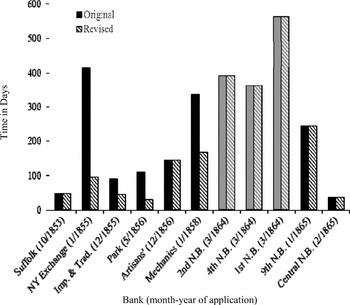
To test whether NYCHA members discriminated against the new national banks, we compare the average time lag in their admissions decisions before and during the Civil War period. We focus on these delaying tactics for two reasons. First, from the minutes of the NYCHA and its admissions committee, we can accurately track the progress of applications from the initial submission to a final vote, but we lack sufficient evidence to justify the decision to accept or reject an application. Second, regardless of the outcome, a protracted admissions process was still costly, as it relegated new entrants to peripheral, often riskier, market segments that could jeopardize their application let alone their long-term reputation and economic viability.
TIME LAG FOR NYCHA ADMISSION DECISIONS, 1853 TO 1865

The minutes record applications from six banks in the 1850s and five in 1864/65. The graph in Figure 1 identifies each bank and measures on the vertical axis the waiting time between the initial submission (indicated in parentheses) and final decision. For example, the New York Exchange Bank applied for membership in January 1855 and was ultimately rejected at the very end of February 1856, 414 days later. For several antebellum banks, we include a revised, significantly lower estimate. The New York Exchange Bank application, for example, arrived in the midst of the “commercial crisis” and was tabled until the banking system fully recovered in November 1855. For the others, the NYCHA record was ambiguous or incomplete.Footnote 31
Whether we rely on the original or revised estimates, the first three national banks to apply for NYCHA admissions—shaded in light gray—endured significantly longer delays than bank applicants in the 1850s (or after 1864). The original data—which is biased against our hypothesis—implies a wait time of 439.3 days for the national banks versus only 190.5 days for the 1850s applicants, or a gap of 8.2 months. According to the revised estimates, the antebellum banks waited only 88.2 days or almost a year less for a decision.Footnote 32
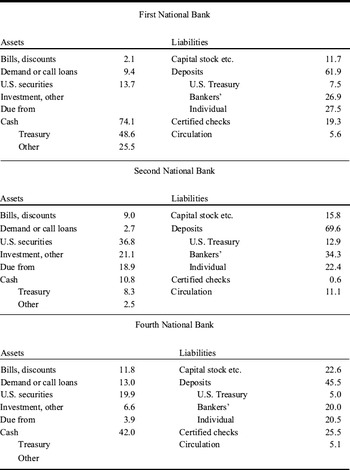
The balance sheets collected during the admissions committee's site visits indicate the impact of the delays on these fledgling national banks. Excluded from the clearinghouse and local market, they relied more heavily on their Treasury business and the growing demand for reserve agents by country national banks. On the liability side, the U.S. Treasury and country bank correspondents accounted for one-half to nearly two-thirds of their total deposits (see Table 1), but comparable sources made up less than 20 percent of the deposits of state-chartered New York City banks.Footnote 33 Likewise on the asset side, the national banks relied more heavily on U.S. securities and demand or call loans. Local customers' discounts and loans accounted for less than one-quarter of their interest-earning assets as compared to around a half for state-chartered banks. Moreover, they held unusually large amounts of cash including Treasury items (which they could use to purchase Treasury certificates paying 5 percent interest).
NEW ENTRY AND THE CHANGING STRUCTURE OF THE NEW YORK CORRESPONDENT MARKET
The entry of new national banks into the New York market largely replayed the competitive dynamics of the previous decade. In the late antebellum period, private banks and brokers rushed in to fill the economic void left by the demise of the Second Bank of the United States, and aggressively vied for the correspondent market by offering to pay upwards to 6 percent interest on bankers’ balances.Footnote 34 The newly state-chartered Metropolitan and Park Banks as well as some incumbents including the Bank of Commerce responded in kind, but typically paid only 4 percent interest reflecting their greater safety. Other established banks such as the Bank of New York and City (later National City) Bank abandoned the practice altogether and so effectively withdrew from this market.
BALANCE SHEET STRUCTURE OF NATIONAL BANK APPLICANTS TO THE NEW YORK CLEARING HOUSE IN 1864, AS A PERCENTAGE OF TOTAL ASSETS

Source:
NYCHA, Clearing House Admissions Committee Minutes (1865–1891).
In proposing to ban deposit interest rates in 1858, the vast majority of NYCHA banks sought to quash what they regarded as a destabilizing form of competition.Footnote 35 Correspondents were particularly vulnerable to country banks' panicky withdrawals of their “idle” deposits, especially during times of financial stringency.Footnote 36 Compounding the problem, they loaned these funds in the call market, demand loans that financed stock market transactions and were collateralized by the underlying securities.Footnote 37 These assets yielded the liquidity and returns that ideally matched their interbank deposit liabilities, but only under normal conditions. During panic periods, by contrast, they directly coupled banks' fate to a depressed stock market.
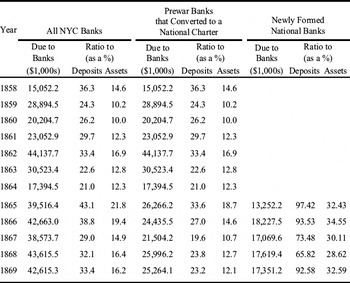
The new national banks deployed these same questionable tactics to attract correspondent accounts and deposits. The resulting industry shakeup, however, was even greater than in the 1850s, as the new entrants exploited the mounting struggle for control between NYCHA members and Treasury Secretary Chase. Table 2 tracks the real value of bankers' balances in New York over the 1860s and their distribution between “old” and “new” banks.Footnote 38 Between the years 1858/59 and 1868/69 New York banks' holdings of bankers' balances nearly doubled, and country banks held increasing shares of their correspondent deposits in New York.
NEW YORK CITY BANKS’ CORRESPONDENT DEPOSITS

Notes:
Nominal values are deflated by the Warren-Pearson wholesale price index. Figures are for the fourth (autumn) call date.
Sources:
New York State Banking Department, Annual Reports, 1858–1869; and U.S. Comptroller of the Currency, Annual Reports, 1865–1869.
The formation of new more specialized national banks, not the growth in incumbents' correspondent business, accounted for the greater concentration of correspondent banking in New York over this decade. The aggregate deposits of incumbents that converted to national status increased from $22 to $25.6 million or by 16.6 percent. The new national banks held the remaining $17.5 million in bankers' balances, or 40.6 percent of the New York City total. Strikingly, these new banks relied more heavily on their correspondent businesses for deposits, as shown by their relatively high ratio of correspondent deposits to individual deposits (0.93 versus only 0.23 for incumbents) and correspondent deposits to total assets (0.33 versus only 0.12 for incumbents).
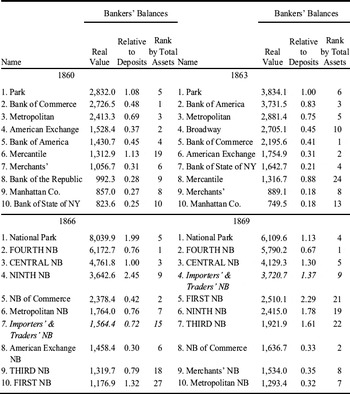
New national bank entry is associated with a temporary increase in the concentration of correspondent balances among New York banks.Footnote 39 Nonetheless, it fundamentally reconfigured the ranking of the largest correspondents in the New York market. A simple listing of the top ten correspondents between 1860 and 1869 illustrates the point (Table 3). In 1860 the Park Bank was the largest correspondent bank, as well as the youngest and most specialized with a nearly 1-to-1 ratio of bankers’ balances to individual deposits.Footnote 40 While retaining the top position over the decade, it showed no tendency towards greater specialization in correspondent banking notwithstanding the temporary blip in 1866. Merchants’ Bank was the only other large, pre-Civil War correspondent to experience growth in its real bankers’ balances over the decade, although it slipped in the ranks from seventh to ninth.
TEN LARGEST NEW YORK CORRESPONDENT BANKS RANKED BY REAL VALUE OF THEIR BANKERS’ BALANCES

Notes:
Bankers’ balance levels are taken from the fourth (autumn) call date, and are expressed in $1,000's with nominal values deflated by the Warren-Pearson wholesale price index. After 1863 several banks on the earlier lists converted to a national charter and changed their name mainly by appending National Bank (NB) to their antebellum name. The exceptions are the Park Bank, which became the National Park Bank, and the Bank of Commerce, which became the National Bank (NB) of Commerce.
Other leading correspondents on the 1860 list did not fare as well during the decade. The Bank of Commerce saw a 40 percent decline in the real value of its bankers' balances, and dropped from second to eighth place by 1869. Just as McCulloch had warned, its continued delay in switching to a federal charter likely cost the bank correspondent business. As President John E. Williams had feared, the Metropolitan Bank lost almost half of the real value of its bankers' balances. While still on the list in 1869, it too conducted a more local operation with only 24 percent of its deposits from “foreign” country bank sources as compared to 41 percent a decade earlier. Finally by 1869 the American Exchange and Mercantile Banks and the Manhattan Company had dropped off of the list entirely.
This evidence vividly connects the dramatic churning in the New York correspondent market over the Civil War divide to the entry and rapid growth of new national banks (see the capitalized entries for the years 1866 and 1869). Between July 1863 and March 1864 ten new national banks began operations in New York. By October 1864 the First, Fourth, Ninth, and Central National Banks had amassed almost $5.7 million in real bankers' balances. Sustaining this momentum, these four banks along with another recent entrant, the Third National Bank, quickly rose up the ranks to join the list of the ten largest correspondents by 1866. The Importers' and Traders' (shown in italics), which dated from the antebellum period, was effectively reorganized at the time of its conversion to national status and experienced a remarkable sixtyfold increase in real bankers' balances over the decade.Footnote 41
As an alternative metric of a bank's correspondent business, we simply count its out-of-town correspondent relations in the 1870 Homans Bankers' Almanac and Register.Footnote 42 The resulting ranking parallels that based on the value of bankers' balances; the National Park Bank occupied the top slot, and was closely followed by the Fourth, Central, Ninth, and First National Banks. Over one-half of the 1,300 banks reporting a New York correspondent relationship listed these four banks along with the Third and Importers' and Traders' National Banks.
The transformation in the New York correspondent market after the Civil War involved more than just the changing identities of the dominant banks. The evidence also suggests a fundamental change in the correspondent business itself and the New York banking market. In 1860 nine of the ten largest correspondents in Table 3 also ranked among the largest ten banks in terms of total assets. Two exceptions were the Mercantile Bank, ranked seventh in total bankers' balances but nineteenth in terms of total assets, and the Bank of New York, ranked seventh in terms of total assets but only twenty-fifth in terms of bankers' balances (and so did not make the top ten list in Table 3).
Put another way, before the Civil War the dominant correspondents were simply large banks with significant shares in all market segments. In most cases, their bankers' balances comprised approximately one-quarter of their total deposits and did not overly skew their liability structure and behavior. The Park Bank was the outlier, an antebellum prototype of the specialized bankers' bank whose bankers' balances accounted for over one-half of its total deposits.
After the war, the rank correlation between total assets and bankers' balances is notably weaker, largely because of the newly formed national banks.Footnote 43 Although relatively small in overall size, they ranked among the leading correspondent banks because of their greater specialization in this market segment. In terms of their liability structure, for example, bankers' balances comprised at least 60 percent of their total deposits. In fact, by this measure, all of the new national banks on the list and for that matter all of the banks formed after 1855 were more oriented to correspondent than to local individual banking. The only partial exception was Cooke's Fourth National Bank, which held the most assets of any New York City bank in 1869. Despite its strong local base, it was more specialized in correspondent banking than were the antebellum banks.
WERE SPECIALIZED BANKERS' BANKS RISKIER?
The successful entry of the new national banks into the correspondent market and the NYCHA heightened conflicts of interest among members that were clearly evident after the Panic of 1873. In another striking replay of the events of the late 1850s, incumbents constituted a committee to diagnose the causes of the panic and to recommend preventive measures. Like its earlier 1858 report, the 1873 report essentially blamed the “many new institutions, … which divert[ed] to themselves business from established channels … [by] paying interest upon deposits.”Footnote 44 Unsurprisingly, it also sympathized with “the older banks,” which had succumbed to the “sharp and degrading competition” and “in self-defense, … yield[ed] more or less to the pressure in the same direction.”
In 1866—well before the crisis—the Comptroller of the Currency had rebuked New York City banks for their imprudent behavior. While focusing on their speculative call market lending, he ultimately blamed the payment of interest on deposits.Footnote 45 The Treasury Secretary in 1869 repeated these charges, and even proposed legislation “prohibiting absolutely the payment of interest by banks upon deposits” to remedy the problem.
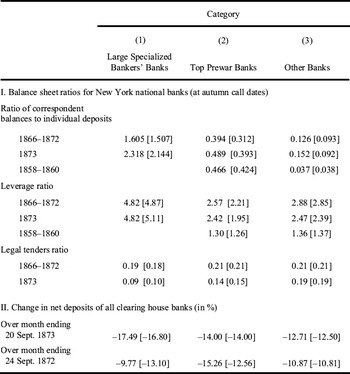
To assess these indictments against the new national banks, we first examine the 1866–1873 balance sheets of New York City national banks reported to Comptroller of the Currency on the autumn call date. The banks are divided into three categories: (1) the new, large specialized bankers' banks, (2) the top pre-Civil War correspondents, and (3) all other banks.Footnote 46 We separately report the 1873 figures, because the autumn call in that year just preceded the official outbreak of the crisis. Additionally, because the National Park Bank and Importer's and Traders' National Bank adopted the same strategy as the new specialized national banks in category 1, we derived a second set of estimates shown in brackets by adding these banks to category 1 and deducting them from categories 2 and 3 respectively.
BALANCE SHEET RATIOS AND CHANGES IN NET DEPOSITS OF NEW YORK BANKS

Notes:
Deposit composition = (Due to banks – Due from banks)/ Deposits. Leverage = (Individual deposits + Due to Banks – Due from banks – Checks and cash items – Exchanges for Clearing House)/ (Capital + Surplus + Undistributed profits). Legal tender ratio = Legal tender notes/ (Individual deposits + Due to banks – Due from banks – Checks and cash items – Exchanges for Clearing House). Net deposits = Individual deposits + Due to banks – Due from banks – Checks and cash items – Exchanges for Clearing House.
Sources:
U.S. Comptroller of the Currency, Annual Reports, 1866–1873 (Washington, DC); New York State Banking Department, Annual Reports, 1858–1860 (for Panel I); NYCHA, Weekly Statements of Condition of Member Banks, 1872–1873 (for Panel II).
The results in the first row of Table 4 clearly distinguish the large postbellum bankers' banks by the composition of their deposit business. Compared to the top prewar banks, they relied heavily on what contemporaries regarded as a type of “hot” money.Footnote 47 Their correspondent balances were 1.61 times as large as the “individual” deposits of local customers between 1866 and 1872 and 2.32 times as large in 1873. For the leading prewar banks, by contrast, the deposits of country banks were less than one-half the size of their individual deposits.
The leverage and legal tenders ratios identify two other, related risks facing specialized bankers' banks. Although the prewar and other banks relied more heavily on deposit debt relative to shareholder equity after the Civil War, their postwar leverage ratios were only 50 to 60 percent of those of the new specialized bankers' banks.Footnote 48 More leverage implied higher returns to equity during boom periods, but also greater losses and insolvency risks during the subsequent busts. To compound their vulnerability, the specialized bankers' banks faced greater liquidity pressures, especially during panic periods. The legal tenders ratio gauges their capacity to meet depositors' immediate withdrawal demands.Footnote 49 The liquidity of specialized bankers' banks was comparable to that of other New York national banks between 1866 and 1872, but dropped by more than half in 1873 as compared to a decline of one-third for the leading prewar and other banks.Footnote 50
To assess whether correspondents were more prone to withdrawal shocks, we analyze the changes in deposits of clearinghouse banks in the month prior to the 1873 panic.Footnote 51 The published weekly reports on the condition of member banks record their net deposits, the sum of individual and correspondent deposits less checks and cash items and exchanges for the Clearing House. This aggregate variable only indicates the overall change in a bank's liquidity, not sudden withdrawals by respondent banks alone. Our analysis in Panel II of Table 4 covers the month ending on 20 September 1873 when the NYCHA decided to equalize reserves and suspended the publication of individual balance sheets.Footnote 52 Because New York banks typically experienced large seasonal deposit withdrawals in the late summer and early fall months, Panel II also shows the percentage change in net deposits during the comparable month (ending on September 24) of the preceding year.
We first consider the other banks in category 3, which mainly conducted a local deposit business. Significantly, the changes in their net deposits show no sign of imminent panic; they dropped by 12.7 percent in the 1873 period versus 11.2 percent in the 1872 period. The six leading prewar banks, which presumably still paid interest on deposits, were more vulnerable to country bank withdrawals. Even so, they experienced no large deposit withdrawal in the 1873 as compared to the 1872 period, 14 percent versus a 12.6 percent decline. In striking contrast, the newly chartered national bankers' banks (in category 1) suffered larger deposit withdrawals of 17.5 percent just prior to the 1873 panic, 78 percent greater than the 9.8 percent drop the year before.Footnote 53
This evidence suggests that respondent banks quickly liquidated their excess reserve deposits in New York at the earliest signs of trouble in financial markets. During the month from late August to late September 1873 when New York correspondents were experiencing unusually large cash withdrawals, bankers certainly would have been aware of disturbances in Europe, several notable bankruptcies in the United States and the bearish trend in New York Stock Exchange. Yet, prior to the failure of Jay Cooke and Co. on September 18, there was no indication that New York banks faced a serious liquidity crisis. The call loan rate—the barometer of liquidity in the New York banking market—hovered around 7 percent, which was normal for that time of year.Footnote 54
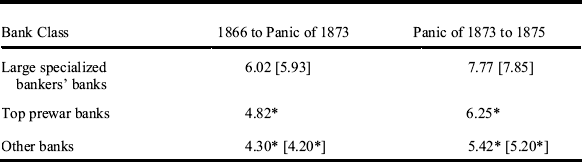
If these differences in riskiness mattered, we would expect equity investors to command a premium to hold shares in specialized bankers' banks, both before but especially after the 1873 panic. We gauge their pre- and postpanic risk perceptions by differences in the annual dividend yields across banks between early July 1866 to the Panic of 1873 and then from the panic to late December 1875. With weekly observations from the Commercial and Financial Chronicle, we calculate yields by the ratio of the current annualized dividend payout to the average of the bid and ask share prices.Footnote 55
DIVIDEND YIELDS OF NEW YORK NATIONAL BANKS BY CLASS, ANNUALIZED IN PERCENT
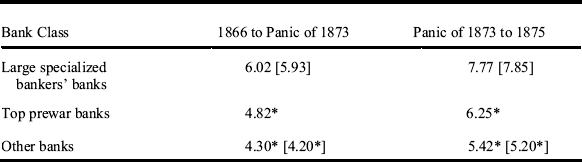
* statistically significantly different from the yields on large specialized bankers’ banks at the 1 percent confidence level.
Sources:
See the text.
The evidence in Table 5 confirms our prediction. Prior to the panic, the dividend yields on the stocks of newly chartered national banks averaged 6 percent per year. Strikingly, they were comparable in magnitude to the stock yields of the National Park and Importers' and Traders' National Banks, the two incumbents which adopted similarly aggressive policies after the Civil War. Moreover, the yields on all specialized bankers' banks exceeded those of the leading antebellum correspondents (4.8 percent) and all other banks (4.3 percent) by statistically significant margins.Footnote 56
The Panic of 1873 precipitated a sharp drop in stock prices across the board.Footnote 57 Not surprisingly, then, the dividend yields on all bank stocks increased, as investors also worried about their solvency. Consistent with our risk assessment, the increase was greatest for the specialized bankers' banks, especially when the experience of their close competitors, the National Park and Importers' and Traders' National Banks, are included. Their yields increased by nearly 2 percentage points, as compared to an increase of 1.4 percentage points for the leading antebellum correspondents and only 1 percentage point for the other banks.
None of the at-risk national banks actually failed in the wake of the panic. Their survival attests, at least in part, to the unprecedented interventions by the NYCHA to relieve the mounting liquidity pressures on its members. On September 20, along with the closing of the stock market, the NYCHA authorized the issue of loan certificates and voted to pool reserves among member banks.Footnote 58 Four days later, they also agreed to a partial suspension of cash payments.
SUMMARY AND CONCLUSIONS
While new national banks may have enjoyed decided advantages in deposit banking, these factors alone cannot explain their unusual reliance on correspondent deposits.Footnote 59 Instead, we argue, their early fate was shaped by the political economic struggle between the NYCHA and the U.S. Treasury under the leadership of Chase and McCulloch, and not simply by the invisible hand. Marginalized locally by the NYCHA, they relied on the Treasury's economic lifeline both directly, but also indirectly by cultivating their business as national bank reserve agents. Their initial success in the latter correspondent banking market, in fact, realized Chase's (and McCulloch's) goal to anchor the new national banking system in New York.
Unlike their privileged position as Chase's “pet banks,” the initial advantage of the new national banks in the correspondent market was more enduring and consequential. By early 1865 the Treasury was put on a more secure financial footing and no longer required their direct services. Yet, despite the mass conversion of older established New York banks to federal charters around the same time (another victory for now Treasury Secretary McCulloch), the new national banks retained their dominant position in the correspondent market, as measured by their bankers' balances. Viewed from a network economics perspective, the National Banking Act and ensuing conflict between NYCHA banks and the Treasury had decisively shifted critical mass to the new entrants.
Still, to gain their initial foothold in the correspondent market, new national banks revived the antebellum practice of paying interest on deposits with dire consequences for the New York banking sector and the U.S. macroeconomy. Because of their excessive dependence on correspondent balances relative to other more stable sources of funds such as individual deposits and equity, these new bankers' banks were more vulnerable to financial panics. Compared to other banks, they suffered much larger declines in net deposits in the month before the Panic of 1873. Their fragile condition, moreover, prompted the NYHCA to take ever stronger steps to prop up the New York banking sector, culminating in the partial suspension of cash payments.
The payment of interest on deposits was a divisive issue among NYCHA banks after the 1857 panic. Because of their aggressive competition for and increasing specialization in the correspondent business, the new national banks only deepened this rift. After the 1873 panic, a November proposal prohibiting the practice failed to win the necessary unanimous support. A similar proposal after the 1884 panic fell short as well.Footnote 60
At stake in this internecine conflict was the policy of pooling reserves, which had prevented suspension entirely in the 1860 crisis and partially in the Panic of 1873.Footnote 61 In the latter case, it disproportionately benefitted specialized bankers' banks, which had experienced the largest withdrawal shocks. By drawing on the collective reserves of all NYCHA banks, they could still redeem their correspondent balances for cash even after they had restricted payments to local depositors. The mainly local banks had contributed their reserves to the “common good,” but only with the expectation that more specialized correspondents would agree to the proposal prohibiting interest payments on deposits.
The rejection of this measure undermined the basis for future cooperation among NYCHA members.Footnote 62 At their next opportunity, the Panic of 1884, opposition to pooling reserves was so widespread that members did not even formally consider the option. As Elmus Wicker rightly concluded, the lack of will, not means, handicapped the NYCHA in the face of future liquidity crises.Footnote 63 By the turn of the century, in fact, these internal conflicts would further intensify because of another wave of new entry and aggressive competition, in this case by trust companies. Moreover, they would assume even greater macroeconomic importance, as New York correspondents anchored an increasingly integrated national check-based payments system. Not surprisingly, then, the Panic of 1907 was followed by calls for banking reform to substitute a public for a private lender of last resort.