Introduction
In agriculture, water is usually the predominant factor limiting plant growth. If plants do not receive adequate rainfall or irrigation, the resulting drought stress can reduce the growth more than all other environmental stresses combined. In this context, crops characterized by a more effective use of water will be at an advantage. Among the morpho-physiological traits that have been shown to influence drought resistance, root morphology (e.g. depth, angle, size, number of root-hairs, etc.) plays a crucial role (Richards, Reference Richards2008; Shao et al., Reference Shao, Chu, Jaleel and Zhao2008; Hodge et al., Reference Hodge, Berta, Doussan, Merchan and Crespi2009). In monocots, a systematic genetic analysis of root formation has been carried out mainly in maize and rice (de Dorlodot et al., Reference de Dorlodot, Forster, Pagès, Price, Tuberosa and Draye2007; Taramino et al., Reference Taramino, Sauer, Stauffer, Multani, Niu, Sakai and Hochholdinger2007; Hochholdinger and Tuberosa, Reference Hochholdinger and Tuberosa2009; Coudert et al., Reference Coudert, Périn, Courtois, Khong and Gantet2010). This notwithstanding, the information on the genetic control of root morphology and functions in barley (Hordeum vulgare L.) is rather poor, with only one notable exception (Kwasniewski and Szarejko, Reference Kwasniewski and Szarejko2006). Additional evidence shows the complexity of root growth and how it is continually challenged by a wide spectrum of stimuli such as distribution of nutrients, obstacles, heat, light and oxygen availability (Eapen et al., Reference Eapen, Barroso, Campos, Ponce, Corkidi, Dubrovsky and Cassab2003; Massa and Gilroy, Reference Massa and Gilroy2003).
At DiSTA, a mutagenized population of barley (H. vulgare L.) cv. ‘Morex’ has been produced following chemical treatment with sodium-azide (Talamè et al., Reference Talamè, Bovina, Sanguineti, Tuberosa, Lundqvist and Salvi2008, Reference Talamè, Bovina, Salvi, Sanguineti, Piffanelli, Lundquist, Tuberosa and Shu2009). This Targeting Induced Local Lesions IN Genomes (TILLING; McCallum et al., Reference McCallum, Comai, Greene and Henikoff2000) resource, named TILLMore (http://www.distagenomics.unibo.it/TILLMore/), is available for both forward- and reverse-genetics applications in barley. We report the results of a forward-genetics analysis to identify mutants for root architecture.
Materials and methods
The phenotypic analysis for root-related traits was carried out on a subset of c. 1000 M4 families from the TILLMore collection. The analysis was performed using a paper-roll approach as described by Woll et al. (Reference Woll, Borsuk, Stransky, Nettleton, Schnable and Hochholdinger2005). The method is based on seedlings grown in rollers made of a wound sandwich of filter papers and kept in a growth chamber under controlled conditions (16/8 h photoperiod and 24/22°C day/night temperature). The analysis was performed on c. 12 seeds/family per paper-roll. At the stage of 8-d-old seedling, the morphology of the seminal roots was visually compared to that of the wild type cv. ‘Morex’. The phenotypic evaluation was repeated (three reps of 12 seeds/paper-roll) only for the putative mutants identified during the preliminary screening.
For those mutants that presented an altered root-hair phenotype, further observations were made in aeroponic conditions. The germinated seeds were placed in sterile glass tubes covered with cotton bungs, one seed/tube. Each tube with seed was then connected with an empty tube and both parts were held together with parafilm. The plants were grown for 5 d under controlled conditions. Microscopic observations and image analyses of 5- to 7-d-old seedlings were performed with the use of Stemi 2000-C (Zeiss) stereomicroscope and AxioVision LE (Carl-Zeiss) program. On the same samples, the terminal root segments (c. 1 cm portion) were excised and viewed with a Tesla BS-340 scanning electron microscopy (SEM) microscope.
Results and discussion
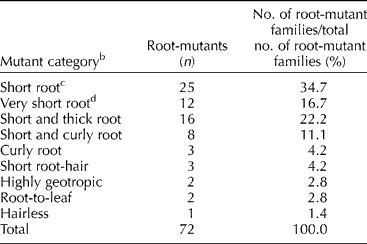
The screening of 1000 TILLMore M4 lines showed altered root morphology for 72 families. One group of 26 mutants showed fairly stable phenotype, while 47 lines showed unstable, indistinct or segregating phenotypes. The mutations identified affected different aspects of root development and were classified as belonging to nine main categories (Table 1). Some of the unstable phenotypes may reflect genetic segregation or responses to environmental conditions like gases (e.g. O2, ethylene and CO2), light and physical impediments (Engvild and Rasmussen, Reference Engvild and Rasmussen2004). Furthermore, shortened roots could sometimes be due to a pleiotropic effect of other mutations such as dwarf or chlorophyll mutants. Almost all the detected mutants showed reduced length of seminal roots ranging from slightly short to extremely short. In various cases, short-root mutants developed other alterations such as curled morphology and thick appearance. In barley, an experiment similar to what is herein reported has been performed for the identification of short-root mutants (Nawrot et al., Reference Nawrot, Szarejko and Maluszynski2005). In this case, nine mutants showing significant shortening of seminal roots were identified in a collection of dwarf and semidwarf lines obtained after mutagenic treatment of spring barley with N-nitroso-N-methylurea and sodium-azide (Nawrot et al., Reference Nawrot, Szarejko and Maluszynski2005). The analysis on our population was carried out on lines randomly chosen without considering the phenotype of the visible portion of the plant. Thus, the majority of mutants (c. 70%) showed alterations in the root but not in other organs.
List of barley mutant categories with altered root phenotypea

a Pictures of these mutants are available at http://www.dista.unibo.it/TILLMore/check.php. The images can be viewed by typing the mutant code number (e.g. highly-geotropic: 194, 3580; hairless: 5545; short root-hair: 5387, 2588, 1568; root-to-leaves: 2956, 3109) or search for the mutant category.
b For each mutant category, we report the total number of mutants identified and their percentage among the root-mutant families.
c Roots c. 50–60% shorter compared with wild-type ‘Morex’.
d Roots c. 70–90% shorter compared with wild-type ‘Morex’.
Four lines showed an altered root-hair formation. Such mutations affected two stages of root-hair development and were classified as root hairless (rhl) or short root-hair (srh). A more detailed phenotyping of the root-hair mutants was carried out growing the mutant lines in aeroponics and root observation was performed using a stereomicroscope and a SEM microscope. The images showed a noticeable difference between the hairless mutants, with a perfectly smooth root surface, and the short root-hair mutants, where the elongation of the root hairs is blocked in the early stages of development (Fig. 1). Recently, a similar survey was conducted at the University of Silesia in Poland with a population of barley mutants screened in aeroponic conditions (Szarejko et al., Reference Szarejko, Janiak, Chmielewska and Nawrot2005). This analysis allowed for the identification of 17 mutants with changes in root-hair development and the cloning of an expansin gene related to root-hair formation in barley (Kwasniewski and Szarejko, Reference Kwasniewski and Szarejko2006). Except for this outcome, until now, very little information is available on the molecular control of root-hair growth in barley and, in general, in almost all the monocots.
Two root-hair mutants compared with Morex wild-type (a) used as reference. The picture (b) shows a short root-hair mutant (cod. 2588), where the hairs are strongly shortened. The image (c) shows an hairless mutant with a smooth root (cod. 5545). All the pictures were obtained with a Stemi 2000-C (Zeiss) stereomicroscope at 50 × of magnification.

Remarkably, two TILLMore root mutant categories presented alterations that, to our best knowledge, so far have not yet been described in barley. The most interesting is a mutant category where the root does not appear and is replaced by a leaf (root-to-leaf). Further studies on these materials may provide important information for a better understanding of the signalling networks that lead to root/leaf differentiation. The second category of mutants presented a highly geotropic growth. Similar mutants of Arabidopsis, presenting an increased response to gravitropism, lack the capacity to perceive a moisture gradient that is thought to be important for controlling root orientation (Kobayashi et al., Reference Kobayashi, Takahashi, Kakimoto, Miyazawa, Fujii, Higashitani and Takahashi2007). Consequently, the two barley highly geotropic mutants may actually be hydrotropic mutants, unable to perceive water gradient in the paper-roll system. Further studies are required to validate this hypothesis.
Further details on root mutants and an informative set of pictures are available in an on-line database at http://www.distagenomics.unibo.it/TILLMore/. This database is publicly accessible and seed for mutants of interest is available on request.
For some of the TILLMore mutants with clear changes in root architecture, an appropriate series of backcrosses and outcrosses are in progress prior to their mapping in order to fix the mutations and then map and clone new genes involved in root formation and growth. From a physiological standpoint, these mutants may also help to better comprehend the role of roots in water and nutrient uptake (Gahoonia et al., Reference Gahoonia, Nielsen, Joshi and Jahoor2001), association with symbiotic organisms (Chen et al., Reference Chen, Roos, Borggaard, Zhu and Jakobsen2005) and root–soil interaction, hence providing valuable information for agronomic applications.
Acknowledgements
The research was partially funded by International Atomic Energy Agency. We thank the Department of Agronomy and Plant Genetics, University of Minnesota, St. Paul, USA, for providing ‘Morex’ seed.