He who reveals the secrets of a prison-house must have been in it. Even so, gentle reader, is it with lunatic asylums.
Louisa Lowe, The Bastilles of England; Or, The Lunacy Laws at Work (1883)When the Honourable Lewis Wingfield protested in the St. James's Gazette in 1884 that the “Lunacy Laws as they stand are a disgrace to the Statute Book,” he was giving voice to a widespread dissatisfaction with how the British state regulated the treatment of mental illness.Footnote 1 Public disapproval of the Lunacy Laws had been fierce ever since the emergence of dedicated mental hospitals in the eighteenth century, and journalists and social commentators found an easy target in the conditions tolerated by these institutions. Gazette readers would have expected just such a complaint from Wingfield, whose fiction had recently advocated penal reform. They could not, however, have expected his startling admission that he spoke from personal experience: “I occupy a unique position,” he declared. “I have never been mad, have never had a larger bee in my bonnet than that which is given to most of us, and yet I have been an inmate for a brief space in a lunatic asylum” (6). By entering the asylum using a false identity, he explained, he had seen first-hand what life was really like inside a mental institution. Equally arresting was Wingfield's motive: to conduct research for a novel. With this audacious deception, he joined a vanguard of writers who adopted the methods and materials of investigative journalism, and specifically undercover reporting, for the purpose of writing fiction. Wingfield was Britain's first undercover novelist.
The era of asylumdom in Britain began in earnest with the passage of the Lunacy Act of 1845, which established a nationwide system of institutional care for people with mental illnesses, then termed “lunatics.”Footnote 2 The new regime mandated the founding of county asylums and the provision of custodial care for those who had hitherto been relegated to workhouses, prisons, or the street. Even as it addressed a pressing social problem, however, the legislation did little to allay anxiety about a steep rise in the frequency of insanity diagnoses. According to official statistics, the number of people certified in England and Wales more than tripled in the three decades following the Act.Footnote 3 As Henry Maudsley remarked in 1871 in his annual presidential address to the Medico-Psychological Association, professional methods of treatment had signally failed to prevent insanity diagnoses from growing by more than a thousand a year since mid-century.Footnote 4 Publicly funded asylums seemed to represent an advance upon the unregulated brutality of earlier times, when those affected by mental illness had been chained to walls. Yet their humanitarian claims were widely viewed with suspicion, and in the latter half of the century the asylum system was criticized relentlessly by former patients, skeptical members of the public, scandal-hungry newspapers, and even medical experts in a foreshadowing of Michel Foucault's influential thesis that the mental institution is an instrument of social power.Footnote 5 As the Journal of Mental Science observed in 1860, “The tide of public opinion has set strongly against asylums.”Footnote 6
Privately owned asylums were doubly contentious. In contrast to county asylums, which assumed responsibility for so-called “pauper lunatics” who could not afford fees for medical care, these establishments catered primarily to patients of means. Known colloquially as “madhouses,” private asylums differed from their public counterparts in being run by proprietors as for-profit business ventures, something critics lambasted as a “trade in lunacy.”Footnote 7 Regardless of the quality of the care they provided, this commercial basis made them a target for malpractice accusations, both substantiated and tendentious, even as the yoking of pathology and profit fueled public apprehensions about asylums as sites of potential danger.Footnote 8 The distressing and graphic testimonies given by former patients about mistreatment loomed large in the popular imagination, where one fear assumed special prominence: the wrongful confinement of a sane person.Footnote 9
Novelists readily exploited this fear with melodramatic plots about mentally sound protagonists being confined to madhouses by villainous conspirators and even misguided well-wishers. Private asylums are a common motif in sensation novels, most famously Wilkie Collins's The Woman in White (1859), Mary Elizabeth Braddon's Lady Audley's Secret (1862), and Joseph Sheridan Le Fanu's The Rose and the Key (1871), which titillate readers with scenes of engineered committals and desperate escapes. The best-known fictional indictment of private asylums is Hard Cash (1863) by crusading novelist Charles Reade, who anchored its extravagant plot in painstaking research. Having collected materials for more than a decade under the notebook heading “Asyla,” he finally wrote the novel after reading in the Times about a clergyman who, having inherited a fortune and married his maid, had been imprisoned in an asylum by scheming relatives.Footnote 10 In the novel's preface, Reade underscores the factual basis of his tale in parliamentary blue books, journals, letters, pamphlets, reports, and even interviews with ex-inmates such as Edward Fletcher, whom Reade had sheltered after his escape from Kensington House Asylum.Footnote 11 This boundless zeal for authenticity—Reade enjoyed confounding skeptical reviewers by producing the real headlines upon which his plots were based—has led scholars to describe him as a “documentary” or “newspaper” novelist.Footnote 12 Tellingly, Hard Cash is subtitled A Matter of Fact Romance. Yet Reade remained distant from his subjects in one crucial respect: he never spent more than a few hours within the walls of an asylum.
Wingfield's Gehenna; Or, Havens of Unrest (1882) thus joined a venerable tradition of “lunacy panic” novels. At first glance, this three-decker novel closely resembles its predecessors, especially Reade's Hard Cash, by virtue of its treatment of wrongful incarceration in a lunatic asylum, reliance upon extensive research, and exploitation of a newspaper topic of the day. But Wingfield's use of a covert identity meant that Gehenna also made a radical break with the established formula. To venture beyond recycling other journalists’ headlines by undertaking a private investigation was perhaps a natural expedient for a writer like Wingfield, who was ambitious and hungry for facts in the service of novelty. Why settle for interviewing former asylum inmates when you could become one yourself? What other novelists had merely imagined, read about, or inspected with official permission, Wingfield would see with his own eyes from a covert vantage point.
As this article will argue, Wingfield's innovation could not have happened without key developments in the emergence of mass media, in particular the consolidation of a repertoire of new reporting techniques into what is now termed “investigative journalism.”Footnote 13 Incognito reporting had been effectively unknown until 1866, when a Pall Mall Gazette journalist named James Greenwood disguised himself as a vagrant in order to spend a night in the casual ward of a London workhouse.Footnote 14 The extraordinary impact of Greenwood's coup established disguise as a legitimate stratagem for writers to access social spaces and institutions that otherwise remained off-limits.Footnote 15 Among the countless imitators of the “Amateur Casual,” as Greenwood styled himself, were an “Amateur Lunatic,” an “Amateur Maniac,” and other undercover investigators who feigned insanity to gain admission to mental asylums in Britain and elsewhere. As he sat down to write Gehenna, Wingfield therefore had at his disposal not only sensation novels and electrifying headlines but a new mode of immersive journalism. The result was a unique experiment in undercover authorship, one that exposed the workings of a corrupt asylum system to the reading public even as it opened up new avenues for novelists in pursuit of enhanced realism and social transformation.
A Journalist among the Maniacs
Anyone who knows the name Nellie Bly will probably have been told that she became a household name by daring to go where no journalist had gone before: inside a madhouse. In 1887, the New York World hired Bly (whose real name was Elizabeth Cochrane) as an amateur reporter to infiltrate the Women's Lunatic Asylum on the city's Blackwell's Island. Although this asylum had been described by visitors such as Charles Dickens and Margaret Fuller, so the story goes, no one had ever disguised themselves as a patient to gain an insider's perspective. In accepting the challenge, Bly became the pioneer of a distinctly American tradition known as “Girl Stunt Reporting,” whose practitioners wrote vivid firsthand accounts of experiences acquired as domestic servants, factory workers, and chorus girls, and while posing as mental patients or women seeking abortions.Footnote 16 Later commentators would see Bly's impersonation as the most spectacular use of disguise to access asylums and other restricted institutions, a practice that Frank Luther Mott identifies as a key feature of the sensationalist press that emerged in the United States and Britain in the second half of the nineteenth century.Footnote 17
Bly's exposé did indeed cause a sensation after appearing on the World's front page beneath a blaze of multideck headlines:
Behind Asylum Bars
The Mystery of the Unknown Insane Girl
Remarkable Story of the Successful Impersonation of Insanity
How Nellie Brown Deceived Judges, Reporters and Medical Experts
She Tells Her Story of How She Passed at Bellevue HospitalFootnote 18
Such headlines were typical of the investigative genre in giving more attention to the journalistic heroine than to the object of investigation. Not until the second half of the summary did the investigation's real subject announce itself: “Harsh Treatment of the Insane at Bellevue.” Presuming that the public was more interested in how a twenty-three-year-old woman had gained access to a secure asylum than in standards of care, the World invited readers to follow the transformation of a middle-class professional into what Bly called “the most helpless of God's creatures, the insane.”Footnote 19 Despite playing up her vulnerability as a woman and the performative aspects of her imposture, Bly's electrifying account prompted significant reforms, including a grand jury investigation, a budget increase for mental health care, an overhaul of admissions procedures, and, ultimately, the closure of Blackwell's Island asylum. All in all, it was a spectacular outcome for a stunt supposedly without precedent in the annals of journalism.Footnote 20
There is a serious flaw in this narrative, however, namely that Bly was not the first reporter to enter a lunatic asylum. By 1887, at least two other journalists had successfully posed as patients to gain admittance to asylums in New York and London. Although Bly, as the first woman to do so, styled herself “a Feminine ‘Amateur Casual’” in tacit acknowledgment of her debt to Greenwood, the pioneer of undercover reporting, she would have done better to credit his followers who had already infiltrated asylums: Julius Chambers (as an “Amateur Lunatic”) for the New York Daily Tribune in 1872 and Charles Payne (as an “Amateur Maniac”) for the Pall Mall Gazette in 1884. The proliferation of asylum investigations reveals the extent to which Greenwood's precedent had opened previously restricted spaces to exploration by enterprising journalists.
For these reporters, disguise offered the only way to expose corrupt institutions that had proven resistant to conventional methods of investigation. Chambers's recourse to feigning acute psychosis in order to infiltrate Bloomingdale Insane Asylum followed a decade's intense public scrutiny of American mental hospitals.Footnote 21 Although many states had established hospitals as a compassionate measure for those in urgent need of psychiatric care, persistent allegations of abuse had raised questions about conditions inside these facilities, prompting numerous investigations into whether existing legislation adequately protected the rights of patients. The most sensational case involved Elizabeth Parsons Ware Packard, whose husband had obtained her committal to Jacksonville Insane Asylum in Illinois solely on the basis of a marital disagreement; after her release in 1863, she founded the Anti-Insane Asylum Society.Footnote 22 In the late 1860s, the public's faith in private hospitals was further eroded as institutions such as the Pennsylvania Hospital for the Insane were battered by scandals over the incarceration of manifestly sane individuals.
Chambers's assignment came in response to allegations of mismanagement by Bloomingdale Lunatic Asylum, which had led to the appointment of a state-authorized Lunacy Commission to consider the charges leveled by former patients and employees of systematic neglect, physical abuse, and lewd conduct. The most serious of these, an alleged wrongful incarceration, sparked a dispute among medical professionals over whether examination procedures were robust enough to prevent a sane person's confinement. Bloomingdale's Managing Physician, Dr. David T. Brown, a vehement opponent of legislative reform, claimed that it would be impossible for a sane person to arrive at the asylum without being immediately detected and discharged. Yet his assurances failed to convince the asylum's critics, among them the Tribune, which dismissed the existing laws as “a hideous farce” whose committal safeguards would prove inadequate if tested in person.Footnote 23 What the editors cannily omitted to mention was that two weeks earlier they had done precisely that.
The next day, the Tribune triumphantly announced that one of its reporters had succeeded in getting himself committed to Bloomingdale by convincing two reputable physicians that his brain was “disordered.”Footnote 24 Chambers's own account of his fortnight inside Bloomingdale appeared on the Tribune's front page. The headline “The Lunacy Law Tested. How to Imprison a Sane Man and What It Costs” was accompanied, in the first of many nods to Greenwood, by the byline “The Amateur Lunatic.”Footnote 25 According to the Tribune, Chambers had undertaken his inquiry in order to test admissions procedures, evaluate the medical profession's understanding of insanity, and expose maltreatment of patients. It left unaddressed the ethics of making the treatment of mental illness into an object of entertainment for the readership of one of New York's largest dailies.
In focusing on the journalist's performance of madness, rather than on the complex issue of mental illness itself, Chambers's “Amateur Lunatic” set the terms for all subsequent asylum exposés. Investigators typically devoted extensive column space to diverting accounts of the stereotypically “mad” antics that had enabled them to pass as madmen and madwomen. (Bly memorably described perfecting her act in front of a mirror.) For his imposture, Chambers adopted a haggard appearance, stared at the wall, made nonsensical remarks, hinted darkly at suicide, and threw a glass of brandy out the window. This erratic behavior had been carefully prescripted, of course, thanks to a fortnight's study of the symptoms of insanity as described in more than thirty textbooks—above all, John Charles Bucknill and Daniel Tuke's A Manual of Psychological Medicine (1858), which helpfully included a section titled “The Diagnosis of Feigned Insanity.”Footnote 26
The diagnostic ambiguity surrounding insanity is central to asylum investigations. Much of the appeal of Chambers's article lies in watching a journalist rationally decide how best to appear irrational in order to fool the medical “experts,” whose competence is openly mocked by scare quotes. This vulnerability makes Chambers into a proxy for the reader, who is kept in suspense less by uncertainty as to whether the asylum will be exposed (an institutional scandal) than by the prospect of the undercover journalist being unmasked (a personal and professional embarrassment). With each successive examination Chambers ratchets up the tension by speculating about whether “the game is up.”Footnote 27 He need not have worried. Within forty-eight hours, Chambers had been committed to an asylum on the recommendation of two physicians who had interviewed him for barely twenty minutes and the ruling of a magistrate whom he had never even met.Footnote 28 “It had not taken long to swear away a man's wits, to deprive him of his liberty, and to condemn him to dreary exile in a mad-house,” Chambers observes, in one of the article's jarring tonal shifts between flippancy and disgust.Footnote 29 Clownish antics could not obscure the fact that lives were at stake, and any reader tempted to dismiss the pseudo-patient's account as a journalistic stunt had only to turn to the Tribune's correspondence pages to find letters from real patients headlined “Testimony of a Former Sane Inmate.”Footnote 30
The Tribune investigation nonetheless failed to capitalize fully on the opportunity to expose the inhumane treatment in Bloomingdale. For the most part, Chambers's account prioritizes the reporter's personal experience of the asylum over those of the other inmates. As he candidly admits, “It is unavoidable, in narrating [these observations], to avoid the charge of egotism—it is only the reporter's experience which he can tell.”Footnote 31 This self-absorption prevents readers from identifying with the other inmates, who are objectified and at times even dehumanized by his unemotional descriptions of attendants slapping a blind inmate and hurling a patient nicknamed “Baby” across the dining room. As the ordeal of a shamming journalist is allowed to overshadow the systemic and unending mistreatment of bona fide patients, whose number includes genuinely disturbed and dangerous individuals, the line between amateur and actual lunatics remains firmly intact. The series’ final installment, sensationally headlined “Among the Maniacs,” is followed by Gothic subheadings such as “A Night of Horror among Raving Patients” and “Sleep Disturbed by Agonized Cries of the Dangerous Idiots.”
Yet a rare moment of vulnerability teaches Chambers just how fragile the boundary between sanity and insanity is. Worn down by his disturbed companions, physical inactivity, sleep deprivation, and confinement among filth and incessant shrieking, he experiences an epiphanic moment of disempowerment and disconnection, what psychiatrists today call depersonalization. As he senses the danger of experiencing for real a mental disturbance that hitherto he has merely been faking—an ever-present risk when going undercover—what started out as a glimpse into the vulnerability felt by other patients becomes a recognition of the proximity of acting insane to actually being insane. Only by doubting his own sanity can the journalist gain awareness of the plight of the other inmates: “He fully realized then, for the first time, how terrible must be the reflections, how wild the despair, of a sane man condemned to exile among these maddened souls.”Footnote 32 Even if his epiphany extends no further than to other sane persons, it reveals the ease and rapidity with which anyone forcibly incarcerated can become one of those “maddened souls.” This chilling but hard-won insight, a moment of solidarity that has its equivalent in almost every genre of Victorian “amateur” investigation, is a unique payoff of the undercover imposture.
Unsurprisingly, Chambers's adoption of a fictive persona did little to protect him against ad hominem attacks made in response to the exposé. Critics sought to discredit the reporter by denouncing his unorthodox methods. The specialist who had certified him as insane protested that psychiatric examinations were not designed to catch fraudulent journalists.Footnote 33 A rival newspaper refused even to report on the investigation because Chambers had entered a private institution under false pretences, what it called “sneak-thieving journalism.”Footnote 34 The Tribune countered these criticisms by insisting that incognito reporting was the only way to secure the story precisely because Bloomingdale and other asylums did not provide full access to official inquiries. For the Tribune's editors, the public interest amply justified the journalist's subterfuge: “That he feigned insanity is not a discreditable thing. The discreditable thing is that the doctors didn't find out that he was shamming it.”Footnote 35 The “Amateur Lunatic” vindicated their paper's claim that a sane man could be locked up in an asylum.
General recognition that undercover reporting had exposed an urgent need to reform mental institutions did not change the fact that many people were uncomfortable with the story's blurring of fact and fiction. Chambers himself had foregrounded the similarity between incidents in his report and a recent novel, Theodore Winthrop's Cecil Dreeme (1861), in which a woman is abducted and confined to an asylum to prevent the exposure of her father's crimes. Such melodramatic plots, the journalist declared, could no longer be considered far-fetched given how easily he and his confederates had manipulated the legal system: “The ease with which the law had been rendered a pliant instrument . . . suggested the terrible thought that unscrupulous conspirators against private rights might take advantage of venal physicians and the Lunacy enactments to perpetrate just such a crime as the novelist portrays.”Footnote 36 This convergence of fact and fiction would emerge as one of modern journalism's most celebrated—and vilified—innovations.
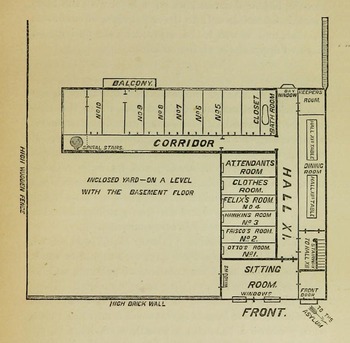
Writing in the Tribune, Chambers had likened his findings to fiction, but he jettisoned the distinction altogether for the book version of his investigation, A Mad World and Its Inhabitants (1876). Echoing Thomas Middleton's A Mad World, My Masters (1605), this volume literally transforms his original newspaper reports about playing the role of a mental patient into theater, presenting a “Programme” followed by passages of dialogue spoken by individual actors complete with songs, asides, and stage directions. The narrative's self-consciously literary tone contrasts starkly with the impersonality expected from newspaper reporting. Yet there were obvious risks in repackaging the story as entertainment: the reader's indignation derives from the imposture having really taken place. Thus A Mad World reprints Chambers's statement to the court that the abuses in question belong “not . . . to the province of fiction, but of fact” and, additionally, encloses documentary evidence in the form of a map indicating the location of his alter ego Felix Somers's cell (fig. 1).Footnote 37 Even so, the Saturday Review protested that the volume's literary format made it hard to take the charges seriously: “The author has, indeed, so managed matters that history, if it be a history, reads wonderfully like a novel.”Footnote 38 Tellingly, A Mad World affirmed the common goal of journalists and novelists by opening with an endorsement from none other than Charles Reade.
Julius Chambers, A Mad World and Its Inhabitants (1876), 89. The Internet Archive: public domain.

An Author among the Lunatics
Undercover asylum investigators may have been driven by a desire to access spaces previously hidden from view, but the advent of this journalistic mode also suggested radical possibilities for the novel. Although journalism had long influenced novelists in their choice of theme, plot, and prose style, incognito investigative journalism implied a new approach to authorship. Generations of novelists, including Greenwood himself, had drawn on firsthand experience and personal research, and Chambers, as we have seen, had repackaged press accounts of his investigation into a hybrid fictional format.Footnote 39 In the next stage, the roles of novelist and investigative journalist merged in the figure of the undercover author, someone who undertakes an incognito investigation for the specific purpose of researching a novel. Decades before Konstantin Stanislavski formulated his influential theory of dramatic performance as the “art of living a part,” undercover authors such as Wingfield (and, following him, Margaret Harkness and Stephen Crane) turned to covertly acquired experiences in their pursuit of documentary realism.Footnote 40
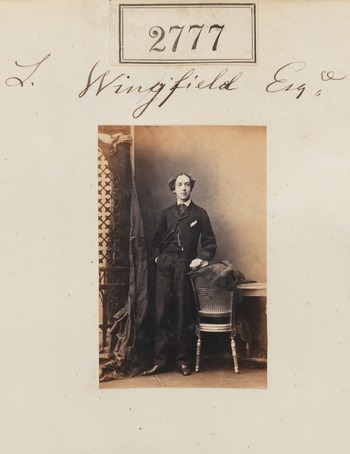
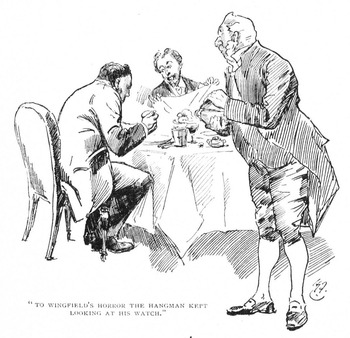
The forgotten pioneer of undercover authorship, Anglo-Irish aristocrat Lewis Strange Wingfield (1842–1891) was an unlikely candidate to become the clandestine chronicler of Britain's incarcerated mental patients (fig. 2). The youngest son of the sixth Viscount Powerscourt, he had been educated at Eton and Bonn University before embarking on a colorful career that included being an actor, artist, author, surgeon, theater critic, travel writer, and war correspondent.Footnote 41 His tastes were distinctly outré. Visitors to his London home recalled his disturbing collection of photographs of “trials by torture” and a dinner table decorated with a real-life hangman's rope; Wingfield once invited its former owner to supper (fig. 3). After his death, obituarists struggled to reconcile the numerous occupations of a “many-sided man” who cycled through professional identities as if in illustration of Dryden's dictum “everything by starts and nothing long.”Footnote 42
Camille Silvy, Hon. Lewis Strange Wingfield, albumen print, March 28, 1861. © National Portrait Gallery, London.

Wingfield dining with public hangman William Marwood. From Harry Furniss, “The Comic Side of Crime,” Strand Magazine 37 (January 1909): 43–48; esp. 46. British Library, shelfmark P.P.6004.glk.

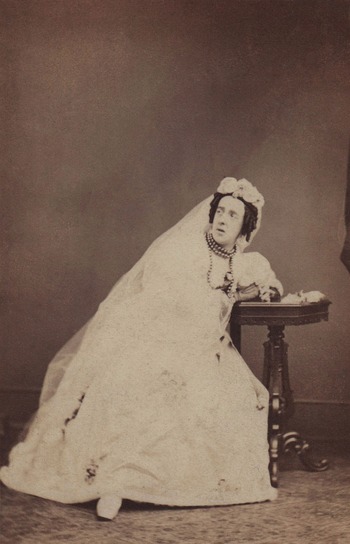
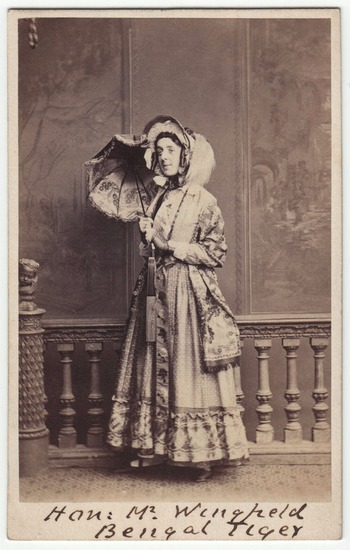
Wingfield led what today would be recognized as a “queer” lifestyle marked by a fascination with artifice and refusal to conform to conventional gender norms. He made his stage debut in 1865 as the goddess Minerva in Francis Burnand's West End burlesque Ixion, and, after founding his own touring company, he went on to play a wide range of dramatic parts, often cross-dressing as a woman (figs. 4 and 5). His expertise in historical costume attracted the notice of Oscar Wilde, and his Shakespeare productions influenced impresarios such as Henry Irving.Footnote 43 Wingfield's passion for costumery went far beyond play-acting and simulation. Before becoming a journalist, he had indulged a penchant for costumes that enabled him to cross class, gender, and ethnic lines. Friends recalled how Wingfield had once arrived at their club dressed as a “Heathen Chinee” and, on another occasion, spent a day at Epsom Derby in blackface disguised as a “negro minstrel” (fig. 6).Footnote 44 Yet these were not merely racist pranks or bohemian flânerie. Insatiably curious and seemingly careless of his safety—he may have been blackmailed by one of his male sexual partners—the aristocratic Wingfield was searching for an outlet worthy of his flair for disguise and appetite for acquiring experiences under another persona.Footnote 45 Given Wingfield's later career, there is an obvious irony in Henry Morley's scathing description of his performance in Ixion as “an idiotic dance in petticoats that might stand for something in competitive examination for admission into the Earlswood Asylum.”Footnote 46 Going undercover would come easily to a man who had already spent much of his life concealing his identity.
Lewis Wingfield as Minerva in Ixion; or the Man at the Wheel, Royalty Theatre, London, 1865. By kind permission of Paul Frecker.

Lewis Wingfield as Miss Yellowleaf in The Bengal Tiger, Dublin, 1865. By kind permission of Paul Frecker.

“Lewis Wingfield as a Street Nigger Home from the Derby.” From Harry Furniss, The Confessions of a Caricaturist (London: Unwin, 1901), 1:67. British Library shelfmark 10827.h.7.

Wingfield took up writing professionally only after pressure from his family to abandon the theater. His first book was a travelogue based on a nine-month stay in Algiers and Tunis, and during the Siege of Paris he sent dispatches about the Commune to the Telegraph and the Times by balloon. Returning to London, he worked as a theater critic for the Globe in the early 1870s under the nom de plume “Whyte Tighe” before publishing the first of seven three-decker novels, most in the category of historical fiction. It was around this time that Wingfield, like many other bohemian journalists influenced by Greenwood and the contemporary vogue for “slumming,” undertook his first incognito investigation of the capital's poorest lodgings.Footnote 47 Borrowing clothes from an actor who specialized in low-life characters, he sought shelter in the guise of an impoverished street photographer (an identity intended to allay any suspicions about his delicate hands). Titled “A London Pilgrimage among the Boarding-Houses,” the resulting series ran in All the Year Round from September 1873 to January 1874 and culminated with an account of visiting the Refuge for Distressed Persons, the last resort of the capital's destitute. Wingfield pursued his self-appointed mission with the same zeal he had brought to the stage. The publisher William Tinsley remembered him as “a master of slum-slang” who deftly used his theatrical talents to navigate risky environments, while another acquaintance related how Wingfield returned to a hostel to oversee the dismissal of its manager, who had treated him harshly while in disguise.Footnote 48 Here was the investigative journalist as witness, prosecutor, and judge.
Undercover investigating of this kind nonetheless operated under burdensome limitations. Above all, the first-person perspective restricted journalists to an account of what they had experienced personally: hostile critics would demand corroboration, and the targets of the exposé might even invoke libel law. By contrast, the authors of fictional narratives were free to synthesize background materials, use temporal compression and expansion, and embellish reality to elicit suspense and empathy in their readers. The question was, how to integrate the two genres?
Wingfield's answer—the invention of a hybrid mode of authorship—may have been inspired by the nature writer and novelist Richard Jefferies, whose investigative series “Hodge's Masters” ran in the Evening Standard from August 16, 1879, to January 12, 1880, before being republished as Hodge and His Masters (1880). For this follow-up to The Amateur Poacher (1879), Jefferies had undertaken an extensive survey of rural life in the south of England by means of ad hoc interviews, casual conversations, and eyewitness observation. He then wrote up his findings in the form of sketches, which eloquently celebrated the beauty of the natural world and the resilience of agricultural workers even as they exposed the corrosive impact of price subsidies, financial speculation, and creeping proletarianization. Although obviously firsthand testimony, “Hodge's Masters” rarely reveals Jefferies himself, whom readers glimpse only occasionally and in the narrative's margins. One of those readers was Wingfield, who praised Jefferies's ingenuity in revealing “the seamy side of existence in the provinces.”Footnote 49 The solution to the constraints of investigative journalism would be to take this process one step further: writing fiction based on eyewitness testimony obtained through an alter ego. Neither mere invention nor bald fact, this would be a narrative amalgam of both—in the person of the author himself.
Wingfield launched himself into the project of undercover authorship by beginning work on In Her Majesty's Keeping: The Story of a Hidden Life (1880), a novel that openly aimed to expose the shortcomings of the penal system. In preparation for writing, he secured permission from the Home Office to spend time as a warder observing and interviewing inmates at Dartmoor, Chatham, and various prisons in London. The idea had come to him while reading about a spate of convict memoirs, whose reliability and plausibility were openly questioned by reviewers.Footnote 50 Wingfield assured readers of his own book, by contrast, that its portraits of convicts were all based on “real individuals”; their badge numbers were available to anyone wishing to verify the testimonies.Footnote 51
Reviewers were impressed by Wingfield's use of firsthand experience as the basis for In Her Majesty's Keeping. The Morning Post noted approvingly that the novel's facts, statistics, and testimonies were “all the result of actual observation,” and the Spectator commended its author's appeal for criminal justice reform as having “the sight of his eyes and the hearing of his ears to back it.”Footnote 52 The reviews likewise recognized the author's disregard for the usual generic categories. One critic insisted that In Her Majesty's Keeping was as much an “account of convict life” as the memoirs that had inspired it; another even questioned whether “novel” was an appropriate designation for a narrative that mostly comprised reportorial description of life inside prison walls.Footnote 53 As contemporaries recognized, the novel's investigative basis substantially changed the nature of its appeal. The result of Wingfield's immersion in the realities of prison life, declared Victoria Magazine, “is a book which will be read by the mere novel reader with all absorbing interest, as well as by those who care to study the discipline to which the criminal classes in this country are subjected.”Footnote 54 The pleasure of novel reading had been enhanced rather than diluted by the acquisition of useful knowledge.
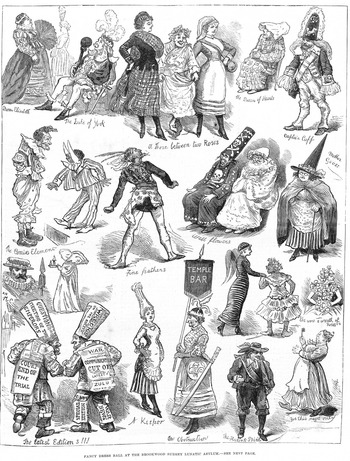
By the time Wingfield sat down to write Gehenna, he had taken his methods of observation to another level, irked perhaps by the reviewer who had faulted him for not securing a short jail sentence in order to gain a truly authentic perspective.Footnote 55 Instead of merely visiting in person or passing himself off as an itinerant tradesman, he had adopted a false identity within the institution being investigated. As part of the research for his second fictional investigation into a “total” institution, he visited asylums across the country, at one point even taking part in a fancy dress ball held at Brookwood Asylum in Surrey with costumed doctors, attendants, and more than four hundred patients (fig. 7).Footnote 56 (Wingfield came as Shakespeare's Orlando in a costume that he had designed for As You Like It.)Footnote 57 It was while visiting one of these asylums that the idea had come to him—to pose as a “keeper” so as to learn how patients were really treated when the asylum proprietor was not lingering nearby with his “company smile” (6).
“Fancy Dress Ball at the Brookwood Surrey Lunatic Asylum,” Illustrated London News, January 22, 1881, 85. British Library shelfmark MFM.MLD47.

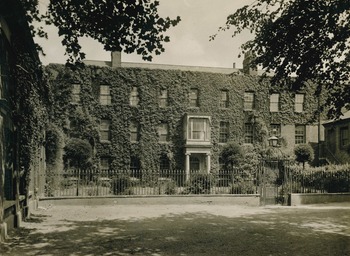
Like Chambers, Wingfield prepared for the role of asylum warder by studying Bucknill and Tuke's A Manual of Psychological Medicine. Dressed in what he judged to be “appropriate attire,” he applied to four different asylums before managing to secure a position by bribing a porter to vouch for him (6). The novelist had entered the “madhouse.” Although the identity of the asylum Wingfield infiltrated remains unconfirmed, the novel's precise description of Corbould House as a cluster of buildings centered on a red mansion not far from Bow in London's East End, coupled with his later reference to the asylum director as a botanist engaged in writing a book, indicate that it was almost certainly Bethnal House, a private asylum on Bethnal Green (fig. 8).Footnote 58 Its director, Dr. James Millar, was the author of Hints on Insanity (1862) and a member of the botanical Linnean Society, and its population, like that of Corbould House, included paupers supported by the local authority as well as private inmates with independent means.
Bethnal House Asylum, London, c.1870. Tower Hamlets Local History Library and Archives shelfmark P34082.

Wingfield took care to inform reviewers about his experiment in undercover authorship so that it would be mentioned in advance notices for Gehenna. On December 4, 1880, the Athenaeum reported that he had almost finished a novel exposing the evils of private asylums, for which he had taken the unprecedented step of seeking out direct personal experience: “With a view to working into his plot . . . true sketches of character, Mr. Wingfield has been studying carefully in Broadmoor Criminal Lunatic Asylum, and other asylums, public and private, in various parts of the country, and has been shut up daily for many hours with different patients.”Footnote 59 The Athenaeum's information made its way into newspapers throughout Britain and as far afield as the United States and New Zealand. Some papers may have exaggerated the extent of Wingfield's undercover authorship: “The author tells us in his preface that he has been in several madhouses, and passed himself off as insane, for the purpose of being able to write of what he has actually witnessed.”Footnote 60 But there was hardly a need to sensationalize a topic that was already sensational enough. A Manchester paper reprinted the story beneath the headline: “An Author Amongst the Lunatics.”Footnote 61
Wingfield's personal experience of asylums also featured prominently in advertisements when the novel began its serialization in British newspapers in March 1881 under the title “The Haven of Unrest.” In promoting Gehenna as a novel of purpose, the marketing campaign located it within a category of fiction that contemporaries, as Amanda Claybaugh notes, expected to “act on its readers—and, through its readers, the world.”Footnote 62 For such readers, the adoption of investigative journalism's methods, and not merely its findings, marked a significant evolution of the didactic genre. More than just exposing the abuses of private asylums, the undercover author's “actual experience” promised a degree of insight and authenticity unavailable to armchair reformers:
The Writer has not contented himself with Official Records. A la James Greenwood, the “Amateur Casual,” he has acquired special knowledge by actual experience, and has encountered the toils and hardships of life in one of such Institutions that he might write with additional interest and authority.
His New Work will therefore be, in the best sense, a Novel with a purpose and a mission, viz., to inform and arouse public opinion on Lunacy Reform. As a Work of Fiction, however, the Story will be one of strong and thrilling interest. The Plot is most skilfully and ingeniously conceived, and many of the characters portrayed will produce a powerful impression. The events and surroundings of lunacy life, the (alleged) brutal treatment, the influence of cold officialism, and the effect of kindly treatment, with descriptions of scenes and situations, and social relationships, and colloquy, will result in a Novel of strong and thrilling interest. Indeed, it is a Novel likely to attract great attention among Members of Parliament, and to influence legislation.Footnote 63
Wingfield's novel thereby promised to adapt for fiction the undercover reporter's unique perspective on sites inaccessible to the public gaze for the benefit of the public and parliamentary reformers alike. Subtly but significantly, it also promised an enhanced reading experience: like the roman à clef, the undercover authored novel delivers a frisson precisely by virtue of being factual.
Gehenna's documentary origins stand in marked contrast to its unrealistic plot. Although defenders of the Lunacy Laws pointed out that wrongful incarceration was possible only through elaborate conspiracy, Wingfield seems to have taken this as a dare. His novel attacks the loopholes in the law by means of a baroque plot involving the machinations of Brunhilde Patterson, a beautiful and unscrupulous Cuban émigré who succeeds in having not one but two sane men (her husband and her fiancé's brother) committed to Dr. Pagani's private asylum. Both possess fortunes that other people want to get their hands on. Much of the novel's suspense hinges on whether Patterson's scheme will be exposed by rival characters, who include a conscience-stricken doctor, an incorruptible Scotch governess, and an escaped convict. The fraudulently incarcerated men regain their liberty by the novel's end, and the scheming wife gets a comeuppance of sorts when a bigamous second marriage is thwarted by the release of her first husband.
Critics protested that the plot was hopelessly improbable; Reade's storylines seemed positively banal in comparison to Wingfield's flights of extravagance. And although most reviewers conceded that he had successfully exposed abuses to which the Lunacy Laws were susceptible, they also pointed out that novels of purpose stood a greater chance of enlisting public sympathy when presenting relatable narratives grounded in everyday life. As more than one commentator observed, a narrative based on wealthy baronets and beautiful adventuresses was hardly a plausible hypothetical through which to assess the robustness of British lunacy legislation. Some even took reassurance from the notion that the present system was proof against all but such wildly implausible circumstances.
In objecting to Gehenna's florid plot, critics nonetheless failed to recognize the contribution of its least plotted elements toward realizing the goal of reform. Wingfield became the first novelist to infiltrate an asylum, not in search of models for appealing or realistic protagonists, but because he wanted to describe with absolute certainty the legal and physical basis of his novel's institutional setting. The novel's documentary descriptions—many of them drawn from Wingfield's experiences inside the wards—have the cumulative effect of advocating the abolition of private asylums. The misdeeds of dissolute aristocrats are everywhere eclipsed by the graphic representation of the ineptitude of physicians, the brutality of asylum attendants, and, above all, the everyday suffering of patients in what one former inmate called “licensed hell.”Footnote 64 The novel's symbolic title—in the Old Testament, Gehenna is a cursed valley—cannot obscure the timeliness of its investigative focus.
Wingfield's novel metafictionally distances itself from overtly fictional narratives lest it be dismissed as one, in much the same way as a roman à clef slyly insists on its fictionality in order to avoid prosecution for libel. The governess, Cloris Galbraith, bears no resemblance to those pathetic creatures “who harrow us in novels,” we are told, and her admirer is, in turn, “no hero of romance.”Footnote 65 The novel's characters are brought within the realm of plausibility to emphasize the proximity of events to everyday life. Nor is the narrator alone in taking pains to differentiate between fact and fiction, as we see when Galbraith forbids Sir Arthur Dyson, Esq., to forfeit his £30,000 inheritance and luxurious mansion at Dyson Grove in order to marry her. “Woodbine and honeysuckle bowers are all very well in story-books,” she explains, “but not in real life” (1:67). For Wingfield, grounding in reality was a prerequisite for effectively promoting reform. Gehenna even warns that fiction might work against this goal by fomenting madness instead of fighting it. In a passage that verges on bathos, a patient left alone with a volume of Edgar Allan Poe is found “raving and rocking himself” by dinner time (3:49).
The novel genre nevertheless had the advantage of getting readers to pay attention to distasteful aspects of institutional life. Indeed, the public was notorious for closing its eyes to the treatment of mental illness. As Maudsley had insisted in The Physiology and the Pathology of the Mind (1867), the major obstacle to asylum reform was society's “selfish avoidance of insanity.”Footnote 66 In tacit recognition of this impulse, Wingfield's novel forestalls the revulsion that delicate readers might feel by giving a voice to it. Thus, Galbraith confesses her terror of insane people even though she has never seen one. “The howling wretches! Oh!” she confides to a doctor. “I should sink through the earth if one I loved went mad” (1:165). The doctor's role here is to educate readers about the reality of mental illness—or at least disabuse them of stereotypes. As one of Wingfield's medical sources complained, “It is difficult to get rid of old notions on the subjects of lunatics.”Footnote 67
There was no shortage of real-life cases for an author to draw on. Lunacy laws had again hit the headlines in 1877, the year in which Wingfield's novel is set and just a year after the publication in Britain of Chambers's A Mad World and Its Inhabitants. This latest lunacy panic had prompted a spate of autobiographical publications in the vein of My Experiences in a Lunatic Asylum (1879) by “A Sane Patient.”Footnote 68 The scandals led the House of Commons to appoint a Select Committee on Lunacy Law to investigate inter alia allegations of wrongful confinement and hear testimony from inmates allegedly being held against their will. As we will see, Wingfield's novel drew heavily, and sometimes explicitly, on the Committee's five-hundred-page report.
The traffic between fact and fiction went in both directions. Wingfield's novel fictionalized abuses of the lunacy laws to illustrate how easy it was to confine an innocent person—especially if that person had money. Crucially, Gehenna differs from other sensation novels by explaining the Lunacy Laws in detail. Because wrongful confinement was premised on an arcane set of legal stipulations, the most effective way to interest readers in the finer points of legislation was to invent thrilling situations in which a character's liberty was at stake. Gehenna echoed previous sensational novels in questioning whether the medical profession could reliably distinguish between sanity and insanity. In its discomfiting opening scene, an inexperienced surgeon named Melvil Winthrop—whose surname is an obvious allusion to the author of Cecil Dreeme—is forced to decide on a hotel guest's sanity after a mere fifteen minutes of observation. The shrieking patient is Winthrop's first encounter with mental illness, prompting him to wonder privately: “So this was madness, was it?” (1:30). Brushing aside his concerns, the senior physician and the hotel manager badger him into signing an affidavit that will commit the foreign visitor to an asylum for the rest of his life. Winthrop has no illusions about the situation's gravity, noting unhappily that the warrant resembles the lettres de cachet used by France's Ancien Régime to imprison subjects without trial. He nonetheless yields, confining the patient to an asylum where he will remain long after regaining his sanity. Wingfield even entangles Mr. Patterson's wife in a second plotline involving incarceration, further underscoring the novel's Foucauldian message that British Lunacy Laws were ultimately about social control.
At the same time, Wingfield's fictional narrative was scrupulously grounded in fact. Although he did not model its characters on real people to the same extent as Reade, who recycled newspaper stories for plots, his inclusion of legal precedents ensured that readers would recognize the scenarios as more than hypothetical. Legal precedents referenced in the narrative kept actual cases of wrongful confinement continually before the audience's eyes. Specifically, the Select Committee on Lunacy Law had investigated each of the three cases cited in the pages of Gehenna: Walter Marshall, who testified to the Committee that he had been committed to Ticehurst for radical political beliefs; J. W. Thomas, an Anglican minister who was detained even after his recovery to prevent him from retaliating against family members; and Alice Petschler, a middle-class woman who had been needlessly confined to a pauper asylum and forced to eat, wash, and sleep with patients beneath her social station.Footnote 69 Wingfield later confirmed that factual and fictional discourse worked toward the same end—in his eyes, at least—by reprinting the novel's summary of Thomas vs. Thomas almost verbatim in an editorial published by the St. James Gazette.Footnote 70
Gehenna's narrative further drew on the resources of investigative journalism by incorporating material gleaned from parliamentary investigations. Although the novel cites sources ranging from Bucknill and Tuke's A Manual of Psychological Medicine to the fictional Dr Pagani's own Psychological Physiology, the dominant intertext is unmistakeably the report submitted by the Select Committee on Lunacy Law. From one perspective, then, Gehenna is essentially a blue book turned into fiction and Winthrop a personification of the Lunacy Commission's report. His conscience drives him to specialize in lunacy at the Bethlehem Hospital (commonly known as Bedlam), a career decision that, in narrative terms, makes him into a mouthpiece for Wingfield's research into the history of lunacy, the current state of the Lunacy Laws, and proposals for potential reforms, which, if delivered by the narrator, would likely invite charges of authorial didacticism.
Winthrop also acts as a proxy for Wingfield to recapitulate his own experience of scrutinizing the existing legislation on insanity. “Dr. Winthrop examined the statutes minutely,” we are told, “and they made him sick” (2:254). The narrative's legalistic citation of actual laws such as “(16, 17 Vict., cap. 97)” serves as corroborating evidence while also supplying a paper trail for any reader interested in checking abuses in the real world (2:256). If Wingfield's efforts to smuggle in so much research risked turning the novel of purpose into a pamphlet, his reliance upon verifiable evidence caught reviewers’ attention. As the Athenaeum observed approvingly: “He is a writer who does not spare pains in making researches for the matter of his novels. This time he has left history and gone to Acts of Parliament and newspaper reports.”Footnote 71 The Academy put it more succinctly: “The author . . . is deep in Blue Books.”Footnote 72 Patrick Brantlinger may be right in proposing that “Victorian fiction aspires to the condition of bluebooks,” but making dryasdust reports into entertaining stories was never easy.Footnote 73 Although Reade had boasted that fiction breathes life into the “dry bones” of blue books, it was equally true that an excess of facts could turn the raciest narrative into a corpse.Footnote 74 Several reviewers complained that research had overburdened Wingfield's narrative—the novel as blue book rather than the blue book as novel.
Had Wingfield's investigation stopped at blue books, Gehenna might be dismissed as Reade-lite. After all, plenty of novelists had based plots on blue books and even written about abuses they had witnessed in a private or professional capacity. But Gehenna's basis in undercover authorship introduced a perspective without precedent in British fiction. Wingfield went beyond previous “newspaper” novelists, who merely recycled material taken from the day's headlines, by acquiring “special knowledge by actual experience”: firsthand testimony from his time impersonating an asylum attendant. The result was an innovation in narrative realism that promised to document injustices that had so far eluded inquiry. As The Graphic noted: “If fiction proves, and can prove, nothing, and is by its nature open to suspicion, [Wingfield] may fairly answer that fiction enters where evidence and argument find barred doors.”Footnote 75
Undercover authorship enabled writers to experience for themselves the scenarios that official reports described impersonally. In this case, Corbould House, the novel's fictional asylum located in East London, replicates Wingfield's insider experience of patient care, including the attendants, all former soldiers and disgraced servants, who were entrusted with maintaining discipline in the wards. As the physician Andrew Wynter observed, “It is the attendant who is the real master of the patient: hour by hour he is at his mercy.”Footnote 76 Observation of the cruelty shown to patients by poorly supervised and morally depraved staff led Wingfield to condemn the asylum as a “haven of unrest” (a phrase appearing in both the novel's subtitle and his subsequent journalism), somewhere more likely to exacerbate than to heal mental illness.Footnote 77
A villainous attendant named Patsey serves as the fictional embodiment of the callousness witnessed by Wingfield during his undercover foray. A carryover from Wingfield's previous novel on prison life, he has three months remaining on his ticket of leave after a five-year spell in Portland Prison. This was a realistic detail. Low wages, grueling labor, and the lack of a character reference requirement meant that asylum attendants often came from semi-criminal backgrounds, what Wingfield calls “the cesspools of the earth” (1:159). Finding competent staff was a continual headache for asylum proprietors, who were liable for the consequences of hiring attendants who turned out to be even more violent than their patients. As a result, asylums were frequently marred not by isolated abuses but by deep-rooted cultures of maltreatment where staff routinely used physical coercion and petty incentives to pit inmates against one another. For Wingfield, who had seen for himself, it was nothing less than a “system of terrorism” (6).
The press reported the deaths of numerous patients at the hands of attendants, prompting the latter to devise punishments that left no incriminating physical marks. (The Pall Mall Gazette once published a letter from Reade under the title “How Lunatics’ Ribs Get Broken.”Footnote 78) In Gehenna, Winthrop invokes prevailing theories of mental health in an effort to persuade asylum attendants to use moral persuasion instead of physical force, but their response is simply to exercise violence by other means. As one real-life asylum employee confided to Wingfield: “Forbearance and reasoning and what they call moral control is all bosh” (6).
Wingfield takes particular pains to show the patients’ vulnerability to physical and psychological abuse. Patsey repeatedly intimidates a soft-spoken clergyman who is tormented by thoughts of suicide and unable to defend himself. The novel provides a detailed description of the attendant's favored methods for disciplining the “loonies” under his care: slapping them with an open hand; planting a knee against their ribs; strangling them with a handkerchief; and depriving them of clothing (2:152). The stricken parson, apparently suffering from Stockholm syndrome, confirms that such mortification operates on minds as well as bodies. Even though his tormentor has already killed at least one patient, the parson pleads with the doctors responsible for his protection: “Don't take me away from Patsey—I love Patsey” (2:213). Predictably, Patsey ignores all warnings against using physical force and, after causing the parson's death, clumsily tries to disguise it as a suicide by stuffing the corpse's mouth with laurel leaves—a crime that Wingfield took directly from the Lunacy Commission's report.
This detail brings us to the novel's most explicit uses of investigative journalism. Wingfield openly departs from the fictional mode at two points in the novel, each taking the form of an unobtrusive paratextual interpolation: a footnote. The first provides the source for a legal quotation relating to Chancery lunatics that is presented as running through Winthrop's mind: “Evidence of Dr. Bucknill (himself a Chancery visitor) before the Committee of the House of Commons, 1877. Since that one-sided investigation no change has been made in the Lunacy Law” (2:255). Wingfield here follows the precedent of writers like Wilkie Collins, who concludes his short story “A Mad Marriage” (1875)—also about wrongful committal to an asylum—with a signed authorial footnote confirming its basis in a real legal case.Footnote 79 Such documentation, the Victorian equivalent of “based on a true story,” counteracts any escapist impulse by reminding audiences that the ostensibly fictional narrative is anchored in reality, and, in this case, that such injustices were likely to continue without legal reform.
Wingfield's other departure from the fictional mode was a literary first. Rather than invoking blue books or newspaper reports to confirm the grim reality of its setting, Gehenna reveals that the author has himself witnessed such abuses. Although asylums had by this time abandoned the physical restraints of a less enlightened age, they had been replaced by a de facto system of “chemical restraint.”Footnote 80 Thus Patsey soliloquizes like a stage villain about a drug commonly used to subdue patients: “Digitalis . . . sedative fust, and then a stemmilint. How convenient! No records kep’ of how we use it—no rude questions put. I'm too violent, am I, Mr. Sawbones? Oh, indeed! If it suits me, I can quiet ’em” (2:216). But what sounds like Gothic melodrama turns out to be one of the novel's most realistic details, taken straight from the notepad of an investigative journalist. To emphasize the point, an asterisk directs readers to a footnote, which starkly confirms that this chilling declaration is no novelistic flourish: “A fact” (2:216). So inconspicuous as to be overlooked by all but the most observant reader, Wingfield's “fact” announces the special truth-value of fiction based on undercover authorship. It is a forceful reminder of the real-world social injustices pervading this fictional narrative.
Undercover authorship sought to have it both ways by telling an imagined story using incriminating details drawn from life. Unlike his predecessors, Wingfield was not content to base his tale on medical textbooks, parliamentary investigations, blue books, or even what he witnessed in propria persona. Instead, assuming the role of undercover author, he used fiction to expose mistreatment in a manner akin to the press itself. Gehenna thereby joins the Fourth Estate and those other sources of evidence in documenting abuses inside the asylum. It is all the more curious, then, that Wingfield's undercover authorship is nowhere mentioned in the text. In contrast to his previous novel, in which an envoi mentions the author's prison visits, no preface explains the author's excursions to Broadmoor and other asylums, or accounts for why he singles out this solitary “fact.” The footnote's brevity suggests Wingfield is speaking to an audience that already knows about his investigation, from advertisements or other sources, and has trust in the hard-won authority of an “amateur attendant.”
As we saw in this article's introduction, it was not until two years after Gehenna's publication that Wingfield publicly revealed how he had entered an asylum disguised as an attendant. In a series of essays on lunacy reform published in the St. James Gazette in 1884, he described an actual attendant (closely resembling Patsey) who kept a secret cache of digitalis and other opiates for use on night shifts, thereby confirming the truth of the horrifying statements footnoted in Gehenna as “fact.”Footnote 81 Journalism gave Wingfield another platform from which to restate the novel's implicit call for the abolition of private asylums. The threat they posed had less to do with wrongful confinement than with turning sane patients into insane ones—a grotesque paradox that Wingfield, echoing Gehenna, calls “asylum-made lunacy.”Footnote 82 Intended to expose the threats facing vulnerable asylum inmates, his undercover investigation had ultimately highlighted the fragility of all mental health.
Coda
Undercover investigations of asylumdom would continue long after the publication of Wingfield's novel. Most notably, the journalist Charles Payne followed in Chambers's footsteps by posing as an “Amateur Maniac” to conduct the first undercover newspaper investigation into Britain's private asylums. Serialized in the Pall Mall Gazette between August 27 and September 2, 1884, “My Experiences in a Madhouse” describes three days spent by the author in a mental institution after being directed by his editor to “go mad.”Footnote 83 Yet the genre's sensationalist tendencies were becoming apparent, and many readers would have seen Payne's story as little more than a stunt. His pose as a man who believes himself to be a walrus at the Zoological Gardens owes more to comic stereotyping than the realities of mental illness. Indeed, Payne's charade initially failed to secure him admittance to the asylum, forcing him to resort to false statements, assistance from medical acquaintances, and an elaborate backstory involving previous committals. The Pall Mall 's campaign exposed the susceptibility of existing protocols to fraud but hardly to false diagnosis.
Payne's investigation came at a time of growing skepticism toward the press and its blurring of the line between observation and invention. Where predecessors had flaunted their literary credentials, Payne downplayed the writer's role. A prefatory note to the collection Matrimony by Advertisement (1885) reassured audiences that the journalist's “social experiments” had a practical goal: “The desire to study various phases of life as an aid to the writing of works of fiction has been subsidiary.”Footnote 84 Such disclaimers were necessary now that Wingfield and other writers had begun to combine the formerly discrete roles of novelist and undercover investigative journalist. Even the original “Amateur Casual” himself would eventually get in on the act. Not to be outdone by his imitators, Greenwood, now in his seventies, spent time at an asylum gathering material for a book based not on the kind of undercover reporting that he had pioneered but on interviews with asylum inmates. Ironically, reviewers insisted on consigning Among the Cranks (1905) to the category of fiction.
As the investigative journalism of the nineteenth century shows, at the heart of every visit to the closed world of the asylum lies the permeable boundary between fact and fiction. Despite using more refined methods and ethical standards, even latter-day investigations have faced crises of legitimacy. The best-known example is the 1972 Rosenhan Experiment, which purported to show that feigned auditory hallucinations were sufficient grounds for committal to a psychiatric hospital, but which has since been questioned on the grounds of accuracy and even veracity.Footnote 85 As these modern investigators suggest, the legacy of Victorian lunacy investigations is not merely a skepticism about the realities of psychiatric care but a recognition of the difficult distinction between reality and unreality on which that care depends.