INTRODUCTION
Currently, real estate and industrial expansion in coastal areas without environmental planning have led to a disorderly occupation of the coastal landscape, including estuarine areas (Blaber, Reference Blaber2000). The habitat value and ecological services of coastal and marine environments are well recognized (Beck et al., Reference Beck, Heck, Able, Childers, Eggleston, Gillanders, Halpern, Hays, Hoshino, Minello, Orth, Sheridan and Weinstein2001; Johnston et al., Reference Johnston, Grigalunas, Opaluch, Mazzotta and Diamantedes2002), as well as the ecological consequences of anthropogenic impacts (Worm et al., Reference Worm, Barbier, Beaumont, Duffy, Folke, Halpern, Jackson, Lotze, Micheli, Palumbi, Sala, Selkoe, Stachowicz and Wtason2006). In this context, estuaries are valuable ecosystems that provide direct use and non-use values to society, such as water supply (for irrigation and drinking), medicinal resources and cultural heritage (Barbier et al., Reference Barbier, Hacker, Kennedy, Koch, Stier and Silliman2011). In addition, estuaries are involved in sociocultural and economic conflicts in the ecosystem, such as artisanal and industrial fisheries (Bennett et al., Reference Bennett, Carpenter and Caraco2001; Gómez et al., Reference Gómez, Lloret, Demestre and Riera2006). One of the gaps in estuarine conservation in emerging tropical countries (e.g. Brazil) is the lack of scientific information related to the immense variety of existing ecosystems. Barletta & Costa (Reference Barletta and Costa2009) claim that each estuarine ecosystem has unique cultural, ecological and climatic features that have to be considered in management planning.
Estuarine systems are composed of natural rich-structured habitats such as mangrove forests, beaches, marshes, seagrass beds and tidal creeks, and they serve as potential fish nursery areas by provisioning shelter against predators and abundant food supply (Beck et al., Reference Beck, Heck, Able, Childers, Eggleston, Gillanders, Halpern, Hays, Hoshino, Minello, Orth, Sheridan and Weinstein2001; Gillanders et al., Reference Gillanders, Able, Brown, Eggleston and Sheridan2003; Sheaves et al., Reference Sheaves, Johnston, Johnson, Baker and Connolly2013). The importance of these areas as nursery grounds has been identified in temperate, subtropical and tropical estuaries (Nagelkerken et al., Reference Nagelkerken, Kleijnen, Klop, Van den Brand, De la Moriniere and Van Der Velde2001; Nagelkerken & Van Der Velde, Reference Nagelkerken and Van Der Velde2004). In general, the estuaries and fish biodiversity of Brazil have been heavily affected since European colonization until today, and the conservation of these natural ecosystems is linked to the development of baseline ecological studies, primarily involving protected estuarine areas and commercially important fish species (Barletta et al., Reference Barletta, Jaureguizar, Baigun, Fontoura, Agostinho, Almeida-Val, Val, Torres, Jimenes-Segura, Giarrizzo, Fabré, Batista, Lasso, Taphorn, Costa, Chaves, Vieira and Corrêa2010).
The environmentally protected area of the São Mateus River estuary (APA de Conceição da Barra) was created in 1998. It comprises 7728 ha and is located in the Brazilian Atlantic Forest biome. Although this biome was previously recognized as a conservation priority hotspot (Myers et al., Reference Myers, Mittermeier, Mittermeier, Da Fonseca and Jennifer2000; Myers, Reference Myers2003), the aquatic habitats and fish ecology of the biome remain poorly known (Menezes et al., Reference Menezes, Weitzman, Oyakawa, Lima, Castro and Weitzman2007). Barletta et al. (Reference Barletta, Jaureguizar, Baigun, Fontoura, Agostinho, Almeida-Val, Val, Torres, Jimenes-Segura, Giarrizzo, Fabré, Batista, Lasso, Taphorn, Costa, Chaves, Vieira and Corrêa2010) reinforced that mangrove-lined estuaries of Brazil (e.g. the São Mateus River estuary) require the attention of the Brazilian Environmental Authority to ensure fish habitat conservation due to current impacts in the coastal zone such as port operations. Recently, the continental shelf adjacent to the São Mateus River estuary (i.e. the non-protected areas of Abrolhos Bank) was reported to shelter an unexpectedly rich mosaic of benthic habitats with the largest continuous rhodolith bed in the world (Amado-Filho et al., Reference Amado-Filho, Moura, Bastos, Salgado, Sumida, Guth, Francini-Filho, Pereira-Filho, Abrantes, Brasileiro, Bahia, Leal, Kaufman, Kleypas, Farina and Thompson2012), highlighting the high biological importance of this region. From this perspective, the São Mateus River estuary provides suitable conditions to understand how the habitat structure influences juvenile fish assemblages in a tropical estuary since this habitat has not suffered from substantial human-induced environmental changes (e.g. port and dredging operations).
Thus, we selected juvenile fish habitats in the estuary mentioned above and evaluated the influence of these habitats in structuring juvenile fish assemblages. We hypothesized that the environmental factors (salinity, turbidity, habitat depth and temperature) associated with each juvenile fish habitat contribute to the fish distribution. In addition, we proposed strategies to implement a management plan for this estuarine conservation area (APA de Conceição da Barra) in relation to commercial fish species.
MATERIALS AND METHODS
Study area
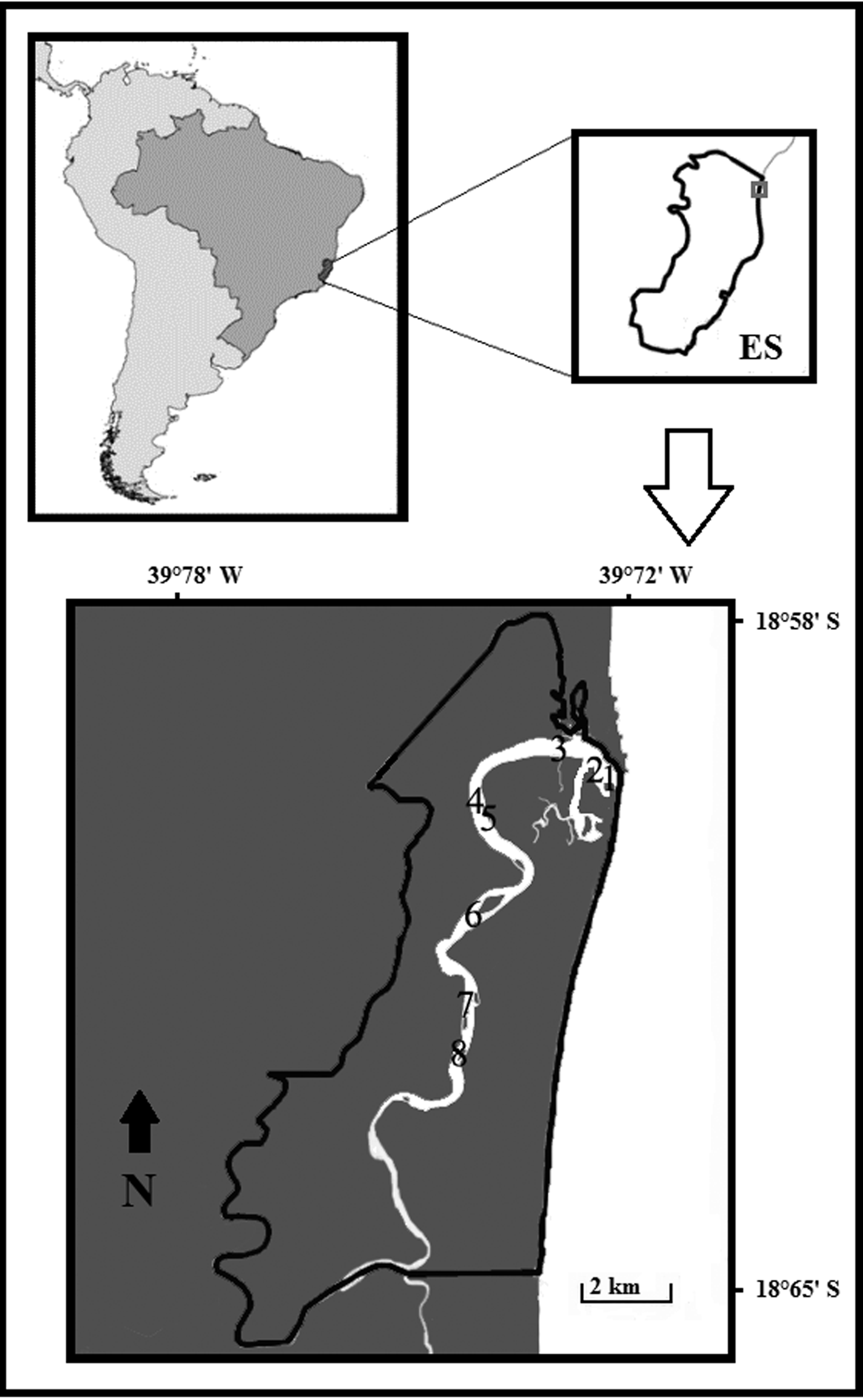
The São Mateus River estuary (SME) (18°35′59.8″S 39°43′56.3″W) is located in the northern region of Espírito Santo, Eastern Brazil (Figure 1), and the river basin comprises ~13,400 km2, which is formed by the Cotaxé and Cricaré rivers. The annual rainfall is 1372 mm, ranging from 50 mm (May) to 200 mm (November), and the tidal regime is semi-diurnal with a tidal height of 0.8 m. The estuary is dominated by 11 km2 of mangrove vegetation, including Avicennia germinans, Avicennia schaueriana, Laguncularia racemosa and Rhizophora mangle (Silva et al., Reference Silva, Bernini and Carmo2005; Bernini et al., Reference Bernini, Silva, Carmo and Cuzzuol2006), and is included in the APA de Conceição da Barra protected area. Bernini et al. (Reference Bernini, Silva, Carmo and Cuzzuol2006) reported low heavy metals concentrations (Fe, Mn, Zn and Cu) in the SME mangrove sediment in relation to other Brazilian estuaries, mainly due to the absence of industrial activities surrounding the SME. However, some illegal activities, such as fishing, mangrove deforestation and aquaculture, are still recorded in the estuary (Silva et al., Reference Silva, Bernini and Carmo2005; Vale & Ross, Reference Vale and Ross2011).
Study area showing the eight sampling sites in the São Mateus River estuary, Brazil. Black outline denotes the coverage zone of the protected area (APA de Conceição da Barra). Sites 1 and 2 comprise sandy beaches, 3 intermediary sandy beach-mangrove habitat, 4 and 5 mangrove shoreline habitats, 6 intermediary mangrove-macrophyte vegetated habitat, and 7 and 8 macrophyte vegetated habitat.

Although the mangrove vegetation covers a huge portion of the estuary, different shallow habitat mosaics are observed across the estuarine system. Eight shallow areas, comprising the entire estuarine area (lower, middle and upper), were chosen to evaluate the distribution of juvenile fish. Furthermore, the sampled sites represented different habitat mosaics, as follows: Sites 1 and 2 consist of sandy beaches (SB) located in the lower estuary area; Sites 4 and 5 are located in the middle estuarine area comprising mangrove shoreline habitats (MSH), mainly covered by Rhizophora mangle; and Sites 7 and 8, which are shallow habitats located in the upper estuary, are covered by dense macrophyte vegetation (MV), mainly Typha domingensis. Sites 3 and 6 comprise the intermediary shallow habitat types of SB-MSH and MSH-MV, respectively.
Data sampling
A sampling programme was designed to cover eight sites over one year (Jul/2012 to June/2013), and three replicates were performed each month using a beach seine net, 10 m long and 2.5 high, with a 5 mm mesh size. Seine hauls were always pulled during neap tides and diurnal periods. Once collected, individuals were counted, measured in relation to standard length (SL mm) and weighed (g). All individuals were identified according Figueiredo & Menezes (Reference Figueiredo and Menezes1978, Reference Figueiredo and Menezes1980, Reference Figueiredo and Menezes2000), Menezes & Figueiredo (Reference Menezes and Figueiredo1980, Reference Menezes and Figueiredo1985), Carvalho-Filho (Reference Carvalho-Filho1999) and Carpenter (Reference Carpenter2002). The seasons were defined as winter (21 Jun–20 Sep), spring (21 Sep–20 Dec), summer (21 Dec–20 Mar) and autumn (21 Mar–20 Jun). Environmental factors were measured for each sample using a thermometer (temperature), an optical refractometer (salinity), a turbidimeter (turbidity) and a 2-m ruler (water depth).
Data analysis
Cluster analysis was performed for the environmental data (salinity, temperature, turbidity and water depth) from the eight sites sampled using Euclidean distance, and analysis of similarity (ANOSIM) was applied to verify the similarities among the sites in terms of environmental factors. In addition, environmental data were previously log-transformed and tested by permutational multivariate analysis of variance (PERMANOVA; Anderson et al., Reference Anderson, Gorley and Clarke2008) using sites, months and replicates as the factors to verify the possible spatial and temporal differences in the abiotic patterns.
We selected the most representative fish species (i.e. relative abundance >1%) to evaluate the spatial and temporal variations in the fish community structure of the SME. For this, we log-transformed the data and determined if the fish abundance differed among sites, months and hauls through the PERMANOVA. In addition, we evaluated the spatial variation of the most abundant and target species in the SME using a Kruskal–Wallis test, and their seasonal distribution and potential recruitment events were evaluated using size abundance histograms based on fish standard lengths. To assess the influence of environmental variables on the fish assemblage distribution, canonical correspondence analysis was conducted on the standardized environmental data and the log-transformed fish abundance data (ter Braak & Verdonschot, Reference ter Braak and Verdonschot1995).
RESULTS
Estuarine environmental data
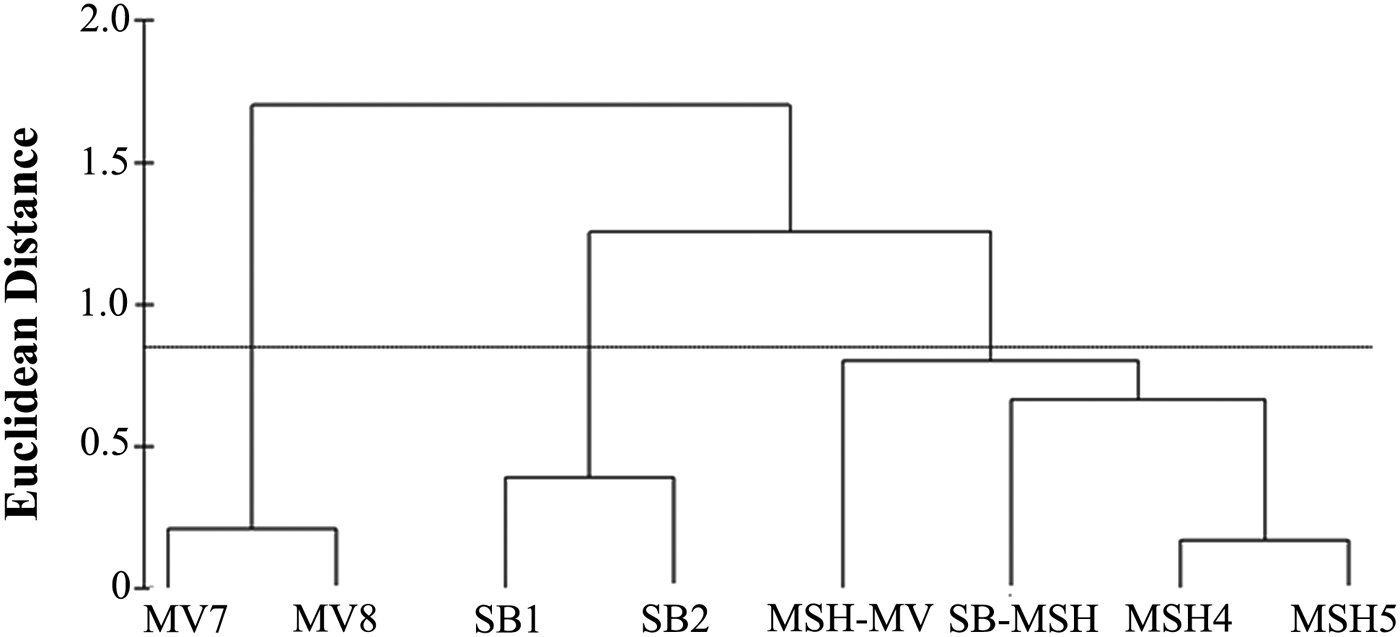
Overall, the environmental conditions varied among months (PERMANOVA: Pseudo-F = 257.5; P < 0.001) and sites (Pseudo-F = 27.14; P < 0.001). The pairwise tests highlighted the differences between months (e.g. January–August; P < 0.05) and sites in the lower, middle and upper areas of the SME (e.g. Sites 1 × 9, 2 × 8 and 5 × 8; P < 0.05). The cluster (Figure 2) and ANOSIM analyses indicated that the environmental factors structured the different habitat mosaics in the SME (P < 0.001; Global R: 0.36), mainly according to the salinity gradient. Sites in the lower portion (1 and 2) had the highest salinities and clearest water and were grouped, as was observed in the habitats located in the upper area of the estuary (7 and 8), which were dominated by the macrophyte Tipha dominguensis and had salinity values near zero. Sites in the salinity transition zone (middle portion) were grouped separately.
Cluster analysis using Euclidian distance based on environmental data (salinity, water temperature, depth and turbidity) measured in eight shallow habitats in the São Mateus River estuary. Acronyms denote sandy beaches (SB1 and SB2), mangrove shoreline habitats (MSH4 and MSH5), macrophyte vegetated habitats (MV7 and MV8), intermediary habitats between sandy beaches and mangroves (SB-MSH) and intermediary habitats between mangroves and macrophyte vegetated habitats (MSH-MV).

Juvenile estuarine fish fauna
We performed 288 seine hauls in the shallow areas of the SME, comprising 43,200 m2 of the total area. Altogether, 13,090 fish of 83 taxa belonging to 31 families were collected (Table S1; Supplementary Material). The mean density was 30 fish/100 m2, and the mean biomass was 63 g/100 m2. Twelve fish families comprised 98% of the total catch; Engraulidae was the most abundant (44%), followed by Tetraodontidae (9%), Mugilidae (9%), Clupeidae (7%), Gobiidae (7%), Achiridae (7%), Atherinopsidae (5%), Gerreidae (3%), Centropomidae (2%), Carangidae (2%), Ariidae (2%) and Paralichthyidae (1%). Regarding species richness, Engraulidae was composed of nine fish species; Carangidae was composed of seven species; Gobiidae, Achiridae and Gerreidae were composed of five species each; Ariidae, Paralichthyidae and Sciaenidae were composed of four species each, and Haemulidae was composed of three species. Based on our data, the SME shelters high densities of commercially important species, such as Centropomus undecimalis, C. parallelus and Mugil curema. On the other hand, one exotic species was recorded, Prochilodus argenteus.
Fish community and size structure
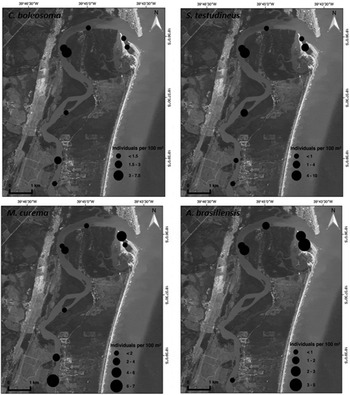
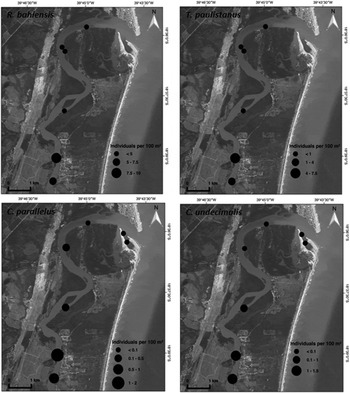
The fish community structure varied through months (PERMANOVA: Pseudo-F = 5.05; P < 0.001) and sites (Pseudo-F = 19.66; P < 0.001). The pairwise tests indicated higher densities in November than in the other 6 months (P < 0.005). Eight ecologically and commercially important species presented noteworthy densities and associations within the site/estuarine portions (Kruskal–Wallis; P < 0.05) (Figures 3 & 4). Elevated densities of Atherinella brasiliensis were recorded in the sites located in the lower and middle portions of the SME. Sphoeroides testudineus and Ctenogobius boleosoma were associated with mangrove shoreline habitats, mainly Site 5, and Centropomus species (C. parallelus and C. undecimalis), Trinectes paulistanus and Rhinosardinia bahiensis occurred in higher densities in the upper portion of the SME. Conversely, Mugil curema juveniles were not associated with a specific shallow habitat in the SME (P > 0.05).
Mean densities (fish per 100 m2) of Ctenogobius boleosoma, Sphoeroides testudineus, Mugil curema and Atherinella brasiliensis in São Mateus River estuary. Kruskal–Wallis test showed significant differences for all fish species densities between the sampled sites (P < 0.05). Image: Google, DigitalGlobe.

Mean densities (fish per 100 m2) of Rhinosardinia bahiensis, Trinectes paulistanus, Centropomus parallelus and Centropomus undecimalis in São Mateus River estuary. Kruskal–Wallis test showed significant differences for all fish species densities between the sampled sites (P < 0.05). Image: Google, DigitalGlobe.

The size histograms of the fish standard lengths highlighted the seasonal variation in the distribution of abundant species. Atherinella brasiliensis and C. boleosoma had the smallest individuals in elevated densities during the autumn (Figures S1–S4; Supplementary Material). A high abundance of early juveniles of the commercial species C. undecimalis was recorded during the winter, and the distribution of early juvenile C. parallelus did not show a clear seasonal pattern. The clupeid Rhinosardinia bahiensis appears to recruit during the winter, according to the histograms.
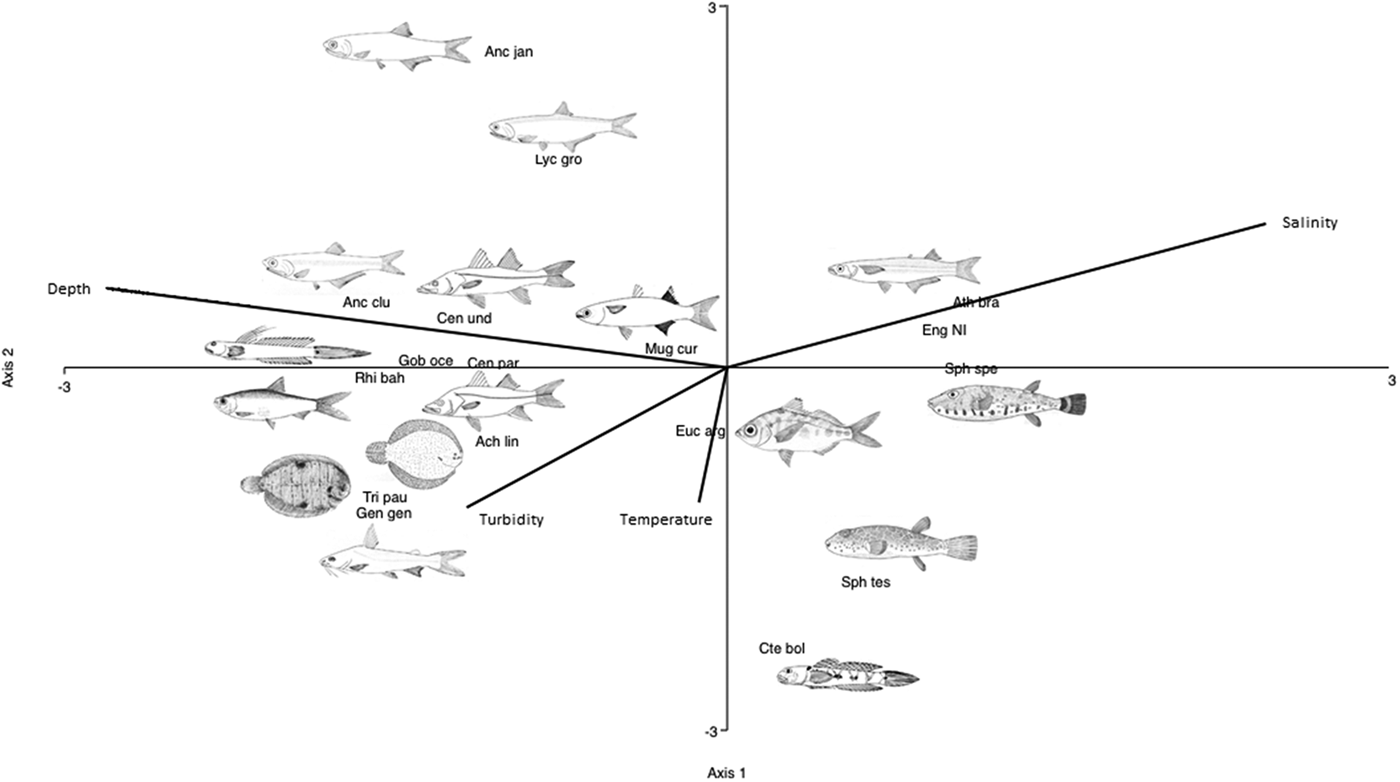
The CCA performed based on the most abundant species and the environmental factors revealed strong influences of salinity, water depth and turbidity on the fish assemblage structure. The correlations between fish and environmental data accounted for 89.06%, 66.73% on the first axis and 22.33% on the second (Figure 5). The distribution of A. brasiliensis, S. spengleri and non-identified Engraulidae (Engraulidae NI) juveniles were correlated with high salinity values. On the other hand, A. clupeoides, C. undecimalis, C. parallelus and G. oceanicus were associated with depth, probably because of the high abundances of these species at MV Site 7, where the highest depth values were recorded. Species abundant in the upper areas of the SME were associated with turbidity, as observed for T. paulistanus, G. genidens and A. lineatus.
Canonical correspondence analysis of species and environmental data (vectors) in shallow estuarine habitats. Fish drawings were adapted from Menezes and Figueiredo's works aforementioned in Materials and methods. Anc clu = Anchovia clupeoides; Lyc gro = Lycengraulis grossidens; Anc jan = Anchoa januaria; Eng NI = non-identified juvenile Engraulidae; Rhi bah = Rhinosardinia bahiensis; Gen gen = Genidens genidens; Mug cur = Mugil curema; Ath bra = Atherinella brasiliensis; Cen und = Centropomus undecimalis; Cen par = Centropomus parallelus; Euc arg = Eucinostomus argenteus; Cte bol = Ctenogobius boleosoma; Gob oce = Gobionellus oceanicus; Ach lin = Achirus lineatus; Tri pau = Trinectes paulistanus; Sph tes = Sphoeroides testudineus.

DISCUSSION
In tropical and temperate estuaries, abiotic variations (e.g. salinity and temperature) may drive changes in the fish distribution, influencing their reproduction, feeding and recruitment events (Blaber & Blaber, Reference Blaber and Blaber1980; Claridge et al., Reference Claridge, Potter and Hardisty1986; Akin et al., Reference Akin, Winemiller and Gelwick2003; Giarrizzo & Krumme, Reference Giarrizzo and Krumme2007; Dantas et al., Reference Dantas, Barletta, Ramos, Lima and Da Costa2013). In the present study, although habitat mosaics (SB, MSH and SB) appeared to influence the fish distribution, changes in temperature, salinity and turbidity throughout the year strongly influenced the distribution of fish species, such as the typically freshwater fishes Astyanax lacustris and Pimelodella lateristriga, which were only recorded in the upper portion of the estuary; the introduced species Prochilodus argenteus, which was recorded in the lower and mid estuarine portions was also associated, however, with lower salinities. The latter species originated from the São Francisco River basin and was introduced to the SME and other basins of south-eastern Brazil. This species poses a threat to native species competing for resources and habitat, mainly for the native Prochilodus vimboides (not recorded in this study), which has been identified as having Vulnerable status in this region (State of Espírito Santo) due to population decline and the presence of exotic species (Vieira & Gasparini, Reference Vieira, Gasparini, Passamani and Mendes2007). Thus, synergetic processes involving habitat features and environmental parameters are probably acting on the fish community in the SME.
Although (few) studies in the estuaries of the Atlantic rainforest have described the recruitment of fish species, the habitat complexity, abundance of resources and local features of the natural aquatic habitats in this biome may reveal a wide range of biological patterns, which are necessary to improve local conservation planning and management. In this context, the fish densities and size-structure changes provided evidence for recruitment events; small recruits of A. brasiliensis were recorded (<32.4 mm SL) during the autumn months in the SME. Neves et al. (Reference Neves, Pereira, Da Costa and Araújo2006) caught recruits of this species during spring months in Sepetiba Bay – RJ. Regarding spatial distribution, A. brasiliensis occurred near sandy beaches and mangrove shoreline habitats associated with high salinity (Neves et al., Reference Neves, Pereira, Da Costa and Araújo2006; Paiva et al., Reference Paiva, Chaves and Araújo2008; present study). Small recruits of the commercially important species Mugil curema were recorded (<32 mm SL) throughout the year; however, higher recruit densities were recorded during the winter months. Juveniles of M. curema present schooling behaviours and inhabit shallow areas of estuaries to avoid predation and seek food (Carvalho et al., Reference Carvalho, Corneta and Uieda2007; Trape et al., Reference Trape, Durand, Guilhaumon, Vigliola and Panfili2009). Centropomus species are also commercially important and were recorded in the upper portion of the estuary, and according to the SL, most of the individuals that were recorded were juveniles (Peters et al., Reference Peters, Matheson, Richard and Taylor1998; Adams & Wolfe, Reference Adams and Wolfe2006). The upper portion of the SME may be a potential nursery ground for these species since it shelters large amounts of macrophytes (e.g. Tipha domingensis) and has turbid waters and low salinity (Yagi et al., Reference Yagi, Kinoshita, Fujita, Aoyama and Kawamura2011). The clupeid Rhinosardinia bahiensis was also recorded almost exclusively in the upper portion of the SME, recruiting during the winter months. The small recruits and juveniles of other species, such as Ctenogobius boleosoma and Sphoeroides testudineus, showed spatial and temporal distributions different from previously cited species. This result reinforces the complexity of the fish assemblage dynamics and the importance of holistic conservation planning to fish conservation in these habitats that involves applied research, traditional ecological knowledge and citizens to better solve conflicts in fishery management and stock protection.
As expected, the fish assemblages of the São Mateus River estuary comprised juvenile and small-sized fishes. Other studies investigating the ichthyofauna in shallow estuarine and coastal areas also primarily caught juvenile fish, even using different sampling methods (Giarrizzo & Krumme, Reference Giarrizzo and Krumme2007; Monteiro-Neto & Prestrelo, Reference Monteiro-Neto and Prestrelo2013), corroborating the hypothesis that these areas are potential nurseries for fish that provide food and shelter from predators; however, more investigations are needed for a precise assessment of the nursery function of the SME habitats and the adjacent coastal areas (Beck et al., Reference Beck, Heck, Able, Childers, Eggleston, Gillanders, Halpern, Hays, Hoshino, Minello, Orth, Sheridan and Weinstein2001; Gillanders et al., Reference Gillanders, Able, Brown, Eggleston and Sheridan2003). In the last decade, studies have debated the roles of shallow areas as true shelter against predators and essential juvenile habitats. Baker & Sheaves (Reference Baker and Sheaves2007) tested predation pressure across depths in a tropical estuarine area and verified that predation pressure did not vary from shallow to deep areas. In addition, Sheaves (Reference Sheaves2001) discussed, despite the general information reported about the absence of predators, that piscivorous fishes are underestimated in shallow estuarine areas due to the difficulty of applying standard sampling in different estuarine habitats and the incipient report about the piscivorous behaviour of some estuarine species when using shallow areas during juvenile stages. In this context, the Centropomus species sampled in this study are classified as piscivorous in the literature (Blewett et al., Reference Blewett, Hensley and Stevens2006); however, during the juvenile stage, C. parallelus feeds primarily on benthic crustaceans (Contente et al., Reference Contente, Stefanoni and Gadig2009), and juvenile C. undecimalis have been reported to feed mostly on crustaceans and, of minor importance, fishes (Peters et al., Reference Peters, Matheson, Richard and Taylor1998; M. S. Bolzan, unpublished data). Given that all Centropomus individuals sampled in this study were juveniles, we suggest, based on the absence of juvenile or adult piscivorous species in the sampling, that predation pressure in the shallow areas of the SME is small, but not null. Most likely, small piscivorous fishes forage in the studied shallow areas; nevertheless, additional efficient methods to verify these occurrences, such as visual surveys (Baker & Sheaves, Reference Baker and Sheaves2006), are not possible due to the turbid waters of the SME.
In addition to the spatial and temporal variations in the fish distribution, the CCA highlighted abiotic variables as the main descriptors of the species distribution. The ariid Genidens genidens and soles Trinectes paulistanus and Achirus lineatus were associated with turbid waters. In general, turbid waters limit fish distribution (Ferrari et al., Reference Ferrari, Lysak and Chivers2010), even though fishes during the early stages may benefit from moderately turbid waters and develop schooling behaviour (Ohata et al., Reference Ohata, Masuda, Takahashi and Yamashita2013), consequently reducing predator efficiency. Catfishes, such as G. genidens, have maxillary barbells and efficient lateral line sensory mechanisms to help during foraging in turbid waters, unlike the predators that are dependent on vision (Carvalho-Filho, Reference Carvalho-Filho1999; Pohlmann et al., Reference Pohlmann, Atema and Breithaupt2004). Anchovia clupeoides and Centropomus spp. individuals were associated with depth areas. These fishes are good swimmers (Tolley & Torres, Reference Tolley and Torres2002) and perhaps occupy these habitats because they may avoid the predation pressure of larger fishes more easily than other juvenile fishes.
We provided evidence in this study that the shallow areas of the São Mateus River estuary may act as potential nursery grounds for juvenile fish. Each habitat (sandy beaches, mangrove shoreline and macrophytes vegetation) benefits different fish species, including the commercially exploited Centropomus undecimalis, C. parallelus and Mugil curema, but vegetated habitats are probably more important to early life stages than non-vegetated habitats (Whitfield, Reference Whitfield2017). Additionally, early life stages of other commercially important species were recorded (Lutjanus jocu, Oligoplites saliens and O. saurus). The present study area encompasses the highly valuable Atlantic rainforest biome on land and the southernmost range of the Abrolhos Bank in the sea, which is the largest and richest coral reef ecosystem of the South Atlantic. This condition denotes the urgency for baseline studies to address juvenile fish richness and their contribution to adult populations. Future studies also need to emphasize the trophic function of the ecosystem using conventional gut content studies and stable isotope approaches to better understand the importance of shallow waters to juvenile fish.
SUPPLEMENTARY MATERIAL
The supplementary material for this article can be found at https://doi.org/10.1017/S0025315418000012.
ACKNOWLEDGEMENTS
We thank Flora Zauli, Luciane Reis, Romulo Araújo, Henrique Campião, Arieli Falchetto and the fishermen that helped in field collection, mainly ‘Senhor Bi’ for field assistance. We also thank Hédrick Colona for the technical contribution, and Naercio Menezes and José L. Figueiredo for authorizing the use of the fish drawings. The sampling of the biological material was previously authorized by Brazilian Environment Ministry through the ICMBIO/SISBIO licence no. 33920.
FINANCIAL SUPPORT
M. Hostim-Silva thanks CNPq for financial support (Processo 482499/2013-3).