Despite the ongoing debate between the performance and the patronage paradigms in the study of political selection in China, scholars increasingly recognize the comprehensive, complex, nuanced and endogenous nature of the political selection process led by the organization departments of the Chinese Communist Party (CCP).Footnote 1 One of the complexities revealed in the promotion of local leaders is the existence of a fast track for career advancement aimed at ensuring cadres’ allegiance and maintaining the regime’s control.Footnote 2 What remains understudied is the proactive role of the Central Organization Department (COD) in cultivating subprovincial leaders under the “one-level-down” (xiaguan yiji 下管一级) personnel system. This article adopts a central–local interaction perspective to enrich our understanding of non-institutionalized incentive alignment measures and the understudied mechanism through which meritocracy is achieved in the Chinese nomenklatura system.
China’s political incentive structure is predominantly investigated through the lens of formal rules, such as the target responsibility system,Footnote 3 or statistical analyses of political promotion.Footnote 4 Irregular and soft measures are generally assumed to be irrelevant or ineffective. However, in practice, model setting (shudianxing 树典型) and ideological building (sixiang jianshe 思想建设) have been promoted and widely used by the CCP to strengthen the corps of cadres during revolutionary and reform eras. The nationwide selection of 100, 102 and 103 model county Party secretaries (MCPSs) in 1995, 2015 and 2021, respectively, serves as a clear example. Despite its irregular occurrence, the selection and recognition of MCPSs send a clear signal regarding what particular competences and virtues are privileged by the central authority in a given political context and serve as a soft measure to align local officials’ behaviour with the preferences of the centre. The lasting incentive alignment function of the MCPS hinges on whether, and to what extent, honour recipients experience faster promotions in their post-recognition careers, which is a relationship that has not been rigorously tested.Footnote 5 Furthermore, the sole focus on the broad incentivizing function of the MCPS, as emphasized in the official rhetoric, leads to a neglect of other roles the MCPS may play. To address these limitations, this article explores what role the MCPS, as an example of model recognition, plays within the larger framework of political selection, especially regarding incentive alignment and leadership grooming in contemporary China.
The article contends that the MCPS serves two interrelated substantive functions, incentive alignment and the creation of a fast track for officials through deliberate organizational cultivation, both of which stem from the centre–local interaction in the dynamics of political recognition. In the absence of any formal rule regarding the post-recognition management of recipients, their subsequent career trajectories continue to be fully managed by relevant local Party organization departments. To achieve the incentivizing goals outlined in the official rhetoric, the centre needs the cooperation of local organization departments in promoting recipients. In a centralized system, the authoritative power of the centrally bestowed recognition compels the local organization departments to provide not only rapid promotions but also additional organizational cultivation (i.e. deliberate grooming) for these recipients. The result is a merit-based fast track for local leaders.
Investigating the role of the MCPS enhances our understanding of political selection in China in three ways. First, it expands our knowledge of the toolkit the COD possesses for aligning local officials’ behaviour with the preferences of the centre and for expanding political meritocracy. The existing research on personnel institutions emphasizes the control logicFootnote 6 and a seemingly unavoidable trade-off between stability (control) and efficiency (meritocracy).Footnote 7 This analysis demonstrates that the central authority can enhance both control (incentive alignment) and meritocracy simultaneously through the conferral of political recognition. In addition, political meritocracy, which is the idea that political power should be distributed in accordance with ability and virtue,Footnote 8 is predominantly conceptualized and demonstrated by the extent to which promotion is based on the achievement of various targets set by the immediate leadership.Footnote 9 We propose that the conceptualization of political meritocracy should be expanded to incorporate the dimension that more competent officials are promoted faster. Existing research finds that economic performance is a major predictor of receiving the COD-sponsored MCPS recognition, while county leaders’ patronage networks with senior politicians negatively moderate the impact of economic performance.Footnote 10 The particular career trajectories of MCPS recipients, if they exist, therefore further demonstrate the effectiveness of the recognition conferment tactic used by the COD to cultivate and promote competent county leaders and suggest that fast-track promotion is not entirely focused on control.Footnote 11
Second, the post-recognition career trajectories of the selected county leaders illustrate the degree of willingness and the capacity of local Party organization departments to align with the COD’s initiative as well as the complex central–local interaction that is involved in the dynamics of political recognition. On the one hand, the nexus between the centralized political system and the institutionalized “one-level-down” personnel system necessitates the centre’s use of less formal channels to influence the management of grassroots-level officials. In addition to rulemaking,Footnote 12 the COD has organized frequent training for county leaders over the past two decades.Footnote 13 The three rounds of MCPS selection further demonstrate the willingness of the central authority to shape county leaders’ behaviour (and more importantly) in a way that abides by the “one-level-down” rule, as reflected in the post-recognition management of recipients. On the other hand, the COD, which has ultimate authority to approve the final list, primarily acts as a gatekeeper and assigns responsibility for nominating MCPS candidates to provincial and prefectural Party organization departments to reduce information asymmetry. The existing literature reveals important local variations in responses to central policy signals,Footnote 14 driven by factors such as the credibility of central signalling,Footnote 15 the age and tenure of local leadersFootnote 16 and the strength of patron-client ties.Footnote 17 Variations in the post-recognition career trajectories of MCPS recipients, if there are any, thus provide a laboratory to observe disparities in local organization departments’ responses to the COD’s initiative to screen and cultivate competent county leaders.
Third, the effect of political recognition also indicates the Party’s capacity to adapt or its level of resilience in the face of increasing bureaucratic slack.Footnote 18 Existing research has demonstrated the limitations and drawbacks of sanction-based accountability in reducing bureaucratic shirking. While this kind of accountability may address some overt types of slack behaviour, it can backfire by invoking opportunistic behaviour and coping strategies among local bureaucrats.Footnote 19 Therefore, “softer” measures that promote “a high level of public service motivation, value-based compliance and a strong awareness of public interest among officials” are needed.Footnote 20 The timing of the 2015 launch of the MCPS honours round, coming just a year after the removal of 38 corrupt county Party secretaries, indicates the Party’s intention to use role models as a means of enhancing moral standards among local officials. The MCPS also introduces new and credible career incentives into the personnel system if the recipients indeed have better and faster promotion prospects. Thus, the winners’ post-recognition career trajectory can demonstrate the potential effectiveness of non-sanction-based measures as a cure for bureaucratic slack.
This article draws on the demographic and biographical data of 305 MCPSs to illustrate the characteristics and changes in the dissemination of political recognition over the past three decades and employs a difference-in-differences (DID) approach to identify the causal effect of the MCPS recognition on recipients’ post-recognition career trajectories. The rest of the article proceeds as follows. The following section describes both the background and implementation of the MCPS recognition programme as well as the profiles of recipients. The article then introduces data and methods. It draws on data from the 2015 round of MCPS recipients and employs a DID approach to demonstrate the impact of the recognition on recipients’ career prospects. The last section concludes with a discussion of the implications for understanding political meritocracy and political recognition in contemporary Chinese politics.
The Development of the MCPS Recognition Programme
Awards in various forms are ubiquitous across all regimes, from monarchies and republics to communist countries.Footnote 21 As an important means of mass mobilization and political socialization, the distribution of awards in the communist system differs from that of other political systems in its careful ideological control over how recipients are characterized and the intensity of campaigns designed to encourage extensive emulation by the public.Footnote 22 Widely practised in Imperial China, model setting was a mainstay of Confucian education. The Chinese Communist Party (CCP) adapted this method following experimentation during the Yan’an period (1935–1948)Footnote 23 and examples set by the Soviet Union.Footnote 24 Whereas most scholarly emphasis is on whether and how the state shapes norms and values at the societal level through the award system, the central authorities in Imperial China and during the Maoist era proactively regulated model setting by local officials as a means to control and manage the leviathan of bureaucracy. For example, the establishment of a monument (libei 立碑) to local officials required the approval of the emperor during the Tang dynasty (618–907). The process served as an informational channel between the public and the emperor and helped establish a role model for good officials to follow.Footnote 25 Jiao Yulu 焦裕禄, Party secretary of Lankao 兰考 county, Henan province, who led the county to agricultural success despite his own severe illness, also served as a model setter. A campaign launched in 1966 aimed to educate and mobilize high-ranking Party cadres to emulate his selflessness, heroic endurance of pain and devotion to serving the people.Footnote 26 The narrative construction of the Jiao Yulu spirit evolved from “the revolutionary spirit of rising to the challenge” between 1966 and 1968, to “the good hardworking style” in the early 1990s, and finally to “the sentiment of a public servant honestly pursuing public affairs” during the period from 2009 to 2014.Footnote 27 Xi Jinping 习近平 has upheld Jiao Yulu as a role model for all county Party secretaries to follow.Footnote 28 Over time, historical and cultural symbols that support the moral and political authority of the Party, including labour heroesFootnote 29 and models, have been adapted to meet the specific needs of the time to strengthen regime legitimacy.Footnote 30 While formal rules and regulations on the conferment of Party and national honours have been introduced since 2016,Footnote 31 the selection of the MCPSs reflects a continuity with the Maoist traditions of moral mobilization. This recognition is framed through a normative narrative that re-interprets developmental success as moral worth and thus simultaneously serves as a modern instrument of performance management and bureaucratic legitimation.
As the only non-monetary honour bestowed solely upon county-level individual leaders,Footnote 32 the stated goal of the MCPS programme is to improve the image and legitimacy of leadership selection and to motivate Party members and officials nationwide, particularly leading cadres, to excel in their work.Footnote 33 The creation of the award is a reflection of the importance the central authority attaches to county leaders, who play a key role in bridging the gap between upper-level governments and the grassroots level and in balancing development and stability. Most importantly, the three rounds of the MCPS programme have consistently aligned with the Party’s shifting governance priorities over time. The inaugural 1995 cohort of 100 MCPSs emerged during the formative years of the socialist market economy when the centre sought to establish county-level exemplars capable of implementing reform policies and maintaining social stability. In 1995, the first formal and comprehensive personnel management rules for leading officials were promulgated.Footnote 34 Many of the recipients that year demonstrated an ability to sustain development and stability under increasing social inequalities and tightened fiscal constraints after the 1994 tax-sharing reform. The 2015 revival reflects the urgent need to rejuvenate the corps of grassroots-level cadres in the aftermath of a sweeping anti-corruption campaign. Between 2013 and 2014, at least 38 county Party secretaries were investigated for corruption.Footnote 35 Against this backdrop, the COD relaunched the MCPS selection process to reshape the image of the cadre team and set a new benchmark for grassroots governance. The “four-haves” (siyou 四有) criterion for officials was formed,Footnote 36 and integrity (lianjie 廉洁) was unprecedentedly emphasized in the official announcement of MCPS recipients.Footnote 37 The third round in 2021 coincided with the centenary of the CCP’s founding and marked the first year of promoting “rural revitalization” following the “victory” over poverty in 2020.Footnote 38 Compared with the previous two rounds, the third round placed more emphasis on the political and economic capabilities of cadres to lead the modernization process.Footnote 39 More county Party secretaries from former poverty-stricken counties were thus selected.Footnote 40
In the absence of any concrete official selection criteria, we manually coded the content of the reports on all 55 MCPS recipients in the 2015 round that were published by People’s Daily Online (Renminwang 人民网).Footnote 41 Based on a simple word count, on average, nearly 50 per cent of the content of reports introduces their achievements in economic and social development, with an average of 25 per cent of the content highlighting their close ties with the masses and their public reputation (qunzhong koubei 群众口碑). Content regarding Party building (dangjian 党建) and integrity only constitutes an average of 11 per cent and 5 per cent, respectively. These suggest the importance of economic and social development in MCPS selection. This is exemplified by the cases of Liao Junbo 廖俊波, the former Party secretary of Zhenghe 政和 county in Fujian province, and Bao Xiuying 鲍秀英, the former Party secretary of Kaihua 开化 county in Zhejiang province. Liao was made an MCPS in 2015 for his achievements in industrial development and poverty alleviation in Zhenghe county. In 2017, while serving as deputy mayor of Nanping 南平, he lost his life in a traffic accident while en route to chair a meeting. During the 2021 round of MCPS selection, Liao was promoted as a typical example of an outstanding county Party secretary and a role model for Party members.Footnote 42 Bao attracted attention for her achievements in ecological construction and poverty alleviation through the development of a sustainable ecological economy in Kaihua county. Six months after being recognized as an MCPS in 2015, she was promoted to deputy director of the Zhejiang Provincial Supervision Bureau, a deputy department-level position. In general, the emphasis on economic or social development achievement in model selection is aimed at addressing the issue of increasing bureaucratic slack and inactivity.
In the MCPS selection process, the COD local officials’ office (ganbuerju 干部二局) takes the lead in finalizing the list of recipients. The prefectural organization departments are responsible for nominating candidates, and the provincial organization departments make the final decision on the candidates after a five-day public notice period.Footnote 43 Each provincial organization department forms a special task force to conduct comprehensive investigations and solicit opinions about the candidates from various sources.Footnote 44 In the 2021 MCPS selection, for example, 103 out of 148 nominated candidates were finalized by the COD.Footnote 45 The process for the one-year evaluation and selection of the MCPSs is summarized in Figure A-1 in the online Appendix.
The COD’s gatekeeping power is exercised in two phases. The first screening takes place before the national public notice is issued. For example, in the 2021 round, the COD removed 43 nominees in this initial phase. The candidate lists submitted by all provinces, except Heilongjiang and Qinghai, experienced attrition, with several, including Henan and Sichuan, seeing multiple nominees removed. The calibration served to enforce compliance with the centre’s agenda by filtering out candidates whose profiles, however competent in local terms, were deemed a poor fit. The second screening occurred during the national five-day notice period when two candidates, Jin Chengjun 金成俊 and Wang Baoyu 王宝玉, were removed from the list. Both were later formally investigated for corruption. Such a multi-stage vetting constitutes a sophisticated mechanism through which the centre not only mitigates agency risks and information asymmetry but also proactively sculpts the political incentive structure. By unilaterally defining and approving the shortlists for MCPSs, the COD ensures that this significant political recognition exclusively serves and reinforces the centre’s governance agenda.
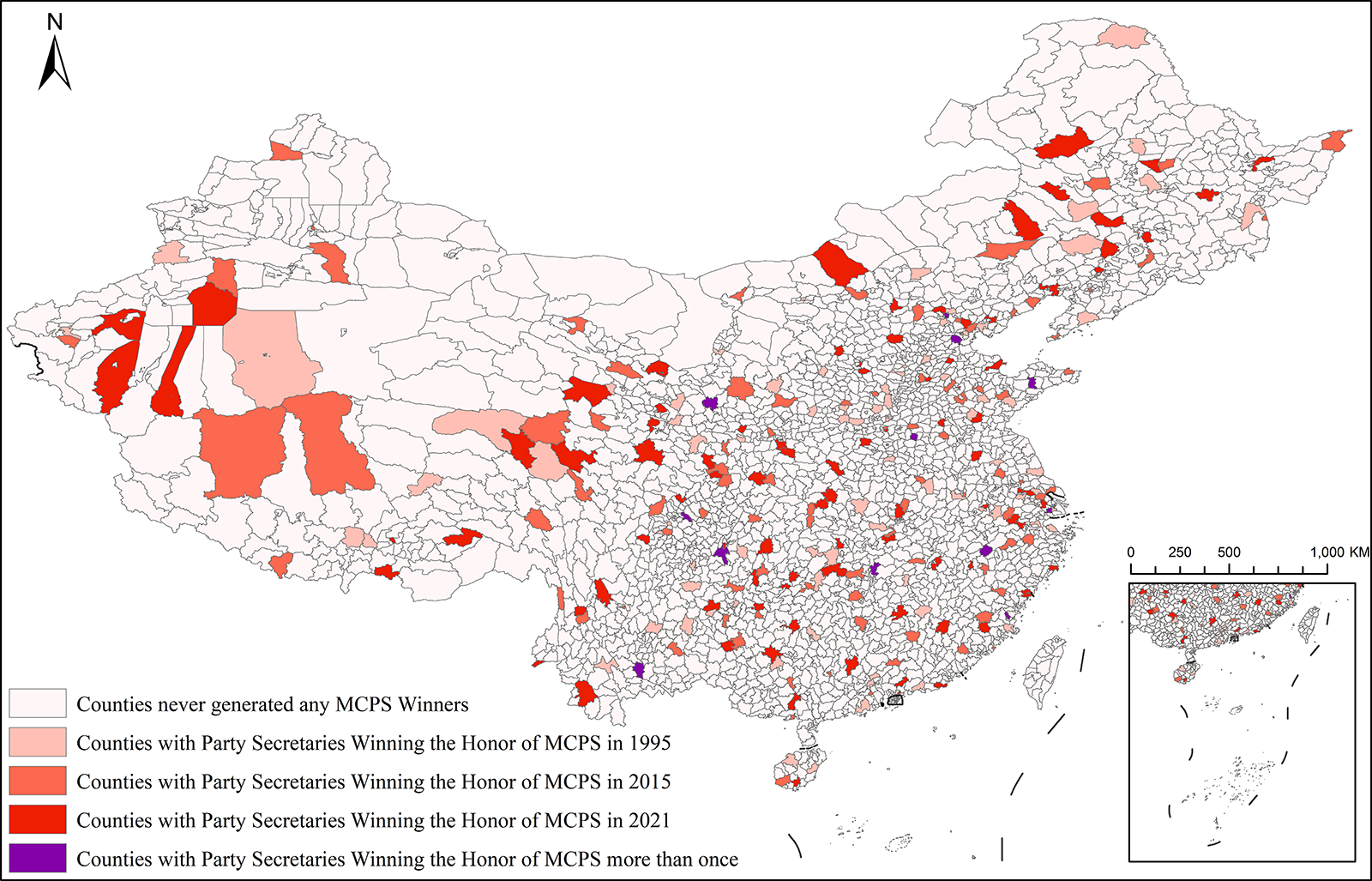
Figure 1 maps out the geographic distribution of MCPSs across the three rounds. The number of MCPSs for each province varies from three in Ningxia to 17 in Sichuan. The age when MCPSs receive recognition varies from 34 to 59, with an average age of 50; the length of Party membership of MCPSs varies from nine to 40 years, with an average of 26 years. Among the 305 MCPSs, 21 are female and 45 are ethnic minorities.Footnote 46 The share of female MCPSs increased from 4 per cent in 1995 to 7 per cent in 2015, and finally 10 per cent in 2021; the share of ethnic minorities rose from 11 per cent in 1995 to 16 per cent in 2015 and then 18 per cent in 2021. When selected, almost 45 per cent of MCPSs were working in counties in western provinces. District Party secretaries in urban cities accounted for 13 per cent in 1995, 21 per cent in 2005 and 27 per cent in 2021.
Distribution of MCPS Winners

Figure 1 Long description
The map illustrates the geographic distribution of counties in China where Party Secretaries have won the honor of MCPS across different years. Counties are marked in various colors to indicate the years they won: 1995, 2015 and 2021. Some counties are highlighted to show they have won more than once. Additionally, counties that have never generated any MCPS winners are also marked. The map includes a scale and a smaller inset map showing additional geographic details.
We do not find significant regional variation in the implementation of the MCPS selection process. The results of the analysis of variance (ANOVA) presented in Table A-1 in the online Appendix demonstrate no differences across provinces in various characteristics of the 2015 MCPS recipients and their serving counties at statistically significant levels.Footnote 47 However, the distribution of MCPS recipients across prefectural-level cities within each province exhibits an interesting variation. When considering recipients from all three rounds, Anhui province has the lowest concentration ratio (0.375), whereas the Xizang Autonomous Region has the highest (1). This indicates that only 37.5 per cent of prefectural-level cities have contributed MCPSs in Anhui, while all prefectural-level cities have produced MCPSs in Xizang (see Figure A-2 in the online Appendix).
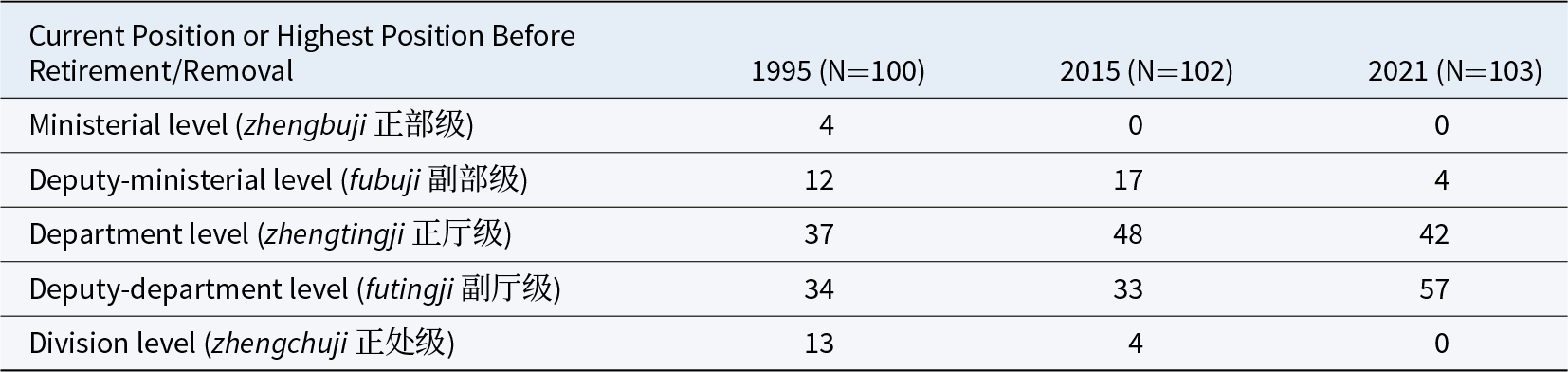
Table 1 summarizes the current or the highest positions held by MCPSs before their retirement or removal. In the 1995 round, most MCPSs held department- or deputy department-level positions before retirement; only four achieved ministerial level. As of the end of 2024, 19 MCPSs had been removed from their positions due to corruption, of which 74 per cent had received recognition in 2015 and 21 per cent in 2021.Footnote 48 The gap between receiving the honour and disciplinary investigation (jilüshencha 纪律审查) varies from 11 months to nine years. According to the available information, most of these corrupt MCPSs’ malfeasance occurred before they received recognition, and nine MCPSs’ corruption scandals had been made public before 2021, the year of the third round of recognition for MCPSs. The corruption scandals of MCPSs reveal the limitations and variations in the capabilities and incentives of local Party organization departments in aligning with the COD initiative. The extent to which the recipients’ promotion prospects are enhanced by this recognition indicates the value (zhongshi 重视) that local Party organization departments attach to centrally bestowed recognition in their personnel decisions. The greater the positive effect of the recognition on recipients’ post-recognition career trajectories, or the more support local Party organization departments provide to these models, the more loyal they are or appear to be.Footnote 49
Post-recognition Career Advancement of MCPSs

Table 1 Long description
The table measures the career advancement of MCPS from 1995 to 2021, focusing on their highest positions before retirement or removal. In 1995, 4 individuals were at the ministerial level, but this number dropped to zero by 2015 and remained so in 2021. The deputy-ministerial level saw a peak in 2015 with 17 individuals, but decreased to 4 by 2021. The department level had a slight increase from 37 in 1995 to 48 in 2015, then decreased to 42 in 2021. The most notable change was at the deputy-department level, which rose from 34 in 1995 to 57 in 2021. The division level saw a decline from 13 in 1995 to zero by 2021. These trends suggest a shift towards more individuals holding positions at the deputy-department level over time.
Source: Authors’ dataset.
Data and Method
Data
To address the endogeneity problem and assess the impact of recognition, rather than the recipients’ latent capability, on recipients’ post-recognition career trajectories, a control group is needed to match recognition recipients on factors that affect the likelihood of receiving recognition, including capability. The differences between the control group and the MCPS recognition recipients (the treatment group) in their post-recognition career trajectories can then be attributed to the recognition itself, rather than to other confounding variables.
We focus on the 2015 MCPS awardees in the following empirical analysis because of limited publicly available information about the 1995 MCPS recipients and the insufficient length of time to observe any recognition effect for the 2021 recipients. A potential concern is whether findings from this single cohort are generalizable. To address this, we compared the observable characteristics of the recipients and the counties where they served as Party secretary (at the time of selection) across all three rounds. Our analysis, detailed in the online Appendix Figure A-3 and Figure A-4, reveals no systematic differences in key demographic attributes, regional distribution or duty station’s socio-economic profiles (before the MCPS selection). This similarity provides confidence that our main findings are likely generalizable beyond the 2015 round. Moreover, the absence of significant differences in the provincial performance rankings of the recognition recipients’ counties selected in 2015 compared to those in other years indicates that the selection criteria for the MCPS programme remained consistent across rounds.
To begin, we constructed a matched dataset of the 2015 MCPS recipients using two steps. First, owing to data limitations, we only have information on the counties of 97 out of 102 MCPS recipients prior to matching. We created a matched dataset of 96 counties using the caliper nearest neighbour matching method, along with covariates including average county GDP, average local fiscal revenue, average growth rate of county GDP and average local fiscal revenue growth rate between 2010 and 2015, based on the finding that economic performance is a key factor enhancing the likelihood of receiving recognition.Footnote 50 Counties with 95 MCPS recipients were successfully matched with 96 counties with non-recipients, while counties of two recipients were not. Second, 87 out of the 96 county Party secretaries (non-recipients) of the matched counties in 2015 (before the recognition selection) were identified and treated as the matched county Party secretaries of the recipients.Footnote 51 The final panel dataset contains 95 MCPS recipients and 87 non-recipient county Party secretaries between 2010 and 2024 (see Table B-1 in the online Appendix). Please refer to the online Appendix C for a description of data collection.
The balance test (see Table B-2 in the online Appendix) between the matched county Party secretaries (control group) and the MCPS recognition recipients (treatment group) reveals that no statistically significant difference exists between the two groups across various aspects, including relative economic performance and political connection.Footnote 52 The unit of analysis is county Party secretary-year. Figure B-1 in the online Appendix demonstrates the variation in treatment timing across county Party secretaries and the distinct separation between treated and control groups in the post-treatment period. The descriptive results provide suggestive evidence that MCPS recognition likely leads to a career boost for the recipients. Compared with MCPS recipients who enjoyed a significant increase in their administrative ranks after 2015, those in the control group experienced far more stable ranks over the years (see Figure B-2 in the Appendix). A direct comparison of promotion speed and the degree of increase in administrative rank up to 2024 between the MCPS recipients and control group members further substantiates this (see Table B-3 in the Appendix). Out of the 95 MCPS recipients, four experienced a boost in administrative rank by three levels between 2015 and 2024, such as from division level to deputy ministerial level, and 37 experienced a boost by two levels, proportions that are significantly higher than those of the control group members. Over one-third of the control group members did not experience any change in administrative rank over these nine years, which is considerably higher than that of the MCPS recipients.
Identification strategy
To further test the impact of MCPS recognition on the career trajectories of recipient county-level leaders, we used a multiple period difference-in-differences (DID) approach. Our main specification takes the following form:
 \begin{equation*}{Y_{it}} = {\beta _1}({T_i} \times {P_t}) + \theta {X_{it}} + {\gamma _i} + {\lambda _t} + {\delta _p} + {\eta _c} + {\varepsilon _{it}}\end{equation*}
where Yit is the administrative rank for county Party secretary i in year t. Our binary treatment variable is Ti, indicating whether the county Party secretary is the 2015 MCPS recipient. The dummy variable Pt indicates the time period, such that Pt =1 when t > 2015. The model includes county Party secretary (γi) fixed effects, year (λt) fixed effects, province (δp) fixed effects and prefecture (ηc) fixed effects. X it denotes a set of control variables that might independently affect administrative ranks, including demographic attributes and working experience.Footnote 53 The key parameter of interest is β1^, the DID estimate for the effect of MCPS recognition on administrative rank. The sample does not contain gaopei 高配 county Party secretaries (see the description in the online Appendix B), as their initial administrative rank differs from that of regular county Party secretaries, which may lead to estimation bias when the outcome variable is administrative rank.
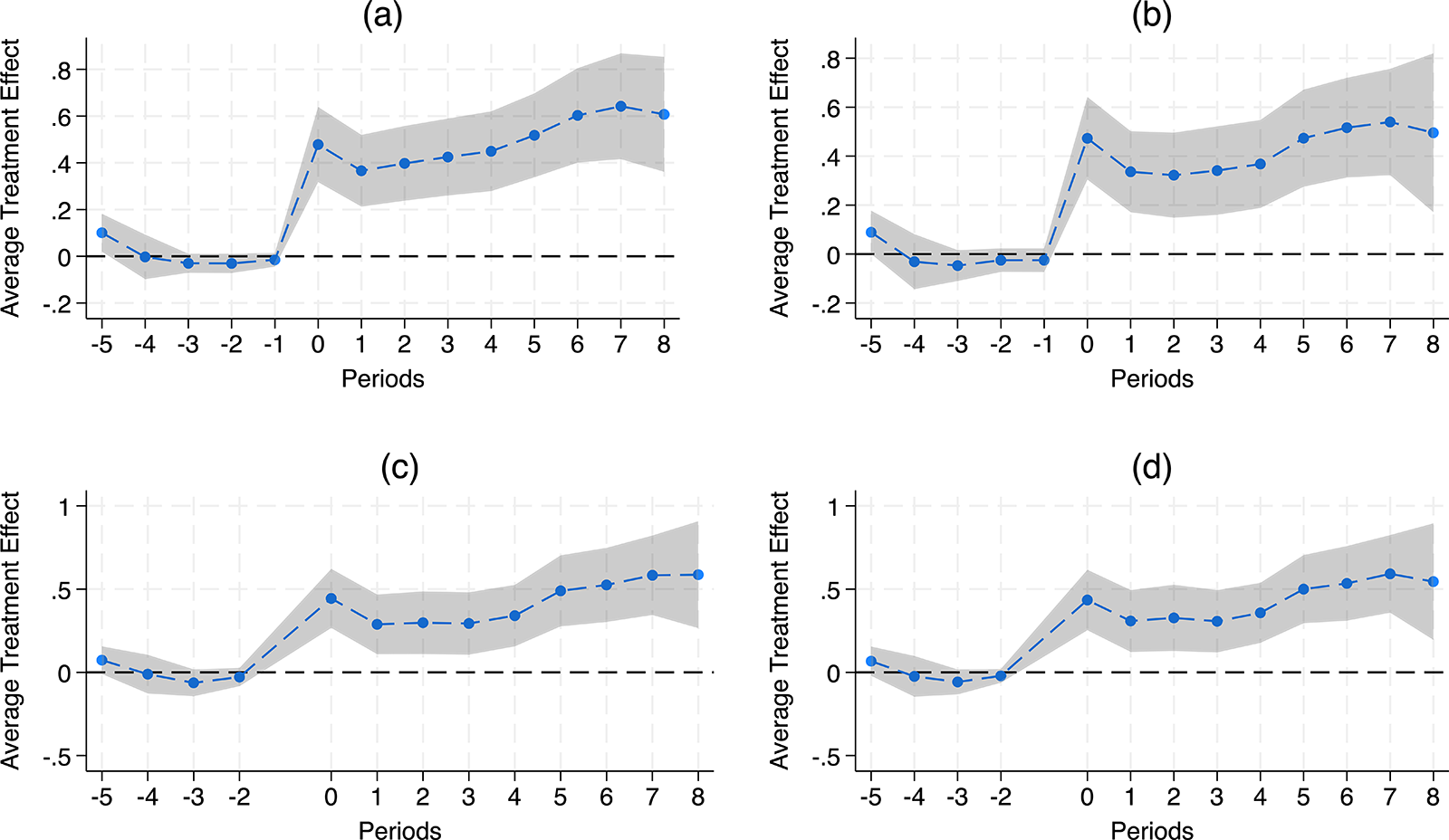
The DID estimation relies on the parallel-trends assumption. We tested this assumption in two steps. First, average administrative rank trends were found to be largely similar between the control and treatment group until 2015 but diverged significantly afterwards (see Figure E-1 in the online Appendix). Second, we performed an event study estimation. Figure 2 presents the dynamic treatment effects of the 2015 MCPS recognition on administrative rank. Prior to receiving the recognition (periods -5 to -1), the treatment effect is small and not statistically significant, enhancing our confidence in the parallel-trends assumption. After the recognition is received (periods 0 and beyond), the effect becomes positive and significant, indicating a lasting increase in administrative rank. This pattern is robust to different estimators (see Figures E-2 and E-3 in the online Appendix).
Dynamic Effect of Recognition on Administrative Rank

Figure 2 Long description
The image contains four line graphs labeled (a), (b), (c) and (d), each depicting the average treatment effect over periods ranging from -5 to 8. The x-axis is labeled 'Periods' and the y-axis is labeled 'Average Treatment Effect'. Each graph shows a line with data points connected by segments and a shaded area representing variability or confidence intervals. The graphs illustrate a similar pattern where the average treatment effect is relatively stable or low in earlier periods, followed by a noticeable increase around period 0 and continuing to rise in subsequent periods.
Empirical Results
DID estimation: the career effects of political recognition
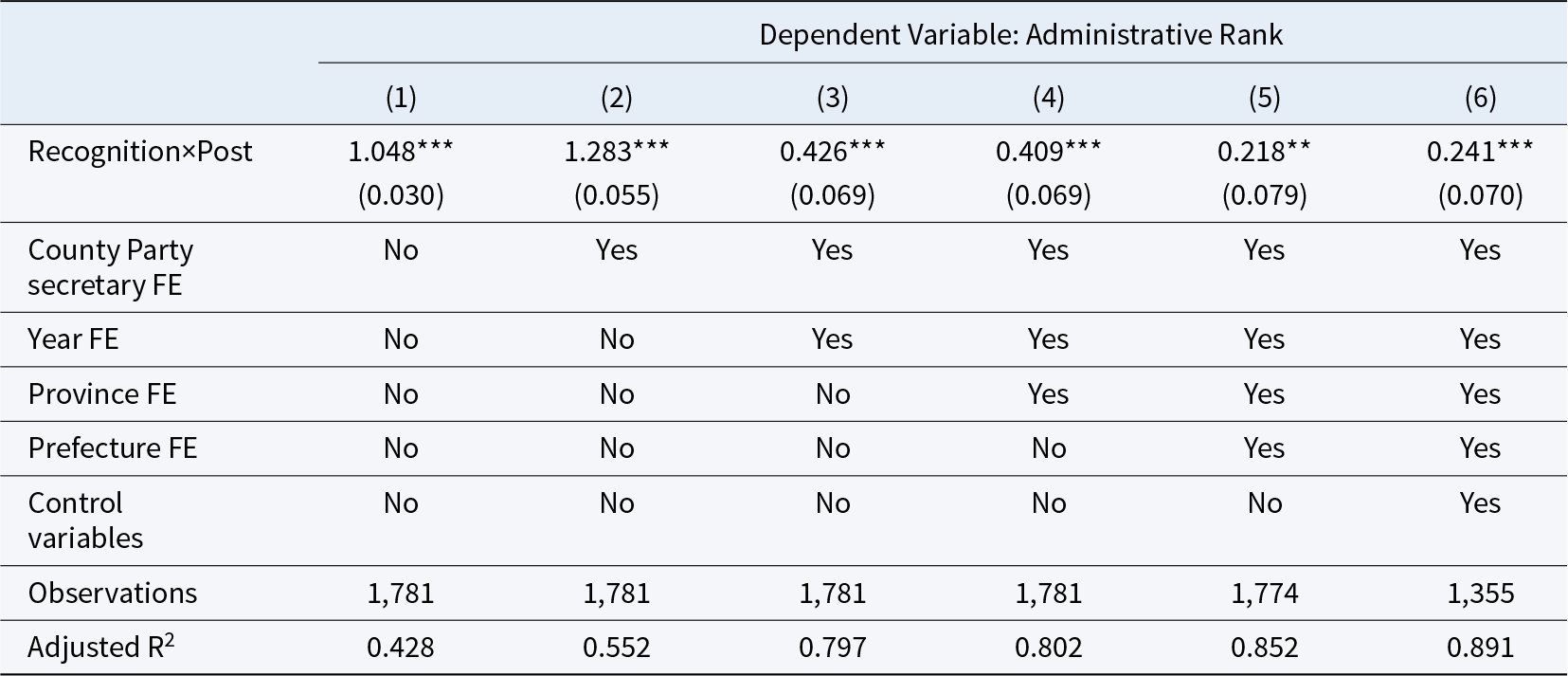
As shown in Table 2, the administrative rank of the 2015 MCPSs is significantly higher than that of the matched non-recipients after 2015. Across all specifications, the recognition effect is positive and highly statistically significant (p < 0.01 or better). The DID estimation with propensity score matching (PSM) and various matching methods does not change the main results (see Table E-1 in the Appendix). Our preferred model (Model 6 in Table 2) indicates that, after controlling for a host of individual and institutional factors, recognition boosts a recipient’s administrative rank by an average of 0.241 points annually, which corresponds to a substantively large increase of 0.33 standard deviations.
The Effect of Recognition on Administrative Rank

Table 2 Long description
The table examines the impact of recognition on administrative rank, showing that the interaction of recognition and post period consistently has a positive and significant effect across all models. The coefficients for Recognition×Post range from 0.218** in model 5 to 1.283*** in model 2, indicating a strong relationship. As more fixed effects and control variables are included, the adjusted R2 values increase from 0.428 in model 1 to 0.891 in model 6, suggesting improved model fit. Models 2 through 6 include various fixed effects, such as County Party secretary, Year, Province, and Prefecture, with model 6 also incorporating control variables. The number of observations slightly decreases from 1,781 in models 1 to 4 to 1,355 in model 6, which may affect the generalizability of the results.
Source: Authors’ dataset.
Note: We interact time-invariant control variables with the time dummy variable. Robust standard errors clustered at the county level are reported in parentheses. + p < 0.10 *p < 0.05 **p < 0.01 ***p < 0.001.
To understand the substantive importance of this figure, one must consider the structure of the Chinese bureaucracy. It implies that, all else being equal, a recognition recipient is on a trajectory to achieve a full promotion to the next administrative level – for instance, from a division-level post (rank 4) to a deputy-department-level post (rank 5) – approximately four years faster than an otherwise identical, non-recipient peer.Footnote 54 In a system where promotion is highly structured and constrained by strict age limits, such an acceleration is a profound career advantage. It can help an official to reach the deputy ministerial-level with eligibility for further advancement and avoid stalling at the bureau level before the mandatory retirement age.
The career trajectories of several 2015 MCPS recipients illustrate this fast-track effect. For example, Cheng Lianyuan 程连元, recognized for his work as Party secretary of Chaoyang 朝阳 district in Beijing, was transferred across the country to become Party secretary of the provincial capital of Kunming – a deputy ministerial-level position (rank 7) in the same year – and a member of the Yunnan Provincial Party Standing Committee within two years of receiving the recognition. Similarly, Li Shuqi 李树起, then Party secretary of Tianjin’s Ninghe 宁河 county, was promoted to the position of deputy mayor of Tianjin within five months of receiving recognition. These are real-world manifestations of the average causal effect identified by our model, demonstrating how the MCPS recognition translates into tangible and rapid career advancement.
Regional heterogeneity of the fast-track effect
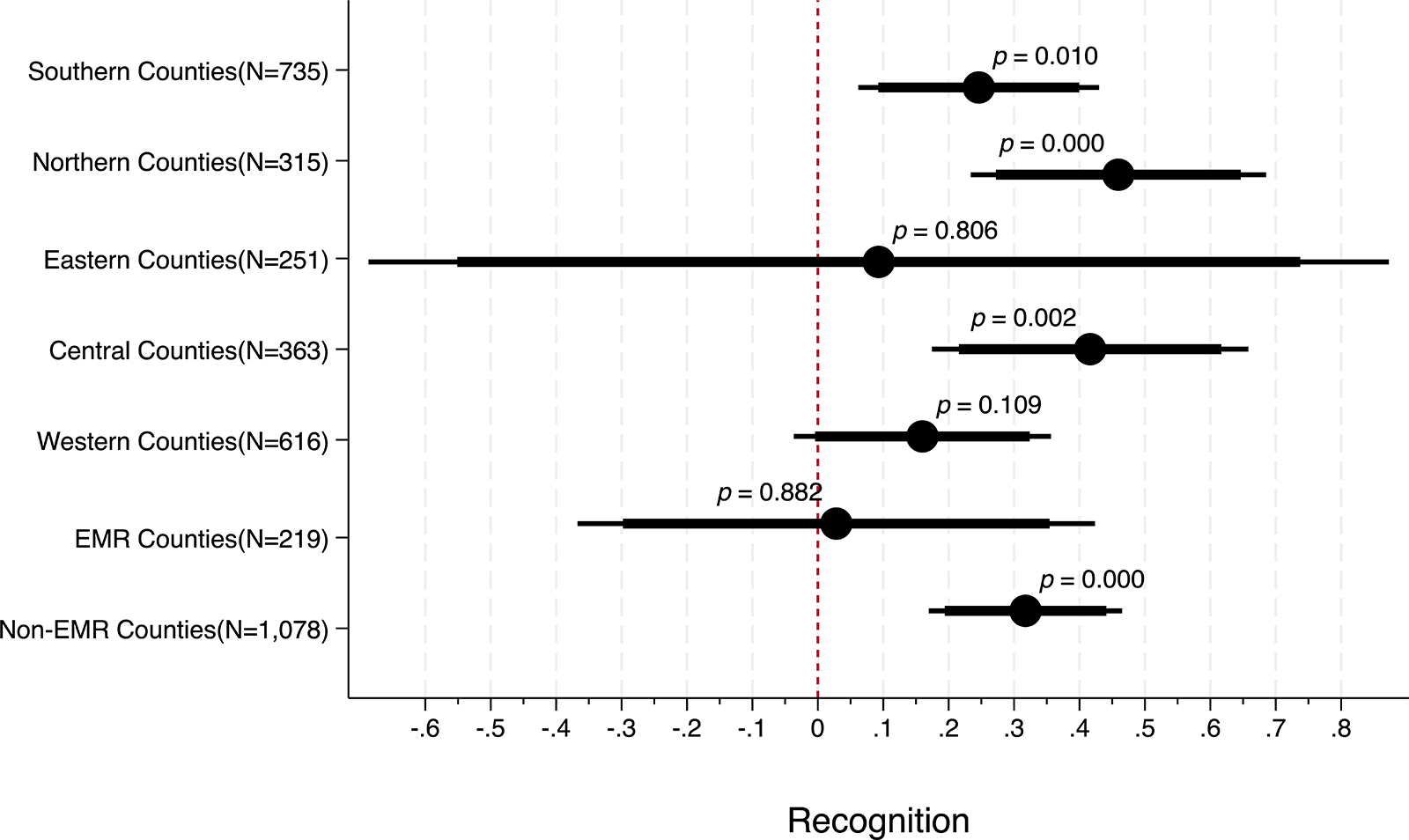
While the MCPS programme offers a clear career advantage overall, our heterogeneity analysis reveals that the positive impact of the honour on post-recognition career trajectories is uneven across regions; however, this heterogeneity of effect is not observed among groups with different biographic attributes (see Table E-2.1 in the online Appendix). Figure 3 presents the effect of the MCPS recognition on administrative rank in different subsamples. The results show significant positive effects in counties in southern, northern, central and non-ethnic minority autonomous regions. The positive effect of recognition is much smaller and not statistically significant in ethnic minority autonomous regions, which suggests that local leaders in these areas may already receive special attention in their regular career development, which could suppress the positive impact of recognition on career advancement.Footnote 55 In addition, the enhancing effect of MCPS recognition is larger in northern counties than in southern counties. The positive effect is also found to be greater in central counties than in counties in other regions. Using interaction terms instead of subsample regressions generates similar results (see Table E-2.2 and Figures E-4 and E-5 in the online Appendix). A potential explanation for the observed heterogeneity, which needs more thorough examination in future research, lies in the availability of other viable resources that officials can use to distinguish themselves for promotion, as well as the rate of upward mobility in the region. More alternative resources and a higher rate of upward mobility may dilute the boosting effect of recognition on career advancement.
The Effect of Recognition on Administrative Rank in Subsamples

Figure 3 Long description
The graph displays the effect of recognition across different counties, with each region labeled and accompanied by a p-value. The counties listed are Southern Counties with N equals 735, Northern Counties with N equals 315, Eastern Counties with N equals 251, Central Counties with N equals 363, Western Counties with N equals 616, EMR Counties with N equals 219 and Non-EMR Counties with N equals 1078. The x-axis is labeled Recognition, ranging from negative 0.6 to 0.8. Each county has a horizontal line representing the confidence interval, with a dot indicating the mean effect size. The p-values are shown next to each line: Southern Counties p equals 0.010, Northern Counties p equals 0.000, Eastern Counties p equals 0.806, Central Counties p equals 0.002, Western Counties p equals 0.109, EMR Counties p equals 0.882 and Non-EMR Counties p equals 0.000. A vertical dashed line is present at zero on the x-axis, indicating the baseline for comparison.
The robustness of the fast-track effect
Having established our core argument, we then conducted a battery of robustness tests to confirm the causal nature of this fast-track effect. We began by employing placebo tests (see Figure F-1 in the online Appendix), including an “in-time” placebo by pretending the recognition was awarded in earlier years, and an “in-space” placebo by randomly assigning the recognition to officials in our control group hundreds of times.Footnote 56 The results confirm that the career divergence began precisely in 2015, not before, and that our result is not a product of random chance.
Next, we used synthetic difference-in-differences (SDID) and the synthetic control method (SCM) to provide more reliable counterfactual outcomes by constructing an ideal comparison group that mimics the treated units’ pre-treatment trajectory.Footnote 57 Both methods revealed that the treated group experienced a sharp increase in administrative rank following the treatment year (indicated by the vertical dashed line), while the control group’s rank increased more modestly (see Figure F-2 in the online Appendix). This pattern lends further evidence that the treatment had a substantial positive effect on administrative rank.
Additionally, we conducted four robustness checks to verify that our results are not driven by the choice of variable operationalization, sample selection or model specification. First, we used binary variables (increase in administrative rank and promotion measuresFootnote 58 ) that more accurately capture subtle career advancement, as well as continuous variables (degree and speed of rank increase) based on the cross-sectional data, as dependent variables to rerun the regression (see Tables E-3, E-4, and E-5 in the online Appendix).
Second, we included a set of control variables that are likely correlated with both administrative rank and recognition, such as relative economic performance and informal political connections (overlapping tenuresFootnote 59 and tongxiang 同乡/tongxue 同学/tongshi 同事Footnote 60 ), with provincial Party secretary, provincial governor, prefectural Party secretary and the prefectural mayor (see Figures E-7 and E-8 in the online Appendix). Furthermore, we included province-specific and prefecture-specific time trends and the interactions of fixed effects (see Figure E-9 in the online Appendix). These help to control for province- and prefecture-specific annual shocks and local time trends.
Third, we show that our main results are robust to alternative model specifications,Footnote 61 including random effects, panel-GLS, system-GMM, difference-GMM, negative binomial regression and Poisson regression (see Figure E-10 in the online Appendix). Clustering at the county and year levels, the provincial level, the prefectural level, and using T.G. Conley standard errors accounting for spatial correlation did not alter the results (see Figure E-11 in the online Appendix).Footnote 62
Fourth, our findings are not driven by any single province or period. We re-estimated the main specification by dropping one province at a time and one year at a time (see Figures E-12 and E-13 in the online Appendix), and the main results still hold. Moreover, we performed 1,000 bootstrap replications and used nonparametric bootstrap estimation to build an empirical distribution of the estimator, which produced robust standard errors and confirmed that the recognition effect is stable (see Figure E-14 in Appendix). Taken together, this battery of tests provides powerful evidence that the career boost is a causal consequence of the MCPS recognition itself.
Cultivating recognition recipients
The preceding analysis establishes a robust causal link between the MCPS award and career acceleration; however, it does not answer the question of how the MCPS triggers a more active process of personnel development. In this part, we explore the specific mechanisms through which this promotion fast-track operates.
We argue that in addition to faster promotion, MCPS recipients have also received more intensive and deliberate organizational nurturing. We demonstrate this by analysing their movement across different kou 口 (see the description in the online Appendix D).Footnote 63 Cadres’ careers are often shaped by their experience within these systems. A long tenure within a single kou tends to produce a technocratic specialist. In contrast, preparation for top-level, generalist leadership positions, such as a provincial governor or Party secretary, requires a much broader skillset and a holistic understanding of governance. Therefore, the strategic, cross-system rotation of a promising official is a key instrument in the CCP’s cadre-management toolkit. This practice, often referred to as deliberate cultivation or “promotional grooming,” is a resource-intensive investment by the Party’s organization departments.Footnote 64 It is designed to equip selected cadres with a well-rounded portfolio of experiences, testing their capabilities in diverse roles and preparing them for the complex challenges of high-level leadership. Officials who demonstrate competence across multiple kou are considered more reliable and capable candidates for the highest echelons of power.
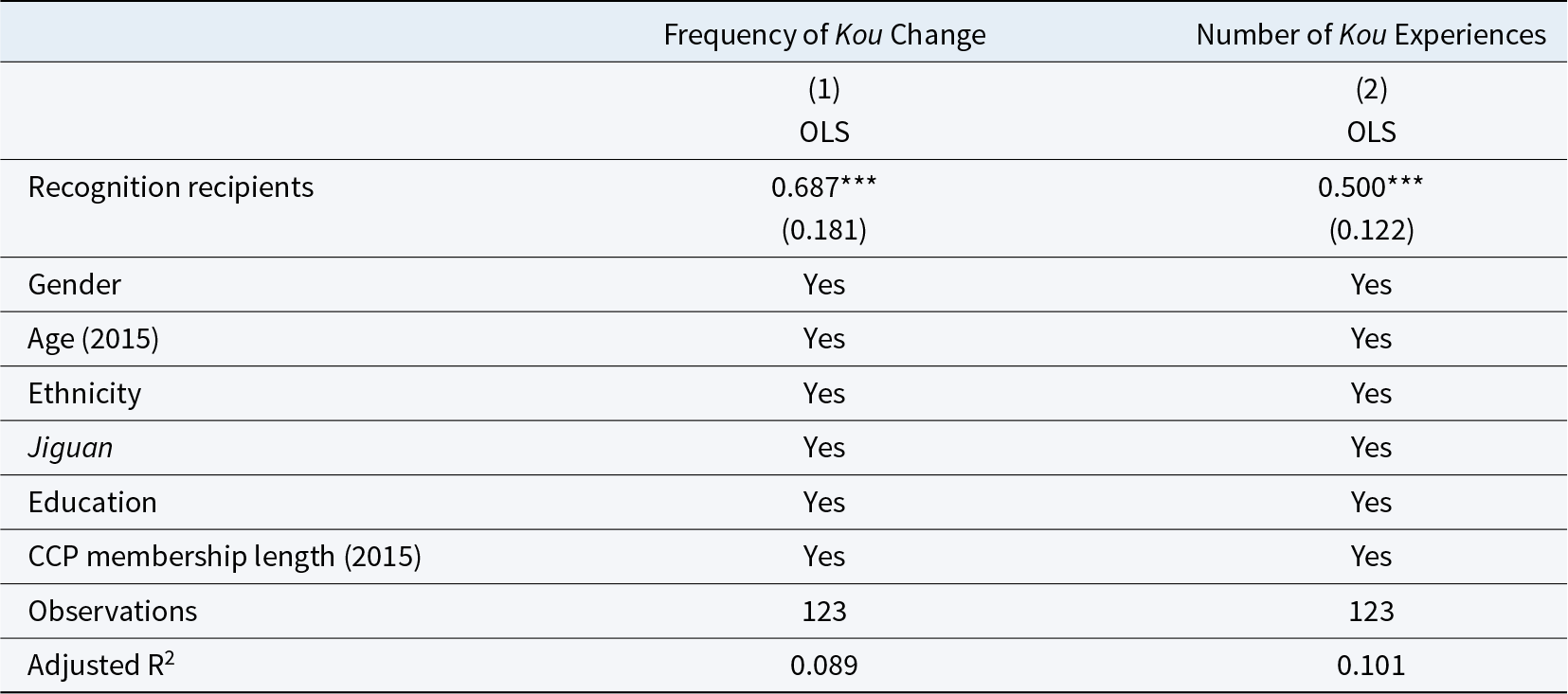
Our analysis in Table 3 tests this cultivation process using two specific measures: “Frequency of kou change,” which captures the number of times an official is transferred between different functional systems, and “Number of kou experiences,” which measures the breadth of their portfolio by counting the number of new functional systems they are exposed to post-2015. The results are unambiguous and provide powerful evidence of a mechanism that drives the observed accelerated promotions. Compared with the members of the control group, the MCPS recognition recipients are positively and significantly associated with both a higher frequency of kou changes and exposure to a greater number of distinct functional systems. These findings indicate that the MCPS recognition does not merely serve as a passive signal of promotion-worthiness; it actively triggers a process of grooming by the local personnel apparatus. The Party attaches great importance to the capability and experience accumulation, at least, for this small group of “preferred cadres.” Thus, the fast-track promotion system does not merely serve “as a mark of party patronage to encourage allegiance” but also promotes meritocracy.Footnote 65
Comparison Between Treatment Group and Control Group in Organizational Cultivation

Table 3 Long description
The table compares the impact of being a recognition recipient on the frequency of Kou change and the number of Kou experiences using OLS regression. Recognition recipients show a significant positive effect on both metrics, with coefficients of 0.687 and 0.500, respectively, and robust standard errors of 0.181 and 0.122. Demographic factors such as gender, age, ethnicity, jiguan, education, and CCP membership length are controlled for in both models. The adjusted R2 values are 0.089 for Kou change frequency and 0.101 for Kou experiences, indicating modest explanatory power. The analysis is based on 123 observations, and results are statistically significant at the 0.001 level, suggesting a strong relationship between recognition and Kou metrics.
Source: Authors’ dataset.
Notes: County Party secretaries without complete working history information are excluded from the analyses. Robust standard errors clustered at the county level are reported in parentheses. + p < 0.10 *p < 0.05 **p < 0.01 ***p < 0.001.
A key question, however, is whether the programme is just one part of a broader set of tactics used by the COD to groom rising stars. While comprehensive data on all county-level officials are unavailable, a reasonable test of the programme’s systemic impact can be conducted by comparing our treatment group with the matched control group, which includes high-achieving but unrecognized officials. We focus on cross-prefectural rotations as a key indicator of intensive and deliberate cultivation, while cross-provincial transfers require coordination with the COD and thus are too rare for prefectural or county-level officials to allow for meaningful comparison. A cross-prefectural move, however, is a non-routine effort that requires provincial-level coordination, signalling that the official is being groomed for a broader, provincial-level career.
Our analysis, which is presented in Table B-4 in the online Appendix, reveals the programme’s profound impact. An overwhelming 76.8 per cent of MCPS recipients experienced at least one cross-prefectural rotation between 2015 and 2024, compared to only 34.4 per cent of their peers in the control group. This indicates that MCPS recipients were more than twice as likely to receive this form of grooming. Consequently, MCPS recipients accounted for nearly 70 per cent of all cross-prefectural rotations observed within our entire sample of high-performing officials. This pattern is reinforced by data on functional rotations: recognition recipients experienced nearly double the frequency of kou changes and were exposed to twice the number of new functional systems as their non-recipient counterparts. These findings provide strong evidence that MCPS recognition is not just one of many grooming tactics; it functions as a powerful, systemically significant signal that triggers intensive, cross-jurisdictional cultivation by the provincial personnel apparatus. Once an official is recognized by the MCPS programme, local Party organizations often perceive a shared responsibility to nurture that official. This cultivation process reinforces the centre’s evaluative power: local governments internalize the central judgement and act as co-producers of meritocracy. The MCPS fast-track, therefore, is not just about rewarding past performance; it is about investing in the future generalist leadership corps of the party-state. The centre governs not merely through performance measures but through the cultivation of exemplary officials who embody desired administrative norms.
Conclusion
This article adopts an expanded view of political meritocracy by examining whether more competent officials experience faster promotion. Built on a novel dataset, the DID estimation provides strong evidence that the centrally bestowed MCPS recognition has a positive, albeit uneven, effect on the locally managed post-recognition promotion prospects of the recipients. The recognition is distributed based on economic performance and, thus, meritocratic principle.Footnote 66 Furthermore, MCPS recipients receive more deliberate organizational nurturing and faster promotion afterwards. This constitutes the centrally instituted merit-based fast-track of county leaders and the promotion of meritocracy through political recognition.
The finding has three implications for improving our understanding of political meritocracy and political recognition in contemporary China. First, the central authority plays a more substantive role in promoting political meritocracy in the management of subprovincial leaders beyond merely issuing guidelines. Like some formal personnel rules, such as cadre rotation,Footnote 67 irregular recognition allocation practices from the centre also play a non-negligible role in simultaneously promoting control and leadership grooming in local cadre management. Second, political recognition has an enduring function of benefiting recipients’ political career and thus constitutes an important yet understudied part of the political incentive structure. The under-institutionalized arrangement of the MCPS programme allows the COD to easily adapt its selection criteria and model narratives to align with the Party’s priorities.Footnote 68 The design preserves both the centre’s authority and the element of surprise associated with the award, helping to prevent performative “vanity projects” (zhengjigongcheng 政绩工程). It also serves as a multi-functional tool for the central authority to test and connect with local Party departments in rejuvenating the corps of local cadres. Third, the MCPS programme is a prime example of the institutional adaptability that helps to explain the CCP’s resilience. It demonstrates how the regime creates flexible, informal mechanisms that operate in parallel with the formal system to resolve critical governance problems. At the same time, the MCPS programme allows the Party to adapt discourse to legitimize an increasingly technocratic, performance-driven state. This helps the Party to maintain the symbolic power of moral authority while embedding it within the institutional routines of modern governance.
We find mixed evidence regarding local variation in responses to the MCPS programme. On the one hand, the characteristics of MCPS recipients and their serving counties do not vary significantly across provinces. On the other hand, the heterogeneity of the recognition effect on post-recognition career advancement is statistically significant; for example, the recognition effect is larger in northern and central counties. This finding is consistent with the fact that the guidance of the COD on the MCPS programme primarily relates to selection rather than post-recognition arrangements. Further research into the broader impact of political recognition on the system, such as the spillover effect of the MCPS honour on the incentives and performance of local leaders,Footnote 69 may provide a better understanding of the function of political recognition and its implications for uneven local development trajectories in China.
Supplementary materials
The supplementary material for this article can be found at https://doi.org/10.1017/S0305741026102264.
Acknowledgements
The authors are grateful to the three anonymous reviewers who provided valuable suggestions for the revision of this article. All errors remain our own. This work was supported by the National Social Science Fund of China (Grant No. 21BZZ073).
Competing interests
None.
Weilin XIAO is a doctoral student in political science at the School of Social Sciences, Tsinghua University. His research interests include comparative political development, political regimes and political behaviour.
Haoyue HU is a master’s student in political science at the School of International Relations and Public Affairs, Fudan University. Her research interests include Chinese politics and African politics.
Cai (Vera) ZUO is a professor at the School of International Relations and Public Affairs, Fudan University. Her research has appeared in World Development, Democratization, Political Studies, Studies in Comparative International Development, International Political Science Review, European Political Science and Journal of Contemporary China, among others.