A number of benevolent institutions aimed at improving the financial resilience of the working classes were established in Britain in the late eighteenth century. Most were formed with the express aim of enabling the working poor to protect themselves against the financial challenges presented by periods out of the labor market as a result of illness, injury, or old age. The most popular early form of organized income protection was the friendly society Footnote 1 , but a range of politicians and elite interests actively promoted savings banks as safer and more socially desirable. Savings banks provided deposit facilities only, with maximum amounts for deposit set at levels that were judged to be sufficient for the needs of the working class. The first savings bank—opened in Ruthwell, Scotland in 1810—proved an effective template for the rapid expansion of local banking institutions throughout Great Britain in the first half of the nineteenth century. By 1818, following the passing of legislation enabling the establishment of savings banks in 1817, there were 283 trustee Footnote 2 savings banks in England and Wales, with an additional 182 in Scotland.
The existing literature on the growth and development of savings banks in Britain in the nineteenth century is limited. Prior to Garon’s study of savings institutions in the developed world, Footnote 3 there were only two general histories of British savings banks. Footnote 4 Research articles have been relatively few in number, and have concentrated on two areas: the class of investors Footnote 5 or local/regional studies of particular banks. Footnote 6 Within these studies, the use of savings ledger data and of gendered or family unit savings behavior has attracted little interest, although the recent work of Ross is an exception. Footnote 7 This neglect is difficult to explain because depositor data are rich in detail and show clear savings strategies in use among the small savers of this period.
We use data from sample years from the depositor ledgers of four savings banks in the period 1851 to 1865 to examine savings behavior and saver categories. Although nineteenth-century bank data are interesting in their own right, an analysis of the accounts also provides an insight into the distribution of resources and power structures of working-class households. In a society comprising primarily patriarchal households, adult males would be expected to dominate account holding. In a society of egalitarian households, we would expect to see a much more dispersed pattern of account holding among women and children, as well as other arrangements, such as joint marital and familial accounts. Our study reports a substantial number of accounts that were opened and operated by married women, as well as accounts held jointly by married couples and other family groupings and accounts opened and operated by minors. The data suggest that married women and minors were contributing to household income and exercised considerable freedom and autonomy in the management of their own financial resources. This is relevant to developing our understanding of the range of financial management roles taken by married women in the household, and how independent strategies of saving and spending developed as minors made the transition into employment. Savings bank depositor data have the potential to add to our understanding of how British working-class families functioned in the nineteenth century and how financial decision making and power were exercised within them. This article therefore adds to our knowledge of savings behavior by the working class in this period and to the history of household and individual financial management.
Household Financial Management in Economic and Social History
The working-class family and its relationship to production and waged labor and consumption is an established research area. Footnote 8 However, for those interested in the choices made in the internal allocation and nominal control of family finances, the family can be difficult to position in the economy. For Marx, the working-class family was akin to the concept of the firm in neoclassical economics—that is, “a black box whose inner workings are simultaneously neglected and mystified.” Footnote 9 Later economists made their own attempts to explain the family economy. Becker Footnote 10 claimed that families acted as an altruistic unit, in which the sexual division of labor was efficient and differed from other groups by families taking collective action designed to increase their collective well-being. In Becker’s model, the head of the family controls and allocates the central resources in a stringent fashion that promotes collective well-being. As the family acts “as one,” the gender of the head of the household is immaterial. Bargaining models, in contrast, hold that individuals calculate the utility gain of contributing to the family unit relative to the utility they are likely to enjoy outside the marriage/family. In bargaining models, subjective differences in power are taken into account and affect the outcomes. Further modifications to bargaining models also take into account social norms that create different fallback positions for men and women. Footnote 11
Sociological research into modern family financial management patterns provides a more nuanced picture than does the economics literature. Jan Pahl’s research directly addresses issues of financial authority and decision making within households. Footnote 12 Multiple models of earning and spending have been mapped onto working-class and middle-class income households. For example, research based on household panel data has indicated that about half of couples pool their income and share its management, one third give control to the wife, and one sixth to the husband. There are other models in use, however. Footnote 13 Some couples divide responsibility for joint bills but otherwise manage their own expenditures; another group assigns specific areas of expenditure to each party or keeps entirely separate financial arrangements. Pahl suggests that the variables that shape the decisions made are about income levels—women are, it seems, more likely to control household finances when money is in short supply, and financial control also follows income. The higher the proportion of household income provided by an individual, the more control that individual appears to be able to claim. Footnote 14
The historiography of working-class households is heavily skewed toward exploring debt and credit in working-class communities—for example, pawn shops, doorstep lending, gambling, and hire purchase. Footnote 15 There have been attempts to construct the same sort of sociological insight into household finances as that provided earlier, but a limited evidence base has hampered the construction of a picture of how individuals and families used financial institutions and mechanisms in the nineteenth century. Apart from Playfair, Footnote 16 survey evidence of household structure and budgets is concentrated at the very end of the period (the late 1890s and early 1900s). Footnote 17 As a result, and to a very large degree, the contributions of family members remain out of sight of historians and commentators, and are effectively “buried in the family economy.” Footnote 18 The difficulty of reliably accounting for financial decisions directly from the historical record in the period prior to the 1890s has resulted in historians extrapolating from income data, inflation data, housing and food costs, and traces of regular expenditures evident in friendly society and insurance records from the period. Some types of data are more readily available than others. For example, the combined histories of the labor movement, industrialization, and welfare expenditure reform have ensured that income data for male workers are relatively accessible.
The establishment of the financial contribution made by women and children to the household income during the nineteenth century is more difficult to establish than that of male workers. Horrell and Oxley have asserted that in the nineteenth century, “the idea of complete dependence on a male breadwinner was a myth, and women’s work was crucial in getting the family through periods of strain. The family did not survive comfortably without women’s and children’s financial contribution.” Footnote 19 This is not to say, however, that women’s contribution was solely through waged income; women made money in ways other than working for wages. Footnote 20 Many of the income-generating activities by married women were extensions of their work inside the household. A typical example is that of a miner’s wife in 1842 who reported that she made up the rent payment for the family by making flannel shirts for colliers, but also supplemented the household income by trading bones left over from meals for salt, and earned enough for black lead and mustard by “any little job.” Footnote 21 Other researchers have established that women contributed to the household income via “penny capitalism,” by selling surplus produce or animal products, selling food and beverages outside their houses or from door to door, taking in laundry and sewing, baking bread, decorating, seasonal agricultural work, and being landladies. Footnote 22
Women also worked for wages. Edward Higgs and Joyce Burnette are among those who have challenged the assumption of falling levels of female/child activity as paid work moved outside the family home with industrialization. Footnote 23 Burnette suggests a number of factors that contributed to the systematic and pervasive underrecording and distortion of women’s activity. These include a cultural framework for the census takers of 1841 and 1851 leading to reluctance to identify women in a household as paid workers, the tendency to exaggerate the incidence of women’s employment as domestic servants and to ignore seasonal occupations outside the home, and the elision of the wife in working husband-and-wife partnerships. Recent writing on women’s self-employment in businesses also suggests that it has been understated in incidence and significance—see, for instance, Katrina Honeyman’s Footnote 24 study that draws on a wide range of writing to challenge claims that women were “marginalized or excluded” from the employment market.
However, those who believe that the nineteenth century saw a retreat of married women of all classes into the domestic realm have been reluctant to characterize the home as a female sanctuary. Women were considered vulnerable to what are often presented as the inevitable conflicts of working-class marriage in this period. Ellen Ross’s view is also that most working-class London marriages were routinely violent. Footnote 25 In Hammerton’s studies of conflict in working-class families, he identifies economic “mismanagement” as the trigger for the violence that resulted in both divorce and marital cruelty cases being brought to court and asserts that money was the traditional flashpoint for violence within the marriages of unskilled laborers. Footnote 26
The contribution of children to the household income is, in comparison, more widely acknowledged. Studies that focus on the early factory stage of industrialization (the early 1800s) note the numbers of children employed in waged positions, as well as their contribution to household income. Footnote 27 The continuing significance of child labor to production as the century progressed is fiercely debated, however, especially when the employment of children under ten years of age became less common and employment of any sort before the mid-teens varied enormously by season and by gender. Footnote 28 It is more difficult to make confident assumptions about the redistribution of income within households from older, resident children who had made the transition into regular employment. Scott and Tilly Footnote 29 suggest that it was common practice for factories to send the wages of girls straight to their parents, and that it was not until the 1890s that English single working women living at home were permitted to keep some of their wages for their own use. They also suggest that single women working away from home—for example, in domestic service—also sent their wages home to support their household. Footnote 30 Goose and Honeyman, though, stress the concept of “agency” in considering aspects of children’s employment in that period. Footnote 31 The large number of female domestic servants and single textile workers listed as depositors in our records suggests that not all earnings were surrendered to the family, and are suggestive of agency not only with respect to employment, but also in the management of waged income.
The existing historical narrative around women’s and children’s financial agency within working-class households follows the social history narrative presented previously and assumes a patriarchal model of authority and control, although in some variants, Footnote 32 and increasingly in oral histories of the early twentieth century, Footnote 33 the control exercised in this model is matriarchal. Married women’s management of money was confined to “stinting themselves.” Ellen Ross is firm in her assessment that most married women were dependent on allowances for their necessities, and that women and children would go without in order to prioritize the feeding and clothing of the father. Footnote 34 Laura Oren also stresses the asymmetry of the distribution of earnings within the working-class family, with the wife acting as an adjustable “buffer” for her husband. Footnote 35 The wife calculated the smallest share of the family’s resources she could survive on so her husband and then the children could be provided for first. The wife’s role was to manage on the smallest resource allocation as possible. Ross and Williamson identify similar restrictive regimes in their studies of different parts of England in this period. Husbands’ secrecy about their earnings—and the restriction of wives to pocket money only—meant that wives could carry out budgeting around consumption but not exercise control over allocation. Footnote 36 Financial control lay with the husband; even when the wife’s contribution was added to the household income, it was assumed that the husband controlled the distribution of monies. The strategies for money management identified as very important by Ross—pawning, sharing, borrowing, and the like—are makeshift strategies of women with no access to income of their own, dependent on their husbands’ generosity. Footnote 37
The issue of intra-household allocation of surplus resources raises difficult questions for economic historians within the family wage and male breadwinner narratives. The “male breadwinner” wage has rarely been sufficient to ensure the well-being of the working-class family. Footnote 38 The degree to which it represented the main income stream of the family has depended on the stage in the life cycle of the family, the prevailing economic conditions, and the industrial sector in which the head of the family worked. The “transition” narrative from family unit of production to male breadwinner has also been seen as problematic. De Grazia, for instance, contests that a model of exclusive male earning and female money management was the norm for all working-class families from the mid-nineteenth century onward. She implies that the male breadwinner/female consumer model is an exclusively twentieth-century fiction, generated by a Fordist perspective on the efficiency of the family “firm” as opposed to reality. Footnote 39
In summary, the story of working-class household income across the nineteenth century is fragmented—differing across regions and industries—and based on our best estimates and calculations as to waged labor, outwork, and the ability of “penny capitalism” to cover essential expenditures. This is in accord with the research of Horrell and Humphries, who note that any account of women’s and children’s contributions to household income in this period is conditional on both occupational and regional positioning. Footnote 40 In the face of this fragmented evidence, accounts of working-class financial management explanations have tended to rely heavily on ideal types, rather than empirical evidence. For example, the feminist economists Braunstein and Folbre Footnote 41 posit two possible household types. The first model is the familiar patriarchal one. In this model, the household has a male head who is both aware of and exercises his legally enforceable property rights over all household income. He provides his wife with such necessities as are guaranteed by the marital contract and her reproductive labor, which is neither negotiated nor controlled, increases her dependency on the head of the household. Footnote 42 In the context of our research, the logic of this model would assume that the husband controls the decision making and savings account, with the wife responsible for delivering efficient household management and consumption that helps to create surplus. The second, the egalitarian model, is characterized by gender-neutral property rights, with the husband and wife jointly deciding on how the wife should split her time between productive and reproductive labor in order to maximize surplus. From our own study, we would add evidence to the egalitarian model of joint decision making on how to save pecuniary surplus.
Research Data and Sampling
The data used in this paper are from a pilot research project on the financial management strategies of working-class families in the nineteenth century. The pilot project was designed to evaluate the extent to which savings bank depositor records existed, whether there were long runs of data, and the overall utility of bank depositor records in establishing baseline historical data on working-class savings.
The Savings Banks
We identified four savings banks in England for the pilot phase, based on the availability of their records and the socioeconomic environment they represented. We also consulted the register of 7,440 depositors for the Sheffield and Hallamshire Savings Bank between December 1857 and May 1860. The sample of accounts is drawn from banks that served the East End of London (Limehouse), a textile town (Bury), a large urban mixed economy (Newcastle), and a northern port town (South Shields).
All the banks investigated were established early in the nineteenth century in the first flush of British enthusiasm for the savings bank movement. After a rapid early expansionary phase, the growth of savings banks slowed, stopped, and then reversed in the later nineteenth century, when the trajectory of growth in other countries—such as Germany, United States, France, Italy and Spain—was still upward. Footnote 43 Limehouse was founded in 1816, one of twenty-seven savings banks in the London area by the end of 1819. Footnote 44 It operated at a time when the East End of London moved away from heavy industry and, in part because of the cost of land in the capital, developed a model of district as workshop. Limehouse was a district with a wide range of businesses, from heavy engineering to dressmaking, as well as many inhabitants who worked on the newly established London docks. Footnote 45 The bank survived until 1896, when it was, like many smaller savings banks, overtaken by competition from the Post Office Savings Bank (POSB), which could offer branches open daily for longer hours. Footnote 46 At the time of its closure, Limehouse had some 2,333 depositors, and was seventh out of the ten savings banks in London in terms of size. Footnote 47 Given that Limehouse had the longest continuous run of depositor ledgers in our sample, we used their accounts to collect data on the type of account holder (gender, age, marital status) of all depositors—some 14,661 accounts—in the period from 1822 to 1876.
The other banks in our sample were larger and had longer lives, but have fewer surviving depositor ledgers. Bury, described in 1853 as “a respectable and thriving market town and parliamentary borough,” Footnote 48 was dominated by the textile industry, an important employer of women. The Bury Savings Bank was founded in 1822 by the then rector Footnote 49 of the town, Geoffrey Hornby, and survived until the amalgamation of local savings banks into the national Trustee Savings Bank in 1975. Both Newcastle and South Shields had links to shipbuilding, docks, and coastal trade: shipbuilding, engineering and the coal industry were crucial in Newcastle’s rapid growth. Its population increased from just under 30,000 to 200,000 over the nineteenth century, while South Shields grew from 12,000 to some 60,000. The South Shields and Newcastle Savings Banks were founded in 1817 and 1818, respectively, and survived as independent banks until they merged in 1971. The South Shields Savings Bank, described as “very attentively conducted,” had attracted 737 depositors by 1830. Footnote 50 This compares with the 3,625 depositors in the Newcastle Savings Bank in 1826. Footnote 51 By the end of the nineteenth century, the three surviving banks had, respectively, 4,612 (Bury), 7,459 (South Shields) and 26,434 (Newcastle) depositors. Footnote 52
The specific archive material consulted for each of the banks was determined by its availability. The Lloyds/TSB Archive holds the Bury depositor ledgers, but there are also microfilm copies of some records in Bury Archives, which include minute books from 1829 to 1896, printed annual reports for 1865 to 1975 (with a gap from 1915 to 1918), internal accounting records from 1822 to 1904, and depositor account ledgers for 1822 to 1903. The Tower Hamlets Local History Centre and Archives holds the depositors’ ledgers for Limehouse Savings Bank, covering all accounts opened between 1817 and 1876. The depositor ledgers for Newcastle City Branch Savings Bank and the South Shields Savings Bank are also held by the Lloyds/TSB archive.
Establishing Depositor Savings Behavior
In addition to recording the gender, marital status, and adult status of depositors of all of the Limehouse accounts, we selected sample years in the period 1851 to 1865 to examine savings behavior in more detail at each of the four banks. The years 1851 and 1861 were selected prior to the start of the data collection to allow crosschecking of depositors against the census records. Matching depositors with census records proved difficult for two main reasons. The first is the lack of consistency regarding the presentation of depositor addresses in the ledgers of each bank. Limehouse Savings Bank included the full address of depositors at the top of all new account columns. South Shields ledgers merely noted whether account holders lived north or south of the River Tyne. Newcastle made no reference to the registered address of their savers at the head of their account columns. Bury included address details in a separate index at the front of the ledger. The presumption is that depositors were local residents. The legislation made clear that only one savings account per person could be opened (although it is difficult to see how this was policed). The restricted opening hours of the banks made local account holding likely, although Limehouse did list a very occasional account address outside its area. The second unexpected difficulty in matching depositors to census records was related to ledger irregularities. Bury renumbered its accounts around 1850. We used the closest year (1855) that we could be confident recorded new depositors rather than renumbered accounts, and then used 1865. We chose 1853 for the South Shields data, which was at the end of its available ledgers and 1863 from the Newcastle accounts to give us a ten-year interval snapshot of savings behavior in the industrial North East.
We summarized individual account behavior using the following measures: length of account holding, maximum balance held, number of transactions, and notes taken of any additional activity in respect of the account, such as the addition of a spouse as co-holder or unusual features. We have more detailed data on a total of 4,448 accounts, split in the following way: Newcastle (n = 2739), Limehouse (n = 732), Bury (n = 665), and South Shields (n = 312).
The coding system for account use is based on the number of total transactions on the account throughout its life. This was the basis of the method used in two surveys undertaken on account usage by the POSB in 1930, in which accounts were grouped into three broad categories based on the total number of transactions. Footnote 53 However, using total transactions as the criterion for classification results in a one-dimensional picture. Another option is to include the number of years the account was held (which the POSB surveys did not), which then can be used to provide an indication of average account usage per annum. But again, the calculation of a “transaction per year” score does not indicate how the accounts were used.
Our method of categorizing saver behavior does not replicate or extend nineteenth-century bank reporting. Neither the savings banks nor (later in the century) the POSB reported specifically on the gender and/or marital status of account holders. The focus of nineteenth-century institutions immediately after formation—beset, as they were, by critics who believed that the generous interest rates attracted the middle classes rather than the thrifty poor—was on providing occupational data of depositors in their defense. Footnote 54 The 1857–58 and 1902 House of Commons Select Committees that inquired into the savings bank sector produced overall data on the number of branches and accounts and on average balances. However, nothing was said about the conduct of balances—for instance, how long were accounts maintained? What was the pattern of deposits and withdrawals? Did particular types of savers behave in different ways? It appears that the savings banks were not interested in depositor behavior once the account had been opened.
To identify different types of account usage, we removed interest additions by the bank from the total activity count and created a simple set of categories by comparing the number of deposit and withdrawal transactions. By doing so, we were able to identify four initial categories of account use. The first account type is characterized by having two transactions in total: an opening deposit and a subsequent withdrawal of the total balance, resulting in the closure of the account. We labeled this account type as the “in-and-out” account. We decided not to make a further distinction in the data between in-and-out accounts that were closed prior to reaching the qualifying date for interest, and those that were closed after accumulating (sometimes several years’ worth of) interest, because we could not be sure that the two account types revealed different intentions of savers past that of putting the money beyond use for a period of time. The second type of account is one for which there is deposit and withdrawal activity. We made no distinction in this pilot phase between accounts in which the overall trend, despite occasional withdrawals, was toward accumulation or in which the overall trend, despite occasional deposits, was toward dispersion of funds. As many of the accounts we studies were suggestive of activity related to normal household contingencies, we labeled an account with this broad pattern of use as the “contingency account.” The third category of account is one in which there is a series of deposits and then one lump sum withdrawal, presumably when the individual’s saving objective has been met. This account usage has been designated as the “accumulating account.” The last category of account Footnote 55 is one in which there is a single lump sum deposit and the customer withdraws money in more than one transaction, depleting the opening balance until the monies are depleted and the account closed. This is referred to the “draw-down account.”
Depositor Account Trends
Savings banks were not designed to attract very small deposits. The minimum deposit was 1 shilling; customers with smaller amounts were directed from the mid-century to “penny banks.” The POSB, from its creation in 1861, also attracted smaller investors. Looking at the data point of 1875, and using the long-run data of Limehouse, the difference in the average size of accounts held in savings banks and the POSB is clear. The savings banks had approximately 1.5 million savers in total, or an average of 3,150 accounts per bank, holding an average balance per account of £29; the POSB had 1.8 million savers, an average of 338 accounts per branch, which held an average balance of £5.45. Although these averages hide considerable variations between rural and urban banks and branches, they nonetheless suggest that the POSB’s greater geographical spread attracted a greater number of small depositors.
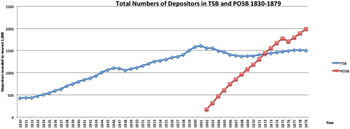
Limehouse long-run data (1830–1876) on account growth was compared with national figures on national savings bank depositors (see Figure 1). The general growth trends are similar—Limehouse experienced a steady growth of depositors from the 1830s to 1850s, with numbers peaking at the end of the 1850s. At the point that competition was introduced in the from of the POSB, the numbers of new accounts decreased, but the bank was clearly still attracting substantial numbers of new account holders, given the small section of London it served
Total numbers of depositors in savings banks and the Post Office Savings Bank, 1830–1879 (based on Horne, Reference Horne1947)

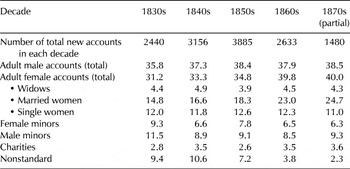
Using our more detailed breakdown of the types of depositors that made up the population of savers in Limehouse in this period (see Table 1), we can see that adult men were the main category of savers. However, the adult male category is not disaggregated according to marital status in the same way as it is for women. We are able to show a further disaggregation of adult women savers by marital status into widows, married women, and single women. The general category of “adult male” prevents us from isolating the savings behavior of married adults and being able to compare it to that of unmarried savers.
New accounts per decade in Limehouse Savings Bank 1830s–1870s split by type, gender, and marital status

Effect of the Married Women’s Property Act 1870
The period for which we have long-run data from Limehouse about demographic trends encompasses the first of the Married Women’s Property Acts (MWPAs). All deposits made after the MWPA 1870 were declared the separate property of such women. The Spectator (1878, p. 347) noted approvingly that this had “tempered the injustice of the ancient law, which gave to a lazy or drunken husband the right to appropriate the fruits of the labor of his wife,” and that the passing of the MWPA meant that women no longer had reason to hide the fact that they saved. Footnote 56 However, the Savings Bank Act allowed for the operation of married women’s accounts prior to this date and worked on the default assumption that the women could draw from their accounts without requiring the consent of their husbands. The same regulations and legislative safeguards were replicated in the formation of the POSB. Only if the husband had previously given notice to the bank that the deposit should be paid to him were husbands permitted to draw. Clerks and trustees did not uniformly understand this regulation, however, and the Limehouse ledgers record instances when the bank refused to release funds to the husband or colluded with the wife to deny the husband access. Footnote 57
The passing of the first MWPA in 1870 is therefore an important analysis point in the national and Limehouse long-run data. In research based on the examination of wills left by middle-class women before and after the MWPA, Combs Footnote 58 was able to identify a changing pattern of the assets held by married women from property to cash. Combs interpreted this as women enjoying a larger share of marital wealth after 1870. We can find no evidence, however, of any significant new account activity immediately after 1870 in the national trend data for the savings banks or the POSB or in the gender-specific data from Limehouse that would suggest that the MWPA had a similar impact on the type or amount of assets married working-class women controlled directly or indirectly.
Forbes’s treatise Footnote 59 on savings banks noted several cases in which women had kept their savings accounts hidden. Even though there were undoubtedly cases in each bank in which married women banked under their maiden names and/or in different districts to maintain control over their own earnings, to keep large numbers of married accounts secret would require subterfuge on a substantial scale. The more likely interpretation is that married women had confidence in the savings banks, as evidenced by the numbers who opened accounts throughout the decades prior to the MWPA. Accounts opened by married women increased throughout the 1850s and 1860s Footnote 60 and complemented other married-household management strategies. For example, Limehouse permitted the practice of joint married accounts that until 1860 constituted, on average, 4 percent to 5 percent of new accounts opened annually. The overall picture presented by the existence of joint married and married women’s accounts in such numbers supports the thesis that decisions about household and individual savings were not exclusively conflictual, and that cooperative savings strategies were pursued by many couples.
Account Usage Trends Across All Four Banks
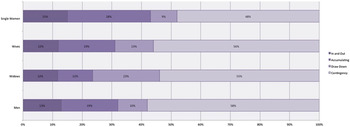
In our sample banks and years, adult men held 53 percent of the adult accounts, and adult women 47 percent (married women 22 percent, single women percent, and widows 5 percent of the total adult accounts). In Figure 2, we show the comparison of savings behavior among the main categories of adult savers. As mentioned previously, the lack of disaggregated data for the marital status of men does not allow us to see the representation of married and single men and widowers in the figures for adult males.
Account types held by adult savers in all sample banks, by saver category

The most striking feature of the aggregate adult data is the similarities in the account usage between men and women, and among women. Contingency accounts are the most common accounts for all saver categories, with very little difference in the percentage held by adult men, married women, and widows. The difference in the contingency account figures for single women is a result of single women operating greater numbers of accumulating accounts. The higher number of accumulating accounts held by single women may be a result of the numbers of single women in domestic service. Domestic servants represented a large occupational category in the reports of the savings banks from their inception, Footnote 61 and they continued to be a major category of single women savers in the mid-century period sampled in the data. Domestic servants who lived in with their employers were able to accumulate savings because they did not have to pay rent or subsistence costs out of their wages and time off was restricted. We are cautious of ascribing the savings behavior of single women to saving for marriage, not least because the depositor ledgers frequently record women carrying savings accounts opened as single women into their marriage and banks merely noting the change of surname.
The other account use category that does show variation among categories of savers is that of the draw-down account. Our assumption, on first noticing this distinct account type was that it was largely a mechanisms for supporting “spare” women in the household, such as widows or unmarried female siblings, through allowances. Indeed, the frequency with which the draw-down account was seen in relation to widows (23 percent) earned it the nickname of the “widow’s account” in our first scan of the data. However, the draw-down account is seen across all saver categories, with married women also holding these accounts at a level slightly above the 9 percent to 10 percent enjoyed by adult men and single women. Gifts and inheritances are both plausible explanations, even if it is not possible to be certain of why lump sum accounts are opened. Footnote 62 The draw-down account remains the most difficult type to which to assign motive or explanation and is an account type we want to examine in more detail in future research projects using depositor data.
Overall, the account usage categories suggest that adult savers used their accounts in similar, predictable, and pragmatic ways to manage their finances. We do not think that it is possible to assume from these figures that particular savings behaviors are a quality or possession of a particular marital status or gender. For example, the data do not appear to support a hypothesis of married women using accounts for specific, segmented savings accumulation using spousal wages or those of other adult earners in the family. In the next section, we look in more detail at the different locations and sample financial data to explore the impact of local economic conditions on savings behavior.
Sample Year Data by Bank
Limehouse, London (1851 and 1861)
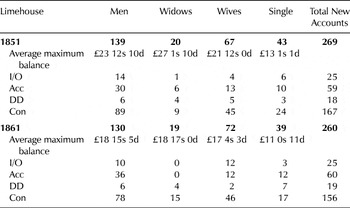
Limehouse saver category data match the sample data trend in adult accounts (see Table 2). For example, in 1851 (and 1861), adult male accounts comprise 53 percent (50 percent) of new adult accounts, widows 7 percent (7 percent), married women 25 percent (28 percent) and single women 16 percent (15 percent). Married women were more likely to hold savings account in Limehouse than in any other of our sample locations; we attribute this to growing rates of economic participation of women generally in London in this period. Research into mapping adult female employment in England using the 1851 census Footnote 63 estimated the rates of regular employment of adult women in the London registration districts that cover the East End to be 20 percent to 30 percent. As it is not clear to what extent irregular employment was recorded in the census, these figures will likely understate female economic participation rates. Therefore, it is reasonable to conclude that the growth in married women’s accounts broadly reflect growing economic participation rates of all women if they are present in equal numbers in the savings records as adult men. Field and Erickson have suggest that savings bank data are the best indication of the rates of economic participation by married women in the pre-census era, but we would go further and suggest that these data might be the best indication of economic participation of adult women in the nineteenth century post-census. Footnote 64
Limehouse 1851 and 1861 account usage and average maximum balance for each adult saver category

I/O: in-and-out accounts.
Acc: accumulating accounts.
DD: draw-down accounts.
Con: contingency accounts.
The notable element of the Limehouse figures relates not to the saver categories or account usage types, but to the average maximum balance held. Maximum average balances were a figure that the banks reported in the nineteenth century and provide a useful comparator between locations. The average maximum balances held in Limehouse are the lowest of our four sample banks in all categories of savers (except that the maximum balances of widows in 1851 are higher than those of widows in South Shields in 1853). The comparatively low maximum balances reflect the Limehouse economy in the 1850–1870 period. An inadequate level of income was a fate that the vast majority of London workers shared throughout the nineteenth century. The cost of doing business in London was high, as premiums were paid for fuel, transport, and premises, which maintained an incessant downward pressure on wage levels. Footnote 65 The capital attracted a steady stream of skilled and unskilled labor that also acted to keep wages low, despite increasing unionization and worker disputes and unrest. White comments that wage levels in the nineteenth century were such that they allowed very little capacity to save. Footnote 66 The decline of savings in the period after 1861 is most probably the result of the decline in shipbuilding Footnote 67 that affected allied trades and services in the district. Additionally, a series of severe winters in the 1860s brought some of the poorer poor law unions in the East End to the point of collapse because of the heavy demands on their funds.
Tyneside (South Shields, 1853 and Newcastle, 1863)
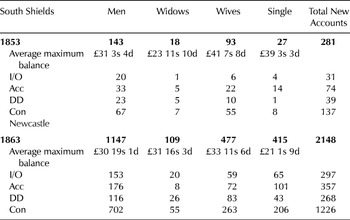
Two things are immediately apparent in looking at the data for South Shields (1853) and Newcastle (1863), as seen in Table 3. The first is that there is much more variation of average maximum balances across saver categories, with married women’s accounts holding slightly more, on average, than adult males in Newcastle and by a significant amount in South Shields. Our more detailed examination of the occupations represented in the married women category in South Shields suggested that mariners’ wives were represented in the married women category to the point of being the majority of the married women’s accounts (53 percent). We were able to isolate the data from mariners’ wives in South Shields and Newcastle (the only other sample bank in which they appeared in significant numbers), as well as the data of mariners’ accounts. In terms of maximum average account balances, mariners’ wives in South Shields had higher balances than all other wives in all other locations, as well as all other wives in South Shields. In terms of account activity rates—that is, the total number of deposits and withdrawals—mariners’ wives in South Shields had a lower activity rate than other wives in South Shields (an average of 13.6 transactions per account, compared with 14.2), but a higher activity rate than non-mariners’ wives in all other locations (11.5).
South Shields (1853) and Newcastle (1863) account usage and average maximum balance for each adult saver category

I/O: in-and-out accounts.
Acc: accumulating accounts.
DD: draw-down accounts.
Con: contingency accounts.
Tabili’s research on the maritime industry of South Shields suggested that mariners’ wives shouldered extraordinary responsibilities in the absence of their husbands at sea, entailing autonomy and being recognized as official intermediaries. Footnote 68 In similar seafaring communities on the Atlantic coast of the United States, women were considered “deputy husbands” and business agents with wives settling debts, selling property, and paying taxes on behalf of their husbands. Footnote 69 As a result of high desertion and mortality rates in the industry, and the uncertain financial returns to the more junior mariners, business agents of the ship owners were reluctant to release funds except to the wives of the most senior and experienced officers. Footnote 70 The wives of mariners, as a similar study of the wives of soldiers and sailors in eighteenth-century London Footnote 71 also showed, were largely left to their own resources and ran boarding houses and alehouses, took in lodgers and laundry, nursed children, and sewed clothing. The wives maintained explicit separate work identities while managing the financial affairs of their husbands in ways that enabled them to sustain not only their households, but also the maritime industry. Footnote 72 The wives of colliers in the North East of England employed similar complex strategies for married women to contribute to household income in this time period.
The pattern of single women’s savings in South Shields shares similarities with the married women’s accounts in Bury—that is, a small number of accumulating accounts holding relatively high maximum balances—but not with the single women’s accounts in London. Although not represented in the table, the joint account average maximum balance in Newcastle in 1863 also stands out, being double those seen in the same sort of accounts in London for the same period.
Bury (1855 and 1865)
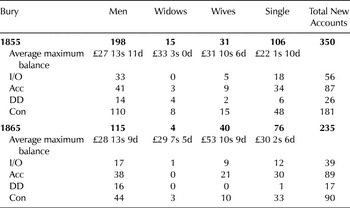
Bury in 1855 is the outlier in terms of the dominance of the adult male category in 1855, and also notable for the low number of married women’s accounts against single women’s accounts (see Table 4). Adult males’ accounts in 1855 (and 1865) comprise 57 percent (49 percent) of new adult accounts, widows 4 percent (2 percent), married women 9 percent (17 percent), and single women 30 percent (32 percent). Also notable, although not following any discernible pattern,are the high maximum average balances held by married women in 1865.
Bury (1855 and 1865) account usage and average maximum balance for each adult saver category

I/O: in-and-out accounts.
Acc: accumulating accounts.
DD: draw-down accounts.
Con: contingency accounts.
An analysis of any data from Bury in this period must take account of the textile industry, which created both regular and irregular employment opportunities for women. Many women left the industry only when their children became adult wage earners, although the consequence of this was a doubled workload of factory and housework. Footnote 73 The absence of married women textile workers from the savings data is therefore puzzling. Two possible explanations present themselves. The first explanation is that in a marginal wage economy, the costs to women working full time although they had young children—childcare and buying ready-made food—left no surplus Footnote 74 to bank. The other is that when women were married but had a full-time job, they were identified in the Bury depositor ledgers with their job roles and were classified as single as a result. Classification of married women in this way would be unusual in the banks we have studied and the age profile of married savers. Bury married women’s accounts are an area that we hope to analyze further in the next phase of the research.
The interpretation of the two years of sample data from Bury must also take account of the “Cotton Famine” (circa 1861–1865). Footnote 75 Lack of supply of raw cotton as a result of the U.S. Civil War had a devastating local effect on the textile industry and caused enormous contraction in income and job opportunities in the industrial North West of England. A comparison of the occupations listed in 1855 and 1865 in Bury is indicative of the general damage done to the local economy as a result of the fall-off in production in the early 1860s, although the proportion of adult savers overall did not change between the two data points. In 1855, 30 percent of adult males, 19 percent of married women, and 36 percent of single women savers were directly, or indirectly, connected to the textile trade. In 1865, the number of depositors allied to the textile industry had been reduced to 23 percent of adult males, 8 percent of wives, and 25 percent of single women.
Disaggregated Marital Status for Adult Men in Bury, 1865
As we have already noted, making a firm case for the existence of cooperative household financial behaviors and control in working-class households is difficult without disaggregated adult male marital status data. In this respect, we were fortunate to be able to match surviving registration records from Bury in 1865 to depositors and to record the marital status and age of all account holders at the time the accounts were opened. Although the sample is small (77 married and 129 single adults), the split between married men and single men is close to 50:50 (52 married, with an average age of 44, and 60 single, with an average age of 23). There is an obvious need to find more disaggregated male marital status data, but even this small sample allows us to make some comparisons between married and unmarried men.
The first query we made of the age and marital status in the Bury 1865 data was to compare the savings behavior of married men and married women. Married men had a higher number of draw-down accounts (17 percent to 0 percent). The Bury married men’s draw-down accounts do not appear to have any underlying patterns relating to occupation, age, or size of the original deposit. Draw-down accounts were operated by laborers to paper makers to mechanics, were opened with amounts from £4 to £30, and took from a year to ten years to run down and close. The most popular form of account for married men was the accumulating account (37 percent), reflecting the greater capacity of families with older children to save.
We were also interested in seeing what effect the ability to separate our single male savings behavior would have. In splitting the data between married and single male savers, we could see the extent to which marriage affected the overall account usage. Single male accounts differed from the pattern of single female accounts we saw across the four sample banks in that the majority account pattern was not of accumulation, but contingency (39 percent). There is a broad similarity in both the percentage of in-and-out and draw-down accounts (17 percent single; 12 percent married). The difference is in the majority account type, which, as discussed, is the accumulating account for married men and the contingency account for single men. In our next (and final) section of this article, we turn to the role of child saving in relation to the issue of family financial management strategies. Children’s accounts are interesting because they show children being economically active, as well as providing more insight into general family savings cultures and/or strategies. We have examples of both in our data.
Minors’ Accounts Across All Sample Banks
The designation of “minor” in the depositor ledgers does not follow the legal age of majority (twenty-one) in British law at this time. In practice, most of the savings banks in our samples appear to follow a rough rule of thumb in allocating the label “minor” to accounts. When an individual is judged too young to operate an account independently of an adult, one or both of the parents, or another relative, is listed “to sign” for the child with respect to withdrawals. Of the forty accounts of this type opened in Limehouse between 1854 and 1858, twenty-one accounts had female relative signatories, and nineteen had male relative signatories. It seems unlikely, given the even split of men and women signatories, that child accounts were being used by women to hide money from their spouses. They appear to be genuine accounts opened and operated on behalf of children. Children between the ages of seven and nine were judged to be competent enough to own and operate savings accounts without direct adult supervision—these form the majority of the “minor” accounts in our sample and probably reflect the ability of the account holder to access some transitional economic activities and/or irregular income opportunities, such as errand running, rather than full-time employment. Footnote 76
If an individual was economically active and/or in regular employment at the time of opening, the account was attributed to the individual and his or her occupation, even if the account holder had not reached the age of majority. From the analysis of the age ranges of the Bury 1865 depositors (the only sample year and bank for which we also have age at account opening data), minors held accounts as “adults” from age thirteen for boys and girls, although in practice the majority of the teenage single women opening accounts did so around age sixteen. This is in line with many other data sources in the period after 1850. For example, Nigel Goose and Katrina Honeyman note that the number of five- to nine-year-olds enumerated as employed in the 1851 census was less than 2 percent, whereas 28 percent of ten- to fourteen-year-olds had entered full-time employment. Many more became fully economically active after that point, with the vast majority of boys making the transition between ages fourteen and sixteen, and girls at sixteen when entering domestic service. Footnote 77 The adult male category in our data is therefore likely to encompass a slightly wider age range (thirteen and above) than that of the adult female category because of the slightly delayed entry of young women into the workforce.
Local employment conditions also appear to affect the number of minor accounts, with locations dominated by one industry more likely to report higher proportions of adult accounts. In 1855, both Bury and South Shields have higher proportions overall of accounts held by adults (90 percent in South Shields in 1853, 87 percent in Bury in 1855) in comparison with other locations. Locations with a more mixed economy resulted in more numerous minor, joint, trust, and other irregular accounts (for example, only 72 percent of Limehouse accounts in 1851 were adult accounts, as were 78 percent of Newcastle accounts in 1863).
The savings patterns in child/minor accounts emerge when looking at account activity in combination with census information and, when available, other accounts held by siblings. The findings are suggestive of three broad account-opening strategies by families. The first strategy is the one that opponents to the savings banks suggested would be a persistent abuse of the aims of the savings bank—that is, when accounts were opened with the maximum amount that could be deposited in one year (£30) and used to generate income from interest payments. This behavior has traditionally been ascribed to middle-class investors gaming the system, but there are alternative complex gift and/or lump sum earnings explanations that suggest legitimate working-class savings strategies. For example, in Limehouse in 1861, accounts were opened with £30 for two children in the Berridge family of Bromley Street, Emily (£30 16s 0d) and Louisa (£30 0s 0d). We know from the census records that in April 1861 Emily was four years old and living with her mother, three siblings—two older and one younger—and her widowed grandmother. Her sister Louisa was born later that same year, shortly before the account was opened in her name. The mother, Elizabeth Berridge, had declared herself to be a mariner’s wife, with her spouse presumably away at sea. The property in which she was living was shared with another mariner’s wife and her son. The money in both accounts was deposited and withdrawn again before the accounts were two years old. It is unlikely that either Emily or Louisa was aware that the accounts had been opened in their names and closed again, so it seems safe to assume the accounts were being used to store surplus safely for the household. However, the origin of the money (such as a gift to the family, money pooled between the mariners’ wives, or a lump-sum payment of mariners’ wages) was obscured. Although we can make judgements as to what savings strategies were being pursued within families and what this suggests by way of control and distribution decisions, we cannot ever be sure of the reasons why individual intra-household savings decisions were made.
The second and third types of children’s accounts are illustrated by two other sisters in the records who opened accounts and had one deposit and one withdrawal in an account length of less than two years. Like the Berridge sisters, Eliza and Martha Smith also had identical amounts deposited for them in bank accounts—but in this case only 3s 6d, which suggests a gift of money from the parents or other relative that is subsequently used for a purchase for or on behalf of the child. The final account strategy is a transition account type—in which an account is opened by or for a child to encourage the habit of thrift or saving for a specific outcome and the child continues with the habit over a longer period of time. Alice Hayward, for example, took more than five years and four separate deposits to accumulate her £4 5s 11d before withdrawing the whole amount when she reached her late teens. Children’s accounts, coming as they do from three “opening” strategies, thereafter fall into two main saver behavior categories—the in-and-out account (as with the two sets of sisters) and the “accumulation” account, as demonstrated by Alice Hayward. Minor accounts that were held for longer periods of time (more than five years or more than ten years) show a trend toward becoming contingency accounts as the account holders exited childhood and became economically active in their early teens.
Conclusion
Previous research on savings banks in the nineteenth century has dealt largely with the history of banks as institutions or concentrated on two aspects—the class composition of the savers and/or the performance of individual banks. At the same time, gender and family historians have debated economic decision making in the household relying on a restricted number of sources. Savings bank depositor data have been largely neglected as a source for the investigation of intra-household financial decisions. Our research, which will be of interest to business historians concerned with the development of mass retail banking institutions, financial historians, social historians, labor historians, gender historians, and cultural historians who have an interest in working class households and their behavior, uses depositor data to cast light on the financial management strategies of working-class households. Women (married, single, and widowed) have a large presence as account holders, minors’ accounts are significant in number and value, and there is evidence of joint family savings when larger urban banks allowed for such “irregular” accounts.
We want to be clear about the limitations of our empirical work in establishing why individuals were making the choices they were in relation to their banking arrangements, and what goals they may or may not have been pursuing. Considerable challenges exist in linking bank accounts to basic biographical information via the census or other extant records that are likely to capture working-class individuals. This makes even the most rudimentary sketch of an individual’s circumstances difficult to establish. Furthermore, our pilot research was intended only to establish whether savings records were likely to be a good source of data on working-class women’s financial management. The extent of women’s representation, and especially of married women’s representation, in the records took us by surprise. Further work is clearly needed to return to the depositor records and to construct a more detailed savings database that captures not only the types of transaction, but also the exact amounts and their specific dates, to allow for more detailed analysis within and across households in specific time periods and locations. A greater number of years also need to be sampled across the nineteenth century to be able to account for changing labor market conditions as the century progressed. These caveats notwithstanding, we believe that the data we have presented suggest a repertoire of historical household management strategies around savings that are the equal, in terms of differing models and contexts, of contemporary trends as established in the sociological literature.
The accumulated data that saving was not an exclusively male activity represents a challenge to the historiography of working-class male control of household finances. Although some researchers Footnote 78 have questioned the common assumption that the legal environment prior to the MWPA was hostile to cooperative money management, the dominant narrative—especially with respect to the social history of working-class households—has assumed that the restrictive legal environment and social taboos against women’s economic activity encouraged patriarchal control and financial management. The large numbers of married women’s accounts, the evidence of accounts transitioning from single to married status, joint married accounts, and the encouragement of savings accounts of minors, including working minors, are all suggestive of a number of varied, and contextual, household financial strategies in operation. It can, of course, be argued that the operation of accounts by married women indicates that control of household finance remained with husbands, and that what was delegated to them was simply the day-to-day management of scarce resources. However, the popularity of accounts in the name of the wife only, when husband-only or joint accounts were readily available, suggests that the savings banks are evidence that women could exercise financial strategies of their own.
These preliminary findings are encouraging and suggest that savings bank depositor data represent an important, and informative, data source for the understanding of savings behavior and the history of individual and household financial management. The depositor records provide a much-needed additional source of information about working-class incomes and money management, and hopefully will provide a rich source of data for research that is more akin to the sociological analysis of household money management than the less-nuanced economic models of household financial management.