INTRODUCTION
Four species of spider crabs of the genus Maja Lamarck, Reference Lamarck1801 (Brachyura: Majoidea: Majidae) have been reported in European waters: M. brachydactyla Balss, Reference Balss and Michaelsen1922; M. crispata Risso, Reference Risso1827; M. goltziana D'Oliveira, Reference D'Oliveira1888; and M. squinado (Herbst, Reference Herbst1788) (Neumann, Reference Neumann1998; Sotelo et al., Reference Sotelo, Morán and Posada2008, Reference Sotelo, Morán and Posada2009). Balss (Reference Balss and Michaelsen1922) described M. brachydactyla as an Atlantic (Canary Islands) variety of M. squinado, and it was previously considered a synonym of M. squinado (Neumann, Reference Neumann1996; Ng et al., Reference Ng, Guinot and Davie2008). However, Neumann (Reference Neumann1998) pointed out that Atlantic and Mediterranean populations of ‘Maja squinado’ could be separated into two distinct species based on morphological and biometric characters, and justified the recognition of M. squinado, from the Mediterranean, and M. brachydactyla from the Atlantic.
Recent genetic analyses support the recognition of M. brachydactyla and M. squinado as well-differentiated species (Sotelo et al., Reference Sotelo, Morán and Posada2008, Reference Sotelo, Morán and Posada2009). Maja brachydactyla has been reported in the eastern Atlantic from the western Sahara in the south to the southern British Isles in the north, including the Açores and Canary Islands (d'Udekem d'Acoz, Reference d'Udekem1999), while M. squinado is restricted to the Mediterranean Sea (Neumann, Reference Neumann1998; d'Udekem d'Acoz, Reference d'Udekem1999; Sotelo et al., Reference Sotelo, Morán and Posada2009; Guerao et al., Reference Guerao, Andree, Froglia, Simeó and Rotllant2011). Both these species constitute an important fishery resource (Freire et al., Reference Freire, Bernárdez, Corgos, Fernández, González-Gurriarán, Sampedro and Verísimo2002; Motoh, Reference Motoh2008; Martín et al., Reference Martín, Maynou, Stelzenmüller and Sacanell2012), however, populations of M. squinado throughout the Mediterranean have drastically been reduced in recent years by over-exploitation (Durán et al., Reference Durán, Palmer and Pastor2013; Rotllant et al., Reference Rotllant, Guerao, Gras and Estevez2014).
Guerao et al. (Reference Guerao, Andree, Froglia, Simeó and Rotllant2011) reported a morphometric index to differentiate adults of both sexes for M. brachydactyla and M. squinado. These authors also reported a molecular identification technique useful for discriminating all European species of Maja. It should be noted that an error was inadvertently introduced into the text which was later clarified by Guerao et al. (Reference Guerao, Andree, Froglia, Simeó and Rotllant2014).
The aim of this study is to assess the occurrence of M. brachydactyla in western Mediterranean waters based on morphological and molecular examination of specimens collected in the Alboran Sea.
MATERIALS AND METHODS
An ovigerous Maja crab was collected by demersal trawling on 5 May 2011 from a depth of 43–44 m at 36.5605°N 4.5518°W in the vicinity of Fuengirola (Malaga) during a fisheries research survey (MEDITS_ES_2011) along the Mediterranean coasts of the Iberian Peninsula (Bertrand et al., Reference Bertrand, Gil de Sola, Papaconstantinou, Relini and Souplet2002). The specimen was 148 mm in carapace length, 1121 g wet weight, had recently spawned eggs, and was photographed and morphologically examined for identification at species level (Neumann, Reference Neumann1998; Guerao et al., Reference Guerao, Andree, Froglia, Simeó and Rotllant2011). A portion of a pleopod was excised and kept in ethanol 100% for later molecular analysis. The specimen was returned alive back to sea.
Additional Maja specimens from Caleta de Velez, Malaga were morphologically examined and identified in the University of Malaga. They comprised four males (carapace length without rostrum: 191 to 146 mm) and three females (carapace length without rostrum: 162 to 124 mm). Validated Maja field observations from the ‘Seawatchers’ citizen science website database (www.seawatchers.org), which is run and co-ordinated by the Institut de Ciències del Mar—CSIC, were accessed on 18 February 2014, and used in this present study.
Total genomic DNA extraction was performed with muscle tissues using the QIAamp DNA Mini Kit (QIAGEN Inc). The 710 base pairs (bp) region of the mitochondrial cytochrome oxidase subunit I (COI) gene was amplified using universal primers LCO1490 and HCO2198 (Folmer et al., Reference Folmer, Black, Hoeh, Lutz and Vrijenhoek1994). The amplification products were then incubated with two restriction enzymes, HpyCH4V and Ase I (New England Biolabs) (for methodology details see Guerao et al., Reference Guerao, Andree, Froglia, Simeó and Rotllant2011). Using this combination of restriction endonuclease enzymes with the COI gene fragment amplified utilizing the primers of Folmer et al. (Reference Folmer, Black, Hoeh, Lutz and Vrijenhoek1994) has been proved useful for discriminating all four Maja European species (Guerao et al., Reference Guerao, Andree, Froglia, Simeó and Rotllant2011).
RESULTS
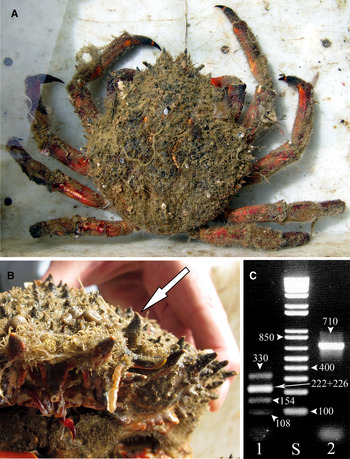
The morphology of the specimen collected during the MEDITS_ES_2011 cruise (Figure 1A, B) agreed well with the descriptions by Neumann (Reference Neumann1998) and Guerao et al. (Reference Guerao, Andree, Froglia, Simeó and Rotllant2011). Special note should be made of the shape of the antorbital spines, as these are more robust and more vertically directed in M. brachydactyla than in M. squinado, as figured by Guerao et al. (Reference Guerao, Andree, Froglia, Simeó and Rotllant2011). PCR-RFLP analysis of a partial sequence of the COI using the combination of restriction endonuclease enzymes HpyCH4V and Ase I produced a specific pattern for M. brachydactyla (Figure 1C) (108, 154, 222 and 226 bp; restriction fragments length pattern MBa; see Guerao et al. Reference Guerao, Andree, Froglia, Simeó and Rotllant2011). Additional 330 bp fragments appear in RFLP analysis (Figure 1C).
Maja brachydactyla: (A) specimen from Fuengirola (Malaga) (36.5605°N 4.5518°W); (B) shape and orientation of the antorbital spine (frontal view); (C) RFLP analysis of the COI mtDNA segments after digestion with HpyCH4V and Ase I. Numbers indicate the length of the fragments in base pairs (bp). S, molecular weight standard; 1, digested fragments; 2, undigested fragment.

The seven Maja specimens captured in the vicinity of Malaga (Caleta de Velez) and kept at the University of Malaga collections were morphologically and morphometrically identified as M. brachydactyla.
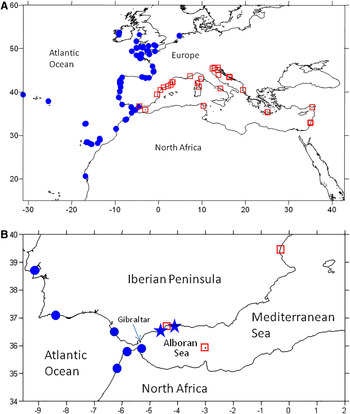
Figure 2A shows the distribution area of M. brachydactyla and M. squinado using validated information in Neumann (Reference Neumann1998), published information from Sotelo et al. (Reference Sotelo, Morán and Posada2008) and Guerao et al. (Reference Guerao, Andree, Froglia, Simeó and Rotllant2011), data obtained from the University of Malaga collections and data available on the ‘Seawatchers’ website. The geographical locations of the present reports off Fuengirola and Caleta de Velez, Malaga in the northern Alboran Sea (Figure 2B), show that M. brachydactyla is present in western Mediterranean waters and that its distribution overlaps in this area with that of M. squinado.
(A) Distribution area of Maja brachydactyla (blue circles) and Maja squinado (red squares) along the distribution area of the species (validated data based on Neumann (Reference Neumann1998), Sotelo et al. (Reference Sotelo, Morán and Posada2008), Guerao et al. (Reference Guerao, Andree, Froglia, Simeó and Rotllant2011), www.seawatchers.org (accessed 18 February 2014) and Malaga University Collections are shown); (B) detail of the contact region of the two species of Maja and location of the studied specimens of Maja brachydactyla (blue stars).

DISCUSSION
This study provides collection details of a morphologically and genetically identified specimen of M. brachydactyla from waters off Fuengirola, Malaga, Spain, which together with the material from the Strait of Gibraltar (Guerao et al., Reference Guerao, Andree, Froglia, Simeó and Rotllant2011), and seven specimens from Caleta de Velez, demonstrate the presence of M. brachydactyla in western Mediterranean waters. The current Mediterranean distribution of M. brachydactyla is apparently restricted to the western Alboran Sea, an area with important Atlantic influx (Clark et al., Reference Clark, Neale and Rainbow2001; Palero et al., Reference Palero, Abelló, Macpherson, Beaumont and Pascual2011; García-Merchán et al., Reference García-Merchán, Robainas-Barcia, Abelló, Macpherson, Palero, García-Rodríguez, Gil de Sola and Pascual2012).
D'Udekem d'Acoz (Reference d'Udekem1999) reported M. squinado from the Alboran Sea, based on the report of García Raso (Reference García Raso1984) on decapod crustaceans occurring in the vicinity of Malaga, although the attribution to M. squinado was made before the full implementation of Neumann (Reference Neumann1998) and the recognition of two different Maja species. Present results imply that careful morphological identification of large Maja specimens should be undertaken, at least in the western Mediterranean, to confirm precise species identification, and therefore to determine the distribution limits of M. brachydactyla and M. squinado in this region. This may help confirm the occurrence of sympatric populations, as well as to elucidate the occurrence of genetic mixing between the two species.
The additional 330 bp fragment present in the RFLP analysis performed could be due to incomplete digestion by the enzyme Ase I. However, the presence of this additional band appears to be shared with M. squinado (Guerao et al., Reference Guerao, Andree, Froglia, Simeó and Rotllant2011). Therefore a case of of heteroplasmy or NUMTS (nuclear mitochondrial DNA) cannot be disregarded. Genetic divergence between M. brachydactyla and M. squinado was 6.7% (Sotelo et al., Reference Sotelo, Morán and Posada2008). Sotelo et al. (Reference Sotelo, Morán and Posada2009) also reported that the split between the ‘Mediterranean’ (M. squinado + M. crispata) and the ‘eastern Atlantic’ (M. brachydactyla) lineages was dated in the late Miocene (9.59 million years ago). Therefore, the data are consistent with a case of occurrence of intermediate hybrids between Atlantic and Mediterranean species or incomplete lineage sorting. However, present data are insufficient to draw any further conclusion. A more detailed analysis is necessary to determine the genetic relationships between these two species.
The presence of eastern Atlantic coastal species in the Alboran Sea has been reported in several instances and has been related to the inflow of the less dense Atlantic surface water into the Mediterranean Sea through the Strait of Gibraltar (Abelló et al., Reference Abelló, Carbonell and Torres2002; García Muñoz et al., Reference García Muñoz, Manjón-Cabeza and García Raso2008; García Raso et al., Reference García Raso, Salmerón, Baro, Marina and Abelló2014). The coexistence of closely-related Mediterranean and Atlantic congeneric species, as happens too in the case of the portunid crabs Carcinus maenas (Linnaeus, Reference Linnaeus1758) and C. aestuarii Nardo, 1847 (Clark et al., Reference Clark, Neale and Rainbow2001), confirms the special interest of this area which was also the gateway for north-west African species into the Mediterranean basin during post-glacial and present global warming events (Palero et al., Reference Palero, Abelló, Macpherson, Gristina and Pascual2008).
ACKNOWLEDGEMENTS
We are grateful to all participants in the research cruise MEDITS_ES_2011 on-board RS ‘Cornide de Saavedra’, and especially to its Chief Scientist, Dr L. Gil de Sola, for their support; also to Sebastián Martín Sánchez for his help in collecting specimens from Caleta de Vélez (Málaga). This work was partially supported by an INIA Ministerio de Ciencia e Innovación postdoctoral fellowship (G.G.), and research projects BENTHOMICS (grant number CTM2010-22218-C02) and DisMarGen–FBBVA (P.A.).