Introduction
Faḍlallāh Astarābādī (740/1339–796/1394) was the founder of Hurufism, a mystical philosophy that interprets the Quran, hadith, religious rituals, and existence (wujūd) based on letters. The aim of interpreting existence using these letters is the contemplation of God; in other words, the contemplation of the letters in all beings. Kalām, as an attribute of God that consists of letters, is inseparable from the divine personality (dhāt-i ilāhī). When we contemplate the letters in existence, we examine the personality of God, who manifests Himself through these letters. While many Muslims regarded Adam as the perfect manifestation of God, the Hurufis consider Faḍlallāh as the “true Adam,” i.e. Ādam-i Ḥaqīqī. God taught Adam the names of all things and created him according to His proper form, and the presence and signs of the letters in existence and religious rituals were discovered and explained for the first time by Faḍlallāh.Footnote 1
By propagating his doctrine, which is distinct from other branches of lettrist study (ʿilm al-ḥurūf),Footnote 2 Faḍlallāh gained dedicated followers in Iran and Azerbaijan throughout the fourteenth century. His growing popularity attracted the ruling elites of several political entities, including the Jalayirids, Muzaffarids, Sarbadars, and, more importantly, the Timurids. It seems that he had very good relations with the ruling class, but competing ʿulamāʾ, Sufis, and sayyids defamed him throughout his life. Contrary to the common cliché that he was executed because of his ideas or because he was Mahdi, it seems more likely that what led to his execution was his growing popularity among the people and the ruling classes, as well as his personal disputes and contempt for religious figures. Following his execution, Faḍlallāh’s followers, including some members of his family, began to penetrate Anatolia and the Balkans. Those who stayed on the lands of Tīmūr were at risk of the same fate as Faḍlallāh, such as execution or arrest. Although these family members played an important role in post-Faḍlallāh Hurufism, their identities have previously not been fully known.
The importance of Faḍlallāh’s family members to Hurufi scholarship is known mainly from two existing incidents in the historic chronicles. The first was a regicide attempt on Shāhrukh’s life in 1427, which was organized by Aḥmad Lūrī, a so-called Hurufi who was killed on the spot. After an investigation, ʿAḍud, who instigated the assassination attempt, along with other comrades of Aḥmad Lūrī, were captured and executed. Many famous people—Sufis, poets, calligraphers, and scholars—were also traced and exiled. One and a half years after the assassination attempt, the famous Hurufis Amīr Ghiyāth al-Dīn and Amīr Nūrallāh were detained. The main figures of this incident, ʿAḍud and Amīr Nūrallāh, have been considered to be the son and grandson of Faḍlallāh.Footnote 3
The second incident is the execution of 500 Hurufis in Tabriz during the reign of Jahānshāh in 845/1441. Tarbiyatsuggests that one of Faḍlallāh’s daughters was executed during this incident.Footnote 4 According to Ritter and Kiyā, it might have been Kalimatallāh Hiya al-ʿUlyā;Footnote 5 Gölpınarlı claims that it was Makhdūmzāda, who is alternatively known as Kalimatallāh Hiya al-ʿUlyā, who was executed.Footnote 6
In this study, by exposing the real identities of Faḍlallāh’s family members, I shed light on these historical incidents. As, according to certain Hurufi texts, the death of Faḍlallāh was considered as the end of the sainthood period and the beginning of the deity era, Faḍlallāh’s successors, and especially his guardian and trustee, are crucial for an enhanced understanding of the post-Faḍlallāh state of Hurufism.Footnote 7 In addition, it has become essential for us to clarify the identity and connections of Faḍlallāh’s family members in some of the historical records of the fifteenth-century Persianate world.
We have an almost complete knowledge of Faḍlallāh’s life thanks to two different biographies, written by his disciples under the name of Khwābnāma, and the chronicles of his time.Footnote 8 Regarding Faḍlallāh’s family members, the main Hurufi sources are the Vaṣiyyatnāma, Istivānāma, Maḥramnāma, and a letter written by the author of Istivānāma. In addition to the absence of any critical research on these sources, the unique copy of his family tree remains ignored and unanalyzed. Finally, over the years, the number of Faḍlallāh’s children and contradictory information about them have arrived at a point where historical facts about Hurufi risk becoming only legends. Thus, to achieve a better understanding of this subject, an accurate and critical reading of primary sources is necessary.
Faḍlallāh’s Life
Faḍlallāh was born into a high-class family in Astarabad, where his father was the chief justice. After his father died, the courthouse officers took care of him. He studied for a while in a traditional school; however, he was more interested in religious life and prayed every night, even before puberty. When he heard a distich by Rūmī and tried to comprehend its meaning, his master told him that these words could only be understood through asceticism. Faḍlallāh followed an ascetic life until he was eighteen or nineteen years old and one night left his house and goods to further his Sufi experiments.
During his travels in search of the truth, Faḍlallāh received his first revelation, which gave him the knowledge of dream interpretation in Khwarazm.Footnote 9 When he was settled in Tabriz, he was further blessed with the interpretation of the Quranic muqaṭṭaʿāt (disconnected letters), and the secret of the methods of sharīʿa in Ramaḍān 775 (March 1374), which refers to Hurufism. The Khwābnāma confirms these abilities to be the same as those explained in Faḍlallāh’s Jāvidānnāma, ʿArshnāma, and Maḥabbatnāma.Footnote 10 Finally, in 788/1386 Faḍlallāh arose as the Mahdi and revealed the secrets of the Quran when he began penning the Master Book (Jāvidānnāma).Footnote 11 It was also described as the manifestation of wisdom on Faḍlallāh,Footnote 12 and Faḍlallāh’s ẓuhūr u burūz (manifestation and appearance).Footnote 13 Faḍlallāh continued to write his Jāvidānnāma—in other words, to reveal the secrets of the Quran—until his arrest and execution.Footnote 14
The network of Faḍlallāh’s relationships within political, scholarly, and Sufi circles can shed light on his execution. Some evidence shows that some ʿulamāʾ, Sufi shaykhs, and sayyids did not welcome Faḍlallāh because either they had had a discussion with him or he had interpreted their dreams in a way that revealed their private lives and secrets.Footnote 15
Faḍlallāh’s relations within top-level political elites began in Tabriz with the Jalayirid Sulṭān Uvays (reign: 757–76/1356–74) and his circle. In Sabzavar, he had contact with Sarbadari governors. Amīr Bisṭām and his father Amīr Jāgir of Tīmūr’s circle also met with Faḍlallāh in his lodge in Tabriz,Footnote 16 and later on Faḍlallāh met again with Amīr Bisṭām when he was the governor of Gawrud Castle.Footnote 17
Amīr Tīmūr himself knew of Faḍlallāh and probably met with him personally. According to Hurufi narrations, when Faḍlallāh and his three companions were imprisoned in Damghan for an unknown reason, Tīmūr issued a decree to free them, stating that they had been imprisoned without his knowledge. Amīr Buzurg and Faḍlallāh met in the vicinity of Bistam, and Amīr Buzurg showed him the utmost respect and esteem.Footnote 18 Amīr Aygū Tīmūr, who was a council amir of Amīr Tīmūr,Footnote 19 and Amīrzāda Muḥammad (Pīr Muḥammad), the grandson of Tīmūr,Footnote 20 met with Faḍlallāh and for an interpretation of their dreams and confirmed the accuracy of this interpretation. When Faḍlallāh arrived at Samarqand, Tīmūr sent Amīr Aygū Tīmūr to him for another dream interpretation; however, when Tīmūr heard Faḍlallāh’s interpretation, he became angry and told Aygū Tīmūr “not to attend Faḍlallāh’s assembly anymore.”Footnote 21
In Jāvidānnāma, Faḍlallāh notes that he saw Amīr Tīmūr performing prayers in his dream. Faḍlallāh joined him in praying, and Tīmūr rolled out his carpet for the dervishes.Footnote 22 In another dream that he had in a masjid in Baku on the third Monday of Ṣafar (in 796/1394), he saw a dome with threads tied to it, which represented Amīr Tīmūr, his son, the earth, and the one who is above the earth.Footnote 23 The fact that Faḍlallāh experienced these dreams in the year of his execution, and that there is no other negative comment in Hurufi sources about Tīmūr until the time leading to Faḍlallāh’s execution, gives rise to the thought that Mīrānshāh was more active in the execution process than his father, Tīmūr. It should be remembered that Faḍlallāh was arrested in Damghan by order of Mīrānshāh and was set free by order of Tīmūr, which perhaps aroused a desire for revenge in Mīrānshāh. More importantly, Faḍlallāh’s charismatic persona, which attracted statesmen and followers to his accurate dream interpretations, disturbed ʿulamāʾ, sufis, and sayyids. All these factors brought Faḍlallāh closer to execution.
In Tabriz, for instance, signs of this were visible. Those who were turned away reported to the judges that many people from the upper and lower classes participated in Faḍlallāh’s assemblies and that those who attended were hiding guns. Such reports made the judges suspicious of him, and, one night, the dervishes were surrounded by soldiers. In the morning, the dervishes saw they had been besieged, but the soldiers ultimately found nothing but their personal belongings. The subsequent investigation proved that the allegations had been false.Footnote 24 Meanwhile, in Khwarazm, during another assembly, Faḍlallāh told Sayyid Ḥusām al-Dīn Astarābādī that they (Sayyid Ḥusām and his friends) had gossiped about him with the congregation in a certain caravanserai,Footnote 25 which demonstrates how some of the ʿulamāʾ and Sufis secretly spread propaganda against Faḍlallāh and his followers both in the community and within political circles.
After leaving Samarqand, Faḍlallāh passed by some southern Iranian cities and returned to Tabriz, finally arriving in Baku. He and his companions were followed and inspected by soldiers in Baku. As the Baku elite refrained from engaging with the soldiers,Footnote 26 Faḍlallāh, his family, and his followers were required to stay in tents on the island close to Baku.Footnote 27 During his sojourn there, he visited Qāḍī Bāyazīd, who had fallen ill in Shamakhi. On his way back to the island he was captured in Baku by the soldiers waiting on the coast and imprisoned. Later, he was executed in Alinjaq on 6 Dhū al-Qaʿda 796/2 September 1394.Footnote 28
Before his execution, Faḍlallāh declared that his daughter, Kalimatallāh Hiya al-ʿUlyā, was his absolute guardian. According to Sayyid Isḥāq, this appointment signifies the end of the period of sainthood and the beginning of the era of deity, much like the prophet Muḥammad and his daughter Fāṭima; when the former died, the period of prophecy ended and the period of sainthood began. As we will explain below, both Muḥammad and Faḍlallāh’s lineages continued through their daughters.
Faḍlallāh’s Marriage and Spouse
When Faḍlallāh was in Tabriz, Khwāja Bāyazīd Dāmghānī’s wife contacted Mawlānā Kamāl al-Dīn Hāshimī,Footnote 29 one of Faḍlallāh’s trainees and later one of his successors, and told him that she wanted to speak with Faḍlallāh, even if it had to be behind a curtain. Faḍlallāh welcomed her. She asked Faḍlallāh to take her daughter as a servant in the lodge, in other words, as his wife, which she hoped would be a means of salvation in the afterlife for her and her husband Khwāja Bāyazīd, a vizier to Sultan Uvays. Although Faḍlallāh first declared that it was a huge imposition, the woman insisted, and Faḍlallāh told her that he would only say yes if his conditions were met.
The conditions, in brief, were as follows: she would bring nothing from her house; her clothing, food, and all other needs would be met by the earnings of the dervishes; she would never leave the zawiya or visit anyone in their home; she would sleep on a straw mat and felt pillows; she would wear cotton dresses; after the assembly was dismissed and Faḍlallāh moved into the cell, she would not allow anyone in; she would not disturb Faḍlallāh when he was busy tending to his spirituality at night; and, finally, she would follow the programs and activities of the dervishes.Footnote 30 As seen, the conditions Faḍlallāh laid out for this marriage were somewhat harsh, therefore it would be fair to say that he was not keen to make contacts for his political ambitions through this marriage.
The daughter of the vizier, Bāyazīd Dāmghānī, who is only referred to as the Ḥażrat-i ʿĀliya, agreed to the conditions. Since Faḍlallāh arrived in Tabriz in the year 775/1374, he would have been at least thirty-five years old when he got married. He sent a cotton dress, a burqa, and a pair of boots to his future wife, which had been purchased with his earnings, and told her to go to the house of one of his relatives (Sayyid Muḥammad), who was older and married. She was to stay at this house for four months, and Faḍlallāh was to marry her after that period; by eating the food consumed in Sayyid Muḥammad’s house, her body was cleansed of the food she had eaten in her family’s home, along with the parts of her that had been formed during that time.Footnote 31 At the end of the four months, Faḍlallāh married and had his wife brought to the lodge in a green woolen dress. Following her arrival, Faḍlallāh gave the dress to the dervishes to sew caps and asked his spouse to help them learn how to make the caps.Footnote 32
According to Darvīsh Raʾīs, sometime after the wedding, on the evening of ʿĪd Ramaḍān, Faḍlallāh traveled to Sufian, near Tabriz. Faḍlallāh’s mother-in-law cooked a meal and sent a bowl of the food to her daughter, who ate it. During the night, as Faḍlallāh was returning to Tabriz from Sufian, his wife dreamt of food in a bowl and picked up a spoon, but instead of carrots, she saw worms in the soup and awoke in horror. She told Faḍlallāh of her dream. In a scolding manner, Faḍlallāh said, “Instead of eating the meal prepared by the dervishes, you ate the food from Khwāja Bāyazīd’s house,” and instructed her to vomit and never to behave outside his rules of piety again. Furthermore, in Khwābnāma, it is stated that they stopped making this particular soup in the lodge and did not even say its name because this would remind Faḍlallāh’s wife of the dream she had and would make her nauseous.Footnote 33
It is also known that Faḍlallāh was physically absent from his wife for the entirety of her pregnancy. Mawlānā Kamāl al-Dīn Hāshimī noticed this situation and asked Faḍlallāh why.Footnote 34 Faḍlallāh replied that this act was not obligatory; however, he acted thus because of his sense of piety. Based on his notion of piety, the purpose of being in a sexual relationship with a spouse was the continuation of the family; even though lust could be considered a requirement, it was not the main purpose.Footnote 35 We do not have any knowledge concerning Faḍlallāh’s wife in the years that followed; however, there is no doubt that she died before Faḍlallāh because when the children were mentioned in Faḍlallāh’s testament, they were described as “motherless, lonely, and beloved.”Footnote 36
Faḍlallāh’s Children
Ṣādiq Kiyā was the first scholar who tried to discover the identity of Faḍlallāh’s children. Kiyā interpreted the Hurufi-sounding names to which Amīr Ghiyāth al-Dīn was referring in the Istivānāma as Faḍlallāh’s probable sons, daughters, or wives. These names are Salāmallāh, Kalīmallāh, Bībī Umm al-Kitāb, and Bībī Fātiḥat al-Kitāb. He references Sayyid Isḥāq’s poems in which Kalimatallāh Hiya al-ʿUlyā was defined as “the light of Faḍlallāh’s eyes”; however, he does not precisely claim that she was one of Faḍlallāh’s daughters.Footnote 37 Further to Kiyā’s list, Helmut Ritter mentions Āzāda and Amīr Nūrallāh as Faḍlallāh’s children; the first was referred to by ʿAlī al-Aʿlā in the Qiyāmatnāma, and the second was mentioned in the Istivānāma.Footnote 38
In his earlier studies, Gölpınarlı mentions only Amīr Nūrallāh and Salāmallāh as Faḍlallāh’s children.Footnote 39 In his last work, referring to a genealogy of Faḍlallāh’s children and grandchildren, he concludes that Amīr Nūrallāh was the grandson of Faḍlallāh,Footnote 40 while Āzhand maintains the tradition of Kiyā and Ritter.Footnote 41 Meanwhile, one of the current scholars of Hurufism, Shahzad Bashir, considers Amīr Nūrallāh and Salāmallāh as Faḍlallāh’s sons, as per Gölpınarlı’s earlier works. According to Bashir, ʿĀʾisha and Fāṭima were Faḍlallāh’s daughters, and he adds that “Fazlallah, in fact, had more children than these who are referred to in the testament in general as sons and daughters without specifying names.”Footnote 42
However, Faḍlallāh’s testaments contain exact names and important information about his children. Faḍlallāh prepared his testaments while he was in prison, just before his execution. They are known today as the “short version,” which was published along with its translation by E. G. Browne,Footnote 43 and the “long version,” published by Gölpınarlı, who gave only brief information about the physical characteristics of the manuscript without any further explanation.Footnote 44 In fact, the long version includes the short version, and, more importantly, not one or two testaments but six; but since they were written one after another in the manuscripts, they were considered as one. In terms of the long version, which, as noted, comprises all six testaments, Bashir says,
The only existing copy of this version is garbled and not fully comprehensible. Nonetheless, we can tell that the testament was addressed to Fazlallah’s eldest son Salamallah, whom he also designated the executor of all his affairs and the guardian of the family … Fazlallah enjoins members of his family to follow the advice of Salamallah.Footnote 45
However none of these testaments were addressed to Salāmallāh, but rather to his sister Fāṭima.
By relying upon the phrase, “ وکیل مطلق فرزندان من همشیرۀ بزرگ سلام الله است ” from Vaṣiyyatnāma, Gölpınarlı also claims that Salāmallāh was Faḍlallāh’s daughter. As I will discuss below, this sentence does not say “the elder sister Salāmallāh” (hamshīra-yi buzurg Salāmallāh) but rather “Salāmallāh’s elder sister” (hamshīra-yi buzurg-i Salāmallāh),Footnote 46 which is why Gölpınarlı posited that Salāmallāh, who was mentioned in the testament, was a girl and that “Faḍlallāh also has a son with the same name.”Footnote 47 However, in his testaments, Faḍlallāh says that “Salāmallāh’s elder sister is my unconditional trustee and guardian,”Footnote 48 “Salāmallāh’s elder sister is the unconditional guardian of my children,”Footnote 49 and “It was intended that the elder sister of Salāmallāh should take care of her younger sisters, she should protect them as if she was both their mother and their father.”Footnote 50 Therefore, contrary to previously held beliefs, there are not two versions of Faḍlallāh’s testament, and the testament was not addressed to Salāmallāh but to his elder sister.
Regarding Salāmallāh’s elder sister, Faḍlallāh advises the younger ones to listen to her.Footnote 51 In the second testament, he mentions her name, Fāṭima, saying, “May Fāṭima be under the protection of Allāh, with her sisters … If that child [Fāṭima] considers it important, let her take two sisters.”Footnote 52 In the first testament, Faḍlallāh also gives some directions for hiding his daughters: “If Khwāja Fakhr al-Dīn arrives, he should take the oldest daughter and go somewhere they are unknown to others. The middle daughter should go with Raʾīs Maḥmūd and the youngest with Kiyā. If this is not possible, then Kiyā should take the little one, and Darvīsh Ḥājjī should take the oldest and ʿĀʾisha with him.” We can conclude from this passage that the name of Faḍlallāh’s middle daughter was ʿĀʾisha.
Further, the name of Faḍlallāh’s youngest daughter is revealed in another passage in which he says that “if one of the dervishes is going to Gilan one day, if possible, he should take ʿIṣmat with him, as, if Sayyid joined the journey, it would not be appropriate for them [i.e. Sayyid and ʿIṣmat] to be together.”Footnote 53 It is here understood that ʿIṣmat refers to the youngest daughter of Faḍlallāh. Moreover, in the fifth testament, he says “greetings to ʿIṣmat and ʿĀʾisha.” In sum, we conclude that Fāṭima was the name of Faḍlallāh’s oldest daughter, ʿĀʾisha was the name of his middle daughter, and ʿIṣmat was the name of his youngest daughter.
One of the most interesting points in the testament is that Fāṭima was identified as the “older sister of Salāmallāh,” which means that Faḍlallāh had a son called Salāmallāh. However, there are no more details in the testament (Vaṣiyyatnāma) concerning Salāmallāh; his name is only mentioned here. Even when he sent greetings to his three daughters, Faḍlallāh never mentioned Salāmallāh. However, the name Salāmallāh is also mentioned in Faḍlallāh’s Nawmnāma, where he states that he dreamed of Salāmallāh’s birth.Footnote 54
At this point, it becomes essential to examine the comparison made between Faḍlallāh and Muḥammad, as written in the Maḥramnāma by Sayyid Isḥāq, one of Faḍlallāh’s followers. His explanations inform us that Kalimatallāh had no children and points out that Faḍlallāh had no son who survived. According to Sayyid Isḥāq, since Muḥammad had no son, as the seal of prophecy, the generation continued with his daughter, closing the period of prophecy and beginning the period of sainthood. Like Muḥammad, when Faḍlallāh appointed his daughter Kalimatallāh Hiya al-ʿUlyā as his guardian, that ended the period of sainthood and began the era of deity. If Faḍlallāh had had a son, the era of sainthood would have continued; therefore, Allah never allowed him to have a son. If these two seal holders (Muḥammad and Faḍlallāh) had sons, there would have been two possible outcomes: their sons would either have been a substitute in prophecy and sainthood, or they would not. If they had been substitutes, their fathers would not have been seal holders. If they did not have the ability or were not ready to accept the requisite responsibilities, this would have been detrimental to their perfection. If it is stated that these two seal holders did not have any children, this means that they did not have male children, but they did have female ones. Kalimatallāh Hiya al-ʿUlyā, Faḍlallāh’s trustee, was the substitute for the holder of the seal, and thus she was her father’s substitute in deity, not in sainthood. The reason Kalimatallāh Hiya al-ʿUlyā had no children—either female like herself or male like her father—was so she could not transfer her perfection to anyone else. Her time was the end of human comprehension, and, therefore, the door to the emergence of new science or knowledge was closed.Footnote 55
Thus, Sayyid Isḥāq established the relation between Muḥammad (who was a seal of prophecy) and Faḍlallāh (who was a seal of sainthood) because they did not have sons. It is more accurate to say that Muḥammad had no sons who survived. One might say Faḍlallāh also had a son, which was why Fāṭima was called Salāmallāh’s older sister in the testament, but he did not survive.Footnote 56 Along the same lines, Sayyid Isḥāq stated openly that Kalimatallāh Hiya al-ʿUlyā was appointed as successor, and that she did not have any children. In Faḍlallāh’s family tree (shown below), it can also be seen that no child was shown under Fāṭima (Kalimatallāh Hiya al-ʿUlyā). The person who was referred to as Kalimatallāh Hiya al-ʿUlyā was Fāṭima herself, who was Faḍlallāh’s successor, as mentioned in the testament. Faḍlallāh ordered his children to change their names,Footnote 57 and Fāṭima took Kalimatallāh Hiya al-ʿUlyā as her name.
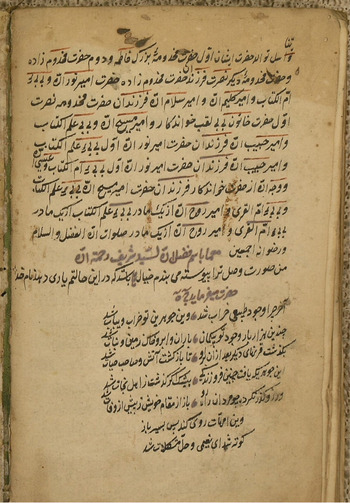
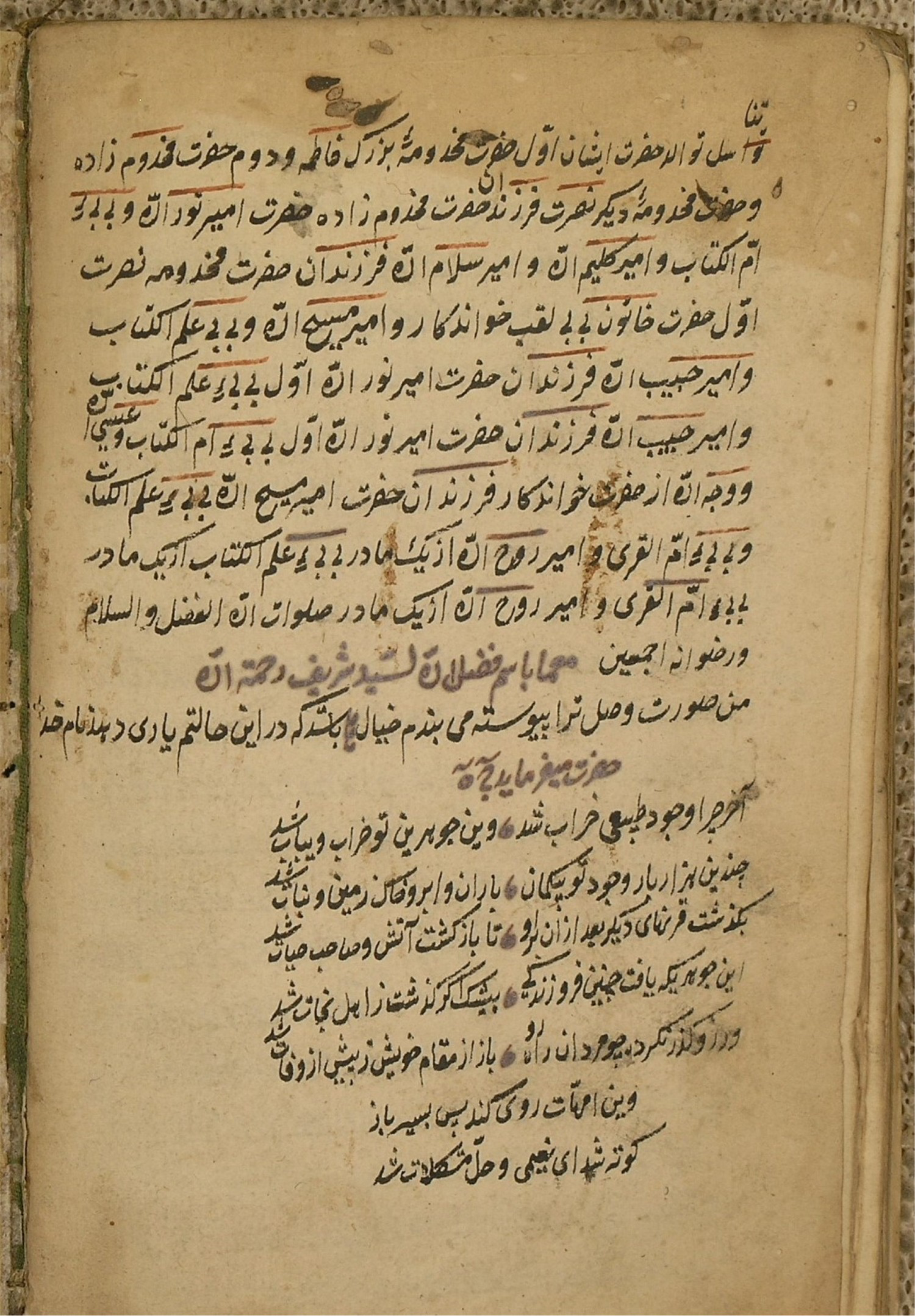
Another question arises here, which is what were the aliases of Faḍlallāh’s two younger daughters? Gölpınarlı informs us about a genealogy of Faḍlallāh’s children, which is found on the last page of the book titled Maʿādiyya-yi Faḍl-i Ilāhiyya, in Istanbul Millet Library,Footnote 58 and begins with the words “the children and generation of his Ḥażrat.” This figure (Figure 1) named as Maʿādiyyayi Faḍl-i Ilāhiyya and can be found in Millet Library, ʿAlī Amīrī, Persian, no. 1027, 61b. It is anonymous. This important genealogy is transliterated here:
Tanāsul-i tavālud-i Ḥażrat-i Īshān. Avval Ḥażrat-i makhdūma-yi buzurg Fāṭima va duvvum Ḥażrat-i Makhdūmzāda. Va Ḥażrat-i makhdūma-yi dīgar Nuṣrat.
Farzandān-i Ḥażrat-i Makhdūmzāda: Ḥażrat-i Amīr Nūrallāh va Bībī Umm al-Kitāb va Amīr Kalīmallāh va Amīr Salāmallāh.
Farzandān-i Ḥażrat-i makhdūma Nuṣrat: Avval Ḥażrat-i Khātūn Bībī laqab-i Khāndkār va Amīr Masīḥallāh va Bībī ʿIlm al-Kitāb va Amīr Ḥabīballāh.
Farzandān-i Ḥażrat-i Amīr Nūrallāh: Avval Bībī Umm al-Kitāb va ʿĪsāallāh va Vajhallāh az Ḥażrat-i Khāndkār.
Farzandān-i Ḥażrat-i Amīr Masīḥallāh: Bībī ʿIlm al-Kitāb va Bībī Umm al-Qurā va Amīr Rūḥallāh. Bībī ʿIlm al-Kitāb az yak mādar. Bībī Umm al-Qurā va Amīr Rūḥallāh az yak mādar. Ṣalawāt Allāh al-faḍl wa-l-salām wa-riḍwānuhu ajmaʿīn.Footnote 59
We may here give the translation of this genealogy with some known dates:
The descendants of his excellency. First the eldest daughter Fāṭima and second Makhdūmzāda. And the other daughter Nuṣrat.
Children of Makhdūmzāda: Amīr Nūrallāh, Bībī Umm al-Kitāb (d. 826/1423), Amīr Kalīmallāh (d. 826/1423), and Amīr Salāmallāh (d. 826/1423).
Children of Nuṣrat: Khātūn Bībī (Khāndkār), Amīr Masīḥallāh, Bībī ʿIlm al-Kitāb, Amīr Ḥabīballāh.
Children of Amīr Nūrallāh, who was the child of Makhdūmzāda: Bībī Umm al-Kitāb, ʿĪsāallāh, and Vajhallāh from (their mother) Khāndkār.
Children of Amīr Masīḥallāh: Bībī ʿIlm al-Kitāb, Bībī Umm al-Qurā, Amīr Rūḥallāh. The last two had a different mother.
From this note, we can conclude that Faḍlallāh had three children: Fāṭima, Makhdūmzāda,Footnote 60 and Nuṣrat, and, as seen earlier in Maḥramnāma, Fāṭima used Kalimatallāh Hiya al-ʿUlyā as her alias and ʿĀʾisha used Makhdūmzāda.Footnote 61 Nuṣrat was referred to as ʿIṣmat in the testament, which could have been a simple typographical mistake or the new name that she adopted according to her father’s testament.
As stated above, at the time of the Qaraqoyunlu sultan Jahānshāh (d. 872/1467), Faḍlallāh’s daughter and a dervish called Yūsuf or Pīr Turābī expanded Hurufism in Tabriz. The faqīhs, who were afraid of Hurufi influence on Jahānshāh, forced him to issue a fatwa for their execution. Uskūyī, a trustworthy judge of Jahānshāh, refused, but finally Jahānshāh obtained permission from the muftī and ordered the execution of 500 Hurufis, including Faḍlallāh’s daughter, in 845/1441–42.Footnote 62 The earliest source that gives this information is Ḥāfiẓ Ḥusayn Tabrīzī’s (d. 997/1589) Rawḍāt al-jinān va jannāt al-janān, dated 975/1567.Footnote 63 Subsequently, Ḥashrī Tabrīzī resumed Tabrīzī’s account in Rawḍa-yi Aṭhār (1011/1602).Footnote 64 That is to say, the earliest source of this incident is dated one and half centuries after it occurred. No other chronicle during this time mentioned an execution of 500 Hurufis that included Faḍlallāh’s daughter. On the other hand, the source of those books is the tales of local people around a shrine: the author visited a city and registered the shrines and the tales circulating among the people related to the shrines. Even though the primary sources of the time do not provide any information regarding to the identity of Faḍlallāh’s daughter, it seems that modern scholarship almost entirely agrees that the daughter executed in the Tabriz incident was Kalimatallāh Hiya al-ʿUlyā.Footnote 65
ʿĀʾisha’s (Makhdūmzāda’s) and Nuṣrat’s (ʿIṣmat’s) children were listed in the abovementioned family tree, but no child was shown under Fāṭima (Kalimatallāh Hiya al-ʿUlyā), which aligns with the information given by Sayyid Isḥāq. Another point to note is that when Faḍlallāh wrote his testament, among his three daughters only Fāṭima (Kalimatallāh Hiya al-ʿUlyā) was engaged; thus, since Fāṭima had no children and Faḍlallāh’s other daughters were single, we can assume that Faḍlallāh did not meet any of his grandchildren.
Concerning Fāṭima, Faḍlallāh states:
Previously, I gave Fāṭima to Mawlānā Majd al-Dīn. If Mawlānā Majd al-Dīn is alive, then that girl [Fāṭima] belongs to Majd al-Dīn [in other words, she is his spouse]. If the news arrives that Majd al-Dīn is dead, then the child [Fāṭima] should protect her religion and worldly honor. Send someone to Muḥammad [a Hurufi dervish in Faḍlallāh’s circle], and she should marry him. If there is a problem with them visiting each other, she should not suffer at the hands of bad people in both worlds. Sayyid Tāj al-Dīn is there and she should marry him.Footnote 66
Although Kiyā and Āzhand mention that Kalimatallāh (that is, Fāṭima) was the spouse of Sayyid Isḥāq,Footnote 67 and according to Shaybī she was married to ʿAlī al-Aʿlā,Footnote 68 there is no tangible evidence for this theory, particularly as we know that ʿAlī al-Aʿlā was the spouse of ʿĀʾisha (Makhdūmzāda).
To ensure their future well-being after his death, Faḍlallāh also provided directions regarding the two younger daughters’ marriages. Security was the vital component of the well-being of these two daughters because, in the Vaṣiyyatnāma, Faḍlallāh openly expresses his concerns about potential harassment by soldiers and other people: “When Sayyid Ḥusayn escapes Tīmūr, send Kiyā to bring him along and let ʿĀʾisha marry him. Qivām al-Dīn should tell Mawlānā Kamāl al-Dīn to take the youngest daughter as his spouse.”Footnote 69 He further proposes an alternative:
May the youngest marry Sayyid ʿAlī b. Sayyid Muḥammad and the middle daughter should marry Sayyid Ḥusayn. These proposed plans are to be implemented if the daughters are separated from each other. If they are not separated, then the middle daughter [ʿĀʾisha] is to marry Ḥājjī or Mawlānā ʿIzz al-Dīn.
He then elaborates on the benefit of being a spouse to Ḥājjī: “Therefore, Ḥājjī would also support the other girls. ʿAlī is forbidden to marry them; therefore, they should take him with them.” He also states that Sayyid ʿAlī should not neglect his duties.Footnote 70
It is not known to whom Faḍlallāh’s youngest daughter Nuṣrat was married; however, we know that the middle child, ʿĀʾisha, did not marry any of the dervishes proposed by her father, and instead married ʿAlī al-Aʿlā, who was also known as Khalīfatallāh and wrote an elegy for Makhdūmzāda (ʿĀʾisha) when she passed away on 19 Shawwal 814/3 February 1412. Some lines of the elegy reveal clearly that the person to whom ʿAlī al-Aʿlā wrote was his wife.Footnote 71 In his Maḥsharnāma, ʿAlī al-Aʿlā mentions Makhdūmzāda as shahīd,Footnote 72 but in his Marsiya, written following her death, there is no mention that she was killed—in Islam, someone who died because of a sickness or while giving birth is also considered as shahīd. In this Marsiya, ʿAlī al-Aʿlā mentions the names Kalīm (Allāh), Salām (Allāh), Fātiḥa (al-Kitāb), Umm al-Kitāb, and Nūr (Allāh), saying that they became motherless.Footnote 73 These names can also be seen in the genealogy as the children of Makhdūmzāda.
Amīr Ghiyāth al-Dīn stated in his Istivānāma that when he was in Bitlis, he saw in his dream Amīr Salāmallāh, Amīr Kalīmallāh, Bībī Umm al-Kitāb, and Bībī Fātiḥat al-Kitāb—who died in 826/1423 of plague—in heaven and talked with them about life after death.Footnote 74 Amīr Ghiyāth al-Dīn never gave the identity of these people, but beginning with Kiyā, Hurufi researchers have considered them—or at least some of them—Faḍlallāh’s children.Footnote 75 However, these individuals were not, in fact, Faḍlallāh’s children; instead, they were the children of ʿAlī al-Aʿlā and Makhdūmzāda, that is ʿĀʾisha, the middle daughter of Faḍlallāh, as is seen from the genealogy and elegy mentioned above. In his Maḥsharnāma, ʿAlī al-Aʿlā attributes the adjective “āzāda” (free or “noble”) to his wife Makhdūmzāda, as in Makhdūmzāda-yi āzāda-yi īn faqīr Footnote 76 and Makhdūmzāda-yi āzāda-yi du jihānī.Footnote 77 Ritter confused this adjective with the name and stated that Faḍlallāh might have had a daughter called Āzāda.Footnote 78
Amīr Nūrallāh was the son of Makhdūmzāda and ʿAlī al-Aʿlā, and Amīr Ghiyāth al-Dīn was the son of ʿAlī al-Aʿlā’s sister.Footnote 79 These two cousins, Amīr Nūrallāh and Amīr Ghiyāth al-Dīn, were arrested in 832/1429 under the pretext that they had dispatched someone to stab Mīrzā Shāhrukh. After interrogation and imprisonment in various cities, they escaped from the Castle of Sulaymānī in 835/1432. When they arrived in Bā ʿAnqabaFootnote 80 (probably Baqubah, close to Baghdad) in 836/1433, Amīr Ghiyāth al-Dīn wrote a letter to a Hurufi named Mawlānā Ḥasan, explaining all that had happened to them during their imprisonment. In this unique manuscript, the author named the letter Ṣaḥīfat al-Istikhlāṣ Footnote 81 (letter of salvation).Footnote 82 Gölpınarlı published this letter with the title “A letter belonging to Faḍlallāh’s son.” In his short explication, he states that this letter was written by Amīr Nūrallāh, the son of Faḍlallāh, and his brother, after the assassination attempt on Mīrzā Jalāl al-Dīn Mīrānshāh.Footnote 83 Gölpınarlı corrected the information in his later research and concluded that Amīr Nūrallāh was the son of Faḍlallāh’s daughter Makhdūmzāda.Footnote 84
Amīr Nūrallāh’s mother Makhdūmzāda (d. 814/1412) and father ʿAlī al-Aʿlā (d. 822/1419) were already dead when Shāhrukh was stabbed in 830/1427. Amīr Ghiyāth al-Dīn and Amīr Nūrallāh were caught in Mazandaran in 832/1429. During the interrogations, Amīr Nūrallāh stated that at the time of the assassination they were traveling from Tabriz to Bitlis and Kurdistan, and they had not sent any assassins.Footnote 85 He was also previously in Van.Footnote 86 We know that, at one time, Amīr Nūrallāh also sent Amīr Ghiyāth al-Dīn to Bitlis, where there was a khanegāh of the Hurufi circle.Footnote 87 It can be seen that beginning from the time of ʿAlī al-Aʿlā, Hurufis were visiting the Bitlis–Van region and meeting with the Hurufis of Bitlis, such as Ḥājjī ʿĪsā Bidlīsī.Footnote 88 However, it is also known that Amīr Nūrallāh was using a Hurufi zāviya in Tabriz, probably the same as Faḍlallāh’s zāwiya of Valī-yi Dūlāq, and intellectuals and statesmen continued to visit.Footnote 89
It is known that Amīr Nūrallāh met with Qaraqoyunlu leaders; for example, he met with Qara Yūsuf in Nakhchivan (r. 1389–1420), and with Amīrzāda Iskandar in Tabriz (r. 1420–38). Moreover, after escaping from Shāhrukh’s prison he met in Baghdad with Shāh Muḥammad (Shāh Maḥmad), who was the oldest of the five sons of Qara Yūsuf.Footnote 90 However, it is not known what Amīr Nūrallāh and Amīr Ghiyāth al-Dīn did after Baqubah, where they wrote this letter. Ten years later, Amīr Ghiyāth al-Dīn wrote his Istivānāma, in which he mentions Amīr Nūrallāh as afḍal al-shuhadā,Footnote 91 which means that he was martyred before 846/1443.
Lastly, the name ʿAḍud or ʿAḍud al-Dīn is seen frequently among the works of Hurufi historians in relation to the assassination attempt on Shāhrukh. Today, ʿAḍud al-Dīn is thought of as a member of Faḍlallāh’s family; Bashir says that ʿAḍud al-Dīn, who was burned with several Hurufis after an assassination attempt on Shāhrukh, was Kalimatallāh al-ʿUlyā’s son, in other words, Faḍlallāh’s grandson.Footnote 92 Ḥāfiẓ-i Abrū further states that after Lūrī’s assassination attempt on Shāhrukh, ʿAḍud al-Dīn, the son of Mawlānā Majd al-Dīn Astarābādī, was among those arrested, and, after standing in a white sheet, he was executed.Footnote 93 However, according to Khwāndamīr, ʿAḍud al-Dīn was the son of Faḍlallāh’s daughter,Footnote 94 although Binbaş notes that, from Ḥāfiẓ-i Abrū to Faṣīḥ-i Khwāfī, ʿAḍud al-Dīn was simply the son of one of Faḍlallāh’s vicegerents who then became one of his family members.Footnote 95
There could be some intentional disinformation in these sources; however, it seems more likely that these historians recorded some rumors that are not historically correct. Firstly, there is no ʿAḍud or ʿAḍud al-Dīn among Faḍlallāh’s family members, and second, Mawlānā Majd al-Dīn and his wife Kalimatallāh al-ʿUlyā (Fāṭima) did not have any children. Third, as mentioned earlier, Amīr Nūrallāh and Amīr Ghiyāth al-Dīn were accused of instigating the assassination and were arrested. Also, according to the Ṣaḥīfat al-Istikhlāṣ, they did not mention ʿAḍud al-Dīn in their defense. Thus, if, as was claimed, ʿAḍud al-Dīn confessed that he was the instigator of this assassination and was punished, Amīr Nūrallāh and Amīr Ghiyāth al-Dīn would not have been accused of the assassination. Therefore, we can conclude that the information provided by the chronicles of the period is unreliable.
Further Notes on Faḍlallāh’s Testament
The issues mentioned in Faḍlallāh’s testament could be categorized into three groups: greetings sent to dervishes, advice for dervishes and their children, and matters related to securing the safety of the children. Faḍlallāh tried to ensure that his verbal or written testament reached the appropriate parties. First, he spoke to Darvīsh Ḥājjī concerning his children and advised them not to disregard his warnings. He wrote a couple of notes to be given to Mawlānā Maḥmūd and asked for these notes to be hidden as reminders.Footnote 96 As there was no other person known as Darvīsh Ḥājjī, we believe him to be Ḥājjī Kirmānī, one of those closest to Faḍlallāh. Faḍlallāh called Ḥājjī Kirmānī “Darvīsh Ḥājjī,” while his followers called him Bābā Ḥājjī because of his advanced age. We can, therefore, ascertain that Darvīsh Ḥājjī was the most important executor of the testament.
Faḍlallāh gave advice to the dervishes and advised Raʾīs and Kiyā not to ignore their duties and for Darvīsh Muḥammad to trust Ḥājjī and not to oppose him.Footnote 97 Faḍlallāh also sent his greetings to the dervishes and their families, whomever the testament reached. They can be listed as follows: all women, younger and older children of Sayyid ʿAlī; Ḥasan, Ḥusayn, and Shams al-Dīn Sarkhūk (in the third testament called ʿAlī Sarkhūk; in the fifth testament only Sarkhūk); the spouse of Qivām al-Dīn (in the fifth testament, Sarkhūk and Qivām al-Dīn’s mother); Khwāja Fakhr al-Dīn, who would take care of the children and protect Allah’s good name; Kiyā’s family; Darvīsh Raʾīs’s family, who would trust Ḥājjī’s words; Mawlānā ʿIzz al-Dīn and Khwāja Fakhr al-Dīn; Darvīsh Ḥusayn; Darvīsh Kiyā’s family; and Sayyid Tāj al-Dīn’s household and mother. Faḍlallāh states that: “If Darvīsh Kiyā’s wife wants to act as a mother, then she can be a mother to the children” and “if Qivām al-Dīn’s and Sarkhūk’s mothers want to act like mothers and put up with the children’s problems, then today is the day.”Footnote 98
In the moral advice that Faḍlallāh gave to his children, he stated that they should not abandon their prayers and invocations: “Let them have Allah in their hearts.”Footnote 99 We can further appreciate Faḍlallāh’s concern for his daughters from the emphasis he placed on them in his testaments: he tried to protect his daughters, advising them not to talk to strangers coming into the town and if they needed anything of importance, they were to send someone to Sayyid Muḥammad and Sayyid Ḥusayn.Footnote 100
Faḍlallāh did not trust people from Bakuya (Shirwan) and tried to articulate his concerns and guarantee his daughters’ safety and, therefore, considered different hideout alternatives. In their escape from Baku, Faḍlallāh advised his older daughter Fāṭima and her two sisters to change their clothing and names, go to a mountainous region under the supervision of Khwāja Fakhr al-Dīn before anyone from the army began inquiring about them. As a second alternative, he divided the duty of supervision amongst his three dervishes (Khwāja Fakhr al-Dīn, Raʾīs Maḥmūd, and Kiyā), since “there is a possibility they could perish if someone tracked them.”Footnote 101 For this reason,
Raʾīs, Kiyā (Ḥusayn Kiyā b. Naqīb), and Khwāja Fakhr al-Dīn (if he is there) should take the children to a hideout. If they cannot … do that, then they should leave the daughters with their wives. [Because] If someone follows them, and all the [disciple] men are killed, they [my daughters] may be injured. Wherever you are, nobody should know that you are my follower. If possible, do not let them [the daughters] go to Mazandaran and Gilan, since the son of Ḥaydar Kiyā and his people will find out and send an assassin.Footnote 102
Conclusion
This study reaches a definite conclusion regarding the number and real identities of Faḍlallāh’s children and grandchildren as well as the historical and theological backgrounds related to them. The theories concerning Faḍlallāh’s children were first discussed in detail and developed by Kiyā and Ritter, though the indirect discussions of the subject were engaged in by Browne and Tarbiyat.
Beginning with Kiyā, Faḍlallāh’s grandchildren, such as Kalīmallāh, Bībī Umm al-Kitāb, and Bībī Fātiḥat al-Kitāb, came to be thought of as his children, a misconception that has continued until today. Bashir, for instance, who wrote the most detailed biography of Faḍlallāh, identified Amīr Nūrallāh, Faḍlallāh’s grandson, as his son. In his book on Hurufi history, another contemporary researcher, Āzhand, neither altered nor criticized any of the information he inherited from his predecessors, including Kiyā and Ritter. Mir-Kasimov, when referring to a passage of Jāvidānnāma in which Faḍlallāh used the names of Kalimatallāh and Rūḥallāh to signify Jesus, concluded that these figures were Faḍlallāh’s children (see Figure 1).
Source: Millet Library, ʿAlī Amīrī, Persian, no. 1027, 61b.
Although most of the primary sources that deal with Faḍlallāh’s family are known, it is clear that researchers have not adequately understood or analyzed them. Faḍlallāh’s testament itself, published nearly a century ago, is sufficient to determine the identities of Faḍlallāh’s children. Gölpınarlı, the first to publish a copy of Faḍlallāh’s testament, was content with a transliteration of the text, but when he attempted to interpret one sentence of the text, he concluded that Faḍlallāh had a daughter and a son both named Salāmallāh.
This article is based, first, on Faḍlallāh’s testament as the means for uncovering the identities of Faḍlallāh’s daughters: Fāṭima, ʿĀʾisha, and ʿIṣmat. Second, Sayyid Isḥāq’s Maḥramnāma makes the destiny of Faḍlallāh’s son clear. It also describes how the death of Muḥammad brought the period of prophecy to an end and that his generation continued through his daughter, who inaugurated the period of sainthood. Like Muḥammad, with Faḍlallāh the period of sainthood ended and, with the appointment of his daughter, Kalimatallāh Hiya al-ʿUlyā (i.e. Fāṭima), as his guardian, the era of deity began. The reason that these two epochal shifts occurred at the hands of daughters is that neither Muḥammad nor Faḍlallāh had a surviving son.
Third, a unique copy of Faḍlallāh’s genealogy provided a list of his children and grandchildren. Gölpınarlı informed us about this genealogy; likely because of its form, it was not understood and thus not employed as a source. Based on this genealogy, a list of Faḍlallāh’s grandchildren was prepared, which justified the results of our exploration of Faḍlallāh’s testament. Throughout our research, other Hurufi works, such as those of ʿAlī al-Aʿlā and Amīr Ghiyāth al-Dīn, were employed to cross-check and confirm our results.
This article casts an important doubt on the reliability of the execution of 500 Hurufis, including Faḍlallāh’s daughter, by order of Jahānshāh in 845/1441–42. This article also questions the validity of historical narratives that claim that a Hurufi named ʿAḍud al-Dīn was burned with a number of other Hurufis after the assassination attempt on Shāhrukh.
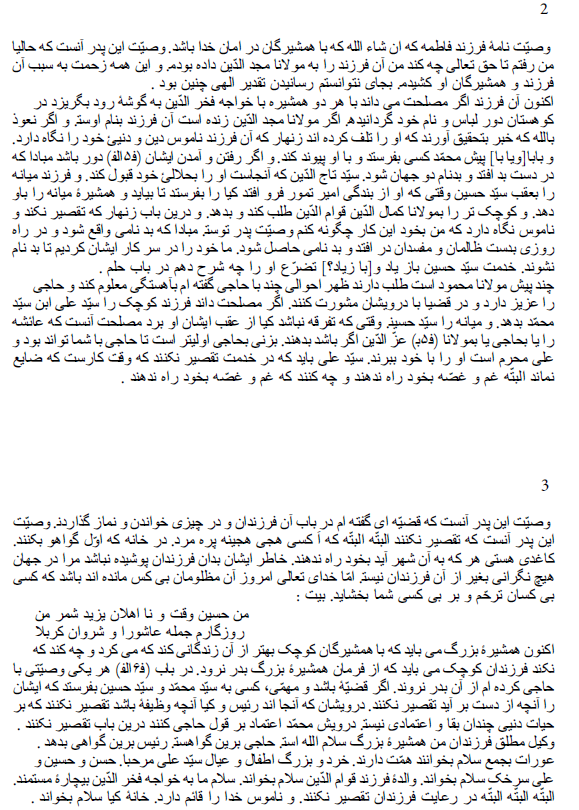
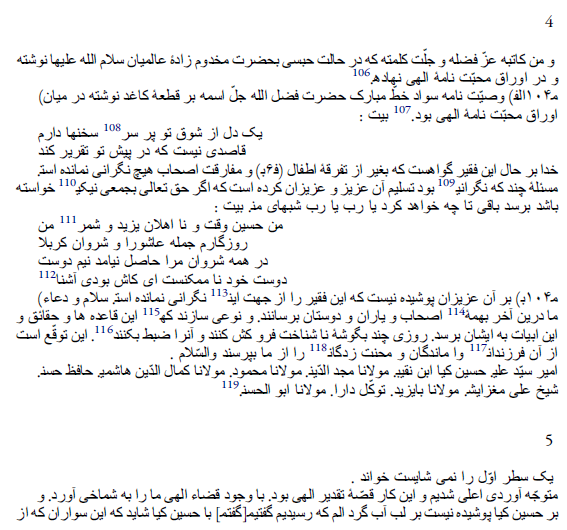
In this research, we provided a unique original copy of Faḍlallāh’s genealogy and a critical edition of all extant copies of Faḍlallāh’s testament. The passages of the testament in Gorgan dialect have been translated into Persian in the endnotes. This critical edition is especially suitable as a reference for further research. It is anticipated that these materials will serve future studies of Faḍlallāh’s disciples and circle.
The Main Text of Faḍlallāh’s Testament
There are two copies of Faḍlallāh’s six testaments, which, until today have been known as the “long version.” The first copy can be found in Millet Library, ʿAlī Amīrī, Persian, no. 1009, and has not been published before now. We named this text ( ف ) in our publication. The second copy is in Istanbul University Library, Persian, no. 1291, which was published by Gölpınarlı. The differences in the second copy are shown below in parentheses.
There are also two copies of the so-called “short version,” which is the fourth testament in our publication. The first copy can be found in the British Museum, MS. Or. 6380. The second is in Millet Library, ʿAlī Amīrī, Persian, no. 993, and has not been published before. We named the first copy “ ب ” and the second copy “ م ,” as can be seen in the fourth testament.
In our article, we compare all of these four copies and, as noted, the differences seen in the published works are shown in parentheses. The first paragraph of the sixth testament is the same as the first paragraph of the first testament, while the two subsequent paragraphs of the sixth testament were taken from various passages in the first testament. The third testament (ff. 5b–6a) seems to be a summarized version of the first testament (ff. 1b–4b), and its sentences follow the same order. The testament listed second in our publication was addressed directly to Faḍlallāh’s eldest daughter, Fāṭima.
The fourth testament, in Millet Library, ʿAlī Amīrī, Persian, no. 993 and the British Museum MS. Or. No. 6380, is an abbreviated version of Faḍlallāh’s testament, written in his handwriting on a piece of paper and left in the Maḥabbatnāma papers for Faḍlallāh’s middle daughter, also known as Makhdūmzāda (Nūrallāh’s mother). This version can be accepted as a small note. We believe this version was written when Faḍlallāh was first sent to prison as he later wrote his testaments in greater detail. One of the copies displayed at the British Museum was published by Browne,Footnote 103 which is included in this publication in our comparison of the fourth testament.
The testaments in which the first line was inappropriate to read—yak saṭr-i avval rā namī shāyist khwānd—were listed fifth in our publication; the fifth testament is more detailed compared with the other testaments. As we mentioned above, until now these were considered to be two separate testaments. To show the limitations of each testament, it is necessary to publish the text itself. The differences between the versions will enable researchers to interpret the testament differently, which is why we have provided this critical edition. By doing so, we believe that Faḍlallāh’s testament will become the most fitting possible text for reference for further research related to Faḍlallāh’s circle and family.


 Footnote 106Footnote 107 Footnote 108 Footnote 109 Footnote 110 Footnote 111 Footnote 112 Footnote 113 Footnote 114 Footnote 115 Footnote 116 Footnote 117 Footnote 118 Footnote 119


ORCID
Fatih Usluer https://orcid.org/0000-0001-5543-770X

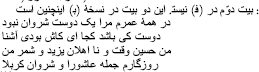
 Here, Amīr Ghiyāth al-Dīn does not say, as Ritter represents, that he visited Amīr” .
 Nūrallāh during his imprisonment in Bitlis Castle, but rather that Amīr Nūrallāh sent him to Bitlis Castle and there, in khanegāh, he saw Darvīsh Ḥusām al-Dīn. See Ritter, “Studien zur Geschichte der Islamischen Frömmigkeit,” 366.

 .











 .