Introduction
The study of young individuals at increased risk of psychosis has become a promising approach to unraveling developmental mechanisms involved in the etiology of psychotic illnesses such as schizophrenia. Such ‘high-risk’ approaches are based on the premise that certain groups of young individuals are considered more vulnerable for developing psychosis later in life than others. Applying a close-in strategy involving certain genetic (i.e. first-degree relatives of schizophrenia patients) or clinical (i.e. prodromal symptoms, ‘at risk mental state’) inclusion criteria has provided a means to study populations with substantially higher risk of psychosis as compared to individuals from the general population. Follow-up studies have reported high conversion rates to psychosis in samples defined by such ‘ultra-high risk’ (UHR) criteria (Olsen & Rosenbaum, Reference Olsen and Rosenbaum2006), with rates even higher than those reported for biological relatives of patients with a psychotic disorder. For assessing such UHR, several instruments have been developed (Olsen & Rosenbaum, Reference Olsen and Rosenbaum2006).
Two-hit models of psychosis (Weinberger, Reference Weinberger1987; Cannon et al. Reference Cannon, van Erp, Bearden, Loewy, Thompson, Toga, Huttunnen, Keshavan, Seidman and Tsuang2003), on which the concept of high-risk studies has been based, postulate that (1) multiple genes are involved in several key events during neurodevelopment and/or brain maturation early in life leading to a ‘predisposition’ and (2) that the manifestation of psychosis later in life results from interaction with environmental factors such as viral infections, birth complications, stressors and/or normal maturational processes. Thus, by studying behavior, cognitive abilities and brain functioning in high-risk populations, an insight may be gained into vulnerability markers or protective factors, although such factors may not be necessary or sufficient for transition to full-threshold psychotic illness. Predictors of transition to a psychotic disorder such as schizophrenia may, however, be identified when applying a longitudinal design in these high-risk studies. As the typical age of onset of psychotic disorders extends to 30–35 years, these longitudinal follow-up studies are generally very laborious and time-consuming.
Although many high-risk studies have focused on impairments in neurocognitive functions, such as attention, memory and executive functioning (Brewer et al. Reference Brewer, Wood, Phillips, Francey, Pantelis, Yung, Cornblatt and McGorry2006), very few studies have investigated problems in social cognition as possible vulnerability markers for psychosis. Social cognition has been defined as ‘the ability to construct representations of relations between oneself and others, and to use those representations flexibly to guide social behavior’ (Adolphs, Reference Adolphs2001). Within the domain of social cognition, the ability to decode facial expressions of emotions plays an important role. The lack of studies on facial affect recognition in high-risk populations is surprising, considering (a) the bulk of studies on facial affect processing deficits in schizophrenia patients (Mandal et al. Reference Mandal, Pandey and Prasad1998; Aleman & Kahn, Reference Aleman and Kahn2005; Trémeau, Reference Trémeau2006), which have an impact on social skills (Hooker & Park, Reference Hooker and Park2002; Pinkham & Penn, Reference Pinkham and Penn2006; Ikebuchi, Reference Ikebuchi2007), and (b) the range of studies that consistently point to social interaction difficulties as a precursor of schizophrenia (e.g. Done et al. Reference Done, Crow, Johnstone and Sacker1994; Cannon et al. Reference Cannon, Cadenhead, Cornblatt, Woods, Addington, Walker, Seidman, Perkins, Tsuang, McGlashan and Heinssen2008). Of note, recent studies on social cognition in adolescents at UHR for psychosis have revealed deficits in mentalizing, or ‘theory of mind’ (Chung et al. Reference Chung, Kang, Shin, Yoo and Kwon2008), in addition to impairments in the identification of affective and neutral facial expressions (Addington et al. Reference Addington, Penn, Woods, Addington and Perkins2008; Eack et al. Reference Eack, Mermon, Montrose, Miewald, Gur, Gur, Sweeney and Keshavan2010), although findings are not consistent (Marjoram et al. Reference Marjoram, Miller, McIntosh, Cunningham Owens, Johnstone and Lawrie2006; Pinkham et al. Reference Pinkham, Penn, Perkins, Graham and Siegel2007). Furthermore, individual at genetic risk (first-degree relatives of patients with schizophrenia) seem to display deficits in identifying socio-emotional signals, but only with more subtle and complex emotions (Toomey et al. Reference Toomey, Seidman, Lyons, Faraone and Tsuang1999; Bolte & Poustka, Reference Bolte and Poustka2003). These studies illustrate the importance of studying atypical cognitive processing of facial emotions as a potential cognitive deficit contributing to psychotic phenomena in UHR adolescents.
Although social cognition may have a unique contribution, besides neurocognitive functions, in explaining daily life social skills (Pinkham & Penn, Reference Pinkham and Penn2006), there is also evidence to suggest that processing of social signals is related to executive functioning (Bozikas et al. Reference Bozikas, Kosmidis, Anezoulaki, Giannakou and Karavatos2004). In complex and dynamic social environments, executive functions may allow us to shift our mind set flexibly in response to changing demands, inhibit inappropriate or irrelevant interpretations, thoughts and actions, and hence help to organize the processing of incoming stimuli in a goal-directed way (Anderson, Reference Anderson2001).
The aim of this study was to assess facial affect processing skills as a potential vulnerability marker in adolescents at UHR of psychosis. We specifically focused on the labeling rather than the recognition of facial emotions. This allowed us to study error patterns in the attribution of emotional expressions, that is the misattribution of the feelings and intentions of others. We hypothesized that misattribution of emotional expressions would be related to executive functioning, particularly cognitive inhibitory control, which is needed to suppress inappropriate interpretations. We tested our hypotheses in a population of adolescents meeting criteria for UHR for psychosis, aged 12–18 years. However, rather than finding predictors of progression to full-threshold psychosis later in life, our focus was on vulnerability markers of psychosis during adolescence. By studying this clinical population in this age range, we may gain an insight into the underlying cognitive mechanisms, which can help to explain increased levels of schizophrenia-like symptoms and traits in adolescence, before the typical age range in which psychotic illness generally presents.
Method
Subjects
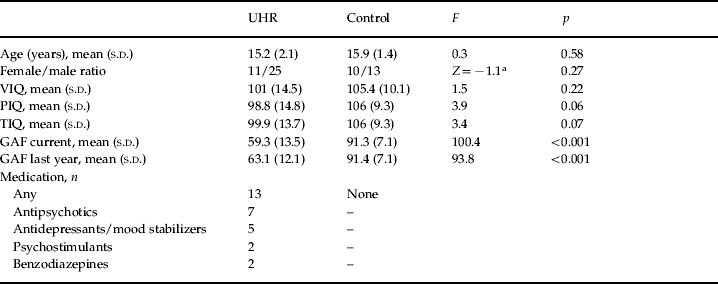
We included 36 adolescents at increased risk of psychosis and 21 non-clinical controls in the age range 12–18 years. The groups were matched on age, gender, IQ and social-economic status (SES) indicated by average parental education [F(1, 55)=0.50, p=0.48] (see Table 1). For both groups mental retardation and neurological disorders were exclusion criteria, and age between 12 and 18 was an inclusion criterion.
Group characteristics with regard to age, functioning, gender, medication and intelligence level

UHR, ultra-high risk; VIQ, Verbal IQ; PIQ, Performance IQ; TIQ, Total IQ; GAF, Global Assessment of Functioning; s.d., standard deviation.
a Non-parametric, Mann–Whitney test.
The UHR group was derived from a referred sample at the Department of Child Psychiatry at the University Medical Center Utrecht. To identify UHR adolescents, inclusion criteria and clinical instruments were used that in other studies have been proved to be successful in identifying those at UHR for psychosis (Olsen & Rosenbaum, Reference Olsen and Rosenbaum2006). The Structured Interview for Prodromal Symptoms (SIPS; McGlashan et al. Reference McGlashan, Miller, Woods, Rosen, Hoffman and Davidson2001; Miller et al. Reference Miller, McGlashan, Rosen, Cadenhead, Ventura, McFarlane, Perkins, Pearlson and Woods2003) is a structured diagnostic interview that includes the Scale of Prodromal Symptoms (SOPS), the Schizotypal Personality Disorder Checklist, a family history questionnaire and a Global Assessment of Functioning (GAF) scale. The semi-structured Bonn Scale for the Assessment of Basic Symptoms – Prediction List (BSABS-P) interview was used to rate subjective disturbances, which have been found to be predictive for psychosis (Schultze-Lutter & Klosterkotter, Reference Schultze-Lutter and Klosterkotter2002). More specifically, adolescents were included because they met at least one of the four European Prediction of Psychosis Study (EPOS) inclusion criteria (see Klosterkotter et al. Reference Klosterkotter, Ruhrmann and Schultze-Lutter2005; Sprong et al. Reference Sprong, Becker, Schothorst, Swaab, Ziermans, Dingemans, Linszen and van Engeland2008):
(1) Brief, limited or intermittent psychotic symptoms (‘BLIPS’ assessed with the SIPS): a history of psychotic symptoms with duration of less than 1 week and spontaneous remission.
(2) The presence of at least one of: ideas of reference, odd beliefs or magical thinking, perceptual disturbance, odd thinking and speech, paranoid ideation, odd behavior or appearance, as defined in DSM-IV and assessed with the SIPS. These symptoms should occur at least several times a week and should have been present for at least 1 week.
(3) Individuals with a first- or second-degree relative with a history of any DSM-IV psychotic disorder or a DSM-IV schizotypal personality disorder and a change in mental state or functioning leading to a reduction of 30 points or more on the GAF scale (assessed with the SIPS).
(4) At least three self-perceived deficiencies of cognition or perception from the list of basic symptoms as assessed with the BSABS-P.
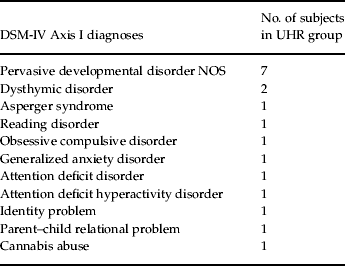
In this study, none of the adolescents met criterion 1 (BLIPS), 88.9% met criterion 2 (attenuated positive symptoms), 2.8% met criterion 3 (family history and reduced functioning) and 55.6% met criterion 4 (basic symptoms). Overall, 52.8% of the UHR adolescents met one criterion, 44.4% met two or more criteria and 2.8% met three or more criteria. Information with regard to functioning (GAF), age, gender, medication and intelligence level can be found in Table 1. The presence of Axis I disorders was screened for by board-certified psychiatrists based on DSM-IV criteria. The results are given in Appendix 1.
The control group was recruited from local secondary schools. Using identical screening instruments as for the UHR group, none of the controls belonged to one of the four above-mentioned groups and hence did not meet UHR criteria. They were also excluded if they had a history of any psychiatric illness themselves, or in a first-degree relative, or a second-degree relative with a psychotic disorder. The study was approved by the local Ethics Committee at the University Medical Center Utrecht. Informed consent was obtained from all adolescents and parents, according to the Declaration of Helsinki.
Schizophrenia symptoms and schizotypal traits
Schizotypal traits were measured with the Schizotypal Personality Questionnaire (SPQ; Raine, Reference Raine1991). The SPQ is regarded as an indicator of the genetic vulnerability to schizophrenia, as there is a gradient increase in schizotypal traits in relatives of schizophrenia patients that is in proportion to the risk for schizophrenia associated with the degree of kinship with the schizophrenic family member (Vollema et al. Reference Vollema, Sitskoorn, Appels and Kahn2002). Factor analytical studies have revealed three dimensions of schizotypy: positive, negative and disorganzed schizotypy (Vollema & Hoijtink, Reference Vollema and Hoijtink2000).
The degree of schizophrenia symptoms was measured with the Positive and Negative Syndrome Scale (PANSS; Kay et al. Reference Kay, Fiszbein and Opler1987). This is a widely used semi-structured clinical interview to assess symptom profiles within the schizophrenia spectrum that are present in the week prior to the interview. Two trained clinical raters reached consensus after independently scoring the PANSS interview. The PANSS allows categorization of negative, positive and general symptoms.
Face processing
The Benton and Van Allen Test of Facial Recognition, Short Form (Benton & Van Allen, Reference Benton and Van Allen1973), comprises a series of sheets containing a single photographed target face to be matched to a set of six face photographs. In the first six trials, the identical face has to be selected out of six options. In the remaining six trials, three different views (changed in orientation or lighting conditions compared to the target photograph) have to be distinguished from three incorrect alternatives. All faces are physically similar, and do not show glasses or hair.
Facial affect labeling
The Facial Affect Labeling test provides a measure of explicit facial affect labeling of degraded faces, and has been used in earlier studies on emotion processing (van ‘t Wout et al. Reference van 't Wout, Aleman, Kessels, Laroi and Kahn2004, Reference van 't Wout, Aleman, Kessels, Cahn, de Haan and Kahn2007; Van Rijn et al. Reference Van Rijn, Swaab, Aleman and Kahn2006; Van't Wout et al. Reference Van't Wout, Van Dijke, Aleman, Kessels, Pijpers and Kahn2007). Photographs of four different actors, two male and two female, were used (Frigerio et al. Reference Frigerio, Burt, Montagne, Murray and Perrett2002). Sixty-four trials were presented, consisting of 16 face presentations in each of four conditions: angry, happy, fearful and neutral. In each condition, eight trials displayed 100% emotional intensity and the other eight trials displayed 75% emotional intensity (which was obtained by morphing the emotional faces with neutral faces). The 75% emotion condition of the test has been designed to assess the capacity to label more subtle expressions. This condition might be more sensitive to impairments in facial emotion processing. All photographs of the faces were passed through a filter that reduced visual contrast by 30% to avoid local and stimulate global processing. Subjects were asked to indicate the expression of each emotion by clicking with the mouse on one of the four emotion labels depicted on the computer screen. They were asked to work as accurately as possible. The number of correct responses and selected emotions were registered.
Inhibitory control
Inhibitory control, that is inhibition of prepotent responses, was measured using the Shifting Set Task of the Amsterdam Neuropsychological Tasks (ANT) program (De Sonneville, Reference De Sonneville, Den Brinker, Beek, Brand, Maarse and Mulder1999). Several studies have demonstrated satisfactory psychometric properties of ANT tasks (for a review see De Sonneville, Reference De Sonneville2005). The Shifting Set Task is based on the inhibition of prepotent responses paradigm for assessing inhibitory control. A colored square moves randomly to the right and to the left on a horizontal bar that is permanently present on the computer screen. Depending on the color of the square after the jump, the subjects should either copy the movement, by pressing right (left) when the square jumps to the right (left), or ‘mirror’ the movement, by pressing left (right) at a right (left) movement. We used two parts of this task. In part 1 (40 trials, green squares), the subject is required to copy the movements (fixed condition). In part 2 (40 trials, red squares), only trials that call for ‘mirror’ responses are presented (incompatible condition), requiring the inhibition of prepotent responses. The dependent measures in this task are accuracy (i.e. percentage errors) and reaction times, with inhibitory control defined by the ‘incompatible’ condition (part 2) minus the ‘compatible’ condition (part 1). This particular test has been used in numerous studies on executive functioning in non-clinical and in psychiatric populations (e.g. Polderman et al. Reference Polderman, Posthuma, De Sonneville, Stins, Verhulst and Boomsma2007; Rommelse et al. Reference Rommelse, Altink, Oosterlaan, Buschgens, Buitelaar and Sergeant2008).
Statistical analyses
Data were analyzed using SPSS version 16.0 (SPSS Inc., USA). Between-group differences on the SPQ and the PANSS were tested using a multivariate ANOVA. The matching variables (IQ, age, parental education) and mean percentage correct in the Face Processing test were analyzed using an ANOVA. Group differences in gender ratios were analyzed using a non-parametric test, that is a Mann–Whitney test. Data from the Facial Affect Labeling test were analyzed using a multivariate ANOVA. Between-group differences in accuracy and reaction time data obtained in the Shifting Set Task were tested using general linear model (GLM) repeated-measures analyses with the group as between-subjects factor (control, UHR) and task condition (fixed compatible, fixed incompatible) as levels of the within-subjects factor. A difference score between the task conditions (i.e. the increase in errors and reaction time in the fixed incompatible condition as compared to the fixed compatible condition) was calculated to allow for correlational analyses. For correlational analyses Pearson's r was used. Effect sizes were calculated using Cohen's d. The level of significance was set at p=0.05.
Results
Schizophrenia symptoms and schizotypal traits
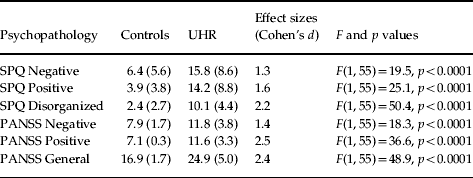
The total SPQ score was 37.0 (s.d.=17.7) in the UHR group and 10.9 (s.d.=8.1) in the control group. All three dimensions of the SPQ (positive, negative, disorganized) were entered in a multivariate ANOVA, revealing a main effect of group [F(3, 53)=17.9, p<0.001]. Univariate ANOVA showed that in the UHR group scores were significantly elevated in all domains of the SPQ (see Table 2). The total PANSS score was 48.6 (s.d.=8.0) in the UHR group and 32.0 (s.d.=2.5) in the control group. The three PANSS dimensions (positive, negative, general) were entered in a multivariate ANOVA, revealing a main effect of group [F(3, 53)=31.8, p<0.001]. Univariate ANOVA showed that in the UHR group scores were significantly elevated in all three domains of the PANSS (see Table 2).
Scores on measures of schizotypal traits (SPQ) and schizophrenia symptoms (PANSS) in the UHR group compared to the non-clinical control group

SPQ, Schizotypal Personality Questionnaire; PANSS, Positive and Negative Syndrome Scale; UHR, ultra-high risk.
Face processing
In the Benton and Van Allen test, the mean percentage of correct responses was 90.0% and 89.1% in the control group and UHR group respectively. No significant group differences were present in the general face recognition performance [t(1, 55)=0.15, p=0.70]. The mean number of correct responses was 21.6 (s.d.=1.7) for the control group and 21.4 (s.d.=1.9) for the UHR group.
Facial affect labeling
In general, performance in the Facial Affect Labeling test was well beyond chance level for each emotion. The total percentage of correctly identified emotions was 76.2% in the UHR group and 84.3% in the control group. A repeated-measures analysis with group (control, clinical), intensity (75%, 100%) and emotion (four emotions) showed no significant group×intensity interactions or group×emotion×intensity interactions. Therefore, the facial affect data were further analyzed regardless of intensity, that is the 75% conditions and 100% condition were collapsed for each emotion.
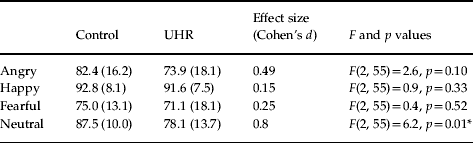
A multivariate ANOVA showed a main effect of group [F(7, 49)=2.4, p=0.05], which justified testing for univariate group effects for specific emotions. The univariate ANOVA showed a significant group difference in percentage of correctly labeled neutral emotions [F(2, 55)=6.2, p=0.01], with performance in the UHR group below that of controls. The percentage correct for each emotional expression is presented in Table 3.
Mean (s.d.) percentage correct and effects sizes for each emotional expression in the Facial Affect Labeling test for the UHR group and the non-clinical control group

s.d., Standard deviation; UHR, ultra-high risk.
* Significant group difference at p<0.05.
Analysis of the error patterns showed that, compared to the control group, the UHR group more often made ‘neutral-as-anger’ errors (reporting ‘angry’ facial expressions where faces were in fact neutral) [F(1, 55)=4.8, p=0.03 (Cohen's d=0.78)]. No significant group differences in the mean number of ‘neutral-as-happy’ error [F(1, 55)=0.9, p=0.33] or ‘neutral-as-fearful’ error [F(1, 55)=1.8, p=0.19] expressions were found.
Inhibitory control
Because of the incomplete data, two subjects in the control group and five subjects in the clinical group were not included in the analysis of the Set Shifting Task. A repeated-measures analysis with the factors ‘group’ (high risk, control) and ‘condition’ (compatible, incompatible) indicated no significant group by condition interaction. The degree of inhibitory control, reflected in performance deterioration in the incompatible condition compared to the compatible condition, was not significantly different in the UHR group compared to the controls, as expressed in percentage errors [F(1, 48)=0.26, p=0.61] and reaction times [F(1, 48)=0.01, p=0.91].
Correlation between mislabeling emotional expressions and degree of inhibitory control
The percentages correct for each facial expression (angry, happy, fearful and neutral) and the reaction times in the Set Shifting Task (i.e. the increase in reaction times in the incompatible compared to the compatible condition) were entered in a Pearson's test of correlation. In the UHR group, the number of correctly identified neutral expressions correlated significantly with the reaction times in the inhibitory control task (r=−0.52, p=0.003). In other words, an increase in reaction times in the incompatible condition compared to the compatible condition (reflecting more inhibition problems) was associated with a lower percentage correct in recognizing neutral faces. R 2 indicated that 27% of the variance in mislabeling neutral faces could be attributed to inhibitory control problems. The correlation remained significant after covarying for age (r=−0.50, p=0.005) or IQ (r=−0.38, p=0.05).
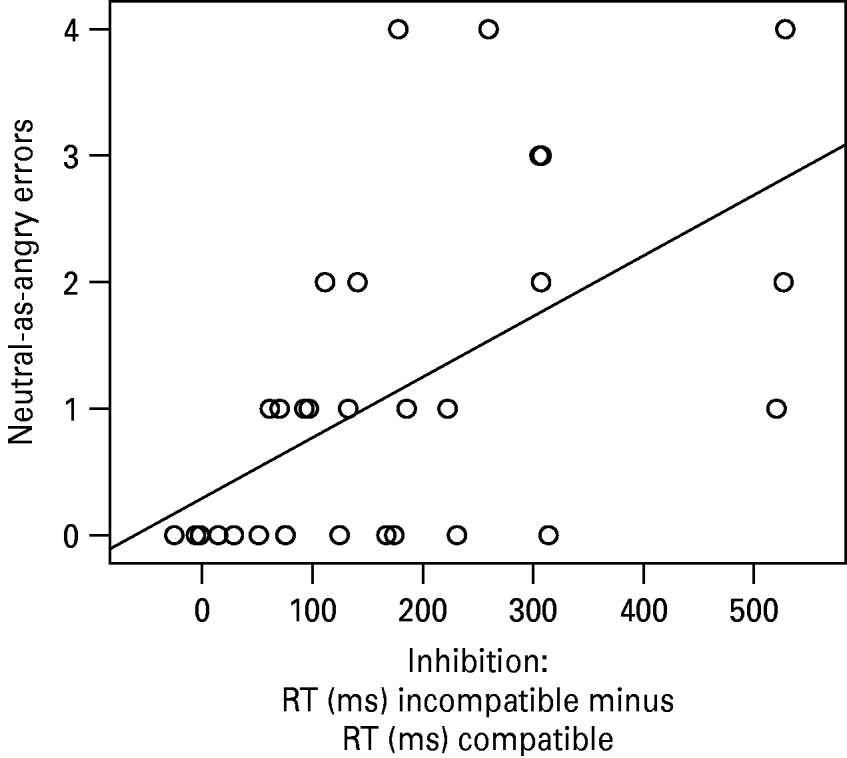
Next, the number of neutral-as-angry errors and reaction times in the Set Shifting Task were entered in Pearson's test of correlation. An increase in reaction times in the incompatible condition compared to the compatible condition (reflecting more inhibition problems) was associated with making more neutral-as-angry errors (r=0.55, p=0.002). R 2 indicated that 30% of the variance in mislabeling neutral for angry faces could be attributed to inhibitory control problems (see Fig. 1). The correlation remained significant after covarying for age (r=0.53, p=0.004) or IQ (r=0.53, p=0.005).
Scatterplot of the correlation between ‘neutral-as-anger’ errors and inhibitory control in the ultra-high risk group (r=0.55, p=0.002, R 2=0.30).

None of the correlations were significant in the non-clinical control group. In the UHR group, the number of correctly identified neutral faces and the number of ‘neutral as anger’ errors did not correlate significantly with intelligence (total IQ: r=−0.25, p=0.15; verbal IQ: r=−0.17, p=0.33; performance IQ: r=−0.26, p=0.14) or age (r=−0.11, p=0.52).
Discussion
The aim of this study was to identify potential vulnerability markers for psychosis in the domain of social emotional processing. Our findings suggest that adolescents at UHR for psychosis have impairments in labeling facial expressions of others, in addition to spared ability to recognize facial identity. Compared to non-clinical controls, the UHR group made more errors in labeling neutral expressions, and analysis of error types indicated that neutral faces were misattributed as being angry. These difficulties were not related to intellectual functioning. Although the UHR group did not show a significant impairment in inhibitory control, the degree of errors in labeling neutral faces and, more importantly, the degree of misattribution of neutral-as-angry faces was significantly correlated with reduced inhibitory control. This relationship remained significant after covarying for maturation (age) and IQ. In other words, high-risk adolescents showing an increased tendency to misattribute neutral faces as being angry had more difficulties with cognitive inhibition.
Considering the substantial number of reports on early social dysfunctioning in populations at high risk for psychosis, we hypothesize that misattribution of facial expressions may be a potential cognitive mechanism contributing to social impairments in adolescence at high risk for psychosis. Reported social difficulties in high-risk adolescents include social maladjustment, social anxiety, overly restrained or disinhibited social behavior, social isolation and impaired interpersonal relationships (for a review see Tarbox & Pogue-Geile, Reference Tarbox and Pogue-Geile2008). Of interest, social self-consiousness, which is closely related to social anxiety, is shown to be associated with exaggerated perception of oneself being the target of other people's actions (Fenigstein, Reference Fenigstein1984; Smári et al. Reference Smári, Stefánsson and Thorgilsson1994), which fits with our finding that UHR adolescents tended to report negative (i.e. angry) faces erroneously. The relevance of abnormal processing of social cues in high-risk adolescents is especially illustrated by recent findings in a large follow-up study, revealing that social impairments were among the five significant, unique predictors (out of 77 potential predictors) of transition to psychosis (Cannon et al. Reference Cannon, Cadenhead, Cornblatt, Woods, Addington, Walker, Seidman, Perkins, Tsuang, McGlashan and Heinssen2008).
The finding that the degree to which neutral faces were not correctly labeled and, more importantly, the degree to which neutral faces were mislabeled as angry was associated with more problems in inhibitory control may provide an insight into underlying interacting cognitive systems. Although the UHR group did not show significant deficits in inhibitory control, we cannot exclude the possibility that deficits in cognitive inhibition may only be present in the subpopulation that will develop psychosis. Based on our findings, we speculate that inhibitory control is needed to override an initial negative interpretation of neutral faces. As people typically enter social interactions with a friendly facial expression, neutral faces may be regarded as ambiguous and prone to be misinterpreted as unfriendly when explicitly asked to label. We speculate that individuals at risk for psychosis may have the tendency to identify ambiguous stimuli as being threatening, similar to schizophrenia patients with delusions (Phillips et al. Reference Phillips, Drevets, Rauch and Lane2003).
Our findings are in line with several studies on emotion attribution in individuals diagnosed with schizophrenia. Premkumar et al. (Reference Premkumar, Cooke, Fannon, Peters, Michel, Aasen, Murray, Kuipers and Kumari2008) have reported that schizophrenia patients misattribute fearful facial expressions as being angry. Of interest, similar to our study, this bias towards angry faces was correlated with inhibitory control as reflected in the degree of perseverative errors in the Wisconsin Card Sorting Test. Another study with schizophrenia patients has shown that the tendency to mistakenly see angry facial expressions is associated with poorer social and global functioning, and also with more negative and disorganized symptoms (Cohen et al. Reference Cohen, Nienow, Dinzeo and Docherty2008). Finally, another study exploring attributional style in processing facial expressions showed that schizophrenia patients made more errors in labeling neutral faces and reported seeing sad, happy or disgusted faces (Kohler et al. Reference Kohler, Turner, Bilker, Brensinger, Siegel, Kanes, Gur and Gur2003). Our findings also fit with a recent study showing that individuals at familial high risk for schizophrenia were significantly more likely to overattribute emotions to neutral faces; more specifically, misinterpreting neutral faces as negative (Eack et al. Reference Eack, Mermon, Montrose, Miewald, Gur, Gur, Sweeney and Keshavan2010). Increased neural activity in response to neutral faces has also been observed in high-risk adolescents using functional magnetic resonance imaging (Seiferth et al. Reference Seiferth, Pauly, Habel, Kellermann, Shah, Ruhrmann, Klosterkotter, Schneider and Kircher2008). The observation that misattribution of emotion is not only confined to chronic schizophrenia patients but is also possibly present in adolescents at risk tentatively suggests that such a negative attribution bias in emotion perception may be among the early vulnerability markers of subclinical psychotic traits and symptoms in the absence of a full-fledged psychotic disorder. It will be interesting to assess in future follow-up studies whether misattribution of facial expressions also has predictive value for transition to psychosis, although transition to a full-fledged disorder is probably best predicted by a combination of several cognitive deficits, and also environmental factors, that have an additive effect.
The present study has several limitations. As we focused on a young UHR sample (12–18 years), our findings may not generalize to other UHR samples with older subjects. In addition, in the facial affect labeling test no dynamical but only posed expressions were used, which limits the ecological validity. However, static faces are used in many studies and are generally well validated in terms of reliability and sensitivity in uncovering impairments in facial affect processing. It also remains unclear why neutral faces were misattributed specifically as angry and not also as fearful, as a bias towards negative emotions might predict. Furthermore, we were not able to draw conclusions with regard to the predictive value of the reported impairments for transition to psychosis, as our sample size was relatively small. In addition, although social cognitive functioning was hypothesized to be related to social behavior, social behavioral measures were not included in the study. Another limitation is that our finding of a relationship between inhibitory control and emotion labeling does not allow causational inferences. Finally, although IQ scores were not significantly different between the groups, we did observe a trend. However, mislabeling of emotions did not correlate significantly with IQ scores.
In sum, the study of social cognition in individuals at risk for psychosis is still in its early stages of development and our results call for further research. The present findings of negative misattributions of neutral facial expressions, and the relationship with inhibitory control deficits in adolescents at UHR for psychosis, may have relevance to understanding mechanisms underlying interpersonal difficulties and hence may potentially play a role in remediation interventions.
Axis I disorders

UHR, Ultra-high risk; NOS, not otherwise specified.
Acknowledgments
This study was supported by a VernieuwingsImpuls grant (no. 016.026.027, awarded to Prof. A. Aleman) from the Netherlands Organization for Scientific Research (NWO).
Declaration of Interest
None.