

After the return to democracy in 1990, Chile went through a process of economic and political development based on the search for consensus between its two main political coalitions, the Concertación, which brought together the center and left-wing parties; and the Alianza, formed by the center-right and right-wing parties. That consensus democracy collapsed during the 2013 presidential and parliamentary elections, in which the center-left coalition committed to quickly advancing structural reforms without first forging broad political agreements, as had been the custom during the previous two decades.
Michelle Bachelet, who had already served as president from 2006 to 2010, returned as the presidential candidate for the center-left coalition, ready to use all her political capital to implement these structural reforms. Citizen support was resounding, giving her 62.17 percent of the votes in the ballotage. It was in this scenario that an enthusiastic senator from her winning coalition (renamed the Nueva Mayoría, New Majority) summed up the challenges facing the new government with a metaphor for changing the prevailing model: “we are going to put a backhoe to this because it is necessary to destroy the foundations of the dictatorship’s neoliberal model” (Emol 2014). Why did the consensus democracy end?
At first glance, the conflict seemed to emerge after the 2011 student protests, which quickly evolved into broader citizen mobilizations. At the center of the citizen protests were demands for profound reforms to the educational system, with a strong rejection of for-profit education. Mansuy (Reference Mansuy2016) suggests that those protests were the way citizens found to overcome the political neutralization of previous years. In contrast, Claro (Reference Claro2017) proposes that they were the result of the emerging middle class’s expectations for social mobility through education. In any case, the political elites were disoriented and unresponsive to citizens’ discomfort. Also, polls showed record levels of distrust toward political parties. Moreover, given that several politicians on the front line had been leading figures in Chilean politics for decades, the criticism set up a discourse for a total replacement of the politics and politicians of the consensus era.
Citizen mobilizations provided tangible images of this phenomenon. This article, however, finds empirical evidence that the end of consensus can be explained by a phenomenon that started during the previous decade. Specifically, we identified a growing polarization trend, starting in the 2000s, that can be explained by two main factors. On the one hand, the ideological center was increasingly demobilized, thereby reducing political adherence among moderate citizens. This process shifted the existing balance within political platforms supporting each coalition. On the other hand, the binomial electoral system (which governs how Congress members were elected) provided the framework to sustain centrifugal forces among political coalitions when the conditions for tacit political agreements began to erode in the late 2000s. As a result, over the years, political discourse moved slowly away from the political center and thus made consensus less probable. The evidence was built by analyzing a series of surveys that cover the whole period (1990–2014) and using spatial voting theory and methods.
This article is organized in five sections. It illustrates the move from a consensus to a polarized democracy, then presents evidence that a process of polarization was in motion at least ten years before the consensus era ended. The following section argues that both the demobilization of the center and the electoral incentives provided by the binomial system explain why the polarization trend continued to pick up momentum. The final section considers the implications of this phenomenon.
From A Consensual Democracy to a Polarized One
Both the polarization that preceded the 1973 coup d’état and the traumatic experiences during the Pinochet dictatorship (1973–90) led the fledgling democracy in 1990 to commit to gradual reforms and find broad agreements between the Concertación and the Alianza (Walker Reference Walker1992). This tacit arrangement was upheld during the four Concertación-led governments (Aylwin 1990–94, Frei 1994–2000, Lagos 2000–2006, and Bachelet 2006–10), and was partially sustained during the Alianzaled administration (Piñera 2010–14), but was definitively cut short during Bachelet’s second period (2014–18).
The Concertación had “two souls” with regard to this arrangement. One supported it by claiming that only gradual and negotiated reforms were politically doable (their promoters were known as los autocomplacientes, the self-complacent); the other rejected it and pushed for more aggressive structural changes to the political and economic rules inherited from Pinochet’s regime (they were known as los autoflagelantes, the self-flagellants).
Although the Concertación was able to manage this internal tension between its two souls, it does not mean that their specific weights remained constant during those two decades. A slow but sustained decline of the moderate vision was in motion, and it is observable at least from the late 1990s. It was indirectly observable by looking at the voting shares: autoflagelantes and autocomplacientes were distributed across all parties, but the latter were more prevalent in the Christian Democracy Party (DC). This party lost 15 seats in the lower chamber between the 1997 and 2001 parliamentary elections; meanwhile, its political partners (the Socialist Party or PS, the Radical Party or PRSD, and the Party for Democracy or PPD) simultaneously increased their share by three seats. Moreover, after the 2005 election, the DC also lost its status as the most voted party in the country. Hence, the less the DC’s power, the harder it was to manage the Concertación’s internal balance.
In that context, the Concertación faced the 2008 municipal election with two lists of candidates that did not summon votes, a clear signal of disunity. A year later, Eduardo Frei ran as its 2009 presidential candidate, but his coalition followed him with an evident lack of enthusiasm. And he was challenged by two former members of the Concertación (Jorge Arrate and Marco Enríquez Ominami) and the Alianza’s candidate (Sebastián Piñera), who won the election.
With the Concertación on the brink of virtual extinction, Piñera’s opposition came from massive protests and citizen unrest. As mentioned by Segovia and Gamboa (Reference Segovia and Gamboa2012), in 2011 alone, 240 mass demonstrations took place in the Metropolitan Area, along with 6,000 public demonstrations throughout the country, with a total of 2 million participants. On the other hand, in that same period, the criticism leveled against the Concertación’s “inheritance” flourished without any sort of counterbalance.
Thus, with an empowered citizenry requesting changes and placing new issues on the public agenda, Chile faced a new presidential election in 2013, but all political parties lacked clear platforms to offer the voters. The Concertación was reunited as the Nueva Mayoría (comprising the same parties plus the Communist Party), willing to embody citizens’ discomfort through the candidacy of Michelle Bachelet, who, despite the disapproval of her own coalition, had ended her previous presidency with high levels of public support. But this time, there was no trace of the autocomplacientes’ discourse in the presidential campaign. Bachelet was committed to shoring up all her political capital to carry out profound reforms in several key areas, such as the electoral, educational, and tax systems; labor laws; and even the replacement of the constitution. And she won the election with more than 60 percent of the votes in the ballotage. By 2014, the consensus democracy was dead.
To put it succinctly, with the beginning of a new presidential term, Chile kicked off 2014 with a polarized elite. One side was “driving a backhoe” to remove all remnants of what it dubbed the Chilean neoliberal model, and the other side was prepared to reject any attempt to modify it. Two hypotheses might explain this scenario. First, the weariness of the political class that had governed Chile encouraged the new generations to seek a total replacement of their predecessors and their political practices. Hence, the political elites, already devoid of ideas and under the threat of being replaced by new players, reacted to the empowered citizenry who had taken to the streets and shaken the public agenda. Second, the polarization between the political parties’ adherents had rendered the pursuit of consensus impracticable as a political practice on the part of the elites.
Consequently, the empirical challenge is to identify whether there was polarization of political adherence and, if so, when it began. If empirical analysis shows no evidence of such polarization, the second hypothesis can be rejected. On the other hand, if empirical evidence shows signs of polarization between the parties’ adherence, then the events of 2011 and subsequent years were symptoms of a process rather than its cause. Likewise, the renewal of politics and politicians suggested by the first hypothesis would be an epiphenomenon.
To search for evidence pointing to the existence or absence of those trends, this study analyzes the phenomenon of polarization within the framework provided by the spatial theory of voting.
Polarization: Method and Data
Political polarization refers to the observation of increasing antagonism among the political views of individuals, whether elites or citizens. Elite polarization indicates the presence of conflicting views among central political actors with different political projects. Citizen or mass polarization refers to struggles among followers of those political projects and, consequently, the platforms on which they are built.
One way to analyze polarization is to look at people’s disagreement on topics (DiMaggio et al. Reference DiMaggio, Evans and Bryson1996; Evans Reference Evans2003; Fiorina et al. Reference Fiorina, Abrams and Pope2005; Baldassarri and Bearman Reference Baldassarri and Bearman2007). This approach helps to understand the political identity of different groups and the main issues that generate division between them. Unfortunately, this approach is not well suited here, for two reasons. On the one hand, during the consensus era, there was a central dividing issue during most of the period under study (support for or opposition to Pinochet’s regime); on the other hand, there was an electoral rule creating incentives to form two large coalitions. These two features together created a political environment in which the discrepancies among supporters of the Concertación and the Alianza on topics unrelated to Pinochet were minimized. Consequently, although intragroup differences on topics would eventually emerge, the vision regarding Pinochet’s regime and the binomial electoral incentives divided the political elites and the citizens into two big groups. For example, abortion was a topic dividing positions within the Concertación, but it was not strong enough to prevent its supporters from cooperating and claiming to be part of the regime.
An alternative better suited to studying polarization in the Chilean case is one that uncovers the latent ideological preferences that underlie individuals’ opinions and then to observe how the preferences change during the period under study. On those grounds, polarization is understood as a process of increasing ideological distance between individuals or groups (either citizens or politicians). One way to analyze the changes is to perform content analyses of political discourses. By coding parties’ and politicians’ speeches, official documents, or public statements and by comparing those codes, we obtain a measure of the existing gap on political issues among political actors. Then, repeating the exercise for various periods would give us a measure of the evolution of that gap.
That is precisely the method followed by the Manifesto Project (Volkens et al. Reference Volkens, Lehmann, Matthieß, Merz, Regel and Weßels2017). For Chile, Volkens et al. have coded election programs for the main presidential candidates and parties in concurrent parliamentary elections between 1989 and 2013. Codes cover six domains, labeled external relations, freedom and democracy, political system, economy, wage and quality of life, and social groups. From the data, the authors built a right-left indicator for each coalition or party supporting a presidential candidate.
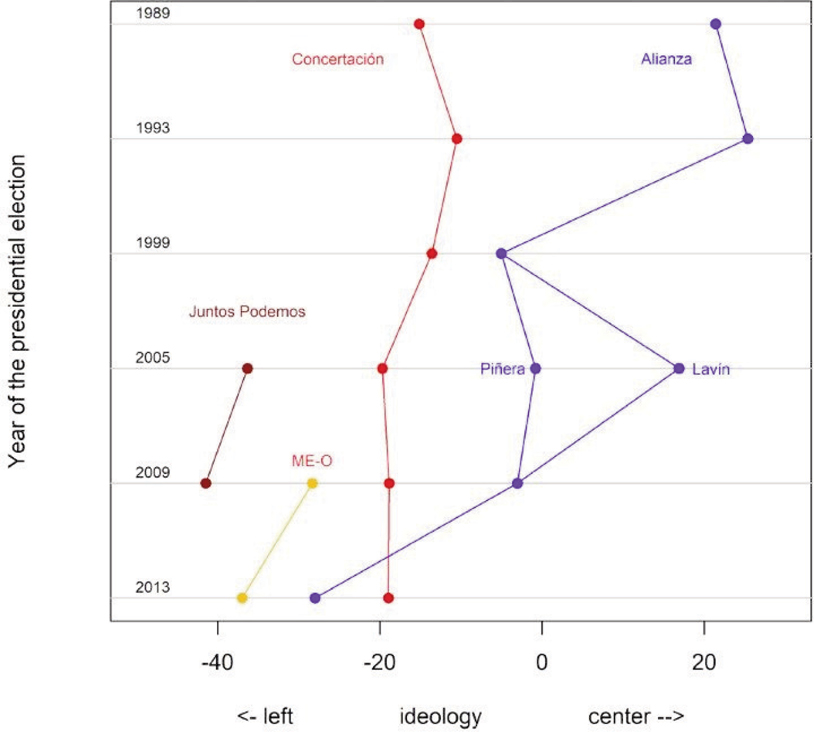
Figure 1 summarizes the evolution of the coalitions’ positions using the estimates of the Manifesto Project.Footnote 1 The x axis represents the ideological positions of each coalition, and the y axis orders the elections from 1989 to 2013.Footnote 2 According to the Manifesto, there was a clear reduction in the ideological gap between 1989 and 1999. In 2005, the Concertación moved slightly to the left, to a position that it held until 2013.
Manifesto Project Dataset (right-left position)

By contrast, the Alianza’s ideological position shows several significant changes, according to the Manifesto. First, in 2005, the Alianza had two candidates (Sebastián Piñera and Joaquín Lavín). Both their election programs moved the Alianza’s ideological position to the right of that of 1999. By 2009, the Alianza came back slightly to a relatively more centered position. Then, according to the Manifesto Project, it surprisingly moved to the left of the Concertación in the 2013 election. This last change does not look to be correct, and calls for a review of the method. A possible explanation is that in 2013, Bachelet, the Concertación’s presidential candidate, was perceived as unbeatable, and this encouraged the Alianza to strategically prepare a more progressive election program. If that was the case, it could not be captured by the Manifesto’s coding procedure.
Between 2005 and 2013, two other political processes were also in motion, with impacts on the composition of electoral programs. The Communist Party (PC) formed a coalition with other groups, named Juntos Podemos (Together We Can), which competed in both the 2005 and 2009 elections. But in 2013, the PC regrouped with the Concertación under Bachelet’s candidacy. In addition, Marco Enríquez Ominami (M. E-O), a former Concertación deputy, ran for the presidency in 2009, obtaining a share of the votes (20.14 percent) significant enough to allow him to sustain a third alternative political project. Both cases opened new competition from the left and, consequently, could affect the topics covered in electoral programs across the political spectrum. These interdependencies between the promises made by different political projects via their electoral programs are not clearly captured by the coding procedure.
This article proposes to use a different method that takes into account those interdependencies among political actors that cannot be captured by the content analysis of political manifestos. Formally, let us assume that individuals’ ideologies can be reasonably represented in one dimension (Poole and Rosenthal Reference Poole and Rosenthal1998). We can also assume that for each period of time t, each individual can be in one of three possible states: a member of group L, a member of group R, or without a group. Moreover, in each period t, the ideologies of groups L and R are necessarily functions of their members’ ideologies. Let us assume that individuals do not change their ideological position, but they can decide to join or leave groups at any time. Also, let the ideological position of a group i, Ii, be the average among the ideological positions of its members. Hence, the relative ideological position of groups L and R in period t+1 will depend on the states in which their members claim to be in t+1, and so on.
Thus, d = |IR − IL| represents the ideological distance between groups L and R. Following DiMaggio et al. (Reference DiMaggio, Evans and Bryson1996), polarization increases when d is higher in period t+1 than in period t. Consequently, if the end of the consensus era is related to polarization, d had to increase over time. To check if a process of polarization was happening in Chile, let us see how citizens evand politicians’ ideological preferences can be recovered from observed data.
Data and Method
At first glance, it seems a straightforward exercise to ask people directly what their political position is on a scale from left to right. Unfortunately, people are reluctant to give answers to questions about their ideological stance, and therefore there is a significant loss of observations using direct questions. Moreover, some individuals who choose to locate themselves in the same position on a given scale can actually be dissimilar to each other. For instance, two individuals can locate themselves in the “center” but hold completely different opinions on politically related topics. These limitations can be overcome by obtaining their ideological positions through indirect means.
Following Converse (Reference Converse1964), we assume that voters have consistent beliefs that explain their political opinions. Those beliefs can be interpreted as ideological dimensions (Hinich and Munger Reference Hinich and Munger1994). In particular, on average, people can be expected to have better opinions on alternatives that they consider closer to their views and worse opinions on alternatives that they consider farther from their ideologies. Therefore, individuals’ ideological positions can be obtained by simultaneously asking them to evaluate politicians or issues of political interest and deducing their relative political positions from the answers.
For this purpose, we took advantage of the National Public Opinion Survey managed by the Centro de Estudios Públicos, known as the CEP survey (CEP 1990–2014). This unique survey series (three or four times per year) covers the entire period during which consensus politics was in full force. The CEP survey enjoys an excellent reputation because of its rigorous sampling approach and because all its databases are accessible for scrutiny and research. As a consequence of its reputation, each new release of the CEP survey has become a political event in itself, even being used by political parties to define their presidential candidates, as if that poll were a primary election (Dockendorff Reference Dockendorff2010).
From the CEP survey, we used a set of questions asking respondents to evaluate Chilean politicians, in order to estimate the latent ideological positions of both a representative sample of citizens and the mentioned politicians. The questions had the following frame: “Now I will read a list of people, and I want you to tell me, what do you think about each of them? If you have not heard about one person, please let me know that you do not know him or her. … Which of the following sentences best describe your opinion of each person?” The alternative answers are “very positive,” “positive,” “neither positive nor negative,” “negative,” and “very negative.” Two individuals may give the same answer (say, “positive”) for a given politician, but if one gives lesser values to the rest (say, “negative”) and the other assigns them higher values (say, “very positive”), then the former is closer to that politician than the latter. Thus, ideological positions can be recovered from the entire ranking that respondents give to a set of politicians.
A total of 155 politicians were evaluated by respondents throughout the 54 surveys covered in the period under study. Each survey asks about a list including about 20 of them. Some are included in only some surveys, and others—like presidents, former presidents, and main political figures—appear in most of them. These 54 surveys correspond to 88.5 percent of the CEP’s surveys during the period and a total of 81,737 observations.Footnote 3
Consequently, there is a matrix with 81,737 potential evaluations of 155 politicians grouped in 54 periods. The key assumption is that those evaluations are a function of each respondent’s ideology, such that the probability that an individual assigns a “very positive” evaluation to politician j is greater the closer j’s views are to the respondent’s own. Also, the complete set of evaluations provided by that respondent, together with those provided by others, helps to identify their relative ideological positions and the relative ideological positions among the evaluated political actors.
Then the method consists of computing the ideological distribution that best represents those evaluations. In other words, it computes the subsequent distribution of ideological points from the observed data (Clinton et al. Reference Clinton, Jackman and Rivers2004). Within the family of nonparametric models based on this technique, we used the Expected Maximization alternative proposed by Imai et al. (Reference Imai, Lo and Olmsted2016), given its benefits for scalability on large datasets.Footnote 4 The process of estimating ideological positions was implemented in R using the package emIRT (Imai et al. Reference Imai, Lo and Olmsted2016). For that purpose, the “very positive” and “positive” answers were collapsed into one category, and the “negative” and “very negative” answers were added in another one. The ordIRT algorithm was applied to the full dataset. The latent ideology was recovered for 72,913 individuals (89.2 percent) and the 155 politicians. Then individuals’ estimates were grouped by survey and other attributes for further analysis.
Polarization Started Before 2011
In each survey, ideological points were obtained for the Concertación’s and the Alianza’s political platforms as the average ideological point among individuals who declared themselves to be close to each coalition. The ideological distance between political platforms was computed as the absolute value of the difference between their estimated ideologies. In the case of politicians, we manually classified them according to whether they belonged to a party or a coalition. Then we took the average ideology among those politicians who were included in each survey to obtain an estimate per coalition in each one of the 54 surveys.Footnote 5
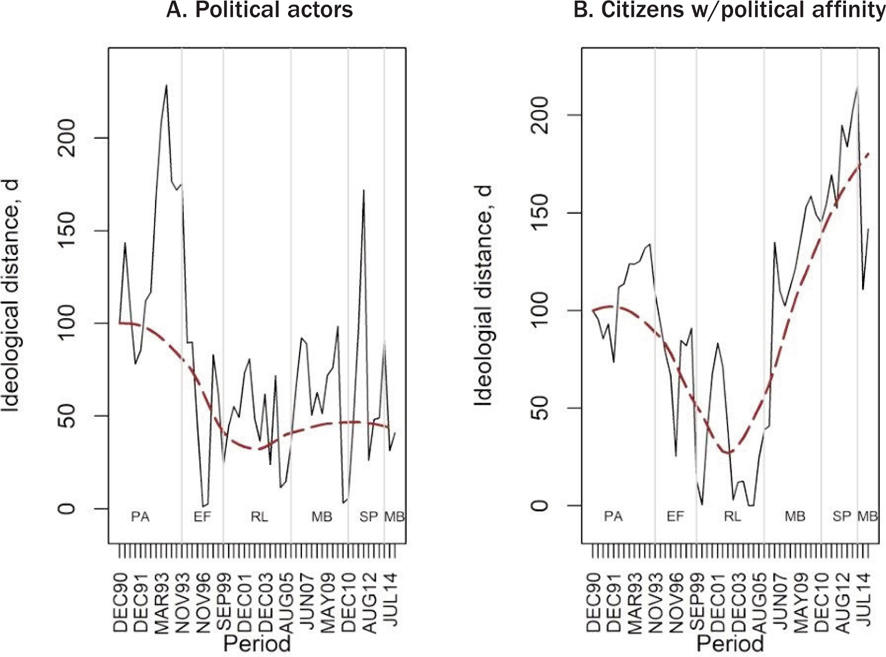
Figure 2 summarizes the results for political actors (panel A) and adherents to coalitions (panel B). The x axis shows surveys in chronological order covering the period under each presidency, identified in the figure by presidential initials. The y axis measures the ideological distance between the Alianza and the Concertación. For the sake of comparison, the estimated distances among political actors and among citizens are set at 100 in the first survey. Consequently, when the line connecting the estimates for subsequent surveys decreases, the polarization decreases, and when the line moves above 100, polarization increases. Two estimates are included in each panel. The solid line shows the estimated value, and the dashed line indicates the trend calculated as a robust, locally weighted regression.
Ideological Distance Between the Concertación and the Alianza

According to this estimation, Chile experienced a period of ideological convergence among politicians and among adherents to the main political coalitions from 1990 up to Ricardo Lagos’s administration (2000–2006), followed by a period of mild polarization among politicians and strong polarization among their political platforms. Therefore, the polarization among voters was in motion about a decade before the end of the consensus era. This result is not consistent with the understanding of the end of consensus as a renewal of political elites or as a consequence of citizens’ mobilizations.
Thus, the evidence suggests that a process of polarization was happening in Chile in the second half of the 2000s, and it was not confined to political elites. In addition, toward the end of Piñera’s term, that polarization was even greater than the one observed immediately after the return to democracy in 1990. However, among politicians, the ideological gap tended to stabilize by the middle of the 2000s, misaligning them from their political platforms. Therefore, the evidence is consistent with the idea that the polarization among adherents to different parties or coalitions by the late 2000s systematically discouraged the search for consensus across political elites in the following years.
This study proposes a twofold explanation for these trends. For the sake of exposition, we first explain the electoral incentive that conditioned the actions of political parties during the era of consensus. Then we explain how the demobilization of the citizens influenced these incentives, creating the conditions for them to discard the search for consensus.
The Electoral Incentives and the Impact of Demobilization on Political Elites
During Chile’s consensus era, an increasing detachment on the part of citizens modified the parties’ political platforms, making the search for consensus less desirable among political elites. To understand how that demobilization had an impact, it is necessary to analyze the incentives under the electoral system in place between 1990 and 2013 in Chile. Cox (Reference Cox1990) offers the first systematic study of the incentives provided by different electoral rules and how they influenced the ideological positioning of political players. He synthesizes these effects by using the concepts of centrifugal and centripetal forces. Centrifugal forces move political actors away from the median voter, while centripetal forces induce actors to seek positions close to those of the median voter. According to his analysis, systems in which citizens cast fewer votes than the number of vacancies generate centrifugal incentives. Also, when the system has closed lists, these centrifugal incentives always predominate over centripetal ones. In contrast, centripetal forces are stronger in systems with fewer disputed seats, and where the difference between the number of votes that each citizen casts and the number of disputed seats is small or nonexistent.
Between 1990 and 2014, the Chilean system for electing members of Congress was known as the Binominal.Footnote 6 This system combines the D’Hondt method for districts of magnitude 2 with open lists. According to these rules, in each electoral district, a list obtains two seats when its candidates win twice the votes (or more) than the second most voted list. Given that Chilean citizens can cast only one vote, the second list needs only a third of the total district votes to secure a seat. Therefore, in the framework proposed by Cox (Reference Cox1990), the Binominal could be a system in which either the centripetal or the centrifugal forces can predominate: the former because the difference between votes per person and seats is small, the latter because each voter casts fewer votes than seats.
Magar et al. (Reference Magar, Rosenblum and Samuels1998) extend Cox Reference Cox1990 for systems with open lists, such as the Binominal. The authors contend that electoral competition becomes intracoalitional in districts where the chances to win both seats are low. In those cases, partners on the same list are forced to compete among themselves for the single seat that their coalition can obtain. As a result, they do not have incentives to “pursue” the median voter. Therefore, according to Magar et al., in the Binominal, a centrifugal force would predominate. At the empirical level, using pre-election data from 1989, Dow (Reference Dow1998) and González (Reference González2000) found evidence consistent with these predictions. Later, Bonilla and Silva (Reference Bonilla and Silva2008) also found evidence of centrifugal incentives with data from a period (2003) when no election campaigns took place.
However, there are also reasons to consider the existence of centripetal forces under the Binominal system. Given that the political regime is highly presidential and that the vast majority of parliamentary elections are concurrent with presidential elections, there is a possibility that candidates for Congress line up behind the presidential candidate chosen by their coalition; that candidate, in turn, has incentives to seek the support of the median voter because he or she needs a majority to win the election. On the other hand, Guzmán (Reference Guzmán1993) holds that the Binominal shares some features with majoritarian systems, since it not only induces the formation of bigger coalitions but also punishes ideological extremes. In the long run, says Guzmán, a kind of majoritarian system will hold, with relatively homogeneous ideological positions among political parties and voters.
In addition, von Baer (Reference Von Baer2009) claims that the Binominal is a proportional system, but one of low magnitude: it produces diversity within each coalition but encourages few coalitions, forcing the search for agreements. Furthermore, González (Reference González2008), relying on the empirical evidence that the Binominal has centrifugal effects while the presidential election has moderating ones, holds that together they produce strong incentives for ideological ambiguity, such that centrifugal and centripetal forces will dominate in one or another election for idiosyncratic reasons.
In sum, at both the theoretical and empirical levels, there are reasonable arguments to expect both centrifugal and centripetal forces in the Chilean electoral system, leaving open the empirical question of whether one dominates or not. To search for traces of polarization, the evidence for the prevalence of centrifugal forces found by Dow (Reference Dow1998), González (Reference González2000), and Bonilla and Silva (Reference Bonilla and Silva2008) is insufficient because each of them analyzes either one particular moment in time or a short period; moreover, their results are not comparable to each other. Therefore, it is not possible to deduce from these studies whether the incentives to depart from the median voter continued at the same level, declined, or increased over the years.
Given that previous analyses have been cross-sectional, the Binominal has been tacitly studied, assuming that political platforms remain constant. Nevertheless, citizens not only have to choose among candidates; they can also decide not to vote. Also, even while holding their ideological positions constant, they could feel that they are not close to a particular coalition any longer. Therefore, citizens’ political affinities to coalitions and to each political party vary over time, and therefore political platforms are not constant.
The results summarized in figure 2 show that coalitions’ electoral platforms experienced convergence first (between 1990 and the first half of the 2000s) and divergence later. While their adherents became increasingly polarized after the second half of the 2000s, politicians reached a stable ideological gap among themselves. Therefore, if political elites are responsive to the ideological positions of those who claim to be closer to their platforms (Downs Reference Downs1957; Black Reference Black1958; Enelow and Hinich Reference Enelow and Hinich1984, Reference Enelow and Hinich1990), a persistent gap between relatively moderate politicians and their increasingly polarized constituencies will erode the willingness of the former to reach agreements with their political adversaries. Together, those trends are consistent with a predominance of centripetal forces in the first part and centrifugal forces in the second part of the consensus era.
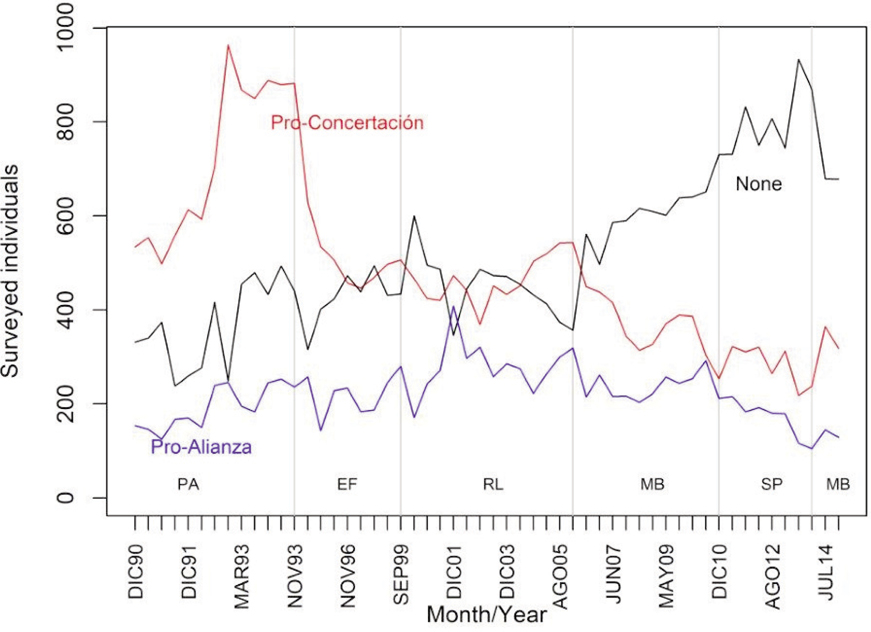
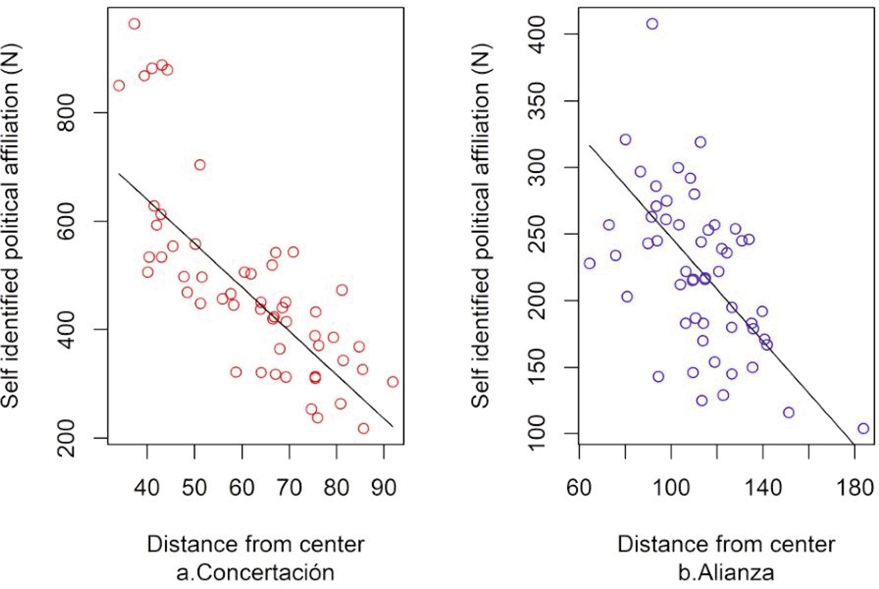
Now, when most citizens are mobilized, parties have leverage to choose which topics to move forward and prioritize on the public agenda, but that degree of freedom diminishes when the size of their political adherence is decreasing. And the latter is what happened in Chile. Chilean democracy has experienced a systematic demobilization of the electorate since the return to democracy. For example, voter participation diminished from 84 percent in the first democratic election to 49 percent in the last one under the Binominal. Demobilization is also observed in political affinity. Figure 3 shows how, from the end of the Aylwin administration on, the number of people who identified with coalitions systematically fell in CEP surveys to the point that, during the 2013 presidential election, the sum of those identified politically with the main coalitions was less than the number of people who identified themselves with none. Figure 4 also reflects how political affinity with the Concertación and the Alianza declined as their ideological platforms moved away from the ideological center. The pattern of increasing ideological detachment affected the electoral incentives for parties and coalitions.
Demobilization and Political Affinity in Chile, 1990–2014

Political Affiliation and Distance from the Center

A coalition’s political platform moves toward the center (predominance of centripetal forces) when the ideological detachment is smaller among moderates. Conversely, ideological platforms move away from the center (predominance of centrifugal forces) when moderates decrease faster. The estimation of ideological points among respondents presented in the previous section allows us to observe how political platforms moved from 1990 to 2014. For that purpose, we calculated the ideological positions of each party and coalition’s adherents by averaging the ideological points among respondents who claimed to be closer to them.
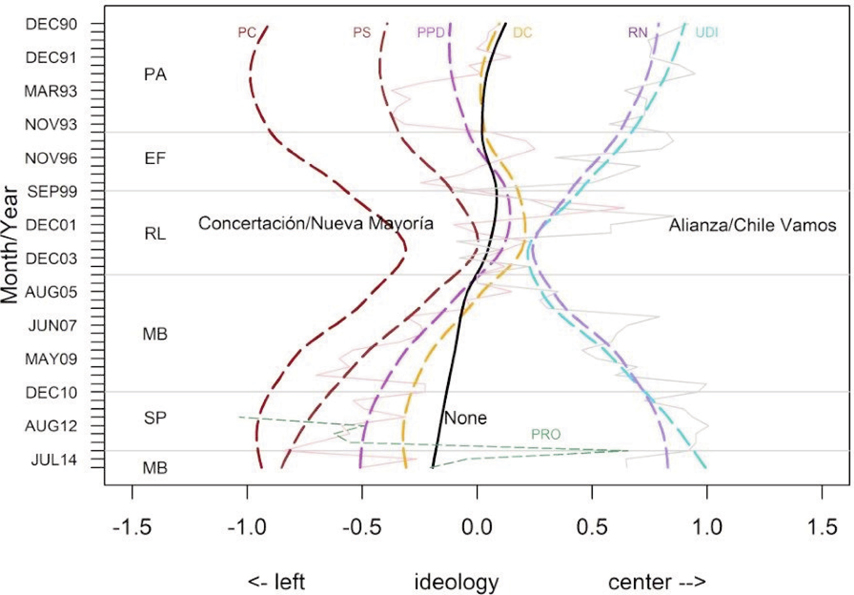
Similarly, the average of the ideological positions of those who claimed to be detached from parties represents the demobilized citizens. These results are shown in figure 5. The figure shows the estimated ideology for adherents to each coalition (the Concertación and the Alianza) and to neither of them with tiny zigzag lines. The brief segment between 2011 and 2014 is the estimation of the ideological position of the PRO (Partido Progresista, Progressive Party), the new party formed by Marco Enríquez-Ominami. In order to facilitate the visualization of these data, we chose to present the estimated trends of ideologies for main political parties using robust, locally weighted regression (Cleveland Reference Cleveland1979), implemented in R by the loess function. They are represented with dashed lines and labeled at the top of the graph as the Partido Comunista, or PC; Partido Socialista, or PS; Partido por la Democracia, or PPD; Partido Demócrata Cristiano, or DC; Partido Renovación Nacional, or RN; and Unión Demócrata Independiente, or UDI.
Ideological Points of Adherence to Parties and Coalitions in Chile, 1900–2014

According to the results summarized in figure 5, the trajectories of political platforms move to relatively moderate positions until Lagos’s administration, and they move to polarized ones thereafter. The case of the PC is an illustrative example. The figure shows that the Communist Party’s political platform moved closer to that of the Concertación during the Frei and Lagos administrations, returning during the Bachelet government to its original position.
Those movements preceded key political decisions made by the leaders of the PC. During the Aylwin, Frei, and Lagos administrations, the Communist Party held a critical view of the Concertación and tried to channel citizens’ dissatisfaction with the existing political system. Nevertheless, it suffered a significant decrease in its voting levels during the 2000 and 2001 elections, almost falling below the legal minimum to be considered a political party. Later, the PC changed its strategy and began to modify its positions to approximate those of the Concertación, as its adherents were already doing. In the 2005 presidential elections, the PC supported the Concertación’s candidate, Bachelet, in the ballotage.
In the 2009 parliamentary elections, the PC agreed with the Concertación to set a pact of omissions in some districts (i.e., the parties agreed that one of them would not present candidates in one district and the other would not do so in another in order to shore up votes and increase the chances of being elected). That agreement enabled the PC to obtain congressional representation for the first time since the return to democracy. Subsequently, during Piñera’s administration, the PC returned to its 1990s ideological position, but this time as part of the Nueva Mayoría.
Meanwhile, the Alianza maintained a position anchored toward the right. Its adherence also included a movement toward relatively moderate ideological positions until Lagos’s administration. During that period, intracoalition disputes intensified, but under the first Bachelet government, the UDI emerged as a winner in the intracoalition fight and managed to become the most voted party in the country, with the greatest representation in both chambers of Congress. When Piñera won the presidential election in 2009, both parties had returned to their ideological positions of the 1990s.
The most interesting changes in political platforms happened in the Concertación. This coalition’s platform also included a movement toward moderate positions during the first three administrations. But at the end of the period under study, all the main parties (PS, PPD, and DC) ended up in ideological positions to the left of their original ones. To understand this shift, it is important to take a look at the black line representing citizen demobilization. Between 1990 and 2014, the number of respondents who considered themselves unconnected with parties was not only growing but also shifting toward the center-left. This means that the moderates among the Concertación’s supporters were feeling increasingly disconnected from that political platform. Therefore, the demobilization had a greater effect on moderate voters in the Concertación, mainly damaging the DC’s sphere of influence.
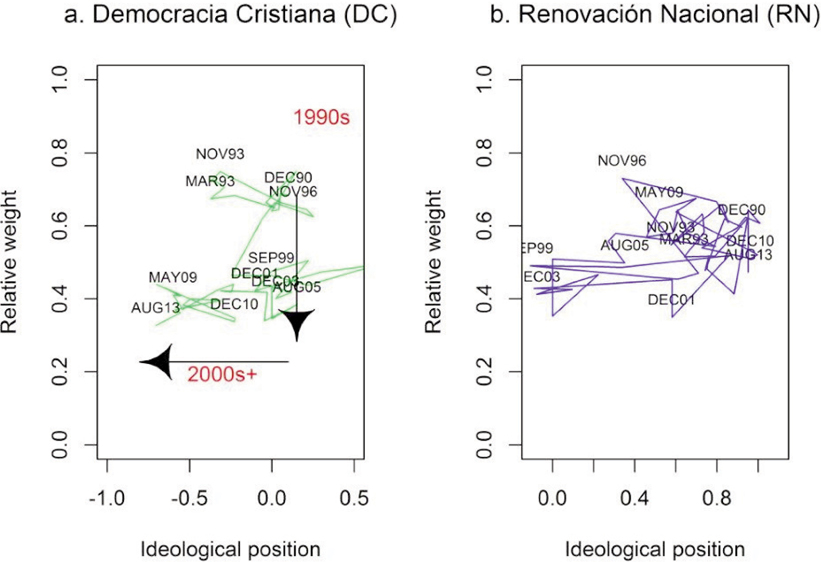
This can be further observed in Figures 6a and 6b. The horizontal axes measure the distance of the DC and RN from the ideological center. The vertical axes measure the relative weight of each party in the political platform formed by voters identifying with parties in each coalition. As figure 6a shows, there is an inverse relationship between the distance from the center and the relative weight of the DC within its coalition, meaning that this party’s political platform first contracted (in the period 1990–2000) and then moved away from the center (2001 and thereafter), a process generated by the demobilization of the moderates who used to vote for it. But the same did not happen to RN (see figure 6b) because that party did not decide to move to more moderate positions.
Relative Weight of the Most Centered Party in the Center-Left Coalition

As long as the DC remained the most voted party in its coalition, the contraction of its political platform did not have an effect on its intracoalition bargaining power. However, after Lagos’s decision to support Bachelet as the coalition’s candidate for the 2005 election (instead of Soledad Alvear, the DC’s precandidate), the moderate forces within the DC and the DC itself started a long and sustained fall. Thereafter, from its partners’ viewpoint, the DC had been subsidized beyond any reasonable measure (in parliamentary seats and executive positions), and therefore the intracoalition bargaining costs increased.
The emptying of the center caused by citizen demobilization, the RN’s shift closer to the UDI’s platform, the reduction of DC’s negotiating power within the Concertación, and the high costs of negotiating parliamentary quotas (especially in the center-left) should open spaces for enterprising politicians willing to conquer the center of the ideological distribution. Thus, if it were true that polarization was in motion, some political “entrepreneurs” might try to motivate the disaffected center by offering new political platforms. That was exactly what Socialist representative Marco Enríquez-Ominami (M. E-O) attempted. He was a former Concertación representative in Congress when he saw and seized an opportunity in 2009; he left the Socialist Party and launched an independent presidential candidacy. Although its origin was Socialist and therefore could have positioned him to the left, M. E-O decided to defend a program against what he called the duopoly (the Concertación plus the Alianza), appealing to the disenchanted electorate.
M. E-O also formed a working team with people from both the left and right. He was not able to go on to the runoff elections (ballotage), but he obtained a considerably high result: 20.1 percent of the vote. On those grounds, he later created a new party, the PRO. Figure 5 includes the average political ideology of those who identified themselves with PRO. As we can see, there is a great variation from the left to the right in the narrow period of time during which this party existed. This is an expected pattern for a party built around a political figure looking for an ideological platform. But the PRO also became closer to the center at the end of the period under study, during which M. E-O ran again as president (this time garnering only 10.98 percent of the vote), as an expected consequence of the polarization between the main two political forces.
After M. E-O’s venture, other political actors also left their original coalitions to conquer the median voter. For example, Lily Pérez (former RN senator) created a movement called Amplitud; Andrés Velasco (finance minister during Bachelet’s first administration and presidential precandidate in 2013) created a movement called Ciudadanos; and Felipe Kast (minister of social development under Piñera) created Evopoli. All these political undertakings introduced themselves as moderate parties representing the center. We will know whether they have better luck than M. E-O in the years to come.
In sum, the polarization observed in the middle of Lagos’s administration is consistent with the centrifugal incentives that the Binominal generates by shifting political competition from between coalitions to within the coalitions themselves. In the case of the Alianza, party leaders seem to be satisfied garnering the votes from the most right-wing third of the electorate. With this, the Binominal allows the Alianza to obtain enough seats to maintain a veto power with respect to structural reforms. In the case of the Concertación, the demobilization of the moderates also altered its intracoalition bargaining costs. The autocomplacientes lost power as the political platforms of the Concertación’s parties were moving toward the left. The end of consensus was not a consequence of citizens’ awakening in the 2010s. In the mid-2000s, this process was already in motion.
Concluding Remarks
Relying on spatial voting techniques to recover a latent, ideological dimension from survey data covering the whole period governed by Chile’s Binominal electoral system, this research estimates the ideological position established in the political platforms of Chile’s main coalitions and parties between 1990 and 2014. A pattern of polarization began in the middle of the 2000s. This pattern is consistent with the hypotheses put forward by Magar et al. (Reference Magar, Rosenblum and Samuels1998) and the partial evidence presented in Dow (Reference Dow1998), while Bonilla and Silva (Reference Bonilla and Silva2008) refer to the centrifugal forces within the Binominal. Moreover, the evidence presented here shows that this polarization is gradually increasing, a trend that previous studies were unable to show.
Moreover, we found that polarization was growing while adherence to political parties was contracting, a trend explained by political demobilization of the centrists. This latter pattern had important consequences. Given that demobilized citizens simply stayed at home and did not vote, polarized coalitions did not face threats to their share of power when an enterprising candidate (M. E-O) shook the political landscape in 2009. However, in 2012, a voluntary voting system replaced the compulsory one, and a new layer of uncertainty was introduced into the political turnout for the 2013 presidential and parliamentary elections.
Furthermore, the explicit polarization during the period in which the Alianza was in government (2010–14) substantively shifted the balance of power among the center-left parties. It was an intense period of citizen mobilizations, and the Concertación moved to the left by including the Communist Party in a new coalition, Nueva Mayoría. It was 2013, and the consensus democracy had lost its appeal. The Nueva Mayoría proposed a more progressive agenda, and its presidential candidate, Michelle Bachelet, was willing to invest all her political capital to move it forward. In that scenario, new groups emerged to conquer the center with still unknown results.
The idea to reform the electoral system and introduce a new law for political parties gained momentum. The Binominal was deliberately designed by Pinochet’s supporters to guarantee that the return to democracy would not jeopardize the structural reforms made during his regime. The objective was to produce a political balance induced by the rules of the electoral game. But as Riker (Reference Riker1980, 443) says, “Disequilibrium, or the potential that the status quo be upset, is the characteristic feature of politics.”
It would be of interest for further research to study whether, under the Binominal, disequilibrium was an unintended consequence caused by the predominance of its centrifugal forces. This is precisely the point where the comparison between centrifugal and centripetal forces applies: had the Binominal produced moderate platforms from which to choose, those changes would not have broken the longstanding equilibrium among its opponents and defenders. However, the increasing polarization caused by the demobilization of the moderates (centrifugal forces), the evidence of higher negotiating costs among political parties in the Nueva Mayoría, and the uncertainty created by the new voluntary voting system opened the door to an instrumental agreement between the Nueva Mayoría and some independent members of Congress, like Lily Pérez, looking forward to creating new political parties. A completely new electoral system was approved in less than a year.