Green parties have persisted and proliferated over the last several decades, but there is no consistent manner in which they have joined or supported governments, given the differing electoral systems and political opportunities and barriers they have encountered. Per Gahrton (Reference Gahrton2015) identifies four key types of participation: individual co-optation where a Green personality is individually co-opted into government; resilience-creating where Greens join government, not because their numbers are required, but because they provide resilience; necessity-based where Green participation is needed to achieve a parliamentary majority; and legitimacy-creating where Greens support minority government, which is the concern of this article.Footnote 1 It is less typical for Greens to support minority government than join coalitions, with Green parties having significant coalition experience in Eastern and Western Europe. Besides many instances of individual co-optation, there have been resilience-creating and necessity-based arrangements in a total of 10 European countries, but legitimacy-creating minority government support arrangements in only two (Gahrton Reference Gahrton2015: 84).
Support of minority government by Green parties is a ‘toleration’ approach (Rüdig 2002: 28–29), favoured by Green parties at the regional level in Germany and Tasmania, and at the national level in Sweden and New Zealand (Rüdig 2002: 22). It remains a rare occurrence. Between 1990 and 2006, the Swedish Greens were the only Green party in Western Europe that supported a minority government rather than joining a coalition government (Rihoux and Rüdig Reference Rihoux and Rüdig2006). And in Eastern Europe between 1990 and 2003 Green parties supported government exclusively in coalition (Rüdig 2006). In Denmark and Sweden (Gahrton Reference Gahrton2015), Green parties have joined coalitions to help form (rather than support) minority governments. Otherwise, the only other recent examples of Greens supporting national minority governments were in Australia (2010–13), New Zealand (2005–8) and Portugal (Lisi Reference Lisi2016).
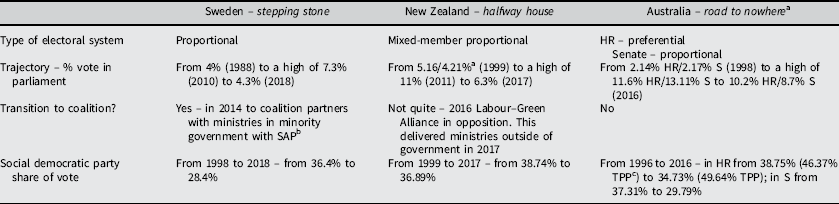
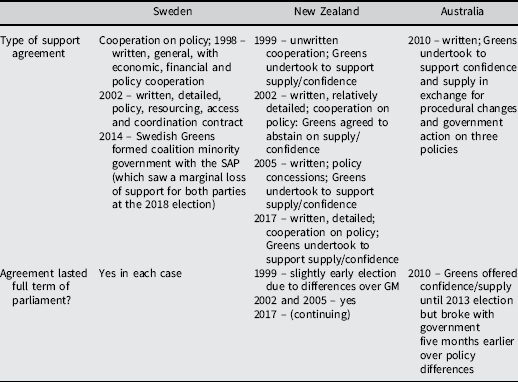
This article compares and contrasts three very different experiences of Greens supporting minority governments at various times, when they did not hold ministerial portfolios, in Sweden, New Zealand and Australia.Footnote 2 These instances of Greens supporting minority governments involved support arrangements with social democratic governments that lasted the whole or most of the government’s term and were largely based on written agreements outlining specific areas of policy cooperation or policy trade-offs in exchange for ‘confidence and supply’, although in differing parliamentary and electoral systems and contexts (Tables 4 and 5). In addition, the repeat experiences in Sweden and New Zealand, over 16 and 17 years respectively, can be contrasted with the recent first-time experience in Australia.
We are interested in where Green support of minority government leads, if anywhere, after such repeat instances. Is it a stepping stone, a halfway house or a road to nowhere in terms of support of, or participation in, subsequent governments? And given that it is more tenuous than coalition, does it nevertheless offer policy benefits sufficient to insulate Greens against subsequent electoral loss? We explore party trajectory and policy gain across three countries over 20 years and in doing so inevitably identify further questions. How does the political trajectory of Green parties differ from others that support minority governments, for example? How do Green policy gains in support circumstances differ from gains in coalition? And what do Green members think about the costs and benefits of supporting the government? These are all questions for future research.
Political trajectory, minority government and policy impact
The political trajectory of Green parties warrants consideration for a number of reasons, including the significance of their ability to displace votes from other parties, and the various ways in which they work in differing circumstances to impact upon policy. Mogens Pedersen (Reference Pedersen1982: 3) suggests that the mapping and analytical discussion of minor parties, including consideration ‘of their origins, their fates, and their political impacts’, can be aided by the construction of a party lifespan heuristic. According to this, parties will eventually pass – or avoid – important thresholds as they increase or decrease in strength. These include: declaration as a party; authorization in being able to contest elections; representation where parliamentary seats are gained; and finally, relevance in terms of helping form government (Pedersen Reference Pedersen1982). Although Pedersen sees relevance as difficult to define, Ferdinand Müller-Rommel (Reference Müller-Rommel2002: 3) suggests that it refers to ‘the impact of small parties on government formation and government policy output (ideally as coalition partners in national governments)’. Furthermore, the passing of the threshold of relevance has correlated, for most European Green parties, with sustained electoral performance that in turn has ‘strengthened both the organisational structure and the overall stability of the Greens in these countries’ (Müller-Rommel Reference Müller-Rommel2002: 7). It is less clear, however, whether this is true of Green parties that have supported minority governments, nor what was actually delivered in (Green) policy terms as a result of enhanced influence.
Of course, political trajectory is always specific to context and circumstance (Rihoux and Rüdig Reference Rihoux and Rüdig2006: S10). Parties will cross Pedersen’s thresholds more easily, for example, in countries with an electoral system of proportional representation. In Westminster systems, it is rare for the Greens to cross the representation threshold at all, with only one Green currently in each of the UK, Canadian and Australian lower houses of parliament. The Green vote may build in a Westminster system, as it has in Australia (Table 3), but without translation into the number of seats in parliament that proportional representation would deliver (Table 1). Equally significant is the nature of the party system. Two-party dominant Westminster systems such as Australia’s, for example, would not typically return minority governments, which are the norm for multiparty systems such as Denmark’s and Norway’s. It can happen, however (Russell Reference Russell2008), as it has occasionally in the UK (Paun Reference Paun2011) and does with regularity in Canada, where there is no tradition of coalition formation (Conley Reference Conley2011). However, the Greens have not yet supported a national government in either of these countries. By contrast, in multiparty systems it is more typical for Greens to join governing coalitions (Rihoux and Rüdig Reference Rihoux and Rüdig2006), although the Swedish and New Zealand Greens only contemplated forming a coalition and an alliance respectively after several earlier experiences of supporting a national minority government.
Swedish Greens’ General Election Results, 1998–2014

Sources: Aylott and Bolin (Reference Aylott and Bolin2015); Burchell (Reference Burchell2008); Swedish Electoral Authority, www.val.se/val_och_folkomrostningar/.
It is important, then, to acknowledge that the political trajectory of Green parties, and their policy impact, relies on favourable institutional and political conditions (Rihoux and Rüdig Reference Rihoux and Rüdig2006: S10), which will vary at differing times in differing circumstances and shift over time. The three cases examined here differ in terms of parliamentary and voting systems, with Sweden and New Zealand both being unitary systems, Sweden with proportional representation and New Zealand with mixed-member proportional, and Australia having a bicameral, federal parliament with proportional representation in the Senate and a preferential system in the House of Representatives. As discussed below, these differing systems have resulted in different political trajectories. Furthermore, our analysis of circumstances in Sweden, New Zealand and Australia shows that Pedersen’s shift from representation to relevance is not easily executed for a minor party, and, in each of these cases, was initially presented as an invitation to support a minority government. Such an invitation offers a pathway to subsequent participation in government; however, the immediate focus by the minor parties at such times is upon policy gain, as we have seen recently in the UK (ABC 2017), and in British Columbia (BCGC and BCNDC 2017). Kaare Strøm (Reference Strøm1990: 38) observes that minor parties in these circumstances are highly likely to be motivated by policy-seeking rather than office-seeking behaviour. The invitations to support minority government were propitious in each of our cases for offering potential policy gain, but also for providing the opportunity to develop trust and familiarity between Green and social democratic parties as the basis for improved future governing relationships. Only after repeated experiences of supporting minority government in Sweden and New Zealand were the Greens offered ministries, respectively within and outside of social democratic minority government, and with them potentially enhanced policy leverage.
In terms of research methodology, we collected primary (debates, party manifestos, agreements, election results and press releases) and secondary textual information and subjected it to comparative-historical analysis. This assisted in our charting of the political trajectory of Green parties that have supported minority governments, their crossing of Pedersen’s threshold of relevance, and our determining of any subsequent policy influence. Patterns over time, including support details and agreements, party positioning, electoral results and trends in major- and minor-party support, are identified, debated and discussed (Tables 4 and 5). We discern comparative results that facilitate a discussion and assessment of the impact of Green support of minority governments in terms of party trajectory and policy gain.
Determining the policy impact of a minor party that has supported a minority government is more difficult (Pedersen Reference Pedersen1982: 3), given that the literature equates generic policy impact with the tangible indicators of office, portfolios and votes (Elklit Reference Elklit1999: 82–3), whilst the Greens’ literature is often focused on policy constraints and lack of influence. Here we review primary and secondary documentation in order to comparatively establish influence where Greens cross what we are calling a ‘policy impact threshold’ as a nuance of Pedersen’s (Reference Pedersen1982) various thresholds. We describe influence by distinguishing between three types of policy reforms: signature reforms or achievements sought by Greens in return for supporting a minority government; parliamentary and policy-based process reforms that Greens routinely seek; and crash-through or crash reforms that can make or break a governing arrangement (Crowley Reference Crowley2003).
In the remainder of this paper we address our primary research concerns: the experience and trajectory (and indeed the comparative trajectory) of national Green parties that have supported minority government; and the Green policy gains or impacts in these circumstances. Whilst the experience of Green parties in national coalition governments is now well documented, we consider the less common minority government experience. Our article is inspired by the scholarly attention that has focused to date on this latter experience (for example Bale Reference Bale2003; Bale and Bergman Reference Bale and Bergman2006a, Reference Bale and Bergman2006b; Bale and Dann Reference Bale and Dann2002; Burchell Reference Burchell2001, Reference Burchell2002; Hazell and Paun Reference Hazell and Paun2009) and expands upon and updates the comparative work, with greater emphasis on party trajectory over time and policy outcomes. We consider whether such arrangements proved, over time, to be a stepping stone, a halfway house or a road to nowhere in terms of leading to Green participation in subsequent governments, and what they delivered, if anything, in terms of Green policy gains and enhanced influence.
Supporting national minority governments
National-level Green parties arose in Sweden, New Zealand (Gahrton Reference Gahrton2015) and Australia (Miragliotta Reference Miragliotta2006) in differing contexts but prompted by the common failure of the major parties to adequately articulate environmental concern. In Sweden and Australia their formation was preceded by subnational Green party activity that afforded the Greens significant prior experience to draw upon when they entered the national parliaments (Burchell Reference Burchell2001; Miragliotta Reference Miragliotta2012). This was achieved in 1988 in Sweden, in 1996 in Australia’s Senate, and in 1999 in New Zealand after the shift there to a mixed-member proportional representation (MMP) electoral system. Greens in each country have since supported social democratic minority governments: three times in Sweden, four times in New Zealand and once only recently in Australia. Since entering parliament, the Green vote has generally risen over the long term in each country, with dips at times, however – for example, in Australia in 2013 after supporting minority government, but also due to other party-political and broader contextual factors. In this sense, while the three instances occurred in different electoral and parliamentary systems, they reveal similar party trajectories, with differing details, but similar timelines, opportunities and outcomes, and a common decline in support for social democrats. Each case will be examined in a novel fashion in terms of the literature thus far, namely by establishing the Green political trajectory and minority government support circumstances, before considering the policy leverage that may have been achieved at various times.
Sweden
The Swedish Greens, Miljöpartiet de Gröna, founded in 1981, first entered Sweden’s unicameral legislature (Rikstag) in 1988 aided by an electoral system of proportional representation. They have since supported the Socialdemokratiska Arbetarepartiet (SAP) in minority government in 1998 and in 2002 (both with the Left Party), before achieving coalition status in 2014 when they entered a coalition minority government with the SAP, which included Green ministers for the first time. Whilst the trajectory of the Greens’ vote (Table 1) has been marginally upwards since 1998, with no significant dips before 2018, support for the Greens has oscillated, at times dangerously close to the 4% threshold required to win seats (Johnson Reference Johnson2016). The poor 2018 results show the electoral impact of the Greens’ policy difficulties and backflips, on immigration in particular, and arguably that voters are more comfortable with Greens supporting rather than forming government (Anderson and Erlanger Reference Anderson and Erlanger2018). Despite promising beginnings (Hinde Reference Hinde2014), the Greens struggled in office, with two ministers resigning and criticism of their lack of impact on energy, transport and immigration policy (Duxbury Reference Duxbury2017). Whilst the lead-up to the 2018 election had been dominated by anti-immigration politics, heatwaves and wildfires briefly refocused debate on climate change and environmental issues (Henden Reference Henden2018). The party lost half its membership after joining the government (MSE 2018) and achieved its lowest vote for 20 years at the 2018 poll (Table 1), albeit in circumstances that also saw Sweden’s left–right bloc politics disrupted by an anti-immigrant party.
In terms of their earlier support of a minority government, in 1998 and 2002, the Greens secured ‘toleration’ (Rüdig Reference Rüdig2002) agreements with the SAP, delivering it two full terms in office as a minority government, initially exchanging their support for cooperation on select issues of concern to both parties (Table 5). The Greens had pioneered similar minority government support agreements during the late 1980s and 1990s at the municipal level, which allowed the party ‘to disassociate itself from policies that it could not tolerate’ (Burchell Reference Burchell2001: 246). Tim Bale and Torbjörn Bergman (Reference Bale and Bergman2006b: 432) refer to these agreements in general as ‘contract parliamentarianism’ and note that, over the 1990s in Sweden and New Zealand, they became ‘longer and more specific’, both symbolizing and institutionalizing ‘a developing system of not so much minority government as minority governance’. The parties agreed in 1998 to cooperate on ‘the economy (the state budget), employment, distributive justice, gender equity and the environment’ (Bale and Bergman Reference Bale and Bergman2006b: 433). The scope of issues expanded considerably in the 2002 iteration, with broad areas complemented by more specific detail, as well as detailed coordinating and advisory staffing arrangements, joint press conferences and regular party leaders’ meetings (Bale and Bergman Reference Bale and Bergman2006b).
These agreements ensured that the Greens retained their independence, thereby mollifying their base, whilst allowing them to demonstrate competence and reliability in dealing with policy and legislation, but left them frustrated over their lack of influence (Bale and Bergman Reference Bale and Bergman2006a; Burchell Reference Burchell2001, Reference Burchell2002). Nevertheless, in the wake of the 1998 and 2002 experiences, their electoral support marginally improved. The party had learned, from its extensive participation within and support of local governments, how to move beyond parliamentary representation to relevance, including making an impact on policy (Burchell Reference Burchell2001). Invariably this involved working with other parties. After the SAP lost seats in 2006, the Greens and the Left briefly joined it in a ‘Red–Green Alliance’ which earned an increase in support for the Greens in 2010 but saw the SAP continue to decline (Aylott and Bolin Reference Aylott and Bolin2015). This placed the Greens in a stronger position to achieve the coalition status they had previously been seeking (Burchell Reference Burchell2008) and led to their entering a two-party coalition minority government with the SAP in 2014 (Gahrton Reference Gahrton2015). Foremost on the Greens’ agenda in government were environmental taxes, forestry restrictions, no new Stockholm bypass and nuclear reactor closures, which set them up for conflict with their coalition partner (Aylott and Bolin Reference Aylott and Bolin2015).
New Zealand
The Green Party of Aotearoa-New Zealand, founded in 1990, first entered New Zealand’s unitary, unicameral legislature (Pāremata Aotearoa) in 1996, aided by the newly introduced system of MMP and a 5% electoral threshold. After leaving a leftist alliance, seven Greens were elected in 1999.Footnote 3 The Greens then supported Labour in a minority government for three terms until it lost the 2008 election. Over this time the Green vote grew, peaking at 11% (Table 2), nearly double the Swedish Greens’ highest vote, and positioning the party for the striking of a cooperative Labour–Green Alliance (LGA) in 2016 (Edwards Reference Edwards2017). This saw Labour and the Greens coordinate parliamentary business and investigate joint policy and/or a joint election campaign between the parties, with ‘no surprises’, but did not rule out working with other parties (Roy Reference Roy2016). In 2017, Labour formed a minority government with the populist New Zealand First (NZF) party – which otherwise would have supported the Nationals – with the Greens holding their first ministries but outside cabinet (Hurley and Gower Reference Hurley and Gower2017). Besides holding portfolios but not sharing office, which constrains their influence and performance, the Greens’ role is to ensure confidence and supply for the minority coalition government (Roy Reference Roy2017; Small Reference Small2017).
New Zealand Greens’ General Election Results, 1999–2017

Source: NZEC (2017).
Note: aThe first percentage is the party list result, the second for individual electorates. 1999 is the only election at which the Greens achieved an electorate seat.
Whilst the Swedish SAP had only the Greens and the Left to deal with as support parties, the New Zealand situation began as more complicated, with an abundance of splinter parties vying for involvement. In 1999, Labour formed a coalition minority government with the leftist Alliance (New Labour, the Democrats, the Liberal Party and Mana Motuhake) and arranged only an unwritten agreement with the Greens in which the latter agreed to support the government on confidence and supply (Bale and Bergman Reference Bale and Bergman2006b). The government did agree to keep the Greens informed and to listen to their suggestions on an ad hoc basis; however, relations between the parties were severely strained over policy and the Greens’ feeling that they were often ignored or taken advantage of (Bale and Dann Reference Bale and Dann2002). The Greens became a de facto opposition pursuing their own policies – for example on animal welfare, and their opposition to New Zealand’s role in the war in Afghanistan (Bale Reference Bale2003) and the government’s support of genetically modified (GM) crops (Bale Reference Bale2003; Bale and Bergman Reference Bale and Bergman2006a, Reference Bale and Bergman2006b). Not surprisingly, then, after the 2002 election Labour formed a minority coalition government with the Progressive Party and secured a confidence and supply agreement with the centrist United Future Party, while striking only a lesser cooperation agreement with the Greens (Yong Reference Yong2009).
However, agreements with the Greens in 1999, 2002, 2005 and 2017 (Table 5) showed that the parties learned the lessons of cooperation that secured a range of near-full-term governments.Footnote 4 The 2002 agreement was based on cooperation, good faith and consultation on shared policy, providing for procedural matters, while securing confidence and supply from the Greens (Yong Reference Yong2009). In 2005, the Greens struck a similar agreement, with the difference that they agreed not to withdraw confidence and supply, but this time in return for the right to develop policy and to provide spokespersons on issues (NZLP and GPANZ 2005). Meanwhile, two smaller support parties, which would not countenance Greens in government, signed innovative ‘enhanced confidence and supply agreements’ that delivered them ministerial positions outside cabinet (Yong Reference Yong2009: 43). This informed the Confidence and Supply Agreement (NZLP and GPANZ 2017) that delivered the Greens their first ministries. The Greens will be tested on multiple fronts (in terms of policy delivery, compromise, disappointments and the consequences for membership and support), with limited capacity in their halfway house outside government (Cooke Reference Cooke2018; Espiner Reference Espiner2018).
Australia
Unlike Sweden and New Zealand, Australia is a federation with a bicameral national (federal) parliament and government formed in the lower house, the House of Representatives (HR), although the elected Senate (S) has almost equal powers. Following several false starts, the Australian Greens (AG) was founded in 1992 as a confederation of long-established subnational (state-level) parties that formalized candidates under the Australian Greens banner for the first time at the 1996 election (Miragliotta Reference Miragliotta2012). Although various green politicians had previously sat in the Senate, aided by a proportional representation (PR) system, the AG gained their first Senate seats in 1996, and HR seat in 2002 at the Cunningham by-election. The trajectory of their vote has been from 2.14% (HR)/2.17% (S) in 1998, to a high in 2010 of 11.76% (HR)/13.11% (S), with a significant slump in 2013 after supporting the Labor minority government, which was extremely unpopular (Table 3). While the vote rose again in the HR in 2016, it increased only marginally in the Senate, perhaps reflecting the increasing diversity of candidates, and thus increased competition, in this chamber. As of 2018 the Greens have nine senators; however, the HR’s preferential system, which requires 50% plus one vote for a candidate to be elected, is a formidable obstacle to minor party representation. The major parties, Labor and the Coalition (the Liberal and National parties), are therefore dominant. The Greens have supported only one national minority government and have never formed a national coalition government, although state-level Green parties have been the sole support for minority governments on numerous occasions, at times with cabinet positions.
Australian Greens’ General Election Results, 2010–2016

Source: AEC (2016).
Note: aHouse of Representatives (HR) result; Senate (S) result.
The 2010 election result was a breakthrough for the Greens on a number of fronts. They achieved an electoral high with a double-digit vote in both houses, which in Sweden or New Zealand would have made them a coalition contender with nearly 20 HR seats, rather than one. They gained the balance of power in both houses (McCann Reference McCann2012), albeit shared in the lower house, and were then relied upon to support a Labor minority government (Costar Reference Costar2012).Footnote 5 Their success was attributed to the popularity of leader Bob Brown, his support for the government’s stimulus response to the global financial crisis, the fading popularity of the internally destructive Labor government and a lack of trust in the major parties (MacAllister et al. Reference MacAllister, Bean and Pietsch2012). Labor and the Greens negotiated a four-page agreement, modest in comparison to the 33-page, multi-billion-dollar agreement with the regional independents. In return for their support (i.e. supply and confidence), the Greens received policy deals, including a commitment to national carbon pricing, and procedural concessions (AG-ALP 2010).
In Australia’s ‘majoritarian’, two-party-dominant Westminster system, there had been only one other experience of federal minority government, and the new Labor minority government was attacked as unstable and incompetent from the outset (Hartcher Reference Hartcher2010). Agreements with the Greens and independents were key to the government running for its full term despite internal tensions, a leadership change, strained relations between the government and the Greens and the independents who supported it, and the upheaval caused by reform (Swan Reference Swan2014). Although this first-time experience is very recent, Green parties in Australia have had two decades of supporting state minority governments, and their leader and deputy personally understood the challenges (Crowley Reference Crowley2003). However, the growth of the national Green vote from 1998 parallels the decline in Labor’s vote (Table 4), so to keep faith with both their bases, Labor distanced itself from the Greens early in the government (Gillard Reference Gillard2011) and the Greens abandoned the increasingly besieged government prior to the election (Milne Reference Milne2013).Footnote 6 Labor lost office in 2013 and failed to regain it in 2016, and Labor–Green relations remain strained today (Crowe Reference Crowe2018). The Greens, who suffered a brief setback in 2013, are attempting to expand their representation beyond the Senate to gain more seats in the HR. In Australia’s majoritarian party system, this would mean gain at Labor’s expense, so a Labor–Green alliance remains unlikely in the near future with the deep differences and animosity between the parties made clear in speeches by their respective leaders (Gillard Reference Gillard2011; Milne Reference Milne2013).
Green Support of Minority Government: Systems and Political Trajectory

Notes: HR – House of Representatives; S – Senate.
a The first percentage is the party list result, the second for individual electorates. 1999 is the only election at which the Greens achieved an electorate seat. Source: NZEC (2017).
b SAP – The social democratic Socialdemokratiska Arbetarepartiet.
c TPP – Two-party preferred. The effect of the preferential system inflating the major party vote can be seen.
Comparative trajectories
The Swedish case study shows that support for a minority government was a stepping stone that after 16 years led the Greens to full partnership in coalition government, with no significant electoral harm experienced until coalition including ministries was achieved for the first time. The New Zealand case confirms that support for a minority government was more often a halfway house, with electoral setbacks, but also that, after 17 years, it led to an alliance with Labour and ultimately ministries for the first time. The Australian case study shows that this very recent first-time experience of the Greens supporting minority government in a majoritarian, two-party preferred Westminster system is currently a road to nowhere. These three situations are obviously quite different and each is subject to change. However, to date there have been several constants: the incrementally increasing Green vote over the last two decades notwithstanding rises and falls;Footnote 7 the incrementally decreasing vote for social democrats (although not always going to the Greens); and the increasing sophistication of support arrangements where Greens support minority governments. The cases also show the stability, if not ease, of these arrangements, and that any electoral cost to Green parties from supporting minority government is not lasting, nor does it preclude repeat arrangements (Table 4). Sweden and New Zealand show, furthermore, that it took almost two decades of working with the social democrats to build trust and gain ministries for the first time, although the Greens have struggled to make an impact in these.
The differing outcomes can be explained in terms of differing party systems, differing institutional and behavioural contexts, leadership styles and historical relations between the parties that offer differing opportunities for, and constraints upon, Green parties supporting government. The extent to which a minority government needs Green party support is also significant but will vary markedly over time, both within and between countries. Nevertheless, Green–social democratic relations are key to the differing minority government support arrangements involving Green parties in Sweden, New Zealand and Australia. In Sweden, a more comfortable relationship in a consensual context has evolved between Greens and Social Democrats, leading to a minority coalition, than in New Zealand and Australia. In New Zealand, there is residual distrust, with the Greens kept at a distance and, in Australia’s adversarial majoritarian political context, there is enduring animosity as the Greens threaten Labor’s electoral support and status as a major party (Crowe Reference Crowe2018).
Having compared and contrasted the experiences of Greens supporting minority governments, we next consider what this transitioning closer to government delivered in terms of various categories of recognizable policy gains.
Crossing the ‘policy impact’ threshold?
In each of the Swedish, New Zealand and Australian case studies social democratic parties short of a majority sought assurances from the Greens of their support, at times offering policy concessions in return (see Table 5). Instances of some of the Swedish and New Zealand policy outcomes are well documented and analysed by Tim Bale and Christine Dann (Reference Bale and Dann2002), Bale (Reference Bale2003), Bale and Bergman (Reference Bale and Bergman2006a, Reference Bale and Bergman2006b) and Bale and Magnus Blomgren (Reference Bale and Blomgren2008). Their analyses, besides inspiring this research, have confirmed that, contrary to the traditional office-seeking accounts, these Green parties are classically ‘policy-seeking’: entering parliaments as advocates for ecology, the environment, social justice and the future (Gahrton Reference Gahrton2015) but that their influence in minority government situations varies. However, it is not easy to attribute policy influence to the Greens because, as is observed where Greens join coalitions, ‘[n]ot necessarily every policy change in line with Green demands that occurred during their period in office can be ascribed to their influence’ (Rihoux and Rüdig Reference Rihoux and Rüdig2006: S16). There is also an atmosphere of policy competitiveness between the government and support parties – for example, in the rush to take credit for the same policy, or where the government co-opts and then ‘owns’ a Green proposal (Bale and Bergman Reference Bale and Bergman2006a).
Details of Support Agreements

Sources: AG-ALP (2010); Bale and Bergman (Reference Bale and Bergman2006b); Liddy (Reference Liddy2010); NZLP and GPANZ (2017).
Here we introduce the notion of a ‘policy impact threshold’ to focus attention on the policy efforts and outcomes of Green parties supporting minority governments, further to the relevance (Pedersen Reference Pedersen1982) of achieving support status. In the absence of greater clarity as to what policy influence may be in these circumstances, we are, in this instance, considering it in terms of: signature reforms or key achievements sought by the Greens in return for supporting minority governments; parliamentary and policy-based process reforms that Greens routinely seek; and crash-through or crash reforms that are contentious and can make or break a governing arrangement (Crowley Reference Crowley2003). These reforms, and indeed all policy achievements, are difficult to identify and categorize precisely, so we have at least chosen three distinctly differing reform types that enable a qualitative discussion of policy outcomes over the period of the respective governments. Strøm (Reference Strøm1990: 23, 26) acknowledges that supporting a minority government offers an opportunity for a minor party to achieve some policy leverage. However, thus far there are no systematic measures of policy influence in these circumstances.
We can nevertheless learn what the Greens were seen to have gained as key achievements, or what they themselves thought that they gained, from supporting government. We can also reflect upon the less-recognized reforms of parliamentary and other processes that were adopted as a consequence of the Greens supporting a minority government. And, importantly, we argue, we can reflect upon the policy frustrations felt by Green support parties that may have precipitated the end of the support arrangement or minority government. There are lessons to be learned from failed policy influence or policy disputes between support parties and minority governments in terms of what these parties stand for, but also ways in which such disputes can be better managed in future arrangements.
Signature Green reforms
Between 1998 and 2002 the Swedish Greens’ support of minority government delivered policy outcomes ‘close to exceeding the capacity of the Greens to dream up projects’ in eco-taxation, nature protection, regional spending, energy, transport, building, agriculture and forestry (Bale and Bergman Reference Bale and Bergman2006a: 201). Even as the Greens were pleased with the scope and funding of these projects (Bale and Bergman Reference Bale and Bergman2006a), they were critical of the government’s carbon dioxide emissions target, and of the lack of a timetable for decommissioning nuclear power (Elander Reference Elander2000), both signature issues for the party. They regard ‘nuclear decommissioning, international solidarity and peace, and alternatives to the traditional growth economy’ as ‘core issues’ in any discussions or involvement with government (Gahrton and Aylward Reference Gahrton and Aylward2010: 4). Many proposals from the Greens were either only partially supported or, in the case of those more threatening to the economic and geopolitical status quo, rejected outright by the SAP – for example, a Tobin tax or the banning of genetic modification (Bale and Bergman Reference Bale and Bergman2006a). The Greens’ ongoing failure to achieve nuclear decommissioning (Gahrton and Aylward Reference Gahrton and Aylward2010) reflects the difficulties of achieving signature reforms, particularly those of a transformative nature, as could be seen during the 2014–18 coalition with the SAP (Orange Reference Orange2018). However, early in the coalition, the Greens claimed a number of achievements, climate-smart housing, a target of 100% renewable energy, enhanced environmental protection, investment in education, and providing a global role model in terms of feminism, the environment and human rights by ending military cooperation with Saudi Arabia (Miljöpartiet de Gröna 2014).
For the New Zealand Greens, the banning of genetically modified food is a significant but failed reform aim. After achieving a Royal Commission and a voluntary moratorium process in 2000 (Hobbs Reference Hobbs2000), they fell out with the Labour minority government over making the moratorium a pre-condition of their continued support beyond the 2002 election (Bale and Blomgren Reference Bale and Blomgren2008). This overshadowed their policy gains during the first term of supporting Labour, which, although including some that appealed to their constituency (Bale and Dann Reference Bale and Dann2002), were otherwise financially and symbolically minimal (Bale and Bergman Reference Bale and Bergman2006a). The party itself, though, reported more substantial achievements, such as NZD$31.4 million in environmental, health and education funding with energy efficiency the legislative centrepiece (2000–2001) and NZD$30 million funding for further Green initiatives in 2002 (GPANZ 2016). While Bale and Bergman (Reference Bale and Bergman2006a) point to the Greens’ failure to influence policy after their 2002 GM walk-out, the achievements noted by the Greens (GPANZ 2016) from supporting the government include their successful call for the government to buy back the nation’s railways (2003), initiatives in sustainable transport and their achievement in the 2005–8 term of around NZD$138 million for programmes such as Buy Kiwi Made, energy efficiency, climate change research, school nutrition and further community, education, health and environmental initiatives. While the New Zealand Greens achieved no signature reforms, such as a ban on GMOs, they did make progress in areas of core interest, such as energy efficiency, sustainable transport and public infrastructure. Their achievement of the climate change and conservation portfolios in 2017, and Labour’s support for Green priorities (NZLP and GPANZ 2017) may still see signature reforms achieved.
The Australian Greens’ experience was very different from New Zealand’s, in particular in the sense of having 20 years of state-level experience of supporting minority governments behind them when they struck their agreement to support Labor in 2010. Lessons had been learned about contract parliamentarianism from repeat experiences at the subnational level starting in Tasmania in 1989 (Pybus and Flanagan Reference Pybus and Flanagan1990), and the Greens placed their emphasis in 2010 on achieving signature reform. In return for their support (i.e. supply and confidence) of the Labor minority government, the Australian Greens received policy deals and procedural concessions, providing, amongst other things, the introduction of national carbon pricing and national dental health care as signature reforms (Liddy Reference Liddy2010). Action on climate change had been their top priority for many years and, following years of government recalcitrance, inadequate action and policy failure, the minority government gave them the opportunity to achieve it (Jozo Reference Jozo2012). Meanwhile dental health reform was a social policy win for the Greens (Liddy Reference Liddy2010), although the subsequent coalition government repealed both this and the Clean Energy Act. Otherwise the Greens claim campaigning efforts for environmental, welfare, social justice and accountability reform as their attempts to make a difference during their support of the Labor government (Australian Greens 2013).
Parliamentary and policy-based process reforms
By including various process reforms, for example access to ministers, parliamentary staff and other resources, agreements between governments and support parties can help ensure effective government while maintaining political distinctiveness (Boston and Bullock Reference Boston and Bullock2010; Griffith Reference Griffith2010). These agreements between minority governments and Green support parties in Sweden and New Zealand have become ‘longer and more specific’ over time as the system of ‘minority governance’ has evolved (Bale and Bergman Reference Bale and Bergman2006b: 432). This has included increasingly clear process reforms that would see the Greens better resourced and taken more seriously by the government as well as reforms to improve the processes of parliament itself (McCann Reference McCann2012). Such reforms are critical to enhanced policy impact for Green parties, for example for prioritizing either a specific reform such as carbon pricing, a process to investigate reform such as a ban on genetically modified food, or areas of policy cooperation like eco-taxation. They can also document the issues on which the Greens and the government will cooperate, those on which they agree to disagree, policy concessions that have been made, and the processes by which to explore others (AG-ALP 2010). Green parties in Sweden and New Zealand have used such agreements to ensure increased access to and consultation with the government and public sector (Bale and Bergman Reference Bale and Bergman2006b) and to clarify collective responsibility in relation to portfolio responsibilities (NZLP and GPANZ 2017). In Australia, the government signed a further Agreement for a Better Parliament with the Greens and independents to reduce partisanship, secure their involvement in parliamentary process, set up an independent Parliamentary Budget Office and investigate the establishment of a National Integrity Commissioner (DPS 2013).
Crash-through or crash reforms
Support parties’ lack of policy influence can be identified in ‘crash-through’ or ‘crash’ reforms, when the actions of the governing party go so much against the core principles of the support party that it feels impelled to take drastic action, potentially threatening the support arrangement (Crowley Reference Crowley2003). The government may seek backing for legislation or policy that cuts very much against the support party’s principles, fully aware that the reform will either fail, and with it possibly the government, or crash through the obstacles and succeed. So there can be brinksmanship on both sides, and the looming context of the next election can play a part as the government and those supporting it return to appealing to their bases, which a battle over contentious reform can do. Either the government or the support party may feel compelled by bad polling, for example, to build popularity by distinguishing itself from its partner(s) in the minority government and their policies.
This has not been the experience thus far in Sweden despite the lack of progress on the signature issue of nuclear decommissioning. Bale and Bergman find no political drama between the SAP and the Swedish Greens, beyond both occasionally voting with the opposition (2006a: 199), possibly because the Greens’ policy gains were already quite substantial (2006a: 201) and politics in general is more consensual in Sweden. By contrast, the issues that broke the Greens’ minority government support arrangement in New Zealand in 2002 was a parliamentary vote to end the moratorium on GM crops (Bale Reference Bale2003), and in Australia, in 2013, the government’s watering-down of a new mining tax that was intended to have raised significant revenue (Milne Reference Milne2013) – both issues that played out in a pre-election context. In neither case did the Greens force an early election, although the New Zealand Labour government called an election several months early and used the GM issue to campaign against the Greens. In Australia, the Greens used their inability to sway the government on environmental protection, wilderness issues, coal-seam gas and coal export to justify abandoning their agreement (Milne Reference Milne2013: 7). But both Green parties still guaranteed supply and confidence until the next election.
Discussion – stepping stone, halfway house or road to nowhere?
This review of Greens supporting minority governments reveals similarities and differences between the experiences in three countries in terms of leading to participation in subsequent governments and delivering Green policy gains and enhanced influence. When viewed over the last two decades, the Green vote in each place can be seen to have been on a long-term upward trajectory, despite peaks and dips, most notably upwards in Australia and New Zealand whilst less so in Sweden until 2018 (Table 4). In terms of how support for the Greens correlates with their support of minority governments, support rose in each of the elections following the end of this experience in Sweden (in 2006 and 2010) and New Zealand (in 2008, 2011 and 2014). But it fell significantly at first in Australia (in 2013), in line with the swing against the government, before rising again at the next election in the House of Representatives if not in the Senate. In both Sweden and New Zealand future research will examine any electoral consequences of the Greens forming their alliances with the social democrat/labour parties and accepting ministries, respectively within and outside cabinets in minority governments (Espiner Reference Espiner2018; Orange Reference Orange2018).
Although Greens have supported conservative governments (Crowley and Tighe Reference Crowley and Tighe2017), in the instances we have examined here they supported only social democratic governments, almost exclusively by way of increasingly sophisticated contract parliamentarism, and almost exclusively running full term. The ‘toleration’ model has thus largely outgrown the lack of viability identified by Wolfgang Rüdig (2002: 29) after the repeated experiences and lessons learned over the last two decades. In each instance the Greens did achieve independence, although they struggled with their lack of influence, and learned the need to work with other parties and independents with varying degrees of success, just as parties in coalitions do. In none of the minority support situations was the government reliant only upon the Greens, although in Sweden and New Zealand, at least, the Greens have since emerged as natural partners in terms of alliances with the social democratic/labour parties. The flexibility in the Labour–Green Alliance in New Zealand did, however, allow the Labour Party to form a coalition minority government with New Zealand First, which otherwise would have formed a government with the incumbent conservative National Party. The very different models adopted by social democrats in Sweden and New Zealand, with Greens having ministries in contrasting circumstances, will offer further relative lessons about political and policy success for the Greens in these minority government situations.
Each of our case studies also shows that Green parties supporting minority governments have been crossing Pedersen’s threshold of relevance by having an impact upon government formation and with it have earned the opportunity to cross the policy impact threshold that we have identified. By undertaking a comparative-historical analysis, we can appreciate this development as a stepping stone, halfway house and road to nowhere in varying circumstances at varying times. Whilst we have seen that Green parties taking this less direct pathway have had sustained political success as minor parties, we have also identified various policy results, including potential impact with the recent achievement of ministries. We have found, however, that policy impact is a nuanced concept, overshadowed in the early days of Greens supporting minority governments by debate over signature reforms to the neglect of lesser achievements. We explored the nuance in policy outcomes between signature achievements, process reforms and crash-through or crash reforms. Whilst there is most attention given to (often failed) efforts to achieve signature reforms, we found that this was to the neglect of important lesser reforms, including process- and governance-based reforms, and the lack of influence and policy differences that can be identified where Greens walk away from government.
Conclusions
Green parties supporting, or tolerating, minority governments was initially not considered a viable model of Green government involvement (Rüdig Reference Rüdig2002: 29). By adopting a comparative-historical perspective, however, we have shown that this is no longer so. As a first-time experience, it is more a ‘toleration’ than a cooperative arrangement – in Australia for example – but repeat experiences have strengthened ties and led to alliances and coalitions. The Swedish study shows that support of a minority government can offer a minor party a stepping stone from Pedersen’s representation to relevance thresholds. We see, however, a continuing halfway-house situation in New Zealand (Bale and Bergman Reference Bale and Bergman2006a) and, currently, a road to nowhere for the Australian Greens in terms of supporting subsequent governments.Footnote 8 There are various lessons to be learned, therefore, from these differing circumstances, where a key factor has been Green–social democratic relations, and lessons for Green parties will continue to be learned after recent and ongoing arrangements.
The Swedish, New Zealand and Australian arrangements show that where Green parties are asked to support government for the first time, a toleration or ‘arm’s length’ arrangement that delivers clear policy gains should not precipitate long-term electoral cost. But it may deliver short-term electoral cost depending upon the type of minority government that the Greens are supporting and the extent to which the Greens are insulated from any government unpopularity. There should be a written agreement governing the arrangement and detailing the delivery of policy gains, the management of interparty relations, access to government and legitimate escape clauses. If the long-term focus of Green parties is upon government participation, then periods of supporting government offer the opportunity for building trust between parties and learning the lessons of governing. Such arrangements can run full term, as they have in our case study countries, and can offer a stepping stone onto fuller participation in government. In Sweden and New Zealand, the Greens have stepped up by accepting ministries, and future research will scrutinize and compare these arrangements in terms of policy gains and the subsequent impact on party trajectories.
Author ORCID
Kate Crowley https://orcid.org/0000-0001-6190-2233
Acknowledgements
We acknowledge funding support from the Multi-Disciplinary Environmental Research Group at the University of Tasmania, Australia.