I
Lord Ernle, President of the Board of Agriculture during the Food Production Campaign of the Great War, wrote of the farming community that ‘they submitted to State control; they cooperated with the Government in the effort to increase production: in spite of harassing difficulties they raised more human food than had been produced from the land during the previous 40 years’.Footnote 1 This was in spite of severe shortages of labour. Ernle estimated that by the spring of 1917 ‘of the rural population permanently employed on the land . . . 250,000 had been already recruited for the Army’.Footnote 2 Murray's review of the First World War suggests that one third of regular male workers left the landFootnote 3 and Whetham states that 300,000 agricultural workers in England and Wales joined the services out of about 1.25 million working in 1911.Footnote 4 Peter Dewey's revisionist work however, has downgraded the extent of the labour shortage and after an examination of both supply and demand he concluded that the labour shortage in 1917 was only eleven per cent greater than before the war and that in 1918 this fell to nine per cent.Footnote 5
Both contemporary and later estimates of labour shortages are for England and Wales as a whole and no attempt has been made to consider any regional variation in the labour problem. Although there are no data for recruitment at the county level and no coherent complete estimates of substitute labour, qualitative evidence exists in correspondence, committee papers and local newspapers and an assessment of the level of labour shortages can be made. The paper will show how national policies of recruitment, substitution and agricultural production affected the supply of and demand for labour in pastoral upland areas and suggest that shortages here were more severe than those calculated by Dewey nationally.
Survival of the local correspondence and committee papers relating to agriculture during the Great War is very patchy.Footnote 6 The author was fortunate to uncover the working papers and correspondence of the West Ward District Committee of the County War Agricultural Executive of the old county of Westmorland.Footnote 7 These papers provide a detailed view of the impact of war, conscription and changed labour demand due to direction of agricultural production and show the impact of national policy on the local.Footnote 8 Westmorland was and still is an area of small family farms chiefly engaged in the rearing of livestock. The West Ward was the most isolated region of the county and agriculture here was least affected by the developing tourist industry. The Ward rises from the upper Eden valley in the north, where the presence of the town of Penrith allowed an orientation to mixed dairy and livestock farming, to the higher moorland of Shap and Patterdale further south where farming concentrated on the rearing of hardy upland store livestock. The West Ward fortuitously provides a tidy example of pure pastoral upland agriculture and the effects of national recruitment and production policies here would have been paralleled in other areas with a similar farming tradition.
Dewey's revision of labour shortage is based on analysis and criticism of the Z Reports of the Board of Trade. By January 1917 these showed a loss of thirty per cent of the permanent male labour force and eighteen per cent of permanent female labour. Dewey argues that sampling for these reports was not representative with only one to two per cent of farmers questioned. The sample was based on larger farming units which employed the bulk of the hired labour and surveys excluded farmers and their relatives. Dewey's recalculation of labour shortage is based on three key assumptions: first that farmers were almost unrecruitable, second that male family workers were less vulnerable to recruitment and that female relatives would have left agriculture at about the same rate as other female labour. This paper queries these assumptions for Westmorland and by extension other upland areas, where the small family farm was the mainstay of the agricultural economy worked by just those individuals excluded from the government survey. Section II reviews the national supply of agricultural labour and the impact of military policy on agriculture. Section III considers the pre existing labour problem in Westmorland and its development over the course of the war. The next Sections, IV, V and VI, provide evidence of significant recruitment of farmers and their relatives, highlight the problems of substitution, and show how the shift from pastoral to arable cultivation, enforced by the Food Production Campaign, caused labour demand here to rise at rates greater than suggested by Dewey's calculations. The paper concludes with an assessment of the combined effect of supply and demand on labour shortage and argues that assessments of shortage should be revised upwards for upland regions dominated by small family farms.
II
Conscription was not introduced until March 1916 but from the outbreak of war volunteers to the military or to higher paid jobs in munitions had an immediate and negative effect on the supply of agricultural labour. By May 1915 the War Office aimed to protect agriculture from further loss by issuing instructions to recruiters not to accept farm worker volunteers.Footnote 9 These protective measures were not always followed on the ground and men continued to be lost from agriculture at rates that caused concern to farming communities. In August, the National Register for those aged fifteen to sixty-five provided for ‘starring’ of essential workers who were not allowed to volunteer or to be solicited. In addition, employers could appeal to Tribunals for the starring of essential workers. A final attempt to avoid conscription was the Derby Scheme introduced in October 1915: ‘starred men’, including skilled agricultural workers, could attest their willingness to serve but they would pass into the reserve and return to their civilian occupation thus protecting essential industries from the loss of skilled workers. Such attested men would not be called up subsequently without a Tribunal hearing provided they remained in their starred occupation.Footnote 10
With the introduction of conscription in March 1916 starring was replaced with a list of ‘certified occupations’ which again included skilled agricultural workers. However no exemptions were to be given to unskilled workers under twenty-five or unmarried bailiffs under thirty and none were available to any man not in his present position before 15th August 1915.Footnote 11 It was from March 1916 onwards that evidence is found of numerous applications to Tribunals from farmers apparently struggling with insufficient labour to meet government exhortations to increase food production. As 1916 wore on the military situation worsened and exemptions were refused to some 60,000 agricultural workers. In October 1916 it was decided that these would not be called up until January 1917 to allow for winter ploughing and sowing of winter crops. Early in 1917, as concerns about shortage of shipping space and impending food shortages grew, a Food Production Department was set up at the Board of Agriculture. Lord Ernle, the new president, described the aims of the Food Production Policy as ‘the improvement and extension of arable cultivation, with spade as well as plough; decentralization; and drastic powers of compulsion which could only be justifiable or tolerable in a war emergency.’Footnote 12 With the labour requirements of the extension of arable in mind the January 1917 call up was eventually restricted to only 30,000 men.
The pressing needs of agriculture resulted in further protection for farm workers and from June it was agreed that there would be no further losses to agriculture without the consent of the County War Agricultural Executive Committees (CWAECs).Footnote 13 During the next nine months farmers enjoyed a period of relative certainty about labour supply and the County Executives were at the height of their powers. The spring offensives of March 1918 brought this period to a close. Agricultural needs were subordinated to the military and the upper age limit for military service was raised to fifty-one. In April all exemption certificates for younger men aged eighteen to twenty-three were withdrawn if they were medically in category A1. On May 8th agriculture was informed it needed to yield a further 30,000 men aged nineteen to thirty-one in addition to those released by the ‘clean cut’ exemption withdrawal, and quotas were issued to each county, with the individual men to be selected by County Executives.Footnote 14 The frustration of both farmers and the Board of Agriculture was expressed by Ernle:
The endurance of the rank and file of farmers was strained to breaking point. The Executives might be relied on to do their utmost . . . but if a great mass of agricultural opinion defiantly arrayed itself against the continuance of the plough policy coercion on a large scale would become so difficult as to be impracticable.Footnote 15
This final withdrawal of labour forced plans for the plough up of 1919 to be put on hold, and happily they were not needed.
The unprecedented military manpower requirements of the Great War were met initially by volunteers with few safeguards in place to prevent a detrimental drain on agricultural labour. Conscription policy after March 1916 was applied without any regional variation, a national programme being superimposed onto agriculture regions each with their own pre existing labour patterns and problems. The upland regions of the north and west of Britain had long been areas of high wages, out migration and severe labour shortage and it was inevitable that wartime demands for both food and men would cause acute difficulty.
III
From the late nineteenth century Westmorland in common with other areas of the pastoral north and west experienced rural outflows and agricultural labour shortages. The census statistics for agricultural workers in Westmorland show a decline of 38.36% between 1871 and 1911.Footnote 16 The shortage was reflected in the high level of wages paid and the shortage of labour at the hiring fairs.Footnote 17 By 1913:
There was a great reduction in the number of men seeking engagements . . . the hiring ground was not nearly so crowded as it has been. There is no doubt that as at other hirings in the two counties the servants had decidedly the best of the argument. Masters had faced the inevitable and given their men rises of from 10s to 30s for the half year to induce them to ‘stop on’.Footnote 18
Labour was also scarce at the Penrith Whitsun Hirings even before the outbreak of war where ‘bargains were decidedly in favour of the servants,’ and at Cockermouth ‘demand was greatly in excess of supply.’Footnote 19 Female labour was particularly scarce, ‘for the first time the Labour exchange was placed at the disposal of women servants but few put in an appearance. This is a branch of farm labour which is getting scarcer year after year.’Footnote 20 In addition to the hiring fairs farmers began to advertise in the local press which lists situations vacant throughout the year with an increase in volume ahead of the hiring fairs. ‘Wanted at Candlemas for Farmhouse, a respectable GIRL, no milking.’Footnote 21 Agencies like Mrs Alderson's Servants Registry in Penrith also placed labour on farms.
Before the outbreak of war wage levels were of great concern to farmers. At a meeting of the Cumberland and Westmorland Chamber of Agriculture speakers drew attention to lower wages paid in the south but felt they were uneconomic ‘because of lack of efficiency’. Low wages led to ‘underfeeding and men in this condition were therefore physically unfit. . . . A good wage was money well invested.’ Overall there was no doubt amongst farmers ‘that there was a very great scarcity of agricultural labour.’Footnote 22 Even the harvest of 1914 caused problems. The effects may be exaggerated in the press, but the war has already had some impact:
There is a very great deal of harvesting yet to be done . . . on account of the war troubles from calling up the reserves and the commandeering of farm horses many farmers have had immense trouble . . . [but] most farmers prefer to work away with such men and horses as they have rather than take the risk and trouble of having amateurs about them.Footnote 23
By the autumn of 1914 labour shortages due to recruitment are being identified with the need for wage increases to entice men to stay rather than to volunteer.Footnote 24 Many labourers had decided to stay on at increased rates without running the gauntlet of the recruiting sergeants who were there in strength at the Martinmas Hirings. ‘Captain Wilink said this was a memorable Martinmas. It was their country's call. It was the chance of their lives to join this glorious war for freedom for liberties for all.’ Captain Weston MP said that ‘nothing but exceptional circumstances would justify them in interfering more or less with farmers, but the circumstances were exceptional’.Footnote 25
Against Government direction the military made even stronger efforts at the hirings the following May: Councillor Pattinson said ‘Farmers had to be inconvenienced . . . He asked farmers not to obstruct recruiting. They wanted more farmers' sons and they must all do the best they could.’Footnote 26 A conference of the Cumberland and Westmorland Farmers on the subject of labour stated ‘that twelve months ago there was a shortage of labour . . . they had to meet the competition of the railways and other industrial concerns,’ but now ‘at the hirings they sent the recruiting officers and practically told the farmers to get out of the way. However the shortage of farm labour did not begin with the war and it would not end with it.’Footnote 27
In early 1916 the newly formed War Agricultural Committee undertook qualitative parish labour surveys. They show labour was short:
There is a labour shortage in Patterdale. Farmers who in ordinary times employed three men or two men and a boy have only one man now.Footnote 28
I am instructed to point out that in this neighbourhood farm labour is so very scarce that it is in the highest degree essential that labour be retained . . . otherwise the object of more extensive cultivation of the land will be defeated.Footnote 29
Some farmers are already working short handed and greater difficulties are anticipated as the war progresses. There appears to be no surplus labour available.Footnote 30
The introduction of conscription exacerbated the labour situation resulting in uncertainty and real concern. The Farmers' Protection and Advisory Society for the Counties of Westmorland and Cumberland wrote to the Earl of Crawford and Balcarres at the Board of Agriculture. ‘The amount of skilled labour remaining on farms in these two counties is already considerably below the scale drawn up between the Army Council and the Board’ the Society want to know what the situation will be in January 1917 ‘to clear up if possible the great feeling of uncertainty existing at the present moment . . . which is going to arrest all preparatory cultivation for next year's crops.’ This uncertainty was also reflected in the reports of limited commitment to ploughing in the West Ward of Westmorland early in 1917.Footnote 31
Farmers' meetings provided an important forum for the expression of frustration: ‘Every farmer in the North of England was short staffed. The Government must make up its mind whether they would have a shortage of food or fewer farm men in the army.’Footnote 32 A letter from the Agricultural Union of Cumberland and Westmorland to the Board of Agriculture states that:
A large number of farmers are not going to plough any lea owing to uncertainty of having sufficient labour after 1st January 1917. . . . A stop must be put to the uneconomical and promiscuous policy of whittling away still further the already disastrously depleted ranks of skilled horsemen in the two counties.Footnote 33
In response to national concerns the War Office announced in mid January 1917 that it would only take one half of the 60,000 who had been refused certificates of exemption, and encouraged farmers with the promise that ‘the total volume of labour to be provided will be in excess of that which farmers have been able to command during the past eight months.’Footnote 34 In April 1918 however a further 30,000 men were called up from agriculture to counter the spring German offensive. After accounting for the ‘clean cut’ resulting from the removal of exemptions for younger men, the call up quota allocated to Westmorland was 150 men, but the county had enormous difficulty in finding the required men and the Executive Committee were forced to institute a detailed survey of labour showing the names of all farm workers. The West Ward District Committee found twenty men after a long series of meetings and rough lists show how long and difficult the discussions were and that numerous changes were made.Footnote 35
The general shortage of labour was widely discussed in the local newspapers. Farmers bemoaned the difficulties they faced particularly once the Board of Agriculture began to direct cultivation in accordance with the Food Production Policy in 1917. There was resistance to change and frustration at loss of control but the opposition to ploughing orders centred on the practical and environmental issues and the labour shortage. Labour shortage may have been used as an excuse by some but it was increasingly frequently cited and particularly so in the period after March 1918. On small units with just a few workers the loss of a son, probably the fittest man on the farm, would have made a big practical and psychological difference. The extent to which the community drew on the traditions of mutual help and support is not clear but the Tribunals were keen to encourage such cooperation. On occasion the Tribunal decided to ‘delegate its powers to a still lower court to decide issues . . . the slaughter men of the district have been advised to call themselves together and to decide who's to go, . . . In another case a family has to decide amongst them who shall defend the country in the army and who shall keep the flag flying at home.’ The newspaper editorial is critical suggesting ‘this has the air of feeble administration.’Footnote 36
The possibility of pooling labour between productive units was seized on by the military representatives on the tribunals. The Kendal Mercury reports on the problems in Langdale: ‘where shepherding is a high art among the almost inaccessible fastness of the mountainous district of the Lakes.’ The military suggested Langdale ‘could be run co-operatively with two or three shepherds to look after sheep and prevent overlapping.’ But the Chair pointed out that ‘we have no authority authorising one man to go to another farm, it will have to be done by consent.’ Farmers were reluctant to agree, one said ‘substitutes were no good, it was one of the highest farms in England and the man before could not get anything out of the land.’ A number of applicants were given conditional exemptions provided they helped others, although how that was to be monitored was not made clear.Footnote 37 The military challenges here to exemptions were aggressive. They were looking to rationalise agricultural production but they did not have the power to enforce cooperation.
Overall the evidence suggests a very real problem with regard to the supply of skilled agricultural labour. The long standing pre war shortage of both male and female labour was intensified by recruitment into both the military and wartime industrial production including the large munitions works at Gretna on the Scottish border. The problems were particularly severe on small farming units relying on family labour. Small dispersed arable acreages were very labour intensive to work and the terrain did not lend itself to labour saving mechanisation.
IV
Were farmers' sons as ‘unrecruitable’ as Dewey suggested? The pastoral uplands were regions of small family farms based on the labour of the farmer, his wife and family members. ‘Some paid formal wages to their families for work done, others made less regular payments and still others no specific payments at all, the family receiving board, lodgings, clothes and pocket money.’Footnote 38 Here where the farm was run as a family business the nomination of one individual as farmer was often arbitrary. The father, often in his sixties or seventies, may have been the ‘farmer’ but the bulk of the work would be done by one or more sons who perhaps better deserved the designation. The Tribunal reports for the West Ward contain numerous cases of elderly ‘farmers’ appealing for exemption for their sons on whose labour the farm depends:
I am 75 years of age and my wife is 70. [My son] was the only other worker and the sole manager . . . the only other help on the farm was a daughter of 44 years who died in January this year.Footnote 39
Sometimes the farmer is the widowed mother: an appeal from Mary Rowlandson for her son Thomas to be exempted shows that farmers and their relatives were vulnerable to military conscription. She had dairy cattle and 140 sheep. ‘My son is the only man on the farm and I cannot do without him.’Footnote 40 The farmer may have volunteered or been conscripted: at Hardendale, Shap, Mrs Greenup asked for extended leave for her husband who has done little on the farm due to very wet weather. ‘I cannot do anything outside myself and I am shortly to be confined . . . the potatoes are all in the ground yet and we have a very good crop.’Footnote 41 Many farmers in the county had dual occupations, combining farming with a service function, often for tourism. They were vulnerable to recruitment as the few acres they worked could be let to another to work on their behalf.
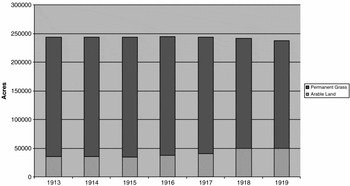
Dewey argues that for England and Wales the number of holdings did not change much over the course of the war and suggests that farmers tended not to join the military. However in Westmorland the total number of holdings fell from 3434 in 1913 to 3209 in 1919 a fall of 6.5 per cent.Footnote 42 The agricultural statistics show a decline of 13.8 per cent in the number of holdings between one and fifty acres and a small increase of 1.9 per cent in those above fifty acres.Footnote 43 This suggests that small land holdings were given up during the war and amalgamated or taken over by larger farmers in Westmorland. In addition to holdings released by small farmers with bi-employments, landlords were encouraged not to renew the tenancies of small farmers who made a poor contribution to food production. Such farmers would have been very vulnerable to conscription.Footnote 44 Although between 1913 and 1919, 2024 acres fell out of cultivation in the county, the arable area rose by 13845 acres and that of permanent grassland fell by 15869 acresFootnote 45 resulting in an increase in demand for labour as holdings were rationalised and land converted to tillage (see figure 1).
Westmorland-Acreage of Arable Land and Permanent Grass.

Farmers' sons seem to have been recruited and conscripted in considerable numbers. A report for June 1915 lists four farmer's sons, five farm servants, a gardener, a nurseryman and a woodcutter out of twenty-eight recruits.Footnote 46 The early tribunals are also full of appeals for farmer's sons to be exempted. Few are allowed in full. A farmer from Longlands appeals for his two sons. Captain Lambert (military representative): ‘What will people say if you have two sons and married men are going?’ Exemption is given to the oldest only. At Great Stickland, Captain Lambert again: ‘It is not fair to other farmers for you to have three sons when they send their only son.’ Exemption was given to the eldest only.Footnote 47
At the Tribunals in March 1916 the military representative took a tough line and expressed the view ‘that several employers of labour had since last November dispensed with their hired labour with a view to getting their sons home and therefore into a safe position.’ This was contrary to Lord Derby's scheme ‘a man should engage hired labour over military age . . . any man who was capable of such an unpatriotic action should receive no sympathy.’Footnote 48 The military authorities on the Tribunals complained about this reluctance of farmers to give up their sons. Major Smith: ‘a number of married men were being released from munitions but the farmers would not engage them for fear of losing their sons.’Footnote 49 The possibility of substitution left farmers' sons very vulnerable to recruitment particularly when the farm was small and they undertook a wide variety of tasks, not all of which were ‘skilled’. In these circumstances their exemption category was open to challenge from the military authorities. Captain Lambert appealed for the withdrawal of exemptions for a farmers' son at Newby: ‘Your feeding sheep will have gone now.’ Farmer ‘but lambs have taken their place. (laughter)’ Captain Lambert: ‘you can afford a girl to look after them’.Footnote 50 The military strongly encouraged farmers to take substitute workers over sons. S. Alderson appeals for his son, the only hand on a farm of 118 acres. Captain Lambert ‘Have you an objection to a substitute?’ Applicant: ‘Yes, every conceivable objection, because they know nothing about work. I will never take a substitute.’ The application was refused.Footnote 51 Thus the loss of sons was strongly resisted but largely without success. Henry Holme at Thrimby appealed for his son James. Their farm was 300 acres with a further 150 acre allotment five miles away. Chairman: ‘I have given up three sons.’ Mr Holme: ‘You gave up your farm; if I had your pocket I could do the same.’ The Chair considers Mr Holme should give up his other job and devote more time to the farm himself. The exemption was refused.Footnote 52
Even before the introduction of conscription, weekly reports list farmers' sons and even small farmers in the lists of volunteers.Footnote 53 The 1911 census shows that 858 male farmers and 1206 of their male relatives were under the age of thirty-five, thirty-eight per cent and ninety-six per cent of the totals respectively and the documentation records the call up of many of these.Footnote 54 In Westmorland the historic skilled labour shortage was exacerbated by the loss of farmers and their sons into the military, leaving wives, sisters and widows to continue to run the holding with substitute labour or letting their tenancy or land to another. The listing of farmers from the 1917 survey of the West Ward District Sub Committee shows thirty-two women farmers out of 477 farms.Footnote 55 Such recruitment reports suggest Dewey is mistaken that farmers and their sons were protected and not recruited in large numbers. As conscription policy was applied nationally, it is likely that small family farmers in other counties were equally vulnerable.
V
The shortage of labour was partly made good by the use of substitutes, chiefly soldiers, women, prisoners and children. To what extent were these available to the farmers in Westmorland and how well were they used?
Soldier labour was available to Westmorland and Cumberland farmers from the Agricultural Corps based at Carlisle Castle. The records of the Cumberland War Agricultural Executive show that soldier labour was well used there, especially in the lowland farms of the Eden Valley close to Carlisle. Soldier labour seemed to be harder to procure in Westmorland but letters from the secretary of the Westmorland CWAEC show that soldiers of less than the A1 medical category were provided to farmers. However, soldier substitutes were not always popular. R. Walker from Crosby Ravensworth requested the temporary release of his son who was indispensable ‘owing to the extra ploughing’: He was offered a man from Carlisle ‘No I don't want a man from Carlisle they are neither use nor ornament’.Footnote 56
Farmers attitudes were criticised: ‘Last summer there were some soldiers employed on local farms but many more would have been but for the obstinate stand taken by some . . . unless they got a particular soldier they would have none.’Footnote 57 Reluctance to give up a son and take on a soldier, often with limited experience was no doubt emotional but also in this area where family labour was rarely paid farmers would also have had an economic motive. Many farmers seem to have preferred Canon Rawnsley's suggestion. At a dinner of the Agricultural Club, he said ‘the success of agriculture would depend very much more than normally on the personal labour and direction of the farmer himself. He would have to go to bed later and rise earlier.’ He felt for ‘the man who had worked hard and who was unable to pay for outside labour and dependent on the labour of his family but ‘these men must also make sacrifices and the strong lass should fill the place of her brother.’Footnote 58 Even though there was a general reluctance to use paid women workers on farms this did not extend to the help of unpaid female family workers who would have continued to perform all their usual tasks both inside and outside the farmhouse and made their vital contribution to the family economy often without cash reward.
Paid women workers were not attractive to farmers despite their protestations about labour shortages. The Women's Committee wrote an open letter to farmers in the local press requesting suitable training openings for women volunteers, but parish representatives were negative. ‘I have made inquiry in this parish and I do not find any farmer willing to undertake the duty.’Footnote 59 The Appleby District Sub Committee did not report favourably on female help and ‘did not hold out any hope of assistance from that quarter.’Footnote 60 But Colonel Weston MP of the County Committee was enthusiastic: ‘90% of farm labour could be done by women . . . though the more muscular work such as filling manure carts would require men.’Footnote 61 At a meeting to discuss labour shortages and women workers it was agreed that ‘farmers were reluctant to take on women but women's labour was better than no labour at all and that was the ugly choice which would by and by be facing the farmers. There were in some quarters the extraordinary idea that farm work was degrading for women . . . it might be hard and perhaps disagreeable but after all, it was nothing compared to life in the trenches.’Footnote 62
The War Agricultural Committee was keen to encourage women but there seemed to be confusion over the type of female labour they were advocating. They report that ‘women from refined homes had helped [although] the farmer was sceptical, thinking at first of sending them into the sitting room for a cup of tea with his wife.’ They go on to suggest that ladies committees would be responsible for the welfare of women farm servants. They discuss the practical details and encourage ‘ladies’ to work. It was suggested that ‘ladies are divided into three groups to avoid mixing classes.’ Different clothing was suggested for the higher classes . . . they hoped that these suggestions would be seriously received ‘by ladies who have the most leisure at their disposal to nobly respond to the call of duty.’Footnote 63 There seems to be a class based division of the type of help given, with work for some and supervision by the ‘ladies’.Footnote 64 There is some open correspondence from women frustrated at not being able to find work and addressing some of the unspoken fears of farmers:
You admire our patriotism, our willingness and keenness to do war work but you tell us ‘Keep off my land.’ Women do not desire to act as aide de camps to the Military in taking men from farm service, neither do we wish to replace schoolboys . . . or even soldiers but when all three have been engaged there still remain ways in which farmers are able to find work for women.Footnote 65
Despite all the discussion and reluctance farmers had to face reality and many made use of soldiers and of women workers. That said, a distinction needs to be made between family females and paid women workers, full time or casual: farm servants where they could be obtained or village women. Of the latter the living in farm servant would have been less costly to engage in cash terms and farmers had long experience of them even if their range of work was now extended. Village women would have lived away from the farmhouse, were often part time or casual and would have been relied on to a lesser extent.
Dewey suggests that female family members would have taken up opportunities outside agriculture at a similar rate to other females but in this area this seems unlikely. Women still living at home often with aged parents would already be a vital part of the farm economy and although their pre-war contribution went largely unrecognised they would have continued to work as they always had done. However although they would not have provided any significant additional pool of labour the Tribunals were happy to include them in an assessment of the labour available when making decisions about exemptions for farmers' sons. A Rydal farmer with 700 acres, thirty-seven cattle and over 1000 sheep appeals for one of his two sons. ‘It was a complete farce to think the shepherding could be done by himself 69, and one son.’ However the Tribunal note that he also has two daughters. Joseph Fleming worked 200 acres with eighteen milk cows and fifteen other cattle and over 1200 sheep. The tribunal felt that his father, mother, sister and a lad of sixteen were sufficient for the holding if he were substituted.Footnote 66
Few parts of Westmorland seem to have benefited from prisoner labour. This was controlled by the Cumberland WAEC and little was offered to Westmorland. The press reported that North Westmorland would not be able to have German Prisoners as desired. The Journal of the Board of Agriculture lists the requirements for use of prisoner labour:
The Executive must be satisfied that there is sufficient agricultural work in the locality to keep at least 65 out of 75 prisoners occupied for a period of at least two months, the work to be within a radius of 3 miles of the depot.Footnote 67
This would have been difficult to achieve in areas with small isolated upland farms and scattered parcels of land and it is unsurprising that relatively little prisoner labour was used here and the situation would have been the same in other upland areas. In Cumberland the requirements for using prisoner labour would have been easier to meet on the larger farms of the lower Eden Valley.
Children had always helped on family farms and the Education Committee relaxed the attendance by-laws, agreeing that:
The best thing that could be given to a boy or girl was a good education . . . but at a time like this . . . they must show they were not hide bound pedants and recognise the need in case of a farm where there was shortage of labour.
They asked farmers not to take advantage of the relaxation to save a few shillings a week.Footnote 68 The School Logs show that attendances were in fact little changed but that school holidays were adjusted to coincide with haymaking, harvest and potato picking.Footnote 69
This review of the evidence for the use of substitute labour suggests that upland areas had more limited access to soldier and prisoner labour and also showed significant reluctance to make use of any available substitutes particularly women. This reluctance may have been because the shortage was not as great as the case being made for it or more probably that by making better use of the remaining family labour and working much harder himself, adjusting tasks to meet available man hours, the Westmorland farmer could get by and achieve what was asked of him. He probably did so at the expense of farm maintenance and his capital depreciated as a result, however he did not have to pay out significant sums as cash wages and did not have to acquire the management skills required to run his business using new and unfamiliar sources of labour in place of his family. He was perhaps following the advice of the Chair of the CWAEC who reminded the farmer he:
Would need to spend more time upon the farm himself, because there would be no one else to do it. It was nonsense to say that if the military authorities took a man the farm would have to be given up, and no Westmorland farmer would be proud of himself if he ever tried to do it.Footnote 70
VI
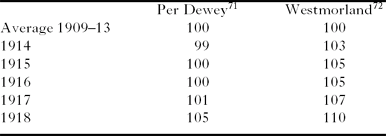
Having determined that Westmorland suffered a greater drain on its labour force through the conscription of farmers and their sons, and that substitute labour was not as plentiful as in lowland areas, the question of labour demand needs to be considered. Using the agricultural statistics for England and Wales, and applying man hour requirements for each category of production, Dewey shows that labour demand is more or less constant until 1918. It then rose by four per cent. A comparable exercise for Westmorland shows by contrast a steadily rising demand throughout the war reflecting the net conversion of permanent grassland to arable cultivation.
Index of labour demand (1909–13 = 100)
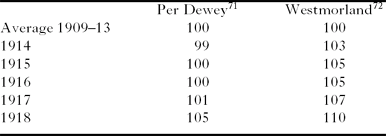
Given that Westmorland was one of the few counties which over the course of the war managed to achieve the government goal of ‘back to the seventies’ and expand their arable acreage back to the levels of the early 1870s, but also to maintain livestock flocks and herds at substantially pre war levels, the continually rising demand for labour is unsurprising.Footnote 73 The county expanded production in labour intensive arable crops of oats and potatoes which resulted in the ten per cent rise in demand for labour. In addition the index used to evaluate the labour requirements of production would not take into account the difficulties of upland areas with small uneconomic fields, little mechanisation and farmers inexperienced in arable cultivation on any significant scale. The rise in demand calculated on the basis above is therefore probably understated.
VII
In responding to the wartime production regime, farmers in upland regions faced particular difficulties. They were operating in a physical environment ill suited to large scale arable food production, their farms were often small, their fields scattered and unsuitable for mechanical cultivation. Farmers themselves often lacked expertise and equipment and the increased labour input required for arable crops would have stretched their manpower resources. The labour index calculated above makes it unsurprising that farmers were so vocal about the labour shortage and lends credence to the view that the calls for assistance were largely genuine and the shortages in the uplands greater than those calculated by Dewey for England and Wales as a whole.
Farmers, their sons and much of the skilled agricultural labour in these regions were eventually conscripted, exacerbating a pre war problem and leaving an aging farming population doing what it could with the substitute labour available, although reluctantly taken up. Substitute labour provided a challenge both to those organising its availability and to those who made use of it. Soldiers were available but not in the numbers required and for a farmer used to unpaid family help, soldiers were expensive. Women were considered undesirable but family female help continued to be an important part of the farm economy. Children helped with harvest and haymaking as they always had and the schools made some efforts to align their availability with need. For logistical reasons, prisoner of war labour was scarcely used. The loss of one son out of a work force of just two or three was an enormous strain when additional and unfamiliar work was required and it is likely that pre war systems of cooperation such as ploughing days and clipping days formed an essential part of making possible the increase in production achieved. Indeed tribunals were regularly told that farmers helped neighbours wherever they could and some conditional exemptions were given on that basis.Footnote 74
The increase in production on an extended arable area could only have been achieved by working available labour much harder and by the adjustment of tasks and neglect of regular maintenance with a resulting decline in farm infrastructure. In evidence given to the Royal Commission on Agriculture in 1919 Mr F. Wallace says of farms in Westmorland:
Almost all the farms that I have seen are very badly in arrear now from neglect and want of labour during the war . . . and will want an extra amount of labour employed upon them in order to bring them back into a good state.Footnote 75
Despite this the increased levels of production are a testament to the adaptability and resourcefulness of the farming communities involved.
A letter from J. Hawell, Fisherbeck Farm, Ambleside set out the position of Westmorland farmers and others on upland family farms:
Many farmers have sent their last son in response to the country's call when it was almost impossible to work their farms and do without them. Now through real hard work, perseverance and determination they are just able to keep the wheels of the farm in motion.Footnote 76