1. Introduction
Antarctica is one of the most remote and inhospitable places on the planet and its unique and extreme environment has been a potent attraction for composers since the so-called ‘Heroic Age of Antarctic Exploration’ (c.1897–1922). From the occasional songs that were composed by explorers during early Antarctic expeditions, to the large-scale Antarctica-inspired orchestral works of Ralph Vaughan Williams, Peter Maxwell Davies and Nigel Westlake, there have been musical works composed in connection with the far south in a wide range of genres and styles (Philpott Reference Philpott2012, Reference Philpott2013). While the majority of the compositions created in association with Antarctica during the twentieth century were inspired by stories of human endeavour, heroism and sacrifice on the ice, since the final few years of the twentieth century, composers interested in the southernmost continent have increasingly turned their attention towards the scientific and environmental issues under investigation in the region, and this is reflected in their creative work. This change of focus is undoubtedly related to the general rise of media and public interest in climate change and Antarctic research that has occurred within the same timeframe. However, it is also clear that it has been strongly influenced by the increased participation of composers in Antarctic arts residencies. Since the mid-1990s, numerous composers have visited the continent in person as part of arts fellowships offered by the Antarctic programmes of various nations with scientific bases in Antarctica, such as those operated by the United States’ National Science Foundation, the Australian Antarctic Division, the Argentine Dirección Nacional del Antártico and (until 2009) the British Antarctic Survey.Footnote 1 By their nature, such fellowships or residency programmes enable artists and writers to spend several weeks interacting with scientists and learning about current research being undertaken on board the research vessels and within the stations on the Antarctic continent, with the expectation that they will then disseminate the knowledge they have gained to wide audiences through their creative outputs.
Most of the composers who have travelled southward since the mid-1990s have utilised sound recording technologies to document their journeys sonically and to create new audio art works. In particular, composers have captured and utilised in their compositions biological sounds such vocalisations of penguins and seals (both on the ice and underwater); non-biological or ‘geophysical’ (Pijanowski et al. Reference Pijanowski, Farina, Gage, Dumyahn and Krause2011a: 1213) ambient sounds that emanate from the natural landscape, such as wind and blizzards, and ice cracking and calving; and even anthropogenic (human) sounds recorded within the Antarctic environment. As scholars working in the relatively new field of science known as ‘soundscape ecology’ have observed, the integration of these various sound sources – biological, geophysical and anthropogenic – that emanate from a landscape to create its ‘soundscape’ will vary over time and space and consequently can be used to inform understanding of ‘coupled natural-human dynamics across different spatial and temporal scales’ (Pijanowski et al. Reference Pijanowski, Farina, Gage, Dumyahn and Krause2011a: 1213). While the study of soundscapes can reveal valuable information to scientists about environmental quality and how humans are affecting ecosystems (Pijanowski et al. Reference Pijanowski, Villanueva-Rivera, Dumyahn, Farina, Krause and Napoletano2011b: 203, 213) and this is particularly worthy of scholarly attention in relation to Antarctica, the work undertaken by composers to record and/or evoke the sounds of Antarctic soundscapes for the purposes of creating audible artworks that are available to the general public is also very important. Not only is this work fascinating in its own right, but it also makes the sounds of Antarctica accessible to a large number of people who would otherwise never hear them. In the words of American composer John Luther Adams, such gestures in the field of music are necessary not to ‘change the world,’ but rather to change ‘the quality of our attention to the world’ (Adams Reference Adams2009: 103). By composing sonic art works that are inspired by and/or based directly upon soundscapes of Antarctica, composers are able to draw attention to the sounds of a place that is generally out of the sight and minds (and ears) of most human beings and yet is of vital importance to the wellbeing of humanity and the planet as a whole.
This article examines recent sonic art works by four established composers from two countries on opposite sides of the globe (the United States of America and Australia) who are united in their attraction to the sounds and environment of the far south. All four composers – Douglas Quin, Jay Needham, Lawrence English and Philip Samartzis – have visited Antarctica for at least one austral summer and then returned to their homelands with numerous field recordings and myriad ideas relating to how to share their experiences, in sonic terms, with an audience consisting primarily of people who have never been (and most likely never will go) down to the ice. Compositions discussed in the article include Resonant Evidence (2012–15), a collaborative composition by United States-based composers Jay Needham and Douglas Quin; Chronography: Animal (2012) by Jay Needham; and two recorded works by Australia-based composers: Viento/Antarctica (2015) by Lawrence English and Antarctica, An Absent Presence (2014) by Philip Samartzis. Excerpts from these works, in the form of sound or movie examples, are included with the article as supplementary materials. The primary aim of this research is to investigate what these works reveal about the composers’ personal encounters with and perceptions of the southernmost continent, as well as to explore the role of these compositions in conveying messages about climate change to listeners around the world. In order to contextualise this discussion, it is necessary to begin with a brief overview of the significance of Antarctica, its connection to climate change, and responses from within the arts and humanities.
2. Antarctica, Climate Change and Responses Within the Arts and Humanities
Antarctica is the coldest, windiest and driest continent on earth, with the highest average elevation (Dastidar and Persson Reference Dastidar and Persson2005: 1552; Wayman Reference Wayman2013: 19; Convey Reference Convey2014: 1).Footnote 2 Given its extreme climate, it is perhaps not surprising to note that Antarctica is the only large landmass on earth without a native or long-term resident human population and was one of the last parts of the planet to be fully chartered and explored. As an isolated place that is not only geographically distant from the world’s major cities, but also generally far from the minds of the vast majority of people who live in them, the frozen continent has had a long history of being regarded as little more than a blank space at the bottom of the map. However, in recent years, it has begun to attract more widespread attention, especially as messages about climate change have been conveyed with greater frequency via the press, and through mediums such as television, film, literature, fine arts and music.
As scientific research conducted over the past few decades has shown, Antarctica and the Southern Ocean’s unique and complex environmental processes play significant roles in driving and regulating the world’s climate (Convey Reference Convey2014: 1). The extremely cold water at the periphery of the continent sinks deep into the ocean and drives the circulation of currents across all the oceans, while the atmosphere above the ice is likewise central to global atmospheric circulation. In addition, the Southern Ocean is very effective at absorbing carbon dioxide from the atmosphere, which is vitally important given that the current concentration of carbon dioxide in the atmosphere ‘exceeds any value measured in ice cores covering the last 800,000 years’ (British Antarctic Survey 2015). The strong link between increasing carbon dioxide concentrations and rising temperatures has seen changes in climate occur on all continents and across all oceans on the planet and Antarctica itself does not appear to be immune to the effects of global climate change either, as perhaps first thought (Wayman Reference Wayman2013; British Antarctic Survey 2015). It is has been widely reported that the Antarctic Peninsula and large parts of West Antarctica have warmed considerably over recent decades, which has led to the collapse of some of the region’s smaller ice shelves. While natural environmental events also contribute to global climate change, according to the Intergovernmental Panel on Climate Change’s fifth assessment report (2014), it is extremely likely that human activities have been the ‘dominant cause of the observed warming since the mid-20th century’ (IPCC 2014: 4). For this reason, the British Antarctic Survey, among other organisations, is spreading the message that ‘understanding Antarctica’s role in climate change is not only a huge scientific challenge but also an urgent priority for society’ (British Antarctic Survey 2015).
Since the Antarctic Treaty System came into force in 1961, Antarctica has truly become a ‘continent for science’ and while scientific research is still the primary form of research associated with the region, there has been a steady rise of interest in Antarctic studies among scholars working in the humanities, social sciences and the arts in recent years (Dastidar and Persson Reference Dastidar and Persson2005; Hua et al. Reference Hua, Li and Yuan2014: 273). Additionally, growing numbers of artists, curators and composers are also actively working to ‘bridge the gap’ between the arts and the sciences in relation to Antarctica and climate change (Miles Reference Miles2010; Gabrys and Yusoff Reference Gabrys and Yusoff2012; Allen Reference Allen2013; Crossman Reference Crossman2014). The fine arts and music are steadily gaining recognition as important mediums through which information about critical issues such as climate change can be communicated to the general public. Music, in particular, has been identified for its unique capacity as a non-verbal language, and as a temporal art form, to have a ‘far stronger’ impact on an audience than verbal messages about climate change alone (Moser Reference Moser2010: 40). Of course, not all musical/sonic works composed in connection with climate change also reference Antarctica, and likewise, not all musical/sonic works composed in response to Antarctica make overt references to climate change. Although an increasing number of composers appear to be engaging with both Antarctica and issues related to climate change within their creative works, this is a relatively recent phenomenon that has paralleled the rise of interest in climate change among the general public. Most of the Antarctica-related musical works that were composed prior to the final decade of the twentieth century focus on human interactions with and perceptions of the far south, rather than centre on the continent itself as a focal point.
3. Antarctica and Music
A large number and variety of musical works have been composed in association with Antarctica since the dawn of the so-called Heroic Age of Antarctic exploration in the late nineteenth century. These include, among others, various collections of occasional songs composed in Antarctica by explorers during the Heroic Age (Philpott Reference Philpott2012, Reference Philpott2013); a little-known 12-tone opera by Schoenberg pupil Winfried Zillig based on the story of the sacrifice made by Lawrence Oates during Scott’s fatal expedition to the South Pole (Das Opfer, 1937, see Leane et al. Reference Leane, Philpott and Nielsen2014); and the large-scale Antarctica-related orchestral works of British composers Ralph Vaughan Williams (film score for Scott of the Antarctic, 1948, and Sinfonia Antarctica, 1949–52) and Peter Maxwell Davies (Antarctic Symphony, 2000) and Australian composer Nigel Westlake (film score for the IMAX film Antarctica, 1991, and Antarctica suite for guitar and orchestra, 1992). Most of the composers who have produced works in connection with Antarctica since the mid-1990s have visited the continent, collected various sound recordings and then utilised these sonic records within their compositions. While there have been a number of other established composers who have ventured south and produced Antarctica-related compositions, such as Craig Vear, Ian Tamblyn, Cheryl Leonard and Andrea Polli, this article focuses specifically on recent works by four other leading contributors to this growing field of composition: Douglas Quin, Jay Needham, Lawrence English and Philip Samartzis. As Quin (Reference Quin2015b) has observed, these composers (including himself) ‘seem to be grappling with Antarctica across a range of modalities of thought and perception. The intersections of science and art that are common threads between us and the various ways in which we have engaged the senses seem to inform a collective reckoning of sorts.’ Similarly, Needham (Reference Needham2015d) writes: ‘The actions and intentions of [our] collected works … serve as an anthology of both answers and questions in sonic form about Antarctica.’ As the following discussion will show, their Antarctica-related compositions not only establish a sense of place through their sonic properties and capture aspects of the composers’ personal experiences and perceptions of Antarctica, but also connect with issues that are currently under scientific investigation in relation to the continent, including topics related to climate change and/or human presence in the region, both historically and today.
4. Jay Needham and Douglas Quin, Resonant Evidence (2012–2015)
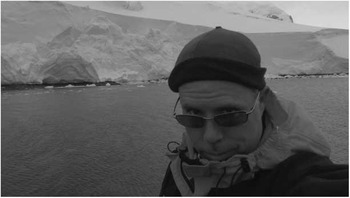
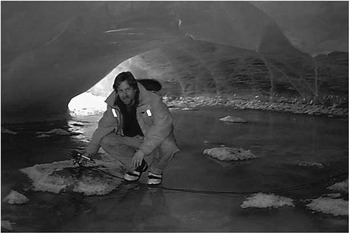
Resonant Evidence (2012–15) is a collaborative composition by Jay Needham (Figure 1) and Douglas Quin (Figure 2), who are both United States-based composers, sound artists and academics. Needham and Quin have visited Antarctica on separate occasions (Needham in 2009 and Quin in 1996, 1999 and 2000)Footnote 3 and accumulated large sound libraries of Antarctic field recordings that they have since drawn upon for numerous independent creative works. For example, Needham produced the sound sculptures South Polar Suite and Reviving Spirits for a collaborative exhibition and installation with photographer Gary Kolb titled Antarctic Dreams in 2010 (Kolb and Needham Reference Kolb and Needham2014), while Quin’s three trips to the ice have led to the creation of his landmark soundscape recording Antarctica (1998); the sound design for Werner Herzog’s Oscar-nominated documentary Encounters at the End of the World (2008); and a multimedia composition based on the 1912–13 diaries of Bert Lincoln (an Able Bodied seaman who participated in the Australasian Antarctic Expedition) titled Aurora Passage (2012).
Jay Needham in Antarctica in 2009. Photograph by Jay Needham, used with permission.

Douglas Quin recording in an ice cave (which no longer exists) in Antarctica in January 2000. Photograph by Steve Dunbar, used with permission.

Needham and Quin had known of one another’s work for several years prior to their first face-to-face meeting in March 2012 at an Antarctica-related conference (Quin Reference Quin2015a). Soon after meeting, they made plans to create a composition together that combined their shared interests in soundscapes and Antarctica; Resonant Evidence was the result. The work was premiered live by the composers at the fourth Antarctic Art and Culture International Conference and Festival in Buenos Aires, Argentina, in September 2012, and featured their collective polar field recordings of wind, weather and other mechanical sounds from the ice (Sound example 1).Footnote 4 Quin (Reference Quin2015a) has written the following about the process of creating Resonant Evidence:
The idea for the piece grew out of many conversations and ideas around the documentary role of our recordings, notions of sonic memory, and the particular aesthetic interests that we share—namely the perceived musical identities within the recordings … We rehearsed and intuitively settled on a loosely structured improvisation with the materials we had selected from the ice. Using a variety of signal processors, we were able to manipulate the field recordings live in performance. The result was a nice ‘conversation’ between the two of us.
While the rendition of Resonant Evidence that Needham and Quin performed in Buenos Aires focused primarily on Antarctica’s wind, the pair have subsequently created another version of the work that features ‘more of an ice palette’ (Quin Reference Quin2015a) (Sound example 2).Footnote 5 The emphasis on wind and ice in the different iterations of Resonant Evidence is particularly relevant and timely given that these elements have received considerable attention from scientists studying climate change in Antarctica in recent years. For example, the monitoring of near-surface wind speeds at numerous scientific stations on the continent has shown that the majority have experienced increasing mean wind speeds over their periods of operation (Turner et al. Reference Turner, Colwell, Marshall, Lachlan-Cope, Carleton and Jones2005: 280, 289), while data derived from ice cores are now revealing to scientists information about past temperatures and concentrations of gases (including carbon dioxide and methane) in the atmosphere, enabling them to identify and analyse changes and patterns over the last 800,000 years (Jouzel et al. Reference Jouzel, Masson-Delmotte, Cattani, Dreyfus, Falourd and Hoffmann2007; Lüthi et al. Reference Lüthi, Le Floch, Bereiter, Blunier, Barnola and Siegenthaler2008; British Antarctic Survey 2010; Jouzel Reference Jouzel2013). In addition, scientists have recently begun to conduct research into the sounds of ice and what they can tell us about glaciers and the behavioural patterns of seals and other marine mammals that live on and in the waters surrounding the ice (Pettit et al. Reference Pettit, Nystuen and O’Neel2012, Reference Pettit, Lee, Brann, Nystuen, Wilson and O’Neel2015). Both Quin and Needham are deeply interested in, and inspired by, current Antarctic science and this is evident within their creative outputs. As Quin (Reference Quin2015a) writes:
For [the second] version of Resonant Evidence, we wanted to turn our attention to more of an ice palette, given … how ice core data has informed an understanding of climate change over time and how polar ice melt is presenting real, immediate and tangible change in a time scale we can grasp, i.e., decades, not millennia … In revisiting my ice recordings … I have been drawn to a number of qualities in the sounds: from percussive booms from calving; to the thudding, cracking and knocking of ice refreezing and settling from a glacier; the grinding sounds of icebergs bumping up against one another; and the subtle pitched, patter of melt and bubbles—both glacial and from brash ice. Part of the ‘resonance’ I have been exploring in the melt recordings involves using filters that I set to feedback at frequencies within the samples and recordings. This kind of emphasis or accentuation reveals a remarkable range of microtonal harmonies.
Through their independent and collaborative work, both composers strive to ‘bridge the gap’ between the arts and the sciences (Needham Reference Needham2015b). Indeed, their field recordings can be viewed as data-rich sources in themselves; they are sonic records or artefacts that provide documentary evidence of the composers’ experiences on the ice (and their perceptions as listeners) that can be stored and then ‘analysed’ at a later point in time. This is important because, as Pijanowski et al. (Reference Pijanowski, Villanueva-Rivera, Dumyahn, Farina, Krause and Napoletano2011b: 203, 213) point out, ‘sound is a fundamental property of nature and because it can be drastically affected by a variety of human activities [it is likely that] … recordings made today will become tomorrow’s “acoustic fossils,” possibly preserving the only evidence we have of ecosystems that may vanish in the future because of a lack of desire or ability to protect them’. Some of the locations at which Quin and Needham have captured field recordings have already experienced considerable environmental change in the past few years, such as the ice cave depicted in Figure 2, which no longer exists today (Quin Reference Quin2015c). Both Needham and Quin are aware of the potential cultural and archival value of the recordings they have made in the far south, which are now being used in compositions such as Resonant Evidence, as Needham (Reference Needham2015b) suggests:
I remember a specific phone call (one of many) where Doug and I were talking about the cultural value of archives and also talking about the science that is a part of what drives us. Besides the rich sonic world that sustains our curiosity, we also hit on the notion that these kinds of field recordings have a basis in a kind of proof. This led us to consider the evidentiary nature of what we were up to and hence the eco-informed title.
In addition to its role as a sonic record, Resonant Evidence is also a highly effective and engaging work of art. It consists of a rich tapestry of aural impressions of the far south, captured by two of the most experienced practitioners in the field, and allows listeners to hear some of the rhythms and harmonies of the Antarctic soundscape. As friends and colleagues with mutual interests in Antarctica and sonic art forms, Quin and Needham have shared many discussions about their work and experiences on the ice. Resonant Evidence is a continuation of that dialogue, expressed in a language that is, indeed, universal.
5. Jay Needham, Chronography: Animal (2012)
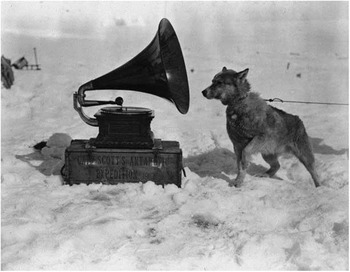
Composed in the same year as the first version of Resonant Evidence, 2012, Needham’s Chronography: Animal is an electroacoustic composition that combines field recordings he made in Antarctica in 2009 with live sounds produced from repurposed antique gramophone horns and mechanical clockwork (Movie example 1).Footnote 6 The year 2012 marked the centenary of the death of Robert Falcon Scott and his polar party during the British Antarctic Expedition 1910–13 (Terra Nova), and this composition was directly inspired by a photograph taken during that expedition. The image, which was captured by Herbert Ponting, depicts one of the expedition’s dogs, known as ‘Chris’, standing on the ice next to a gramophone and peering into the instrument’s horn, as if listening intently (Figure 3).
Dog Chris, listening to the gramophone, during the British Antarctic (Terra Nova) Expedition of 1910–13. Photograph taken by Herbert Ponting, circa January 1911 (Ref: PA1-f-067-099-2). Used with permission from Alexander Turnbull Library, National Library of New Zealand.

Scott and his companions had taken two gramophones and hundreds of 10 inch, 78 rpm records on board the Terra Nova in 1910, and these items proved to be invaluable to the expedition in terms of providing much-needed relief from the monotony of long voyages and freezing cold, dark winters inside the huts in Antarctica (Locantro Reference Locantro2012: 2, 9–11). Gramophones also served as time keepers during the early expeditions and were frequently used as alarm clocks to wake the men so that they could undertake important routine duties, such as conducting scientific and meteorological observations (King Reference King1988: 69; Philpott Reference Philpott2013: 462). An additional function that these instruments served during the Heroic Age was as mechanisms through which the men could interact with the local wildlife, as is apparent in various photographs of gramophones surrounded by penguins on the ice that survive from the period (Laseron Reference Laseron1999: 260–1; Shackleton Reference Shackleton1999). It is fitting, therefore, that Needham drew inspiration from the themes of time, sound, technology and interaction with animals that are presented in the Ponting image for the creation of Chronography: Animal. The composer writes:
The image offers a curious set of entry points for analysis and creative reflection. Performed as a bit of comic relief on the ice and as a homage to/riff on His Master’s Voice, Ponting’s picture reveals a number of relationships, extending the role this image has as an historic exploration artifact. The image portrays several intervals of time simultaneously. One such interval is the initial exposure on film, perhaps a fraction of a second. Another interval represented is the domain of musical time occurring on the platter and in the air. An additional interval is the perceived time that we accord the dog in the image. The latter illustrates the continued desire we as humans have to communicate with other animals, in this case using the Victor Talking Machine in an effort to establish a communicative link … The layers of accumulated time in the Ponting image influenced my concepts around the framing and performing of Chronography: animal. The piece is a live electroacoustic work that unwinds layers of time; it is conceived as a bridge to connect practices of improvised music and sound art as an evocation of place. In this piece, we hear sounds from Antarctica accompanied by the sounds of manufactured objects that were used in the exploration of that continent. (Needham and Leonardson Reference Needham and Leonardson2013: 37)
During live performances of Chronography: Animal, Needham and usually one or two other artists play repurposed antique gramophone horns as amplified instruments in a variety of ways – such as by bowing, tapping or scraping the objects – in order to achieve an array of different percussive and timbral effects that are ‘strangely similar to some of the sounds one hears down there’ (Needham Reference Needham2015a). For example, some of the sonic effects produced with the amplified gramophone horns closely resemble the sounds of rain, wind and even animal vocalisations. Similarly, in selecting the field recordings for use in the composition, Needham has been ‘drawn to those that had a certain richness, evoking a sense of scale and immersion that audibly described Antarctica’ (Needham and Leonardson Reference Needham and Leonardson2013: 37). In order to further suggest a sense of time and place in the work, the composer incorporates live sounds from an antique clock mechanism, with the ‘familiar interval of the clock tick … used as a kind of rhythmic antonym to the field recordings’ (Needham Reference Needham2015a). Chronography: Animal also features excerpts from recordings of songs known to have been taken on board the Terra Nova, such as ‘Love is Meant to Make us Glad’ from Merrie England, performed by Margaret Cooper; ‘Wait Till the Work Comes Round’ by Gus Elen; and ‘Night Hymn at Sea’, performed by Clara Butt and Robert Kennerley Rumford (Needham Reference Needham2015c). These songs are played back live on stage from 78 rpm records, creating yet another point of connection with the Ponting image and the sound (and sound quality) of the music that might have been heard by the dog on the ice at the time the photograph was taken.
While Ponting’s image can suggest sound, it is, nevertheless, a silent artefact. Needham’s composition, however, provides an audible exploration of (or soundtrack to) the Ponting photograph that locates the image of the dog and the gramophone sonically, in time and place. Through its incorporation of Antarctic soundscape recordings, historical recordings of songs played on 78 rpm records, and sounds created with mechanical clockwork and antique gramophone horns, Chronography: Animal gives the listener a sense of what Chris the dog might have actually heard during that moment on the ice. It also highlights for the listener the important roles that sound, technology and communication (both human to animal, and human to human) have played in Antarctic exploration for more than a century, as well as the ongoing function that they continue to serve today in assisting with scientific investigations in the region and in conveying important information about climate and environmental changes to people around the globe.
In contrast to these two compositions by United States-based composers, which are primarily intended for presentation to audiences through live performance, the final two works to be discussed here are by Australia-based composers and focus to a greater extent on presenting raw sounds from Antarctica through the medium of the sound recording.
6. Lawrence English, Viento/Antarctica (2015)
Based in Brisbane, Lawrence English’s creative output includes works in a variety of media art forms and reflects his fascination with sound and space, the environment, memory and the politics of perception. Field recording is an important component of his creative work and his methodological approach and field recording techniques are informed by his theory of ‘relational listening’ (English Reference English2014a). This theory recognises the critical role of listening in the conception, creation and execution of audible artworks and seeks alignment between the listening of the human organic ear and that of the ‘prosthetic ear’ of the microphone in order to create ideal conditions for successful transmission of the listener’s listening (English Reference English2014a, Reference English2014b, Reference English2015a). In recent years, English has released a number of recordings that reveal a preoccupation with the sounds of winter weather, such as For Varying Degrees of Winter (Baskaru 2007), Shadow of the Monolith (a collaboration with Austrian artist Werner Dafedecker, released by Holotype Editions in 2014) and Viento (Taiga 2015). The title of the latter, Viento, is the Spanish word for ‘wind’ and this album features two separate field recordings of wind in Patagonia and Antarctica, respectively. English made these recordings during his journey to and residency in Antarctica in early 2010 as part of the Antarctic Cultural Program run by Argentina’s Dirección Nacional del Antártico (Figure 4).
Lawrence English in Antarctica in 2010. Photograph by Werner Dafeldecker, used with permission.

Viento/Antarctica comprises raw sound recordings made in the midst of blizzards at the two largest Argentine bases in Antarctica: Marambio and Esperanza (Sound example 3). English has written the following about the process of making these recordings in Antarctica and then listening to the blizzards again through the sonic snapshots captured in Viento/Antarctica:
During the blizzard in Marambio, the temperature dropped to -40degrees centigrade (with wind chill) which made recording particularly challenging. The wind battered the base’s structures and telecommunications equipment, making a range of unusual tonal phase drones, which you can hear in these recordings. The blizzard at Esperanza was mild by comparison, but still strong enough to coat penguins in a layer of snow as they huddled together during the worst of the wind storm. Listening back to these recordings I am struck by the sheer physicality of the wind. It’s rare that you feel physically reduced by the motion of air, but in … Antarctica that is just how I felt. A small speck of organic dust in a howling storm. (2015b)
English’s reaction to the wind in Antarctica is understandable considering the continent is widely acknowledged as the windiest on earth (Dastidar and Persson Reference Dastidar and Persson2005: 1552; Wayman Reference Wayman2013: 19; Convey Reference Convey2014: 1). His dedication to recording the sounds of wind in Antarctica in spite of the technical difficulties he encountered demonstrates how very important it was to him to capture, in sonic terms, this extreme feature of the environment. Like Quin and Needham in Resonant Evidence, English’s focus on Antarctica’s wind in Viento/Antarctica is very timely in light of the scientific investigations currently underway into wind speeds on the continent, which are not only affected by changes in climate themselves, but which also have impacts of their own, including upon the atmosphere and the spread of sea ice in the region (Turner et al. Reference Turner, Colwell, Marshall, Lachlan-Cope, Carleton and Jones2005; British Antarctic Survey 2015). Through the use of untreated sound recordings in Viento/Antarctica, English allows listeners to engage with his own subjective experience of wind in Antarctica. In other words, he invites the listener to listen to his own listening. While technically a raw field recording, the work is marked by great clarity and depth and is notable for its range of textures and timbres. It has previously been presented as a diffusion/live performance and has recently been issued on LP through the American label, Taiga (2015), enabling a larger audience to experience some of the sounds of the windiest continent on earth, perhaps also increasing their awareness of, and interest in, Antarctica and its unique weather and climate in the process.
7. Philip Samartzis, Antarctica, An Absent Presence (2014)
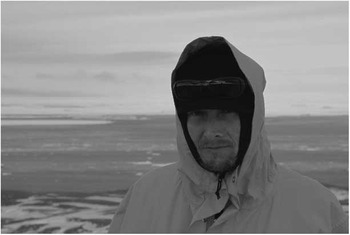
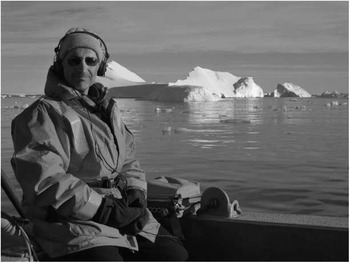
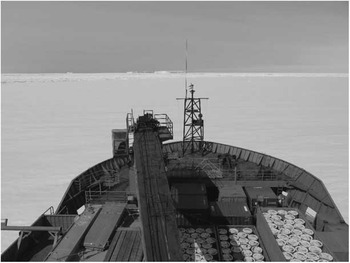
While English’s Viento/Antarctica captures primarily geophysical sounds, Philip Samartzis’s Antarctica, An Absent Presence (2014) focuses more on human experiences of the far south, in an attempt to ‘represent the complexities of our incursion into Antarctica’ (Samartzis Reference Samartzis2010). Samartzis (Figure 5) is a sound artist, curator and academic with a particular interest in sound art, acoustic ecology and spatial sound practices. In 2009 he was awarded an Australian Antarctic Division Arts Fellowship to travel to Antarctica on board the icebreaker and research vessel Aurora Australis (Figure 6) in order to make a series of sound recordings that documented his journey and the everyday lives of those who travel to Antarctica and spend extended periods at research stations. He spent six weeks at the busy Australian base Davis Station in East Antarctica, followed by a stopover at the subantarctic Macquarie Island on the way back to Australia. The primary objective of his project was to ‘observe and document the effects of extreme climate and weather events upon various environments, communities and infrastructure’ (Samartzis Reference Samartzis2015). He recalls:
The principal idea was to chronicle the minutia of everyday life framed within the cold and isolation that delineates the Antarctic and Sub Antarctic regions. While I was curious about the daily operations that occur on ship and station, I was specifically interested in the systems and technologies required to sustain life … By experiencing life in Antarctica I hoped to articulate a point of difference whereby the continent is understood purely through its impact on people and infrastructure. (Samartzis Reference Samartzis2015)
Philip Samartzis in ‘Iceberg Alley’ (Antarctic Sound), Antarctica, in March 2010. Photograph by Ian Aitkinson, used with permission.

Sea of white: the icebreaker and research vessel Aurora Australis ploughing through the frozen sea. Photograph by Jim Smith, January 2010, used with permission.

Samartzis has utilised the recordings he created during his Antarctic journey to develop a series of audio pieces for galleries, performances and festivals. These works include At the End of Night (2012), Aurora Australis (2012), Crush Grind (2013), Macquarie Island (2013), Antarctica, An Absent Presence (2014), Icebreaker (2015) and Davis Station (2015). Antarctica, An Absent Presence was jointly commissioned in 2014 by France Culture, the INA-GRM in Paris and the Creative Audio Unit of the Australian Broadcasting Corporation’s Radio National in Melbourne, and the work also received funding from the Australia Council for the Arts. With its focus on human life in Antarctica, it is fitting that the piece centres around readings of excerpts from Samartzis’s travel journal that are framed by a variety of both anthropogenic and natural sounds, as the composer explains:
Antarctica, An Absent Presence provides a compendium of observations using sound recordings and text formatted as a journal to convey an experience of Antarctica different to those presented through the lens of natural history, climate science or human exploration. It is a reimagining of a place marked by a strong sense of absence, empty and white, deserted and silent. The journal acts as repository for displaced memories – real and imagined – chronicling the people, places and conditions I encountered, supplemented by descriptions of technical and artistic process. The format is designed to acknowledge the revered, almost religious place of the journal in Antarctic exploration. (Samartzis Reference Samartzis2015)
Due to the fact it was created for the French radio programme Atelier de Création Radiophonique, Antarctica, An Absent Presence has been recorded in full in the French language,Footnote 7 and also exists in an English version. The following is an excerpt from the text of the English version:
February 5
Nearing the frozen continent the Aurora Australis encounters iceberg alley comprising tremendous forms of white and blue ice of various shapes and sizes.
A strange calmness descends as the ship traverses the glistening maze.
After drifting dreamily for several hours the continent finally comes into view.
Assembled across the bleak topography bordering Broad Peninsula and Heidemann Bay are the odd assortment of buildings and structures of Davis Station.
After peering at the alien landscape for some time I notice a long band of white stretching across the horizon.
At first I presume it is a cloud formation until I finally realise I am staring at the Antarctic Plateau rising ever so gently into the sky.
This extract, which is taken from a journal entry dated 5 February 2010, describes the journey of the Aurora Australis through so-called ‘Iceberg Alley’ (see Figure 5) in the western Weddell Sea and around the perimeter of the continent to Davis Station in East Antarctica. In the audio recording of the work, these lines of text are set to a backdrop of assorted environmental sounds that are created as the vessel moves ‘dreamily’ through the icy sea; the sounds of water and ice moving alongside the ship and ice calving are particularly prominent (Sound example 4). Other sections of the work feature the sounds of the vessel creaking and groaning and ploughing through the sea ice; the sounds produced by infrastructure, technology and the various forms of transport that are utilised to facilitate research, construction and maintenance projects in the area; and sounds from the natural environment. Among the latter, the most pronounced are those sounds made by moving water and icebergs; by animals, including southern elephant seals; and by the weather, especially the howling wind, which in turn has an effect upon man-made structures and objects by causing them to move, resonate and project their own distinctive ‘voices’. All these audible effects are contrasted in the work with intensely quiet passages and moments of complete silence, conveying to the listener the extremes of sonic experiences that are possible within Antarctica and that parallel the extremes in weather and climate patterns within the region.
Overall, the text and environmental sounds (both natural and anthropogenic) heard in Antarctica, An Absent Presence combine to form an effective and unique annotated audio journal of Samartzis’s visit to Antarctica. This innovative work not only conveys his thoughts about and perceptions of the southernmost continent through its text, but also permits listeners to gain insight into what it might be like to be part of a scientific expedition to Antarctica through the incorporation of sounds from an active expedition vessel and research station. While Antarctica is more accessible to the general public now than ever before due to increased tourism in the region in recent years, it is nevertheless rare for non-expeditioners to experience life on board research vessels in the Southern Ocean and within Antarctic stations. Through listening to Antarctica, An Absent Presence it is possible for listeners not only to take a behind-the-scenes glimpse at life in Antarctica, but also to develop a deeper appreciation for the important scientific work being undertaken in the region and the various impacts that the place has upon the expeditioners who venture there and the infrastructure that sustains their life and work on the continent.
8. Observations and Conclusions
The compositions discussed within this article are examples of recent sonic art works by established composers who have visited Antarctica and then used their experiences and perceptions of the continent’s soundscape, weather and environment and their knowledge of issues affecting the region to inform their creative work. All four of the composers represented here have employed sound recording technologies to document their Antarctic journeys sonically and have since utilised their field recordings to craft new works for the purpose of sharing their experiences with a wider audience. Two of the four works (those by Quin and Needham) are intended primarily for live performance, incorporating improvised elements, while the remaining two (by English and Samartzis) rely more exclusively on the medium of the sound recording to reach the listener. Despite some differences in compositional approaches and modes of presentation, there are nevertheless numerous parallels and common themes apparent within these works.
Most obviously, all four of these compositions give pride of place to the unique soundscapes of Antarctica. The different types of sounds captured or evoked in these compositions encompass biological sounds, such as animal vocalisations; non-biological or ‘geophysical’ ambient sounds that emanate from the natural landscape, such as those created by the movement of wind, ice and water; and anthropogenic sounds recorded within the Antarctic environment. In particular, the sound of wind features prominently in all four works, ranging in intensity from a gentle breeze to a raging blizzard – suggesting that this was a common and unignorable component of their individual visits to the ice. Importantly, many of the sounds and ideas that these composers have sought to present in their compositions are ones that relate to aspects of the environment that are under scientific investigation and monitoring in the region and that are impacted by climate change, including the wind, ice, wildlife and even the effects of Antarctica’s extreme weather and environment upon human beings living and working there. This engagement with ideas and sounds relating to Antarctic science and/or climate change appears to be intentional in each case, rather than coincidental. The role of technology in human encounters with Antarctica is also a theme that is presented within both Needham’s Chronography: Animal and Samartzis’s Antarctica, An Absent Presence and, of course, technology has also played an essential part in the creation and dissemination of all four of these compositions.
The works examined within this article are significant from a historical viewpoint as aural artefacts or ‘sonic snapshots’ that capture the actual sounds of Antarctica at specific moments in time, which is important given the current rates of environmental change within the region. Considered individually, each of these works reflects its composer’s personal encounters with and perceptions of the southernmost continent and has its own aesthetic value as a sonic art work. However, each piece is also notable for its capacity to raise public awareness of Antarctica and the fundamental role it plays in global processes, including in driving and regulating the world’s climate. This is particularly important in light of the fact that most people will never visit the continent in person and should not be encouraged to, in order to minimise human impacts upon the region. In this context, such compositions can help to shape ‘public conception of “unknowable” spaces that are beyond the reach and view of the average person’ (Kolb and Needham Reference Kolb and Needham2014: 7). As Schafer (Reference Schafer1994) and others argue, actively listening to sonic works that incorporate soundscapes can unite or reunite humans with sounds and also inspire the ‘appreciation, management and conservation of the organisms and resources that create them’ (Pijanowski et al. Reference Pijanowski, Farina, Gage, Dumyahn and Krause2011a: 1227). In other words, composition can lead to conservation. Considered collectively, the compositions discussed in this article not only establish a sense of place through their sonic properties, but also carry with them gestures of environmental advocacy. By capturing the sounds of Antarctica and giving others the opportunity to listen to their own listening, these composers are not only sharing their experiences in the far south, but also inviting listeners to give their attention to this place and to broaden their understanding of Antarctica, and climate change, in the process.
Acknowledgement
The author would like to acknowledge the assistance of Douglas Quin, Jay Needham, Lawrence English and Philip Samartzis in the preparation of this article and for kindly providing sound and/or movie examples to accompany the text. An earlier version of this article was presented as part of the conference Balance-Unbalance 2015, held at Arizona State University in March 2015, where the four works discussed here (as well as Cheryl Leonard’s White on White) were presented in a concert. For more information about this event, see www.balance-unbalance2015.org/ (accessed 19 August 2015).