Introduction
Social protection systems and functions
Social protection is an important instrument for the pursuit of at least six of the eight Millennium Development Goals (United Nations System Task Team, 2012). But there are debates about the approach to social protection, ranging from macroeconomic to humanitarian responses (Gentiline and Omamo, Reference Gentiline and Omamo2011). The World Bank's approach, Social Risk Management, is based on the notion that the poor are exposed to diverse risks and have the fewest instruments to deal with the risks, and hence are the most vulnerable in society (Holzmann et al., Reference Holzmann, Sherburne-Benz and Tesliuc2003).
The criticisms of this include its focus on transitory income shocks as the strategy for intervention rather than on the structural determinants of poverty (Guenther et al., Reference Guenther, Huda and Macauslan2007); the emphasis on risk mitigation as opposed to rights and entitlements (Haddad, Reference Haddad2007); and the focus on economic protection rather than social protection and lack of concern for equity and social rights (Devereaux and Sebates-Wheeler, 2007a).
One alternative approach, the Transformative Social Protection framework, is based on the notion that social protection is a basic human right and addresses concerns about social justice and exclusion (such as exploitation of workers) to enable poor people to achieve sustainable livelihoods (Holzmann et al., Reference Holzmann, Sherburne-Benz and Tesliuc2003; Devereaux and Sebates-Wheeler, 2004, 2007a). Criticisms of this approach include: setting a sweeping transformative agenda for the poor could be patronising and arguably an assertion of outside power; and parts of the agenda may be contested by the people who are meant to benefit from it, as in the case of child labour where livelihoods might be harmed by a ban on child labour (Aoo et al., Reference Aoo, Butters, Lamhauge, Nappier-Moore and Ono2007). Yet, despite the different approaches to social protection, there are common grounds, including safety nets (which may include cash transfers), insurance and labour market interventions and social services (Gentiline and Omamo, Reference Gentiline and Omamo2011).
Social protection in South Africa and the child support grant
South Africa's social protection system is consisistent with the Transformative Social Protection framework. Devereaux (2011) observed that the definition employed of a comprehensive system of social security for South Africa by the 2002 Taylor Committee of Inquiry is broader than the traditional concept of social security and incorporates development strategies and programmes designed to ensure, collectively, at least a minimum acceptable living standard for all citizens. The purpose of the Taylor Committee of Inquiry was to make recommendations to government so that it could achieve its commitments to eliminating poverty and achieving widely acceptable income distribution, providing income in old age, affordable, decent and effective health care for all, as well as full employment. Citing Patel (Reference Patel2005), Devereaux (2011) noted that the developmental perspective to social welfare in South Africa is firmly rooted in a rights-based approach. Unlike in many African countries, the social protection system in South Africa is government-led with very little donor involvement in its design or financing (Devereux, Reference Devereux2011).
Social protection is entrenched in South Africa's constitution. Section 27 (1) (C) of the 1996 constitution states: ‘everyone has the right to have access to . . . social security, including, if they are unable to support themselves and their dependants, appropriate social assistance . . . The state must take reasonable legislative and other measures, within its available resources, to achieve the progressive realisation of these rights’ (Mirugi-Mukundi, Reference Mirugi-Mukundi2009; Laryea-Adjei et al., Reference Laryea-Adjei, Devereux and Motepe2011). By the end of apartheid in 1994, South Africa's social security system was already well developed to incorporate other groups, although previously it had benefited the White minority (Woolard et al., Reference Woolard, Harttgen and Klassen2011). It includes comprehensive health services for all children, primary health care free of charge for all residents, an expanded public works programme, unemployment insurance fund, road accident fund and compensation funds (Laryea-Adjei et al., Reference Laryea-Adjei, Devereux and Motepe2011).
The Social Assistance Act 13 of 2004 (Republic of South Africa, 2004) provides the legislative framework and stipulates eligibility criteria and procedures for access to social grants for the elderly, children living in poverty, people with disabilities, children in need of foster care and people in social distress (Mirugi-Mukundi, Reference Mirugi-Mukundi2009). The child support grant (CSG) is the largest of the social assistance programmes (Laryea-Adjei et al., Reference Laryea-Adjei, Devereux and Motepe2011). The South African Social Security Agency's (2013) latest figures indicate that by 28 February 2013, 11,314,128 persons out of a total of 16,060,083 grant recipients (i.e. 70.4 per cent of grant recipients) were CSG recipients. These figures may be seen in the following demographic context. Seventeen per cent of the total female population aged thirteen years and over in 2011 were in the age group thirteen to nineteen, and 15 per cent of this group had had at least one live birth (Stats SA, 2012).
The eligibility criteria for the CSG are: one must be a South African citizen or permanent resident living in South Africa, a single parent or caregiver with income not more than R2,600 per month (approximately US$325 per month) and, if married, have a joint income of not more than R5,200 per month (approximately US$650 per month), and be caring for a child under eighteen years of age. The dates of the gradual extension of the qualifying age were: 2003 – children under nine years; 2004 – children under eleven years; 2005 – children under fourteen years; January 2009 – children under fifteen years; November 2009 – children up to the age of eighteen years (Laryea-Adjei et al., Reference Laryea-Adjei, Devereux and Motepe2011). The current value of the grant is R260 per month (approximately US$33). Social grants expenditure constitutes about 3.5 per cent of South Africa's Gross Domestic Product (Laryea-Adjei et al., Reference Laryea-Adjei, Devereux and Motepe2011).
Mounting evidence suggests that well-designed social transfers can contribute to poverty reduction (Devereux and Sabates-Wheeler, 2007b). Samson et al. (Reference Samson, Lee, Ndlebe, Mac Quene, Van Niekerk, Ghandi, Harigaya and Abrahams2004) estimated that extending eligibility for the CSG to eighteen years would reduce the poverty gap by 21.4 per cent. Woolard et al. (Reference Woolard, Harttgen and Klassen2011) estimated that the rapid roll-out of the CSG from 2000 onwards contributed to an improvement in household poverty, and that without government grants poverty would have worsened over time rather than improved.
There are, however, concerns about the negative consequences of teenage fertility and pregnancy. These consequences are well established in the literature (see, for example, Goldenberg and Klerman, 1995). Cunningham and Boult (Reference Cunningham and Boult1996) noted a host of negative consequences associated with teenage pregnancy in South Africa, which include school drop-out or interrupted education, vulnerability to criminal activity, social ostracism, child neglect and abandonment, school adjustment problems for children born to teenage mothers, poverty, and repeat pregnancies before the age of twenty. Gustafsson and Worku (Reference Gustafsson and Worku2007) found that teenage childbearing in South Africa is negatively correlated with completing high school. Macleod and Tracey (Reference Macleod and Tracey2009) observed that about three-quarters of teenage learners in South Africa who conceive leave school at the time of the pregnancy, although between a third and a half of these return to school. Karra and Lee (Reference Karra and Lee2012) noted that teen mothers in the Western Cape Town region have higher school dropout rates as a group, fewer years of schooling and lower graduation rates compared with non-teen mothers from the same region. However, there was no evidence that teen mothers in a rural KwaZulu-Natal region are lagging behind in schooling, or are less likely to be enrolled or differ in their household characteristics compared with non-teen mothers in the same region (Karra and Lee, Reference Karra and Lee2012).
In view of the above, there are concerns, especially in political circles, about the impact of the CSG on teenage pregnancy in South Africa, with some arguing about perverse incentives – that the grant encourages teenage pregnancy (Kesho Consulting and Business Solutions, 2006). In South Africa's Sunday Times of 15 April 2012 (page 6), Prega Govender cited the CSG as one of the possible reasons for a rise in teen pregnancies in South Africa. Despite this claim, no solid empirical evidence has been produced in support of the relationship. A number of studies have attempted to examine the relationship but the studies have methodological weaknesses.
Limitations of studies on the relationship between the child support grant and teenage pregnancy in South Africa
On the basis of teenage fertility rates for the periods 1996, 1998 and 2001, Moultrie and McGrath (Reference Moultrie and McGrath2007) noted that among all population groups, teenage fertility fell by at least 10 per cent over the five years preceding the introduction of the CSG in 1998, and concluded that the CSG is unlikely to have given rise to an increase in the number of teenagers giving birth. Teenage fertility is a component of overall fertility. Since South Africa (all population groups) has experienced a decline in overall fertility rate since the 1970s (see Chimere-Dan, Reference Chimere-Dan1993; Udjo, Reference Udjo2003), each reproductive age group (including fifteen to nineteen-year-olds) would have also experienced a decline in fertility rates. It would have been more meaningful, therefore, if Moultrie and McGrath had examined the changes in fertility rates for the fifteen to nineteen age group relative to overall fertility rates (i.e. relative age-specific fertility rates). Udjo's (Reference Udjo2009) analysis indicated that the relative contribution of Black women aged fifteen to nineteen to the overall fertility of Blacks increased from 4.4 per cent in 1995 to 5.5 per cent in 2000, indicating an increase in relative fertility of women aged fifteen to nineteen despite the decline in overall fertility of the group. Udjo's (Reference Udjo2009) estimates showed a similar pattern among Coloured women aged fifteen to nineteen, but the opposite pattern among Indians and Whites during the same period.
Kesho Consulting and Business Solutions (2006) relied on estimates of teenage fertility by three demographers and an actuary to examine the relationship between the CSG and teenage pregnancy and noted that there is no consensus over whether teenage fertility is increasing or decreasing. However, they concluded that, from their analysis, no link could be established between the CSG and fertility behaviour of teenagers. Yet, because they did not present any statistical estimates of the relationship in their report, it is not possible to evaluate the veracity of their conclusion.
Makiwane and Udjo (Reference Makiwane and Udjo2006) examined trends in fertility in South Africa with a particular focus on teenage fertility. The study also considered trends in the percentage of children receiving the CSG by province, using administrative data. While the study noted that whether or not the CSG is influencing teenage pregnancy is best answered through a specially designed study on this question, it came to the conclusion that the rate of teenage fertility increase is not associated with the introduction of the CSG. However, the basis for the conclusion is again somewhat questionable as the study did not present any analysis of teenage fertility as a dependent variable and the CSG as an independent variable.
Makiwane (Reference Makiwane2010) argued that there is no individual-level information in South Africa to assess whether the CSG has a significant influence on teenage fertility. Using secondary estimates of teenage fertility, administrative statistics on CSG and abortion statistics, Makiwane assessed the association of the CSG with trends in teenage childbearing and concluded that the data do not show a positive association. There are, however, a number of methodological weaknesses in the study. Firstly, the trends in teenage fertility rates and decline in teenage fertility nationally, by province and by population group in the study, are misleading. As already noted, teenage fertility is a component of overall total fertility. Since total fertility rates in South Africa vary by time period and by province and population group (even among population groups within the same time period), teenage fertility rates should have been computed in a manner that controlled for the varying levels of total fertility rate. If this were done, the pattern would have been different from that given in the study. As already noted, there was a relative increase in teen fertility during the period 1995 and 2000 among Blacks and Coloureds rather than a purported decline. Secondly, the figures presented on abortions between 1997 and 2003 in the study were based on one hospital. Three issues arise: (1) the hospital (Marie Stopes – a private hospital) is not representative of hospitals in the country; (2) even if the data were based on all hospitals in the country, there would still be a problem of selection bias because hospital patients are a highly selective sample; and, (3) the graph on trends in abortions presented in the paper is misleading because, since the absolute number of women in the reproductive age group in the population is increasing over time (due to population momentum), the absolute number of pregnancies and hence the absolute number of abortions should also increase (despite declining total fertility rates). Computation of abortion rates and relative teen abortion rates for the time periods would have been more meaningful.
Case et al.'s (2005) study on the CSG was located in KwaZulu-Natal. Although not the primary objective, the study made inferences (from the small percentage of children on the grant system) about the relationship between the CSG and teenage fertility. The limitation of the study with regard to the CSG is that KwaZulu-Natal is only one of the nine provinces of South Africa and hence the study population is not representative of South Africa. We see from the above review, the weaknesses of the various studies that have attempted to examine the relationship between the CSG and teenage pregnancy in South Africa.
Objectives
This study seeks to answer the question: is there a relationship between the CSG and teenage pregnancy in post-apartheid South Africa? Specifically, the study: (1) provides background estimates of the relationship between social economic factors and teenage childbearing; (2) examines the relationship between receiving CSG and being pregnant with another child.
Data and limitations
The 2007 Community Survey (CS2007) and the 2010 General Household Survey (GHS2010) conducted by Statistics South Africa (Stats SA) are the data sources for the study. The CS2007 (Stats SA, 2007) was a nationally representative survey. The sample comprised 947,331 individuals from 250,348 households. The GHS2010 (Stats SA, 2010) was also a nationally representative survey. The sample comprised 95,918 individuals from 25,548 households. Ideally, it would have been preferable to use only the GHS2010 for this study, since it provided the most current large-scale data set available at the time of this study. However, this was not possible. While the GHS2010 had limited fertility information, the CS2007 had limited information on social grants. In addition, legislation had changed regarding aspects of the CSG, including age eligibility and the amount of the grant since the CS2007 was conducted. To overcome these limitations, the CS2007 and GHS2010 were used for different aspects of the study objectives. The data sets also have limitations with regard to fertility determinants. It would have been useful to include the direct (proximate) determinant of fertility in the regression analysis but this was not possible because, aside from marriage and age, the other proximate determinants were not included in the CS2007 and GHS2010 questionnaires. Another limitation of the data is the absence of information about the level of awareness of the CSG in the population.
Methods
The uni- and bi-variate analysis was based on descriptive statistical methods, while the multivariate analysis utilised logistic regression. Two sets of logistic regression were carried out and expressed as:
 \begin{linenomath}\begin{equation*}
{\it Prob(TF\,or\,PRG)} = \frac{1}{{1 + e^{ - (B_0 + B_1 X_1 + B_2 X_2 + \ldots B_n X_n) } }}\end{equation*}\end{linenomath}
(Hosmer and Lemeshaw, Reference Hosmer and Lemeshow2000) where, in the context of this study:
Prob(TF) is the probability of a teenager being a mother;
TF = 1 if the teenager (aged fifteen to nineteen) is a mother;
TF = 0 if the teenager is not a mother;
e = base of the natural logarithm;
B 0 = constant;
B1. . .n = estimated regression coefficients corresponding to the independent categorical variables X 1. . . .Xn coded 1, if the event was present or 0 otherwise with the reference category being 0.
The second logistic regression was premised on the following: a first child by teenagers may be intentional or unplanned – this cannot be determined from the data. However, if the CSG incentivises teenagers to be pregnant, they would go on to have another pregnancy after a first child so that they can access more grant money. Thus:
Prob(PRG) is the probability of a teenager being pregnant with another child;
PRG = 1 if the teenager (aged fifteen to eighteen) was pregnant in the last twelve months;
PRG = 0 if the teenager was not pregnant in the last twelve months;
e = base of the natural logarithm;
B 0 = constant;
B1. . .n = estimated regression coefficients corresponding to the independent categorical variables X 1. . . .Xn coded 1, if the event was present or 0 otherwise with the reference category being 0. For example, current marital status was coded 1 if the teenager had never formally married or coded 0 if the teenager had ever married.
The independent variables were demographic (teen age, marital status, parental survival), socioeconomic (level of education, employment status) and place of residence (rural/urban). The marital status categories were: married civil/religious, married traditional/customary, polygamous, living together as married partners, never married, widower/widow, separated and divorced. For the present analysis ‘living together as married partners’ and ‘never married’ were combined as ‘never formally married’, while the other categories were combined as ‘ever married’. This was required since, for demographic analysis, singulate mean age at marriage (an indirect measure of the average age at marriage) is computed from the proportions of persons who have never married (Hajnal, Reference Hajnal1953). Persons cohabiting can be a confounder in analysing the impact of marriage on fertility.
The underlying logic in Bongaarts's (Reference Bongaarts1978) analytical framework of the determinants of fertility informed the selection of the independent variables. The framework states that socioeconomic, cultural and environmental factors operate through proximate factors (such as marriage/cohabitation, contraception, breastfeeding) to influence fertility. Attempts at explaining teenage fertility or teenage pregnancy would need to incorporate these factors in the analysis. The pathway through which this operates may be described as follows. A teenager's socioeconomic circumstances may compel her to want to access the CSG as a means of alleviating poverty. She may then cohabit or enter into early marriage or a sexual relationship, and engage in unprotected sex with the intention of falling pregnant. If she falls pregnant and goes on to have the child, she may breastfeed for a short period only, thus shortening the period of post-partum amenorrhea so that she can fall pregnant again. Unfortunately, only two proximate determinants of fertility, age and marriage were available in the data sets. It is not possible, therefore, to test the full pathway through which these factors are related to teenage pregnancy in this study.
It follows from this that the limitation of the logistic regression presented is related to unobserved heterogeneity. The model specifications focus on observed heterogeneity (observed differences between individuals) and do not take into consideration unobserved heterogeneity (variables that are plausibly related to CSG receipt as well as teenage pregnancy). Multivariate logistic regression that does not take into consideration unobserved heterogeneity tends to underestimate the effect that one would estimate as accounting for heterogeneity (Mood, Reference Mood2010). The odds ratios in this study should, therefore, be interpreted as indicative.
Results
Teenage fertility in South Africa
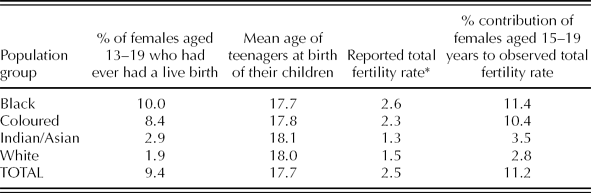
Table 1 shows the percentages of teenagers who had ever had a live birth, as well as the mean age of teenagers at birth of their children (computed from births in the preceeding twelve months) by population group. The figures indicate that Blacks have the highest percentage of teenage mothers as well as the lowest average age at childbirth compared with other population groups. The differences are statistically significant (p < 0.001). ‘Blacks’ in this study exclude the Coloured and Indian populations. Blacks constitute about 79 per cent and Whites 9 per cent of South Africa's population, while Coloureds (persons of mixed descent) and Indians together constitute about 11 per cent of the population (Stats SA, 2012). Blacks were the most historically disadvantaged socioeconomically due to apartheid policies. Currently, they have the lowest average annual household income compared with the other groups (Stats SA, 2012).
Teenage fertility by population group

Notes: *Adjusted total fertility rate: Black (2.8); Coloured (2.5); Indian/Asian (2.1); White (1.8): Total (2.7).
Source: Computed from CS2007 raw data.
Provincial comparison indicates that Mpumalanga and KwaZulu-Natal had the highest percentage of teenage mothers (12 per cent) and (10 per cent) respectively, while the Western Cape and Gauteng had the lowest (8 per cent); rural areas had a higher percentage of teenage mothers than urban areas, 11 per cent and 8 per cent respectively in 2007. A decomposition of the 2007 total fertility rates by age, controlling for differences in total fertility rates (i.e. fixing total fertility rates = 1), indicates that, compared to teenagers aged fifteen to nineteen in other population groups, Black teenagers had the highest relative fertility level, 11 per cent of overall fertility of the group.
Socioeconomic characteristics of teenage mothers
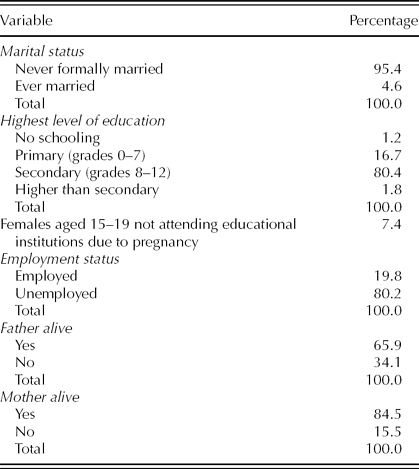
The minimum legal age for employment in South Africa is fifteen years. The analysis in this section was therefore confined to teenage mothers aged fifteen to nineteen. As seen in Table 2, as of 2007 about 95 per cent of teenage mothers were single parents, 18 per cent had a measure of primary education or no schooling, 20 per cent were unemployed, 34 per cent had a surviving father and 16 per cent had a surviving mother. The multivariate analysis in the next section was confined to teenagers aged fifteen to eighteen years since the upper age limit of teenagers that can access the CSG is eighteen years.
Socioeconomic characteristics and place of residence of teenage mothers aged 15–19
Source: Computed from CS2007 raw data.
Multivariate results
Factors associated with teenage childbearing
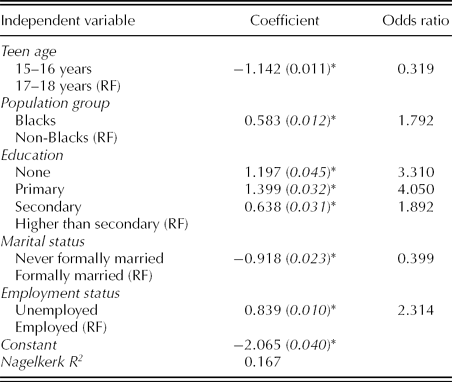
Table 3 summarises the results of the logistic regression and appears to indicate that level of education, marital status and employment status are significantly associated with teenage childbearing in South Africa (p < 0.001) (eighteen years is the standard age for completion of secondary education in South Africa). The Wald's test of the individual coefficients and the Hosmer–Lemeshow's test of overall fit of the model were statistically significant (p < 0.001).
Logistic regression of teenage fertility (dependent variable) by socioeconomic variable: total population
Notes: RF = Reference category, standard errors in parenthesis* statistically significant at p < 0.01.
It appears that, controlling for other factors, unemployed female teenagers are significantly more likely to have a teenage birth than employed female teenagers (p < 0.001). Female teenagers with no schooling or female teenagers with primary education are significantly more likely to have teenage births than female teens with higher than secondary levels of education, controlling for other variables (p < 0.001). Also, never married female teenagers have significantly lower odds of a teenage birth than ever married female teenagers (p < 0.001). Although these results are not new findings, they provide useful background to the analysis in the following section.
Relationship between child support grant and teenage pregnancy
This section examines the probability of a teenager on CSG being pregnant with another child. Parental survival was included in the analysis on the assumption that the welfare of teenagers is also influenced by parental survival status (Sear and Mace, Reference Sear and Mace2008).
The GHS2010 data indicate that about 69 per cent of teenage mothers aged fifteen to eighteen in 2010 were receiving CSG and of these:
1.6 per cent were currently pregnant with another child;
99.8 per cent had not been in a formal marriage;
36.5 per cent had a measure of primary education;
2.7 per cent were currently not attending any educational institution;
99.8 per cent were unemployed;
44.4 per cent were paternal orphans (father dead);
12.5 per cent were maternal orphans (mother dead).
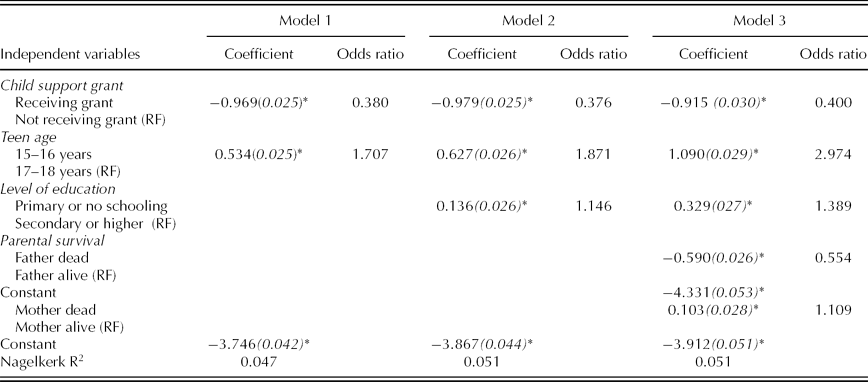
Thus, teenagers receiving the CSG tend to be single parents with a low level of education and are generally unemployed. Despite these characteristics, only a small percentage of teenagers were currently pregnant with another child. Since 99.8 per cent of the teenagers receiving the CSG had not been in a formal marriage and 99.8 per cent were unemployed, these variables were excluded from further analysis. The results indicate that, controlling for teen age, there is a significant negative relationship between receiving CSG and being pregnant with another child (p < 0.001) as seen from the negative beta coefficient (Table 4, Model 1).
Logistic regression of current pregnancy status (dependent variable) by child support grant status and other variables
Notes: RF = Reference category, standard errors in parenthesis* statistically significant at p < 0.01.
The relationship holds, controlling for level of education and parental survival status as seen in Models 2 and 3. The Wald's test of the individual coefficients and Hosmer–Lemeshow's test of overall fit of the models were statistically significant (p < 0.001). The relationship also holds when either population group or area of residence (rural/urban) is included as an additional control (p < 0.001). The Wald's test of the individual coefficients of the variables in this model was statistically significant (p < 0.001); and Hosmer–Lemeshow's test of overall fit of the model was statistically significant (p < 0.001) (coefficients not shown in the table).
The odds ratios in Model 3 indicate that, controlling for CSG status and other variables, teenagers with secondary or a higher level of education are significantly less likely to be pregnant with another child than teenagers with a measure of primary education or no schooling (p < 0.001). The effect of survival status of father or mother had different outcomes. A teenager whose father is dead is less likely to be pregnant with another child compared with a teenager whose father is alive (p < 0.001). However, a teenager whose mother is dead is more likely to be pregnant with another child compared with a teenager whose mother is alive (p < 0.001). This may be because, in South Africa, substantial numbers of children live with their mother rather than with their father (see Udjo, Reference Udjo, Zuberi, Sibanda and Udjo2005). The absence of mothers probably means the degree of discipline that mothers instil is now missing. Fathers may be less approachable compared to mothers when it comes to reproductive matters.
The models including population group or area of residence, controlling for CSG status, teen age, level of education, and survival status of mother, indicate that the odds of being pregnant with another child is significantly higher among Blacks than among non-Blacks (p < 0.001). Also controlling for these variables, the odds of being pregnant with another child is significantly higher (1.8 times) among teens living in rural than in urban areas (p < 0.001, table not shown).
Although the statistical tests of the individual coefficients and overall fit of the models were significant, the values of the Nagelkerk R2 test of the adequacy of the models were low (less than 0.5) suggesting that other factors not included in the models are also important determinants of teenage pregnancy. These would include proximate factors other than age at marriage but which are not available in the data, such as contraception, breastfeeding, frequency of intercourse, sterility, spontaneous abortion and age at menarche (Bongaarts, Reference Bongaarts1978).
Discussion and conclusion
Social assistance to vulnerable groups is common practice (though to a lesser extent than social insurance) in developed countries’ social protection systems. South Africa is one of few developing countries that have an extensive and well-developed social protection system, attributable to its greater fiscal resources and political commitment (Devereux, Reference Devereux2011). The CSG is one of the components of South Africa's social protection system for alleviating poverty in general for children from poor households and more specifically for teenage mothers. Whether or not social protection systems encourage perverse incentives is an on-going international debate (see Blanchard and Landier, Reference Blanchard and Landier2002; Brannstrom and Stenberg, 2007; Aasve and Lappegard, Reference Aasve and Lappegard2009). For example, Brazil's Bolsa Familia cash transfer programme has been criticised for discouraging work (Medeiros et al., Reference Medeiros, Britto and Soares2008). However, Medeiros et al. (Reference Medeiros, Britto and Soares2008) found no such evidence and pointed out that the financial incentive of the programme is not enough for beneficiaries to quit working. Indeed, they argued that it is possible that the cash transfers have the opposite effect to lowering commitment to work.
Media reports in South Africa suggest a link between the CSG and a rise in teenage pregnancies, but no empirical evidence has been produced in support of the relationship. The results from this study indicate the opposite effect, teenagers on the CSG are significantly less likely to be pregnant with another child compared with teenagers who are not on CSG, controlling for teen age, level of education, parental survival as well as population group or area of residence.
Patel et al. (Reference Patel, Hochfield, Moodley and Mutwali2012) argue that the CSG in South Africa is a social investment that builds human capabilities rather than a drain on public resources. They further point out that negative beliefs associated with a growing conservative anti-welfare ideology about the CSG induce unnecessary fears among beneficiaries that the grant may be stopped.
A number of studies elsewhere have examined teenage pregnancy and risk factors. Woodward et al. (Reference Woodward, Fergusson and Horwood2001) concluded that in New Zealand having been reared by a teenage mother was associated with an earlier timing of first pregnancy among daughters. They also found that young women characterised by educational underachievement, conduct problems and attentional problems were more likely to be pregnant at a young age than their more advantaged peers. It emerged from Miller and Benson's review of US studies (2001) that parent/child connectedness was consistently related to lower adolescent pregnancy risk. It also emerged from a review of studies in the European Union countries by Imamura et al. (Reference Imamura, Tucker, Hannaford, Da Silva, Astin, Wyness and Bloemenkamp2007) and a study in the United Kingdom by Allen et al. (Reference Allen, Bonell, Strange, Copas, Stephenson, Johnson and Oakley2007) that socioeconomic disadvantage, disrupted family structure and limited education were consistently related to teenage pregnancy. Aspects of the results in these international studies are not dissimilar to the results presented here, which suggest that South Africa, at one level, is not that different from the USA., the UK, or many other countries.
It should be noted however, that conceptually neither the CSG nor the socioeconomic variables considered in this study have a direct impact on teenage pregnancy. Further research should take account of proximate factors such as contraception, breastfeeding, frequency of intercourse, sterility, spontaneous abortion and age at menarche. A deeper understanding of factors determining teenage pregnancy therefore requires inclusion of these other proximate factors in the analysis when available.
Acknowledgements
The author gratefully acknowledges Statistics South Africa for providing access to their data as well as Professor Pinky Lalthapersad-Pillay (Department of Economics, University of South Africa) for her valuable comments and suggestions on this study. The views expressed in this article, however, are those of the author and do not necessarily reflect those of Statistics South Africa.