Introduction
Effective post-operative pain control is proven to lead to better outcomes, quicker transitions to recovery, and an overall improvement in quality of life.Reference Jalkut 1 Pain management can be challenging in the infant and paediatric populations due to the inability to verbalise pain compared to adult populations. Therefore, pain management is often prescribed on an “as-needed” frequency which can lead to suboptimal and ineffective pain control.Reference Carney, Nicolette and Ratner 2 Poorly controlled post-operative pain can cause tachycardia, hypertension, and an increase in systemic vascular resistance and circulating catecholamines. This leads to increased metabolic demands and oxygen consumption, which manifests as a stress response and can put patients at risk for other complications.Reference Inoue, Caldarone and Frndova 3 , Reference Oliveri, Jerzewski and Kulik 4 If pain is not sufficiently treated, detrimental psychological and physical consequences can occur, especially in children.Reference Moffett, Wann and Carberry 5
Currently, common pain management strategies for infant and children undergoing cardiac surgery include a combination of opioids and acetaminophen plus or minus benzodiazepines for anxiolysis.Reference Jalkut 1 However, these agents carry significant side effect profiles and can lead to over-sedation, especially when used in combination. Non-steroidal anti-inflammatory drugs, such as ketorolac or ibuprofen, have shown to be effective in improving pain in post-operative patients. In a case-control trial of 29 paediatric general surgical cases, patients were administered ketorolac 0.5 mg/kg intravenous every 6 hours supplemented with morphine; controls receiving morphine only were matched for age and surgical procedure. Patients receiving ketorolac plus morphine showed a significant reduction in morphine requirements in the first 48 hours post-operatively (ketorolac + morphine: 0.36 ± 0.16 mg/kg/day, morphine only: 1.08 ± 0.16 mg/kg/day; p < 0.05).Reference Carney, Nicolette and Ratner 2 Despite this, many providers remain reluctant to use these agents, especially in the paediatric cardiac surgical population, due to risks of drug-induced renal dysfunction and potential bleeding complications, which are already higher in these patients. Another study by Moffett and colleagues retrospectively reviewed the safety of ketorolac use after cardiac surgery in a total of 53 patients. The authors found insignificant increases in both serum creatinine and blood urea nitrogen at 48 hours post-non-steroidal anti-inflammataory drug use.Reference Moffett, Wann and Carberry 5 Additionally, a retrospective case-control review by Dawkins and colleagues of 19 patients less than 6 months of age with biventricular anatomy who received intravenous ketorolac after cardiothoracic surgery found no statistically significant changes in pre-operative versus post-treatment renal function or haematological effects compared to the control group. In addition, the authors found no statistically significant differences for the number of post-operative blood transfusions or additional analgesic administration between the groups.Reference Dawkins, Barclay and Gardiner 6
At the University of Maryland Children’s Hospital, all paediatric cardiac surgical patients are initiated on as-needed (PRN) narcotics and around-the-clock acetaminophen post-operatively. Within the first 12 hours post-operatively, non-steroidal anti-inflammataory drugs are administered in the form of intravenous ketorolac at a dose of 0.5 mg/kg every 6 hours for 48–72 hours and then transitioned to oral ibuprofen 10 mg/kg every 6 hours. The purpose of this study is to evaluate both the safety and efficacy of non-steroidal anti-inflammataory drugs in children following cardiac surgery. It is hypothesised that routine use of non-steroidal anti-inflammataory drugs in children after cardiac surgery is both safe and effective for post-operative pain management.
Materials and methods
Study design and patient population
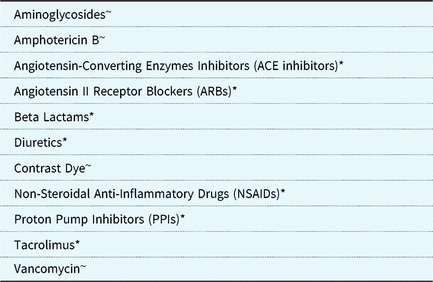
This Institutional Review Board-approved retrospective cohort chart review was conducted in cardiac surgery patients from 1 November, 2015 to 30 September, 2017 at the University of Maryland Children’s Hospital. The beginning of the study period represents implementation on an electronic medical record. Patients aged 1 month to 18 years old receiving non-steroidal anti-inflammataory drugs, who underwent cardiac surgery were included in this study; patients less than a month old were excluded due to their presumed altered pharmacokinetic factors that could skew the results. Patients with known renal failure, chronic kidney disease, or documented history of gastrointestinal bleeds were excluded from this study. Renal failure was defined as documentation of history of renal failure from providers placed in patients’ medical records charts. In addition, patients receiving therapeutic anticoagulation, such as therapeutic heparin, enoxaparin, and/or warfarin, were also excluded. These patients were excluded to limit the confounding factors that could skew results or could have increased renal or bleeding complications. Baseline characteristics were collected including patients’ cardiopulmonary bypass time and transfusion requirements as well as Face, Legs, Activity, Cry, Consolability (FLACC) pain scores to assess pain. The Society of Thoracic Surgeons-European Association for Cardio-Thoracic Surgery(STAT) score is a scoring system used to determine risk of mortality for operative procedure (STAT 1 with lowest mortality risk and STAT 5 with highest) was also collected.Reference Merkel, Voepel-Lewis and Shayevitz 7 In addition, nephrotoxic medications were also documented. A list of what was considered as nephrotoxic medications was decided upon between the investigators involved in this study as well as outside clinicians from different medical professions, including both pharmacists and nurse practitioners (Table 1).
Nephrotoxic medications

* Including both oral and intravenous routes.
∼ Intravenous route of administration.
Endpoints
The primary endpoints of this study were non-steroidal anti-inflammataory drug-associated renal dysfunction and post-operative bleeding. Renal dysfunction was defined as an increase in serum creatinine by ≥0.3 mg/dl, an increase in serum creatinine to ≥1.5 times baseline or a urine output <0.5 ml/kg/hour for 6 hours or greater within 48 hours of non-steroidal anti-inflammataory drug initiation. Patients with acute kidney injury were staged by Kidney Disease Improving Global Outcomes parameters. 8 Pre-operative serum creatinine was used as baseline serum creatinineto evaluate acute kidney failure. Post-operative bleeding was defined as chest tube output >3 ml/kg/hour following non-steroidal anti-inflammataory drug initiation. Number and type of post-operative transfusions werealso accounted. Secondary endpoints examined the effect of non-steroidal anti-inflammataory drug use on total daily dose of narcotics, the number of intravenous PRN narcotic doses received, and impact on pain assessment score. Daily opioid dosing was calculated from all doses of intravenous morphine, fentanyl, hydromorphone, and oral oxycodone and converted to equivalent doses of intravenous morphine.Reference McPherson 9
Statistical methods
Data were analysed using descriptive statistics for frequencies and ranges. Multivariate analysis was performed to measure the association of all predictors and outcomes. For multivariate analysis, a multiple regression model was used for the outcomes with baseline characteristics, and stepwise selection was applied to identify significant variables. The following models were used to identify if any variables were associated with an increased incidence of renal dysfunction and bleeding complications:
Change in serum creatinine = duration of non-steroidal anti-inflammataory drugs (hrs) +gender + age + race + STAT risk score + surgery complication + transfusion + back to OR for bleeding complications + patients transitioned to aspirin + other nephrotoxic medications + medications that cause bleeding + diuretics.
Total Chest Output = duration of non-steroidal anti-inflammataory drugs (hrs) + gender +age + race + STAT risk score + surgery complication + transfusion + back to OR for bleeding complications + patients transitioned to aspirin + other nephrotoxic medications + medications that cause bleeding + diuretics.
To detect any differences on secondary outcomes (narcotic use and pain assessment scores) among different time periods, Wilcoxon singed-rank test was performed. Analyses were performed with SAS version 9.4 (SAS Institute, Cary, NC).
Results
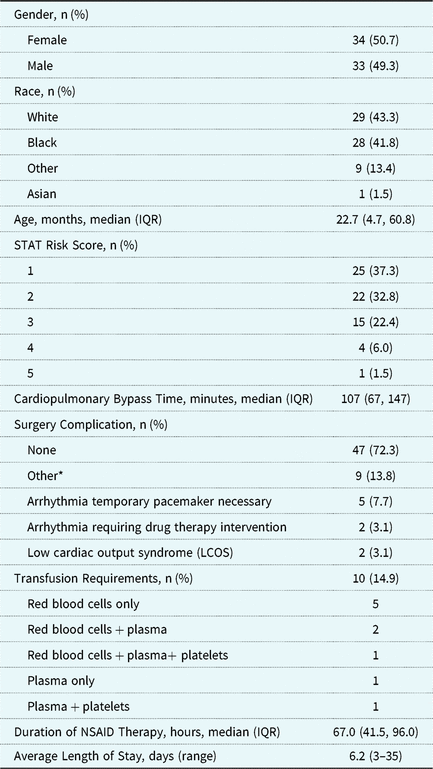
Eighty paediatric cardiac surgical patients were identified. Thirteen patients were excluded for the following reasons: concomitant use of therapeutic anticoagulation (9 patients) or no active non-steroidal anti-inflammataory drug order (4 patients), leaving a total of 67 patients to be evaluated. Of the 67 patients, 34 patients (50.7%) were female with a median age of 22.7 months. The majority of procedures were STAT scores 1–3. The median cardiopulmonary bypass time was 107 minutes (IQR: 67, 147). Forty-seven patients (72.3%) had no surgical complications and only 10 patients (14.9%) required a post-operative transfusion (Table 2).
Patient demographics (n = 67)
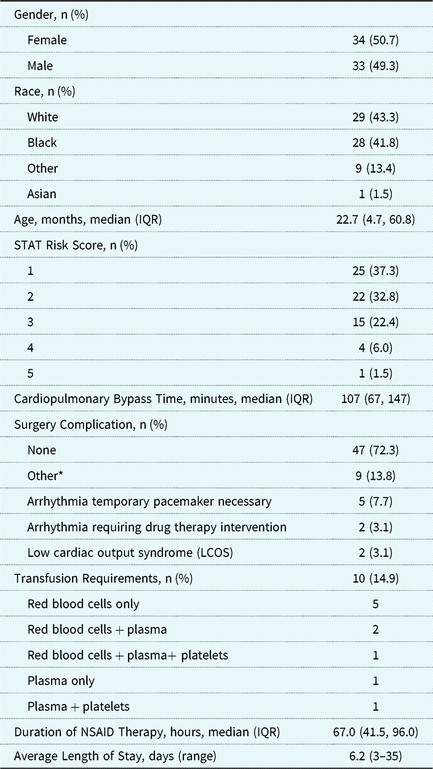
* Including open sternum, pneumonia, unexpected myocardial infarction, stroke, wound infection, pleural effusion requiring draining.
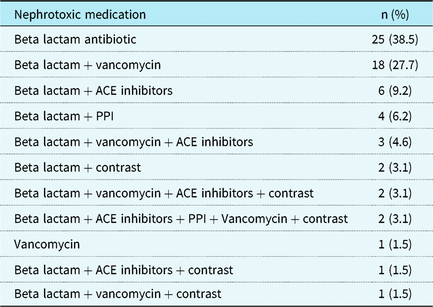
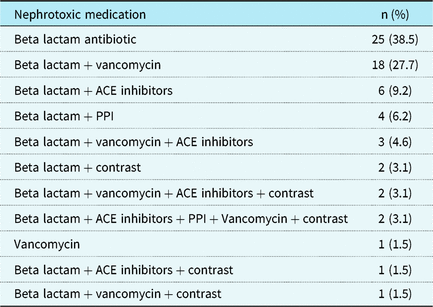
Sixty-three (94%) patients received around-the-clock intravenous acetaminophen. All patients received intravenous diuretics with the majority receiving a combination of furosemide and chlorothiazide (56.7%). In addition to both non-steroidal anti-inflammataory drugs and diuretics, 65 patients (97%) were on other potentially nephrotoxic medications (Table 3). The average length of stay was 6 days (range 3–35 days), and the median duration of non-steroidal anti-inflammataory drugs therapy was 67 hours (IQR: 41.5, 96).
Concomitantly administered nephrotoxic medications (n = 65)
The models used tested each variable and identified whether adding, including, or removing them from the model would result in an association for each primary endpoint. For renal dysfunction, only one variable in the final model demonstrated significance. Thus, our final model was “change in SCr = surgical complication.” A statistically significant association was found between the change of serum creatinine and patients with surgical complication (p = 0.003). On average, patients with surgical complications had an increased serum creatinine by 0.07 mg/dl compared to patients without surgical complications. Overall, no association was found between renal dysfunction and the use or duration of non-steroidal anti-inflammataory drugs. In addition, no association was seen between chest tube output and any of the other variables, including the duration of non-steroidal anti-inflammataory drugs (p > 0.15).
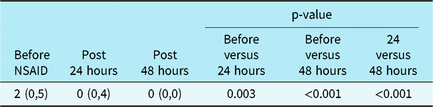
When analysing secondary outcomes, FLACC pain scores were assessed before initiation of non-steroidal anti-inflammataory drugs and at 24 and 48 hours of use.Reference Merkel, Voepel-Lewis and Shayevitz 7 A statistically significant reduction in median FLACC scores was seen within the first 24 hours after initiation from a score of 2 to 0 (p = 0.003). At 48 hours, the median FLACC score was 0 (p = < 0.0001) (Table 4). The daily intravenous morphine equivalent dose was assessed at the time of non-steroidal anti-inflammataory drug initiation. The median daily morphine equivalent on day 1 was 0.3 mg/kg. A statistically significant reduction of morphine requirements was seen from day 1 to day 2 (0.3 mg/kg versus 0.1 mg/kg, p < 0.001) and again from day 2 to 3 (0.1 mg/kg versus 0 mg/kg, p < 0.001); patients typically required minimal to no morphine by day 3 post-initiation of non-steroidal anti-inflammataory drugs. Similarly, a statistically significant reduction in the number of intravenous PRN narcotic doses used was seen from day 1 to day 2 (4 versus 1, p = < 0.0001) and again from day 2 to day 3 (1 versus 0, p < 0.001) where patients were not requiring any additional intravenous PRN doses (Table 5).
Comparison of FLACC pain score, median (IQR)

Comparison of daily morphine amount and number of PRN intravenous, median (IQR)

Discussion
In 2005, the Food and Drug Administration issued a black box warning recommending against the use of non-steroidal anti-inflammataory drugs following cardiac surgery.Reference Oliveri, Jerzewski and Kulik 4 Despite this, many clinicians still elect to use non-steroidal anti-inflammataory drugs in the post-cardiac surgery population, but use of non-steroidal anti-inflammataory drugs is controversial and warrants further examination of their safety and efficacy. The use of non-steroidal anti-inflammataory drugs has been examined in randomised controlled trials and a meta-analysis in adult cardiac surgery patients. This study established that the risk of renal failure was not significantly higher with perioperative non-steroidal anti-inflammataory drugs usage and that there was no statistically significant difference in serum creatinine levels between non-steroidal anti-inflammataory drugs and control groups.Reference Acharya and Dunning 10
The goal of this study was to examine the safety of non-steroidal anti-inflammataory drugs in the post-operative paediatric cardiac surgical patient population through the endpoints of renal dysfunction and post-operative bleeding. No statistically significant association between non-steroidal anti-inflammataory drug use and post-operative bleeding was found. The only statistically significant association was found between patients with surgical complications and renal dysfunction marked by an increase in serum creatinine by 0.07 mg/dl compared to those without complications. However, this trend was deemed to be not clinically significant. Our results show similar findings to Gupta and colleagues who also determined that the use of ketorolac was not associated with significant post-operative bleeding after congenital heart surgery in infant and children.Reference Gupta, Daggett and Ludwick 11 Inoue and colleagues evaluated nephrotoxic and opioid-sparing effects of ketorolac in low-risk cardiac surgery in children and found that ketorolac was not associated with a measureable difference in renal function and that use may be effective in reducing opioid exposure.Reference Inoue, Caldarone and Frndova 3 It is understood that the further time patients are from their surgery, their pain requirements lessen; however, our results showed positive findings in regard to the secondary endpoints of efficacy.
A significant reduction in morphine requirements was seen with non-steroidal anti-inflammataory drug use. Patients required morphine dosing of approximately 0.3 mg/kg/day on day 1 of non-steroidal anti-inflammataory drug use, which is consistent with what Carney and colleagues reported when looking at ketorolac’s opiate-sparing effects in paediatric general surgical patients. However, day 2 morphine requirements reduced by 67% to 0.1 mg/kg/day compared to day 1 requirements and then again on day 3 with patients requiring little to no morphine. There was also the significant reduction in patients’ FLACC pain scores from start of non-steroidal anti-inflammataory drug use to day 3 of therapy.
In addition to paediatric surgical cases, there are a few published cases of post-operative non-steroidal anti-inflammataory drug use in paediatric low-risk cardiac surgery patients.Reference Burd and Tobias 12 However, this study is unique since it is one of the only studies that assessed both the safety and efficacy of non-steroidal anti-inflammataory drugs in high-risk cardiac patients with STAT scores 3 and higher. We had more high-risk cardiac patients with STAT scores 3 and higher when compared to other studies that also included high-risk cardiac patients such as Moffett and Dawkins, especially with the number of STAT scores 4 and 5 patients included in our study.Reference Moffett, Wann and Carberry 5 , Reference Dawkins, Barclay and Gardiner 6 Neonates were excluded from the study due to their different pharmacokinetic profiles. Aldrink and colleagues looked at the safety of ketorolac in surgical neonates and infants 0–3 months old and found that infants younger than 21 days and less than 37 weeks corrected gestational age were at a significantly increased risk for bleeding events and should not be candidates for ketorolac or non-steroidal anti-inflammataory drug therapy.Reference Aldrink, Ma and Wang 13
While this study is one of the larger studies evaluating both the safety and the efficacy of non-steroidal anti-inflammataory drugs in infant and paediatric cardiac surgery patients, one limitation is it was conducted in a single center as a retrospective study. Lack of a control group, since non-steroidal anti-inflammataory drugs are a standard of practice at our institution is another limitation. In addition, various definitions of renal dysfunction and post-operative bleeding exist so these results can only be applicable to patient populations who define these endpoints similarly. Lastly, the use of acetaminophen post-operatively is a confounding factor when determining which agent was responsible for opioid-sparing effects; however, this is still a common practice in post-operative management. The continued decreased amount of opioid use can also be due to the overall progression of patients recovering post-operatively from surgery in addition to the agents that were used for pain management.
Conclusion
The purpose of this study was to evaluate the safety and efficacy of non-steroidal anti-inflammataory drugs following cardiac surgery in the paediatric population. The results validate the hypothesis that routine use of non-steroidal anti-inflammataory drugs in our children after cardiac surgery is both safe and effective for post-operative pain management. We found no significant association between the use and duration of non-steroidal anti-inflammataory drugs and renal dysfunction or increased risk of post-operative bleeding. Further prospective studies are needed to further examine the use of non-steroidal anti-inflammataory drugs, especially in higher risk cardiac surgical and neonatal populations. In addition, further studies need to be done with comparison of non-steroidal anti-inflammataory drugs to a control group to fully evaluate their role in pain score improvement and reduction of opioid use.
Acknowledgements
The primary author would like to acknoweldge the following: Omayma A. Kishk, PharmD, BCPPS, Jill A. Morgan, PharmD, BCPPS, and Jessica M Biggs, PharmD BCPPS for outstanding mentorship through this process; Hyunuk Seung for great contributions to our manuscript; Caroline Bauer for being a great counterpart in the creation of this manuscript for the better of our patients.
Conflicts of Interest
The authors have no actual or potential conflict of interest in relation to this presentation.
Financial Support
This research received no specific grant from any funding agency, commercial or not-for-profit sectors.