INTRODUCTION
Although religion influences a variety of social behaviors, few studies examine the effect of a religious identity on an individual's likelihood of supporting political activity. The Mennonite Church USA presents an interesting case study in which one can examine religious identity and its relationship with political behavior — specifically, one's decision to support, and engage in, political activity. The Mennonite Church USA was formed in 2002 with the merging of the two largest Mennonite denominations in the United States — the General Conference Mennonite Church (GCMC) and the (Old) Mennonite Church (MC). While the Mennonite Church USA is a relatively new church organization, the church can trace its roots to Mennonites that resided in North America since the 18th century.Footnote 1
Historically, the religious doctrine of the Mennonite church, like other Anabaptist denominations, encouraged a separation between church and state, meaning that church members should avoid political participation because of its worldly nature (Kraybill Reference Kraybill2010, 168; Urry Reference Urry2006, 3–4). Anabaptists traditionally thought of church and state as two kingdoms — the Kingdom of God and the kingdom of man. This worldview resulted from years of persecution during the Protestant Reformation and interpreting the New Testament in a way that emphasizes a sense of citizenship in the Kingdom of God, as opposed to the kingdom of man.Footnote 2
Using data from the 2006 Mennonite Church Member Profile (CMP) survey, I seek to determine (1) to what extent there is a Mennonite religious identity among contemporary Mennonites, (2) does this identity discourage political participation, and (3) if Mennonite identity discourages political participation, what is the substantive difference in support for political participation between low and high identity Mennonites.
Although Mennonites may appear to be an isolated segment of American society, as of 2005 there were 236,084 Americans who claimed membership in a Mennonite-affiliated congregation. Of those individuals, 111,038 were members of the Mennonite Church USA (Schrag Reference Schrag2005, 761).Footnote 3 If contemporary Mennonite identity affects individual political behavior, then it is likely that other denominations with similar religious beliefs could possess a religious identity with analogous political consequences.Footnote 4
In the following sections, I provide an overview of social identity theory and how a group attachment could influence individual behavior. Next, I discuss the origins of Mennonite identity and church/state beliefs. I also address instances of Mennonite political participation, and potential reasons for political involvement. Then, I detail the research methods employed to test if Mennonite identity influences individual political behavior. The findings that I present not only provide insights as to how contemporary Mennonites perceive political activity, but the results also demonstrate the potential influence of a religious social identity on individual political attitudes and behavior.
SOCIAL IDENTITY THEORY
According to Tajfel (Reference Tajfel1981, 251; see also Tajfel and Turner Reference Tajfel, Turner, Austin and Worchel1979), a social identity is “that part of the individual's self-concept which derives from his knowledge of his membership of a social group (or groups) together with the value and emotional significance attached to that membership.” Essentially, group membership provides an individual with benefits (psychological or material) that affect social behavior. As a result of the group attachment and benefits, individuals usually show favoritism toward their social in-group or, at least, seek outcomes that do not harm their in-group. In-group favoritism, along with group achievements, leads to the psychological benefit of increased self-esteem (Rubin and Hewstone Reference Rubin and Hewstone1998; see also Brown Reference Brown2000, 755–756). Self-esteem and other potential material or psychological benefits conferred by group membership then provide incentives for individuals to maintain group cohesion. Applying this framework to contemporary Mennonites, adhering to historic church doctrine by abstaining from political activity may increase one's self-esteem, which reinforces group cohesion and promotes further political abstention. While such behavior may seem plausible, this assumes that a religious attachment constitutes a social in-group.
There is reason to believe that a religious denomination can function as a social in-group and influence individual social behavior. For example, Deaux et al. (Reference Deaux, Anne Reid and Ethier1995, 228) suggest that “social identity theory (would) be most applicable to ethnic, religious, political, and some stigmatized identities.” Previous empirical studies confirm that racial/ethnic and political attachments have strong implications for political behavior.Footnote 5 Regarding religion, Wilcox and Gomez (Reference Wilcox and Gomez1990, 283) examined religiosity among African-Americans using data from the National Survey of Black Americans and concluded that black religion “is an important determinant of political attitudes and behaviors among blacks.” Furthermore, when analyzing African-American church-goers in Washington, D.C., Wilcox (Reference Wilcox1990) found that parishioners who identified with Pentecostal or charismatic denominations were significantly more likely to vote as compared to parishioners in other black churches. Religious identification also has implications for the types of political participation believed to be a legitimate form of political action. For example, in the edited volume, Politics and Pulpit (Smidt Reference Smidt2004), American clergy who embraced a conservative interpretation of the Bible were typically less likely to support protest marches and other non-traditional forms of political participation.Footnote 6 Although limited, these studies provide examples of how a religious group attachment could influence political behavior.
MENNONITE IDENTITY
In order for there to be a Mennonite identity that promotes a group mentality, there must be a “common characteristic or social experience” that brings people together as a collective to establish a formal group (Brewer Reference Brewer2001, 117). The Mennonite religious identity is one that is rooted in a history of social stigma and persecution dating back to 1525, when a small group of radical Protestant reformers baptized each other in Zurich, Switzerland, in hopes of establishing a Christian movement that centered on the teachings and literal interpretation of the New Testament. These individuals also sought to establish a “free” church that was separate from state control, unlike many of the churches at the time. The name given to these radicals was Anabaptists (meaning re-baptizers, or to be baptized again).
For Anabaptists, the union of church and state was a core problem with 16th century Christianity. Once an infant was baptized, not only did it signify membership in the church, but it also bestowed citizenship. The Anabaptist practice of adult baptism “threatened the marriage of civil and religious authority that had developed over the centuries … (Infant baptism) gave civil authorities the power to tax and conscript,” thereby asserting control over citizens (Kraybill and Bowman Reference Kraybill and Desportes Bowman2002, 8). Anabaptists believed that the government did not have “the right to interpret and prescribe a Christian practice such as infant baptism … the Bible (was) the sole and final authority” on this matter (Kraybill Reference Kraybill2001, 4). Religious purity was a primary concern to Anabaptist when they began the practice of adult baptism; it signified a conscious, voluntary commitment to Christ, and his teachings. They believed that only adults could turn themselves over to Christ. Yet, there were political consequences for this act of religious protest.
Within months of the first adult baptism, civil and religious leaders hired private citizens to literally hunt down Anabaptists. Anabaptists were labeled as heretics and persecuted well into the 18th Century for their religious beliefs. They were “burned at the stake, drowned in lakes and rivers, starved in prisons, or beheaded by the sword” (Kraybill and Hurd Reference Kraybill and Hurd2006, 6). Because of this persecution, Anabaptists were forced to flee the towns of Europe and seek refuge in the countryside. They turned to an agrarian lifestyle to separate themselves from larger society and they often held religious services in secrecy. Not only was separation from the state a part of their religious beliefs, but it was also needed to ensure their survival and freedom. This experience promoted a social identity where fellow Anabaptists were the in-group, and their persecutors and non-Anabaptists were the out-group.
Mennonites (named for an early Anabaptist leader, Menno Simons) did not emerge from the Anabaptist movement until 1537. However, they were persecuted with other Anabaptists for the religious practice of adult baptism. While persecution was a key factor that caused Mennonites and other Anabaptists to avoid involvement with the state, there were several other factors that compelled separation. First, Mennonites and Anabaptists historically interpreted the New Testament in a way that promotes pacifism; any use of force is contrary to Christ's teachings, and therefore sinful. But at the same time, the state, by its very nature, must use force and coercion to maintain stability and order in society. As such, Mennonites sought to avoid entanglements with the state, thereby avoiding state-sponsored force and coercion. To clarify, this did not mean that Mennonites and Anabaptists believed the state was illegitimate. As Redekop (Reference Redekop1989, 217) notes, “Although they would not participate in the activities of the state, Anabaptists did not deny the state's legitimacy; rather, they submitted themselves to it in those spheres where it had legitimate existence. They recognized that the state was ordained of God for the restraint of the evildoer and the protection of the innocent.” As long as the state did not violate biblical principles, Anabaptists were bound to obey it as an instrument of God. This leads to the second reason for avoiding involvement with the state — the interference with God's will. If the state is an instrument of God, then meddling in the affairs of the state and politics is tantamount to interfering with God's will. Third, according to the Schleitheim Confession of Faith, an early Anabaptist religious doctrine that was also adopted by Mennonites, Christians should not pursue political offices because it is contrary to the teachings of Jesus Christ — “(Christians) wished to make Christ king, but He fled and did not view it as the arrangement of His father … Christ has suffered (not ruled) and left us an example, that ye should follow His steps” (Sattler Reference Sattler1527). Much of these sentiments were reaffirmed in 1632 when Mennonites adopted the Dordrecht Confession of Faith, which dedicated its Article XIII specifically to the subject of the authority of the state and its legitimacy as an instrument of God's will. Thus, Mennonites emphasized a two-kingdom theology that encouraged a separation between church and state from a very early period in their history.
Although Mennonite persecution occurred centuries ago, it could form the basis of a Mennonite identity. Tajfel (Reference Tajfel1981, 258–259) explains that “a social group can fulfill its function of protecting the social identity of its members only if it manages to keep its positively-valued distinctiveness from other groups.” For Mennonites, it seems that maintaining such distinctiveness is possible because:
(R)eligion in general tends to promote the stabilization of individual and group identity by favoring the preservation of old content (in the form of doctrine, ritual, moral frameworks, role expectations, symbols, and the like), offering individuals a basis for reconstructing their identities within a stable or very slowly changing universe of shared meaning (Seul Reference Seul1999, 558).
Thus, if Mennonites preserved traditions that distinguished themselves from others in society since the time of the Protestant Reformation, then there is reason to believe that a Mennonite identity that discourages political involvement may be present among contemporary Mennonites. The question then is: did Mennonites take steps to preserve their identity over the years? The answer to this question is yes.
For centuries, Mennonites and other Anabaptists took measures to preserve their group identity. One of the most visible examples of this identity preservation began in 1660 with the publication of Martyrs Mirror by Thieleman J. van Braght. This text documented tales of Anabaptist martyrdom since the start of the 16th century. Many Mennonites and Anabaptist to this day maintain a copy of Martyrs Mirror as a reminder of the persecution their ancestors suffered throughout Europe in the 16th and 17th centuries.Footnote 7 This text had two primary effects on Mennonites: (1) it helped to maintain a Mennonite commitment to the separation of church and state well after Anabaptist persecution ended, and (2) it preserved a sense of common ancestral experience.
Even when many European Mennonites migrated to North America in the 18th century, they continued to preserve their identity by reading Martyrs Mirror and engaging in traditional Mennonite social practices. Mennonites largely avoided political involvement by refraining from voting or running for political office, even after there was no threat of state-sponsored persecution (Miller Reference Miller1996, 28). Furthermore, many Mennonites continued their pacifistic practices by refusing conscription into military service during World Wars I and II, Korea, and Vietnam.Footnote 8 Furthermore, while American Mennonites continued to officially observe the principles of the Schleitheim Confession of Faith and the Dordrecht Confession of Faith, they adopted other confessions of faith throughout the years that essentially reinforced the tenants of these original catechisms. The most recent doctrine, the Confession of Faith in a Mennonite Perspective, was adopted by the MC and the GCMC in 1995 and it emphasized the same traditional Mennonite values regarding the separation of church and state.Footnote 9 Article 23, titled “The Church's Relation to Government and Society,” reinforces the two-kingdom belief:
… As citizens of God's kingdom, we trust in the power of God's love for our defense. The church knows no geographical boundaries and needs no violence for its protection. The only Christian nation is the church of Jesus Christ … In contrast to the church, governing authorities of the world have been instituted by God for maintaining order in societies. Such governments and other human institutions as servants of God are called to act justly and provide order. But like all such institutions, nations tend to demand total allegiance. They then become idolatrous and rebellious against the will of God. Even at its best, a government cannot act completely according to the justice of God because no nation, except the church, confesses Christ's rule as its foundation (Confession of Faith in a Mennonite Perspective 1995).
The use of the Martyrs Mirror, adherence to Mennonite religious principles, and the reaffirmation of original church doctrine through the 20th century all provide evidence that a Mennonite identity should be present among contemporary Mennonites.
Looking beyond the Mennonite Church USA to other Mennonite groups, there is evidence that the preservation of Mennonite identity leads to low levels of political participation. Old Order Mennonites are the best example of a Mennonite group that has maintained a strong group identity. What is most interesting about this group is their highly cohesive nature and commitment to the historic principles of the early Mennonite Church. The preservation of this identity results in a lack of political involvement, particularly voting (Kraybill and Hurd Reference Kraybill and Hurd2006, 52; Kraybill and Kopko Reference Kraybill and Kopko2007, 192–193). Thus, Old Order Mennonites provide evidence that if historic principles are preserved through Mennonite identity, this will result in low levels of political activity. Given that contemporary Mennonites have taken steps to preserve Mennonite identity, it is possible that Mennonite identity among these individuals would also result in low levels of support for political activity.
MENNONITE POLITICAL INVOLVEMENT
Although there is good reason to suspect that those individuals who strongly identify as Mennonite will be less likely to support political activity, it is important to note that the preservation of Mennonite identity does not mean that all Mennonites will disapprove of political activity. In fact, to varying degrees, Mennonites have been involved in political matters for centuries. There are a number of reasons why Mennonites may support and engage in political matters, even when political involvement is traditionally discouraged. As Urry (Reference Urry2006) discusses in his study of Mennonites in Europe, Russia, and Canada, early in the church's history some Mennonites negotiated with European and Russian political leaders to secure privileges for religious freedom and the right to establish semi-autonomous communities.Footnote 10 To these early Mennonites, interacting with political leaders to secure religious rights ensured that members could practice their faith peacefully without fear of persecution. While negotiating with political leaders for religious rights may not seem to be overly “political,” it nonetheless indicates that Mennonites did not totally distance themselves from the affairs of the state, particularly when political involvement could preserve their religious freedom.
Negotiating with political leaders is not the only form of political participation that Mennonites have historically engaged in. Another form of political participation is political discourse. For example, during the 1930s, the Canadian Mennonite newspaper Der Bote (The Messenger) devoted more than 5% of its published material to discussion of the National Socialist (Nazi) government in Germany (Redekop Reference Redekop1996). Redekop performed a content analysis of articles printed in this newspaper between 1930 and 1939 to determine how often this influential Mennonite periodical discussed (positively or negatively) Germany's National Socialist government and found that 83% of the coverage of the National Socialists was positive in nature (Redekop Reference Redekop1996, 83). While much of the positive support for the National Socialist government was the result of a shared German social identity and loyalties to Germany, this still provides evidence that Mennonites early in the 20th century were aware of international political developments and formed attitudes in response to them.
Additionally, throughout the 19th and 20th centuries, American Mennonites have voted in elections, petitioned the government for policy change,Footnote 11 and occasionally sought public office.Footnote 12 Juhnke's (1975) study of Kansas Mennonites in the late 1800s and early 1900s reveals that while many Mennonites did not vote or engage in political activity before World War II, some Mennonites nevertheless voted and became involved in the political process. As early as 1877, Mennonites held local municipal office in Kansas, and in the early 20th century Mennonites held numerous elected offices, including state representative and county commissioner (Juhnke Reference Juhnke1975, 36, 80).Footnote 13 However, increased political activity among Mennonites was not limited to Kansas. Throughout the 20th century, political participation (i.e., voting, expressing political preferences, working within the government, etc.) among American and Canadian Mennonites was on the rise (Redekop Reference Redekop1983).Footnote 14 This observation is supported by data from the 1972, 1989, and 2006 CMP surveys. Based on the 1972 CMP, 40% of GCMC and MC members in the United States voted in recent elections all the time or most of the time, and 74% of respondents did not associate with or prefer a political party. By the time of the 1989 CMP, 46% of GCMC and MC members voted in all or most recent elections, and 25% did not associate with or prefer a political party. And for the 2006 CMP, only 11% of respondents did not associate with or prefer a political party.Footnote 15 These data represent a significant increase in the percentage of Mennonites who regularly vote, and the data also demonstrate that Mennonites are increasingly partisan in their political preferences.
While there are a number of potential explanations for increased Mennonite political involvement throughout the 20th century, it seems that acculturation, due to modernization, is a key impetus. In recent decades, more Mennonites are living in urban areas, seeking higher education, and expanding their social network to include non-Mennonites, and even non-Christians. Exposure to these influences can affect an individual's self-conception and behavior. Kanagy (Reference Kanagy2007, 170–171) notes that because of modernity's influence, Mennonite perception of “worldly” behaviors has changed sometimes dramatically since the first CMP in 1972. In comparing responses from the 1972 CMP and the 2006 CMP, Kanagy found that 2006 CMP respondents were much more likely to approve of dancing, gambling, the consumption of alcohol, and divorce, among other “worldly” behaviors. In light of these changes, Kanagy (Reference Kanagy2007, 170–171) stated that “the changes support the argument that Mennonites are becoming more conforming to the values and attitudes of the larger society — looking more like their neighbors and co-workers than was true for Mennonites thirty-five years ago.” Bush (Reference Bush1998, 12) made similar claims, observing that in recent decades “Mennonites have rapidly discarded the patterns of speech, dress, and consumption that marked their rural communities to adopt, nearly wholesale, the trappings of larger American culture.”
There is empirical evidence to demonstrate the effects of acculturation on Mennonite attitudes toward political participation. In their study of the 1972 CMP, Kauffman and Harder (Reference Kauffman and Harder1975, 281, 289) found that Anabaptists with higher socioeconomic status and those who lived in an urban environment were most likely to engage in political participation. Kauffman and Driedger (Reference Kauffman and Driedger1991, 238–243) obtained analogous results when analyzing the 1989 CMP.Footnote 16 And given that the Mennonite Church USA's membership is becoming increasingly diverse,Footnote 17 it is highly probable that similar patterns hold among modern day Mennonites. In short, when Mennonites live, work, and are educated in environments where they interact with non-Mennonites, this will help to foster some degree of acculturation and potentially influence their views on political involvement.
Acculturation also has led some Mennonites to re-conceptualize the church's relationship with the state (see Bush Reference Bush1998) and, in particular, the Anabaptist two-kingdom theology. As Driedger and Kraybill (Reference Driedger and Kraybill1994, 122) discuss, starting in the 1960s the two-kingdom view of the world underwent a “paradigm shift.” Instead of the two kingdoms being separate entities, both were now viewed under the “lordship of Christ,” where both church and state were accountable to God. According to Driedger and Kraybill (Reference Driedger and Kraybill1994, 120), “The kingdoms of this world suddenly dropped in esteem. They were now viewed sometimes as agents of rebellious principalities and powers — disobedient to the high standards of God's righteousness which God required of all under the lordship of Christ” (emphasis in original). Under this new conception of the two kingdoms, the church was superior to the state, and Christians could engage in “prophetic witness” and hold elected officials to God's high standards (Driedger and Kraybill Reference Driedger and Kraybill1994, 122). Therefore, Mennonites could work within the political process and hold public office for the purpose of promoting Christian principles, if they so choose.
However, even though Mennonites in general have become more accepting of some forms of political involvement, that does not mean that those individuals who strongly identify and embrace the two-kingdom Anabaptist theology will also support political activity. Kanagy's (2007) study makes clear that the average age of a Mennonite Church USA parishioner is increasing compared to past CMP studies of the GCMC and MC, meaning that fewer young people are remaining in the church. It is possible that those individuals remaining in the church will possess a strong Mennonite identity and will embrace the traditional Anabaptist two-kingdom theology. In the next section, I discuss the methods employed to test whether Mennonite identity diminishes support for political participation.
METHODS
I test my research questions using data from the 2006 Mennonite Church Member Profile survey. The 2006 CMP is a 20-page mail survey administered by the Young Center for Anabaptist and Pietist Studies at Elizabethtown College. To recruit respondents for the CMP, Mennonite congregations were randomly selected from a stratified national database that accounted for congregation size and location. Once a congregation was selected, parishioners were randomly sampled from that congregation's membership directory, and typically 30 members were sampled per congregation. Initially, 3,080 parishioners were selected to participate in the study. After follow-up mailings and phone calls, the 2006 CMP yielded a final response rate of 76.33% (N = 2,216). The data is weighted by respondent gender and congregation.Footnote 18 I use five different dependent variables in logistic regression modelsFootnote 19 to analyze support for Mennonite political participation. The dependent variables measure the following: (1) should Christians avoid government participation, (2) should Christians participate in politics to improve society, (3) should Mennonites run for elected office, (4) should Mennonites vote in national elections, and (5) did the respondent vote in the 2004 presidential election.
If historic Mennonite beliefs that discourage political activity are still present among contemporary Mennonites, then I expect all independent variables measuring Mennonite identity to be signed in the direction that disfavors political participation. The first independent variable that I employ is Mennonite Identity. This variable provides a measure of group identification. In the CMP, respondents were provided with a list of religious characteristics that potentially described themselves (e.g., Christian, charismatic, Mennonite, etc.) and instructed to mark all characteristics that applied. If the respondent selected “Mennonite,” then this variable was coded as 1, otherwise it was coded as 0.
The second independent variable, Strong Mennonite Identity, is quite similar to preceding variable. After respondents noted all the religious characteristics with which they self-identified, they were then asked to select the two characteristics that most closely described themselves. If the respondent identified as “Mennonite,” this variable was coded as 1, otherwise it was coded as 0. This particular variable serves as a measure of the intensity of Mennonite identity. Those individuals who strongly identify as a Mennonite should be most likely to select “Mennonite” as one of their two identification possibilities. If Mennonite Identity or Strong Mennonite Identity equals 1, the respondent should be less supportive of political activity.
The third independent variable is Distinctive Mennonite Beliefs. For this variable, respondents were asked to rate their agreement with the statement: “Distinctive Mennonite beliefs are very important to me.” This variable was measured on a four-point scale where completely disagree was coded as 1, mostly disagree as 2, mostly agree as 3, and completely agree as 4. As the value of this variable increases, an individual's support for political activity should decrease. Although this variable does not explicitly measure Mennonite identity, those individuals who highly identify as Mennonite should be most likely to agree with the above statement. As such, this variable acts as an indicator for Mennonite identity.Footnote 20
The fourth independent variable is Avoid the Worldly Kingdom. For this variable, respondents were asked whether they agreed that “Christians should avoid involvements in the kingdom of this world.” The variable was coded on a four-point scale where completely disagree was coded as 1, mostly disagree as 2, mostly agree as 3, and completely agree as 4. This is perhaps a more powerful indicator of whether an individual will distance themselves from the political realm. Again, as the value of this variable increases, an individual's support for political activity should decrease.
In addition, I control for a number of socioeconomic status and demographic variables, including the respondent's age, race, gender, level of education, and level of income. I also control for one other important factor, the respondent's support of the Mennonite Central Committee's Christian witness efforts in Washington, D.C. and New York City (variable denoted Support MCC). The MCC engages in a wide variety of charitable and Christian mission operations throughout the world. As such, they are often in contact with international leaders to address issues of humanitarian aid. Although the MCC does engage in some political activity in order to carry out its humanitarian projects, it is not entirely clear that negotiating with government officials in order to perform charitable work constitutes political activity in the traditional sense. Rather, this seems to be more along the lines of Christian mission work, which is a component of the Mennonite faith. It is possible that some Mennonites may approve of political activity because they considered the actions of the MCC at the time of completing the survey.
RESULTS
The Prevalence of Mennonite Identity
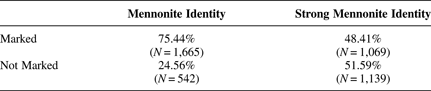
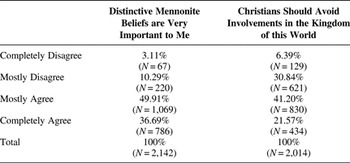
Table 1 presents the frequencies of Mennonite Identity and Strong Mennonite Identity. A majority of respondents (75%) identified themselves as Mennonite. Although this is a large portion of respondents, almost one-quarter of respondents did not identify themselves as Mennonite. And less than half of the respondents (48%) expressed a strong Mennonite identity. Table 2 presents the frequencies for Distinctive Mennonite Beliefs and Avoid the Worldly Kingdom. Regarding Distinctive Mennonite Beliefs, the vast majority of respondents (87%) “completely agree” or “mostly agree” that “distinctive Mennonite beliefs are very important to me.” Additionally, almost two-thirds of respondents (63%) “completely agree” or “mostly agree” that “Christians should avoid involvements in the kingdom of this world.”
Mennonite identity
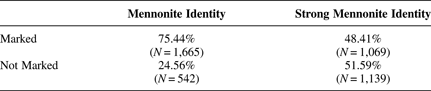
Note: Data obtained from the 2006 Mennonite Church Member Profile survey.
Mennonite beliefs

Note: Data obtained from the 2006 Mennonite Church Member Profile survey.
It is apparent that a significant portion of contemporary Mennonites identify with the Mennonite faith and support Mennonite beliefs. However, there is a substantial minority of respondents (25%) who do not identify with the Mennonite Church and a larger minority (37%) who disagree to some extent with the Mennonite distinction between the Kingdom of God and kingdom of man. Despite this, it appears that there is a Mennonite identity among contemporary Mennonites, and that identity is fairly widespread.
The Effect of Mennonite Identity
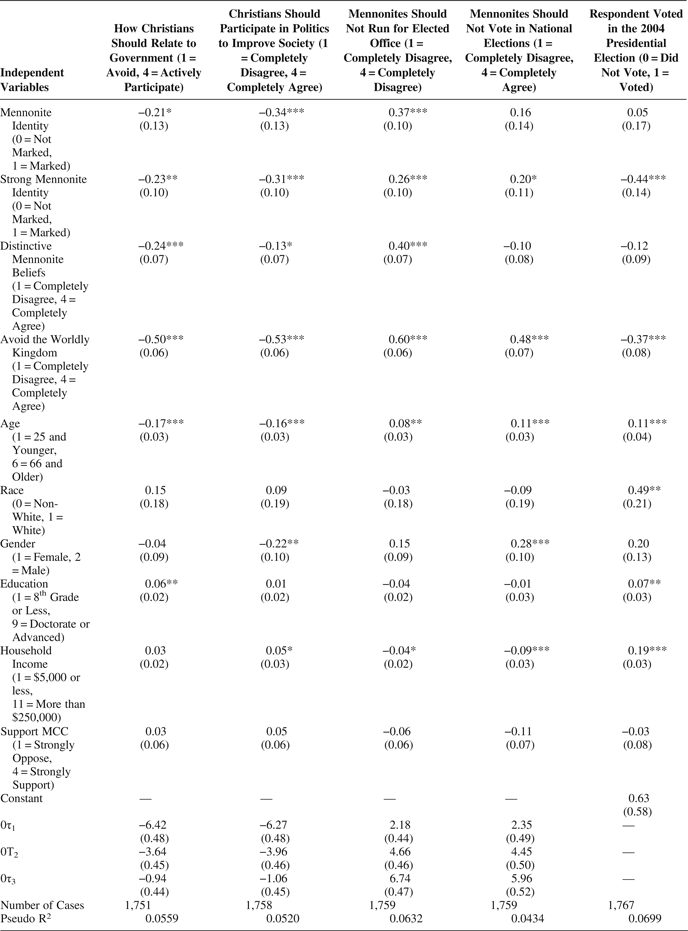
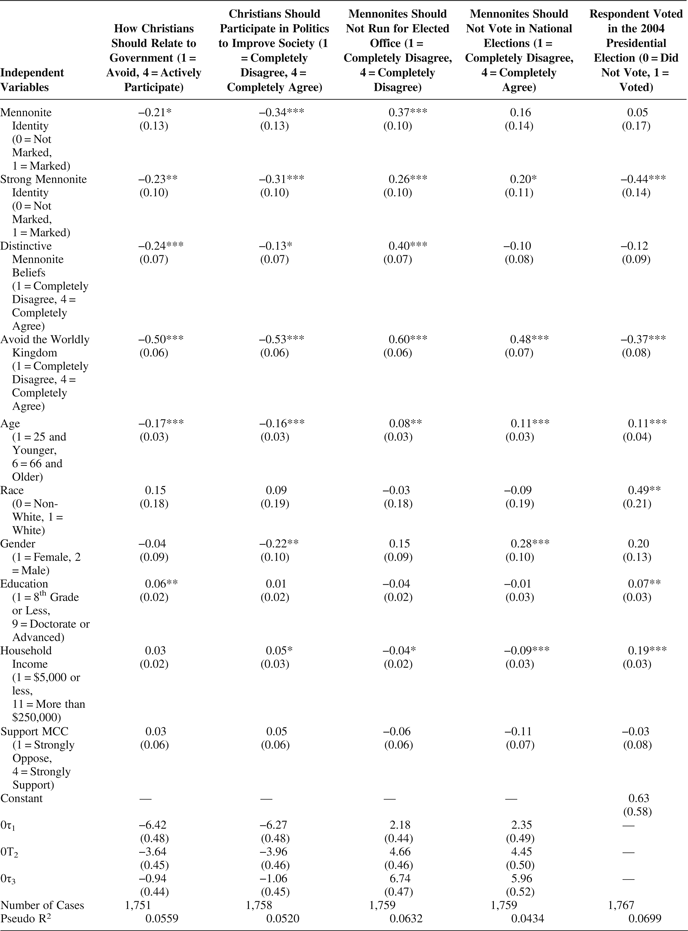
The results of the five logistic regression models are presented in Table 3. The variable Mennonite Identity attains statistical significance in three of the five models, and the Strong Mennonite Identity variable is correctly signed and statistically significant in each of the five models.
Mennonite identity logit and ordered logit models
*p < 0.10, **p < 0.05, ***p < 0.01, two-tailed tests.
Much like the Mennonite Identity variable, the variable Distinctive Mennonite Beliefs is correctly signed and statistically significant in three of the five models. The final variable that taps Mennonite identity, Avoid the Worldly Kingdom, is statistically significant and signed in the proper direction in all five models.
One of the control variables does present an interesting result and is deserving of further comment. The age of the respondent is statistically significant in all five models. In four of the five models, increased age decreases the respondent's probability of supporting political activity. Such a relationship makes intuitive sense because older respondents have spent more time as a member of the Mennonite Church compared to their younger counterparts. These respondents are likely to have been influenced by Mennonite doctrine over the years and internalized it as part of their self-conception. Interestingly, however, older individuals were more likely to vote in the 2004 presidential election than their younger counterparts. Although it is generally accepted that increased age is a predictor of voter turnout among the general public, this behavior is contrary to traditional Mennonite doctrine. It is perplexing that older respondents were less likely to support of Mennonites voting in national elections (model 4), but then these same respondents were most likely to have voted in the 2004 presidential election (model 5). To offer one potential explanation, it is possible that older Mennonites felt compelled to vote in the 2004 election because of the perceived divide between President Bush and Senator Kerry on moral issues.Footnote 21 However, this is only a tentative explanation. The unusual relationship between age and voting in the Mennonite Church USA certainly deserves attention in future research.
Predicted Probabilities and the Implications of Mennonite Identity
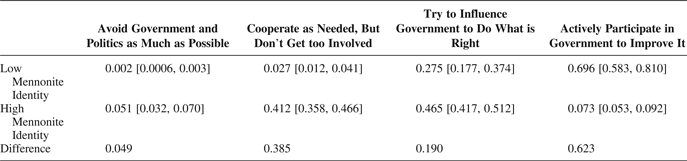
To briefly summarize the above findings, the analysis provides support that (1) a Mennonite religious identity is present among contemporary Mennonites, and (2) increasing levels of Mennonite identity reduces support for political activity. However, it is unclear whether high levels of Mennonite identity result in a substantial decrease in an individual's probability of supporting or engaging in political activity as compared to respondents with low levels of Mennonite identity. For this reason, predicted probabilities are presented in Tables 4 through 8 for each of the five dependent variables analyzed in Table 3. Each predicted probability table contains two respondent profiles. The first respondent profile, Low Mennonite Identity, sets all identity independent variables set to their minimum level, while the second respondent profile, High Mennonite Identity, sets all identity independent variables set to their maximum level. Each profile sets the control variables to their modal values.Footnote 22
Predicted probabilities of how Christians should relate to government
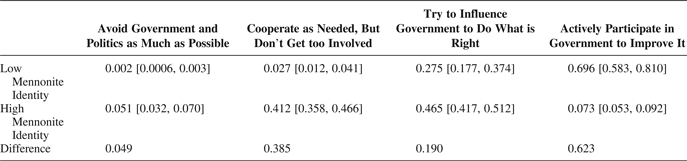
Note: For “Low Mennonite Identity” all identity variables are set to their minimum level and for “High Mennonite Identity” all identity variables are set to their maximum level. All other variables are set at their model category: Age = 46 to 55 years old; Race = White; Gender = Female; Education = High school graduate; Household Income = $50,000 to $74,999; Support for the MCC = Support. Totals may not add to 1.0 due to rounding errors. The 95% confidence intervals are reported in brackets.
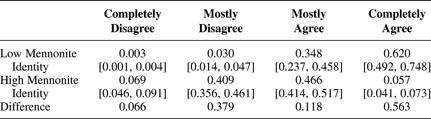
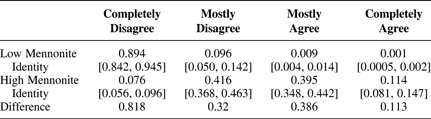
After reviewing the predicted probabilities in these five tables, there are two distinct patterns that can be observed. First, the profile High Mennonite Identity is less likely to approve of any form of political participation compared with the Low Mennonite Identity profile. Second, even though Mennonites with high levels of identity are the least likely members in the sample to approve of political activity, they are supportive of political activity to some extent. For four of the five predicted probabilities, there is more than a 50% probability that high Mennonite identifiers would support political participation to some degree.
In Table 4, which analyzes how Christians should relate to government, there is a 97% probability that respondents in the Low Mennonite Identity profile would state that it is acceptable to “actively participate in government to improve it” or “try to influence government to do what is right.” There is a 54% probability that respondents in the High Mennonite Identity profile would respond in the same manner.
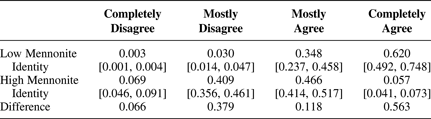
Table 5 presents the predicted probabilities regarding Christian participation in government to improve society. Respondents in the Low Mennonite Identity profile showed great support for participation in government. There is a 97% probability that these individuals would “completely agree” or “mostly agree” that it is acceptable to participate in government to improve society. Respondents in the High Mennonite Identity profile had a 52% probability that they would “completely agree” or “mostly agree” with this statement.
Predicted probabilities, Christians should participate in government to improve society
*See note under Table 4
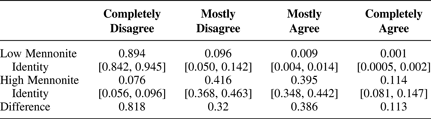
The predicted probabilities in Table 6 denote respondent agreement with the statement “Mennonites should not run for any elected office.” There is a 1% probability that Low Mennonite Identity would “completely agree” or “mostly agree” with this statement, while there is a 51% probability that respondents in the High Mennonite Identity profile would “completely agree” or “mostly agree.” This it is the only time in the predicted probably profiles presented in this section that High Mennonite Identity respondents have greater than a 50% probability of opposing political involvement.
Predicted probabilities, Mennonites should not run for any elected office
*See note under Table 4
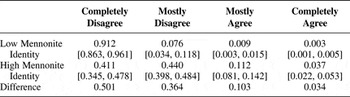
The predicted probabilities in Table 7 measure support for the statement “Mennonites should not vote in national elections.” Low Mennonite Identity respondents have a 1% probability of answering “completely agree” or “mostly agree” to this statement, while High Mennonite Identity respondents have a 15% probability of responding in the same manner.
Predicted probabilities, Mennonites should not vote in national elections

*See note under Table 4
Last, Table 8 presents predicted probabilities of voter turnout in the 2004 presidential election. Respondents in the Low Mennonite Identity profile had a 96% probability of voting, while respondents in the High Mennonite Identity profile had a 70% probability.

DISCUSSION
The analysis reveals several interesting findings regarding the relationship between Mennonite religious identity and political involvement. First, the descriptive statistics show that a large majority of parishioners identify themselves as Mennonites. Seventy-five percent of respondents identify as Mennonite, and 48% strongly identify as Mennonite. Additionally, a large majority of respondents support distinctive Mennonite beliefs and the two-kingdom Anabaptist theology. Thus, it seems that contemporary Mennonites possess a religious identity and support traditional Mennonite beliefs that should discourage political involvement.
The analysis also reveals that the four independent variables representing Mennonite identity generally have a negative statistical relationship with political participation. This finding comports with the historic tradition of Mennonites avoiding political activity. It should be noted, however, that in the two logit models addressing voting, the independent variables Mennonite Identity and Distinctive Mennonite Beliefs were not statistically significant. Such a relationship is unusual because voting is an obvious form of political participation, and given historic Mennonite beliefs, these variables, too, should be statistically significant and negatively signed. One potential explanation for this unexpected finding is that contemporary Mennonites do not view voting to be a highly political act, especially given that some Mennonites have engaged in this practice for decades. Casting a ballot in the privacy of a voting booth seems to be much less political than running for office, making a contribution to a political campaign, or actively working to bring about a policy change. In any event, the relationship between contemporary Mennonite beliefs and voting warrants further investigation.
While increasing levels of Mennonite religious identity reduces the probability that parishioners will support political activity, the predicted probability analysis shows that even those Mennonites with a high level of identity have approximately a 50% probability of supporting political activity. Historic traditions in the Mennonite church suggest that those individuals who highly identity as Mennonite would not engage in any sort of political participation. But, this is clearly not the case among contemporary Mennonites. Respondents with high levels of identity were moderately supportive of political activity, as opposed to showing strong disapproval. It seems reasonable to conclude that contemporary Mennonite political behavior does not necessarily reflect historic Mennonite teachings. Although high levels of Mennonite identity reduce the probability of supporting political activity, its effect is not so strong that it compels parishioners to largely avoid politics. Perhaps one explanation for such results is the influence of acculturation and modernity.
The findings of this article are potentially generalizable beyond this particular group of Mennonites. As noted earlier, the Mennonite Church USA is a part of the Anabaptist religious tradition. If the Mennonite Church USA is open to political activity, it is possible that other mainstream Mennonites and Anabaptist are also supportive of political activity. Future studies of Mennonites and Anabaptists should move beyond measuring levels of support for political involvement and instead seek to analyze actual political involvement. Do Mennonites engage in campaign work for political candidates? Do they contribute money to political causes? Given their strong belief in pacifism and opposition to the use of force, do they engage in anti-war protests? Specifying what forms of political participation Mennonites engage in will help determine if the various forms of political participation are dependent on religious identity. Furthermore, by analyzing specific instances of political involvement, researchers could determine if there is any difference between the political involvement of Mennonites and those of the general public.
Last, the findings presented here also have implications for the study of religion and politics. The results provide evidence that a religious attachment can function as a social identity that influences individual political behavior. Those individuals who possess a strong religious identity are likely to internalize their religion's tenants as part of their self-conception. If tenants of faith influence how an individual perceives political actions, and how an individual forms political preferences, then religious identity could be an important factor in explaining and understanding individual political behavior. As such, researchers should account for this influence when appropriate.
CONCLUSION
This article's results indicate that Mennonite identity is present among members of the Mennonite Church USA. Seventy-five percent of respondents in the 2006 CMP survey identified as Mennonite, and 48% strongly identified as Mennonite. Furthermore, as hypothesized, Mennonite identity decreases the likelihood of an individual supporting political activity. However, contrary to historic church tradition, contemporary Mennonite religious identity does not overwhelmingly suppress political participation. Respondents were fairly supportive of political involvement, regardless of the strength of their Mennonite identity. Even respondents who most strongly identified as Mennonite had approximately a 50% probability of supporting political participation.
Perhaps it is understandable that contemporary Mennonites are not totally opposed to political participation given the effects of acculturation, a paradigm shift in the two-kingdom theology, and the changes in Mennonite church membership in recent decades. It is difficult to predict how Mennonite identity will influence individual political behavior in the years to come, especially as membership in the Mennonite Church USA continues to change. Still, barring a significant change in the church, it seems likely that Mennonites will be supportive of political activity at some level for the foreseeable future.