


1. Wilson cycles and supercontinents
Alfred Wegener was the first to convincingly propose the existence of a past supercontinent gathering all the Earth's continental masses (e.g. Wegener, Reference Wegener1912). Five decades later, while seeding the theory of plate tectonics, Tuzo Wilson provided evidence that the ‘Atlantic’ had closed and re-opened more or less in the same place (Wilson, Reference Wilson1966). These conspicuous observations suggested a pattern of cyclicity in the creation and destruction of large oceanic basins. Later on in the 1970s evidence for the existence of a number of other past supercontinents started to emerge (e.g. Valentine & Moores, Reference Valentine and Moores1970; Piper, Reference Piper1974) and the idea of a cyclicity in the dispersion and assembly of continents over the Earth's history was established. At the largest time scale a supercycle (also referred to as a supercontinental cycle), encompasses the recurring dispersion and assembly of almost all continental masses in supercontinents such as Pangaea (Worsley, Nance & Moody, Reference Worsley, Nance and Moody1982, Reference Worsley, Nance and Moody1984). At an immediately lower time scale order is the Wilson cycle (named in honour of Tuzo Wilson), which describes the history of a particular ocean from its birth to its death, in three phases: (1) opening and spreading; (2) foundering of its passive margins and development of new subduction zones; and (3) consumption and closure. Even though not all Wilson cycles (i.e. the closure of a given ocean) lead to the formation of a supercontinent, the concepts are tightly related because the formation of a supercontinent is always preceded by the closure of one or more oceans (Yoshida & Santosh, Reference Yoshida and Santosh2011). A supercycle can thus be seen as a sort of a superposition of different Wilson cycles acting at the same time, but potentially shifted in phase (and orientation). So, to understand how supercontinents form we first have to understand how Wilson cycles operate. Most of the Wilson cycle stages can be seen somewhere in the world today (e.g. the newly formed continental rift in Africa, the subduction zones surrounding the Pacific Ocean and the Himalayan collision) and are relatively well understood. However, its key phase of subduction initiation remains largely unknown: how do subduction zones initiate in pristine Atlantic-type oceans? Is there a common mechanism governing the formation of new subduction zones?
2. Ending Atlantic-type oceans
As oceanic lithosphere spreads and cools, it becomes gravitationally unstable. Oceanic lithosphere older than 10 Ma has an average density that is higher than the asthenosphere, promoting collapse and sinking into the asthenosphere and formation of new subduction zones (Cloos, Reference Cloos1993). The pull at the subduction zones will eventually drive the continents back together. However, for subduction to initiate at passive margins the oceanic lithosphere has to break where it is generally very strong. This is because oceanic plates also become stronger with age making the process of spontaneous subduction very difficult or even unlikely (Cloetingh, Wortel & Vlaar, Reference Cloetingh, Wortel and Vlaar1989). Hence, in passive margins there are generally no tectonic forces with the magnitude required to spontaneously initiate subduction (Mueller & Phillips, Reference Mueller and Phillips1991). Even though there is a potential energy gradient across passive margins, calculations show that the potential energy difference between continental and oceanic lithosphere is insufficient to initiate subduction (Lonergan & White, Reference Lonergan and White1997). An additional force or pre-existing convergence is thus required (McKenzie, Reference McKenzie, Talwani and Pitman, III1977), and the only source to provide a force conceivably capable of inducing subduction initiation along a pristine passive margin is another subduction system or an associated collision belt (Mueller & Phillips, Reference Mueller and Phillips1991; Duarte et al. Reference Duarte, Rosas, Terrinha, Schellart, Boutelier, Gutscher and Ribeiro2013). Alternatively, weakening processes such as the hydration of a hyper-extended oceanic lithosphere (by serpentinization) or thermal erosion through mantle upwelling (e.g. plume) have been suggested as mechanisms that can aid subduction initiation (Masson et al. Reference Masson, Cartwright, Pinheiro, Whitmarsh, Beslier and Roeser1994; Ueda, Gerya & Sobolev, Reference Ueda, Gerya and Sobolev2008; Burov & Cloetingh, Reference Burov and Cloetingh2010; Whattam & Stern, Reference Whattam and Stern2015). However, this does not seem to be a widespread and sufficient mechanism, otherwise subduction zones should be starting all over the Atlantic margins (in particular when considering weakening by hydration). Or maybe pervasive weakening processes are limited to specific tectonic environments, such as transform plate boundaries (e.g. the Azores–Gibraltar fracture zone), or only have an effect over long time scales (> 200 Ma).
An alternative to the spontaneous subduction initiation model considers that subduction zones are triggered by stress transmission from a nearby collision belt or converging region such as the Scotia and Lesser Antilles subduction zones, which were transmitted from the Pacific into the Atlantic (note that in those two cases the subduction polarity was reversed; Figs 1, 2; Mueller & Phillips, Reference Mueller and Phillips1991; see also Stern, Reference Stern2004; Baes, Govers & Wortel, Reference Baes, Govers and Wortel2011), or simply propagate from one ocean to another (Royden, Reference Royden1993). We will use from now on the term ‘subduction invasion’ to signify a general process of subduction initiation in an Atlantic-type ocean in which the formation of the subduction zone is or was induced by an external (to the pristine basin) mechanism or force (see Duarte et al. Reference Duarte, Rosas, Terrinha, Schellart, Boutelier, Gutscher and Ribeiro2013). In this context, the concept of invasion is similar to the infection mechanism proposed by Mueller & Phillips (Reference Mueller and Phillips1991). Oceans such as the Atlantic are not completely isolated and if a connection (or narrow land bridge) to an ocean with active subduction zones exists they are likely to be ‘invaded’ by subduction zones (Mueller & Phillips, Reference Mueller and Phillips1991; Royden, Reference Royden1993; Duarte et al. Reference Duarte, Rosas, Terrinha, Schellart, Boutelier, Gutscher and Ribeiro2013; Murphy & Nance, Reference Murphy and Nance2013; Waldron et al. Reference Waldron, Schofield, Murphy and Thomas2014). That is because far-field stresses from nearby convergent regions can be transferred to adjacent passive margins (this could have been the case for the Scotia Arc). Also, if a passage exists, trenches can directly migrate from one ocean to another (as may have been the case for the Lesser Antilles). This is because trenches are highly movable and once they form they tend to migrate into places where negatively buoyant oceanic lithosphere is available (Moresi et al. Reference Moresi, Betts, Miller and Cayley2014), especially in the final stages of consumption that precede full continental collision when the incoming plate starts to diachronically collide and decelerates (Royden, Reference Royden1993; Lonergan & White, Reference Lonergan and White1997; Rosenbaum et al. Reference Rosenbaum, Lister and Duboz2002; Magni et al. Reference Magni, Faccenna, van Hunen and Funiciello2014). Because of this slow down the plate cannot maintain the mass influx into the subduction zone, which causes the rapid trench retreat (Royden, Reference Royden1993).
Location of the Atlantic subduction zone arcs invading the Atlantic: Scotia, Lesser Antilles and Gibraltar. White arrows show the direction of present-day movement of the plates (from Schellart et al. Reference Schellart, Freeman, Stegman, Moresi and May2007).

Evolution of the three arcs invading the Atlantic. Panels on the left-hand side are reconstructions based on previous works, with the Gibraltar Arc reconstruction (top left) from Rosenbaum, Lister & Duboz (Reference Rosenbaum, Lister and Duboz2002) and Duarte et al. (Reference Duarte, Rosas, Terrinha, Gutscher, Malavieille, Silva and Matias2011, Reference Duarte, Schellart and Cruden2013); the Lesser Antilles (middle left) from Pindell & Kennan (Reference Pindell, Kennan, Fillon, Rosen, Weimer, Lowrie, Pettingill, Phair, Roberts and van Hoorn2001); the Scotia Arc (bottom left) from Eagles & Jokat (Reference Eagles and Jokat2014); and the tectonic map from Galindo-Zaldívar et al. (Reference Galindo-Zaldivar, Bohoyo, Maldonado, Schreider, Suriñach and Vázquez2006). Speculative scenarios for the future in ~ 20 Ma are also shown, illustrating lateral subduction zone propagation into previously inactive passive margin locations. Grey areas outline the underwater continental promontories.

Even though passive margins are very stable features and ageing by itself alone does not constitute a sufficient condition to its foundering, it is conceivably very difficult, for whatever reason, to maintain a pristine Atlantic-type ocean for long periods (> 200 Ma). This inference is supported by the almost absence of oceanic lithosphere older than this age in the presently existing oceans and in the geological record and by the fact that the average age of the oceanic lithosphere on Earth today is ~ 60 Ma (Turcotte & Schubert, Reference Turcotte and Schubert2002; Müller et al. Reference Müller, Sdrolias, Gaina and Roest2008). Also, in a seminal paper, Bradley (Reference Bradley2008) showed that the present-day passive margins have a mean age of 104 Ma, with a maximum age of 180 Ma. Moreover, he concluded that the 76 analysed passive margins that existed since Archaean time had a mean life span of 178 Ma and a range of life spans from 25 to 590 Ma. But only five of those passive margins, all of them of Mesoproterozoic age, had life spans exceeding 350 Ma.
Oceanic lithosphere near passive margins is negatively buoyant and its natural tendency is to sink. But despite the fact that its negative buoyancy increases with age, causing it to subside, this increase seems to asymptotically approach a maximum value of negative buoyancy after 80–100 Ma (Cloos, Reference Cloos1993; see also Stein & Stein, Reference Stein and Stein1992; Crosby, McKenzie & Sclater, Reference Crosby, McKenzie and Sclater2006). Note that this is in agreement with the fact that with ageing the seafloor seems to approach a maximum depth. This is why deep abyssal plains form. However, there is a trade off between negative buoyancy of old lithosphere and its higher resistance to breaking, and therefore the negative buoyancy only becomes dominant in the process of subduction and subduction zone propagation if the lithosphere has already been broken (for whatever reason) elsewhere nearby. Negative buoyancy of old lithosphere alone cannot provide the force necessary to break a pristine passive margin, unless a strong weakening mechanism comes into play, or an external force is applied (otherwise subduction would be starting spontaneously anywhere on present-day Earth where old lithosphere exists). The dynamic explanation for this is that a finite amount of energy is required to break the lithosphere at these locations and thus it remains in a meta-stable equilibrium. An external force is needed to overcome such an energy barrier (McKenzie, Reference McKenzie, Talwani and Pitman, III1977; Mueller & Phillips, Reference Mueller and Phillips1991). But once this barrier is overcome the ocean may enter a point of no return and the propensity is for subduction zones to propagate. We observe an analogous phenomenon in most laboratory models of subduction, in which the surface tension of the ambient fluid (representing sub-lithospheric mantle) keeps the negatively buoyant plates at the surface rather than letting them collapse at once (Schellart, Reference Schellart2008; Duarte, Schellart & Cruden, Reference Duarte, Schellart and Cruden2013). Only with a small subduction perturbation does the subduction of the oceanic plate progress in a realistic manner. But once it starts and a significant portion of the plate is subducted (180 km according to McKenzie, Reference McKenzie, Talwani and Pitman, III1977) the process becomes irreversible (see also Gurnis, Hall & Lavier, Reference Gurnis, Hall and Lavier2004). In this example the fluid surface tension can be seen as an analogue of the lithospheric strength. That is because in nature the negatively buoyant portions of the plates are maintained at the surface because they are attached to buoyant ridges and continents. But once a negatively buoyant portion of the plate breaks and is forced down into the mantle (subduction initiation) the subduction will likely propagate as long as negatively buoyant lithosphere is available. There will be a point where the resisting forces no longer have the magnitude required to oppose the slab pull and the process becomes irreversible and self-sustained (McKenzie, Reference McKenzie, Talwani and Pitman, III1977; Gurnis, Hall & Lavier, Reference Gurnis, Hall and Lavier2004). For further use, we will call this the buoyancy argument. In short, the buoyancy argument states that once a subduction system has invaded an old ocean (with negatively buoyant lithosphere) the system will likely propagate and the ocean may enter its closing phase. Note that it would only be possible to maintain an ocean with an active continental-scale subduction system if the spreading rate at the corresponding ridge system was higher (or precisely the same) than the consumption rate at the bounding subduction zones. However, such a scenario is unlikely since most of the spreading centres on Earth are passive as plate tectonics is driven, essentially, by the slab pull at subduction zones (Forsyth & Uyeda, Reference Forsyth and Uyeda1975; Davies & Richards, Reference Davies and Richards1992; Conrad & Lithgow-Bertelloni, Reference Conrad and Lithgow-Bertelloni2002). For these reason, ridges can migrate towards the subduction systems and shut down (as is observed in the Pacific Ocean). Only in a perfectly symmetric steady-state system would the ridges remain at the centre of the ocean. Moreover, because subducting slabs have a slab-normal component of sinking, the trenches generally migrate either towards the margins or towards the ridges. The only way to keep an ocean with active subduction zones open is if there is a constant regeneration of marginal seas. However, because trenches migrate and drag portions of the plates and the sinking slabs pull their trailing plates, the continents will eventually start to approach. This seems to be the case for the Pacific Ocean, where the ridges are presently being subducted. In addition, the subduction zone trenches in the Western Pacific and Eastern Pacific are migrating towards each other, as already noted by Elsasser (Reference Elsasser1971). Therefore, the Pacific Ocean appears destined to close. Note that it is possible to start new spreading ridges in the interior of oceanic plates, and there is at least one documented case (Barckhausen et al. Reference Barckhausen, Ranero, Cande, Engels and Weinrebe2008), but because the oceanic lithosphere is very strong, such phenomenon seems to be rare. The Pacific may have persisted for such a long period because it simply grew very big around Pangaea and even though subduction zones started more than 200 Ma ago the ocean did not have the time to close yet. Presently, the observations show that the western margin and the eastern margin are approaching each other. The oceans do not necessarily have to close after ~ 200–400 Ma of their formation, as testified in the case of the Pacific. But there is evidence that subduction zones have to start after ~ 200 Ma and migrate to the passive margins (to explain their limited life span) and that once subduction zones form the ocean may be destined to close, even though that can potentially take a long time (up to 600 Ma).
One could also conceive, by applying the buoyancy argument, that older oceanic plates (> 100 Ma) are more likely to start being consumed in the mantle. This is because older plates are more negatively buoyant. Oceanic plates younger than ~ 10 Ma are positively buoyant, at ~ 10 Ma they become neutrally buoyant and older than that they are negatively buoyant (with a density contrast of Δρ ≈ 40 kg/m3). Therefore, there is more potential energy available to trigger subduction (Cloos, Reference Cloos1993; Afonso, Ranalli & Fernandez, Reference Afonso, Ranalli and Fernandez2007). However, because oceanic plates become stronger during their first ~ 100 Ma of cooling (e.g. Stephenson & Cloetingh, Reference Stephenson and Cloetingh1991; Afonso, Ranalli & Fernandez, Reference Afonso, Ranalli and Fernandez2007) the energetic threshold that needs to be overcome to trigger foundering of an old passive margin (> 100 Ma) is at a high level. This is why old passive margins are very stable features. Thereby, for a subduction zone to be initiated, the following ingredients may be required: the action of an external force (Mueller & Phillips, Reference Mueller and Phillips1991; Marques et al. Reference Marques, Nikolaeva, Assumpção, Gerya, Bezerra, do Nascimento and Ferreira2013; Duarte et al. Reference Duarte, Rosas, Terrinha, Schellart, Boutelier, Gutscher and Ribeiro2013), the existence of pre-existing fractures / transform faults (Mueller & Phillips, Reference Mueller and Phillips1991; Waldron et al. Reference Waldron, Schofield, Murphy and Thomas2014) and/or a weakening mechanism, e.g. serpentinization, thermal erosion by the action of a plume (McKenzie, Reference McKenzie, Talwani and Pitman, III1977; Whitmarsh et al. Reference Whitmarsh, Pinheiro, Miles, Recq and Sibuet1993; Stern, Reference Stern2004; Baes, Govers & Wortel, Reference Baes, Govers and Wortel2011; Whattam & Stern, Reference Whattam and Stern2015). But because the strength of the lithosphere increases with age, subduction zones may actually be more likely to nucleate in juvenile to middle aged lithosphere (~ 20 to < 100 Ma) rather than in locations with very old oceanic lithosphere (100 to 200 Ma) (Cloetingh, Wortel & Vlaar, Reference Cloetingh, Wortel and Vlaar1989; Mueller & Phillips, Reference Mueller and Phillips1991; Cloos, Reference Cloos1993). In fact, the models of spontaneous subduction initiation of Nikolaeva, Gerya & Marques (Reference Nikolaeva, Gerya and Marques2010, Reference Nikolaeva, Gerya and Marques2011) suggested that age (and strength) of the oceanic lithosphere on its own has a secondary influence on the initiation of trenches, and that the main controlling parameters are the thermal structure and chemical buoyancy of the continental lithosphere. The potential likelihood for induced subduction to initiate in young to middle aged lithosphere can also explain why subduction initiated in the Scotia and Lesser Antilles arcs (and potentially in SW Iberia, that shows some signs of passive margin reactivation that may have already started during, or even before, Miocene time), while the older Moroccan and Eastern North American margins (~ 180 Ma) show no clear signs of subduction initiation (see Figs 1, 2). Nevertheless, it is likely that the subduction zones will propagate laterally into these regions of very old lithosphere (see Fig. 2 and discussion below).
3. Are subduction zones invading the Atlantic?
The Atlantic margins are generally described as the typical case of passive margins. However, there are at least two regions where Atlantic oceanic crust is already being consumed in subduction zones: in the Scotia and in the Lesser Antilles arcs (Figs 1, 2). These subduction zones seem to have been transmitted (by direct migration or by stress propagation from a nearby convergent region along a transform structure that could have acted as a stress guide) from the Eastern Pacific Ocean to the Atlantic (see Fig. 2; Barker, Reference Barker2001; Dalziel et al. Reference Dalziel, Lawver, Norton and Gahagan2013; Eagles & Jokat, Reference Eagles and Jokat2014). The exact physical mechanism by which this happened is still being investigated and is a matter of debate, but Goren et al. (Reference Goren, Aharonov, Mulugeta, Koyi and Mart2008) proposed that the Atlantic passive margins were weakened by fluids emanated from the East Pacific subduction system, while Vérard, Flores & Stampfli (Reference Vérard, Flores and Stampfli2012) suggested that subduction in the Scotia Arc was initiated by the differential motion of Antarctica and South America. Plate congestion and stress transmission from nearby subduction zones have been proposed as one of the most plausible mechanisms for subduction initiation in those regions (Mueller & Phillips, Reference Mueller and Phillips1991). Recently, Whattam & Stern (Reference Whattam and Stern2015) suggested that subduction initiation in the Caribbean might have been driven by a plume. Notwithstanding, it is well known that the Lesser and Greater Antilles arcs formed in Early Cretaceous time and propagated radially into the Atlantic until the trench eventually collided with the Yucatan and the Bahamas continental promontories (see grey area in Fig. 2), in the north, and with South America in the south, restraining the arc to its present geometry (Pindell & Kennan, Reference Pindell, Kennan, Fillon, Rosen, Weimer, Lowrie, Pettingill, Phair, Roberts and van Hoorn2001). Similar constraints were imposed on the Scotia Arc after its formation by the Falkland (continental) promontory and the Georgia Rise (to the north; see grey area in Fig. 2) and the South America – Antarctica spreading centre in the Weddell Sea (to the south; see Fig. 2; Eagles & Jokat, Reference Eagles and Jokat2014). It is thus expected, and geodynamically plausible, that the arcs will propagate laterally northwards once they surpass these obstacles (Moresi et al. Reference Moresi, Betts, Miller and Cayley2014). This is likely to happen because as the trench approaches the Mid-Atlantic Ridge the lithosphere becomes less negatively buoyant in relation to its adjacent segments, and therefore it is more likely that the subduction will first propagate northwards (parallel to the East American passive margins) where negatively buoyant lithosphere is available. Note that this was what happened when the Greater Antilles arc formed and spread over the Atlantic until it collided with the Bahamas promontory (Pindell & Kennan, Reference Pindell, Kennan, Fillon, Rosen, Weimer, Lowrie, Pettingill, Phair, Roberts and van Hoorn2001). Evidence for this present-day lateral northwards propagation can be observed in the northern (Puerto Rico) segment of the Lesser Antilles subduction zone where a short S-dipping slab segment already has a northward-retreating component (Schellart et al. Reference Schellart, Stegman, Farrington and Moresi2011). Also in the Scotia Arc there is already a S-dipping segment of the slab that will likely migrate northwards (see Fig. 2; Gudmundsson & Sambridge, Reference Gudmundsson and Sambridge1998; Lynner & Long, Reference Lynner and Long2013). A propagation scenario is schematically illustrated in Figure 2, which is inspired by the recent numerical models presented by Moresi et al. (Reference Moresi, Betts, Miller and Cayley2014) that showed that subduction systems tend to engulf and move beyond these kinds of continental obstacles.
The Gibraltar Arc is a third place on Earth that has been described as a potential locus for subduction to propagate or induce the nucleation of a new subduction zone in the Atlantic (Figs 1, 2; Duarte et al. Reference Duarte, Rosas, Terrinha, Schellart, Boutelier, Gutscher and Ribeiro2013; see also McKenzie, Reference McKenzie, Talwani and Pitman, III1977; Mueller & Phillips, Reference Mueller and Phillips1991; Royden, Reference Royden1993; Ribeiro et al. Reference Ribeiro, Cabral, Baptista and Matias1996; Gutscher et al. Reference Gutscher, Malod, Rehault, Contrucci, Klingelhoefer, Spakman and Mendes-Victor2002, Reference Gutscher, Dominguez, Westbrook, Le Roy, Rosas, Duarte, Terrinha, Miranda, Graindorge, Gailler and Sallares2012). But in this case there is no polarity reversal of the subduction zone (i.e. change in the dip direction; also know as ‘subduction flip’). Instead, the Gibraltar subduction zone is already synthetic (i.e. dipping to the east) with the thrust fault structures at the West Iberia margin and it will likely either retreat to the Atlantic and/or force (together with the overall Africa–Iberia convergence) the initiation of a new subduction zone along the Iberia margin (see Fig. 2). Note that, contrary to the Scotia and Lesser Antilles, in the Gibraltar region a thrust system is already propagating along the adjacent West Iberia passive margin (Terrinha et al. Reference Terrinha, Matias, Vicente, Duarte, Luís, Pinheiro, Lourenço, Diez, Rosas, Magalhães, Valadares, Zitellini, Mendes Víctor and Team2009; Cunha et al. Reference Cunha, Watts, Pinheiro and Myklebust2010; Duarte et al. Reference Duarte, Rosas, Terrinha, Schellart, Boutelier, Gutscher and Ribeiro2013). Such induced passive margin reactivation is assisted by the ongoing terminal stages of collision between Africa and Eurasia (a consequence of the closing of the Tethys) that produces compressive stresses at this location; while in the Scotia and Antilles arcs the adjacent continents are not fully colliding yet. This arc-orthogonal convergence is accommodated by a NE–SW thrust system that extends for 300 km along the West Iberia ‘passive’ margin (Terrinha et al. Reference Terrinha, Matias, Vicente, Duarte, Luís, Pinheiro, Lourenço, Diez, Rosas, Magalhães, Valadares, Zitellini, Mendes Víctor and Team2009; Duarte et al. Reference Duarte, Rosas, Terrinha, Schellart, Boutelier, Gutscher and Ribeiro2013). The thrust-related morphologies have prominent escarpments reaching up to 5 km in height in the case of the Gorringe Bank and the thrusts root deep into the mantle. Even though the Gorringe thrust has been active since at least Palaeogene time, younger thrust faults are nucleating further north away from the Azores–Gibraltar plate boundary and along the west Portuguese passive margin (e.g. the Tagus Abyssal Plain Fault; Terrinha et al. Reference Terrinha, Matias, Vicente, Duarte, Luís, Pinheiro, Lourenço, Diez, Rosas, Magalhães, Valadares, Zitellini, Mendes Víctor and Team2009; Duarte et al. Reference Duarte, Rosas, Terrinha, Schellart, Boutelier, Gutscher and Ribeiro2013). This deformation peaked in Miocene time upon the arrival of the Gibraltar Arc and the Alboran microplate, whose westward movement is still continuing (as observed with GPS data; e.g. Palano, González & Fernández, Reference Palano, González and Fernández2015). The seismicity is concentrated at depths of 40–60 km (Geissler et al. Reference Geissler, Matias, Stich, Carrilho, Jokat, Monna, IbenBrahim, Mancilla, Gutscher, Sallarès and Zitellini2010) with very high magnitude (thrusting) seismic events (Ms ~ 8–9) such as the 1969 Horseshoe earthquake and possibly the 1755 Great Lisbon Earthquake (Fukao, Reference Fukao1973; Stich et al. Reference Stich, Mancilla, de, Pondrelli and Morales2007; Terrinha et al. Reference Terrinha, Matias, Vicente, Duarte, Luís, Pinheiro, Lourenço, Diez, Rosas, Magalhães, Valadares, Zitellini, Mendes Víctor and Team2009). Together, these structures are the expression of a compressive deformation front forming to the west of the Gibraltar Arc and along the SW Iberia margin, and appear to correspond to the onset of the margin tectonic inversion and nucleation of a new subduction zone (Terrinha et al. Reference Terrinha, Matias, Vicente, Duarte, Luís, Pinheiro, Lourenço, Diez, Rosas, Magalhães, Valadares, Zitellini, Mendes Víctor and Team2009; Rosas et al. Reference Rosas, Duarte, Terrinha, Valadares and Matias2009; Duarte et al. Reference Duarte, Rosas, Terrinha, Schellart, Boutelier, Gutscher and Ribeiro2013).
It is worth mentioning that the Asturian margin, North Iberia (Bay of Biscay), also underwent some shortening during middle Eocene to late Oligocene times with the formation of a small accretionary wedge (subduction initiation). However, the system became inactive during Burdigalian time (probably because the portion of the oceanic plate subducted was not long enough for the subduction to become self-sustained) and is now sealed by younger sediments (Alvarez-Marron, Rubio & Torne, 1994; Fernández-Viejo et al. Reference Fernández-Viejo, Pulgar, Gallastegui and Quintana2012). This wedge formed during a period of convergence between Iberia and Europe, which resulted in the formation of the Pyrenees, but since then Iberia remained attached to Europe. The present-day convergence is now accommodated mainly between Africa and Iberia with an oblique WNW–ESE direction, orthogonal to the West Iberian margin (Nocquet & Calais, Reference Nocquet and Calais2004; Duarte et al. Reference Duarte, Rosas, Terrinha, Gutscher, Malavieille, Silva and Matias2011). Therefore, SW Iberia is the only case of an active stage of this process of passive margin inversion (subduction invasion) in the Atlantic, thereby providing crucial insights on how this process may unfold. Together, the three arcs (Scotia, Lesser Antilles and Gibraltar) are likely the precursor of a large-scale Atlantic subduction system that may ultimately lead to its closing (end of a Wilson cycle) and to the formation of a new supercontinent (new supercycle). This hypothesis will be discussed in the following sections.
4. Supercycles
When the concept of supercycles was first proposed they were believed to have a periodicity of about 400–600 Ma (Worsley, Nance & Moody, Reference Worsley, Nance and Moody1982, Reference Worsley, Nance and Moody1984; Veevers, Walter & Scheibner, Reference Veevers, Walter and Scheibner1997). But it has been recently recognized that the cycles are probably less periodic than it was originally envisaged (Meert, Reference Meert2012; Nance & Murphy, Reference Nance and Murphy2013; Nance, Murphy & Santosh, Reference Nance, Murphy and Santosh2014). The timescales of supercycles are difficult to estimate and are not well defined. Neither break-up nor collision happens instantaneously, but rather during time ranges that might even comprise some degree of overlap. Owing to the scarcity of data and the limited number of cycles that Earth underwent, supercyclicity can only be tested using numerical models. Such investigations started several decades ago (e.g. Gurnis, Reference Gurnis1988) but only recently codes reached the sophistication required to solve many of the long-standing problems, including the potential cyclicity in continental drift (see e.g. Yoshida & Santosh, Reference Yoshida and Santosh2011). As an example it is worth mentioning the work of Rolf, Coltice & Tackley (Reference Rolf, Coltice and Tackley2014) that, using 2D and 3D dynamic numerical models, dismissed the existence of regularity in the dispersion and aggregation of supercontinents, suggesting instead a statistical cyclicity with a characteristic period imposed by mantle and lithosphere properties (see also Section 8, Autocyclicity). According to these authors, such a characteristic period is hidden in the immense fluctuations between different cycles that arise from the chaotic nature of mantle convection. For example, in one of their runs with moderate plate strength, six completed cycles occurred during a period of 4 Ga, with an average duration of 640 ± 105 Ma. The same models showed that stronger or weaker plates promote longer supercycles: stronger plates by hampering supercontinent break-up and thus giving origin to longer periods of aggregation, and weaker plates by sustaining longer periods of dispersion. Rolf, Coltice & Tackley (Reference Rolf, Coltice and Tackley2014) also showed statistically that a dispersed configuration can be maintained for up to 2 Ga and argued that this could be a consequence of the higher degrees of freedom in a dispersed configuration, as suggested by Gurnis (Reference Gurnis1988). However, such long cycles appear to be at odds with natural observations, suggesting the importance of other factors that might not have been tested in these models.
Over the last years some discussion has also revolved around the precise definition of supercontinent (see e.g. Bradley, Reference Bradley2011) and their pre-Pangaea existence is still a matter of debate (e.g. Kroner & Cordani, Reference Kroner and Cordani2003). Nevertheless, it is commonly agreed that Pangaea (~ 250 Ma) and Rodinia (1.1 Ga) were supercontinents, gathering ‘almost’ all the continental masses (e.g. Nance, Worsley & Moody, Reference Nance, Worsley and Moody1986; Rogers, Reference Rogers1996; Weil et al. Reference Weil, Van der Voo, Mac Niocaill and Meert1998; Scotese, Reference Scotese2004; Torsvik, Gaina & Redfield, Reference Torsvik, Gaina, Redfield, Cooper, Barrett, Stagg, Storey, Stump and Wise2008; Murphy & Nance, Reference Murphy and Nance2008). Therefore, a supercycle can be defined as the period of time that spans from Rodinia break-up to Pangaea assembly. However, some authors also consider Gondwana (600 Ma) a supercontinent (see e.g. Nance, Murphy & Santosh, Reference Nance, Murphy and Santosh2014 and references therein), even though it did not gather all (or almost all) the Earth's continental masses. Indeed, major continental masses such as Laurentia, Siberia and Baltica were separated from Gondwana. An alternative has been to consider Gondwana as a megacontinent. From this perspective two supercycles can be envisaged in the time span between Rodinia and Pangaea. This ambiguity lies in the existence of some confusion between the classical definition of the Wilson cycle (to describe the evolution of a single ocean) and the more recent concept of supercycle (to describe the cyclical gathering of all or almost all continental masses). Note that the two concepts are indistinguishable when only two oceans and two continental masses are considered (as it is often the case in discussions of whether the Pacific or the Atlantic will close). With more than two continental masses being dispersed and diachronically colliding it becomes clear that the Wilson cycle is of lower order than the supercycle (several oceans close to form a new supercontinent; Murphy & Nance, Reference Murphy and Nance2003; Yoshida & Santosh, Reference Yoshida and Santosh2011). This problem is also directly related with the modes of supercontinent formation: introversion (Atlantic-type closure) versus extroversion (Pacific-type closure), and potential combinations of both (Murphy & Nance, Reference Murphy and Nance2003; Silver & Behn, Reference Silver and Behn2008). In introversion a supercontinent such as Pangaea breaks up to form an internal Atlantic-type ocean. After about ten million years onwards the margins become negatively buoyant and new subduction zones may invade the ocean, bringing the continents back together. The almost non-existence of oceanic lithosphere older than 200 Ma argues in favour of this mode of closure (we could invoke the buoyancy argument here). In extroversion, the continental masses diverge right after the break-up, laterally drifting over the Earth's surface eventually to meet and collide at another given position. In the present-day Earth this mode would correspond to the closure of the Pacific. But, the Pacific also has very old and negatively buoyant oceanic lithosphere and thus we could also apply the buoyancy argument here to conclude that the Pacific is also destined to close. A third possible mode of closure – named orthoversion – was proposed by Mitchell, Kilian & Evans (Reference Mitchell, Kilian and Evans2012) whereby the succeeding supercontinent forms 90 degrees away, within the great circle of subduction encircling its relict predecessor. In this case both oceans are conserved while a third (orthogonal) closes. The question now arises if there are any other alternatives that are not just complex variations of these three hypotheses.
5. The closure of the Atlantic, the Pacific or both? The Aurica hypothesis
Most authors agree that the Pacific is going to be the next major oceanic basin to close (e.g. Silver & Behn, Reference Silver and Behn2008 and references therein). But it is also known that the Atlantic has been opening for ~ 200 Ma, and at the present rate at which the Americas in the east are approaching East Asia and Australia in the west (3–4 cm yr−1) the Pacific may close roughly in ~ 300 Ma. Accordingly with the extroversion mode of evolution, if subduction zones do not propagate along the Atlantic margins this ocean would thus continue to open for another ~ 300 Ma leaving very old (500 Ma) oceanic lithosphere behind. It is, however, difficult to conceive 500 Ma old oceanic lithosphere, having in mind that the present-day average age of the seafloor is ~ 60 Ma. Considering that negative buoyancy does not constitute a sufficient condition for the lithosphere to founder, this fact alone seems to suggest that there may be some kind of lithospheric weakening mechanisms operating at these time scales (e.g. the hydration of the lithosphere, serpentinization, hydrothermal circulation; all recognized as presently ongoing in the West Iberia margin, see Duarte et al. Reference Duarte, Rosas, Terrinha, Schellart, Boutelier, Gutscher and Ribeiro2013 and references therein). Furthermore, the present state of knowledge suggests that the Atlantic oceanic lithosphere is already broken (and gravitationally unstable) and new subduction zones are propagating (Duarte et al. Reference Duarte, Rosas, Terrinha, Schellart, Boutelier, Gutscher and Ribeiro2013). Therefore, an alternative scenario can also be envisaged, in which both the Atlantic and the Pacific will close.
Within this context several specific scenarios have been proposed for the evolution of the Earth's oceans and continents. One is the closure of the Pacific at the expense of the opening of the Atlantic leading to the formation of a new supercontinent by extroversion. This supercontinent was named Novopangaea by Roy Livermore in a BBC documentary (http://www.thefutureiswild.com/; see also Nield, Reference Nield2007). Another scenario, opposite to this one, is the closure of the Atlantic, preserving the Pacific. In such case the resultant continent is formed by introversion and was named Pangaea Proxima (Scotese, Reference Scotese2007). A third hypothesis – orthoversion – was proposed in which the North America and Eurasia plates migrate northwards and gather near the North Pole (Mitchell, Kilian & Evans, Reference Mitchell, Kilian and Evans2012). The resulting continent was named Amasia (following a previous proposal by Hoffman, Reference Hoffman, van der Pluijm and Marshak1997). All these models require that the Pacific, the Atlantic or both continue to grow for another 100–400 Ma, leaving very old oceanic lithosphere behind (up to 600 Ma old). As mentioned earlier, this appears to be unlikely.
Even though the prediction of plate movement beyond 10 Ma is speculative (Rowley, Reference Rowley2008), it is, nevertheless, possible to envisage a fourth alternative class of scenarios in which both the Atlantic and the Pacific will close: the Atlantic by introversion and the Pacific by extroversion (Fig. 3). Such a scenario has the advantage of allowing the removal of very old and negatively buoyant lithosphere that presently covers some areas of the seafloor and at the same time allowing the Atlantic passive margins to disappear. One could even argue that this is not only a possibility but a necessary condition imposed by the buoyancy argument (coupled with the action of weakening mechanisms over long time scales) and the subduction invasion mechanism.
Conceptual model of the evolution of the disposition of the Earth's oceans and continents. In this scenario both the Atlantic and the Pacific will close at the expense of the formation of a new superocean (Indian + Southern oceans) and eventually lead to the formation of a new supercontinent: Aurica, with Australia and the Americas in the core of the new supercontinent. The position of the future plate boundaries does not pretend to be precise but, instead, to illustrate the propagation of the main subduction systems. The construction of Aurica was done by manipulating the present-day continents on a sphere using the software GPlates (http://www.gplates.org/).
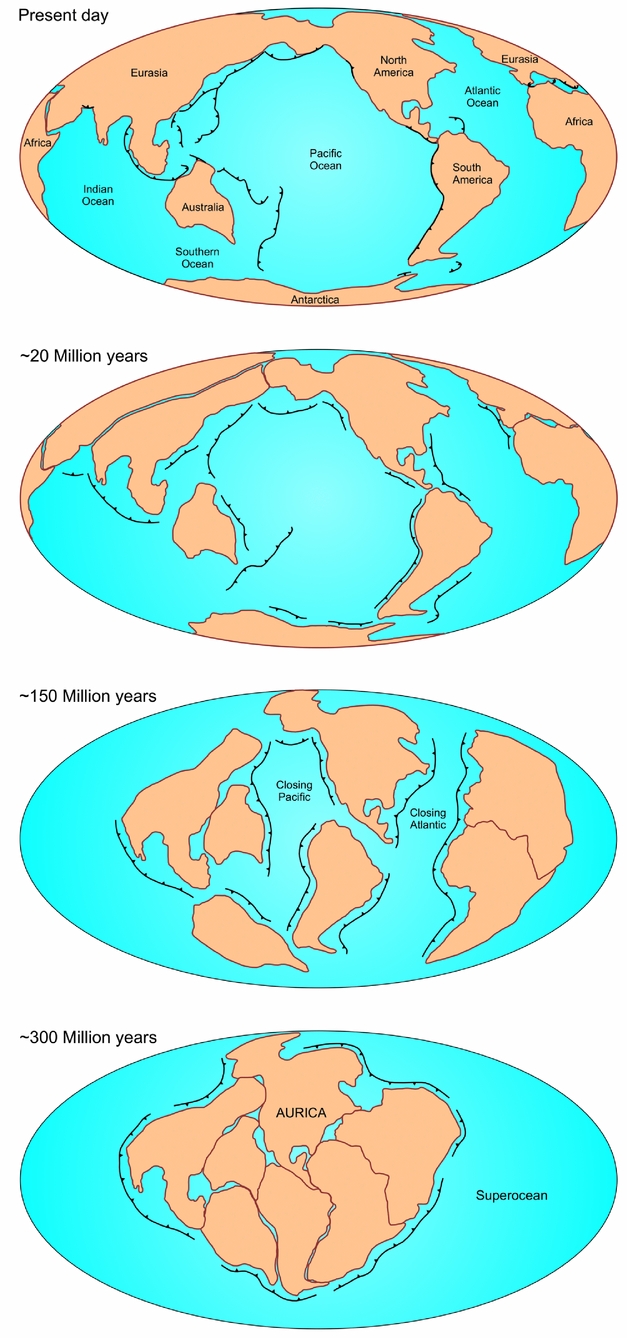
A scenario in which both the Atlantic and the Pacific will close is possible if we consider the expansion of a third or more oceanic basins. For example, the Indian (or a future intra-African ocean, as the Indian Ocean is also relatively old and may be recycled as well) and Southern oceans where more recent ridges are spreading and younger buoyant oceanic lithosphere exists (even though the northward movement of Antarctica may remove part of the Southern Ocean). This scenario requires that a new rift propagate from the Indian Ocean northwards across Eurasia. Such a rift can hypothetically nucleate as a consequence of the gravitational collapse of the Himalayan plateau, as it is recognized that rifts often form near terminal collision belts (where an excess of potential energy exists, especially after the delamination of the root of the belt) and propagate along previous suture zones. This was the case for the Atlantic that formed near the Variscan suture zone, as noted by Tuzo Wilson many years ago (Wilson, Reference Wilson1966). Such a hypothetical rift could propagate along the western margin of the East Asian (active) deformation zone through the Baikal rift, connecting with the spreading centre in the Arctic Ocean.
According to this scenario, the Pacific Ocean may continue to close. But because subduction zones seem to be terminating in the western margin of North America, if new subduction zones do not re-form here, the North American continent may stay relatively stationary or rotate slightly clockwise. Alternatively, it may move eastwards if a new subduction system indeed propagates along the western Atlantic margin. In such case, in ~ 20 Ma, South America will separate from North America, and together with Australia, will rotate and move further north. Simultaneously the subduction zones in the Atlantic may propagate from the arcs along the western passive margins. This will induce an asymmetry in the closure of the Atlantic pulling westwards the then-formed megacontinent Eurafrica (Europe + Africa). At the same time, subduction zones may propagate along the eastern Atlantic margins. A subduction system may also propagate from the South Shetland Islands along the Antarctica margin, forcing it to rotate and move northwards, and eventually collide with the westerns margin of South America.
In about 150 Ma, Australia docks with continental East Asia, while South America rotates further west and Antarctica moves further north. From the great Pacific Ocean only a small internal sea will then remain. At this stage, Eurafrica will be completely detached from East Asia and the Atlantic will also become narrower. The Indian and Southern oceans will expand and will become a new superocean. Notwithstanding, the present-day subduction zones are also starting to propagate into the Indian Ocean (e.g. the Sunda trench) and a new one may even initiate offshore south India (e.g. Mueller & Phillips, Reference Mueller and Phillips1991). This system may develop in what will be a peripheral subduction system that will circumvent a hypothetical new supercontinent.
Having taken into account the present-day average plate velocities a new supercontinent may be fully formed in approximately 300 Ma. Most of the continental masses will move and collide at a point centred slightly north of the equator and Australia and the Americas will gather at its interior and form the core of the supercontinent. For this reason, we have named the future supercontinent Aurica (Fig. 3).
6. Thoughts on past cycles
As we have discussed, the process of subduction invasion and propagation at Atlantic-type oceans can have a crucial role in the turning point of Wilson cycles and supercycles. In this paper we have shown that by applying the dynamic buoyancy argument assisted by oceanic lithosphere weakening, coupled with the subduction invasion mechanism, to our reasoning it is conceivable (if not mandatory) that in the long term both the Pacific and the Atlantic oceans will close. This reasoning can also help us to gain insights into what might have happened in the past. For example, it becomes evident that plate reconstructions should incorporate dynamic constrictions, such as the ones imposed by the buoyancy argument and the action of weakening mechanisms (e.g. hypothetical upper limits for oceanic plate ages). So far, owing to technical limitations a large number of reconstructions are purely kinematical. But we hope to have shown that they should also account for (and be dynamically consistent with) the history, evolution and geometry of the oceans, oceanic lithosphere ages, spatial distribution of subduction zones, timing and position of subduction initiation, the mechanisms by which subduction zones propagate, and how they can close oceans. Such approach was recently applied by Waldron et al. (Reference Waldron, Schofield, Murphy and Thomas2014) to the Iapetus Ocean. The authors proposed that an analogue ‘infection’ mechanism to the one observed in the Gibraltar, Scotia and Lesser Antilles was responsible for the introduction of subduction zones in the relatively young Iapetus and eventually its closing.
Because the geological record is scarce and incomplete it is a scientific challenge to constrain the evolution of ancient oceans, in particular it is difficult to reconstruct when, where and how subduction zones started. Notwithstanding, there are particular geological features that can provide crucial evidence on past subduction zone initiation. Fossilized passive margins and reactivated passive margins, ophiolites and suture zones can give information on the age and position of ancient oceanic basins. Also, well-preserved fore-arc ophiolites usually keep a high-fidelity magmatic and stratigraphic record of subduction initiation (e.g. fore-arc basalts covered by boninites and andesites; Stern et al. Reference Stern, Reagan, Ishizuka, Ohara and Whattam2012). Therefore, by mapping and dating such rocks it should be, in principle, possible to diagnose where and when a certain subduction system nucleated and how it propagated. Such studies would require a good understanding of the present-day fore-arc stratigraphy, mineralogy and geochemistry. These studies are still scarce but are starting to emerge (see e.g. Whattam & Stern, Reference Whattam and Stern2011; Murphy & Nance, Reference Murphy and Nance2013). Furthermore, for a given supercycle (or a Wilson cycle, if only two megacontinents are considered) the chronological relationship (age difference) between the emplaced ophiolites during closure and the break-up of the previous supercontinent can be used to distinguish between the two modes of closure: introversion versus extroversion (Murphy & Nance, Reference Murphy and Nance2003). If the ophiolite rocks are younger than the age of break-up of the previous supercontinent then the new supercontinent formed by introversion. If the ophiolites are older than the age of break-up of the preceding supercontinent then the new supercontinent formed by extroversion. Such relationships can be obtained from the geological record. For example these types of studies revealed that the supercontinent Pangaea and the megacontinent Gondwana formed by introversion and extroversion, respectively. And thus, strictly, Pangaea preserved elements of both types of closure, because Gondwana was part of Pangaea (Murphy & Nance, Reference Murphy and Nance2003).
It is worth mentioning here that terms such as Wilson cycle, supercycle, supercontinent and megacontinent are qualitative and not always well defined. This fact was outlined by Bradley (Reference Bradley2011), who advised that these terms should be used with caution to ‘avoid the artificial pitfall of an all-or-nothing definition’. The author also proposed the usage of the semi-quantitative term ‘supercontinentality – area of the largest continent and number of continents’, but noted that there are still some difficulties in proceeding as such: ‘Precambrian plate reconstructions are not nearly as robust as Phanerozoic ones, so quantitative measures of “supercontinentality” (. . .) are fraught with uncertainty. Proxies are needed.’
7. Simplifications, limitations of our approach
The ideas presented in this contribution incorporate a significant number of simplifications and as a consequence may have some inherent limitations. For example, we preferentially consider subduction invasion as the main mechanism for subduction initiation at Atlantic-type oceans. This assumption is founded on two main reasons, one dynamic and another observational: (1) analytic calculations show that under typical plate tectonic condition the only source of force that can trigger subduction initiation is another subduction system or a collision belt (Mueller & Phillips, Reference Mueller and Phillips1991), at least for short timescales (< 200 Ma). But, it should be noted that other (different or auxiliary) mechanisms may play (or may have played) a role in the initiation of subduction zones, e.g. the impact of voluminous mantle plumes or meteorites, anomalous hydration of the lithosphere, among others; (2) adding to this, there is an observational reason to favour the process of subduction invasion as the dominant mechanism of subduction initiation: in the present day the only two (or three, if Gibraltar is considered) cases of subduction initiation in the Atlantic were invasion cases. Moreover, all the other Cenozoic subduction systems seem to have been induced by other convergent systems (Mueller & Phillips, Reference Mueller and Phillips1991; Stern, Reference Stern2004). In this paper we favour the invasion mechanism for the formation of new subduction zones in an Atlantic-type ocean that is not converging. However, it is possible for subduction zones to start intra-oceanically in oceans where convergence is already occurring (e.g. Indian and Pacific; McKenzie, Reference McKenzie, Talwani and Pitman, III1977; Mueller & Phillips, Reference Mueller and Phillips1991). A present-day example may be the Capricorn plate. Even though this is a different mechanism from direct invasion it can be included in the class of induced subduction initiation (Stern, Reference Stern2004). The consideration of other subduction initiation mechanisms may promote variations within our general model.
We are also considering that the present-day tectonic drivers will not change significantly in the next 100–200 Ma. This is because subduction zones correspond to major mantle downwellings that delimit major mantle convective cells (Conrad, Steinberger & Torsvik, Reference Conrad, Steinberger and Torsvik2013). These cells are expected to be relatively stable over geological time scales of the order of 100 Ma (Collins, Reference Collins2003). Our assumption is reasonable when considering, for example, the South American subduction zone, which has been active continuously since Jurassic time (Coira et al. Reference Coira, Davidson, Mpodozis and Ramos1982), and the eastern boundary of the Australian plate, which has been a zone of subduction for most of Phanerozoic time (e.g. Betts et al. Reference Betts, Giles, Lister and Frick2002; Schellart, Lister & Toy, Reference Schellart, Lister and Toy2006). However, we need to be aware that locally (at smaller scales) things can change dramatically (Rowley, Reference Rowley2008).
The evolutionary model shown in Figure 3 is a simplified sketch that does not pretend to reproduce all possible details of what a more realistic reconstruction would look like. Instead, it should be seen as a class of scenarios in which both the Atlantic and the Pacific close, but an infinite number of variations of this specific scenario are possible. For example, the movement of the continents past 20 Ma is highly speculative and simplified and the proposed time of formation for Aurica is a rough estimation. For a matter of clarity and consistency the models have a minimum amount of complexity. For instance, we do not take into account the creation and evolution of small internal oceans (Wilson cycles). There are two main reasons for this choice. Firstly, the present-day configuration corresponds to a stage of high dispersion with three mature oceans (the Atlantic, Pacific and the Indian) and a fourth terminal one (Tethys) and therefore it is difficult to envisage how a new major ocean would form if not by the propagation of a pre-existent one along a suture or active deformations zone (such as the Indian Ocean). Secondly, even if small ocean basins do form (such as by the propagation of the East African Rift) their evolution will be largely controlled by the dynamics of the major tectonic plates. Notwithstanding, it is worth reinforcing here that the opening of an intra-African ocean along the East African Rift and eastwards migration of the Somalian continental block would allow the Indian Ocean to be recycled.
Complex resurfacing due to the retreat of intra-oceanic arcs is also lacking in our models. This is because, contrary to the large continents and continental subduction zones, isolated trenches are highly movable and their kinematics is difficult to predict. Also, we do not account for the formation of new intra-oceanic rift systems, such as by the propagation of back-arc basins. Notwithstanding, it should be noted that the complete resurfacing of an ocean due to the migration of intra-oceanic trenches or by the formation of new rifts is possible, which could, in principle, preserve a mature ocean for longer than would be expected from the application of the buoyancy argument alone (e.g. the Pacific).
8. Autocyclicity
It should be noted that our conceptual view implies that plate tectonics and mantle convection behave in some sort of autocyclic manner and that Wilson cycles and supercycles are the manifestation of a quasi-periodic variation in states of convergentness and divergentness. Rolf, Coltice & Tackley (Reference Rolf, Coltice and Tackley2014) using global dynamic numerical models showed that a statistical cyclicity should exist in an Earth-like system with mantle convection, plate tectonics and continental drift. Several previous works suggested cycles with lifetimes of 500 to 1 Ga, or longer, depending on parameters such as the strength of the lithosphere, viscosity and temperature of the mantle, and number of continents, among several others factors. As discussed in Section 4, these authors showed that the strength of the plates is a key factor in controlling the lifetime of a cycle. Cycles of the order of 500–700 Ma are compatible with plates with moderate strength, while stronger and weaker plates promote longer periods of aggregation and dispersion, respectively, and consequently longer supercycles.
We further suggest that this cyclicity is inherent to the metastability of old oceanic plate material and that its destruction is somehow preordained. This is because as oceanic lithosphere ages it becomes more negatively buoyant and/or weaker, and therefore oceanic basins must grow and shrink (and therefore continents must disperse and then assemble) in some sort of cyclic manner with combinations of introversion and extroversion. In this work, we have favoured the invasion mechanisms for the introduction of new subduction zones in pristine basins because it is presently occurring in the Atlantic. However, it should be noted that a scenario could be envisaged in which the oceanic lithosphere simply becomes very weak after a certain age (>> 200 Ma) and therefore if subduction zones do not invade an ocean within this period, new subduction zones may spontaneously initiate (intra-oceanically or at passive margins; Nikolaeva, Gerya & Marques, Reference Nikolaeva, Gerya and Marques2010, Reference Nikolaeva, Gerya and Marques2011; Dymkova & Gerya, Reference Dymkova and Gerya2013). However, we do not have any present-day example of oceanic lithosphere of this age to test this hypothesis. Further knowledge on oceanic plate weakening mechanisms (such as serpentinization or thermal erosion) and testing of complying conjectures through numerical modelling may bring new insight into this matter.
A new interesting insight was provided by Rolf, Coltice & Tackley (Reference Rolf, Coltice and Tackley2012) who showed that there is a feedback between the size of the oceanic plates and continents and the temperature of the sub-lithospheric mantle. It was already known that the presence of a supercontinent in the Earth's surface would have the effect of thermal blanketing (i.e. the temperature increase of the sub-lithospheric mantle due to the low heat conduction of the lithosphere; Anderson, Reference Anderson1982; Gurnis, Reference Gurnis1988; Yoshida, Iwase & Honda, Reference Yoshida, Iwase and Honda1999; Coltice et al. Reference Coltice, Bertrand, Rey, Jourdan, Phillips and Ricard2009), which could be the main cause of supercontinental break-up and consequent dispersal. Interestingly, Rolf, Coltice & Tackley (Reference Rolf, Coltice and Tackley2012) showed that large oceanic plates also cause thermal blanketing, increasing the temperature of the sub-lithospheric mantle. This is because oceanic plates become thicker and denser with age, isolating the mantle underneath. We can thus envisage a trade off between the number and size of plates, continental dispersion and sub-lithospheric mantle temperatures. When a supercontinent forms the mantle temperatures start to increase and mantle flow reorganizes, eventually leading to the generation of partial melts and supercontinent break-up (see also Yoshida & Santosh, Reference Yoshida and Santosh2011). The continents then start to disperse at the expense of the creation of new oceanic lithosphere. Maximum dispersion with many different plates and continental blocks allows temperatures to drop. However, if the newly formed oceanic plates grow too big they will start to increase again the temperatures of the sub-lithospheric mantle, which will eventually cause thermal erosion and promote the weakening and failure of the oceanic plates. Note that the plates will be thicker near the passive margins and therefore this is where the temperatures are expected to be higher. This feedback between oceanic plate thickness and sub-lithospheric mantle temperatures may also have a fundamental role in the process of subduction initiation at Atlantic-type passive margins, especially for time scales of the order of >> 200 Ma.
It is also possible to envisage a purely geometric explanation for this (apparently observed) cyclicity, related with the ratio between the surface area of the planet and the area of randomly moving continents. One can imagine an Earth-like sphere with a surface area of 5 × 10⁸ km2 with one-third of continental lithosphere, in which several dozens of plates composing the outer shell of this sphere constantly move relative to each other such that, at any one time, areas of continental lithosphere become increasingly aggregated or dispersed. Therefore, even though the movement of the continents seems random (chaotic?) at relatively short planetary time scales (< 100 Ma) it may create patterns (order) at larger time scales (>> 200 Ma) (see also the statistical approach of Rolf, Coltice & Tackley, Reference Rolf, Coltice and Tackley2014). More interestingly, one can think that there might exist a feedback between these kinematic constraints and the dynamic ones (such as the magnitude of the slab pull force and the viscosity of the mantle), in particular, because the movement of plates and mantle convection cells should work in tandem (see e.g. Gurnis, Reference Gurnis1988; Yoshida & Santosh, Reference Yoshida and Santosh2011 and references therein). Still, Yoshida & Santosh (Reference Yoshida and Santosh2011) recognized and adverted that one of the major challenges in Earth sciences is to resolve the thermal and mechanical feedback between mantle convection and continental/supercontinental drift. We would add that this cannot be done without better understanding the dynamics of oceanic plates and their complex rheological evolution. In particular, the impact of some present-day characteristics of the planet is still not clear, particularly since these may have been different in the past, as for instance the inherent asymmetry of subduction zones (always one-sided; Gerya, Connolly & Yuen, Reference Gerya, Connolly and Yuen2008) or the presence of vast quantities of water pervasively circulating within the oceanic lithosphere (e.g. Duarte, Schellart & Cruden, Reference Duarte, Schellart and Cruden2015 and references therein). Future geodynamic modelling work will certainly allow testing some of these ideas, conjectures and hypotheses.
9. Conclusions
An almost classic discussion in plate tectonics is which of the main oceans on Earth will be the next to close: the Pacific or the Atlantic? These two closure scenarios have been often presented as exclusive. In this paper we argued that it is probable (if not necessary) to envisage a class of future scenarios in which both the Pacific and the Atlantic close simultaneously. This model has the advantage of complying with the buoyancy argument at the same time that it strongly fits the observations of the present-day age of the seafloor, the existence of small subduction zones in the Atlantic and the concepts of subduction zone invasion, migration and expansion. The ideas presented here are expected to be testable by the next generation of dynamic numerical models. Such endeavour has already started (e.g. Zhong et al. Reference Zhong, Zhang, Li and Roberts2007; Yoshida & Santosh, Reference Yoshida and Santosh2011; Coltice et al. Reference Coltice, Rolf, Tackley and Labrosse2012; Rolf, Coltice & Tackley, Reference Rolf, Coltice and Tackley2012, Reference Rolf, Coltice and Tackley2014; Yoshida, 2014). Encouraging results and new ideas are emerging in this field and could provide additional constraints on our conceptual model for the formation of the supercontinent Aurica and the closure of both the Pacific and the Atlantic oceans.
Acknowledgements
Pedro Terrinha, with whom J. Duarte started discussions on tectonic arcs many years ago, is warmly thanked for great discussions over the years. Nicolas Riel, António Ribeiro, David Boutelier and Rui Dias are thanked for enthusiastic discussions on most of the subjects discussed here. We would also like to thank Dietmar Muller and Kara Matthews from the GPlates community (http://www.gplates.org/) for encouraging us using GPlates and giving us some hints. Publication supported by FCT through project UID/GEO/50019/2013 – Instituto Dom Luiz. The authors also acknowledge financial support from Discovery Grant DP110103387 from the Australian Research Council awarded to WPS. JD acknowledges the financial support from the Australian Research Council through DECRA (Discovery Early Career Researcher Award) Grant DE150100326. WPS acknowledges financial support from the Australian Research Council through Future Fellowship FT110100560. FMR thanks the project Pest-OE/CTE/LA0019/2011-12. Finally, we would like to thank the editor Mark Allen for handling the paper and for the encouraging comments, as well as Taras Gerya and an anonymous reviewer for their constructive reviews.



