Implications
The recent ban on individual housing of gestating sows in the EU may result in a renewed interest in group housing systems for lactating sows. Commercial use of such systems is, however, limited and this review attempts to identify key factors that may contribute to the success or failure of group housing of lactating sows in comparison with individual housing. By providing more insight into these factors, this review may be useful in developing and optimising feasible group housing systems for lactating sows.
Introduction
Public demand for more welfare-friendly pig husbandry systems has resulted in a ban on individual housing of sows for the major part of gestation in the EU (Council Directive 2001/88/EC). During farrowing and lactation, however, most sows are still individually confined in crates. Several studies have investigated alternative farrowing systems over the years, such as group housing of sows during lactation (e.g. Wechsler, Reference Wechsler1996). Such systems potentially provide a better transition from group housing during gestation and may facilitate the expression of natural behaviour. Wild boars and feral pigs live in family groups of several females with offspring. Under semi-natural conditions, peri-parturient free-ranging sows separate from the group to investigate nest sites 15 to 24 h before farrowing. Sows build a nest by digging a shallow oval hole and covering it with plant material. When the litter is born, the sow and her piglets initially remain in proximity of the nest. Around 2 days postpartum (p.p.), the sow starts leaving the nest for short foraging trips and 1 day later the piglets gradually follow (Jensen, Reference Jensen1986). The sow and her piglets abandon the nest and return to the group on an average of 9 to 10 days p.p. (Jensen, Reference Jensen1986; Jensen and Redbo, Reference Jensen and Redbo1987) and the litter is gradually integrated in the family group (Jensen, Reference Jensen1986). From early lactation (weeks 1 to 4 p.p.), sows start to decrease nursing frequency and actively terminate an increasing proportion of nursings (Jensen, Reference Jensen1988; Jensen and Recén, Reference Jensen and Recén1989), whereas piglets gradually start to sample and ingest solid feed (Meynhardt, Reference Meynhardt1980). In nature, weaning is thus a gradual process, which is completed between 14 and 22 weeks p.p. (Jensen, Reference Jensen1986 and Reference Jensen1988; Jensen and Recén, Reference Jensen and Recén1989).
Group housing of sows during (part of) lactation – especially in combination with grouping of litters – more closely resembles the natural situation and may benefit welfare of sows and piglets by providing more freedom of movement, an improved control of nursing behaviour by the sows and more possibilities for exploration and social interaction. The latter may facilitate social learning and development of the piglets (Kutzer et al., Reference Kutzer, Bünger, Kjaer and Schrader2009; Oostindjer et al., Reference Oostindjer, van den Brand, Kemp and Bolhuis2011) and may consequently facilitate adaptation to weaning. Despite these possible benefits of group housing during lactation, commercial use of such systems is limited. The recent transition to group housing during gestation in the EU may, however, result in a renewed interest in group housing systems for lactating sows. Recent papers have evaluated farrowing systems for pigs (Johnson and Marchant-Forde, Reference Johnson and Marchant-Forde2009; Baxter et al., Reference Baxter, Lawrence and Edwards2011a and Reference Baxter, Lawrence and Edwards2012), but a review fully focussing on group housing systems is lacking. Therefore, this review aims to identify key factors that may contribute to the success or failure of group housing of lactating sows in comparison with individual housing by (i) describing the variety in sow group housing systems during lactation and (ii) discussing animal behaviour and performance in such systems compared with individual housing. By providing more insight into these key factors, this review may be useful in developing and optimising feasible group housing systems for lactating sows.
Variation in sow group housing systems during lactation
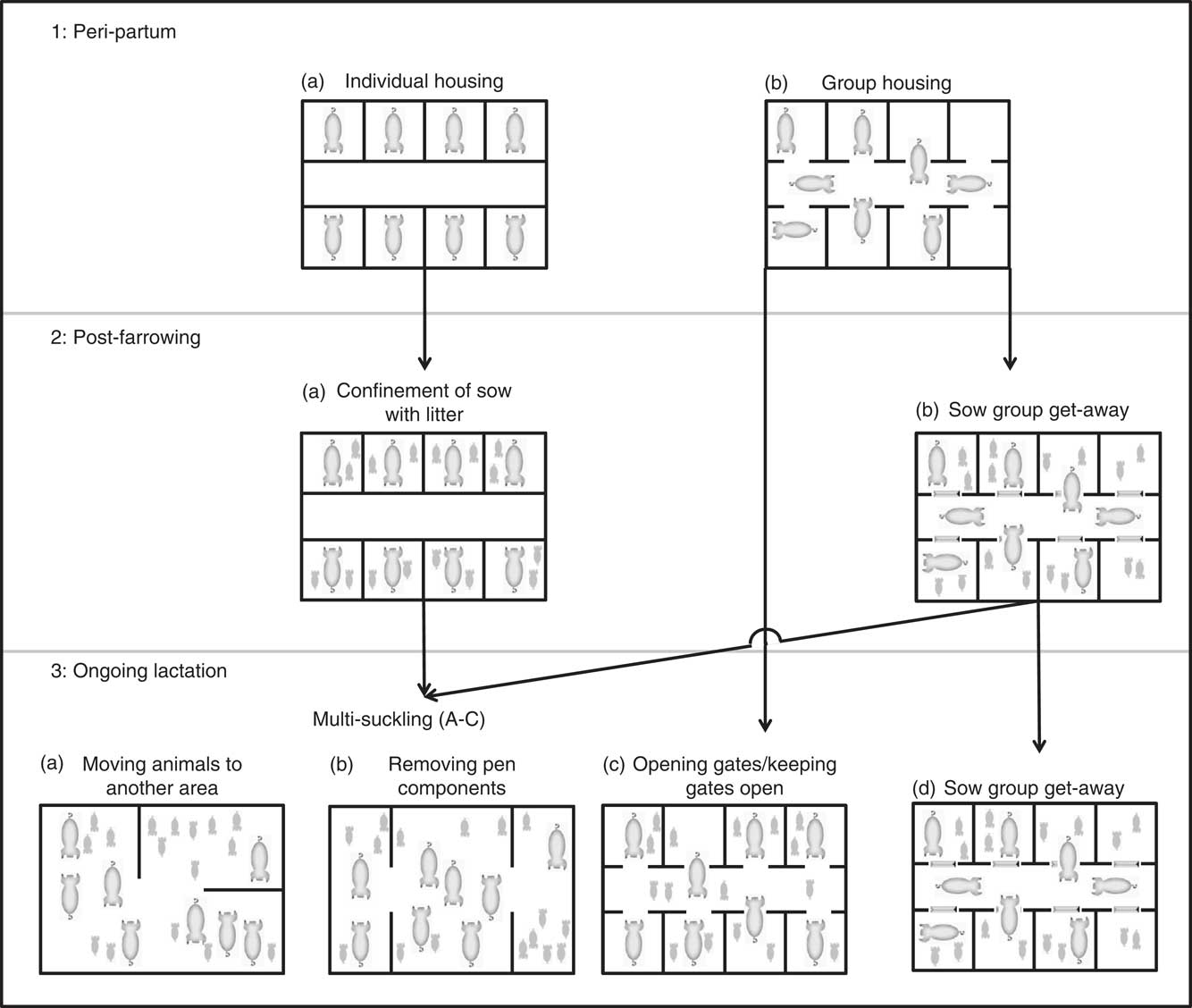
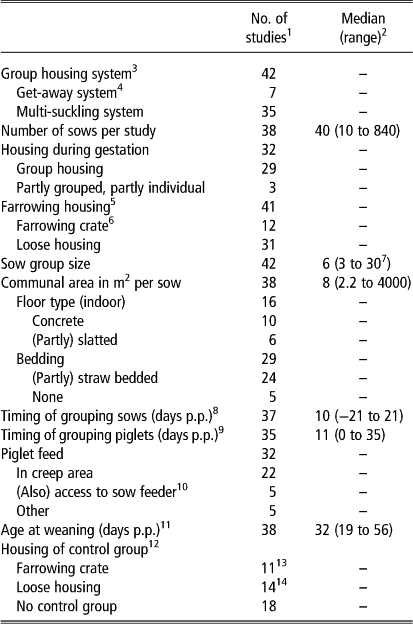
The majority of reviewed papers concern relatively small-scale experimental studies focussed on behaviour and production performance, although also some larger scale studies on commercial farms in Sweden are included. The group housing systems for sows during (part of) lactation vary in many aspects (Table 1). Roughly, a distinction can be made between systems that include a communal area accessible to sows only during the whole lactation period (get-away (GA) systems) and systems with group housing of sows together with their litters (multi-suckling (MS) systems). In some MS systems, GA housing precedes MS housing, but there are many more options to combine farrowing and lactation housing (also see Johnson and Marchant-Forde, Reference Johnson and Marchant-Forde2009). Figure 1 presents the most common transitions in the systems studied.
Variation in sow group housing systems during (part of) lactation. During the peri-partum period (1), sows can be housed individually (1a) or group-wise (1b). When group housed during the peri-partum period, sows can often choose their own farrowing accommodation. Sow access to farrowing crates or pens is either unrestricted (1b–3c) or regulated electronically to avoid multiple sows from entering the same pen and prevent the access of sows to other litters. After farrowing (2 and 3), sows can be kept with their litter for a certain period (2a) before grouping all animals by moving animals to another area (3a), removing pen components (3b) or opening gates (3c). In case both sows and litters are grouped together, this can occur either simultaneously or sequentially. The layout of a free access system remains the same and all animals can access all areas (3c: keeping gates open). Alternatively, in a sow group get-away system (2b), litters can be kept separated (3d) or mixed after a certain period using previously described methods (3a/3b/3c).

Variation in 42 reviewed studies on sow group housing during (part of) lactation

p.p.=postpartum.
1 Not all characteristics were clearly reported in each study, and therefore the number of studies does not always equal 42.
2 If ranges were given in papers (e.g. regarding sow group size), the average was used in calculations.
3 Of which ten (partly) outdoor.
4 Of which two studies with an additional separate litter mingling area.
5 Of which two studies with two different MS systems (preceded by either farrowing in crates or loose farrowing).
6 Of which two studies in which sows were loose housed several days after farrowing.
7 Group size of 30: concerns a system in which lactating sows were integrated with dry and gestating sows.
8 Of which five studies with sows grouped pre-farrowing, but locked in own pen around farrowing.
9 In MS housing only.
10 Only considered when specifically stated.
11 In one study voluntary weaning was allowed.
12 Of which one study with both crated and loose housed sows as control.
13 Of which one study with tethered sows and one study in which sows were loose housed after day 20 p.p.
14 Of which six studies in which (part of) the sows were crated around farrowing.
Sow and piglet behaviour and performance
Nursing and suckling behaviour
Nursing frequency and success
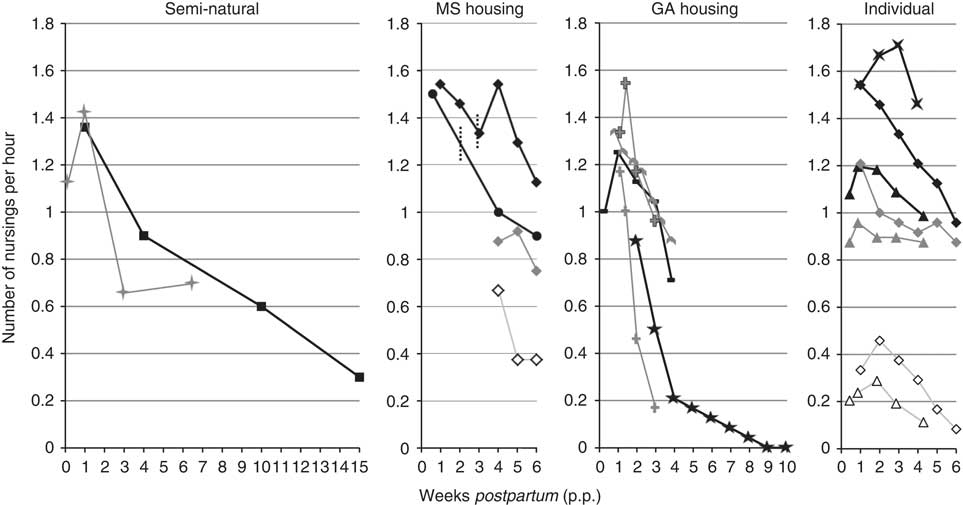
Nursing behaviour is the result of interaction between the sow and her litter. Under semi-natural conditions, the nursing frequency of domestic pigs and wild boars generally decreases over the course of lactation (Figure 2), with a decreasing proportion of nursings initiated by the sow and an increasing proportion of nursings terminated by the sow (Horrell, Reference Horrell1997).
Number of total nursings (black symbols), nursings with milk let-down (grey symbols) and nursings without milk let-down (open symbols) over time in various environments. Dashed lines represent the moment of grouping in the MS systems. ▲ Valros et al. (Reference Valros, Rundgren, Špinka, Saloniemi, Rydhmer and Algers2002): farrowing crates, ♦ Bryant et al. (Reference Bryant, Rowlinson and Van der Steen1983): after farrowing in crates, sows were either MS housed or individually loose housed at day 20 p.p.,  Götz (Reference Götz1991): farrowing crates, ● Wallenbeck et al. (2008): MS housed at day 14 p.p. after loose farrowing,
 Horrell (Reference Horrell1997): studied wild boar in a semi-natural environment, ■ Jensen (Reference Jensen1988), ★ Bøe (Reference Bøe1993), ▬ Houwers et al. (Reference Houwers, Buré and Lokhorst1996),
 Pedersen et al. (Reference Pedersen, Studnitz, Jensen and Giersing1998): symbols without an outline indicate results from a system with an additional GA area for mingling of litters,
 Weary et al. (Reference Weary, Pajor, Bonenfant, Fraser and Kramer2002).
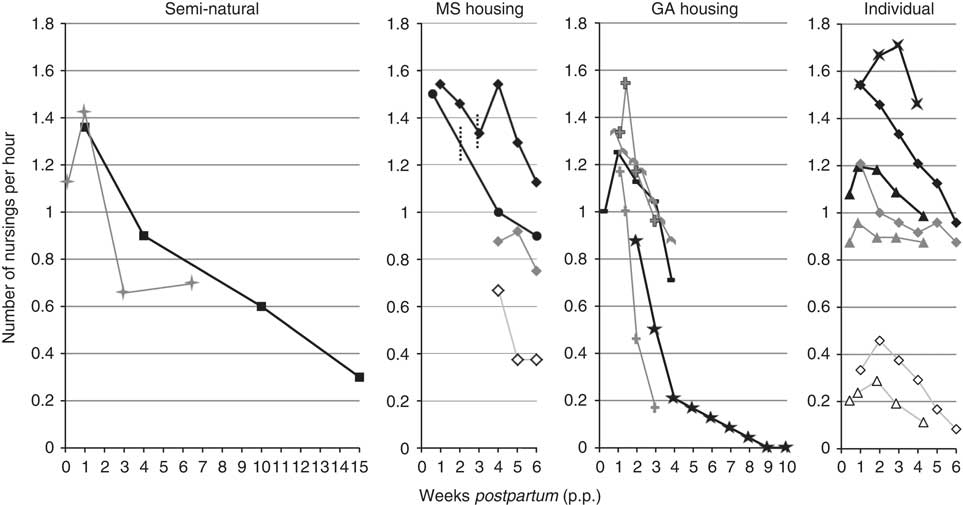
In the GA systems – in which sows can completely evade nursing requests of their piglets – it may be expected that nursing behaviour is more regulated (i.e. restricted) by the sows than in a natural environment or in individual housing. Correspondingly, Weary et al. (Reference Weary, Pajor, Bonenfant, Fraser and Kramer2002) reported that the frequency of successful nursings (i.e. with milk let-down) was lower in a GA system than in individual loose housing. In addition, the nursing frequency in the GA systems seems to decline more rapidly compared with semi-natural conditions and farrowing crates (Figure 2). At 4 weeks p.p., the proportion of nursings terminated by the sow was about 95% in a GA system (Bøe, Reference Bøe1993) and about 62% in farrowing crates (Valros et al., Reference Valros, Rundgren, Špinka, Saloniemi, Rydhmer and Algers2002). This possibly reflects a decreased nursing motivation in the GA systems, as by terminating a nursing bout the sow prevents further udder massage by the piglets.
As MS systems are usually designed to better enable the expression of natural behaviour, it may be expected that the nursing frequency in the MS systems is similar to that under natural conditions. Compared with individual housing, the frequency of successful nursings seems quite similar in the MS systems (Figure 2), which is supported by Bohnenkamp et al. (Reference Bohnenkamp, Meyer, Müller and Krieter2013a). Within the MS systems, the frequency of successful nursings is affected by pre-grouping housing: sows that farrowed in a group GA system nursed more often in the MS phase compared with sows that farrowed in a crate (1.41/h v. 1.34/h, with a similar proportion of successful nursings) (Dybkjær et al., Reference Dybkjær, Olsen, Moøller and Jensen2001). In addition, other studies suggest that a relatively drastic change in physical and social environment may result in decreased nursing success, possibly because of stress (Rushen et al., Reference Rushen, Ladewig and de Passillé1995). The percentage of nursings with milk let-down dropped; from 72% to 98%, to 29% to 57% after pigs were relocated from farrowing crates to a new MS environment (Bryant et al., Reference Bryant, Rowlinson and Van der Steen1983; Wattanakul et al., Reference Wattanakul, Sinclair, Stewart, Edwards and English1997 and Reference Wattanakul, Edwards, Stewart and English1998), whereas nursing success remained rather constant in the same period in farrowing crates (Wattanakul et al., Reference Wattanakul, Sinclair, Stewart, Edwards and English1997), even after relocation from farrowing crates to loose individual housing (Bryant et al., Reference Bryant, Rowlinson and Van der Steen1983). Further, in an MS system from birth, nursing success was higher than in farrowing crates (96.7% v. 93.2%, s.e.d.=1.3, Arey and Sancha, Reference Arey and Sancha1996).
In conclusion, in the GA systems, sows have more freedom to regulate nursing behaviour compared with a natural environment and individual housing. The nursing behaviour in the MS systems seems to be affected by the transitions in terms of physical and social environment within these systems.
Cross-suckling
Milk ingestion from a sow other than the own mother (i.e. cross-suckling or allo-suckling) may occur in a natural environment (Meynhardt, Reference Meynhardt1980). Sows may nurse non-offspring piglets because this can provide inclusive fitness benefits (Roulin, Reference Roulin2002), given that groups of pigs in a natural environment are often composed of related individuals (Meynhardt, Reference Meynhardt1980). Moreover, sows may nurse non-offspring to remove leftover milk and reduce pressure in the udder (Roulin, Reference Roulin2002) or cross-suckling may occur inadvertently because the sow does not notice non-offspring piglets.
The effects of cross-suckling on piglet performance are not straightforward. It has been reported that birth and weaning weights were similar for cross-sucklers and non-cross-sucklers, both in MS housing (Olsen et al., Reference Olsen, Dybkjær and Vestergaard1998) and in farrowing crates in which litters could mingle (Illmann et al., Reference Illmann, Pokorná and Špinka2007). Dybkjær et al. (Reference Dybkjær, Olsen, Moøller and Jensen2001), however, found a negative correlation between cross-suckling frequency and daily growth (r=−0.81) and others reported a lower pre-weaning weight gain for cross-sucklers compared with non-cross-sucklers (Wülbers-Mindermann, Reference Wülbers-Mindermann1992; Goetz and Troxler, Reference Goetz and Troxler1995, cited in Burgwal-Konertz, Reference Burgwal-Konertz1996). On the one hand, cross-suckling may provide benefits for piglets that have a low milk intake from their own mother (Olsen et al., Reference Olsen, Dybkjær and Vestergaard1998) and even lead to greater piglet uniformity when cross-suckling levels out differences in litter size (Algers, Reference Algers1991). On the other hand, competition at the udder may be increased (Pedersen et al., Reference Pedersen, Studnitz, Jensen and Giersing1998), which may be detrimental for the weakest piglets (Algers, Reference Algers1991), cause stress owing to a lack of a stable milk source (Burgwal-Konertz, Reference Burgwal-Konertz1996) and result in injuries to the head and carpal joints (Goetz and Troxler, Reference Goetz and Troxler1995). In addition, sows may be distressed by cross-suckling and cross-massaging of piglets (Bohnenkamp et al., Reference Bohnenkamp, Meyer, Müller and Krieter2013a) and sows can be more aggressive towards non-offspring (Olsen et al., Reference Olsen, Dybkjær and Vestergaard1998). These potential negative consequences make cross-suckling an issue that needs further attention in the MS systems (Olsen et al., Reference Olsen, Dybkjær and Vestergaard1998).
In the MS systems, the percentage of cross-sucklers relative to the total number of piglets varied from 11% to 39% (Goetz and Troxler, Reference Goetz and Troxler1995; Wechsler, Reference Wechsler1996; Olsen et al., Reference Olsen, Dybkjær and Vestergaard1998; Maletínská and Špinka, Reference Maletínská and Špinka2001), the percentage of cross-sucklers per nursing ranged from 10% to 65% (Wattanakul et al., Reference Wattanakul, Sinclair, Stewart, Edwards and English1997 and Reference Wattanakul, Edwards, Stewart and English1998) and the number of nursings in which cross-suckling occurred varied between 29% and 62% (Bryant and Rowlinson, Reference Bryant and Rowlinson1984; Maletínská and Špinka, Reference Maletínská and Špinka2001). Cross-sucklers display different strategies regarding the number of other sows they target and how often they cross-suckle, that is, permanently or non-permanently (Goetz and Troxler, Reference Goetz and Troxler1995; Olsen et al., Reference Olsen, Dybkjær and Vestergaard1998; Maletínská and Špinka, Reference Maletínská and Špinka2001). In literature, several factors contributing to the development and attraction of cross-sucklers have been identified.
Animal-related factors
First, milk yield of the sow may affect the development of cross-suckling. Olsen et al. (Reference Olsen, Dybkjær and Vestergaard1998) noted that litters with a higher weight gain before grouping produced fewer cross-sucklers in the MS phase than litters with lower weight gains before grouping and cross-sucklers most often switched to a sow with a higher milk yield (estimated by pre-grouping litter gain of the sow). Large litters produced more cross-sucklers (Wülbers-Mindermann, Reference Wülbers-Mindermann1992 cited in Burgwal-Konertz, Reference Burgwal-Konertz1996), particularly more permanent cross-sucklers (Maletínská and Špinka, Reference Maletínská and Špinka2001), which is likely mediated by the number of available functional teats. Olsen et al. (Reference Olsen, Dybkjær and Vestergaard1998) found no litter size effect, possibly because of smaller variation in litter size. Wechsler (Reference Wechsler1996) noted that all cross-sucklers switched to sows with the least number of piglets in the group. Goetz and Troxler (Reference Goetz and Troxler1995) found that non-permanent cross-sucklers targeted sows with smaller litter sizes than their own mother, but permanent cross-sucklers had no preference regarding litter size. Possibly, equalising litter sizes and adjusting the number of suckling piglets per sow to the number of functional teats limits cross-suckling. Variable effects of sow parity on the occurrence of cross-suckling were reported (Olsen et al., Reference Olsen, Dybkjær and Vestergaard1998; Maletínská and Špinka, Reference Maletínská and Špinka2001), possibly because parity may be confounded with milk yield or litter size.
Finally, sows may increase synchronisation of their nursing behaviour during the MS phase (Bryant et al., 1983; Wattanakul et al., 1997), which reduces the presence of non-offspring piglets at milk let-down (Maletínská and Špinka, Reference Maletínská and Špinka2001). Nursing synchronisation (i.e. nursing within 2 to 3 min intervals from another nursing) was higher in MS housing than in individual housing (Wattanakul et al., Reference Wattanakul, Sinclair, Stewart, Edwards and English1997; Šilerová et al., Reference Šilerová, Špinka, Šárová, Slámová and Algers2006).
Management-related factors
In most studies on MS housing, sows and their piglets were kept together for at least 1 week before grouping the litters. In the first week p.p., sow–piglet recognition and bonding occurs (Horrell and Hodgson, Reference Horrell and Hodgson1992) and it might be expected that cross-suckling is increased if litters are grouped before 1 week of age. Bohnenkamp et al. (Reference Bohnenkamp, Meyer, Müller and Krieter2013a), however, grouped litters at 5 days p.p. and found a low level of cross-suckling. This might be because sow–piglet bonding had already sufficiently occurred or because the sows were still able to nurse in their own crate. Within their study, more non-offspring piglets were present per nursing bout in the open MS area compared with the individual crates.
Furthermore, although MS-housed sows were more aggressive towards cross-fostered piglets, these piglets were not more likely to become cross-sucklers (Olsen et al., Reference Olsen, Dybkjær and Vestergaard1998).
Wechsler (Reference Wechsler1996) and Maletínská and Špinka (Reference Maletínská and Špinka2001) found that cross-suckling was affected by the variation in litter age within a group (r=0.50, observed between 19 and 32 days p.p.). Although older piglets cross-suckled more often, they did not miss more nursings at their mother (Maletínská and Špinka, Reference Maletínská and Špinka2001).
Finally, previous housing conditions can affect the occurrence of cross-suckling. Dybkjær et al. (Reference Dybkjær, Olsen, Moøller and Jensen2001) found a lower frequency of cross-suckling in the MS phase starting 11 days p.p. when sows had farrowed in a GA system compared with when sows had farrowed in crates (7.4±2.0 v. 25.1±9.1 occurrences/sow per 24 h on day 24 p.p.). Similarly, Wattanakul et al. (Reference Wattanakul, Edwards, Stewart and English1998) found that the percentage of cross-suckling piglets per nursing was about 2.4 to 5.4 times higher when litters came from farrowing crates and were simultaneously relocated and mixed in a new MS environment 2 weeks p.p., compared with litters that came from farrowing crates, were relocated to loose individual housing 7 days p.p. and gained access to an MS area connected to their pens a week thereafter. This effect on cross-suckling may have resulted from a difference in familiarity with the environment, which is also suggested by Wattanakul et al. (Reference Wattanakul, Sinclair, Stewart, Edwards and English1997). Therefore, providing a smooth transition to group housing may limit cross-suckling and possibly reduces the decrease in nursing success, which may be observed after grouping.
Hence, although cross-suckling has some potentially positive aspects, it can be seen as a problem if it negatively affects piglet performance and causes restlessness and disrupted nursing. The level of milk intake at the mother, differences in litter age within a group and the transition to MS housing seem to affect the level of cross-suckling.
Cessation of nursing
In sow group housing, complete cessation of nursing before the designated moment of weaning may occur. The consequences for piglet behaviour and performance may depend on the piglets’ age (Worobec et al., Reference Worobec, Duncan and Widowski1999) and their ability to compensate with increased solid food intake. The risk of nursing cessation before the intended moment of weaning may be higher in the GA systems than in the MS systems because GA-housed sows can evade piglets’ nursing requests.
In the GA systems, weaning before 5 weeks p.p. occurred in 56% (9/16) of sows (Bøe, Reference Bøe1993) and weaning before 3 weeks p.p. occurred in 8.3% (1/12) of sows (Pedersen et al., Reference Pedersen, Studnitz, Jensen and Giersing1998). More sows (9/12 v. 1/12) weaned their piglets before 3 weeks of age in a GA system in which litters could access multiple pens, compared with a GA system with separated litters. Restlessness was increased because of higher competition at the udder and milk intake was negatively affected (Pedersen et al., Reference Pedersen, Studnitz, Jensen and Giersing1998). In MS housing, nursing cessation indeed seems to occur at a lower level. At weaning between 5 and 6 weeks p.p., Hultén et al. (Reference Hultén, Dalin, Lundeheim and Einarsson1995a and Reference Hultén, Lundeheim, Dalin and Einarsson1995b) reported complete udder atrophy in, respectively, 5.0% and 6.6% of the multiparous sows, whereas Hultén et al. (Reference Hultén, Wallenbeck and Rydhmer2006) did not note termination of milk production before weaning at 7 weeks of age. Udder atrophy before weaning never occurred in individual housing and in first-parity MS-housed sows (Hultén et al., Reference Hultén, Dalin, Lundeheim and Einarsson1995a and Reference Hultén, Lundeheim, Dalin and Einarsson1995b). Bohnenkamp et al. (Reference Bohnenkamp, Meyer, Müller and Krieter2013a), however, reported that primiparous sows were more disturbed around nursing and reduced their nursing frequency sooner than multiparous sows did.
Summarising, the risk of cessation of nursing before the intended moment of weaning may be higher in the GA systems than in the MS systems and may be linked to, for example, disturbances around nursing and sow parity.
Piglet mortality
Piglet mortality is a major concern in pig husbandry (Baxter et al., Reference Baxter, Lawrence and Edwards2012). The design of the farrowing pen can greatly affect piglet losses, which mostly occur within the first few days after birth (Marchant et al., Reference Marchant, Rudd, Mendl, Broom, Meredith, Corning and Simmins2000). Farrowing pen design is, however, highly variable in the studies reviewed and therefore total pre-weaning mortality in individual housing and group housing will not be compared. Instead, risk factors characteristic to group housing will be addressed. For instance, providing sows freedom to choose a preferred site of farrowing may increase the risk of piglet mortality. Burgwal-Konertz (Reference Burgwal-Konertz1996) observed that 12.5% (6/48) of sows farrowed dispersed in the communal area or in multiple pens, and Houwers et al. (Reference Houwers, Buré and Lokhorst1996) reported that only 76% of sows voluntarily farrowed in an empty pen. Scattered farrowing or farrowing in an occupied pen may increase the risk of crushing, malnourishment and hypothermia (Burgwal-Konertz, Reference Burgwal-Konertz1996). Furthermore, in an on-farm study on 305 sows, Hultén et al. (Reference Hultén, Lundeheim, Dalin and Einarsson1997) reported higher mortality in the MS phase from 2 to 3 until 5 to 6 weeks p.p. compared with individual housing (6.5% v. 1.4%), whereas piglet losses before grouping were similar (9.6%). However, in smaller scale studies, no difference in mortality was found during the MS phase (Rantzer et al., Reference Rantzer, Svendsen and Weström1997; Wattanakul et al., Reference Wattanakul, Sinclair, Stewart, Edwards and English1997). Hultén et al. (Reference Hultén, Lundeheim, Dalin and Einarsson1997) identified a large litter size at grouping as a risk factor for mortality during the MS phase. In addition, multiparous sows had higher levels of piglet losses after grouping (parity 2 to 4: 5.3%, parity ⩾5: 8.6%) compared with loose individual housing (parity 2 to 4: 1.1%, parity ⩾5: 1.2%). Among first-parity sows, mortality after grouping did not differ (5.6% v. 2.4% in loose individual housing). Furthermore, a transition from farrowing crates to a new MS area 11 days p.p. tended to result in higher mortality after grouping than a transition from a group GA system to MS housing (6.5% v. 4.4%, Dybkjær et al., Reference Dybkjær, Olsen, Moøller and Jensen2001).
In general, piglet mortality may be reduced with increasing experience of the stockpersons with group housing. Wechsler (Reference Wechsler1996) and Li et al. (Reference Li, Johnston and Hilbrands2010) reported reduced piglet mortality in an MS system over the years, partly owing to improved skills of stockpersons, related to better observation and handling of animals and a better approach to occurring problems (Li et al., Reference Li, Johnston and Hilbrands2010).
Crushing or trauma caused 41% to 70% of all deaths in the MS phase starting from 1 to 2 weeks p.p. (Rantzer et al., Reference Rantzer, Svendsen and Weström1997; Dybkjær et al., Reference Dybkjær, Olsen, Moøller and Jensen2001 and Reference Dybkjær, Olsen, Møller, Jensen and Giersing2003). In individual loose housing, 27.2% of mortality was due to crushing from 1 week p.p. (Rantzer et al., Reference Rantzer, Svendsen and Weström1997). Several studies found an increased level of crushing during the MS phase if litters were housed with crated sows before grouping of litters, compared with continuous housing in farrowing crates (Wattanakul et al., Reference Wattanakul, Sinclair, Stewart, Edwards and English1997; Marchant et al., Reference Marchant, Rudd, Mendl, Broom, Meredith, Corning and Simmins2000), which may be explained by sudden exposure to ‘dangerous’ lying behaviour of the sows (Marchant et al., Reference Marchant, Rudd, Mendl, Broom, Meredith, Corning and Simmins2000). In an MS system from birth, it was indicated that MS-housed sows were more careful in their lying behaviour, as they showed a higher and more consistent standing-up response to playbacks of piglet vocalisations compared with sows housed in crates (Arey and Sancha, Reference Arey and Sancha1996). In addition, in MS housing preceded by individual housing, a higher level of crushing may result from an increased activity level of sows (Wattanakul et al., Reference Wattanakul, Sinclair, Stewart, Edwards and English1997).
In conclusion, piglet mortality may be higher in the MS phase compared with individual housing. Specifically, the level of crushing may be increased if MS housing is preceded by housing in farrowing crates because of exposure to ‘dangerous’ lying behaviour of the sows. Piglet mortality may improve with increasing experience of stockpersons with group housing systems.
Piglet (social) development
In contrast to individual housing, MS housing enables social contact between multiple sows and litters and provides a larger and more complex environment. This more closely resembles the natural situation and is expected to benefit piglet development.
Separating the first acquaintance with non-littermates from the moment of weaning reduces the number of concurrent stressors weaned piglets have to deal with. Moreover, when multiple litters are grouped during lactation in MS housing, post-weaning mixing may be unnecessary altogether.
Mixing litters before 2 weeks of age generally results in little aggression and few skin lesions (Wattanakul et al., Reference Wattanakul, Sinclair, Stewart, Edwards and English1997; Kutzer et al., Reference Kutzer, Bünger, Kjaer and Schrader2009), which is in contrast with the vigorous fighting and skin damage that is reported for pigs mixed at weaning after 4 weeks p.p. (Melotti et al., Reference Melotti, Oostindjer, Bolhuis, Held and Mendl2011). Compared with piglets that were first mixed at weaning at an age of 3 to 4 weeks, piglets that could interact with one or more litters before weaning showed less aggression (Weary et al., Reference Weary, Pajor, Bonenfant, Fraser and Kramer2002; Hessel et al., Reference Hessel, Reiners and Van Den Weghe2006; Kutzer et al., Reference Kutzer, Bünger, Kjaer and Schrader2009) and skin lesions (Parratt et al., Reference Parratt, Chapman, Turner, Jones, Mendl and Miller2006) after weaning when kept with familiar piglets. This was likely because new hierarchies did not need to be established. Compared with piglets from single litter housing, piglets raised in the MS systems also showed reduced aggression towards unfamiliar piglets in a social confrontation test (Hillmann et al., Reference Hillmann, Von Hollen, Bünger, Todt and Schrader2003) and towards unfamiliar piglets when mixed at weaning (Li and Wang, Reference Li and Wang2011; Bohnenkamp et al., Reference Bohnenkamp, Traulsen, Meyer, Müller and Krieter2013b). This reduced aggression may have several reasons. First, it has been suggested that pigs housed in large groups are forced to adopt a more tolerant strategy towards unfamiliar pigs (Samarakone and Gonyou, Reference Samarakone and Gonyou2009). Second, the increased space and environmental complexity in the MS systems may enhance piglet social development by better enabling the expression of threatening and submissive behaviour (Lammers and Schouten, Reference Lammers and Schouten1985) and by stimulating play behaviour (Bolhuis et al., Reference Bolhuis, Schouten, Schrama and Wiegant2005; Oostindjer et al., Reference Oostindjer, van den Brand, Kemp and Bolhuis2011). Play is thought to be important for the social development of piglets (Bekoff and Byers, Reference Bekoff and Byers1981), and Arey and Sancha (Reference Arey and Sancha1996) reported a ninefold increase in play behaviour in MS housing, compared with farrowing crates. Šilerová et al. (Reference Šilerová, Špinka, Šárová and Algers2010), however, found no difference in frequency of play between farms with straw-bedded pens for individually loose housed sows and MS housing, possibly because of a lower contrast between housing types. In addition, increased social experience in itself also influences social development. For instance, social recognition was improved in piglets mingled twice pre-weaning, compared with unmingled piglets (Kanaan et al., Reference Kanaan, Lay, Richert and Pajor2012) and piglets mixed with another litter from 10 days until weaning formed a stable dominance hierarchy more rapidly when mixed with unfamiliar pigs at 7 weeks of age (D’Eath, 2005), suggesting enduring effects of early social experiences on the development of social skills.
Finally, MS housing may also positively affect adaptability in non-social challenging conditions. In a novel environment test, MS-reared piglets showed less activity, escape attempts and vocalisations (Bünger et al., Reference Bünger, Hillmann and Von Hollen2000; Hillmann et al., Reference Hillmann, Von Hollen, Bünger, Todt and Schrader2003), and more exploration (Hillmann et al., Reference Hillmann, Von Hollen, Bünger, Todt and Schrader2003) than piglets reared with individually housed sows.
In conclusion, piglet (social) development in MS housing is enhanced by early contact with non-littermates and by increased space allowance and environmental complexity. This may facilitate adaptation to the social and physical environment after weaning.
Pre-weaning piglet feed intake, growth and uniformity
For piglets, adaptation to solid feed is important for a successful transition from lactation to the post-weaning period. Sufficient pre-weaning solid feed intake may improve early post-weaning feed intake and growth (e.g. Bruininx et al., Reference Bruininx, Binnendijk, Van Der Peet-Schwering, Schrama, Den Hartog, Everts and Beynen2002) and reduce the occurrence of diarrhoea after weaning (Yan et al., Reference Yan, Jang and Kim2011). Creep feed intake during lactation, however, shows high individual variation in commercial practice (e.g. Bøe and Jensen, Reference Bøe and Jensen1995).
Group housing systems have the potential for increased piglet feed intake compared with single litter housing. First, motivation to ingest solid feed may be higher in systems with reduced contact between sows and piglets. Specifically in the GA systems, sows can evade nursing requests of piglets. Indeed, piglets from GA-housed sows consumed roughly twice as much feed as piglets in single litter housing pre-weaning (Rantzer et al., Reference Rantzer, Svendsen and Weström1995; Weary et al., Reference Weary, Pajor, Bonenfant, Fraser and Kramer2002). Second, feed intake is promoted if piglets can eat together with the sow (Oostindjer et al., Reference Oostindjer, Bolhuis, Mendl, Held, Gerrits, Van den Brand and Kemp2010) and if piglets experienced with solid feed intake are present (Morgan et al., Reference Morgan, Lawrence, Chirnside and Deans2001). Therefore, MS-housed piglets may have more opportunities to learn from conspecifics, which resembles natural circumstances (Meynhardt, Reference Meynhardt1980). In the MS systems studied, however, piglets were mostly fed in a separate creep area (Table 1) with limited possibilities for vertical (sow–piglet) social learning. Rantzer et al. (Reference Rantzer, Svendsen and Weström1997) and Wattanakul et al. (Reference Wattanakul, Sinclair, Stewart, Edwards and English1997) reported a lower pre-weaning feed intake in the MS systems, compared with piglets from single litter housing (0.4±0.1 v. 0.6±0.1 kg/piglet before weaning at 5 weeks p.p. and 18.4 v. 24.6 g/day per piglet (s.e.d.=3.4) in the MS phase, respectively). Possibly, this may have resulted from the sudden introduction to the larger and more diverse MS area.
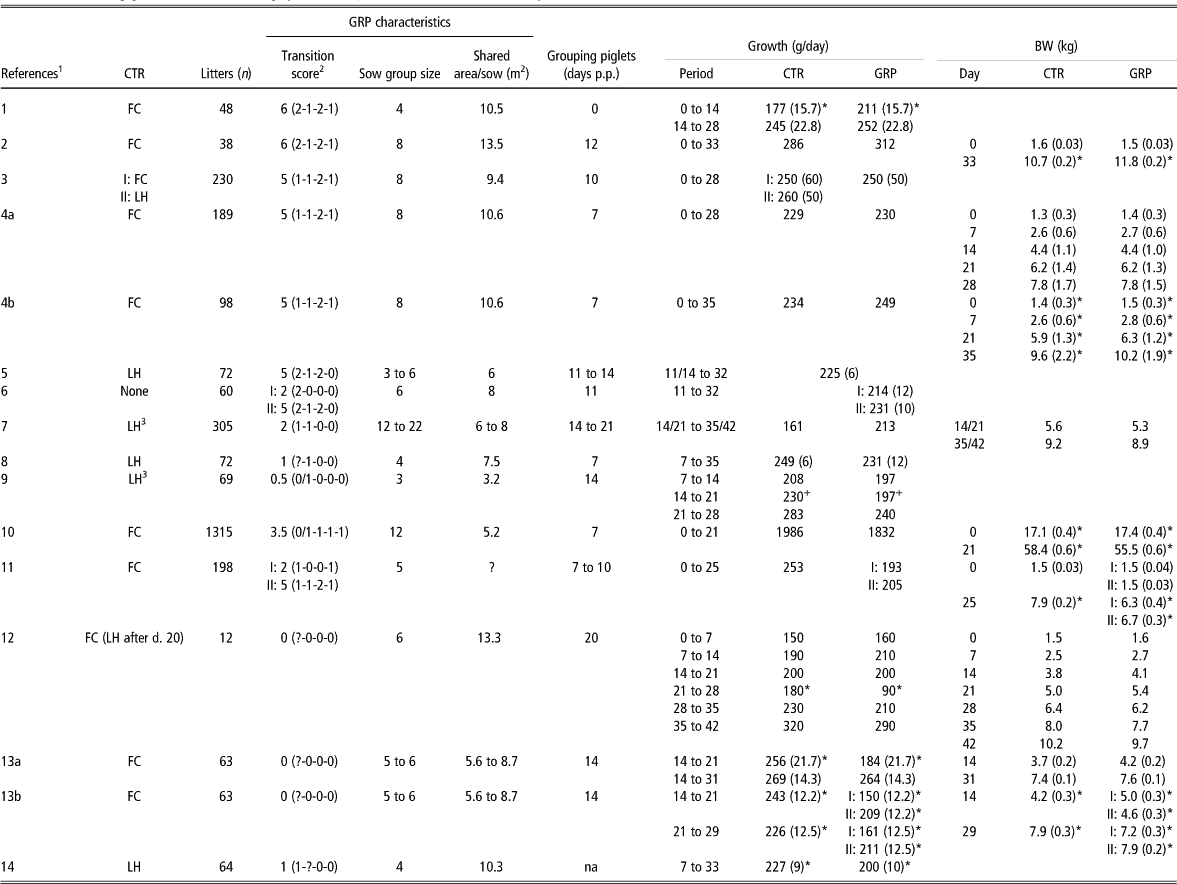
Even though pre-weaning experience with feed intake is important for adaptation to the post-weaning situation, piglet growth during lactation is mostly determined by milk intake. As previously discussed, compared with individual housing, nursing behaviour may be restricted or disrupted in group housing systems, which may be related to the relative transition in physical and social environment. Therefore, it might be expected that pre-weaning growth is lower and more variable in the group housing systems with ‘abrupt’ transitions, compared with individual housing. As presented in Table 2, group housing during lactation either reduces (six studies), does not affect (five studies) or increases (two studies) pre-weaning piglet growth compared with individual housing, and it seems that systems with more abrupt transitions from gestation to farrowing and grouping have a relatively poor performance (Table 3). In line with this, the number of aggressive interactions between familiar sows after introduction to the MS area was found to be negatively correlated (r=−0.65) to piglets’ daily gain during the MS phase (Dybkjær et al., Reference Dybkjær, Olsen, Møller, Jensen and Giersing2003). Other system characteristics such as sow group size, the timing of grouping piglets and the communal area available per litter do not seem to relate to pre-weaning piglet growth in the evaluated studies (Table 2).
Pre-weaning growth in GRP farrowing systems compared with CTR in relation to system characteristics

GRP=group; CTR=control; FC=farrowing crates, LH=loose housing.
1 1=Arey and Sancha (Reference Arey and Sancha1996), 2=Li et al. (2012), 3=Kutzer et al. (Reference Kutzer, Bünger, Kjaer and Schrader2009), 4=Bünger (Reference Bünger2002); 4a and 4b differ in weaning age, 5=Dybkjaer et al. (2003), 6=Dybkjaer et al. (2001), 7=Hultén et al. (Reference Hultén, Lundeheim, Dalin and Einarsson1997), 8=Rantzer et al. (Reference Rantzer, Svendsen and Weström1997), 9=Weary et al. (Reference Weary, Pajor, Bonenfant, Fraser and Kramer2002), 10=Bates et al. (2003), 11=Marchant et al. (Reference Marchant, Rudd, Mendl, Broom, Meredith, Corning and Simmins2000), 12=Bryant et al. (Reference Bryant, Rowlinson and Van der Steen1983), 13=Wattanakul et al. (Reference Wattanakul, Sinclair, Stewart, Edwards and English1997); 13a and 13b differ in used breed and I and II differ in creep accessibility, 14=Rantzer et al. (Reference Rantzer, Svendsen and Weström1995). Measures of variance are indicated as standard error of the difference (study 1 and 13), standard error of the mean (study 2, 5, 6, 8, 10, 11 and 14) or standard deviation (study 3 and 4). Data without a measure of variance are either estimated/calculated from other data or no measure of variance was reported.
2 The transition score has a maximum of 6 and is determined by four aspects; the first aspect concerns gestation housing (0=housed individually, 1=group housed, 2=sows familiar from group housing (specifically stated), the second aspect concerns farrowing housing (0=crated, 1=loose housed), the third aspect concerns the prepartum social situation (0=housed individually, 1=group housed, but housed individually around farrowing, 2=group housed) and the fourth aspect concerns transition to the communal area (0=involves relocation to an unfamiliar area after farrowing, 1=familiar communal area). ?=not reported, which is counted as score 0. If within a study, for example, sows were either housed individually or in a group during gestation, an intermediate score is given (0/1).
3 (In some cases) crated around farrowing.
+ P<0.10, *P<0.05 (significant differences are indicated between treatment groups).
Transition score per study investigating pre-weaning growth in group housing v. individual housing for lactating sows

Each symbol represents one study, in which pre-weaning growth was higher (+), similar (0) or lower (−) in group housing than in individual housing. See Table 2 for explanation on transition scores. Reference 4b is not included in the table, owing to a difference in birth weight between groups. Reference 11 is included twice because two different group housing systems were studied. Reference 13a and 13b are combined.
Uniformity in piglet growth until weaning in the MS systems was either similar (Hultén et al., Reference Hultén, Lundeheim, Dalin and Einarsson1997; Wattanakul et al., Reference Wattanakul, Sinclair, Stewart, Edwards and English1997) or increased (Wattanakul et al., Reference Wattanakul, Sinclair, Stewart, Edwards and English1997; Bünger, Reference Bünger2002) compared with individual housing. Possibly, cross-suckling equalised the number of suckling piglets per sow and thereby piglet growth (Algers, Reference Algers1991). Alternatively, light and weak piglets may have died earlier in MS housing (Hultén et al., Reference Hultén, Lundeheim, Dalin and Einarsson1997).
Pre-weaning feed intake in the group housing systems could thus be improved in future systems by facilitation of social learning. Pre-weaning gain is likely affected by nursing behaviour, which may be influenced by transitions in social and physical environment.
Post-weaning piglet feed intake, growth and uniformity
The post-weaning growth check often observed in piglets from conventional housing may be reduced or absent in piglets raised in group housing. Potential factors contributing to a better adaptation to the post-weaning situation are improved social skills, the absence of mixing of piglets at weaning, increased experience with solid feed or a higher weaning age (Berkeveld et al., 2009). For instance, piglets mingled with other litters during lactation gained 0.8 to 1.0 kg more in the 5 weeks post-weaning compared with housing without contact possibilities (Hessel et al., Reference Hessel, Reiners and Van Den Weghe2006; Kutzer et al., Reference Kutzer, Bünger, Kjaer and Schrader2009).
Feed intake and growth of piglets reared in the GA systems were improved the day after weaning (Weary et al., Reference Weary, Pajor, Bonenfant, Fraser and Kramer2002) and 2 to 4 weeks after weaning (Rantzer et al., Reference Rantzer, Svendsen and Weström1995) compared with piglets reared with individually housed sows. This likely relates to the observed higher pre-weaning feed intake. In both the studies, all piglets remained in their system after weaning; however, in the study by Rantzer et al. (Reference Rantzer, Svendsen and Weström1995) the piglets additionally gained access to the communal area and were thus mixed with unfamiliar litters.
MS studies greatly differ in the transition to the post-weaning environment, both regarding the MS-reared piglets and the piglets reared with individually housed sows, for instance, regarding available space and group size. This possibly partly explains the variable results in post-weaning feed intake and growth: in MS-reared pigs, feed intake was lower (in weeks 3 to 17 post-weaning, Li et al. Reference Li, Wang and Johnston2012), similar (about weeks 0 to 6 post-weaning, Korthals, Reference Korthals2003) or higher (in the first week post-weaning, Wattanakul et al., Reference Wattanakul, Sinclair, Stewart, Edwards and English1997) compared with pigs reared with crated sows. MS-reared piglets showed a higher weight gain (first week, Wattanakul et al., Reference Wattanakul, Sinclair, Stewart, Edwards and English1997), similar weight gain (for at least the first 6 weeks post-weaning, Korthals, Reference Korthals2003; Li et al., Reference Li, Wang and Johnston2012; Bohnenkamp et al., Reference Bohnenkamp, Traulsen, Meyer, Müller and Krieter2013b) or lower weight gain (the first 4 weeks, Rantzer et al., Reference Rantzer, Svendsen and Weström1997) compared with piglets reared with individually housed sows. Only in the study by Hultén et al. (Reference Hultén, Lundeheim, Dalin and Einarsson1997), all piglets were weaned by only removing the sows, and growth rate 2 weeks post-weaning was similar for MS-reared pigs and pigs reared with individually housed sows. This was possibly because weaning resulted in limited stress for both groups.
Concluding, post-weaning performance of piglets reared in MS housing benefits from limited changes in social and physical environment at weaning, as is the case for piglets reared with individually housed sows.
Sow feeding behaviour and physical condition
During lactation, energy requirements for milk are at a level that cannot be met by feed intake and, as a consequence, sows often lose substantial amounts of BW during lactation, affecting subsequent reproductive performance. Sows in GA housing with one ad libitum feeder per sow consumed much feed during lactation, but less than sows in individual housing (11.3 v. 12.9 kg/day), although no differences in BW change were apparent. This is likely related to the observed lower nursing frequency (Weary et al., Reference Weary, Pajor, Bonenfant, Fraser and Kramer2002). In other studies, feed intake and body condition are not comparable, as group-housed sows were fed ad libitum during the MS phase, whereas individually housed sows were fed restrictedly.
When using one ad libitum feeder for four sows, the size of the MS area affected the daily pattern of feed intake but not the level of feed intake (Burke et al., Reference Burke, Brooks, Kirk and Eddison2000). The different eating strategies were possibly related to differences in possibilities to avoid more dominant sows. Aggression may increase around feeding (Goetz and Troxler, Reference Goetz and Troxler1995) and Hultén et al. (Reference Hultén, Lundeheim, Dalin and Einarsson1995b) observed that more primiparous sows, which often have a low social rank (Hoy et al., Reference Hoy, Bauer, Borberg, Chonsch and Weirich2009), had skin wounds on the day of weaning on the MS farms than on farms with individual housing. The percentage of multiparous sows with skin lesions was similar between housing systems. Therefore, space to avoid high ranking sows may be important to limit stress and ensure sufficient feed intake of primiparous sows in group housing with communal feeding.
In group housing systems, it is expected that sows are less affected by health problems related to lack of movement, such as leg problems and obstipation. In addition, it is expected that, owing to better regulation of nursing behaviour, sows in GA housing are less affected by udder and teat lesions than in individual housing. In MS housing, however, more competition at the udder occurs, which may result in higher levels of udder and teat damage. Sow health has not been investigated in the reviewed studies with GA systems; however, on MS farms, indeed fewer sows were culled because of locomotory problems (Hultén et al., Reference Hultén, Lundeheim, Dalin and Einarsson1998) and fewer sows suffered from scapular abscesses (3.0% v. 13.4% of sows), hoof abnormalities (4.6% v. 9.1% of sows), and teat wounds and udder lesions than on farms with individually housed sows (Hultén et al., Reference Hultén, Lundeheim, Dalin and Einarsson1995b). However, this may also be related to the higher amount of straw bedding that was available. The occurrence of mastitis did not differ between the two housing systems (Hultén et al., Reference Hultén, Lundeheim, Dalin and Einarsson1995b). Primiparous sows were, however, possibly more affected by piglet fights around suckling during the MS phase than multiparous sows, as indicated by the higher percentage of primiparous sows with teat wounds (Hultén et al., Reference Hultén, Lundeheim, Dalin and Einarsson1995b). In addition, Bohnenkamp et al. (Reference Bohnenkamp, Meyer, Müller and Krieter2013a) reported that nine of a total of 12 primiparous sows were removed from group housing because of injured teats, compared with three of 12 primiparous sows in farrowing crates.
In conclusion, MS housing may decrease the occurrence of locomotory problems, scapular abscesses, and teat and udder lesions. Primiparous sows may be at a disadvantage in the MS systems, as indicated by a higher incidence of skin and teat damage compared with multiparous sows.
Lactational ovulation and insemination
Individually housed sows usually remain anoestrous until weaning (Quesnel and Prunier, Reference Quesnel and Prunier1995). Lactational ovulation can, however, be induced when suckling intensity is substantially reduced or by stress (reviewed by Langendijk et al., Reference Langendijk, Soede and Kemp2006). In MS housing, the occurrence of lactational ovulation ranged from 0% to 100% (Bryant et al., Reference Bryant, Rowlinson and Van der Steen1983; Hultén et al., Reference Hultén, Dalin, Lundeheim and Einarsson1995a; Wechsler, Reference Wechsler1996; Wattanakul et al., Reference Wattanakul, Sinclair, Stewart, Edwards and English1997; Hultén et al., Reference Hultén, Wallenbeck and Rydhmer2006; Kongsted and Hermansen, Reference Kongsted and Hermansen2009) and was associated with a shorter nursing duration per nursing bout at 4 weeks p.p. and a lower number of piglets present at nursing between weeks 4 and 6 p.p. (Hultén et al., Reference Hultén, Wallenbeck and Rydhmer2006), both of which indicate a reduced suckling intensity in these sows. Lactational ovulations were also associated with higher piglet weight gains between grouping and weaning at 7 weeks of age (Hultén et al., Reference Hultén, Wallenbeck and Rydhmer2006), but this might also be a consequence of high piglet feed intake as piglets had access to sow feed from 2 weeks of age onwards. Sow weight loss, backfat thickness and litter size did not differ between sows with and without lactational ovulation (Hultén et al., Reference Hultén, Dalin, Lundeheim and Einarsson1995a and Reference Hultén, Wallenbeck and Rydhmer2006). In addition, group size was unrelated to the occurrence of lactational ovulation (Hultén et al., Reference Hultén, Dalin, Lundeheim and Einarsson1995a). Weary et al. (Reference Weary, Pajor, Bonenfant, Fraser and Kramer2002) reported no lactational oestrus in a GA system.
In most systems, lactational ovulation is seen as a disadvantage, as it results in longer and more variable weaning-to-oestrus intervals if sows are not inseminated during lactation (Hultén et al., Reference Hultén, Lundeheim, Dalin and Einarsson1998 and Reference Hultén, Wallenbeck and Rydhmer2006), which may be disadvantageous for managed batch farrowing systems. Furthermore, such variable intervals may result in less efficient oestrus detection and explain why Hultén et al. (Reference Hultén, Lundeheim, Dalin and Einarsson1998) found that MS-housed sows were relatively more often culled owing to repeat breeding or failure to farrow than individually housed sows (38.5% v. 20.2%). On the other hand, if sows are inseminated during lactational ovulation, farrowing rates and litter sizes are similar to those in sows inseminated after weaning (Soede et al., Reference Soede, Laurenssen, Abrahamse-Berkeveld, Gerritsen, Dirx-Kuijken, Langendijk and Kemp2012). Thus, lactational inseminations might enhance sow performance in production systems with an extended lactation period (Kongsted and Hermansen, Reference Kongsted and Hermansen2009), such as some MS and GA systems. If the timing of lactational ovulation is not predictable and synchronised, this will increase the age difference of the next batch of litters (Hultén et al., Reference Hultén, Dalin, Lundeheim and Einarsson1995a), which may increase the occurrence of cross-suckling (Wechsler, Reference Wechsler1996; Maletínská and Špinka, Reference Maletínská and Špinka2001). Although lactational ovulations may be stimulated and more synchronised in case sows in oestrus are present (Pearce and Pearce, Reference Pearce and Pearce1992), Hultén et al. (Reference Hultén, Wallenbeck and Rydhmer2006) found low synchrony in oestrus onset; 10%, 13%, 6%, 22% and 49% of ovulations occurred in the 3rd, 4th, 5th, 6th and last week of lactation, respectively. Kongsted and Hermansen (Reference Kongsted and Hermansen2009), however, placed sows in MS housing with boar exposure after 5 weeks of lactation in individual housing, which induced oestrus in 84% of sows within 1 week. Thus, possibilities exist to synchronise oestrus and ovulation in group-housed sows, although little is known about the effects of oestrus behaviour of group-housed lactating sows. Primiparous sows may, however, not show lactational ovulation (Hultén et al., Reference Hultén, Dalin, Lundeheim and Einarsson1995a) or at a low frequency (Hultén et al., Reference Hultén, Wallenbeck and Rydhmer2006) and sows with a low social rank ovulated later during lactation after boar exposure (Kongsted and Hermansen, Reference Kongsted and Hermansen2009). Moreover, sows with high weight loss during lactation ovulated later during lactation (Hultén et al., Reference Hultén, Wallenbeck and Rydhmer2006). On the other hand, timing of oestrus was unaffected by backfat thickness, litter size (Hultén et al., Reference Hultén, Dalin, Lundeheim and Einarsson1995a and Reference Hultén, Wallenbeck and Rydhmer2006; Kongsted and Hermansen, Reference Kongsted and Hermansen2009), nursing duration at 4 weeks p.p., the number of piglets present at nursing between weeks 4 and 6 p.p., piglet weight gain between grouping and weaning (Hultén et al., Reference Hultén, Wallenbeck and Rydhmer2006) and the number of weaned piglets (Kongsted and Hermansen, Reference Kongsted and Hermansen2009).
In conclusion, oestrus and ovulation may occur during lactation in sow group housing systems. Both the occurrence and synchrony of lactational ovulations can vary greatly between the MS systems, and are influenced by sow parity, social rank and boar presence. As lactational insemination can result in good reproductive performance, stimulation of synchronised ovulations may be a beneficial strategy for group housing systems.
Sow suitability
As group-housed sows have more freedom to express behaviours than individually housed sows, the success of group housing systems may to a greater extent depend on sow behaviour. Specifically, the expression of maternal behaviour, for example, attentiveness and lack of aggression towards piglets, is of great importance. In an on-farm study on 840 sows, 3.1% of culled MS-housed sows were removed because of inadequate maternal behaviour compared with 0.9% of culled individually housed sows (Hultén et al., Reference Hultén, Lundeheim, Dalin and Einarsson1998).
Sows show much individual variation in maternal behaviour, and Li et al. (Reference Li, Johnston and Hilbrands2010) found that individual sows showed consistency in piglet mortality over subsequent parities in MS housing. As maternal behaviour is partly genetically determined (Løvendahl et al., Reference Løvendahl, Damgaard, Nielsen, Thodberg, Su and Rydhmer2005), selecting sows with appropriate maternal behaviour may improve performance in group housing systems. Maternal behaviour can be affected by housing type (Baxter et al., Reference Baxter, Jarvis, Sherwood, Farish, Roehe, Lawrence and Edwards2011b), and therefore selection of sows has to occur in a suitable environment, for example, not in farrowing crates. Moreover, the previous experiences of sows with housing systems influence their performance; sows that were raised in an MS system showed lower piglet mortality and tended to crush fewer piglets than sows with no previous experience in the system, resulting in 21.4 v. 20.1 raised piglets per year (Wechsler, Reference Wechsler1996).
Finally, the physical condition of a sow also affects suitability for group housing. With more freedom of movement, a good leg condition is important. In addition, uncontrolled lying down behaviour is identified as a major risk for piglet crushing (Marchant et al., Reference Marchant, Broom and Corning2001).
Thus, in order to be successful, group housing systems may require sows with good maternal behaviour, a good leg condition and with previous experience with group housing. As not all sows are suitable for group housing during lactation, there may be a need for alternative housing for unfit sows.
Concluding remarks
The major strengths of group housing compared with individual housing during lactation include increased freedom of movement for sows and piglets with enhanced possibilities to express behaviours, for example, related to maternal care, an improved social development of piglets and a potential for increased pre-weaning piglet feed intake by enabling piglets to eat together with the sows, resulting in better adaptation of piglets to the post-weaning environment. These aspects also resemble the situation in a natural environment. Furthermore, insemination during lactation provides opportunities for an extended lactation period, which benefits piglets, while maintaining satisfactory sow performance.
In sow group housing systems, most risk factors for poor sow and piglet performance seem to relate to altered nursing behaviour in relation to the level of change in social and physical environment during transitions around gestation, farrowing, grouping and weaning. For good performance, it therefore seems important that these transitions are gradual or limited. In addition, it is beneficial if stockpersons are familiar with the system and it is recommended that sows with suitable physical and behavioural characteristics are used.
Acknowledgements
The authors gratefully acknowledge the Ministry of Economic Affairs for their financial support, Bas Kemp for his valuable comments on an earlier version of this paper and Bo Algers, Johannes Baumgartner, Emma Baxter, Anna-Lena Bohnenkamp, Anne-Marie Dalin, Sandra Edwards, Yuzhi Li, Rebecca Morrison, Lene Juul Pedersen and Josef Troxler for kindly providing additional information on the systems and studies described.