Introduction
Nebria brevicollis (Fabricius) (Coleoptera: Carabidae) is one of the most abundant and widely distributed ground beetle species in Europe and the United Kingdom (Williams Reference Williams1959; Lindroth Reference Lindroth1961, Reference Lindroth1963, Reference Lindroth1966, Reference Lindroth1968, Reference Lindroth1969a, Reference Lindroth1969b, Reference Lindroth1974; Kavanaugh and LaBonte Reference Kavanaugh and LaBonte2008; LaBonte Reference LaBonte2011). Until 2007, only two historic specimens of this species from the 1930s were known from North America, one of which was recorded from St.-Césaire, Québec, and the other is a record from the island of Miquelon, France (Lindroth Reference Lindroth1961, Reference Lindroth1963, Reference Lindroth1966, Reference Lindroth1968, Reference Lindroth1969a, Reference Lindroth1969b; Kavanaugh and LaBonte Reference Kavanaugh and LaBonte2008). Based on the condition of the two specimens, Lindroth (Reference Lindroth1961, Reference Lindroth1963, Reference Lindroth1966, Reference Lindroth1968, Reference Lindroth1969a, Reference Lindroth1969b) speculated that the species was not established in North America. The species was first found in western North America in Oregon, United States of America in 2007 (Kavanaugh and LaBonte Reference Kavanaugh and LaBonte2008) and has since dramatically expanded its range in both Washington and Oregon states (LaBonte Reference LaBonte2011). Here, we report the first British Columbia records of N. brevicollis and data that demonstrate establishment of populations in Coquitlam, British Columbia, Canada.
At least 55 species of exotic carabids are established in Canada (Klimaszewski et al. Reference Klimaszewski, Langor, Batista, Duval, Majka, Scudder and Bousquet2012), of which 20 species have been recorded in British Columbia (Spence and Spence Reference Spence and Spence1988). Although recent introductions have originated in Asia, most long-established species in the province have a European origin (Klimaszewski et al. Reference Klimaszewski, Langor, Batista, Duval, Majka, Scudder and Bousquet2012). Primary means of introduction are thought to be through ocean-going ship ballast and plant nursery material (Spence and Spence Reference Spence and Spence1988; Klimaszewski et al. Reference Klimaszewski, Langor, Batista, Duval, Majka, Scudder and Bousquet2012). Of the abundant European carabid species now found in British Columbia, several appear to have been introduced on both the east and west coasts of North America, based on their distributions (e.g., Carabus granulatus Linnaeus, Carabus nemoralis Müller, Harpalus affinis (Schrank), and Pterostichus melanarius (Illiger)), although two species are strictly western in distribution (i.e., Anisodactylus binotatus (Fabricius) and Calathus fuscipes (Goeze)) (Spence and Spence Reference Spence and Spence1988; Klimaszewski et al. Reference Klimaszewski, Langor, Batista, Duval, Majka, Scudder and Bousquet2012). All of the European species in British Columbia are predominantly synanthropic, occurring in disturbed or anthropogenic habitats and not found in undisturbed forest habitats (Spence and Spence Reference Spence and Spence1988).
Because of the broad range of habitats occupied in Oregon and the rapid expansion of the range of this species, LaBonte (Reference LaBonte2011) has argued that N. brevicollis can be defined as an invasive species. Invasive generalist arthropod predators can cause a variety of negative ecological effects, including displacement of similar native species (Snyder and Evans Reference Snyder and Evans2006; Crowder and Snyder Reference Crowder and Snyder2010). As such, it is important to monitor the spread and establishment of N. brevicollis and its ecological impacts in British Columbia and elsewhere in Canada. Our objectives in this paper are to provide a species description of N. brevicollis to facilitate identification of this species when encountered, report the first records of N. brevicollis in British Columbia, and present data on establishment of populations of N. brevicollis in urban parks in Coquitlam, British Columbia.
Nebria brevicollis (Fabricius)
Species description and identification
Diagnosis. Body dark brown but reddish-brown on tibiae, tarsi, palpi, and antennae. Pronotum with two lateral setae on each side (one in anterior third and one at posterior angle); densely punctate across entire base; each lateral margin strongly sinuate, with the margins anterior of the basal margin virtually parallel; posterior angles acute. Elytra widest near middle, with striae densely and coarsely punctate. Metacoxa and abdominal sternites 3–5 with one seta sublaterally. Hind wings fully developed.
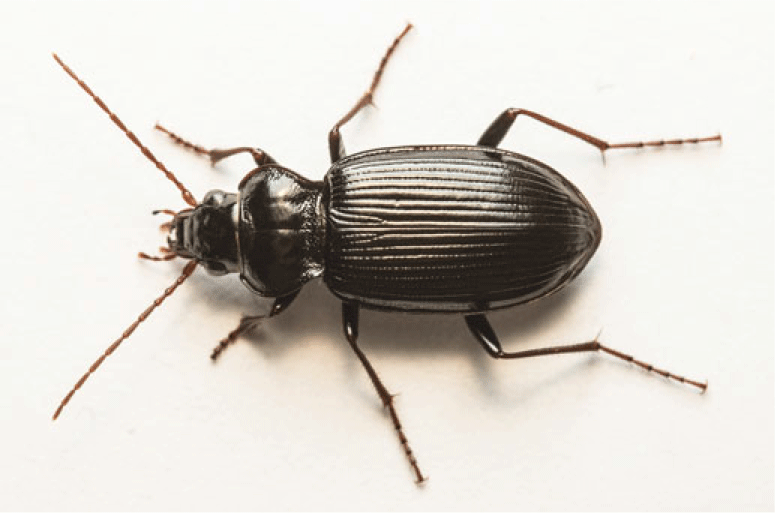
The habitus figure (Fig. 1) should be sufficient to distinguish adults from other genera of co-occurring carabids similar in colour and size. Other species of Nebria in areas where N. brevicollis are apt to be found lack the coarse and dense punctures at the base of the pronotum, and along the elytral striae, have only one seta along each pronotal lateral margin versus the two setae of N. brevicollis, or have lateral margins of the pronotum that are less sinuate. Furthermore, other species of Nebria at low or modest elevations are found along the margins of beaches, streams, rivers, and snow patches. In contrast, N. brevicollis occurs in industrial sites, agricultural fields, city parks, gardens, and forests (LaBonte Reference LaBonte2011).
Live specimen of Nebria brevicollis in dorsal view.
Photograph by H. Goulet.

First records in British Columbia, Canada
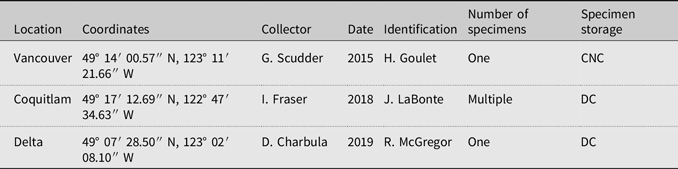
Specimens of N. brevicollis have now been collected from three municipalities in the Metro Vancouver region of British Columbia, Canada, including Vancouver (2015), Coquitlam (2018), and Delta (2019) (Table 1). The Vancouver and Delta collections each consist of single specimens, whereas numerous Coquitlam specimens have been acquired. Specimens are deposited in the Canadian National Collection of Insects, Arachnids and Nematodes, Ottawa, Ontario, Canada or at Douglas College, New Westminster, British Columbia, Canada. Substantial distances, from 17 to 29 km, separate the three collection locations, and as such, the distribution of N. brevicollis is likely much broader in British Columbia than is currently known.
First records of Nebria brevicollis in British Columbia, Canada.

CNC, Canadian National Collection of Insects, Arachnids and Nematodes, Ottawa, Ontario, Canada; DC, Douglas College, New Westminster, British Columbia, Canada.
More information on the Coquitlam populations is provided in the third section of this paper.
Establishment of populations in Coquitlam, British Columbia
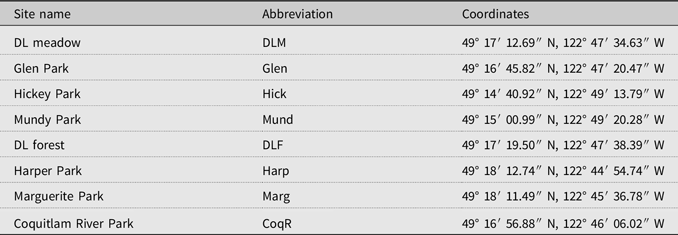
In the fall of 2019, pitfall trap sampling was conducted at eight locations to investigate the distribution of N. brevicollis in Coquitlam, British Columbia, Canada (Table 2). The site where the original Coquitlam collection of N. brevicollis occurred in 2018 – that is, the meadow south of the David Lam campus (DL meadow) of Douglas College, Coquitlam – and seven additional sites in forested areas of city parks were sampled (see Table 2 for geographical coordinates). The plant community at DL meadow is dominated by grasses, herbaceous annuals (often introduced weeds), shrubs, and deciduous trees, of which black cottonwood (Populus balsamifera ssp. trichocarpa (Torrey and A. Gray ex. Hooker) (Salicaceae)) and red alder (Alnus rubra Bongard (Betulaceae)) predominate. Native shrubs such as hardhack (Spiraea douglasii spp. douglasii Hooker (Rosaceae)) occur, but introduced species predominate (e.g., Himalayan blackberry (Rubus discolor Weihe and Nees (Rosaceae)) and Scotch broom (Cytisus scoparius (Linnaeus) Link (Fabaceae)). All other sites sampled were coniferous urban forest fragments of various sizes and with varying proximity to areas of human activity. Vegetation in these sites is typical of second-growth temperate rain forest in the Vancouver area, in which the plant community is dominated by western hemlock (Tsuga heterophylla (Rafinesque) Sargent (Pinaceae)) and western redcedar (Thuja plicata Donn ex D. Don (Cupressaceae)), with an understorey composed of a variety of native plants, including several species of ferns such as Blechnum spicant (Linnaeus) With. (Blechnaceae), Dryopteris expansa (C. Presl) Fraser-Jenkins and Jermy (Dryopteridaceae), Polystichum munitum (Kaulfuss) C. Presl (Dryopteridaceae), and Pteridium aquilinum (Linnaeus) Kuhn (Dennstaedtiacae), and shrubs such as red huckleberry (Vaccinium parvifolium Smith (Ericaceae)), salal (Gaultheria shallon Pursh (Ericaceae)), and vine maple (Acer circinatum Pursh (Sapindaceae)).
Sites where pitfall trapping occurred for Nebria brevicollis in Coquitlam, British Columbia, Canada in fall 2019.
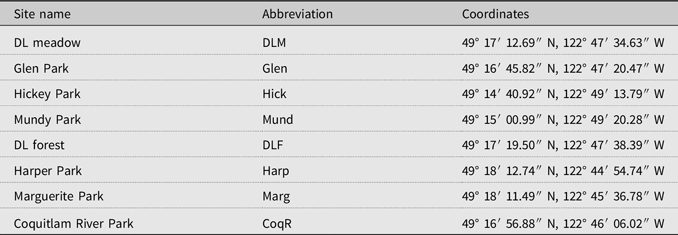
DL meadow (DLM), the meadow south of the David Lam campus of Douglas College, Coquitlam; DL forest (DLF), forest fragment west of the David Lam campus.
Materials and methods
Beetle trapping
Pitfall traps were constructed using 500-mL plastic beverage cups. A double-cup system was used, in which the outer cup had a drainage hole to remove rainwater and the inner cup had a similar hole covered in plastic screening to prevent escape of captured beetles. Traps were inserted into the soil at sampling locations, such that the brim of the trap was level with the surface of the ground. On days when the traps were emptied, the inner cup was removed, beetles were collected, and the cup was replaced to reset the trap. A 20-cm-diameter Styrofoam plate was installed approximately 3 cm above each trap to repel rain and was anchored to the ground with wooden skewers. Four traps were arranged in a square array at each sample site on diagonals from a central point. Each trap was located 5 m from its array’s central point.
Traps were deployed on 10 September 2019 and were visited on 20 September, 30 September, and 9 October 2019, when trap contents were removed and returned to the laboratory. All recovered carabids were identified using Lindroth (Reference Lindroth1961, Reference Lindroth1963, Reference Lindroth1966, Reference Lindroth1968, Reference Lindroth1969a, Reference Lindroth1969b), and species identities and total counts were recorded for the four traps at each site. Beetle counts were pooled for all sample dates at each site for further analysis. Only data for N. brevicollis are presented here.
Data analysis
Variation in pitfall trap counts of N. brevicollis was compared among sample sites using single-factor analysis of variance, and site means were distinguished via Holm–Sidak tests (P < 0.05) (Sigmaplot 12.0, https://systatsoftware.com/products/sigmaplot/ [accessed 27 October 2020]).
Results
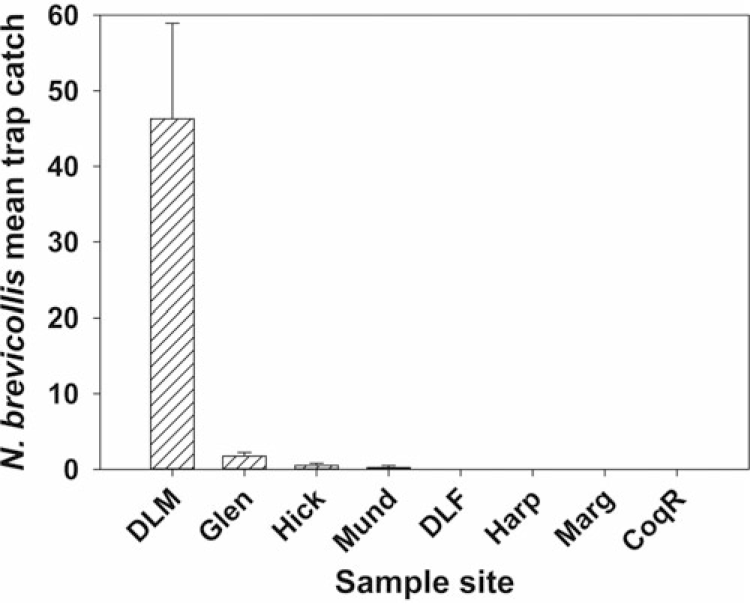
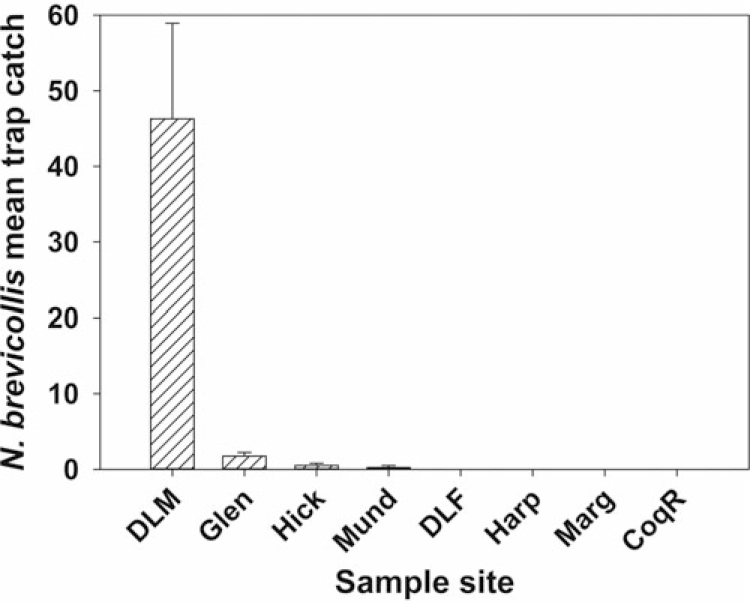
Nebria brevicollis was collected from four of the eight sites sampled (Fig. 2), and trap catches varied among sample sites (F = 13.2, df = 7, P < 0.001). The trap catch at the DL meadow site was significantly higher than at any of the other sample sites (Holm–Sidak test, P < 0.05). Fewer catches of N. brevicollis were recovered from the Glen Park, Hickey Park, and Mundy Park sites. No N. brevicollis specimen was captured at the forest fragment west of the David Lam campus of Douglas College in Coquitlam (DL forest), Harper Park, Marguerite Park, or Coquitlam River Park sites.
Mean trap catch of Nebria brevicollis in pitfall traps at eight locations in Coquitlam, British Columbia, Canada in the fall of 2019 (mean catch ± standard error). DLM, DL meadow; Glen, Glen Park; Hick, Hickey Park; Mund, Mundy Park; DLF, DL forest; Harp, Harper Park; Marg, Marguerite Park; CoqR, Coquitlam River Park.
Discussion
Nebria brevicollis is now established in the Metro Vancouver area. Given its invasive nature (LaBonte Reference LaBonte2011), we can expect future spread and establishment of this species in British Columbia and beyond. Our data from Coquitlam are encouraging as, although N. brevicollis was found in several urban forest sites, trap captures were much lower at these sites than at the more anthropogenic DL meadow. These data suggest that forested habitats may be less vulnerable to invasion by this species. In addition, the N. brevicollis recovered from farmland in Delta, British Columbia, was the only specimen captured in a large pitfall sampling programme in the summer of 2019 (Delta Farm and Wildlife Trust, unpublished data). The previous pattern of establishment of European carabids in British Columbia is that they are synanthropic and primarily restricted to anthropogenic habitats (Spence and Spence Reference Spence and Spence1988). However, given the highly eurytopic nature of this species in Oregon (LaBonte Reference LaBonte2011), our results may simply reflect the early stages of invasion. Incursion into a wider range of habitats may well occur in the longer term.
It is possible that expansion of the range of this species may be limited by more extreme winter conditions that occur east of coastal British Columbia. Nebria brevicollis is a fall-breeding species that undergoes a summer aestivation (Gilbert Reference Gilbert1958; Penney Reference Penney1969; Thiele Reference Thiele1969; Nelemans et al. Reference Nelemans, Den Boer and Spee1989). As such, larvae are active and forage for prey in winter months and may not survive in low-temperature environments (Thiele Reference Thiele1969; Nelemans et al. Reference Nelemans, Den Boer and Spee1989). However, the distribution of this species in Scandinavian countries (e.g., Denmark, Finland, Norway, and Sweden; Lindroth Reference Lindroth1992) indicates it is tolerant of more extreme winter conditions than those that occur in southwestern British Columbia. In addition, both N. brevicollis adults and larvae have been observed actively foraging in the subnivean zone (below the snowpack and above the soil surface) between November and April in Central and Northern Europe (Jaskuła and Soszyńska-Maj Reference Jaskuła and Soszyńska-Maj2011). The subnivean zone presumably provides thermal protection from winter temperatures, due to the insulating properties of snow (Jaskuła and Soszyńska-Maj Reference Jaskuła and Soszyńska-Maj2011). In Oregon, discovery of N. brevicollis populations in montane areas with snow cover for several months of the year suggests that winter conditions may have little effect on the species’ establishment (LaBonte Reference LaBonte2011). As such, conducting more surveys for this species both in coastal British Columbia and elsewhere is critical, as the potential for establishment outside of Metro Vancouver remains unknown.
Although populations of N. brevicollis are known to have been established in Oregon since 2007, negative ecological effects of this species have not, to date, been documented (Kavanaugh and LaBonte Reference Kavanaugh and LaBonte2008; LaBonte Reference LaBonte2011). Invasive insect generalist predators can cause a variety of ecological effects, including competitive displacement of similar native species (Niemelä and Spence Reference Niemelä and Spence1991; Niemelä et al. Reference Niemelä, Spence and Cárcamo1997; Snyder et al. Reference Snyder, Clevenger and Eigenbrode2004; Snyder and Evans Reference Snyder and Evans2006; Crowder and Snyder Reference Crowder and Snyder2010). However, the very high numbers of N. brevicollis observed at many sites (LaBonte Reference LaBonte2011; LaBonte, unpublished data) are not proof of competitive displacement. The competitive potential of an invasive species can be mediated by higher efficiency of resource use, higher reproductive rates, larger prey breadth, intraguild predation, or escape from natural enemies (Snyder and Evans Reference Snyder and Evans2006; Crowder and Snyder Reference Crowder and Snyder2010). Penney (Reference Penney1966) and LaBonte (Reference LaBonte2011) have argued that intraguild predation of N. brevicollis on other similarly sized or larger carabids is unlikely because the documented prey preferences of this species are for arthropods less than 4 mm in size. In contrast, habitat breadth, active dispersal by flight, foraging on upright vegetation (which is unusual in temperate-region carabids), and winter foraging by larvae may confer competitive advantages on N. brevicollis (LaBonte Reference LaBonte2011). Whether N. brevicollis was introduced to North America without one or more of its principal natural enemies from Europe is not currently known. However, Oregon populations of N. brevicollis have recently been shown to be infected by Wolbachia sp. Hertig and Wolbach (Proteobacteria: Anaplasmataceae), and Odden et al. (Reference Odden, Eng, Lee, Donelick, Hiefield, Steach and Chan2019) have been speculated that infection with this symbiont could provide protection from viral pathogens in the new range.
In addition to effects on native carabids, it is also possible that predation by N. brevicollis could cause negative impacts on noncarabid insect species at risk (e.g., endangered Lepidoptera) (LaBonte Reference LaBonte2011). As such, monitoring for N. brevicollis within the ranges of terrestrial arthropod species of conservation concern in British Columbia should be undertaken. Overall, more extensive monitoring across Metro Vancouver and throughout British Columbia is required. We hope that the species description provided here will facilitate detection of this invasive species as it continues to establish in British Columbia. Given the current popularity and use of citizen science programmes (Silvertown Reference Silvertown2009; Guerrini et al. Reference Guerrini, Majumder, Lewellyn and McGuire2018), it may be expedient to engage the public in monitoring efforts. Finally, regardless of subsequently documented negative ecological effects, the introduction of N. brevicollis into British Columbia provides an opportunity to study the dynamics of a biological invasion from its earliest stages. Future work will address habitat and prey preferences, dispersal behaviour, life history patterns, and competitive interactions of N. brevicollis with native carabid communities.
Acknowledgements
Thanks to Drew Bondar and David Charbula of Delta Farm and Wildlife Trust for providing pitfall trap samples from Delta, British Columbia from the summer of 2019. Thanks to Elinor Matheson and Iain Fraser for providing specimens from Douglas College BIOL 3305 pitfall trap samples from the fall of 2018. Financial support was provided through a Douglas College Research Incentive Grant.