Introduction
Freziera Willd. (Pentaphylacaceae, Ericales) is a genus of about 60 species of trees and shrubs, some still undescribed, distributed from Mexico to Bolivia and in the Antilles, with the highest species diversity in the Andes of western South America (Weitzman, Reference Weitzman1987a, Reference Weitzmanb; Weitzman et al., Reference Weitzman, Dressler, Stevens and Kubitzki2004; Mabberley, Reference Mabberley2008). Specimens representing a new species from north-western Ecuador were identified during a herbarium study of Freziera, and this new species is described here. With the inclusion of this one, 16 species are known to occur in Ecuador (Weitzman, Reference Weitzman, Jørgensen and León-Yánez1999; Santamaría-Aguilar & Lagomarsino, Reference Santamaría-Aguilar and Lagomarsino2015).
Materials and Methods
The description of Freziera grandiflora is based exclusively on herbarium specimens. Type and non-type specimens at A, BM, CAY, CR, F, GH, INB, LPB, MO, MOL, NY, PMA, QCA, QCNE, SCZ and USM were examined, together with type images from the JSTOR Global Plants database (no date); these totalled 1060 specimens (not including duplicates), 125 of which were from Ecuador. Herbarium codes follow Thiers (continuously updated).
Flowers were rehydrated in ammonia hydroxide for 1 day and then placed in water until they were sufficiently soft and pliable to be examined under a dissecting microscope. Rehydrated material was then returned to the herbarium specimen. Material was examined under a Leica StereoZoom 5 binocular microscope at × 40. Nodal anatomy was studied with a hand lens; terminology follows Weitzman (Reference Weitzman1987a).
Species Description
Freziera grandiflora D.Santam., D.A.Neill & Lagom. sp. nov.
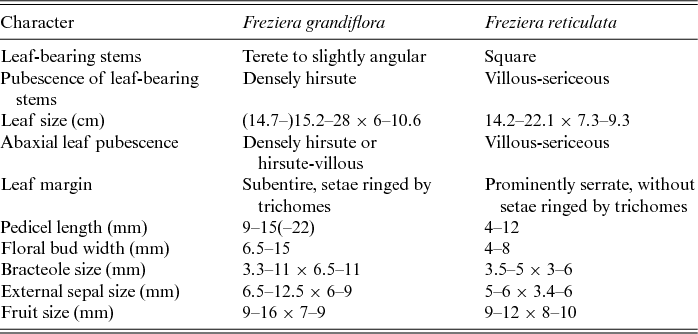
Freziera grandiflora is a very distinctive species characterised by relatively large leaves and reproductive parts as compared with its cogeners, dense indumentum covering the vegetative surfaces and inflorescences, leaves with very conspicuous veins on both surfaces, and leaf margins with numerous setae ringed by trichomes. This species is distinct from Freziera reticulata in its terete stems, subentire leaf margins with setae ringed by trichomes, and generally larger floral organs. – Type: ECUADOR. Pichincha: Reserva Florística–Ecológica Río Guajalito, km 59 de la carr. Antigua Quito-Sto [Santo] Domingo de los Colorados, 3.5 km al NE de la carretera, estribaciones occidentales del Volcán Pichincha, en bosque nublado de vegetación primaria y alrededores, 00°13′53″S 078°48′10″W, 1800–2200 m, 22 ix 1985 (fl), V. Zak & J. Jaramillo 694 (holo QCA; iso GH, MO [3805284], NY). Fig. 1 .
Tree 6–20 m tall; mature branches terete, the bark reddish brown, sometimes drying blackish or whitish in herbarium specimens, finely striate, shortly pubescent or hirsute; unilacunar C-shaped nodal anatomy; leaf-bearing branches cylindrical to slightly angular, densely hirsute, the hairs persistent, golden reddish, to 2–4 mm long, bark smooth or rarely lenticellate, the lenticels, if present, ovate or circular, whitish. Terminal bud conduplicate-involute, 4.1–8.1 mm long, densely hirsute, hairs 2–4 mm long, reddish brown or golden. Leaves petiolate; petiole (1.7–)2–2.4(–2.8) cm long, winged, adaxially canaliculate, abaxially rounded, hirsute throughout, wings often with black setae on their margins, the setae erect or slightly curved, embedded within trichomes, the trichomes 1–3 mm long; colleters absent; lamina (14.7–)15.2–28 × 6–10.6 cm, ovate to elliptic, base rounded, truncate or sometimes slightly cordate, sides equal or slightly asymmetrical, apex acuminate, bearing a black, caducous seta; margin subentire, revolute or not revolute, with 64–137 minute teeth per side, each tooth bearing a terminal black or reddish brown seta, setae conical, caducous, ringed by trichomes; adaxial surface glabrous or villous, densely pubescent in young leaves, hairs 1–2.5 mm long; abaxial surface densely hirsute or hirsute-villous, not papillate, the hairs reddish brown or golden, 1–3.5 mm long; midrib adaxially canaliculate, densely villous or sometimes glabrous, papillate, abaxially rounded, densely hirsute or hirsute-villous; secondary veins 18–30 pairs, weakly canaliculate on adaxial surface, conspicuous and raised on abaxial surface. Inflorescences axillary, fasciculate, bearing 1–3 flowers each. Flowers urceolate, pedicellate, pedicel 9–15(–22) mm long, erect or sometimes curved, cylindrical, densely hirsute-villous; bracts 3–5 × 1.5–2 mm, at base of pedicel, persistent, triangular-lanceolate, not carinate, apex acute, without setae, margin entire, adaxial surface hirsute, abaxial surface glabrous, sometimes sparsely pubescent; bracteoles 2, persistent, opposite or subopposite, at apex of pedicel, 3.3–11 × 6.5–11 mm, unequal, broadly elliptic, not carinate, adaxial surface hirsute-villous, abaxial surface glabrous or sometimes sparsely pubescent from c.2 mm from the apex to the base, margin entire, apex rounded, usually breaking, without setae; flower buds globose, 6.5–15 mm wide; sepals 5, imbricate; outer sepals 6.5–12.5 × 6–9 mm; inner sepals (4–)5–11 × 4–6 mm; outer and inner sepals broadly ovate, adaxial surface densely pubescent, abaxial surface glabrous, margin entire, ciliate, apex rounded, without setae; petals 5, imbricate, (4.5–)5–9 × (2.7–)3–7.5 mm, white, cream or greenish white, free, ovate or widely ovate, apex rounded, margin entire; stamens 25–30, ± uniseriate, free, unequal; anthers 2–4 mm long, not moniliform, generally hastate, base subcordate, apex apiculate; gynoecium 4–9 mm long, glabrous, ovate or conical, 3- or 4-locular; style undivided apically; stigma 2- to 4-lobed. Fruits c.9–16 × 7–9 mm, round, colour unknown, glabrous; walls c.0.5 mm thick; seeds c.511, reddish brown to brown-black, shiny, c.0.1–0.2 mm long, not very defined or ± cuneiform to reniform, foveolate.
Freziera grandiflora. A, Branch showing phyllotaxy, terminal bud and leaves (both abaxial and adaxial surfaces); detail to left shows setae surrounded by trichomes, and detail to bottom right depicts leaf margin, pubescence and abaxial venation. B, Longitudinal section of flower. C, Floral bud showing bracts, sepal and petal morphology. D, Petals and stamens. E, Stamens showing both anther and filament. F, Gynoecium, including a longitudinal view of the ovary, a transverse section showing locules and placentation, and a detail of the stigma lobes. Drawing by Bobbi Angell from J. Jaramillo & V. Zak 7846 (NY) (A), V. Zak & J. Jaramillo 694 (isotype – NY) (B) and V. Zak 1169 (NY) (C–F).

Etymology
The specific epithet refers to the relatively large size of the flowers.
Distribution and habitat
Freziera grandiflora is endemic to Ecuador in the provinces of Carchi and Pichincha on the western slopes of the Western Cordillera of the Andes. It has been collected in cloud forest at 1500–2200(–2390) m, often in disturbed habitats including roadsides, pastures and secondary forests.
Conservation status
Because of its small area of occupancy, the small number of known localities and the threat of future deforestation in its habitat, we tentatively consider Freziera grandiflora to be Vulnerable, following the IUCN criteria: VU B2ab (IUCN Standards and Petitions Subcommittee, 2016).
Phenology
Freziera grandiflora has been collected with flowers in February, June, September, November and December. Fruits have been collected in February.
Freziera grandiflora has been filed in herbaria as F. reticulata Humb. & Bonpl. from Colombia and Ecuador, possibly because both species have conspicuous, reticulate venation on both leaf surfaces and dense pubescence on the abaxial leaf surface and inflorescences. These species can be distinguished, however, by the characters listed in Table 1. Given the relatively large size of the floral buds, mature flowers and fruits, the new species could also be compared with Freziera canescens Bonpl., from Colombia and Ecuador, which differs from F. grandiflora by its smaller leaves with cuneate, revolute bases and abaxial surface covered with whitish trichomes that are densely tomentose or villous. Freziera echinata A.L.Weitzman, known only from the type specimen from the Cauca department of Colombia, is another species with long, dense hairs covering its branches, leaves and inflorescences. Freziera echinata is readily separated from F. grandiflora by its smaller leaves (10.4–12.3 × 2.6–3.5 cm), shorter petioles (2–3 mm) and pedicels (1 mm), and smaller outer sepals (6–6.8 × c.2.9 mm) with tomentose abaxial surfaces.
Principal diagnostic characters of Freziera grandiflora and F. reticulata

The flowers of Freziera grandiflora appear to be hermaphroditic. Hermaphroditism is a very rare trait in Freziera, but see Weitzman (Reference Weitzman1987b). We observed that some flowers with normal, pollen-producing stamens had particularly small gynoecia, whereas all flowers with well-developed gynoecia had apparently normal, pollen-producing stamens. If the flowers with reduced gynoecia are functionally male, then Freziera grandiflora is potentially androdioecious (androdioecy is a mating system that is unknown in the family and is very uncommon across angiosperms; Pannell, Reference Pannell2002); however, we cannot rule out the possibility that the flowers are cryptically dioecious. Mating systems in the entire genus warrant further study, and this species is of particular interest.
Specimens examined. ECUADOR. Carchi: Espejo, Reserva Golondrinas, El Corazón, recorrido por el sendero a La Cortadera hasta El Mirador, 00°50′N 078′06″W, 2390 m, 23 i 2004 (fl bud), H. Vargas et al. 4361 (MO, QCNE); Mira Cantón, Norte del Carmen, camino a Chical, 00°17′N 078°48′W, 2000–2200 m, 10 ii 1992 (fl), W. Palacios et al. 9802 (MO, NY, QCNE); ibid., 2000–2200 m, 10 ii 1992 (fr), W. Palacios et al. 9681 (MO, QCNE). Pichincha: Reserva Florística–Ecológica “Río Guajalito”, km 59 de la carr. antigua Quito-Sto Domingo de los Colorados, 3.5 km al NE de la carretera, estribaciones occidentales del Volcán Pichincha, 00°13′53″S 078°48′10″W, 1800–2200 m, 29 vi 1985 (fl), J. Jaramillo & V. Zak 7846 (MO, NY, PMA, QCA); ibid., 1800–2200 m, 29 vi 1985 (fl bud), J. Jaramillo & V. Zak 7865 (MO, QCA); ibid., 1800–2200 m, 30 vi 1991 (fl bud), J. Jaramillo & E. Grijalva 13657 (MO, NY, QCA); entre Atenas–Sarapullo, km 17, 1750 m, 2 xi 1991 (fl), J. Jaramillo & E. Grijalva 14519 (MO, NY); carretera Quito-Nono-Tandayapa-Los Bancos, colecciones entre Tandayapa, la “Y” de Mindo y Los Bancos, bosque de vegetación nublado, 1800–2000 m, 7 ix 1986 (fl), V. Zak 1169 (GH, MO, NY); carretera Quito-Aloag-Sto Domingo de los Colorados, km 94, sector “La Esperie”, 00°20′S 078°50′W, 1500–1800 m, 2 xii 1987 (fl), V. Zak & J. Jaramillo 3076 (MO, NY, QCNE).
Acknowledgements
We thank the following herbaria for access to their collections: A, BM, CAY, CR, F, GH, INB, LPB, MO, MOL, NY, PMA, QCA, QCNE, SCZ and USM. We appreciate the support and hospitality of the curators and staff of the Harvard University Herbaria. D. Santamaría-Aguilar thanks Missouri Botanical Garden and the Bascom Fellowship Committee for an Elizabeth E. Bascom Grant to support a visit to MO, and A. L. Arbeláez, R. Abbott and R. L. Liesner for facilitating visits to MO. Peter Stevens provided help in interpreting mating system and nodal anatomy. Bobbi Angell drew the excellent illustration of the new species.