Implications
Bulls kept on fully slatted floors show signs of discomfort and are at higher risk of early culling, mainly for problems at the locomotory system. Aiming at improving the health and welfare status of beef cattle, farmers should be addressed towards flooring solutions alternative to the fully slatted floor, particularly when finishing bulls at a heavy weight. Deep litter is a valid alternative but a proper management of the litter is necessary to maintain satisfactory cleanliness of the bulls.
Introduction
The prevalent housing systems for fattening beef cattle in Europe are pens with fully slatted floor or with deep litter where animals are kept from an initial age of 7 to 8 months until a slaughter age between 12 and 16 months (Scientific Committee on Animal Health and Animal Welfare (SCAHAW), 2001). Fully slatted floor is considered as not optimal from the welfare point of view since it does not completely respect the animals’ needs and it may act as a potential stressor (Cozzi et al., Reference Cozzi, Brscic and Gottardo2009 and Reference Cozzi, Tessitore, Contiero, Ricci, Gottardo and Brscic2013; Wechsler, Reference Wechsler2011). Finishing bulls on slats have shown to modify resting and standing behaviour as well as the sequence of lying down and getting up transitions (Ruis-Heutinck et al., Reference Ruis-Heutinck, Smits, Smits and Heeres2000; Absmanner et al., Reference Absmanner, Rouha-Mülleder, Scharl, Leisch and Troxler2009; EFSA Panel on Animal Health and Welfare, 2012). Moreover, slatted floors increase the occurrence of lameness and injuries (Murphy et al., Reference Murphy, Hannan and Moneghan1987). Deep litter allows a more suitable resting comfort compared with slats (Tuyttens, Reference Tuyttens2005) and reduces the incidence of joint lesions and swellings (Schulze Westerath et al., Reference Schulze Westerath, Gygax, Mayer and Wechsler2007). However, cattle locomotory system problems and cleanliness may be compromised also on this type of floor if not properly designed or managed (Gottardo et al., Reference Gottardo, Ricci, Fregolent, Ravarotto and Cozzi2003b; Cozzi et al., Reference Cozzi, Ricci, Dorigo and Zanet2005; Wechsler, Reference Wechsler2011).
In this scenario, there is a lack of scientific information regarding the occurrence of welfare problems related to the flooring system in beef cattle and particularly in bulls finished at a heavy weight. Therefore, the aim of this study was to evaluate the prevalence of welfare problems of bulls housed on deep litter or on fully slatted floor at an early stage of their finishing (short-term) or before slaughter at a heavy BW (long-term). The study considered a single large commercial fattening unit, one trained observer applying validated animal-based measures (Welfare Quality®, 2009) and a restricted time period of the year to avoid bias due to farm, observer, assessment protocol and environmental conditions.
Material and methods
Farm housing system and management
The study was carried out in a large commercial beef farm located in the Eastern Po Valley (Italy) with a housing capacity for 5500 bulls. The farm uses an open cycle rearing system in which batches of about 120 Charolais and French crossbred bulls are weekly imported from France at a live weight of ∼400 kg. Upon arrival at the farm, bulls are inspected by the farm veterinarian and visibly sick animals are moved to the sick bay. Newly arrived bulls are all immunised against respiratory diseases (IBR, syncytial respiratory disease, parainfluenza viruses) and treated against endo- and ecto-parasites and housed in multiple pens. The farm housing capacity is split between pens with fully slatted floor (75%) and straw-sawdust deep bedded pens (25%). Pen size and the number of bulls housed per pen are different between the two housing systems. Fully slatted floor pens house on average 9±1.9 bulls, with a space allowance of 2.9±0.1 m2/head and a manger space of 64±3 cm/head. The pen floor is made of concrete slats 14 cm wide, with a longitudinal gap width of 3.2 and 90 cm length. Deep litter pens contain on average 15±1.5 bulls with a space allowance of 3.5±0.6 m²/head and a manger space of 36±8 cm/head. The floor is made of concrete and a mixture of 50 kg of straw and 30 kg of sawdust is added twice a week as bedding material and it is completely renewed every 3 weeks during the fattening and before the housing of a new batch. All bulls are fed the same finishing diet (CP 13.5% dry matter (DM); starch 32% DM and NDF 32% DM) mainly based on maize (silage and high moisture ear), soya bean meal, dry sugar beets and wheat straw. Diet is provided as total mixed ration once a day and drinking water is available ad libitum through two bowls per pen. All bulls are inspected daily by the farmer in order to check their health status.
Experimental batches and assessment protocol
The study was carried out from October 2008 to January 2009 (daily average temperature from 2°C to 16°C and relative humidity from 55% to 87%) and considered a total of 27 batches of bulls. The short-term effect of the different flooring systems was assessed 1 month after arrival (short-term) in 15 batches of bulls that arrived at the farm from September to December 2008. Consistent with the housing capacity in terms of the two types of floor, 11 batches of bulls were housed in fully slatted floor pens (FS) and four batches on deep litter (DL). The long-term effect of the flooring systems was assessed 1 week before the expected slaughter day (long-term) on 12 batches of bulls that completed their finishing within the study period. Three batches of bulls were on DL and nine on FS.
The assessment was carried out by a trained assessor (unfamiliar to the animals) using the animal-based measures of the Welfare Quality® assessment protocol for cattle (Welfare Quality®, 2009). The assessment started in the morning right after feed distribution with the avoidance distance test at the feeding rack (ADF). The ADF test was applied to 60 bulls per batch to evaluate human–animal relationship. The avoidance distance was estimated as the distance between the hand of the assessor and the muzzle of the animal at the moment of withdrawal and expressed on a 10-cm scale ranging from 300 to 0 cm in the case of touching the animal. The assessment of animals’ health status and cleanliness (one randomly selected side of each bull) was carried out on all fully visible bulls housed in four FS and in two DL randomly selected pens per batch. Health status was evaluated looking at bursitis, lameness, integument alterations (hairless patches and lesions/swellings present on one randomly selected side of each bull), coughing, nasal discharge, ocular discharge, hampered respiration, diarrhoea and bloated rumen. Their prevalence were recorded as binary measures (presence/absence) observing the animals from a distance not exceeding 2 m. Continuous behavioural observations (Martin and Bateson, Reference Martin and Bateson2007) were performed for 10 min observation time per pen on eight pens randomly selected per each batch (80 min per batch). The expression of social behaviours was assessed through agonistic behaviours (head butt, displacement, chasing, fighting and chasing up) and cohesive behaviours (social licking and horning). Mounting was considered a neutral behaviour. The observer was placed on an elevated platform in the feeding alley to have a better view of the whole pen and to minimise interferences with the animals. At the end of these observations, a segment scan was performed and the number of bulls standing/lying was recorded in each observed pen.
During the social behaviour observations and every time a lying down transition occurred, the observer recorded the time needed by the bull to perform this movement using a stopwatch. Among bulls lying down, the occurrence of abnormal lying down sequences with a bull bending first the rear limbs in a ‘dog style’ was recorded to obtain a more complete information about resting comfort. Moreover, during the 10-min continuous behaviour observations, the number of coughs were also recorded at pen level. Approximately 2 h after feed distribution, a herd scan was carried out in the observed eight pens to record the number of the animals that were ruminating either standing or lying.
The long-term effect of the flooring systems included also bulls’ productive performance gathered from farm records for the 12 assessed batches. Mortality and the number of early culled animals of the same batches were gathered from farm records. Reasons for the culling of bulls were classified in three categories: respiratory syndromes, musculoskeletal system pathologies/lameness and other causes (parasites, heart failure, infectious diseases and urolithiasis).
Statistical analysis
The single animal was the statistical unit for data regarding clinical traits, cleanliness, avoidance distance and lying down durations. Pen was the statistical unit for behavioural data gathered from continuous observations and herd scans. Batch was the statistical unit for performance and culling data. Since there was no overlap between batches assessed to evaluate the short- and the long-term effect of the different flooring systems, data sets were statistically analysed separately. Clinical traits and cleanliness data, recorded as dichotomous variables, were analysed by a logistic regression procedure to test the effect of type of floor using the Wald χ 2-test. Proportions of bulls in each ADF category were also submitted to a χ 2-test to assess differences between types of floor. Proportions of bulls exhibiting abnormal lying down sequences were submitted to a Monte Carlo test to assess differences between types of floor. Data regarding behavioural traits and coughing were analysed using a mixed model procedure including type of floor as fixed effect and the batch nested within type of floor and pen nested within batch×type of floor as random effects. Productive performance were analysed using PROC GLM to test the effect of the type of floor. The model used to process final BW and average daily gain included the initial BW as covariate. Mortality and early culling data expressed as proportions were statistically analysed using χ 2-test with the Marascuilo procedure in order to verify their association with a given type of floor. Relative risk ratios for significant culling classes were calculated. All analyses were performed with SAS/STAT (1990) and P<0.05 was set as minimum threshold of statistical significance.
Results
Clinical parameters and cleanliness
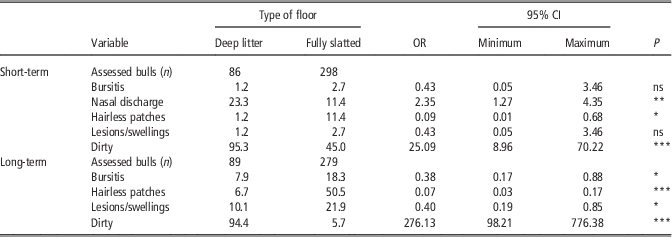
The low prevalence (<1%) of lameness, ocular discharge, hampered respiration, diarrhoea, bloated rumen at both assessments and nasal discharge assessed at the end of the finishing period did not allow to perform statistical analyses on these measures. Coughing events recorded at the short-term assessment were similar for DL and FS bulls (1.27 and 2.05 events/bull per hour, respectively; P>0.05; r.s.d.=3.67). The type of floor did not affect coughing events also at the assessment carried out at the end of the finishing period with a number of events/bull per hour of 0.26 and 0.40 for DL and FS, respectively (P>0.05; r.s.d.=0.22). Compared with DL, bulls on FS had a greater risk of hairless patches already 1 month after arrival (Table 1). Bulls kept on fully slatted floor for the whole finishing period were more likely to develop bursitis and both integument alterations. Deep litter increased the risk of occurrence of nasal discharge at the short-term assessment and had a detrimental effect on bulls’ cleanliness both in the short and the long term (Table 1).
Effect of the type of floor on the prevalence (% of bulls/total bulls) of clinical parameters and poor cleanliness of bulls assessed after a short- or a long-term housing

OR=odds ratios; CI=confidence interval.
Estimated OR and 95% CI according to the type of floor with fully slatted floor as term of comparison.
ns P>0.05; *P<0.05; **P<0.01; ***P<0.001.
Behavioural parameters
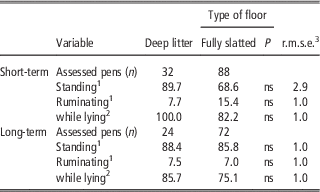
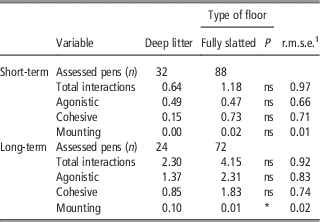
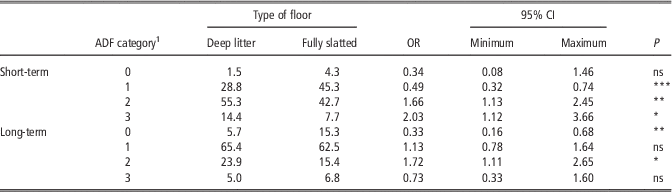
Standing and ruminating behaviour was similar for bulls housed on DL and FS (Table 2). At the short-term assessment, the incidence of agonistic and cohesive interactions was not affected by the pen floor (Table 3) and mounting events were almost null. Social interactions were similar between floors also at the end of the finishing period except for the greater number of mounting events recorded for bulls housed on DL (Table 3). The average duration of the lying down transitions was lower for animals housed on deep litter than on slats. It lasted 5.1 v. 6.5 s (P<0.05; residual=1.4) at the short-term assessment and 6.2 v. 7.6 s (P<0.05; residual=2.0) at the end of fattening for DL and FS bulls, respectively. Atypical lying down sequences were observed only for FS bulls at the short-term assessment (0.33% of animals lying down) but there was no significant effect of the type of floor. The frequency of atypical lying down sequences was null also for DL bulls assessed 1 week before slaughter, whereas it was 2.92% for FS bulls with a significant type of floor effect (P<0.05). The avoidance distance test at the feeding rack (Table 4) showed similar proportions of bulls that could be touched between the two types of floor at the short-term assessment. At the same assessment, the proportion of bulls that could be approached closer than 50 cm was smaller on DL compared with FS (category 1), whereas larger proportions of bulls could not be approached as closely as 50 cm in DL than in FS pens (categories 2 and 3). At the long-term assessment, the proportion of bulls that could be touched was higher in FS than in DL pens, whereas there was a higher proportion of bulls that could be approached as closely as 100 to 50 cm in DL compared with FS (category 2).
Effect of the type of floor on the prevalence of bulls standing, ruminating and ruminating while lying after short- and long-term housing

ns P>0.05.
1 % of bulls/total bulls.
2 % of bulls/total ruminating bulls.
3 Root mean square error of the model.
Effect of the type of floor on the incidence of social interactions (number of events/bull per hour) assessed after short- and long-term housing

ns P>0.05; *P<0.05.
1 Root mean square error of the model.
Effect of the type of floor on the prevalence of bulls (% of bulls/total tested bulls) in each category of the avoidance distance test at the feeding rack (ADF) assessed after short- or and long-term housing

CI=confidence interval; OR=odds ratio.
Estimated OR and 95% CI according to the type of floor with fully slatted floor as term of comparison.
ns P>0.05; *P<0.05; **P<0.01; ***P<0.001.
1 0=animals that can be touched; 1=animals that can be approached closer than 50 cm but not touched; 2=animals that can be approached as closely as 100 to 50 cm; 3=animals that cannot be approached as closely as 100 cm.
Productive performance and culling rate
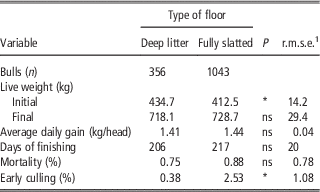
Average initial live weight of bulls housed on DL was higher than that of FS bulls but there was no effect of the type of floor on final live weight, days of finishing and average daily gain (Table 5). Mortality rate was similar between type of floor, whereas early culling rate of FS bulls was higher than that of DL ones (Table 5) with a risk ratio of 6.44 (95% CI 1.57 to 26.37; P=0.003). Musculoskeletal system pathologies/lameness were the main cause of early culling in FS pens (87.8%), whereas respiratory syndromes and other causes were 2.4% and 7.3%, respectively. On deep litter, 75.0% of early culled bulls were affected by locomotory system failure and the remaining 25.0% by respiratory syndromes (not significant).
Effect of the type of floor on growth performance, cycle duration and culling rates of bulls assessed after long-term housing

ns P>0.05; *P<0.05.
1 Root mean square error of the model.
Discussion
Fully slatted concrete floor cannot be considered a welfare friendly type of floor for finishing beef cattle because it may act as a potential stressor and rise culling rates (SCAHAW, 2001; Cerchiaro et al., Reference Cerchiaro, Contiero and Mantovani2005; Schulze Westerath et al., Reference Schulze Westerath, Gygax, Mayer and Wechsler2007). The present study confirmed the high risk for early culling of beef cattle kept on slats, which resulted more than six times higher than that of deep litter. Previous studies addressed the negative effects of the fully slatted floor particularly on the locomotory system (Gygax et al., Reference Gygax, Mayer, Schulze Westerath, Friedli and Wechsler2007; Schulze Westerath et al., Reference Schulze Westerath, Gygax, Mayer and Wechsler2007; Tessitore et al., Reference Tessitore, Brscic, Boukha, Prevedello and Cozzi2009). These negative findings are here supported by both, the high prevalence of early culling due to musculoskeletal system pathologies/lameness and the outcomes of the clinical assessment at the end of the finishing. This study revealed a higher occurrence of hairless patches on fully slatted floor already at the short-term assessment carried out 1 month after the arrival of the bulls and this is in accordance with the increased integument alterations observed by Tessitore et al. (Reference Tessitore, Brscic, Boukha, Prevedello and Cozzi2009) and Schrader et al. (Reference Schrader, Roth, Winterling, Brodmann, Langhans, Geyer and Graf2001) in beef cattle kept on a hard floor. In the present study, however, it could not be totally excluded that some animals were already bought-in with some skin alteration considering that upon arrival at the farm they were checked by the farm veterinarian and not by the trained assessor.
It has been proven that deep litter provides a soft and more comfortable surface for cattle (Schulze Westerath et al., Reference Schulze Westerath, Gygax, Mayer and Wechsler2007; Wechsler, Reference Wechsler2011) along with a better grip that prevents lesions and swellings due to slipping (Platz et al., Reference Platz, Ahrens, Bahrs, Nuske and Erhard2007). On the contrary, Wechsler (Reference Wechsler2011) reported that finishing cattle have difficulty lying down on concrete slats as this type of floor is more likely to be slippery. It could be assumed, therefore, that the shorter lying down duration and the total absence of abnormal lying down sequences observed in DL bulls at both assessments in the current study were due to higher confidence and less fearfulness to slip on DL compared with FS. In addition, the more frequent mounting events recorded on deep litter at the long-term assessment could also be explained by the safe grip allowed by the bedded floor, which made bulls more confident to interact with powerful movements despite their heavy BW and the narrower space allowance. Considering that it is generally agreed that farm animal welfare is at a high level when the animals can behave naturally (Wechsler, Reference Wechsler2007), lying and mounting results of the current study suggest that the welfare status of finishing bulls in this farm was at higher risk on fully slatted floor.
The outcomes of the avoidance distance test in the current study, showed DL bulls to be more fearful compared with FS ones at both assessments. This might be related, rather than to the effect of the type of floor per se, to the different feature of the pens in terms of design, space allowance and number of pen-mates. Deep litter pens were longer than slatted pens and their manger placed in the front side did not allow all pen-mates to feed simultaneously. Under these housing conditions, it is likely that bulls had less opportunity to progressively adapt to the presence of stockpeople, which would shorten their flight distance (Hemsworth et al., Reference Hemsworth, Coleman, Barnett and Borg2000). A further hypothesis to explain the same result could come from the higher number of animals housed per each deep litter pen taking the negative correlation between avoidance distance and number of pen-mates into account reported by Waiblinger et al. (Reference Waiblinger, Menke and Fölsch2003) for horned dairy cows. The same authors suggested that high competition among horned cattle in the feeding area could enhance their alertness and consequently their reaction to an unfamiliar person.
A negative aspect of the deep litter in this study was the poor cleanliness of the bulls despite their larger space allowance compared with that of FS ones. Dirtier bulls on a deep litter floor were also observed by Gottardo et al. (Reference Gottardo, Ricci, Fregolent, Ravarotto and Cozzi2003b). Odds ratios for dirty animals calculated at both assessments in the current study were the result of an inadequate litter management. Indeed, the amount of straw provided as bedding material was ∼1.5 kg/bull per day, which is far below the requirement of 4 to 6 kg/bull per day suggested by Daelemans and Maton (Reference Daelemans and Maton1987). Wechsler (Reference Wechsler2011) suggests a regular litter renewal with sufficient quantity to ensure animal cleanliness. Moreover, a proper management of the deep litter is highly recommended since dirty bulls at the time of slaughter have been shown to increase the risk of meat contamination by harmful bacteria (Reid et al., Reference Reid, Small, Avery and Buncic2002). Consistent with the outcomes of several fattening trials (Lowe et al., Reference Lowe, Steen, Beattie and Moss2001; Gottardo et al., Reference Gottardo, Cozzi, Preciso and Ravarotto2003a and Reference Gottardo, Ricci, Fregolent, Ravarotto and Cozzi2003b; Hickey et al., Reference Hickey, Earley and Fisher2003), the type of floor did not affect bulls growth performance.
Despite gathered from a single farm, the outcomes of the study confirmed that beef cattle finished on a fully slatted concrete floor may show integument alterations and modification of their normal lying behaviour already after a short-term exposure. The detrimental effects of this type of floor are particularly evident in heavy-weight cattle at the end of the finishing. Therefore, aiming at the improvement of the health and welfare status of heavy-weight finishing bulls, farmers should address their choices towards flooring solutions alternative to the fully slatted floor. Deep litter systems are a promising alternative, however, proper litter management is necessary to maintain satisfactory cleanliness of the bulls.
Acknowledgements
The study was carried by applying animal-based measures developed within the European Union-funded integrated project FOODCT-2004-506508 ‘Welfare Quality: Science and society improving animal welfare in the food quality chain’. The text represents the authors’ viewpoint and does not necessarily represent the position of the Consortium, which will not be liable for the use made of such information. The authors are grateful to Dr. Barbara Contiero for her precious statistical support.