INTRODUCTION
Verbal and visual mnemonics, defined as internal strategies that enhance our ability to learn and remember information and that are consciously learned and require effort to place into practice (e.g., Wilson, Reference Wilson2009), play a key role, along with environmental prosthetics and extensive task practice, in some of the most well-studied programs of CR for schizophrenia in the literature [e.g., Compensatory Cognitive Training (CCT); Twamley et al., Reference Twamley, Vella, Burton, Heaton and Jeste2012]. While many of these strategy-based mnemonic approaches have been investigated in the context of treatment of memory loss associated with acquired brain injury (ABI), they have received little attention as stand-alone interventions in the schizophrenia literature. For example, visual imagery interactions, in which a to-be-learned word or object is imaged and then imagined interacting with second to-be-learned word or object, which is then pictured interacting with a third to-be-learned word or object to be learned, etc. produce improvements in word list recall for people with ABI (e.g., Wilson, Reference Wilson1987). Crovitz (Reference Crovitz1979) has used a mnemonic that includes a combination of imagery and narrative to improve word list retrieval performance among individuals suffering from ABI and Korsakoff’s syndrome by presenting words in a story (Story Method). In both of these examples, verbal information is presented, and interpreted as visual information, only to be re-presented verbally, a remediation approach that has been labelled “translation” and “retranslation.” (Cermak, Reference Cermak1975). This is a strategy-based approach to remediation as a preserved area of function, imagery, is applied to an area that is deficient, in this case, verbal memory.
Thus, the purpose of this “proof-of-concept” study was to investigate the relative efficacy of two different mnemonic strategies, the Story Method and the Imagery Technique, for improving verbal episodic memory, as compared to a non-remediated control condition, among individuals with schizophrenia. Recall of verbal information on both word items trained during the interventions, as well as measures of word list learning and prose recall not trained in the intervention were selected as measures of outcome. In the first approach (the Story Method), a narrative technique was applied in which participants listened to a story that linked target words sentence by sentence in an interaction. In the second approach, Imagery, an imagery technique was taught in which participants were guided to imagine target words interacting with one another. The control condition, offered no strategy, just repetition of the target words that was similar to that offered in the two strategy-trained groups. It was hypothesized that both the imagery and story strategies would (1) significantly improve verbal memory performance on the words used on the strategy training task, (2) would generalize by demonstrating significant improvements on other non-trained verbal memory tasks, (3) and that these generalized benefits would endure at a 1-week follow-up assessment.
METHODS
Design
Study procedures were approved by appropriate institutional review boards and all participants provided written, informed consent. Participants were randomly assigned to one of the three treatment groups using an on-line random number generator consisting of the numbers 1, 2, and 3 (1=Story Method, 2=Imagery, or 3=Control) by a member of the research team who was not involved in pre- or post-training assessment, scoring or data analysis. This team member was instructed not to disclose group assignments to members of the research assessment, scoring and data analysis team.
Participants
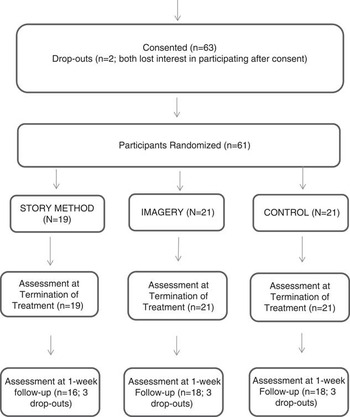
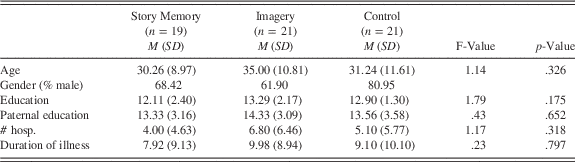
Sixty-one outpatients participated (see Table 1 for a summary of demographic, clinical, and treatment characteristics). Inclusion criteria included meeting DSM-IV (APA, 1994) criteria for schizophrenia or schizoaffective disorder, confirmed by the Structured Clinical Interview for DSM-IV (First et al., Reference First, Spitzer, Gibbon and Williams1995). Exclusion criteria were uncorrected auditory or visual impairment, intellectual disability as evidenced by a documented history of services, lack of proficiency in English, or current substance abuse or dependence. Participants were not excluded for a history of neurological disorder or head injury. Recruitment for the study occurred at two sites. The majority of the study participants were recruited from an intensive outpatient program for patients with schizophrenia at The Institute of Living in Hartford, CT with the remainder recruited from a community mental health center in East Hartford, CT. See Figure 1 for the CONSORT diagram detailing the flow of participants through the study.
CONSORT diagram.

Comparison of demographic and clinical variables between the three experimental groups

Experimental Groups
Before being introduced to the strategy, each participant listened to a list of fifteen words and was tested for immediate recall. Participants were then re-exposed to the words one of the following ways depending on their random group assignment.
The Story Method condition
Participants listened to the fifteen target words embedded in a story that related each word by presenting them in an interaction facilitating both imagery and narrative structure of the to-be-learned words. This image-based elaborative encoding strategy was adapted from a method developed Crovitz (Reference Crovitz1979). We used the following training script in this condition:
“The first word is poster and you can remember that however you like. The second word is barrel because a wanted poster was hung on the side of a barrel. The third word is rainbow because the end of the rainbow was in the barrel. The fourth word is canoe because a man was rowing a canoe across the rainbow. The fifth word is soup because the canoe was filled to the brim with soup. The sixth word is beard because the man had a long beard that touched his knees. The seventh word is carnation because the man had a carnation sprouting forth from his beard. The eighth word is bluebell because next to the carnation there was a bluebell. The ninth word is emerald because at the center of the bluebell was a loose emerald. The tenth word is peach because the man ate a peach and dripped juice onto the emerald. The eleventh word is toilet because the peach accidentally fell into a toilet. The twelfth word is bell because a bell rang when the toilet flushed. The thirteenth word is boot because the bell was attached to the toe of a boot. The fourteenth word is deer because a deer was wearing four boots. The fifteenth word is ring because the deer also had rings on each antler.”
The Imagery condition
Participants listened to the 15 target words embedded in a verbally-guided task that required participants to actively visualize the words interacting but without provision of a narrative structure. We used the following script for this condition:
“First I want you to picture a poster. Now imagine a barrel interacting in some way with a poster. Now imagine a rainbow interacting in some way with a barrel. Now imagine a canoe interacting in some way with a rainbow. Now imagine soup interacting in some way with a canoe. Now imagine a beard interacting in some way with soup. Now imagine a carnation interacting in some way with a beard. Now imagine a bluebell interacting in some way with a carnation. Now imagine an emerald interacting in some way with a bluebell. Now imagine a peach interacting in some way with an emerald. Now imagine a toilet interacting in some way with a peach. Now imagine a bell interacting in some way with a toilet. Now imagine a boot interacting in some way with a bell. Now imagine a deer interacting in some way with a boot. Now imagine a ring interacting in some way with a deer.”
Control condition
Participants were exposed to the training word list two times, the same number of times as the two training groups, to control for passive word-list exposure, non-specific effects of meeting with an experimenter and being in a research study targeted at improving verbal memory.
Outcome Measures
Participants in all three of the study groups were tested for recall of the target words after receiving training in their respective study groups. Change in recall was measured by subtracting pre-training recall from post-training recall. To test for generalization of the strategies’ benefits to verbal episodic memory, word-list recall and prose recall tasks consisting of words not used on part of the training protocol were administered at baseline and at two follow-up assessments. The baseline assessment occurred immediately before the administration of the intervention or control condition. One follow-up assessment was administered immediately after strategy training or control exposure, and a second follow-up assessment was conducted one week after the cessation of training to assess durability. Assessments were conducted by blinded research assistants trained and supervised in these procedures by a doctoral-level psychologist (M.M.K.).
The Hopkins Verbal Learning Test- Revised (HVLT-R; Brandt & Benedict, Reference Brandt and Benedict1998): was used to assess immediate free recall of word lists. This test consisted of 12 words, four from each of three semantic categories, given across three word list presentations. Test–retest reliability coefficients for total recall across different test versions has been reported as moderate (r=.66) with evidence of convergent and divergent validity for this measure. Alternate forms were administered to each participant at different time points to minimize practice effects.
The Rivermead Behavioral Memory Test: Story Subtest (RBMT; Wilson et al., Reference Wilson, Cockburn and Baddeley1985): was used to measure prose recall, and involved recall of plot details for an orally presented story with greater scores awarded to details that were reported verbatim. Three alternate forms were administered to minimize practice effects. Test–retest reliability has been supported for this measure with correlations between initial and follow-up testing, using different versions of the RBMT (r=.85) on the summary Profile Score. Validity has been supported with correlations between the RBMT and other standardized memory measures, clinician reports of client memory lapses and subjective reports of memory impairment (Wilson et al., Reference Wilson, Cockburn and Baddeley1985).
Blinded assessors were asked to guess participants study condition for a subgroup of eight study participants and guessed correctly 37.5% of the time, providing evidence that the blind was successful.
Statistical Analysis
We used an intent-to-treat analysis which included all enrolled participants. The distribution of scores for each variable in each group was inspected for normality and compared to relevant comparison groups for homogeneity of variance. First, the three groups were compared at baseline on clinical demographic, and memory measures using independent sample t tests. Second, we performed a series of independent group t tests on change scores in the number of words recalled on the trained word list before and after the two interventions and in the control condition to assess intervention efficacy. Third, to assess generalization effects we performed a series of one-way analyses of covariance (ANCOVAs) with group (Story Method, Imagery, or Control) as the between-subjects variable, post-training and 1-week follow-up scores on the RBMT and HVLT as the dependent measures, and pre-training RBMT and HVLT scores as covariates. When significant group differences in ANCOVA were observed we conducted independent group t tests on change scores to identify specific group differences. Effect sizes (Hedges g) were obtained by comparing the results on outcome measures from the two treatment condition to those from the control condition at the end of treatment. Ranges for effect sizes were as follows: ≤.2 (minimal to small), .2–.5 (small to moderate), .5–.8 (moderate to large), and .8 and above (large) (Lipsey & Wilson, Reference Lipsey and Wilson2001). All statistical tests were two-tailed and alpha was set at .05.
RESULTS
There were no significant demographic or clinical differences between the Story Method, Imagery or Control groups on any variables at baseline (see Table 1). Only two participants declined to participate after providing consent, and nine participants were lost to follow-up at the 1-week assessment (see Figure 1). With respect to study outcome measures, there were no differences between groups at baseline on the to-be-trained word list, or the two generalization measures, the RBMT Story raw scores, or the HVLT raw scores (all ps>.16). Comparisons of increases in the number of training words retained in the three groups revealed that change scores were greater in the Story Method condition as compared to control (t=2.54; p<.02). No other group comparisons were significant (all ps>.27).
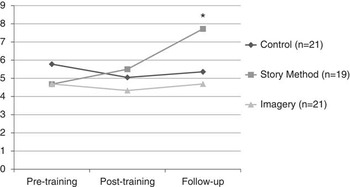
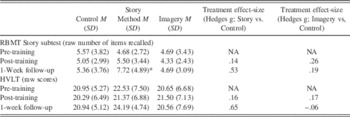
With respect to differences in changes between the three groups on generalization memory measures, there were no differences between groups immediately after training. At a 1-week follow-up, ANCOVA revealed significant differential group improvements (F[2,46]=3.33; p<.05), on the on RBMT Story raw scores, but not on the HVLT raw scores (see Table 2 and Figure 2). Independent group t tests revealed that the Story Method produced greater improvements in recall scores at the 1-week follow-up as compared to the Imagery group (t=2.01; p=.05; g=.72) and the Story Method also produced improvements on the RBMT that approached significance relative to the control group (t=1.96; p=.059; g=.53). Differences from baseline testing to the 1-week follow-up were not different between the Imagery and Control groups on the RBMT.
Number of items recalled on Prose Recall from the RBMT before and after training and at a 1-week follow-up.*p = .05, Story Method vs. Imagery.

Generalization of strategy training to two standardized measures of verbal episodic memory; The Rivermead Behavioral Memory Test (RBMT), Story subtest, and the Hopkins Verbal Learning Test (HVLT)

*p<.05 between groups.
DISCUSSION
This is the first study, to our knowledge, to directly compare the efficacy and generalizability of two mnemonic strategies for improving episodic verbal memory in people with schizophrenia in a randomized, blinded trial. Mnemonic strategies represent a key element of leading, comprehensive programs of CR (e.g., CCT) for schizophrenia, and yet the relative effectiveness of mnemonics more generally, and types of mnemonics more specifically, remains unexplored, raising questions as to the role of these strategies in the efficacy of evidence-based CR interventions. With respect to hypothesis one, the Story Method mnemonic strategy consisting of a strategy consisting of both imagery and construction of a narrative improved the number of words recalled on training word items relative to the control condition, which included equivalent exposure to the training word list without the provision of a mnemonic strategy. The Imagery mnemonic, which consisted of simply visualizing words interacting, did not produce improvements in the trained word list relative to passive word list exposure.
With respect to hypothesis two, neither mnemonic strategy produced generalization to standardized episodic verbal memory measures (RBMT Story subtest and HVLT) at an immediate follow-up. With respect to hypothesis three, moderate-sized generalization effects were evident at the 1-week follow-up in the Story Method training condition on a standardized prose recall task (RBMT Story subtest) but not on a word list recall task (HVLT), relative to participants in a control condition with similar exposure to training and generalization verbal memory tasks.
Taken together, these results suggest that that the Story Method mnemonic, including both visual imagery and provision of a narrative structure for aid in word recall, is both effective at enhancing word recall for trained words, and for generalization of effects to non-trained verbal episodic memory tasks, at least at a delayed follow-up. While generalization of effects at the 1-week follow-up was only evident on one of the two outcome measures selected for the study according to conventional methods of assigning statistical significance, effect-sizes comparing the results from participants in the Story Method to participants in the control condition on the HVLT revealed moderate-sized treatment effects at the 1-week follow-up (g=.65), suggesting that our study may have been underpowered to detect effects on this measure. Baseline scores on the HVLT in the Story Method condition were also modestly higher than in the other two conditions (see Table 2) and thus may have created ceiling effects in that condition making treatment effects more difficult to detect. It is also possible that the nature of this condition, which provided less structure than the Story Method, made it less likely that participants successfully visualized the images than the story condition in which images were provided to participants
These findings are important as it suggests that techniques of imagery and provision of a narrative structure in tandem as a mnemonic may be necessary to facilitate improvements in verbal episodic memory as elements of training in programs of CR for people with schizophrenia, with visual imagery techniques alone lacking sufficient potency as a learning strategy. These findings might also reflect impairment in both verbal episodic memory and visualization skills in people with schizophrenia, and might suggest why previous studies of mnemonic strategies using visualization strategies in schizophrenia have failed to produce generalization (Medalia et al., Reference Medalia, Revheim and Casey2000).
The emergence of generalization effects in the Story Method condition only after a 1-week delay was unexpected. One tentative hypothesis that can be forwarded is that it might be that the simple passage of time coupled with a second post-training exposure to a memory task at a 1-week follow-up permitted the necessary consolidation and practice of these mnemonic skills for successful implementation Alternatively, it could be that the trained mnemonics selected for the study that require both conscious application and effort only become effective after repeated practice. This hypothesis assumes that participants practiced the Story Method independently in their everyday life during the 1-week interval. While participants were urged to apply mnemonic strategies in their everyday life after training as part of the training script that was administered (i.e., “This is a strategy you can use to help remember word lists such as grocery lists when you go shopping or run errands.”), we did not include a measure of independent mnemonic practice in our study and thus cannot attempt to formally assess this hypothesis.
We note several limitations to the current findings. First sample sizes were moderate at the initial follow-up and small at the 1-week follow-up and thus some statistical analyses may have been underpowered. Second, without a third assessment after a longer follow-up period it remains unknown the durability of verbal episodic memory improvements produced by the Story Method mnemonic in this study. Third, mnemonics offered as part of comprehensive CR programs typically consist of multiple training sessions and thus the single training sessions offered in the current study may not mimic these approaches effectively. Nonetheless, this brief training exposure emphasizes the potency of a mix of visualization and narrative strategies for improving verbal episodic memory that we have reported. Fourth, differences in psychometric characteristics between selected standardized measures of verbal episodic memory generalization, including differences in test–retest reliability and floor and ceiling effects may have contributed to differences in sensitivity of these measures to the study interventions. Fifth, the study did not include an independent assessment of the degree to which participants followed instructions in the two conditions, and thus it remains unknown exactly what individual participants were doing during the two different instructional sets. The Imagery condition likely required more effort from the participants in this group to formulate their own images. For this reason, group differences may reflect differences between being presented an image (the story condition) versus following instructions correctly when being told to image words (the Imagery condition).
If these findings do in fact reflect an inability of participants to produce their own imagery for to-be-remembered information this might suggest that both of these types of verbal mnemonics are unlikely to aid recall. Sixth, it remains unknown to what degree these findings apply to older and more chronic samples. Seventh, the Story condition was both longer in duration and involved one more exposure to the training word list the other two conditions. Thus, group differences reported in the current study could be linked to increased demands on attention associated with the Story condition and one extra exposure to the training word list. These methodological concerns could very well explain differences in group performance on the training word lists, but would seem less likely to have an impact on generalization effects reported in the current study with respect to untrained, newly encountered verbal stimuli.
It bears note that, in everyday life, it is likely easier to create written lists for remembering specific item lists (such as shopping lists) than using the types of mnemonic strategies investigated in this report. Nonetheless, results from the current study can inform the application of similar mnemonic strategies for enhancing recall of more ecologically relevant recall tasks such as name-face associations or the completion of future tasks that might be easily visualized as actions. Indeed, while a strength of the current study is the analysis of highly isolated elementary CR strategies, this approach also presents challenges for integrating cognitively active strategies into comprehensive programs of CR in a manner that will translate into real functional gains.
In summary, verbal episodic memory is a key domain of impairment in people with schizophrenia with close ties to a variety of aspects of functioning and therapeutic treatment response. Results of a randomized, blinded trial of two mnemonic strategies for verbal episodic memory deficits in 61 people with schizophrenia revealed that a strategy including both visualization and narrative structure (Story Method) produced improvements on a trained word list, relative to a non-trained control condition in which participants received similar word list exposure. This training generalized to a non-trained, prose memory task at a 1-week follow-up after training. In contrast, provision of a mnemonic strategy of simple visualization of words produced little improvement on word recall of trained words or on measures of generalization. These findings support the inclusion of enriched mnemonic strategies in sustained and comprehensive programs of CR for schizophrenia as a method for enhancement of verbal episodic memory.
Acknowledgments
This work was supported by a Grant in Support of Scholarship (GISOS) from Wesleyan University. The authors have no conflicts of interest to report.