Introduction
In nature, the biology of immature stages of anopheline mosquitoes varies a lot with species. For instance, habitats of Anopheles gambiae Giles and Anopheles arabiensis Patton are small, mostly temporary, sunny and turbid puddles of water, whereas Anopheles funestus Giles is often found in permanent, more wide and deeper water pools. Moreover, Anopheles melas Theobald and Anopheles merus Dönitz are adapted to brackish water (Gillies & De Meillon, Reference Gillies and De Meillon1968). Therefore, creation and adaptation of anopheline colonies in the laboratory require, as a prerequisite, detailed knowledge of the natural biology and ecology of the species to be established. The natural breeding habitats of larval stages have to be studied and characterized, for the developmental cycle to be reproduced efficiently in the laboratory, since it was demonstrated that the size and behaviour of adult mosquitoes are determined by conditions encountered during larval development, including resource availability, competition, parasites and chemicals in the development medium (Reisen, Reference Reisen1975; Hawley, Reference Hawley1985; Klowden et al., Reference Klowden, Blackmer and Chambers1988; Washburn et al., Reference Washburn, Mercer and Anderson1991; Bradshaw & Holzapfel, Reference Bradshaw and Holzapfel1992; Lyimo & Koella, Reference Lyimo and Koella1992; Mercer & Anderson, Reference Mercer and Anderson1994). Likewise, increased fecundity and longevity result partly from reserves accumulated during the immature stages (Howell & Wilkins, Reference Howell and Wilkins2007). These stage interdependences may have an effect on the vector competence, considering it is now well established that larger female mosquitoes tend to ingest more blood, produce more eggs and live longer in nature than smaller ones (Landry et al., Reference Landry, De Foliart and Hogg1988; Packer & Corbet, Reference Packer and Corbet1989; Briegel, Reference Briegel1990; Lounibos et al., Reference Lounibos, Larson and Morris1990; Bradshaw & Holzapfel, Reference Bradshaw and Holzapfel1992; Blackmore & Lord, Reference Blackmore and Lord2000). In particular, larger female An. gambiae live longer and require fewer bloodmeals to complete their first gonotrophic cycle (Takken et al., Reference Takken, Klowden and Chambers1998).
In the laboratory, availability of a stable mosquito colony enables standardised experiments on a range of highly important aspects of mosquito biology, such as: (i) bioassays of compounds that may have attractive, repulsive or insecticidal effects; (ii) experimental infections to measure the infectivity of pathogens to mosquitoes (or the susceptibility of mosquito strains to a pathogen); (iii) assessment of candidate transmission-blocking vaccine on the extrinsic stages of pathogens; (iv) reactivity of mosquito's immune system against ingested micro-organisms; (v) biochemical and molecular analysis; (vi) artificial forced mating and systematic studies; and (vii) release for study of natural behaviours (mating, dispersion and oviposition). Mosquito larval cultures are normally septic, and the larval diet consists of both the supplied food and the microbial growth that results. However, the relationship between the amounts of food supplemented, the microbial environment promoted, the larval density, the volume and dimensions of the rearing water and the rate of larval growth is complex.
The factors driving the productivity of natural breeding sites and, thereby, the mosquito abundance in a locality have been studied widely and consist of: (i) the water temperature and its other physicochemical qualities (Bayoh & Lindsay, Reference Bayoh and Lindsay2004; Edillo et al., Reference Edillo, Tripét, Touré, Lanzaro, Dolo and Taylor2006; Howell & Wilkins, Reference Howell and Wilkins2007); the size and stability of larval breeding habitats (Fillinger et al., Reference Fillinger, Sonye, Killeen, Knols and Becker2004; Tuno et al., Reference Tuno, Miki, Minakawa, Githeko, Yan and Takagi2004; Minakawa et al., Reference Minakawa, Sonye and Yan2005; Mutuku et al., Reference Mutuku, Bayoh, Gimnig, Vulule, Kamau, Walker, Kabiru and Hawley2006; Himeidan et al., Reference Himeidan, Zhou, Yakob, Afrane, Munga, Atieli, El-Rayah, Githeko and Yan2009); the presence and type of micro-organisms (Tuno et al., Reference Tuno, Githeko, Nakayama, Minakawa, Takagi and Yan2006); cannibalism and predation (Clements, Reference Clements2000; Koenraadt & Takken, Reference Koenraadt and Takken2003); and, most probably, the quality, quantity and availability of food resources for larval nutrition. For a given breeding habitat (i.e. a set of values for these parameters), the duration and the yield of larval development is fixed; this is the reason why pupal production (and thereby adult emergencies) corresponding to different batches of eggs are discontinuous in time, even when larvae occupy the habitat continuously (Mutuku et al., Reference Mutuku, Bayoh, Gimnig, Vulule, Kamau, Walker, Kabiru and Hawley2006). While establishing a laboratory colony, permanent and sustainable efforts should be made to bridge the gap of these limiting factors, by maintaining them at their optimal values and supplying larvae with sufficient food enriched in vital nutrients. The aim of these efforts is to reduce the duration of the larval stage, produce synchronized larval development, limit the accumulation of pollutants in the water to reduce mortality, and overall to increase the rate of synchronized pupae productivity. The rationale for this useful toil is that most of the above-mentioned experiments often require large numbers of adult mosquitoes of the same age and at the same time.
The most common foods used worldwide to rear Culicine mosquitoes is a range of products originally manufactured for rearing ornamental fish kept in aquariums, e.g. Tetra Baby Fish Food®, TetraMin® and MicroMin®, just to name a few. However, they are very rare in developing countries' markets. Moreover, they are quite expensive (about 10€ for a package of 25 g excluding custom fees) and purchasing is a time-consuming process. Consequently, laboratories of developing countries bearing this facility are often running out of stock. One of our institutional objectives at the University of Dschang was to create a laboratory anopheline colony from local wild isolates and adapt it to routine membrane feeding as achieved in OCEAC (Tchuinkam, Reference Tchuinkam1994), for consistent year-round availability of mosquitoes. Studying factors that could affect the breeding yield (apart from climatic parameters which were stabilized already at their optimal values) was essential. In this respect, the density of larvae in trays, the size of the breeding habitat (depth and surface area of water) and the quantity of food were tested. Finally, a variety of foodstuffs available in local markets and cheaper than the manufactured baby fish food were selected as candidate substitutes for the current standard. They were tested on An. gambiae strain from OCEAC for their capability of improving the yield of adult production with TetraMin® as the standard control.
The aim of the present study was to determine the optimal values of these non-climatic parameters in order to establish a standard protocol for An. gambiae rearing, which would ensure the biggest fourth instars, the highest pupae productivity, the shortest duration of immature stage and the best synchronization of pupation (small duration range of pupae occurrence and high peak of daily pupation).
Materials and methods
Origin of mosquitoes
Anopheline eggs were imported in Dschang from OCEAC (Yaounde), where a routine rearing Anopheles gambiae sensus stricto strain was established since 1990 and progressively adapted to Parafilm membrane feeding (Tchuinkam, Reference Tchuinkam1994). This strain originated from wild larvae specimens collected at Essos quarter in Yaounde. The imported eggs were incubated for the 24 h following oviposition and then soaked in trays containing spring water in the Malaria Research Unit of the Laboratory of Applied Biology and Ecology (MRU-LABEA). Hatchings occurred within a few hours following the dunking on day 1 post-oviposition and the first instars were counted and transferred into Petri dishes for the various experiments, which were conducted at constant room temperature (28–30°C) and relative humidity (70–80%). These larvae were fed with TetraMin Baby Fish Food® and used to determine the optimal larval density and the optimal size of the breeding water. Local wild adult An. gambiae s.l. specimens were then captured, fed on rabbit and reared at the optimal conditions determined above, to assess the optimal quality and quantity of food required by the larvae of highland isolates.
Experimental design
Different larval densities measured in terms of number of larvae per cm2 surface area (0.3–2.4 cm−2) were tested for the effects on developmental traits with four replicate trials, maintaining each density at a constant depth (1.5 cm), absolute surface area (Petri dishes of 148 cm2) and daily food regime. Then, the effect of water depth on larval growth and development was investigated by rearing batches of anopheles larvae in trays of different depths (1–30 cm), all with the same surface area (148 cm2) and the optimal larval density as defined by the first experiment. The effect of breeding water surface area was assessed using circular pans of different diameters, with the same depth of water (1.5 cm) and the optimal larval density. All these tests were conducted with four replicates.
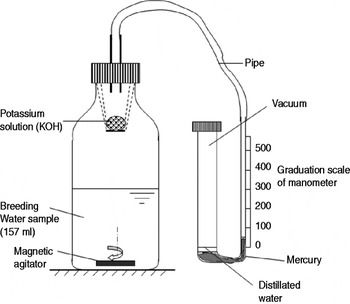
In order to design an optimal rearing food supplement, different quantities of three locally available and cheap foodstuffs, well ground and sieved were given daily to cohorts of larvae reared at optimal density and breeding water size: manufactured human baby food from ground wheat (Bledine®), ground shrimp and ground fish. In addition, a manufactured Baby Fish Food (TetraMin®) was tested as the standard control. The level of breeding water pollution due to food supply was assessed by a respiratory method whose principle is the measurement of biological oxygen demand (BOD) (fig. 1) and by an oxido-reduction method which determines the chemical oxygen demand (COD). The COD is the quantity of oxygen (expressed in mg l−1 of water sample) necessary for chemical oxidation of all organic components (biodegradable or not) and mineral salts. The protocol uses potassium dichromate (K2Cr2O7) in the presence of sulphuric acid (H2SO4). The chlorides are complexed by mercuric sulphate (HgSO2). Both tests were conducted on the same breeding water after eight days of food supply, arbitrarily fixed to coincide with the day of maximum pupation while fed with TetraMin® at optimal conditions. The optimal food diets with the corresponding BOD and COD were determined based on the breeding yield and synchronization induced by each foodstuff. Efficiencies of the different foodstuffs were compared, and then mixtures of these foodstuffs were also assessed. For each experiment, six replicated tests were conducted: a randomly chosen one for the pollution assessment, a second for measurements of the size of larvae on day 5 post-oviposition (i.e. at the stage of young fourth instars, before the start of any pupation process in normal circumstances), the remaining four counterparts for the food quality assays. The yield of growth and development was evaluated based on: (i) the duration of larval stage (which was defined as the time from oviposition till the day of maximum pupation), (ii) the size of day 5 larvae, (iii) the global pupae productivity (i.e. larval survivorship) and the synchronization of pupation (pupation rate on the maximum pupation-day, plus the duration range of pupae occurrence).
The biological oxygen demand analyser (AquaLytic® Model 214). This represents one of the ten mercury manometers of the apparatus. The principle of the BOD analyser is a mercury manometer, which was adjusted to measure the BOD5. The BOD5 is the quantity of oxygen (expressed in mg l−1 of water sample) necessary for microorganisms to consume biological materials in a 157 ml of water sample placed in an incubator for five days at a constant temperature of 20°C. At the top of water sample to be examined is a volume of air containing 21% of O2. This oxygen will progressively replace the dissolved one which is being consumed by microorganisms. It is the reason why the water is continuously turned over by a magnetic agitator during the five days of the experiment. The CO2 formed by the breeding activity of bacteria is removed from the enclosure by three drops of 40% potassium solution (KOH) introduced within the bottle's cover chamber. The drop of pressure due to consumption of oxygen is measured by the mercuric manometer and the value corresponds directly to the BOD5, expressed in mg of O2 per litre of water sample analysed.

The Chi-square test was used to analyse differences in larval mortality and the pupation rate or yield. The Pearson correlation test was used to evaluate the relationship between larval densities and larval size, lifetime and duration range of pupae occurrence. ANOVA analysis of variance was used to assess the difference in the size of larvae and the pupae productivity, between Anopheles populations reared at different densities, in different sizes of habitats, in different levels of water pollution and with different foodstuffs.
Results
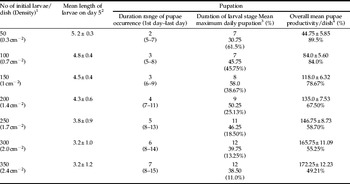
Table 1 shows the relationships between the initial larval density and their growth and development. ANOVA test revealed that the initial larval density significantly affected the pupae productivity (F=31.40, df=6, P<0.001). There was a negative correlation between the density and the size of day 5 larvae (r=−0.685, P<0.0001), with a maximum mean length of 5.2 mm corresponding to the lowest density of 0.3 larve cm−2 surface area and a minimum of 3.2 mm for the highest density of 2.4 larvae cm−2.
Larval breeding yield and synchronization of An. gambiae reared at different densities.

1 The Petri dishes had surface area of 148 cm2 and five trials were conducted for each density (experiment).
2 For each experiment, one of the Petri dishes was devoted to assess the larval growth. The lengths of 30 randomly sorted larvae from this dish were measured on day 5 under stereomicroscope (×60) with micrometer and the size expressed in mm as mean±standard deviation (SD).
3 The duration of larval stage development was arbitrarily defined as the mean time from the oviposition till the day of maximum pupation.
4 The remaining four Petri dishes were monitored for pupation and the average number of pupae occurred per dish expressed as mean±SD.
A consistent lengthening of the mean larval development period from seven to 12 days with increasing density was observed (r=+0.971, P<0.01) and was associated to a reduction of the percentage of pupae produced per dish, which also means an increase in the mortality rates (Chi2=353.72, df=6, P<10−8). A slight increase in the larval density produced a large negative change in the developmental yield. However, beyond the threshold density of 2.0 cm−2 surface area, two asymptotic values were recorded, a lower limit of day 5 larval size equal to 3.2 mm and an upper limit of larval stage lifetime of 12 days.
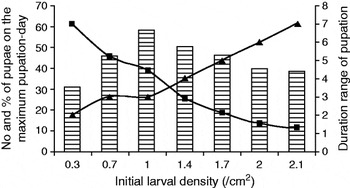
There was an increase of the duration range of pupae occurrence from two to seven days, with increasing density (r=+0.986, P<0.01). The optimal density of larvae, i.e. which induced the shortest duration range of pupation (the best synchronization of development) with the highest number (as well as percentage) of pupae on the maximum pupation-day, was determined to be 150 larvae per dish corresponding to ≈1 cm−2. At this density, the maximum daily output per dish was 58 (38.67%) pupae on day 8 and the global productivity per dish was 118 (78.67%) pupae, within an overall duration range of three days for pupae occurrence. In fact, there was an increase of pupae occurrence on the maximum pupation-day with increasing density, up to a critical density-dependent mortality point of 1.0 cm−2 surface area, beyond which a decrease in the daily production was observed (fig. 2).
Relationship between the initial larval density and the synchronisation of pupation. The optimal larval density that produced the highest number of pupae per dish on the maximum pupation-day within the shortest duration range of pupae occurrence was ≈1 cm−2 surface area. ( ) , Number of pupae on the maximum pupation-day; ▲, duration range of pupation in days; ▪, percentage of pupae occurred on the maximum pupation-day).

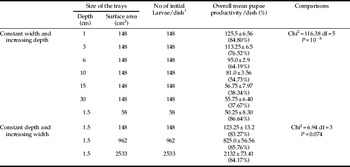
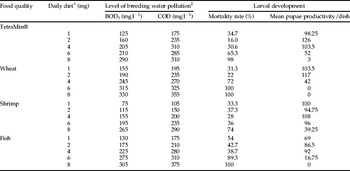
Table 2 shows the relationships between the size of larval breeding habitat (depth and surface area) and the developmental yield. Dishes with 1 and 3 cm water depth had pupation rates of 84.80% and 76.52%, respectively, while less than half of the first instars could reach the pupae stage in habitats beyond 15 cm deep. Thus, shallow breeding water exhibited a significantly higher pupae production compared to deeper ones (Chi2=116.38, df=5, P=10−8). Large and small breeding water surface area had all very good pupation yield at optimal larval density and the same 1.5 cm depth, and the difference was not significant (Chi2=6.94, df=3, P=0.074). Table 3 gives the relationship between the amount of each foodstuff provided and larval developmental yield. Based on the pupae productivity induced by each food, the optimal daily diet was determined to be 2 mg for TetraMin®, 2 mg for ground wheat, 4 mg for ground shrimp and 4 mg for ground fish. Sub-optimal diets resulted in low yield and asynchronous growth, while overfeeding improved the larval development for the start but quickly speeded up the water pollution and enhanced the larval mortality, especially outstanding for fish and wheat. The level of water pollution reached after eight days of optimal feeding ranged between 155 and 225 mg l−1 for BOD and 200–280 mg l−1 for COD. Increasing the daily food supply also increased these values, up to a critical limit above which a reduction of the pupae productivity was observed. It was noted that BOD above 305 mg l−1 associated with a COD of at least 325 mg l−1 could be sufficient conditions for 100% mortality of larvae.
Larval development yield of An. gambiae in breeding sites of different sizes.

1 The larvae were reared at optimal density and 4 trials were conducted for each experiment. The four counterparts of an experiment were monitored for pupae productivity and the average number of pupae occurred per dish was expressed as mean±SD.
Larval breeding yield in highland populations of An. gambiae at optimal density and increasing food ration supply.

1 For each experiment 148 first instars were put into Petri dishes of 148 cm2 surface area and four trials were monitored for pupation.
2 The breeding water was collected after eight days of feeding post-oviposition from a fifth simultaneous trial, devoted to the biological oxygen demand (BOD) and the chemical oxygen demand (COD) measurements to evaluate the level of pollution.
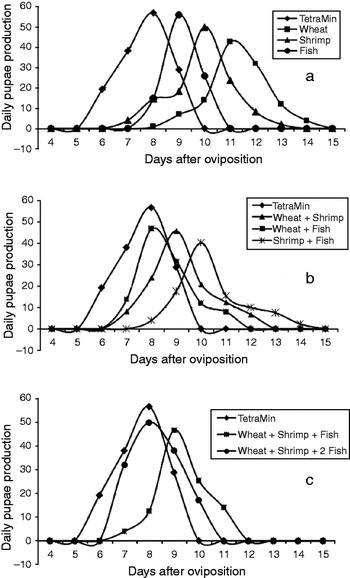
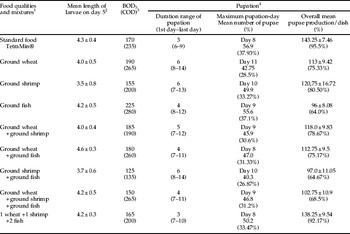
Using the optimal larval density and the optimal daily diet of each foodstuff, comparisons were made to select the food candidate for the substitution of TetraMin® among the ground wheat, the ground shrimp and the ground fish (table 4). With the human baby food from wheat (Bledine®), the speed of growth was normal during the first days and the mean size of day 5 larvae was almost similar to that of those fed on the standard TetraMin®. This growth was later slowed down, since the pupation process was finally delayed to 11 days and the duration range of pupae occurrence extended to six days. A striking observation here is that the breeding water had a physical cloudy feature during the second week. The highest pupae production among the candidates was 120.75 (80.50%) per dish and was obtained with shrimp. In addition to this good performance of shrimp, the BOD and COD indicated the lowest level for the breeding water pollution, 155 mg l−1 and 200 mg l−1, respectively. However, the speed of larval growth was low. Consequently, the mean day 5 larval size was the smallest (3.5 mm) and the mean duration of larval stage lengthened to ten days. The development was heterogeneous (asynchronous), as indicated by the highest standard deviation of the mean size 3.5±0.8 mm and the widest duration range of six days for pupae occurrence. When larvae were nourished exclusively with fish, their growth was faster and completed within nine days, the fourth instars having the biggest average size of 4.2 mm. The pupation was well synchronized, with the highest number of pupae on the maximum pupation-day equal to 55.6 (37.1%), and their occurrence was completed within a range of four days. Nevertheless, the mortality rate was high (36.0%). Figure 3a shows the kinetics of pupation when larvae were fed on either wheat, shrimp or fish, compared to the standard TetraMin® as the positive control. There was a better synchronization of larval development and an early occurrence of pupae in batches feeding on fish, followed by dishes receiving the ground shrimp and lastly the wheat. Although fish induced the highest peak production of pupae, water pollution and, subsequent, mortality discarded its possibility to replace TetraMin® solely.
Kinetics of pupae production in relation to the quality of food supplied to larvae. The weighed mixture of 1 wheat+1 shrimp+2 fish had a comparable pupae production yield, kinetic and synchronization with the standard baby fish food and was recommended for use in absence of the TetraMin®.

Larval breeding yield in highland populations of An. gambiae induced by various foodstuffs and their mixtures at optimal density and diet.

1 The Petri dishes had surface area of 148 cm2 and six trials were monitored for each experiment (food quality).
2 A first one was devoted to estimate the larval growth. Thirty randomly sorted larvae from this dish were measured on day 5 post-oviposition under stereomicroscope (×60) with micrometer and the size expressed as mean±SD (in mm).
3 The second trial aimed to assess the level of pollution by the food offered. The breeding water was collected on day 8 post-oviposition, and then two samples were used to evaluate the level of pollution: one of 157 ml introduced in the biological oxygen demand (BOD) analyser apparatus incubated at 20°C during five days to determine the BOD5, and another of 2 ml for the chemical oxygen demand (COD) measurements.
4 The remaining four trials were assigned to evaluate the larval development and synchronization.
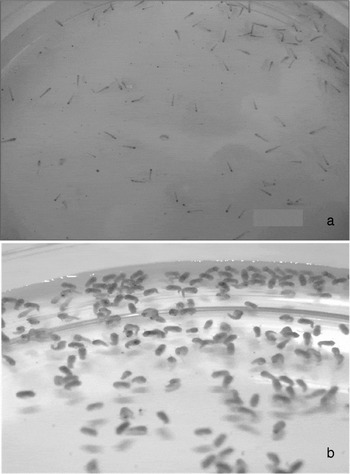
Because of deficiencies and discrepancies arising from each of the foodstuffs when supplied solely, combinations of the different food qualities were offered to larvae. Mixing two of the three stuffs at equal weight slightly reduced the developmental duration period, but not up to a satisfactory level (fig. 3b). The rate of pupae obtained on the maximum pupation-day (peak production) and the duration range of pupae occurrence (synchronization) obtained here were still significantly different from those fed on TetraMin® (P<0.05 for the three mixtures). Combination of wheat with either shrimp or fish yielded almost the same peak of daily pupae production 45.9 (30.6%) and 47.0 (31.33%), respectively (Chi2=0.06, P>0.80) and were preferable to shrimp+fish as far as the size of larvae, the duration of larval development and the synchronization were concerned (table 4). A very good yield close to the standard control was finally obtained by increasing the ratio of fish in the mixture of the three as follows: 1 wheat+1 shrimp+2 fish (fig. 3c). This combination, yielded almost the same overall pupae productivity with the standard control, 138.25 (92.17%) and 143.25 (95.5%) pupae, respectively (Chi2=5.76, P=0.016). In addition, it has brought down the larval stage lifetime to eight days and improved the synchronization of pupation to a duration range of three days like TetraMin®, with comparable maximum daily pupation of 50.2 (33.47%) and 56.9 (37.93%), respectively (Chi2=2.64, P=0.104). Figure 4 shows the visual feature of the last immature stages of Anopheles gambiae in the laboratory when all parameters are adjusted to their optimal values: the fourth instars larvae (fig. 4a) and the harvested pupae (fig. 4b).
Visual feature of the last immature stages of Anopheles gambiae in the laboratory. When all parameters are adjusted to their optimal values, larval growth is synchronized; their density is as shown here, and the water is not polluted before the pupation process. (a) Shows the fourth instars larvae, and (b) shows the harvested pupae.

Discussion and conclusion
The various parameters analysed in this study have shown optimal value ranges and enabled a better understanding of the environmental and nutritional needs of the highland strains of Anopheles gambiae.
Influence of larval density
The optimal density of larvae, herein defined as the value that produced the greatest pupation yield and the highest level of synchronization of development, was found to be ≈1 cm−2 surface area. Adopting this optimal density resulted in a healthier, more synchronized and more productive colony. Because space management in a laboratory is always a worry, it was necessary to determine this value in order to reduce the space occupied by trays in our newly created laboratory, without hindering the synchronization of larval development and the pupae productivity. As many other animal species, An. gambiae exhibited some growth disturbances in relation to population density at the larval stages. Thus, larval densities below 1 cm−2 surface area induced very good pupae synchronization and productivity, while their counterparts, reared at higher densities, presented asynchronous development, smaller size, extended development time and decreasing production yield, probably as a consequence of intraspecific competition. Similar results were reported in overcrowded larval culture of An. stephensi (Reisen, Reference Reisen1975), Culex (Reisen et al., Reference Reisen, Milby and Bock1984) and Aedes (Hawley, Reference Hawley1985), although the effects of intraspecific competition on the fitness seemed to be minimized for the Culicine mosquitoes. In fact, within this genus, the specific cost incurred by competition is expressed differently by the two sexes, each sex maintaining the more important life-history traits for its fitness (developmental time for males, and body weight and size for females) at the expense of other traits (Bedhomme et al., Reference Bedhomme, Agnew, Sidobre and Michalakis2003).
In their laboratory study aiming to unveil the disadvantage of being small on the gonotrophic cycle, Takken et al. (Reference Takken, Klowden and Chambers1998) were able to produce large and small mosquitoes by rearing the small mosquitoes at densities eight times those of the large ones and by giving the smaller ones less food per larva. In the current study, the quantity of food was not adjusted to larval density like Suleman (Reference Suleman1982) and Takken et al. (Reference Takken, Klowden and Chambers1998) did, but to the volume of water (with special attention to the pollution level), and enough was provided for the various larval densities. Seven different densities, ranging between 0.3 and 2.4 larvae cm−2 surface area, were tested and indicated that even with enough food, competitive interactions took place at high density, probably for space. Also, in artificial field habitats designed by Gimnig et al. (Reference Gimnig, Ombok, Otieno, Kaufman, Vulule and Walker2002), An. gambiae larvae responded to crowding by extending their development time and emerging as smaller adults; but their survivorship was not affected by the density of larvae. Herein, hindering effects of increasing density on larval development were observed in the laboratory as well, although the size was assessed differently (length instead of weight) and on a different stage (living fourth instars instead of the dead dry imagos). In addition and contrary to Gimnig et al. (Reference Gimnig, Ombok, Otieno, Kaufman, Vulule and Walker2002), survivorship decreased at higher densities as also mentioned by Schneider et al. (Reference Schneider, Takken and McCall2000). In fact, survivorship could not have been significantly affected in the field study of Gimnig et al. (Reference Gimnig, Ombok, Otieno, Kaufman, Vulule and Walker2002), since the highest density he assessed was far below those tested in this laboratory study. Similar observations to ours were reported in a study on another genus conducted by Mercer (Reference Mercer1999), where both laboratory and wild Aedes polynesiensis were investigated. This author pointed out that when larval density was high, adult dry weight and pupae survival were significantly reduced and development time was significantly prolonged. Increase in mortality rate with density means a reduction of the global pupae productivity and a decrease in the number of larvae that pupated on the maximum pupation-day. However, the global pupae production and the daily pupation peak (synchronization) are both desirable outcomes in laboratory culture of mosquitoes and the most important parameters to assess the breeding output. Whatever the density, the minimum larval size on day 5 was 3.2 mm and the maximum elongation of the development period was 12 days. Both asymptotic values corresponded to the same threshold density of 2.0 cm−2 surface area, which obviously was not far from the optimal value. Indeed, the larval density is a very sensitive parameter in anopheline rearing, since a slight increase in the density produced a great negative change in the breeding output. It is likely that metabolic by-products of growth in anopheline mosquito larvae suppress the development of the other larvae, giving rise to intraspecific competition for space, a bio-ecological hindering mechanism which can be regulated by the presence of phytoplankton as mentioned by Tuno et al. (Reference Tuno, Githeko, Nakayama, Minakawa, Takagi and Yan2006). The conclusion drawn is that An. gambiae's larval growth, survival and development synchronization are density dependent, and the species responds to intraspecific competition by producing smaller and asynchronous fourth instars, as well as fewer pupae, over elongated immature lifetime and duration range of pupae occurrence.
Influence of larval breeding site size
No effect of the absolute surface area of the trays on larval development was observed, probably because climatic conditions were stabilized in the laboratory and food provisions were guaranteed. The surface area of trays should, therefore, be adjusted to the space and shape available in the laboratory, for a better management of the horizontal space, as long as the optimal larval density per surface area is maintained. Logically, it is likely that, in the field, the breeding site expanse influences the amount of natural food that randomly falls into the biotope, the level at which mosquito breeding habitats suffers from environmental climate changes and, therefore, has an impact on larval growth. Surprisingly, it has been observed in the field that breeding site surface areas are negatively correlated with the occurrence of An. gambiae larvae (Himeidan et al., Reference Himeidan, Zhou, Yakob, Afrane, Munga, Atieli, El-Rayah, Githeko and Yan2009). Even during extended dry periods, small breeding sites are more commonly colonized by Anopheles than large drains and swamps, which are associated with no or low larvae density (Sattler et al., Reference Sattler, Mtasiwa, Kiama, Premji, Tanner, Killeen and Lengeler2005). Therefore, an unknown but very striking factor drives the choice of breeding sites (in terms of the size of absolute surface area) by gravid female An. gambiae in the field.
Since anophelines feed primarily at the water surface, foods that float are ideal. Nevertheless, a substantial amount of food eventually settles at the bottom where microbial growth (also necessary for larval nutrition) is promoted. The shallower the water is, the easier it is for larvae to access these microbes. The significant difference in development yield observed between batches of Anopheles reared in habitats with different depths, highlights the importance of diving behaviour for anophelines. In fact, diving enables them in their natural habitats to have access to atmospheric air (the main reason why they usually live near the surface), to search for food floating on the surface or accumulated at the bottom of the breeding water, to avoid predators, to avoid mechanical shock of a direct hit by a rain drop or any other object, and probably to prevent being washed away from the container habitats by overflowing water. However, the necessity to move between the surface and the bottom becomes a vital constraint and a limiting factor for larval development if the water is too deep. This is in agreement with Timmerman & Briegel (Reference Timmerman and Briegel1993) and Tuno et al. (Reference Tuno, Miki, Minakawa, Githeko, Yan and Takagi2004), who had previously suggested that larval diving behaviour may offer the benefits of food acquisition and predator avoidance, but it also incurs energetic costs and increases mortality. The quantity of energy required for diving is even higher for pupae compared to larvae as mentioned by Lucas & Romoser (Reference Lucas and Romoser2001), since the former always contains some air trapped in the inner space provided for the development of wings and mouth parts, which reduces the density of pupae and increases their buoyancy capacity (Remoser, Reference Remoser1975). Fortunately, An. gambiae pupae have a short lifespan (24 to 36 h) and do not feed (Clements, Reference Clements2000). Thus, we did not attempt to clarify the effect of water depth on pupae in this study. The depth of laboratory breeding water should, therefore, be less than 3 cm, for better management of the vertical space available on the shelves and maximal pupae productivity.
Obviously, the volume of natural larval breeding habitats can also indirectly affect the development of immature stages via other parameters like the water temperature (Bayoh & Linsay, Reference Bayoh and Lindsay2003), the breeding habitat stability (Minakawa et al., Reference Minakawa, Sonye and Yan2005; Himeidan et al., Reference Himeidan, Zhou, Yakob, Afrane, Munga, Atieli, El-Rayah, Githeko and Yan2009) and the sunny status (Gillies & De Meillon, Reference Gillies and De Meillon1968; Clements, Reference Clements2000). In that respect, shallow habitats may be more suitable for development of immature stages in the field. The question raised by Tuno et al. (Reference Tuno, Miki, Minakawa, Githeko, Yan and Takagi2004) on whether or not female anophelines could detect water depth and, thereby, avoid laying eggs in deep breeding habitats is emphasized.
Influence of larval diet
Analysis of the effects of water pollution (in relation to food supplementation) on larval development indicated the optimal BOD and COD for An. gambiae, to be ranged from 155 to 225 mg l−1 and from 200 to 280 mg l−1, respectively. Increasing the daily food supply bridged the gap of dietary restriction and improved the pupae productivity, but also increased the water pollution, up to a limit (depending on the food quality), above which a rapid increase in larval mortality was recorded. BOD above 305 mg l−1 associated with a COD of at least 325mg l−1 could be sufficient conditions for 100% mortality of larvae. Reisen et al. (Reference Reisen, Milby and Bock1984) illustrated the relationship between concentration of food and larval development of Culex and did not find such a narrow and compulsive relationship. Herein, we argue that in anopheline breeding, larval diet should be measured and the ratio linked instead with the volume of rearing water (i.e. the pollution level) rather than with the number of larvae. In fact, in natural anopheline breeding sites, a sensitive and critical equilibrium must always be established (for the pupation process to occur) between the availability of food constituted by suspended and sedimented matters, algae and other microorganisms (which must be present in enough quantity for a normal growth), and the level of water pollution. This level should remain below a certain limit to avoid massive precocious larval death. It is probably to avoid this pollution-related mortality that An. gambiae prefers water with fewer impurities for oviposition (Munga et al., Reference Munga, Minakawa, Zhou, Barrack, Githeko and Yan2005). This quality of habitat may not always be easy to find in tropical areas, though An. gambiae s.l. is broadly distributed across a variety of habitat types (Gillies & De Meillon, Reference Gillies and De Meillon1968; Fillinger et al., Reference Fillinger, Sonye, Killeen, Knols and Becker2004). Indeed, An. gambiae s.l. might have a great adaptive plasticity in the field that leads to acquisition of tolerance to highly organically polluted habitats and which is necessary to survive even across extended dry period (Sattler et al., Reference Sattler, Mtasiwa, Kiama, Premji, Tanner, Killeen and Lengeler2005). It should, therefore, be interesting to study how gravid females detect the convenient breeding sites in terms of food provision and pollution level.
Not only is the quantity of food relevant, but its nutritional quality is also of significant importance; and, according to McCay et al. (Reference McCay, Crowell and Maynard1989), even more than the quantity. In most laboratories, manufactured baby fish foods were adapted successfully due to their high nutritive quality that enables completion of the larval development before the breeding water reaches the upper limit of pollution bore by anopheline larvae. However, because of their expensive prices and purchasing constraints, an alternative foodstuff was required for developing countries. Among the three foodstuff tested, none could solely replace TetraMin®. Feeding larvae with wheat powder revealed that this food was rich in growth nutrients but lacked elements required for pupation process. Conversely, shrimps had a boosting effect on the pupation process and a slowing down action both on water pollution and larval growth. A better development was recorded with fish, in terms of growth, pupation process and synchronization, though a meticulous observation showed that the air-water interface was covered with foam (oil extract from fish) which could be the cause of the high larval mortality by drowning. Nevertheless, it was obvious that diet enriched in protein was appropriate for anopheline larval culture. The mixture of wheat with either shrimp or fish was preferable to shrimp+fish for their yields, which were closer to that of TetraMin® in terms of pupae production and synchronization. Apparently, mosquito larvae require carbohydrates (found in the wheat), proteins and vitamins (found in fish) for their growth, but they lack enzyme for digestion of the arthropod chitin. After testing different mixtures, the combination of weighed 1 wheat+1 shrimp+2 fish gave the best pupae production yield, kinetic and synchronization, and was recommended for use in absence of TetraMin®.
Figure 4 is the result of optimal breeding and should serve as a tool for teaching and training purposes of those interested in mosquito domestication and breeding. In fact, during routine processes of mosquito rearing, eggs and first instars are not counted before being soaked in the breeding water, but are appreciated visually by the technicians. To acquire this skill, they must have such a picture at their disposal. They also need such pictures to train others.
Acknowledgements
We are very grateful to OCEAC and the Faculty of Sciences of University of Yaounde I, for the fruitful collaborations through the laboratory facilities placed at our disposal, as well as their technical assistance. The study was initiated within the framework of the ‘Jeunes Equipes Associées IRD’ programme (JEAI), with award from the Institut de Recherche pour le Développement en cooperation (IRD) and from the Agence Universitaire de la Francophonie programme (PAS2002-AUF). This investigation received financial support under the Multilateral Initiative on Malaria (MIM) project A50085 through the UNICEF/UNDP/World Bank/WHO Special Programme for Research and Training in Tropical Diseases (TDR).