An enduring issue in research on bilingual acquisition is the extent to which a speaker's linguistic systems overlap. That is, does the acquisition of one language influence the acquisition of the other, and under what conditions does this cross-linguistic influence occur? Although it is generally accepted that bilingual children distinguish between their input languages very early in development, several domains and acquisition contexts make bilingual children vulnerable to cross-linguistic influence. For instance, the Interface Hypothesis (Sorace & Filiaci, Reference Sorace and Filiaci2006) as it is applied to bilingual acquisition predicts that bilingual children are particularly vulnerable at the syntax-pragmatics interface. Several studies support this prediction (see Serratrice, Reference Serratrice2013). Crosslinguistic influence has also been observed within domains. In the current paper we report on an experimental study of relative clause comprehension in Cantonese–English bilingual children, and demonstrate a specific case of crosslinguistic influence in the syntactic domain.
Müller (Reference Müller1998) argued that transfer occurs in the syntactic domain in instances where the learner is confronted with ambiguous input. Specifically, if a structure X in language A has multiple structural analyses, but in language B the structure matches only one of these possible analyses, then crosslinguistic influence from language B to A is likely. Döpke (Reference Döpke1998, Reference Döpke2000) reported several instances of crosslinguistic influence in the naturalistic speech of English–German bilinguals which support this prediction. For instance, the children passed through a stage in which they appeared to use an English-like structural template to produce German complex verb constructions, placing non-finite verbs before their complements rather than after them (e.g., *ich möchte tragen dich → “I want to carry you”). Whereas verb placement in German differs from main (V2) to subordinate clauses (verb-final), the English pattern is (largely) invariant and therefore predictable. This appeared to promote an English-like strategy as a temporary solution to the ambiguity posed by German. Crosslinguistic influence has also been observed in experimental contexts. Foroodi-Nejad and Paradis (Reference Foroodi-Nejad and Paradis2009) reported that 4-year-old Persian–English bilingual children produced more right-headed novel noun-noun (N-N) compounds in Persian than did Persian-speaking monolingual children, a result likely due to the fact that English only allows this option. Such transfer depended on dominance, such that Persian-dominant bilingual children were less likely to produce right-headed compounds than were English-dominant bilinguals.
Research on adult bilinguals suggests that surface structure overlap is one key predictor of representational integration of grammatical structures across languages. Specifically, results from the structural priming literature show between-language priming in bilinguals in instances where prime and target structure overlap in word order. For instance, Hartsuiker, Pickering and Veltkamp (Reference Hartsuiker, Pickering and Veltkamp2004) reported Spanish to English priming of the passive (e.g., El coche es perseguido por el perro ‘the car is chased by the dog’ primed The frog is kissed by the princess). Bernolet, Hartsuiker, and Pickering (Reference Bernolet, Hartsuiker and Pickering2007) showed that Dutch relative clause structures (e.g., de baby die groen is, “The baby that is green”) primed the German (e.g., der Hai der rot ist, “The shark that is red”) but not the English translational equivalent, a finding that can be attributed to word order overlap between Dutch and German. These results are consistent with psycholinguistic models of language production that posit shared syntactic representations between languages in instances of word order overlap (e.g., Hartsuiker & Pickering, Reference Hartsuiker and Pickering2008; Meijer & Fox Tree, Reference Meijer and Fox Tree2003). Such effects have also been observed in acquisition studies. Vasilyeva, Waterfall, Gámez, Gómez, Bowers, and Shimpi (Reference Vasilyeva, Waterfall, Gamez, Gomez, Bowers and Shimpi2010) reported priming of the passive from Spanish to English (but not vice-versa) effects in Spanish–English bilingual children aged 5–6.
The Competition Model provides a unified framework to jointly consider acquisition and processing across a range of acquisition contexts (e.g., monolingual, bilingual, L2 acquisition – Bates & MacWhinney, Reference Bates, MacWhinney, Wanner and Gleitman1982, MacWhinney, Reference MacWhinney, Gass and Mackey2012). The approach assumes direct mapping from surface form to function on the basis of the coordination of multiple cues to interpretation (e.g., pre-verbal nouns are a reliable cue to ‘agenthood’ in languages like English). Where structures in two languages share formal and functional overlap those structures will be representationally integrated and processed using the same set of cues. The degree of crosslinguistic influence directly varies with dominance: cue strengths from a speaker's dominant language are used to process their weaker language until either greater balance is achieved or cue strengths across both languages are amalgamated (MacWhinney, Reference MacWhinney, Kroll and DeGroot2005).
In the current paper we explore cross-linguistic influence in 5- to 11-year-old simultaneous Cantonese–English bilingual children's comprehension of relative clauses (RCs). These two languages are not genetically related and have typologically distinct relativisation strategies. At the same time, surface structure similarities between the two languages suggest conditions conducive to crosslinguistic transfer. This combination makes the two languages a good case study to test the nature and limits of crosslinguistic influence in acquisition. We next outline the RCs in Cantonese and English, and review the past research on their acquisition in Cantonese–English bilingual children.
Relative clauses in Cantonese and English
Both English and Cantonese have SVO canonical word order. Whereas English follows most SVO languages in having post-nominal RCs, Cantonese RCs are pre-nominal. Consider the English subject and object RCs in (1) and (2), and their Cantonese equivalents in (3) and (4).
-
(1) The mouse [that__kisses the chicken]
-
(2) The chicken [that the mouse kisses__]
-
(3) Sek3 gung1gai1 go2 zek3 lou5syu2
[__ kiss chicken] that CL mouse
‘The mouse that kisses the chicken
-
(4) Lou5syu2 sek3 go2 zek3 gung1gai1
[mouse kiss __] that CL chicken
‘The chicken that the mouse kisses’
Sentences (1) and (3) are subject RCs, so-called because the head noun “the mouse” occupies the subject role in the RC, as denoted by the underscore gap. Sentences (2) and (4) are object relatives; the head noun occupies the object role in the RC. Sentences (3) and (4) are Cantonese classifier relatives (Matthews & Yip, Reference Matthews, Yip and Chappell2001), so-called because they are characterized by the demonstrative go2 and an appropriate classifier (CL) before the head noun. Classifier RCs (henceforth CL-RCs) are most common in spoken Cantonese, and can therefore be considered informal in register. Cantonese also has a more formal relativisation strategy, in which the particle ge3 is used to link a head noun to a modifying clause, as shown in (5), a formal version of (3).
-
(5) Sek3 gung1gai1 ge3 lou5syu2
[__ kiss chicken] PRT mouse
‘The mouse that kisses the chicken’
Formality notwithstanding, CL and ge3 RCs can be used interchangeably in many instances, but do differ subtly in meaning. Whereas CL-RCs entail specific reference, ge3 RCs do not. For instance, the ge3 RC example in (6) could be construed as quantifying over a set of entities, allowing both singular and plural readings of the head. In contrast, the comparable CL-RC in (7) modifies a specific referent (i.e., candy).
-
(6) keoi5 sik6 ge3 tong2
[s/he eat __] prt candy
‘the cand(ies) s/he eats’
-
(7) keoi5 sik6 go2 lap1 tong2
[s/he eat __] that CL candy
‘the candy s/he eats’
The combination of SVO word order and pre-nominal RCs found in Cantonese is typologically rare: in Dryer's (Reference Dryer, Haspelmath, Dryer, Gil and Comrie2013) survey of 879 languages only 5 show this pattern. The contrast between Cantonese and English bears on two important issues in acquisition. Firstly and most centrally to the current paper, the overlap in the canonical word order of the two languages combined with their different relativisation strategies potentially leads to an interesting case of crosslinguistic influence in bilingual development. Secondly, and more broadly, a comparison of acquisition of RCs in the two languages forces us to seriously consider how typological diversity bears upon our theories of acquisition (Kidd, Reference Kidd2011; Yip & Matthews, Reference Yip and Matthews2007a).
Yip and Matthews (Reference Yip and Matthews2007a) reported on diary studies of three siblings which investigated the acquisition of RCs in three Cantonese–English bilingual children (for a preliminary report, see Yip & Matthews, Reference Yip and Matthews2000). All three children were Cantonese-dominant, and all three made the same error during the early stages of English RC acquisition. Specifically, the children passed through a stage in which they used the Cantonese pre-nominal relativisation strategy to form RCs in English, as shown in (8)–(10) (from Yip & Matthews, Reference Yip and Matthews2007a).
-
(8) Where's the Santa Claus give me the gun?
[lit. ‘Where's the gun Santa Claus gave me?’] (Timmy 2;07;05)
-
(9) I want Pet-Pet buy that one videotape
[lit. ‘I want the videotape that Pet-Pet bought’] (Timmy 2;11;25)
-
(10) Daddy, where is that blue bag? My . . .me make that one?
[lit. ‘the one that I made’] (Alicia 3;05;06)
With few exceptions, the children's English pre-nominal RCs were object extracted. There was no influence from English to Cantonese: that is, the children produced no post-nominal Cantonese RCs, which Yip and Matthews (Reference Yip and Matthews2007a) attributed to the fact that the children were all Cantonese-dominant. The use of prenominal English RCs was further explained by appealing to structural overlap between Cantonese object RCs and SVO word order. Cantonese object RCs follow canonical SVO word order, as in (11), whereas subject RCs have non-canonical VOS word order (12).
-
(11) Lou5syu2 sek3 go2 zek3 gung1gai1
[mouseSUBJ kissVERB __] that CL chickenOBJ.
‘The chicken that the mouse kisses’
-
(12) Sek3 gung1gai1 go2 zek3 lou5syu2
[kissVERB chickenOBJ __] that CL mouseSUBJ
‘The mouse that kisses the chicken’
An important structural characteristic of Cantonese object classifier relatives is that they resemble a simple SVO main clause. The object relative in (11) is identical, at least superficially, to a transitive main clause as in (13).
-
(13) [S Lou5syu2 sek3 go2 zek3 gung1gai1]
mouse kiss that CL chicken
‘The mouse kisses that chicken’
The isomorphism between Cantonese object classifier RCs and simple transitive sentences raises the possibility that Cantonese-speaking children acquire object RCs by bootstrapping from simple transitives (see also Chan, Matthews & Yip Reference Chan, Matthews, Yip and Kidd2011). The opposite case has been argued for English, where subject RCs follow canonical SVO word order (Diessel & Tomasello, Reference Diessel and Tomasello2000; Reference Diessel and Tomasello2005; for comparison between European and East Asian languages, see Diessel, Reference Diessel2007). Thus Yip and Matthews (Reference Yip and Matthews2007a) argued that the children in their study transferred a well-attested Cantonese structural pattern and used it for the same function in English. This analysis is supported by the fact that all three children almost exclusively produced CL-RCs in the early stages of Cantonese acquisition. The suggestion is that children may have processed the sentences as internally-headed RCs (Keenan, Reference Keenan and Shopen1985); that is, as having the internal structure of an SVO clause, but the external syntax of an NP. On this analysis, the object NP is located in situ, as in (14).
-
(14)


The acquisition of RCs may be further eased by an additional typological feature of Cantonese. Like many Asian languages Cantonese has a productive noun-modifying construction that is formally similar to RCs (Comrie, Reference Comrie, Boeder, Schroeder, Wagner and Wildgen1998, Reference Comrie and Ramat2002). Consider (15), from Yip and Matthews (Reference Yip and Matthews2007a).
-
(15)

Alicia's early production in (15) shares surface similarities with the object CL-RC in (14), but contains the adjective sai3 (‘small’) where a RC could be.Footnote 1 In many instances it is very difficult to distinguish between such nominalisation constructions and RCs. Consider (16).
-
(16)

Sentence (16) could be loosely glossed as the shoes I wear to school; however, the head noun haai4 (‘shoes’) does not serve as an argument of the verb faan1 [‘go (to school)’]; the two instead stand in a pragmatic relation to each other. Mandarin, Japanese and Korean have similar noun modifying constructions. The argument here is that RCs in Cantonese are one instance of a broad nominalisation strategy where a modifier varies in the degree to which it is “clause-like” (for a discussion based on a larger set of languages, see Shibatani, Reference Shibatani, Givón and Shibatani2009).
These typological issues have direct bearing on issues of crosslinguistic influence in Cantonese–English bilinguals. Yip and Matthews (Reference Yip and Matthews2007a) point out that, whereas Cantonese noun modifying constructions are always head-final, noun modification in English can be either head-initial or head-final (e.g., the cup that's green vs. the green cup). Since their children were all Cantonese-dominant, such input ambiguity may have provided optimal conditions for cross-linguistic influence: the well-attested and early acquired Cantonese noun modification construction provides a pathway to the acquisition of RCs (Chan et al., Reference Chan, Matthews, Yip and Kidd2011), and the fact that all noun modification in Cantonese is head-final provides children with a consistent model. On the other hand, English provides inconsistent evidence regarding the placement of heads and modifiers, which appears to have led children to invest in the pre-nominal modification pattern (the most reliable in the input). Thus it is possible that transfer from Cantonese resulted from the combined influence of a number of factors: (i) Cantonese dominance; (ii) a complex case of input ambiguity for the bilinguals favouring transfer of prenominal modification from Cantonese; and (iii) the overlap between simple SVO sentences and prenominal object RCs, favouring production of prenominal object relative clauses in both languages.
The current study
Yip and Matthews (Reference Yip and Matthews2007a) observed crosslinguistic influence from Cantonese to English in three Cantonese-dominant children during the early stages of English acquisition. In the current study we investigated whether cross-linguistic influence occurs in a group of simultaneous Cantonese–English bilinguals living in an English-speaking country. Specifically, we ask whether overlap between the simple SVO transitive construction in both Cantonese and English influences the children's comprehension of CL- and ge3-RCs.
Yip and Matthews (Reference Yip and Matthews2007a) observed positive influence from Cantonese to English; that is, the overlap between Cantonese and English SVO word order and prenominal object RCs favour transfer of prenominal RCs (a Cantonese relativisation strategy) as a temporary solution to relativisation in English. In the current study we hypothesised that English proficiency would also result in negative effects on Cantonese comprehension in instances where test sentences contain surface structures that are compatible with more than one analysis (MacWhinney, Reference MacWhinney, Kroll and DeGroot2005; Müller, Reference Müller1998). Specifically, we hypothesised that the overlap in surface structure between Cantonese object RCs and both English and Cantonese SVO word order would result in more errors in comprehension of Cantonese object RCs relative to their monolingual peers because the combination of strong preferences for SVO in both languages would compete with the object RC analysis. Furthermore, following arguments made by both Yip and Matthews (Reference Yip and Matthews2007b) and Chan et al. (Reference Chan, Matthews, Yip and Kidd2011), we expected the effect to be most pronounced in the case of the CL-RCs, due to the aforementioned isomorphism between object CL-RCs and SVO clauses, which increases structural ambiguity. In contrast, we hypothesised that there would be less negative crosslinguistic influence for ge3 object RCs. While ge object RCs also have SVO word order, the presence of the ge relative marker serves as a useful cue for learners to identify the structure as a RC. As for Cantonese subject RCs, since they are VOS in surface form [see example (12)] which, unlike Cantonese object RCs, does not align and overlap saliently with an alternative construction in English, we predicted no negative influence for either CL or ge subject RCsFootnote 2 . Finally, we tested whether transfer was affected by dominance.
We compared the bilingual children to monolingual Cantonese-speaking children. There has been no published research on monolingual Cantonese RC acquisition, and reports in the literature suggest an inconsistent pattern of results regarding the relative complexity of subject- and object-extracted RCs (for review, see Chan et al., Reference Chan, Matthews, Yip and Kidd2011). Theories of syntactic acquisition make diverging predictions for Cantonese. Structurally-oriented approaches predict a subject advantage since object RCs are assumed to have a greater degree of structural distance between filler and gap than do subject RCs and are therefore considered more complex (e.g., O’Grady, Lee & Choo, Reference O’Grady, Lee and Choo2003). However, acquisition theories that conceptualise complexity as the outcome of multiple constraints on linear ordering, including the linear distance between filler and gap (e.g., O’Grady, Reference O’Grady and Kidd2011) and similarity of structures to (frequent) canonical word order (e.g., Diessel & Tomasello, Reference Diessel and Tomasello2005), predict either no asymmetry or an object advantage. The inclusion of a monolingual Cantonese-speaking group allowed us to test these competing predictions.Footnote 3
Method
Participants
Forty (N = 40) children participated. Twenty (N = 20, 12 females) simultaneous Cantonese–English bilingual children were recruited through Chinese language schools, churches, and personal contacts in a medium-sized city in Australia. None had any significant exposure to languages other than Cantonese and English. Twenty (N = 20, 10 females) monolingual Cantonese-speaking children, who were recruited from a primary school in Hong Kong, served as a comparison group. All children in the monolingual group were born in Hong Kong, spoke Cantonese at home, with the primary language of instruction at school being Cantonese. The two groups were matched on Cantonese vocabulary level, and as such varied in age. The bilingual group ranged in age from 4;10 – 11;11 years (M age = 8;11, SD = 2;6 years). The monolingual children ranged in age from 5;2 – 9;2 years (M age = 6;4, SD = 1;3). Therefore the monolingual group was, on average, 2;7 years younger than the bilingual group. The children's vocabulary knowledge was measured using Cantonese (for monolingual and bilingual children) and English versions of the Peabody Picture Vocabulary Inventory 4th edition (PPVT-4, Dunn & Dunn, Reference Dunn and Dunn2007) (for details, see Materials section). Table 1 shows the children's performance on each version of the test.
Monolingual and Bilingual Group's PPVT Scores.

The monolingual and bilingual groups did not differ in their Cantonese PPVT scores [t(38) = .5, p = .62, d = .16]. Furthermore, the bilingual group did not differ in their performance on the Cantonese and English versions of the test [t(19) = .35, p = .73, d = .08].
Bilingual children's language experience and use
The parents/guardians of the bilingual children completed a demographics questionnaire, which measured: (i) whether their child was born or had lived in Hong Kong or Macau (and if so, for how long), (ii) the average amount of time the child spends in Cantonese- and English-speaking environments, (iii) how often the child speaks Cantonese and English in the home (5-point scale, from 1 = Never, to 5 = All the time), and (iv) a rating of how well their child understands Cantonese and English (7-point Likert scale, 1 = poor, 7 = excellent). Table 2 summarises the children's experience with both languages.
Summary of Bilingual Children's Cantonese and English Language Experience.

Table 2 shows that the bilingual children had spent, on average, a little over a year living in Hong Kong (none had lived in Macau). This figure is slightly misleading, however, since only seven children in total had ever lived in Hong Kong. These children had lived in Hong Kong for variable periods of time (Range: 0;1 – 11;10), but had all been raised as simultaneous bilinguals. According to their parents the children spent slightly more time in English-speaking environments overall. This is to be expected, since the language of the broader Australian community is English. Overall, the children spoke Cantonese and English with equal frequency at home [t(19) = .50, p = .624, two-tailed, d = .11]. However, the parents rated their children's comprehension of English (M = 5.7, SD = 1.6) as higher than their comprehension of Cantonese (M = 4.75, SD = 1.5), a difference that was significant [t(19) = 2.6, p = .017, two-tailed, d = .58].
Design
The study had a 2 (group: bilingual, monolingual) X 2 (structure: Ge-, CL-relatives) X 2 (extraction: subject-, object-extracted) mixed design. Additionally, the bilingual children were tested on their knowledge of English subject- and object-extracted RCs.
Materials
In addition to the parent-report demographics questionnaire, the children completed tests of vocabulary knowledge and RC comprehension. Each described in turn.
Test of vocabulary knowledge: PPVT-4 (Dunn & Dunn, Reference Dunn and Dunn2007)
The Peabody Picture Vocabulary Test (4th edition, PPVT-4, Dunn & Dunn, Reference Dunn and Dunn2007) was used to assess children's receptive English and Cantonese vocabulary knowledge. In the test children are shown an array of four pictures and are required to select one picture in response to a verbal label read out by the experimenter. The test has two parallel forms: PPVT-4-A and PPVT-4-B. A Cantonese version of the test does not exist, although translated versions have been used in past research (e.g., Bialystok, McBride-Chang & Luk, Reference Bialystok, McBride-Chang and Luk2005; McBride-Chang, Bialystok, Chong & Li, 2004). Following this past research, we constructed Cantonese translated versions of the PPVT-4-A and PPVT-4-B (for details of the translation, see Chiu, Reference Chiu2012). Each form of the PPVT consisted of 228 single-word items, divided into 19 equal sets. The sets progressively increase in difficulty; testing discontinues when children make 8 or more errors in a set. A child's vocabulary score was calculated by subtracting the number of incorrect items from the number of the last item administered. The total maximum score was therefore 228. Raw scores were used in the analyses.
Test of RC comprehension
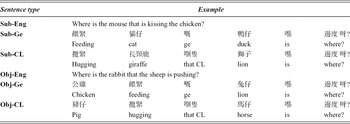
RC comprehension was tested using the picture-pointing method. Thirty-six picture pairs were constructed containing cartoon animals performing reversible actions (e.g., bear pushing lion, lion pushing bear, see Figure 1). There were 15 cartoon animals in total (pig, horse, elephant, tiger, mouse, cow, duck, bear, lion, cat, chicken, sheep, monkey, rabbit and giraffe). The pictures depicted four actions: push, feed, kiss and hug, which were used as verbs in test sentences. Each child was tested on 24 Cantonese RCs: 12 Ge-RCs (6 subject, 6 object) and 12 CL-RCs (6 subject, 6 object). The bilingual children were also tested on 12 English RCs (6 subject, 6 object). Four parallel forms of the RC test were constructed. Across the test sentences the four test verbs appeared an equal number of times (i.e., 9). The test sentences were controlled for length in words/characters and syllables. On average, the English items contained seven words, and between eight to 11 syllables. Cantonese ge items contained seven to eight monosyllabic characters, and Cantonese CL items contained eight to nine monosyllabic characters. All test items contained two animate NPs, since research has shown that animacy mismatches modulate children's processing of object RCs (Brandt, Kidd, Lieven & Tomasello, Reference Brandt, Kidd, Lieven and Tomasello2009; Kidd, Brandt, Lieven & Tomasello, Reference Kidd, Brandt, Lieven and Tomasello2007). Examples of each test item are shown in Table 3. An additional set of pictures were used to create filler trials, which depicted a range of actions. The Cantonese version of the test contained 12 filler trials; the English version contained 6.
Examples of Test Sentences for Each Condition.

Sample picture pair.

Procedure
All children were tested individually by a female simultaneous Cantonese–English bilingual speaker in the presence of their parent/caregiver. The monolingual children were tested in a quiet room in their primary school in Hong Kong. The bilingual children were tested in a quiet area of their home, language school, or church. Children were first tested on the PPVT and then on the test of RC comprehension. Testing language order for the bilingual children was counterbalanced across participants; half were tested on Cantonese first followed by English, and half vice-versa. The bilingual children were greeted in the language in which they were first tested. When they were tested in their second language the experimenter switched to the alternate language and informed the child that from now on they would speak English or Cantonese. The bilingual children were typically tested in one session, although two sessions were required for some children.
PPVT
The administration of the PPVT followed the standardised test instructions. The monolingual children's Cantonese vocabulary was measured using either the A or B version of the test. The bilingual children were tested on opposite versions across both of their languages. For instance, a child who was tested on the English PPVT-A form was tested on the Cantonese PPVT-B form, and vice-versa.
RC comprehension test
The test of RC comprehension was presented on laptop computer using Microsoft Powerpoint. The children were introduced to the task using four practice items that required them to identify specific entities (e.g., the happy snake), as they would be required to do in the test sentences. Past research has shown that children's knowledge of RCs is best revealed when the sentences are presented in a felicitous discourse context (e.g., Brandt et al., Reference Brandt, Kidd, Lieven and Tomasello2009; Corrêa, Reference Corrêa1995; Kidd & Bavin, Reference Kidd and Bavin2002). Test items were therefore preceded by two background scenes, which independently described the two scenes in the test item (e.g., Figure 1) using simple sentences. For instance, for the test item depicted in Figure 1, each picture was shown on its own and described (e.g., Left picture: Look! The bear is pushing the lion; Right picture: And here, the lion is pushing the bear). The children were then shown both pictures side-by-side (as in Figure 1), and were asked the test sentence; for instance, Where is the lion that the bear is pushing? Therefore, a correct response required children to point to the head referent modified by the RC. If a child did not point unambiguously to one referent they were asked to clarify their answer. The location of the head referent was counterbalanced, appearing an equal number of times in the left- and right-hand picture. The order in which the picture containing the head referent was introduced in the background scenes (first vs. second) was also counterbalanced. The order of test sentences was pseudorandomised; four orders were created for both the Cantonese and English tests.
Coding & Data Analysis
The RC comprehension was coded using the following categories: (i) Correct; (ii) Head error: when children pointed to the correct picture but the incorrect animal (e.g., pointing to the bear in the correct picture for the test sentence Where is the lion that the bear is pushing?); (iii) Reversal error: when children pointed to the correct token of the head referent in the incorrect picture (e.g., pointing to the picture where the lion is the agent for the test sentence Where is the lion that the bear is pushing?); and (iv) Other error: when children pointed to the incorrect animal in the incorrect picture (e.g., pointing to the bear in the incorrect picture for the test sentence Where is the lion that the bear is pushing?).
The data were analysed using Generalized Linear Mixed Models (GLMM) (Jaeger, Reference Jaeger2008), which were calculated using the lme4 package for Linear Mixed Effects (Bates & Maechler, Reference Bates and Maechler2010) in R (version 2.14.2, R Core Development Team, 2012). The fixed effects were: (i) Group (bilingual vs monolingual); (ii) Structure type (2 levels: Ge- vs CL-RCs); (iii) and Extraction (subject vs. object). Vocabulary was included as a covariate.Footnote 4 Analyses that investigated the role of dominance in the bilingual children's comprehension used a standardised difference score computed on the basis of the children's Cantonese and English PPVT scores as a predictor variable (see below). All variables were zero-centred to allow meaningful interpretation of effects. Random effects for participants and items were included in all models to control for by-participant and by-item variation within one model. By-participant and by-item random slopes were also included if they significantly contributed to model fit (as indicated by model comparison using the anova function in R, Baayen, Reference Baayen2008). Random slopes ensure that any effects observed for fixed effects predictor variables reflect the slopes for those effects and not between-participant or between-item variation.
Results
Cantonese data
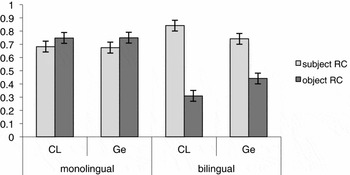
Figure 2 shows each group's average performance on the Cantonese Ge- and CL-RCs.
Mean correct performance and standard errors for bilingual and monolingual children on Ge- and CL-RCs.

Figure 2 shows that the bilingual children showed a subject RC advantage for both RC types (Ge: M subjRC = .74 M objRC = .44; CL: M subjRC = .84, M objRC = .31). In contrast, the monolingual children showed slight object advantage (Ge: M objRC = .75, M subjRC = .68; CL: M objRC = .75, M subjRC = .68).
Overall analysis
The monolingual and bilingual children's correct responses were analysed first. Group, Structure (Ge versus CL), Extraction (subject versus object), and Cantonese Vocabulary were initially entered into a factorial model. A simpler model that only included Cantonese vocabulary as a simple covariate was a better fit to the data (i.e., all interaction terms containing Cantonese vocabulary were removed). By-participants random slopes for the variables of Structure and Extraction significantly contributed to model fit. Several effects emerged. Notably, there was a significant three-way Group X Structure X Extraction interaction (β = -2.4, z = 2.28, p = .004). This interaction was further scrutinised by analysing each group separately.
Monolinguals
The analyses of the monolingual data only revealed a significant effect for Cantonese Vocabulary (β = .05, z = 5.4, p < .001), showing that children's comprehension improved as their vocabulary scores increased. No other effects were significant.
Bilinguals
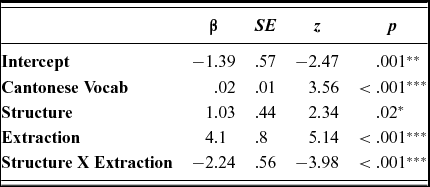
The bilingual children's data were analysed next. Structure (Ge- vs. CL-RCs) and Extraction (Subject vs Object RCs) were entered as fixed effects along with the covariate of Cantonese Vocabulary in a factorial model. A simpler model which included Cantonese Vocabulary as a simple covariate was again a better fit. Random by-participants slopes for Extraction and Structure significantly contributed to the model. The significant effects for the final model are shown in Table 4.
Significant Terms in Final Model for Analysis of Bilinguals’ RC Comprehension.

log likelihood = −225.3, Number of observation = 480. ***p < .001, **p < .01, *p < .05.
The main effect for Cantonese vocabulary showed that children with higher vocabulary scores performed better on the RC comprehension test overall. Significant main effects for Structure and Extraction were subsumed by a significant Structure X Extraction interaction, which was driven by the fact that the subject-object asymmetry was larger for CL- than for Ge- RCs (although both still showed significant subject advantages: Ge: β = 1.84, z = 2.21 p = .03; CL: β = 4.23, z = 5.05, p < .001).
We next analysed whether individual differences in dominance affected the bilingual children's correct comprehension. A new model was run that replaced Cantonese vocabulary with a dominance score, which was computed by subtracting the children's English vocabulary score from their Cantonese vocabulary score. Each child's difference score was then converted into a standardised z-score, with positive scores indicating comparative Cantonese dominance, and negative scores indicating comparative English-dominance. When this variable replaced Cantonese vocabulary in the model the main effects of structure, extraction and their interaction remained significant. Additionally, there was a significant three-way extraction X structure X dominance interaction (β = −1.22, z = −2.01, p = .04). Follow up analyses that analysed each structural type separately showed that dominance positively predicted correct performance on both CL- (β = .78, z = 2.2, p = .03) and Ge-RCs (β = 1.06, z = 2.13, p = .03), but that dominance did not interact with extraction in either analysis. Therefore, the post-hoc analyses did not detect any reliable difference in accuracy that interacted with structure type and dominance. Instead, we can conclude that having comparative strength in Cantonese leads to better performance in general.
English data
Consistent with their performance on the Cantonese RCs, the bilingual children performed significantly better on the English subject RCs (M = .93) in comparison to object RCs (M = .63). The final model included Extraction as a fixed effect and English vocabulary as a continuous covariate. A random by-participants slope for extraction significantly contributed to the final model. A significant main effect for Extraction confirmed that the children performed better on subject RCs than on object RCs (β = 2.68, z = 3.13, p = .002), and a significant positive effect for English vocabulary showed that children performed better on English RCs as their English vocabulary increased (β = .08, z = 3.61, p < .001).
Error Analyses
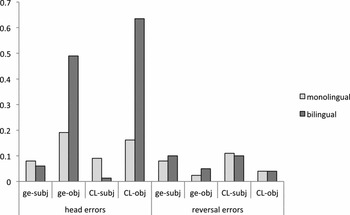
The types of errors children make in referent selection provide an additional source of information regarding the strategies they use to interpret the test sentences. Children made three error types: (i) head errors, (ii) reversal errors, and (iii) ‘other’ errors. Head errors were the most common error type (monolinguals: 16.1%; bilinguals: 29.6%), whereas reversal errors (monolinguals: 7.9%; bilinguals: 5.6%) and ‘other’ errors were less frequent (monolinguals: 4.3%; bilinguals: 6.6%). Figure 3 shows the monolingual and bilingual children's average error percentage on the Cantonese subject and object Ge- and CL-RCs by extraction type.
Distribution of error types for monolingual and bilingual groups for Cantonese Ge- and CL- subject and object RCs.

Only the head errors and reversal errors were analysed, since, unlike ‘other’ errors the processing strategies the children use when making these errors are readily interpretable. As for the analyses of the children's correct responses, an overall analysis comparing the monolingual and bilingual children's proportion of head errors by structure and extraction yielded a three-way group X structure X extraction interaction (β = 4.08, z = 2.44, p = .015). In contrast, a preliminary analysis of the reversal errors revealed no group differences. In fact the only significant predictor was Cantonese vocabulary (β = −.04, z = −3.73, p < .001), which showed that children made fewer reversal errors as their vocabulary increased.
Head Errors: Monolinguals
The final model included the fixed effect of extraction, the covariate of vocabulary, the random effect of participants and items and the random by-participant slope for extraction. However, the only significant effect was the main effect of Vocabulary (β = −.03, z = −3.88, p < .001), showing that children with smaller vocabularies made more head errors. Therefore, despite the fact that the monolingual children made proportionately more head errors for object RCs, this difference is not reliable once vocabulary knowledge is taken into account.
Head Errors: Bilinguals
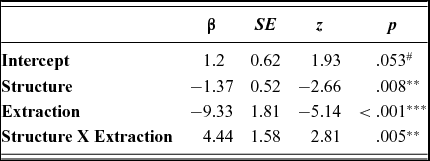
The bilingual children's data were analysed next. The final model contained the fixed effects of structure (Ge- vs. CL-RCs) and extraction (Subject vs Object RCs) in a factorial model, along with the simple covariate of Cantonese Vocabulary. The random effect for participants and items were included and the random by-participant slopes for structure and extraction improved model fit. The significant effects are shown in Table 5.
Significant Model Terms for Analysis of Bilingual Children's Head Errors.

log likelihood = −156.2, Number of observation = 480. ***p < .001, **p < .01, *p < .05,
# p < .1
A significant main effect for structure revealed that the bilingual children made more head errors with CL- compared to Ge-RCs. A significant main effect for extraction revealed that more head errors were made in object-extracted RCs overall. These two main effects were subsumed by a significant structure by extraction interaction, which was driven by the fact that the bilingual children made proportionately more head errors on object RCs relative to subject RCs on CL-relatives (although in both cases the difference was significant: CL-RCs: β = −8.03, z = −4.5, p < .001; Ge-RCs β = −8.07, z = −3.65, p < .001).
The head error analysis was repeated using dominance rather than Cantonese vocabulary as a predictor variable. The main effects of structure, extraction and their interaction remained significant. The main effect of dominance approached significance (β = −.61, z = −1.84, p = .07), suggesting that children made fewer head errors as their Cantonese dominance increased.
English errors
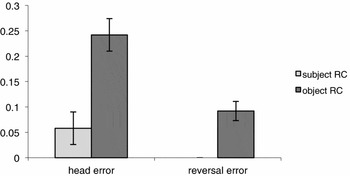
The proportion of head and reversal errors for English subject and object RCs are shown in Figure 4.
Mean proportion of error types and standard errors for bilingual group for English subject and object RCs.

Head errors
The final model for the analysis of the head errors included the fixed effect of extraction, the covariate of English vocabulary, the random effect of participants and items, and the random by-participant slope for extraction. A significant effect of extraction (β = −2.44, z = −2.82, p = .005) showed that the children made more head errors on object RCs. A significant effect for English vocabulary showed that the children made fewer head errors as their vocabularies increased (β = −.06, z = −2.88, p = .004).
Reversal errors
The bilingual children exclusively made reversal errors on object RCs. English vocabulary did not predict this error type (β = −.04, z = −1.01, p = .31).
Discussion
Our hypothesis that Cantonese–English bilinguals would experience difficulty processing Cantonese object RCs in comparison to their monolingual peers was supported. Several features of the results suggest that crosslinguistic influence played a major role in the pattern of findings. Head errors were the most common error type for both groups, but were almost twice as prevalent overall in the bilingual group (up to 3 times more common for object RCs). The predominance of head errors in object RCs indicates that the bilingual children were correctly assigning thematic roles, but failed to identify the head noun as the correct referent (i.e., they pointed to the subject rather than the object of the sentence). Such a response follows canonical SVO word order in both Cantonese and English, and so it is possible that the surface form overlap between basic transitive syntax of both languages and Cantonese object RCs resulted in competing syntactic analyses.
The exact nature of the competing analysis is not entirely clear. One possibility is that the object RC analysis competes with a simple SVO transitive clause analysis. For instance, the combination of Cantonese and English may promote a transitive clause analysis through the use of canonical sentence templates, where NVN sequences are interpreted as SVO (Bates & MacWhinney, Reference Bates, MacWhinney, Wanner and Gleitman1982; Diessel & Tomasello, Reference Diessel and Tomasello2005; Slobin & Bever, Reference Slobin and Bever1982).This is consistent with the fact that the bilingual children made more head errors on CL-relatives, where there is complete surface form overlap with basic transitives. An alternative possibility is that the bilingual children were processing the object RCs as a noun modifying construction that takes the surface form of a SVO transitive but wrongly assigns the agent as the semantic head [similar to the internally headed RC, see sentence (14)]. Noun modifying constructions are common in East Asian languages like Cantonese, and are likely to sit on a continuum with RCs (Comrie, Reference Comrie, Boeder, Schroeder, Wagner and Wildgen1998, Reference Comrie2007). On this interpretation, canonical word order overlap between Cantonese and English may still exert a combined influence. For instance, canonical sentence templates may play a role in initially assigning thematic roles (Townsend & Bever, Reference Townsend and Bever2001). However, the sentence may be ultimately interpreted as a noun modifying construction, where, in contrast to RCs in English where a syntactic relation is established between the head noun and modifying clause, a semantic or pragmatic relationship is established. On this analysis, specific overlap with English head-initial subject RCs could also encourage a head-initial analysis for this Cantonese noun modification construction, due to the fact that both contain SVO word order and both are complex nominalised constructions.
Crosslinguistic influence in comprehension has been attested in studies of bilingual acquisition (e.g., Serratrice, Reference Serratrice2007, and through grammaticality judgments, e.g., Argyri & Sorace, Reference Argyri and Sorace2007), although there has been less of a focus on mechanistic explanations of how parsing strategies interact and are shared between languages. Crosslinguistic transfer in comprehension has been more intensively studied in the adult literature (e.g., Clahsen & Felser, Reference Clahsen and Felser2006; Nitschke, Kidd & Serratrice, Reference Nitschke, Kidd and Serratrice2010). Work within the framework of the Competition Model (Bates & MacWhinney, Reference Bates, MacWhinney, Wanner and Gleitman1982; MacWhinney, Reference MacWhinney, Kroll and DeGroot2005) has shown that unbalanced late bilinguals show strong patterns of forward transfer, from their L1 to their L2, during comprehension (Kilborn, Reference Kilborn1989).Footnote 5 The Competition Model predicts that a bilingual speaker's representation of their two languages diverges over time, as they acquire and differentiate the different cues and constraints to interpretation of each language (Hernandez, Li & MacWhinney, Reference Hernandez, Li and MacWhinney2005). There is evidence for this emergent differentiation: MacDonald (Reference McDonald1987) showed that late Dutch-English bilinguals gradually shifted in their use of cues to sentence interpretation over time to be more consistent with their L2. Other data suggest that bilinguals’ interpretation strategies based on cue strengths are not completely separate. Hernandez, Bates and Avila (Reference Hernandez, Bates and Avila1994) reported data to suggest that highly proficient adult bilinguals amalgamate cue-based processing strategies from both languages. Reyes and Hernandez (Reference Reyes and Hernandez2006) reported similar amalgamated strategies in Spanish–English bilingual children. Specifically, they showed that the Spanish–English children began attending to subject-verb agreement as a cue to interpretation later than monolingual Spanish children but earlier than monolingual English children, and were delayed overall in their use of word order to interpret non-canonical sentences (e.g., the dog the horse is chasing and is chasing the dog the horse, in which monolingual speakers of both languages typically interpret the second NP as the agent).
The theoretical constructs of the Competition Model provide a useful vocabulary in which to interpret crosslinguistic influence in the current data. Both Cantonese and English have impoverished morphological systems; in the absence of semantic cues to thematic role assignment (e.g., animacy, see Brandt et al., Reference Brandt, Kidd, Lieven and Tomasello2009), word order is the most reliable cue to interpretation in both languages (although monolingual Chinese-speakers prefer animacy cues if available, see Liu et al., Reference Liu, Bates and Li1992). If, following Reyes and Hernandez (Reference Reyes and Hernandez2006), exposure to two languages had an additive effect on cue weightings, then Cantonese–English bilinguals are likely to be particularly sensitive to word order as a cue to interpretation. The overlap between canonical word order in both languages and its presence in Cantonese object RC may lead to bilinguals promoting a basic transitive clause analysis over an object RC analysis. Such an analysis can be incorporated into a noun modifying construction, and so we see that, in contrast to their monolingual peers, bilingual children identify the RC internal subject as the (semantic) head noun.
Dominance affects the course of bilingual acquisition and the direction of crosslinguistic influence (e.g. Argyri & Sorace, Reference Argyri and Sorace2007; Gathercole & Môn Thomas, Reference Gathercole and Thomas2009; Paradis, Reference Paradis2010; Paradis, Nicoladis, Crago & Genesee, Reference Paradis, Nicoladis, Crago and Genesee2011). Yip and Matthews (Reference Yip and Matthews2007a) partially attributed the presence of pre-nominal English RCs in their three children's speech to Cantonese-dominance; our data confirm a role for dominance in RC acquisition in Cantonese–English bilinguals. Importantly, unlike many past studies that have identified dominance effects at the group level (i.e., a dominant group performing differently to a non-dominant group), our regression analyses confirm a role for dominance at the level of the individual child (i.e., individual dominance scores predicted performance). Individual differences studies with larger samples are needed to follow up this finding. Our bilingual children were living in Australia where the community language is English, and therefore spent significantly more of their time in English-speaking contexts (including school). Although their vocabulary scores are suggestive of equal proficiency at the group level, the children's greater exposure to English across a range of social contexts and the fact that their parents rated their comprehension of English as being significantly better than their comprehension of Cantonese suggests that they were, on the whole, English-dominant. Therefore an important follow-up to our finding would be to test a larger group of children with a wider array of dominance profiles.
These data complement and extend the work of Yip and Matthews (Reference Yip and Matthews2000, Reference Yip and Matthews2007a) in a number of ways. Firstly, they confirm their observation of cross-linguistic influence in Cantonese–English bilinguals’ acquisition of RCs, and extend this observation from English to Cantonese. Secondly, the data support Yip and Matthew's argument that cross-linguistic influence is due to overlap in word order regularities between the two languages (thereby supporting similar arguments made about bilingual children acquiring closely related languages, e.g., Döpke, Reference Döpke1998; Nicoladis, Reference Nicoladis2006), in addition to patterns of dominance. Thirdly, the data extend the observation of crosslinguistic influence to older children, at the group level, in the domain of comprehension. This suggests that there is significant interaction between the bilingual children's two systems that extends into middle childhood (and beyond, see Hartsuiker & Pickering, Reference Hartsuiker and Pickering2008).
An alternative explanation for what we have identified as crosslinguistic influence is the possibility that the bilingual children were utilising an immature parsing strategy characteristic of young monolingual Cantonese language learners. We argue that this explanation is unlikely, for a number of reasons. Firstly, the bilingual and monolingual group were matched on verbal ability. Although this does not guarantee they had similar grammatical systems (and indeed they did not), it decreases the likelihood that the differences we observed were due to developmental level. Secondly, the bilingual children performed better than the monolinguals on the subject RCs, which for monolingual Cantonese-speaking children appear to be more complex than object RCs. The monolingual children in the present study showed no difference between subject and object RCs (with a slight yet non-significant object advantage, see Figure 2). However, Chan et al. (Reference Chan, Matthews, Yip and Kidd2011) reported that younger Cantonese monolinguals (4-years-old) show an object preference in CL-RC comprehension. Finally, this alternative explanation does not account for the finding that relative dominance predicted performance, which directly links the children's performance on Cantonese to their knowledge of both Cantonese and English. Therefore what we appear to be observing in our bilingual sample is a qualitatively different comprehension strategy that we argue derives from the unique combination of the children's two languages.
Our study is the first experimental study of monolingual Cantonese children's comprehension of both CL- and Ge-RCs. Chinese is an important language in debates regarding RC acquisition and processing because the combination of prenominal RCs and SVO canonical word order allows researchers to tease apart predictions regarding the relative complexity of subject and object RCs. On the one hand, structurally-oriented theories predict a universal subject advantage (e.g., O’Grady et al., Reference O’Grady, Lee and Choo2003). On the other hand, processing based theories that compute complexity on the basis of linear distance between the head and the RC gap predict either an object advantage (Gibson, Reference Gibson, Marantz, Miyashita and O’Neil2000) or no subject-object asymmetry (O’Grady, Reference O’Grady and Kidd2011), and theories that base complexity on deviations from canonical word order predict an object advantage (Diessel & Tomasello, Reference Diessel and Tomasello2005). Our data suggest no subject-object asymmetry in older monolingual Cantonese-speaking children: although the monolingual children performed slightly better on object RCs, their performance on subject and object RCs did not significantly differ. The results complement Chan et al.'s (Reference Chan, Matthews, Yip and Kidd2011) finding of an object advantage for younger 4-year-old monolinguals on CL-RCs, who used the same method in the present study. Given an object advantage in younger children using the same method, it is possible that the lack of object-subject asymmetry in the present sample is due to older children being better able to process subject RCs. At the same time, it must be acknowledged that other results in the literature that used different methodologies suggest a significant subject advantage in Cantonese (Lau, Reference Lau2006) or Mandarin (Hsu, Hermon & Zukowski, Reference Hsu, Hermon and Zukowski2009). Systematic studies that compare children on multiple methodologies across a range of ages are needed to resolve these discrepancies in the literature.
Conclusion
In the current paper we have reported on the first experimental study of Cantonese–English bilingual children's comprehension of RCs. Consistent with naturalistic data reported in Yip and Matthews’ (Reference Yip and Matthews2007a) seminal study, we observed significant cross-linguistic influence in our bilingual children's comprehension, which can be attributed to word order overlap between Cantonese and English. Our results therefore confirm their predictions and extend the observation of crosslinguistic influence to older bilinguals, suggesting that crosslinguistic influence continues to affect the course of acquisition beyond infancy and early childhood.