The search for the underlying mechanism of language processing is of vital importance in the linguistic and neural sciences. Such a discovery would have implications for our understanding of the cognitive processing of human beings, theories of language development, and clinical treatments of communication disorders. Whereas neuroscientists seek to understand how the nervous system's processes support language functions, linguists aim to identify universal as well as unique characteristics of language. Here, we seek to demonstrate how language development could be shaped by both linguistic and neurobiological constraints by considering the auditory sensitivity that may underlie language development.
The underlying mechanisms that subserve language development are the subject of long-standing debate. The central question under debate is whether the mechanisms in question are specific to language or whether they derive from more basic, domain-general factors such as attention, perception, and memory. Current theories may be divided into two broad categories. First, there are those that emphasize the importance of linguistic processes (e.g., Mody, Studdert-Kennedy, & Brady, Reference Mody, Studdert-Kennedy and Brady1997; Ramus et al., Reference Ramus, Rosen, Dakin, Day, Castellote and White2003; Snowling, Reference Snowling, Bishop and Leonard2000). Although such explanations are very influential, they do not account for why children with language impairment also exhibit nonlinguistic impairments, such as in working memory (Lum, Conti-Ramsden, Page, & Ullman, Reference Lum, Conti-Ramsden, Page and Ullman2012) and visual imagery (Johnston & Ellis-Weismer, Reference Johnston and Ellis-Weismer1983). Second, it has been proposed that auditory processing plays a critical role in establishing phonological representations (Tallal, Merzenich, Miller, & Jenkins, Reference Tallal, Merzenich, Miller and Jenkins1998). The rapid auditory processing hypothesis (Tallal, Reference Tallal2004; Tallal & Piercy, Reference Tallal and Piercy1973) specifies that sensitivity to rapid auditory temporal events is a prerequisite for the development of phonology and subsequent language skills such as reading. According to this view, a deficit in processing rapid information will lead to a deficit in language development. Support for the rapid auditory processing hypothesis comes from studies of both visual (May, Williams, & Dunlap, Reference May, Williams and Dunlap1988) and auditory (McGivern, Berka, Languis, & Chapman, Reference McGivern, Berka, Languis and Chapman1991) modalities, as well as interventions that demonstrate that children with language impairments benefit from timing-based treatment (Merzenich et al., Reference Merzenich, Jenkins, Johnston, Schreiner, Miller and Tallal1996). However, the rapid auditory processing hypothesis has been criticized because many children with language impairments perform normally on a variety of auditory tasks (van der Lely, Rosen, & Adlard, Reference van der Lely, Rosen and Adlard2004), rapid auditory processing deficits do not predict much of the variance within language-impaired children (Rosen, Reference Rosen2003), and some children with normal language development show impaired rapid auditory processing suggesting that a rapid processing deficit is neither sufficient nor required to cause language impairment (Bishop, Carlyon, Deeks, & Bishop, Reference Bishop, Carlyon, Deeks and Bishop1999). Therefore, there is substantial evidence questioning the generalizability of the rapid auditory processing hypothesis.
A more recent domain-general proposal is the rhythm detection hypothesis (Goswami et al., Reference Goswami, Thomson, Richardson, Stainthorp, Hughes and Rosen2002, Reference Goswami, Wang, Cruz, Fosker, Mead and Huss2011), which specifies that sensitivity to slower (rather than rapid) auditory events may drive phonological development. Rhythm refers to the periodicity with which strong and weak beats recur in the sequential organization of auditory events (Huss, Verney, Fosker, Mead, & Goswami, Reference Goswami2011). The hypothesis is that very basic auditory processes are used in perceiving both music and language, which enable the extraction of metrical structure and speech rhythm. Support for this view comes from research demonstrating that sensitivity to slower temporal information using musical rhythm detection predicted phonological skills and reading (Huss et al., Reference Huss, Verney, Fosker, Mead and Goswami2011). Given that speech intelligibility on the part of the listener depends on the integrity of rhythm detection (Shannon, Zeng, Kamath, Wygonski, & Ekelid, Reference Shannon, Zeng, Kamath, Wygonski and Ekelid1995), a slow temporal-processing account might be a viable explanation of speech processing and phonological development (Ziegler, Pech-Georgel, George, Alario, & Lorenzi, Reference Ziegler, Pech-Georgel, George, Alario and Lorenzi2005). The rhythm detection hypothesis provides a powerful and intriguing explanation for language development and offers directions for devising effective time-based interventions for language and reading impairments in alphabetic orthographies (Goswami, Reference Goswami2011). According to proponents of the theory, sensitivity to rhythm is crucial for perceiving syllable structure, which in turn affects the development of phonological awareness, and this in turn affects reading development (Goswami, Gerson, & Astruc, Reference Goswami, Gerson and Astruc2010). Thus, interventions based on improving rhythm detection are expected to benefit reading acquisition. Support for this hypothesis is largely based on evidence from Western languages, such as English (Goswami et al., Reference Goswami, Thomson, Richardson, Stainthorp, Hughes and Rosen2002), Spanish (Goswami et al., Reference Goswami, Wang, Cruz, Fosker, Mead and Huss2011), Hungarian (Surányi et al., Reference Surányi, Csépe, Richardson, Thomson, Honbolygó and Goswami2009), French (Muneaux, Ziegler, Truc, Thomson, & Goswami, Reference Muneaux, Ziegler, Truc, Thomson and Goswami2004), and Finnish (Hämäläinen et al., Reference Hämäläinen, Leppänen, Eklund, Thomson, Richardson and Guttorm2009).
It has been proposed recently that rhythm detection may provide a universal explanation for phonological development. Support for this universality claim stems from observations that, in addition to the Western languages listed above, Mandarin children's sensitivity to rhythm predicts Chinese character reading (Goswami et al., Reference Goswami, Wang, Cruz, Fosker, Mead and Huss2011). However, there are several reasons to be cautious about this universality claim. First, the debate between linguistic mechanisms and general auditory processing is still contentious, and domain-general explanations are not yet accepted as definitive even for the (Western) languages that have been studied. Rhythm detection did not predict reading abilities of Greek children, a language with a consistent orthography (Papadopoulos, Georgiou, & Parrila, Reference Papadopoulos, Georgiou and Parrila2012). Thus, cross-language claims of universality may be premature. Second, reading may not be a sufficient investigation of overall language ability. Much of the research comparing linguistic versus domain-general mechanisms of language development has investigated reading skills (and dyslexia); however, the conclusions are often extrapolated to account for broad language development. In order to draw conclusions regarding language development, it is necessary to include measures that index overall language (rather than simply reading) ability. Third, although Goswami et al. (Reference Goswami, Wang, Cruz, Fosker, Mead and Huss2011) concluded that rhythm detection is fundamental to phonological and reading development in Mandarin, in that study, sensitivity to pitch contours (referred to as “tone awareness”) was a stronger predictor of reading than rhythm detection. In addition, the task used to measure tone awareness was a discrimination task in which four tones were presented, which is taxing on working memory. Therefore, pitch contour sensitivity might be expected to be an even more important cue than is currently thought, particularly in languages with more complex tone systems than Mandarin, such as Cantonese. The goal of the present study was to test the universality claim of rhythm detection as the driving force of phonological development. As an alternative to the universality claim, we propose the language-specific auditory cue (LSAC) hypothesis. The LSAC hypothesis, like the rhythm detection hypothesis, assumes that auditory processing is important for language development across spoken languages, but it diverges from the rhythm detection hypothesis by postulating that the set of auditory cues required is language specific, rather than universal. For example, for languages that use pitch extensively, pitch would be a more important cue than rhythm.
Tone languages, unlike most Western languages, signify lexical distinctions using pitch contours (e.g., in Cantonese, the syllable /si/ means “teacher” when spoken with a high-level tone and “market” with a low-rising tone). In both human and nonhuman mammals, sensitivity to frequency modulation as well as pitch contour perception can be attributed to the various structures along the auditory pathway including the inferior colliculus in the brainstem (Chandrasekaran, Kraus, & Wong, Reference Chandrasekaran, Kraus and Wong2012), the anterolateral portion of the Heschl's gyrus (Bendor & Wang, Reference Bendor and Wang2005), and other cortical regions connected to the secondary auditory cortex (Hall & Plack, Reference Hall and Plack2009). Tone languages are demanding of pitch, and call upon these neural resources, more so than do Western languages such as English. The importance of pitch processing in tone languages can be observed in studies that have found differences in neural responses to pitch in tone versus nontone language speakers (Wong, Parsons, Martinez, & Diehl, Reference Wong, Parsons, Martinez and Diehl2004), in the superiority of music perception in tone language speakers (Wong et al., Reference Wong, Ciocca, Chan, Ha, Tan and Peretz2012), and in the association between the volume of left Heschl's gyrus and novel tone word-learning success in tone language speakers as well as native English-speaking adults (Wong et al., Reference Wong, Warrier, Penhune, Roy, Sadehh and Parrish2008). Note that Heschl's gyrus is typically associated with nonspeech processing, suggesting that speech and nonspeech processing of pitch contours are subserved by the same primary auditory regions.
Cantonese is a particularly useful language for testing the interaction between linguistic specificity and cross-linguistic commonalities in language development because it contrasts six tones and thus has a more complex tone system than most tone languages do (only 6.3% of tone languages have six or more tones; Maddieson, Reference Maddieson1984). By investigating language development in Cantonese children, and comparing the findings to past work on Western children (e.g., English, Spanish, French, Hungarian, and Finnish), it is possible to test predictions concerning the features that drive language development and their universality (e.g., Goswami et al., Reference Goswami, Wang, Cruz, Fosker, Mead and Huss2011).
In the present study, Cantonese school children in Grades 1–6 (ages 6.0–12.5 years) completed AX discrimination tasks designed to assess their sensitivity to rhythm and pitch, and were compared to Cantonese adult controls. Pitch processing was assessed following the pitch pattern perception procedure in Wong, Ciocca, and Yung (Reference Wong, Ciocca and Yung2009), and we included a music scale measure to examine if sensitivity to pitch, but more distant to lexical tones, would also contribute to language development. Temporal processing was assessed using a music rhythm task based on that used by Huss et al. (Reference Huss, Verney, Fosker, Mead and Goswami2011). The children's overall language ability was indexed using a narrative task. Narrative tasks are comprehensive measures of overall language ability because they incorporate numerous aspects of language, including vocabulary, grammatical structure, as well as syntactic and discourse complexity (Reilly, Losh, Bellugi, & Wulfeck, Reference Reilly, Losh, Bellugi and Wulfeck2004). Narratives require children to execute several tasks in a carefully coordinated manner. Story information must be organized according to a schema, appropriate vocabulary retrieved, syntactic structures deployed to package the story, and appropriate referential expressions and connectives selected to make the narrative a coherent whole (To, Stokes, Cheung, & T’sou, Reference To, Stokes, Cheung and T'sou2010). In school-age children, the development of narrative skills correlates with academic and literacy skills (Wallach & Butler, Reference Wallach and Butler1994). Narratives are strong predictors of later language outcomes (Bishop & Edmundson, Reference Bishop and Edmundson1987), including syntactic and lexical skills (Johnston, Reference Johnston2007). Narratives correlate with vocabulary (Chang, Reference Chang2006; Tabors, Snow, & Dickinson, Reference Tabors, Snow, Dickinson, Dickinson and Tabors2001) and reading development (Cain, Oakhill, & Bryant, Reference Cain, Oakhill and Bryant2004). Children with language impairments produce simpler narratives with fewer grammar elements than do typically developing children, particularly propositions related to plans, action, and reactions, which involve high cognitive processes (Merritt & Liles, Reference Merritt and Liles1987). Their functional nature and complexity make them better measures of overall language development than are tasks focusing on specific skills, such as grammaticality judgment or character recognition (Liles, Reference Liles1993). If pitch, rather than rhythm, sensitivity is shown to be more important in driving language development in a complex tone language such as Cantonese, this would provide compelling evidence that the importance of detecting temporal information varies across languages, providing support for our LSAC hypothesis. Conversely, if sensitivity to rhythm is shown to be a better predictor of language development in Cantonese children, this would support the universality claim put forth by proponents of the rhythm detection account (Goswami et al., Reference Goswami, Wang, Cruz, Fosker, Mead and Huss2011).
METHOD
Subjects
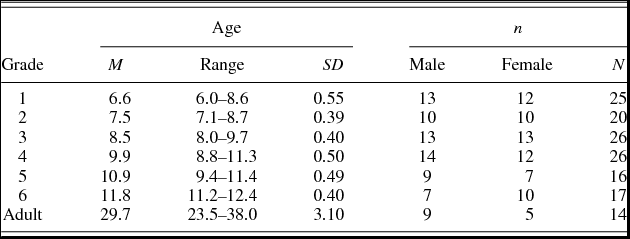
Subjects who took part were 130 Cantonese-speaking school children with no diagnosis of developmental disorders or hearing, speech, or language problems. The children came from six grade levels in a Hong Kong school. All children had been educated in Cantonese. The school system in Hong Kong is stratified based on district and student performance. Thus, the students were from a homogeneous group in terms of intellectual, academic, and socioeconomic characteristics. In addition, 14 Cantonese adults served as a comparison group. Demographics are presented in Table 1.
Demographic information of Cantonese children and adult subjects

Materials and design
The experiment comprised a narrative task and AX discrimination tasks of music rhythm, music scale, and pitch perception sensitivity. In AX discrimination, two stimuli are presented, and the subject must decide whether the first token (A) is the same or different from the second token (X).
Narrative ability assessment
The narrative subtest (To et al., Reference To, Stokes, Cheung and T'sou2010) of the Hong Kong Cantonese Oral Language Assessment Scale (T’sou et al., Reference T'sou, Lee, Tung, Man, Chan and To2006) was administered to the six groups of school children. The narrative test is a story-retelling task with four submeasures: semantics, syntactic complexity, referencing, and connectives. Semantic score measured the child's use of sophisticated vocabulary (e.g., bandaged vs. tied), using adults’ productions as indices, with a maximum possible score of 92. Syntactic complexity measured the use of the syntactic structures, such as relative clause (e.g., the girl who wore a cap heard some noise), preverbal manner modifier (e.g., she blew the whistle loudly), clausal complement (e.g., she suggested that all of the children go there and rescue the cat), and prepositional phrase (e.g., they pulled them to the shore), with a maximum possible score of 38. Referencing measured the accuracy of a referential form used when introducing and switching reference (e.g., the girl who had pigtails), with a maximum possible score of 26. Connectives play a role in conjoining utterances and formulating complex sentences in conversation and narrative contexts that indicate causality (e.g., since), concession (e.g., although), hypotheticals (e.g., still), additives (e.g., not only), and temporal relations (e.g., then), with a maximum possible score of 28. When summed, the four submeasures give an overall narrative score out of 184, with higher scores indicating better narrative ability. Detailed descriptions of the scoring submeasures, including examples, are provided in To et al. (Reference To, Stokes, Cheung and T'sou2010). Each child was presented with a storybook and listened to a model story through earphones. The child was instructed to flip the pages when listening to the story. Upon completion of the story, the child was asked to retell the story using the provided series of 24 pictures. Children were familiarized with the procedure before the test story. The narrative task took approximately 18 min to administer. The narratives were scored by three trained research assistants who possessed experience in administering and scoring the narrative test. Approximately 10% of all samples were counterchecked by one of the authors (C.K.S.T.), reaching >90% interrater reliability.
Music rhythm
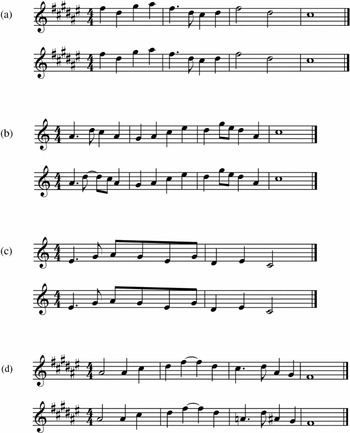
Musical melodies in 4/4 time served as stimuli in the music rhythm AX discrimination task. The music rhythm task was based on related work that has been conducted on Western children (Huss et al., Reference Huss, Verney, Fosker, Mead and Goswami2011). Half of the trials contained identical melody pairs, and the other half contained a melody that differed in rhythm. Examples of same and different melody pairs used in the music rhythm task are shown in Figure 1. In total, six pairs of melodies were presented in random order, and all were presented in same and different configurations, and repeated, resulting in 24 trials. The change in rhythm was caused by having a note occur in a different location to the original melody, but still in 4/4 time. It is important to note that, for the music rhythm task, these differences always involved timing, and the musical notes were always correct. On each trial the subjects were required to judge whether the pair of melodies was the same or different, that is, whether one of the melodies differed in rhythm. The melodies were 5 s in duration, and the interstimulus interval was set to 2 s. Because young children were involved, no response time limit was set. The experiment would advance to the next melody pair once a response had been registered.
Examples of same and different melody pairs used in (a, b) music rhythm and (c, d) music scale tasks.

Music scale
The music scale task presented six musical melodies, and half of the trials presented “different” pairs that contained a melody with a different note. The difference in melody was created by replacing one note with another that differed by four semitones. The timing of the musical notes was held constant and was thus always correct. As in the music scale task, 6 pairs of melodies were presented randomly (6 melodies × 2 same/different pairs × 2 repetitions), resulting in 24 trials. The melodies were 5 s in duration, and the interstimulus interval was set 2 s, and no response time limit was set.
Pitch pattern perception
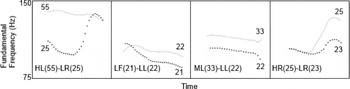
The pitch pattern perception task was identical to that used in past work investigating lexical tone perception (Wong et al., Reference Wong, Ciocca and Yung2009). A male native Cantonese talker produced four words with a level tone (/pei, jy, min, and thʊŋ/). The recordings were made in a sound-attenuated chamber using a high-quality microphone and laptop computer. The six Cantonese pitch contours were superimposed onto the recordings, and new tokens were resynthesized using the pitch synchronous overlap-add function in Praat (Boersma & Weenink, Reference Boersma and Weenink2001). Figure 2 shows the pitch contours of the four tone pairs. The intensity of the stimuli was normalized. The resynthesized tone pairs were judged as acceptable exemplars of the intended tones by three phonetically trained Cantonese native listeners. The four Cantonese tone word pairs were then acoustically manipulated. Nonspeechlike stimuli were created by extracting the F0 values from the tokens and then resynthesizing the stimuli using the pulse-pitch (hum) function in Praat. The resulting hums were then low-pass filtered at 1900 Hz, and a preemphasis filter was applied twice to give the stimuli a nonspeechlike quality. Finally, the amplitude and duration characteristics were normalized. The final tokens that were generated maintained the original pitch information, and resembled a croaking noise. This task was presented to subjects as a frog “ribbit” game in which subjects were required to discriminate the pitch patterns of the frogs’ “croaks.” In total, four pitch pairs were presented in random order, in same and different configurations, in counterbalanced presentation orders,Footnote 1 and all pairs were repeated, resulting in 32 trials. On each AX discrimination trial, subjects judged whether the frog's croaks were the same or different, that is, whether they differed in pitch. The stimuli were 250 ms in duration, and the interstimulus interval was set to 500 ms.
Pitch trajectories of the four tone-pair stimuli used in the pitch pattern perception task adapted from Wong et al. (Reference Wong, Ciocca and Yung2009). Stimulus durations were normalized to 250 ms. The four tone pairs were high level–high rising (HL-HR), low falling–low level (LF-LL), midlevel–low level (ML-LL), and high rising–low rising (HR-LR).

Procedure
The experiment took place in a quiet room, and experimental tasks were presented via high-quality headphones and a computer running E-Prime software. The audio output level was calibrated to 72 dB. All subjects completed the music rhythm, music scale, and pitch pattern perception tasks. The order of the tasks was counterbalanced across subjects. Only the school-aged children completed the narrative task (not the adults).
RESULTS
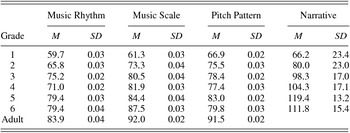
Descriptive statistics for music rhythm, music scale, pitch pattern perception, and narrative scores are presented in Table 2. Pearson correlations were conducted between each measure and narrative score, with age partialled out. Narrative scores were significantly correlated with pitch pattern perception, r (123) = .342, p < .001, music scale, r (123) = .297, p < .001, and music rhythm, r (123) = .298, p < .001.
Cantonese children's and adults’ mean (standard deviation) percentage discrimination for music rhythm, music scale, and pitch pattern tasks

These initial correlational results provide evidence that auditory processing is linked to language development, including rhythm sensitivity, consistent with the predictions of the rhythm detection hypothesis. However, the findings from the partial correlations also suggest that pitch pattern perception might be the best predictor of narrative ability in Cantonese children. To test this possibility, a stepwise multiple regression analysis was conducted with narrative score as the criterion, and the four predictor variables of age, music rhythm, music scale, and pitch pattern perception. In stepwise multiple regression, variables are added to the regression model incrementally to determine which predictors improve the model by contributing the most unique variance that is unaccounted for by the preceding predictors. The process is repeated until the best model is found that accounts for the data. Variables that are not included in the model have the least predictive power. If the rhythm detection hypothesis is correct, we would expect rhythm, but not pitch, to best predict language development (as indexed by narrative score). If the LSAC hypothesis is correct, pitch pattern perception should predict narrative scores, and not music rhythm.
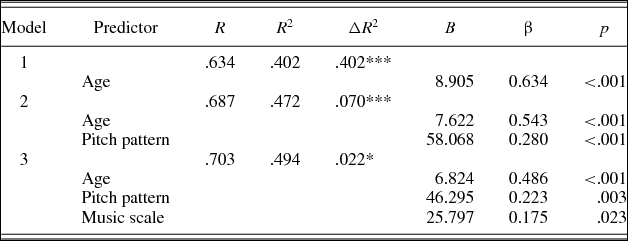
As is shown in Table 3, the best prediction of narrative score was made by the combination of age, pitch pattern perception, and music scale, in that order. After age, pitch pattern perception was the best predictor of language ability, accounting for 7% of the variance in narrative scores. This was followed by music scale, which accounted for an additional 2.2%. It is important that music rhythm did not explain any additional variance in narrative scores. These findings demonstrate that sensitivity to pitch information, regardless of whether it occurs in a musical context, predicts language development in Cantonese-speaking children. In Western languages, temporal information may matter most in language development (Goswami et al., Reference Goswami, Thomson, Richardson, Stainthorp, Hughes and Rosen2002), but in a complex tone language such as Cantonese, sensitivity to pitch information may be of greater importance. The implications for a universal account of language development are that the learner's culture and language specify the functional importance of phonetic features and determine which features will have the greatest weight during the course of development.
Stepwise multiple regression showing the unique variance in narrative score accounted for by age, pitch pattern perception, and music scale scores

Note: B is the unstandardized coefficient, β is the standardized coefficient, and ΔR 2 is the unique variance accounted for by the additional step employed by model.
*p < .05. ***p < .001.
DISCUSSION
These findings provide general support for our LSAC hypothesis. Although all linguistic features are necessarily tied to brain mechanisms, the importance of a linguistic feature to language development will depend on the demands of the specific language in question. From this perspective, processing of a single cue, be it rhythm or pitch, cannot universally account for language development across languages because languages differ in the functional importance that they place on such features.
This LSAC principle has been hinted at in the literature, although predominantly limited to reading research (e.g., Papadopoulos et al., Reference Papadopoulos, Georgiou and Parrila2012). In terms of linguistic specificity, it has been argued that Chinese reading differs from reading in many Western languages because it is more related to orthography than phonological awareness (Tan, Spinks, Eden, Perfetti, & Siok, Reference Tan, Spinks, Eden, Perfetti and Siok2005), but such an explanation is not conclusive because sensitivity to phonological information continues to play an important role in Chinese reading acquisition (Shu, Peng, & McBride-Chang, Reference Shu, Peng and McBride-Chang2008; So & Siegel, Reference So and Siegel1997). In general, caution must be exercised when applying conclusions drawn from studies on reading to overall language abilities because there is evidence for a double dissociation between reading and language: first, because language development entails numerous skills besides reading; and second, because reading is not always affected in language impairment (Scarborough, Catts, & Kamhi, Reference Scarborough, Catts, Kamhi, Catts and Kamhi2005), as observed in cases of hyperlexia (Newman et al., Reference Newman, Macomber, Naples, Babitz, Volkmar and Grigorenko2007). It has been suggested that babbling may be similar across languages, due to the biomechanics of the human vocal apparatus (MacNeilage & Davis, Reference MacNeilage and Davis2000), but the effects of language-specific influences as specified by the LSAC hypothesis become more evident in later language development. Consistent with the LSAC hypothesis, recent work on Mandarin infants has uncovered that language-specific perceptual patterns for tones are evident at as early as 4 months of age, earlier than for vowels and consonants (Yeung, Chen, & Werker, Reference Yeung, Chen and Werker2013), suggesting that for tone-language-learning infants, sensitivity to tones precedes speech segments such as vowels and consonants.
The observation that music scale contributed unique variance to narrative scores challenges the view that language development relies solely on linguistic mechanisms. Rather, the findings suggest that an important contribution to language processing is made by basic auditory-processing mechanisms. This is consistent with findings from the neuroscientific literature, which demonstrate that speech and nonspeech processing of pitch are subserved by the same primary auditory regions (Wong et al., Reference Wong, Warrier, Penhune, Roy, Sadehh and Parrish2008). Thus, the processing of more basic auditory features (i.e., pitch) may be an important component of language learning.
Our results also provide support for a developmental connection between language and music across both pitch and rhythm aspects. With regard to musical pitch in particular, our findings here may also shed light onto the developmental trajectory for the enhanced musical pitch perceptual abilities found in Cantonese-speaking adults (Wong et al., Reference Wong, Ciocca, Chan, Ha, Tan and Peretz2012).
Our findings make an important contribution to our understanding of the auditory basis of language development, but the study has several limitations. First, although the tasks employed here are based on those of previous work (Huss et al., Reference Huss, Verney, Fosker, Mead and Goswami2011; To et al., Reference To, Stokes, Cheung and T'sou2010; Wong et al., Reference Wong, Ciocca and Yung2009), they differ from those employed by Goswami et al. (Reference Goswami, Wang, Cruz, Fosker, Mead and Huss2011). Nevertheless, if rhythm detection provides a universal account of language development, we would expect rhythm to be a better predictor of language development, even when using a narrative story-retelling task to index language ability. In our analysis, sensitivity to rhythm did not explain unique variance in narrative ability, although pitch sensitivity did. Second, school children from only a single language background, Cantonese, were tested. These limitations should be addressed in future studies to test the generalizability of our conclusions. The present findings challenge the universality claims of the rhythm detection hypothesis. According to that hypothesis, sensitivity to rhythm may provide a universal account of phonological development. Our results indicate that this hypothesis does not account for the narrative abilities of Cantonese children. We contend that this is due to the processing demands of Cantonese, a complex tone language.
The LSAC hypothesis postulates that the set of auditory cues required is language specific and reflects the demands of the language in question. What is required next is a way of specifying the exact cues that drive development in each language. For tone languages, the crucial cue may be pitch sensitivity. For stress-timed languages, it may be rhythm. For syllable-timed languages with transparent orthographies (e.g., Greek), it may be phoneme-to-grapheme mapping (Georgiou, Protopapas, Papadopoulos, Skaloumbakas, & Parrila, Reference Georgiou, Protopapas, Papadopoulos, Skaloumbakas and Parrila2010). The present results and LSAC hypothesis provide a framework for systematically exploring these language-specific differences in cue sensitivity and their contribution to language development in future research.
Future research may also examine the neural developmental trajectory of the observed connection between narrative and musical pitch. In addition, the findings may inform future investigations concerning the universality of the treatments of language processing disorders. Follow-up investigations are required examining Cantonese dyslexic children. A speculative hypothesis at this point is that whereas the underlying deficit in Western languages may be timing related and thus require timing-based treatments (see Goswami et al., Reference Goswami, Thomson, Richardson, Stainthorp, Hughes and Rosen2002), in Cantonese the underlying deficit may be pitch based, and as a result, a pitch-based treatment therapy may be more beneficial. These different treatment possibilities await testing in future research.
In conclusion, it has been suggested that rhythm detection may be the language-universal mechanism that underlies language development. To test this assertion, we examined language development using a comprehensive narrative task in Cantonese children, and also assessed their rhythm and pitch-based auditory abilities, to consider whether processing of rhythm drives development in a tone language. Pitch explained unique variance in narrative ability after age, whereas rhythm did not. The findings demonstrate that the cues that are fundamental to development are dependent on the specific processing demands of each language, rather than being universal.
ACKNOWLEDGMENTS
This work was supported by the Chinese University of Hong Kong–Utrecht University Joint Center for Language, Mind and Brain; Lui Che Woo Institute of Innovative Medicine at the Chinese University of Hong Kong; US National Institutes of Health Grants R01DC008333 and R01DC013315; National Science Foundation Grant BCS-1125144; Research Grants Council of Hong Kong Grants 477513 and 14117514; Health and Medical Research Fund of Hong Kong Grant 01120616; and the Global Parent Child Resource Centre Limited.