


Introduction
In nature, piglets are gradually weaned between 14 and 18 weeks of age(Reference Van Kerschaver, Turpin and Michiels1,Reference Jensen and Stangel2) . In intensive pig farming, however, they are normally weaned at only 3–4 weeks of age. The abrupt shift from suckling to consumption of solid food is associated with social, environmental and physiological stress(Reference Ramirez, Hayes and Condotta3,Reference Lallès, Bosi and Smidt4) . Technological advancements in housing, nutrition, health and management have been developed to mitigate these negative consequences, but weaning still challenges piglets(Reference Campbell, Crenshaw and Polo5) and is often argued as the most stressful event in a pig’s life.
Weaning-related stress is closely associated to alterations in gut morphology and function(Reference Cao, Hou and Sun6), intestinal microbiota(Reference Saladrigas-García, D’Angelo and Ko7), intestinal permeability(Reference Tang, Xiong and Fang8), mucosal immune function(Reference Cao, Hou and Sun6) and the oxidation–antioxidant system(Reference Novais, Deschêne and Martel-Kennes9). These challenges are exacerbated by the immature state of the piglet’s digestive system, particularly regarding the secretion of digestive enzymes and acid regulation(Reference Shi, Wang and Kang10). At this young age, the stomach is not acidic enough to denature the biochemical structure of plant proteins or to facilitate the action of pancreatic and intestinal enzymes such as proteases, aminases and peptidases(Reference Mackie and Macierzanka11). Most digestive enzymes except for lactase have only a limited secretion in the first weeks after weaning; the rate of secretion increases progressively as the piglets age and consume more solid feed(Reference Shi, Wang and Kang10,Reference Gao, Yu and Yu12) . The negative effects of improper weaning in piglets can be severe, including gastrointestinal disorders and a systemic pro-inflammatory state. These disorders ultimately result in suboptimal performance(Reference Lallès, Bosi and Smidt4,Reference Novais, Deschêne and Martel-Kennes9,Reference Canibe, Højberg and Kongsted13) .
Proper nutrition can alleviate these undesirable weaning effects, and extensive research has been performed on optimising weaning diets. Correct selection of nutritional interventions is important, particularly when piglets are weaned earlier and/or lighter(Reference Collins, Pluske and Morrison14). One strategy is to include highly digestible and palatable ingredients(Reference Tokach, Pettigrew and Johnston15). These ingredients are added to replace the easily digestible nutrients provided by sow’s milk during the gradual weaning process in nature(Reference Jensen and Stangel2). This strategy theoretically helps the intensively farmed piglet to adapt to solid feed(Reference Collins, Pluske and Morrison14). The inclusion of highly digestible ingredients is usually made in place of less digestible plant-based ingredients such as maize and soybean meal. Both literature and practice refer to this nutritional approach as ‘increasing diet complexity’.
While ‘complex’ diets originally referred to diets including any ingredients other than maize and soybean, over time the concept of ‘complexity’ has lost its meaning. No generally accepted definition can be found in the literature. Nevertheless, intervention trials have been performed to improve the health and performance of weaning piglets using either ‘simple’ or ‘complex’ diets. Without a proper definition, these results are difficult to translate to generalised knowledge, since the definition of complexity differs between scientific papers with a wide variation in the number of high-digestible ingredients, the ingredients that are considered ‘complex’ and the inclusion level of these ‘complex ingredients’. This lack of a clear definition makes objective discussion and an overall analysis difficult. It is especially important to better standardise these terms to better understand research on complex diets.
Most of the papers share a common aim: to improve piglet nutrition. The present review explores the common ground among trials on complex diets published between 2001 and 2024 to better understand how ingredient choice can improve health and performance of piglets as well as the sustainability of pig production. In addition, we investigated what these papers reveal about the effect of ingredient choice on piglet health and performance and how ingredient choice affects sustainability. Finally, we reflect on ways to improve the terminology and understanding of research on ‘diet complexity’.
Diet complexity – current considerations
Complex diets and diet complexity are commonly used in discussions of piglet nutrition, but they lack a commonly agreed-upon definition. Authors tend to define diet complexity based on either (1) the ingredient list or (2) ingredient digestibility.
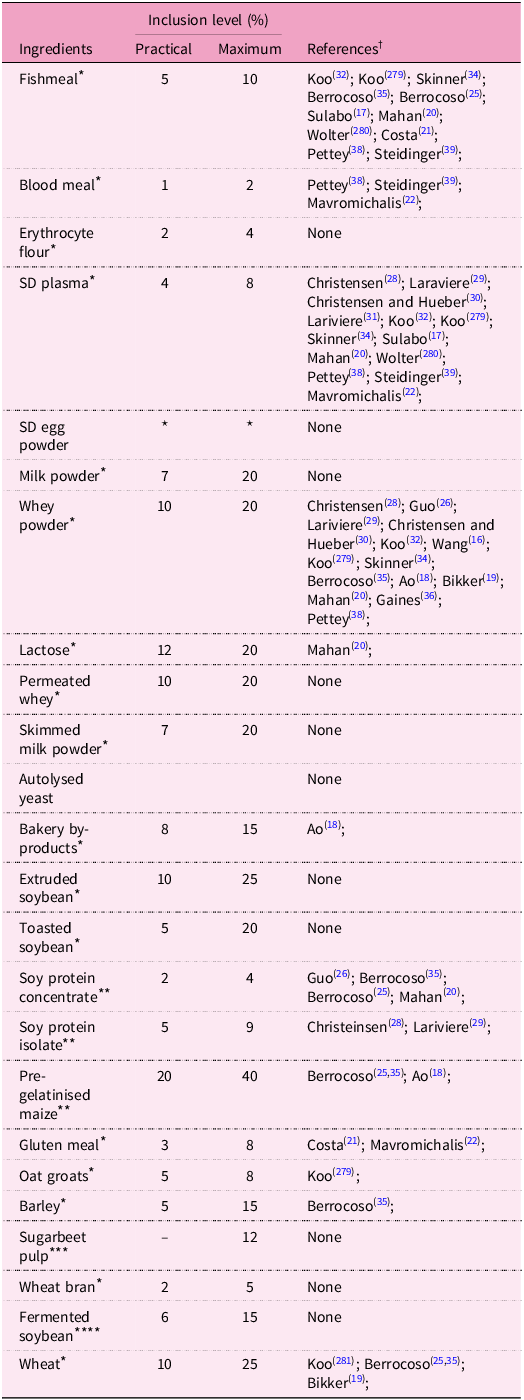
When authors define complex diets by ingredient list, they rely on both the number of ingredients and their proportion in the diet. Although the list of ingredients of complex diets varies from study to study, the following ingredients are generally included: milk protein; carbohydrates from whey and lactose; animal proteins such as from fish- and blood meal; animal plasma; and highly processed plant-based ingredients, such as pre-gelatinised maize and soybean protein isolate(Reference Collins, Pluske and Morrison14,Reference Wang, Chiba and Huang16–Reference Koo, Kim and de Lange27) . Animal fat and feed additives such as zinc oxide are also mentioned, but less frequently: only three of the twenty-three papers reviewed (Table 1) mention these special ingredients(Reference Guo, Wilson and Chiba26).
Papers studying diet complexity since the 2000s

Animal protein sources included: blood meal and fishmeal. Cereals included: barley and oat groats. Dairy products included: dried whey, lactose and skimmed milk powder. Feed additives: acidifiers, antibiotics, feed flavouring and zinc oxide. Processed plant ingredients included: canola meal, maize protein, DDGS, expanded maize, field peas, flaxseed meal, heat-processed maize, linseed meal, lupin kernels, potato protein concentrate, rice protein concentrate, soy protein concentrate, soy protein isolate, wheat gluten and wheat middling.
* Definition based on the criteria used by the authors on the original paper methodology.
** Ratio/subtraction of total number of ingredients in each diet not considering synthetic amino acids.
*** Ingredients in complex diets considered were either specifically mentioned by the authors in the paper’s methodology or were included in a higher proportion in complex diets.
Simple diets, by contrast, range from a truly simple formulation (maize–soybean meal)(Reference Wang, Chiba and Huang16) to formulations that mirror complex diets in ingredient composition but have higher inclusion levels of maize and soybean meal and lower inclusion rates of ‘complex ingredients’(Reference Hongtrakul, Goodband and Behnke40). Most simple diets fall somewhere in the middle(Reference Collins, Pluske and Morrison14,Reference Guo, Wilson and Chiba26,Reference Christensen, Zhu and Niazy28,Reference Christensen and Huber30,Reference Wolter, Ellis and Corrigan37) . These divergences further blur the line between the so-called complex and simple diet formulations.
Authors that define complexity by ingredient digestibility tend to focus on the inclusion of easily digestible protein sources(Reference Christensen, Zhu and Niazy28–Reference Lafleur Larivière, Zhu and Zettell31,Reference Skinner, Levesque and Wey34,Reference Wolter, Ellis and Corrigan37) . Animal proteins have weaker binding forces than plant proteins, which increases their digestibility(Reference Carbonaro, Cappelloni and Nicoli41,Reference Pieper, Villodre Tudela and Taciak42) . Plant proteins subjected to processing (heat, fermentation, grinding) also showed increased digestibility(Reference Lafleur Larivière, Zhu and Sharma29,Reference Christensen and Huber30) and may also be added to increase diet complexity.
Further complicating the discussion, some authors define complexity in a gradient and not in absolutes: instead of working with a complex/simple treatment, they opt to classify complexity in high, low, medium or semi-complex(Reference Collins, Pluske and Morrison14,Reference Christensen, Zhu and Niazy28–Reference Christensen and Huber30,Reference Koo, Choi and Yang32) . These levels are defined according to level of inclusion of an ingredient, number of highly digestible ingredients, and phase feeding.
As none of the current definitions of diet complexity is applied consistently, focusing on terminology is irrelevant. What is relevant is that all abovementioned examples share the same aim, namely, to formulate diets that favour the growth, health and well-being of piglets after weaning. Nutritionists share that aim when formulating diets for weaned piglets.
Ingredients in weanling diets to alleviate the weaning process
Newly weaned piglets have high nutritional requirements in the first days after weaning owing to their tremendous potential for development. The stress of weaning can stunt the piglet’s development(Reference Wu, Zhao and Xu43–Reference Zhong, Zhang and Li45). The first post-weaning diets can help the young animals to cope with the challenges of weaning and support their growth and health by including highly digestible and palatable ingredients. It is expected that these ingredients can help to minimise systemic inflammation of the animals, boost their immune system, modulate their gastrointestinal microbiota and meet their nutritional demands more efficiently(Reference Wensley, Tokach and Woodworth46). Diets formulated with highly digestible ingredients incorporate multiple macro-ingredients at varying inclusion rates(Reference Wensley, Tokach and Woodworth46–49).
Across the globe, a shift towards extending the weaning age in pig production has been observed. In North and South America, for example, recent production guidelines have moved towards a weaning age of 24 d, compared with the previously common 20–21 d. In Europe, recommendations now exist to extend the weaning age from 24 d to 28 d.
When piglets are weaned later and can better digest unprocessed plant-based ingredients, the use of less complex, lower-cost diets after weaning tends to increase. However, this shift may still impose nutritional stress during a critical period of adaptation. As piglets are weaned older, the use of diets that incorporate highly digestible and palatable ingredients will also increase in the form of creep feeding during the pre-weaning phase. A recent meta-analysis(Reference Muro, Carnevale and Monteiro50), which included twenty studies on creep feeding, concluded that the ingestion of dry feed during lactation can improve pre-weaning piglet performance. This finding supports the hypothesis that sow milk alone is insufficient to fully meet the nutritional requirements of large and fast-growing litters. In addition, it was demonstrated that creep feeding using ‘complex’ diets is more effective in promoting piglet’s consumption and improved performance compared with ‘simple’ diets(Reference Collins, Morrison and Smits51,Reference Sulabo, Bergstrom and Tokach52) .
Despite the higher cost associated with the highly digestible ingredients in creep feeding, their strategic use in early nutrition (both in creep feeding and in post-weaning diets) is widely recognised as a means to improve performance(Reference Rodrigues, Koo and Nyachoti47) and increase the diversity of the intestinal microbiota of pigs(Reference Fouhse, Zijlstra and Willing53). This section presents common categories of ingredients used in complex diet formulations, highlighting the differences between ingredients within each category, their effects and the rationale for their inclusion. Recommended inclusion levels for these ingredients are addressed in section 6.
Maize and soybean meal
Soybean is one of the main protein sources used in pig feed formulations. Soybean meal is a source of high-quality protein with a rich amino acid profile. However, its use for young piglets can be problematic due to the anti-nutritional factors present in soybeans(Reference Boehm, Nguyen and Tashiro54). Kunitz and Bowman–Birk factors act as inhibitors of trypsin and chymotrypsin, which are crucial digestive enzymes. Their presence significantly hampers the efficient digestion of soybean meal, leading to decreased nutrient absorption and disruption of the metabolic processes that are essential for the optimal growth and development of piglets(Reference Chen, Wedekind and Escobar55).
Other anti-nutritional factors in soybeans are β-conglycinin and glycinin, which can induce intestinal and systemic inflammation in allergic piglets(Reference Zhao, Naren and Qiang56). The oligosaccharides such as raffinose and stachyose are present in soy, which also reduce its digestibility. Chyme viscosity is increased, which hinders the capacity of digestive enzymes to break down nutrients and, thus, reduces digestibility(Reference Zeng, Zhang and He57). Oligosaccharides also promote an increase in chyme volume, which can lead to dysbiosis, and the production of biogenic amines which are associated with intestinal inflammation(Reference Dersjant-Li and Peisker58). Starch digestibility is also compromised in young piglets. Since amylase secretion is still depressed at 3–4 weeks of age, weanling piglets cannot easily digest the low amylose and high amylopectin composition of maize(Reference Lindemann, Cornelius and El Kandelgy59,Reference Yan, Wu and Li60) .
Maize and soybean meal are the main ingredients replaced in feed formulations to increase complexity in American and Asian countries(Reference Galiardi, Genova and Carvalho61–Reference De Lima, Tavernari and Lelis64). While both are important sources of nutrients for older pigs, they pose a challenge to the weaners’ adaptation to a solid diet. Partial replacement of maize and soybean meal in weaner diets in most economically viable, with the replacement ingredients being more digestible and capable of providing extra nutritional benefits as described in the sections below.
Animal protein sources and bioactive ingredients
Animal protein sources are frequently included in complex diets owing to their high digestibility. Fishmeal is among the most used animal protein sources worldwide; however, its nutritional composition and inclusion levels vary according to regional availability and the quality of available products(Reference Jasour, Wagner and Sundekilde65). Fishmeal quality is influenced by the type of fish included and whether it is being used as a product or as a by-product. An additional criterion to assess fishmeal quality is the degree of enzymatic and bacterial deterioration, which produces bacterial metabolites and may cause lipid peroxidation, compromising the product’s shelf life(Reference de Koning66).
Most authors(Reference Jones, Woodworth and Goodband67–Reference Jones, Rooper and Wilson69) use fishmeal inclusion levels up to 6% in diets of weaned piglets. Jones et al.(Reference Jones, Rooper and Wilson69) observed a linear improvement in piglets’ performance of animals weaned at 21 d of age using 6% as the highest inclusion. Berrocoso et al.(Reference Berrocoso, Serrano and Cámara25) agree with these findings and attributed the improved performance to an increased feed intake due to the palatability of the ingredient.
Blood-derived ingredients such as blood meal and erythrocyte meal are low-cost animal protein sources(Reference Selden, Brown and Ostrowski70) and have been shown to be effective ingredients for weaner pigs, independent of blood source (bovine, porcine or avian)(Reference Kats, Nelssen and Tokach71). Traditional methods of drying blood can depreciate its amino acid balance and worsen its palatability(Reference Waibel, Cuperlovic and Hurrell72); these negative consequences can be partially prevented by fermentation(Reference Pérez-Gálvez, Almécija and Espejo73,Reference Chang, Yin and Wang74) . Nonetheless, the amino acid profile of blood products can be challenging when formulating diets. The isoleucine-to-lysine ratio in blood products is low, which in turn requires isoleucine supplementation. This represents a risk of compromising productive performance at higher doses of blood meal(Reference Waguespack, Dean and Bidner75). Kats et al.(Reference Kats, Nelssen and Tokach71), when evaluating weaned piglets from the end of the first week after weaning to 28 d in the nursery, verified that the optimum inclusion level of dried blood meal is 1·9%. This inclusion level is verified by Zhang et al.(Reference Zhang, Yang and Zhang76); the authors included blood cells and other processed blood products at and under the 2% inclusion level. They observed several positive effects on intestinal morphometry and microbiota modulation associated with this inclusion level.
Spray-dried bovine or swine plasma is a concentrated protein source (75–90%). It is highly digestible, has a high lysine content (7–8%), has a diverse amino acid profile and is rich in vitamin B12 and minerals such as Ca, P, Na, Cl, Mg and K(49,Reference Almeida, Htoo and Thomson77,Reference Polo, Opriessnig and O’Neill78) . The technique of spray drying preserves the immunoglobulins, growth factors, bioactive peptides and other biological components present in the plasma, allowing it to exert protective effects on the intestinal mucosa and interact with the gut-associated lymphoid tissue(Reference Blavi, Solà-Oriol and Llonch79).
The inclusion of dried plasma in the first post-weaning diets commonly varies between 2% and 5%, although inclusions of up to 7% or 8% are sometimes adopted(Reference Torrallardona80,Reference Remus, Andretta and Kipper81) . The high price of plasma limits its use in practice(Reference Jang and Kim82). Inclusion of plasma in diets shows a dose-dependent effect, with immediate repercussions on piglet’s health and performance(Reference Balan, Staincliffe and Moughan83). Several studies observed positive effects associated with spray-dried plasma inclusion on post weaning diets(Reference Bosi, Casini and Finamore84–Reference Torrallardona and Polo86). These results seem to be consistent independently of the source of plasma(Reference Balan, Staincliffe and Moughan83).
The bioactive biological components in plasma interact with gut-associated lymphoid tissue (GALT), helping to prevent intestinal inflammation(Reference Zhang, Yang and Zhang76,Reference Balan, Staincliffe and Moughan83,Reference Bosi, Casini and Finamore84) , maintain intestinal barrier integrity and, thus, minimise diarrhoea. This effect has been attributed to the local action of immunoglobulin G and the modulation of tight junction proteins expression in the small intestine(Reference Balan, Staincliffe and Moughan83,Reference Zhang, Zheng and Yu87,Reference Peace, Campbell and Polo88) . A possibly cheaper alternative to spray-dried plasma is spray-dried egg powder (SDEP)(Reference Ruckman, Petry and Gould89). SDEP offers highly digestible protein and is a source of bioactive compounds, containing immunoglobulins G and Y and lysozymes(Reference Song, Kim and Kim90–Reference Heo, Kiarie and Kahindi92). When producing eggs for SDEP, the laying hens can be hyperimmunised to produce eggs that contain immunoglobulins to specific antigens of diseases that commonly affects weaned piglets(Reference Li, Zhao and Lei93–Reference Pettigrew96). Lysozymes can cleave N-acetylmuramic acid and N-acetylglucosamine residues in Gram-positive bacteria(Reference Schmidt, Nyachoti and Slominski97–Reference May, Wells and Maxwell99). Song et al.(Reference Song, Kim and Kim90) reported that an inclusion of 5% of SDEP in weaner diets improved performance and increased feed intake, even compared with a diet using spray-dried plasma.
When considering animal protein sources, nutritionists should aim to provide highly digestible protein sources with appropriate amino acid compositions and positive extra-nutritional effects. Although some of the abovementioned ingredients may not be the most cost-effective sources of amino acids, their bioactive components contribute to improved intestinal and systemic health that may ease the challenges associated with weaning.
Dairy products
Immediately after weaning, lactose is still an important source of energy for piglets. Dairy (co-)products, represented mainly by milk powder (whole or skimmed), whey powder, permeated whey and lactose, act primarily as a source of lactose as well as high-quality proteins(Reference Jang and Kim82,Reference Jang, Purvis and Kim100) . Whey composition is influenced by processing and is thus classified as either acidic (casein coagulation processing) or sweet (enzymatic processing)(Reference Bansal and Bhandari101). Whey permeate, a co-product obtained after removal of whey proteins and other solids via physical filtration of liquid whey(Reference Menchik, Zuber and Zuber102) is commonly used in human food with limited application in animal feed.
Lactose concentrations differ between these products, with ranges of 36% to 48–51%, 48–51%, 72–73% and 80–85% in whole milk powder, skimmed milk powder, whey powder and whey permeate, respectively(49,Reference Kim, Chen and Pearce103) . Lactose has been shown to improve the palatability of the diet and increase feed consumption.(Reference Jang and Kim82,Reference Zhao, Zhang and Zhang104) .
Some authors suggest a dose-dependent response attributed to the use of dairy products in the diets of weaned piglets(Reference Jang, Purvis and Kim100,Reference Pierce, Callan and McCarthy105) . Despite a large number of studies, there is still no consensus regarding recommended levels of lactose inclusion for weaned piglets. These inconsistencies are attributed to the genetic and environmental changes in the piglet experiments among the studies(Reference Jang and Kim82). In a meta-analysis, Zhao et al. (Reference Zhao, Zhang and Zhang104) concluded that the recommended lactose inclusion should be 20% and 15% for piglets at 0–7 d of age and at 7–14 d post-weaning, respectively. Jang and Kim(Reference Jang and Kim82) suggested that the recommended inclusion values for piglets should be 20% and 13% for piglets from 7 to 11 kg and from 5 to 7 kg, respectively.
Lactose is mentioned by some authors as essential to the definition of a complex diet(Reference Koo, Choi and Yang32,Reference Wolter, Ellis and Corrigan37,Reference Steidinger, Goodband and Tokach39) , as it is an important factor in piglets’ early nursery performance success and intestinal health. Dairy coproducts can offer varying levels of lactose and milk proteins, depending on ingredient processing. Despite its nutritional importance, lactose is highly fermentable in the gut; thus, inclusion of excessive lactose in the diet can negatively impact the development and function of the organs(Reference Zhao, Zhang and Zhang104,Reference Pierce, Callan and McCarthy105) .
Yeasts
Autolysed yeast, which is derived from various yeast strains, including Saccharomyces cerevisiae, Saccharomyces boulardii, Candida utilis and Kluyveromyces arxianus, can also be used in weaner diets(Reference Demirgül, Şimşek and Bozkurt106). Autolysed yeast features a highly digestible crude protein (CP) content of up to 41·3% on a dry matter (DM) basis and a rich profile of essential amino acids, notably lysine (2·71%) and glutamate (4·16%)(Reference Hu, Che and Luo107). In addition to this nutritional value, autolysed yeast offers prebiotic effects due to the presence of cell wall compounds such as β-glucans 1–3 and 1–6, which are known for their immunomodulatory properties(Reference Stier, Ebbeskotte and Gruenwald108). Furthermore, yeast has a notable concentration of nucleotides, an essential nutrient for supporting the repair and development in the intestinal mucosa of newly weaned piglets(Reference Elghandour, Tan and Abu Hafsa109,Reference Sauer, Mosenthin and Bauer110) .
The inclusion of autolysed yeast in weaned piglets’ diets has beneficial effects on performance. It can enhance feed intake(Reference Shurson111) when included below 5%(Reference Boontiam, Bunchasak and Kim112), and it can lead to increased average daily gain (ADG) and improved feed use efficiency (FE)(Reference Li, Zhao and Lei93). Pereira et al.(Reference Pereira, Donzele and Silva113) linked these effects to improved villi height and crypt depth.
Bakery by-products
Bakery by-products are known by many names (dried bakery products, bakery waste, cookie meal, bread meal, biscuit meal and so on) and vary in composition and nutritional value according to the source component (for example, breads, cookies, cakes, crackers, doughs, chips, pasta, snacks, nuts, cereals, flour, baked goods and related food by-products). These ingredients are obtained by separating them from non-edible materials then processing them (mixing, grinding and heat treatment)(Reference Ottoboni, Tretola and Luciano114,Reference Malamakis, Patsios and Melas115) .
As bakery by-products can include various ingredients, their nutritional composition may vary depending on the region in which they are produced. In a study that tested different sources of bakery by-products in several North American states, Liu, Jha and Stein(Reference Liu, Jha and Stein116) identified only few differences in nutritional composition, with average results of 91·84 ± 1·29% DM, 12·20 ± 2·16% CP, 9·38 ± 1·95% fat, 44·61 ± 5·47% starch and 13·77 ± 4·23% neutral detergent fibre (NDF). The amino acid profile was also similar among the bakery by-products tested.
Bakery by-products often undergo thermal processing before they are added to piglet diets, which increases the digestibility of their nutrients(Reference Ottoboni, Tretola and Luciano114,Reference Termatzidou, Dedousi and Kritsa117) . These ingredients have a high energy content that lends high palatability to the diet and are characterised by low amounts of antinutritional factors such as tannins, glucosinolates and heat-labile trypsin inhibitors(Reference Tiwari, Dhakal and Sah Sudi118).
Termatzidou et al.(Reference Termatzidou, Dedousi and Kritsa117) reported that the inclusion of bakery products at levels of 15% to 20% exhibited positive effects on general growth parameters in piglets weaned at 28 d of age. Moreover, Tiwari, Dhakal and Sudi(Reference Tiwari, Dhakal and Sah Sudi118) tested inclusion rates of bakery by-products up to 75% and concluded that the most favourable performance outcomes were achieved when included at a rate of 50%.
Even with the positive results observed with inclusion levels of bakery by-products up to 50%, it is uncommon to see inclusions above 10% in commercial diets. This can be explained by a lack of quality assurance and standardisation of the product, which warrants caution when adding bakery by-products.
Processed plant-based ingredients
Processing of plant-based ingredients may increase their digestibility, degrade antinutritional factors and reduce the challenges of weaning(Reference Taliercio and Kim119–Reference Pangeni, Jendza and Menon122). Soybean can be processed in different ways, resulting in products such as toasted soybean, extruded whole soybeans, soy protein concentrate and soy protein isolate. Both toasted and extruded whole soybeans contain oil and thus have a higher energy content than soybean meal, which are defatted(Reference Kiarie, Parenteau and Zhu123).
In soy protein concentrate, soluble carbohydrates are removed, resulting in an increased CP content of approximately 15–23% compared with soybean meal(Reference Peisker124). Solubilisation of soybean or soy flakes in water results in soy protein isolate. This isolate is similar to soy protein concentrate, but the latter has a higher carbohydrate fraction(Reference Smith and Dilger125). When evaluating the ileal digestibility of amino acids from various soy co-products in barrows, Cervantes-Pahm and Stein(Reference Cervantes-Pahm and Stein126) reported superior digestibility of essential amino acids in soy protein isolate in comparison with soybean meal and enzyme-treated soybean meal. However, the use of soy protein concentrate as a replacement of animal-based protein sources (for example, fishmeal, spray-dried animal plasma) can lead to reduced palatability and lower feed consumption. This can impair performance, particularly in the first week after weaning(Reference Deng, Duarte and Jang127)
Regarding products from the maize industry, pre-gelatinised maize plays a significant role in pre-starter diets, particularly due to its enhanced digestibility and absorption properties compared with untreated maize grain. The extrusion processing alters the starch structure of maize grain, improving its digestibility and palatability(Reference Sun, Lærke and Jørgensen121,Reference Oliveira, Moreira and Furlan128,Reference Solà-Oriol, Roura and Torrallardona129) . The quality of pre-gelatinised maize is defined by the degree of starch gelatinisation. Studies have shown that gelatinisation values ranging from 41·82% to 62·60% result in improved digestibility of protein and ether extract in the diet compared with untreated maize. Pre-gelatinised maize is commonly included in pre-starter diet alongside maize, typically replacing 40–52% of the total maize content without compromising performance(Reference Deng, Wu and Liu130,Reference Moreira, Oliveira and Furlan131) .
Another co-product of the maize industry is maize gluten meal, a product virtually free of starch and germ; these components that are mechanically extracted through wet grinding of maize kernels(Reference Stock, Lewis and Klopfenstein132). The product contains 60–70% of CP and a low concentration of NDF(Reference de Godoy, Bauer and Parsons133).
The processing of plant-based ingredients can reduce anti-nutritional factors and improve digestibility, allowing higher inclusion of these ingredients with fewer harmful effects in weaner diets. However, this does not mean that all animal products should be replaced, as they often ensure better palatability in the diet, which is particularly important during the couple of weeks after weaning. The local availability of plant-based ingredients should also be considered before including them in the diet.
Cereals and other fibre sources
The literature mentions different sources of cereals (oat, barley and rye, among others) as ingredients of complex diets(Reference Collins, Pluske and Morrison14,Reference Sulabo, Tokach and DeRouchey17,Reference Christensen, Zhu and Niazy28,Reference Skinner, Levesque and Wey34,Reference Wolter, Ellis and Corrigan37) , being added as a source of energy in place of maize. One benefit is that cereals can have a higher protein content than maize; thus, their inclusion also reduces the inclusion of soybean meal in the formulation. For example, oat and barley contain 13·90% and 11·33% CP, respectively, while maize has only 8·24%(49).
Cereals have a high fibre content, which can be a problematic nutrient for weaned piglets. Historically, fibre has been avoided in weaner diets as it lowers nutrient density. This, in turn, requires that the animals increase their consumption to reach minimal nutritional requirements. The use of cereals started mainly in European countries as they present a cost-effective alternative to maize. In the rest of the world, nutritionists increased the application of cereals in weaner diets primarily due to the cereal’s fibre content and profile, as recent findings reveal that fibre has some health-promoting effects.
The cereal fibre profile has both insoluble and soluble fibres. Some studies have shown that a mix between both categories can improve piglet intestinal health and performance as they are fermented in different parts of the intestines: soluble and insoluble fibre are fermented mainly in the small and large intestine, respectively(Reference Molist, van Oostrum and Pérez134). The fibres from cereals are rich in non-starch polysaccharides (NSP) such as arabinoxylans and β-glucans, which may have a prebiotic potential when fed to pigs(Reference Adebowale, Yao and Oso135,Reference Choi and Kim136) . Other fibre sources such as beet pulp and wheat bran also show similar potential to improve health and performance(Reference Grześkowiak, Saliu and Martínez-Vallespín137).
Fibre is digested by the microbiota through fermentation, which yields important metabolites for intestinal development and nutrition, short-chain fatty acids (SCFA)(Reference Koh, De Vadder and Kovatcheva-Datchary138). By offering NSP in the diet, microbiota is modulated with an increasing proportion of lactobacilli in the gut and better acidification of the digesta(Reference Högberg and Lindberg139,Reference Wellock, Fortomaris and Houdijk140) . The increase in Lactobacillus and butyrate production is associated with the promotion of intestinal barrier integrity and function(Reference Wang, Gong and Wang141,Reference Peng, Li and Green142) . Including fibre in the diet also increases the expression of tight junction proteins, interleukin (IL)-10 and Muc1 in the ileum of supplemented piglets(Reference Chen, Chen and Tian143), which contribute to this secondary effect. The main consequence is that pigs fed high-fibre diets show improved development of the large intestines and lower incidence of diarrhoea(Reference Chen, Chen and Tian143,Reference Diao, Jiao and Yu144) .
The improvement in intestinal health and microbiota profile can be translated into improved apparent total tract digestibility of DM and CP(Reference Chen, Chen and Tian143,Reference Molist, de Segura and Gasa145) , but this finding is not always consistent, as high-fibre diets can also lower apparent total tract digestibility of energy, protein and ash(Reference Gao, Chen and Huang146,Reference Zhang, Zhang and Lai147) . One alternative could be to add heat-treated fibre sources, as heat treatment of cereals can improve their nutrient digestibility. This might at least partially counter this negative effect(Reference Medel, Salado and de Blas148,Reference Mateos, López and Latorre149) . However, the increased nutrient digestibility in heat-treated cereal products lowered one of its positive effects, namely SCFA production(Reference Rodrigues, Badiola and Francesch150).
Fibre clearly promotes intestinal health, but this benefit does not always translate into improved performance. However, the literature reports that provision of fibre in appropriate inclusion levels and, most importantly, the category of fibre or fibre blend can improve ADG and FE, or at least can lead to performance similar to control diets without the inclusion of additional fibre sources(Reference Chen, Chen and Tian143,Reference Molist, de Segura and Gasa145,Reference Pascoal, Thomaz and Watanabe151) .
Essential fatty acids
Fatty acids (FA) serve numerous functions in the organism and play a key role in maintaining metabolic homeostasis. They influence insulin and glucagon receptors, modulate ion channels in cells and regulate glucose, total protein and lipid levels in the liver and plasma.(Reference Rodrigues, Badiola and Francesch150–Reference Hess, Corl and Lin152). Furthermore, FAs have an important role in cell membrane formation, as they act in the incorporation of phospholipids(Reference Hess, Corl and Lin152). This is an essential function, considering that, in the following days after weaning, oxidative stress and the presence of pathogens lead to damage to the enterocyte’s membrane, compromising the epithelial barrier of the gastrointestinal tract(Reference Tang, Xiong and Fang8). They also can modulate the immune system and reduce the severity of inflammatory disorders(Reference Yates, Calder and Rainger153).
Essential fatty acids are not synthesised by pigs and must be supplied by the diet. Omega-6:linoleic acids (LA) and omega-3:α-linolenic acid (ALA) are the main essential fatty acids considered for piglet’s nutrition(Reference Lauridsen154,Reference Nong, Wang and Zhou155) . Both LA and ALA must first be converted into bioactive long-chain polyunsaturated fatty acids (PUFA) such as eicosapentaenoic acids (arachidonic, ARA; eicosapentaenoic, EPA) and docosahexaenoic acid (DHA)(Reference Metzler-Zebeli156,Reference Jacobi, Lin and Corl157) , which serve directly as precursors for the synthesis of bioactive lipid mediators. The most common and available dietary sources of EPA and DHA for pigs are fish oil and n-3 PUFA from algae(Reference Liu158).
In a study by Liu et al.(Reference Liu, Chen and Odle159), weaned piglets with induced intestinal lesions were fed a diet with 5% of fish oil. Their gut morphometric parameter improved and increased function of the intestinal barrier was observed together with gene expression of intestinal junction proteins, such as occludin and claudin-1, compared with piglets fed a diet with maize oil as a source of fatty acids. The authors also demonstrated that the benefits of fish oil on intestinal lesions are correlated with the inhibition of the signalling pathways of toll-like receptors that are responsible for the recognition of microbial structures and the generation of signals, which leads to the production of proinflammatory cytokines.
Yang et al.(Reference Yang, Jiang and Yu160) reported similar results when comparing piglets fed a maize–soybean meal containing soybean oil, or fish–palm–rice oil mixture or coconut–palm–rice oil mixture. Both groups with oil mixtures had lower serum concentrations of serum cytokines and improved intestinal morphometric parameters compared with the soybean oil. In addition, the group fed the oil mixture containing fish oil had higher levels of expression of junction protein in the duodenal and ileal mucosa and higher expression of nutrient transporter genes than the piglets fed with the soybean oil. These results suggest that the fatty acid profile of these ingredients is more closely aligned with the demands of the newly weaned piglet.
Diets containing oils rich in n-3 PUFA, such as flaxseed oil and fish oil, also have anti-inflammatory capacity in weaned piglets(Reference Lauridsen154,Reference Tang, Xiong and Fang161) . In vitro studies have demonstrated the inhibitory effects of EPA and DHA on the production of IL-1β and tumour necrosis factor-α (TNF-α) by monocytes(Reference Babcock, Novak and Ong162), as well as on the production of IL-6 and IL-8 by venous endothelial cells(Reference Khalfoun, Thibault and Watier163,Reference De Caterina, Cybulsky and Clinton164) .
While an optimal n-6-to-n-3 ratio of 2:1 to 3:1 has been suggested for humans, various ratios have been proposed for pigs, depending on their age, with ongoing research into the ideal proportion for both sows and piglets(Reference Nguyen, Agazzi and Comi165). For example, Yao et al.(Reference Yao, Li and Wang166) demonstrated that adjusting the n-6 PUFA ratio to 9:1 using a combination of n-6-rich maize oil and n-3-rich linseed oil improved immune function in piglets during the suckling period. The use of similar reference oils allows better comparison across studies. However, since maize oil has a broad n-6 ratio, results might vary when oils with narrower ratios or those lower in PUFAs, such as monounsaturated and saturated fats, are used as controls. Saturated long-chain fatty acids, such as those found in tallow, may offer anti-inflammatory benefits due to their stability against oxidation. Nevertheless, there are limited data on the effects of animal-based saturated fat sources on gut health and function in nursery piglets under practical conditions(Reference Metzler-Zebeli156). Further research is needed to fully understand the impact of different fatty acids on piglet development, particularly under farm conditions.
Mineral sources
Mineral content and bioavailability are often low in grains and oilseeds(Reference Byrne and Murphy167), which form the basis of pig diets; therefore, mineral supplementation is necessary to achieve optimal productivity. Mineral deficiency and toxicity can generate various clinical symptoms, depending on the mineral and its severity. Although these conditions are relatively rare in modern pig production, the precise requirements for certain minerals remain uncertain, as several nutritional guidelines provide only recommended levels of supplementation (for example, minimum amounts needed to overcome deficiencies)(Reference Sampath, Sureshkumar and Seok168). Moreover, the levels adopted by the industry are inconsistent and frequently deviate from established guidelines(Reference Dalto and da Silva169).
Due to environmental and economic considerations, nursery diets typically have a narrow safety margin for phosphorus content(Reference Goodband, Menegat and Williams170). Calcium sources, meanwhile, are generally inexpensive and are often used as fillers in premixes or other dietary components, which leads to oversupply. Nevertheless, calcium levels must be precisely controlled, as elevated concentrations can impair the efficacy of phytase and phosphorus digestibility(Reference Lee, Lagos and Bedford171) and down-regulate the expression of certain tight junction proteins that are critical for maintaining intestinal barrier function(Reference Suzuki172). In addition, calcium carbonate has a high buffering capacity and may impair gastric acidification, compromising protein digestibility(Reference Warner, DeRouchey and Tokach173), which is particularly relevant to piglets during the post-weaning phase.
Phosphorus plays a critical role in the growth and development of weaned pigs, particularly in supporting skeletal integrity and metabolic functions. Recent studies have demonstrated that the dietary calcium-to-phosphorus ratio (Ca:P) can significantly impact FE and bone mineralisation. Zhai et al.(Reference Zhai, Bergstrom and Zhang174) observed that increasing the dietary Ca:P beyond 0·93 reduced FE while increasing bone mass deposition in nursery pigs. Similarly, Bikker et al.(Reference Bikker, Fledderus and van Helvoort175) highlighted that an optimal Ca:P enhances utilisation and reduces urinary phosphorus excretion, mitigating potential environmental concerns. However, when dietary phosphorus is limiting, an imbalance in the Ca:P can lead to reduced performance akin to deficiencies in essential amino acids.
According to Bikker et al.(Reference Bikker, Fledderus and van Helvoort175), when dietary phosphorus is adequate, the negative impact of high dietary calcium on growth performance remains negligible at a standardised total tract digestible (STTD) Ca:P ratio below 1·4 (approximately 2·3 Ca:STTD P). Moreover, this effect remains relatively small within the range of 1·4–1·55 (approximately 2·3–2·6 Ca:STTD P).
Although trace minerals are required in smaller quantities, they are critical for immune function and overall performance. Zinc oxide in particular is a widely discussed and used trace mineral source. When used at pharmacological levels as an alternative to antibiotics (that is, ten to twenty times higher concentration of zinc than the nutrient requirement), zinc oxide can improve growth rates in piglets(Reference Hill176). However, excessive zinc use can lead to bacterial resistance, negatively impact feed palatability and interfere with the metabolism of other important minerals such as copper and iron(Reference Bonetti, Tugnoli and Piva177). Excessive zinc supplementation poses significant environmental concerns, leading some countries to enforce limits on zinc content in animal feed(Reference Duffy, Yin and Redding178).
Alternative mineral sources are discussed in literature. Minerals are typically supplied in the feed as inorganic minerals (for example, sulphates, carbonates, chlorides and oxides) that are reactive and can interfere with the metabolism of other nutrients(Reference Byrne and Murphy167). Market-available substitutes include chelated amino acid complexes or encapsulated sources of trace minerals(Reference Sampath, Sureshkumar and Seok168) that reduce unwanted interactions and enhance mineral bioavailability(Reference Byrne and Murphy167). Organic mineral sources are commonly used in the diets of sows and nursery pigs, where high bioavailability is especially important. The choice between organic and inorganic minerals is based primarily on the cost per unit of bioavailable minerals, with organic forms generally being more bioavailable and inorganic forms being more cost-effective.
Fermented products
Fermentation of individual ingredients is a well-established approach for improving the nutritional value of raw materials used in animal feed. When fermented, ingredients such as soybean meal undergo significant transformations that reduce the concentration of antinutritional elements and increase nutrient bioavailability. Fermentation alters the structural conformation and particle size of proteins, making it more digestible and suitable for young animals transitioning to solid feed(Reference Yuan, Chang and Yin179).
Microbial fermentation also enhances the release of chelated minerals(Reference Amadou, Amza and Foh180–Reference Dai, Yan and Xu182) and bioactive compounds, such as SCFA, which enhance gut health by modulating pH and inhibiting pathogens(Reference Liu, Xiao and Xiong183,Reference Missotten, Michiels and Degroote184) . Bacterial strains such as Bacillus subtilis have been shown to be especially effective in these processes, producing higher levels of soluble protein compared with fungal fermentation with Aspergillus. This results in improved amino acid digestibility and reduced populations of harmful bacteria such as Escherichia coli (Reference Missotten, Michiels and Degroote184).
Zhang et al.(Reference Zhang, Shi and Wang185) demonstrated a reduction of 92·4% in glycinin and 88·4% in β-conglycinin through the fermentation of soybean meal with Bacillus subtilis. This processing method thus results in a product of superior quality compared with soybean meal with increased metabolisable energy and amino acid digestibility.
When applied to complete feed formulations, fermentation offers additional advantages, particularly during the critical weaning phase in piglets. Fermented diets enhance the digestibility of nutrients by breaking down complex proteins and improving the bioavailability of key nutrients(Reference Xin, Wang and Xia186). Moreover, these diets promote the growth of beneficial bacteria, such as Lactobacillus, which play a key role in maintaining a balanced gut microbiota and suppressing pathogens(Reference Missotten, Michiels and Degroote184). This microbial balance is crucial for supporting intestinal health and reducing weaning-related stress in piglets.
In addition to improving nutrient digestion, fermented diets also strengthen the intestinal barrier function. Piglets fed with fermented feed exhibit higher expression of tight junction proteins, such as occludin and claudin, which fortify the gut barrier and prevent harmful bacteria from entering the bloodstream(Reference Liu, Xiao and Xiong183,Reference Xin, Wang and Xia186) . This not only improves gut integrity but also enhances the piglets’ growth performance and FE(Reference Liu, Xiao and Xiong183,Reference Missotten, Michiels and Degroote184) .
The overall impact of fermented diets, including the production of SCFA, better nutrient absorption and a stronger gut barrier, makes them a promising strategy to enhance the health and performance of weaned piglets, while also providing a natural alternative to antibiotic use in animal production systems.
Lower crude protein diets and alternatives
Newly weaned piglets are still in the exponential growth phase of their growth(Reference Besteiro, Arango and Rodríguez187). For this reason, historically, nursery phase diets have among the highest CP recommendations in the Nutrient Requirements of Swine and Brazilian tables, 20–23% and 22–23%, respectively(49,Reference Horacio Santiago, Luiz Fernando Teixeira and Arele Arlindo188) . Although recommended protein levels are high, early weaning depresses gastric and pancreatic protease production and stomach pH is higher than the ideal range for pepsin action (that is, 2·0–3·5)(Reference Alizadeh, Akbari and Difilippo189), which impairs digestion, leading to diarrhoea and lower performance(Reference Opapeju, Krause and Payne190). The antinutritional factors and low-bioavailability proteins present in unprocessed plant-based ingredients hinder protein digestion in this period even further(Reference Carbonaro, Cappelloni and Nicoli191–Reference Song, Pérez and Pettigrew193). Undigested proteins reach the large intestines where they are fermented by local bacteria. Clostridia and Streptococcus, both pathogenesis-associated genera, have a higher affinity for protein substrate and proliferate under the abovementioned circumstances(Reference Duarte and Kim194). Protein fermentation yields pro inflammatory metabolites such as ammonia and biogenic amines – cadaverine, putrescine and histamine – which injure intestinal mucosa and trigger fluid secretion to the lumen(Reference Xia, Fan and Yang195). Due to this, several reports indicate that high CP diets, that is, over 20% CP, increase diarrhoea frequency in recently weaned pigs(Reference Xia, Fan and Yang195,Reference Han, Hu and Jin196) .
As an alternative, researchers have extensively studied low-CP diets to mitigate these effects(Reference de Almeida, Latorre and Alvarez-Rodriguez197). Wellock et al.(Reference Faccin, Laskoski and Hernig198,Reference Wellock, Fortomaris and Houdijk199) conducted two trials testing different CP inclusion levels: 23% versus 13% and 23%, 18% and 13%. In both trials, increasing protein levels improved ADG and average daily feed intake (ADFI) but led to a higher diarrhoea score. However, this performance decline was less pronounced at the 18% CP level. In addition, high CP levels reduced the Lactobacillus-to-coliform ratio in the second abovementioned trial. The negative effects of high-protein diets on health were further exacerbated when antibiotics were not included in the diets. Fang et al.(Reference Fang, Jin and Do200) reported that 19·7% CP diets improved ADG and ADFI while also showing a linear response in which CP level negatively impacted performance in the first 3 weeks after weaning. In addition, blood urea nitrogen (BUN) was the lowest and protein digestibility was the highest in the 19·7% CP group. Higher BUN values are associated with higher nitrogen excretion, and thus protein is underutilised(Reference Whang and Easter201). Lowering the CP level even further, Kim et al.(Reference Kim, Lee and Kim202) reported similar results for 17% CP diets.
The abovementioned results, however, are dependent on amino acid supplementation to compensate for the lower total protein level(Reference Rocha, Duarte and Kim203). Limbach et al.(Reference Limbach, Espinosa and Perez-Calvo204) tested three CP levels – 22%, 19% and 16% – without balancing amino acids, which resulted in phenylalanine and histidine levels inferior to those recommended in the 16% group(49,Reference Horacio Santiago, Luiz Fernando Teixeira and Arele Arlindo188) and consequently led to worse performance. Despite scoring worst on performance, the same group also had the lowest faecal and diarrhoea score, while at the more adequate 19% CP level, pigs had the highest villus height.
Nonetheless, diets low in CP also have limitations. Increasing industrial amino acid supplementation cannot overcome a certain threshold, as not all amino acids are available commercially. At a certain level, non-essential amino acids become a limiting factor for pig growth; thus, a minimum CP level is required. Still, a recent metanalysis by Millet et al. concluded that protein by itself may become limiting at a standardised ileal digestibility (SID) Lys:CP ratio above 6·35%(Reference Millet, Aluwé and De Boever205). This means that that, in this period of a pig’s life, to reduce the risk for gastrointestinal issues and disease, it can be acceptable to feed below the amino acid and protein requirements for maximal growth. Accordingly, diets with 19·5%, 18% and 16·5% CP and SID Lys:CP higher than 6·35% linearly decreased ADG and FE(Reference Batson, Calderón and Tokach206). Rocha et al.(Reference Rocha, Duarte and Kim203) estimated that the target for CP level in the diets of recently weaned piglets should be 18·3%, significantly lower than what was previously proposed(49,Reference Horacio Santiago, Luiz Fernando Teixeira and Arele Arlindo188) . As industrial amino acids are also expensive, supplementing them in the already expensive early nursery diets might make such diets prohibitively expensive.
Proteases can be an alternative to lower-CP diets, although their use has yet to be widely adopted in commercial settings. Proteases improve the digestibility of protein and amino acids, increasing the absorption of these nutrients and consequently muscle deposition(Reference Song, Kim and Cho207–Reference Yu, Yu and Yu210). Zhu et al.(Reference Zhu, Wang and Liu211) tested several protease inclusions and observed a quadratic effect on the digestibility of several nutrients, including DM, CP, gross energy and amino acids such as threonine, phenylalanine and cysteine. Proteases also degrade soybean antitrypsin and chymotrypsin factors, favouring endogenous proteolytic activity(Reference Yu, Yu and Yu210,Reference Zhu, Wang and Liu211) .
Among the benefits described regarding the use of proteases are the improvement of the intestinal inflammatory status, with the reduction of the inflammatory cytokine TNF-α(Reference Song, Kim and Cho207), and preservation of intestinal architecture by increasing villus height(Reference Song, Kim and Cho212) and gene expression of tight junction proteins(Reference Zhu, Wang and Liu211). The beneficial changes that were described suggest that proteases have great potential to improve the performance and intestinal health of piglets in the nursery phase. Their use may be even more interesting in simple formulations that feature a high inclusion of soybean meal, as protease degrades the antinutritional factors of this ingredient, which could make it possible to simplify diets and reduce costs.
Phytases
Phytate is a complexed form of phosphorus with inositol that is used by plants for mineral storage(Reference Humer, Schwarz and Schedle213). In legumes and cereals, for example, approximately 1/3 of the phosphorus can be stored in the form of phytates(Reference Kumar and Sinha214). For nutrition, phytate can be considered an antinutritional factor, since it is not digested by monogastric animals(Reference Moita and Kim215). Thus, the content of phosphorus naturally available in plant ingredients is lower than in those of animal origin. In addition, phytates form complexes with other nutrients, such as amino acids and minerals, reducing their bioavailability(Reference Zouaoui, Létourneau-Montminy and Guay216,Reference Rosenfelder-Kuon, Siegert and Rodehutscord217) . Digestibility may also be impaired, since the complexes also inhibit the actions of endogenous enzymes such as trypsin(Reference Singh and Krikorian218).
Phytase is an enzyme capable of degrading phytates, releasing phosphorus and other complexed nutrients for digestion and endogenous absorption by piglets(Reference Kumar and Sinha214,Reference Rosenfelder-Kuon, Siegert and Rodehutscord217) . Due to the extensive literature supporting their use(Reference Torres-Pitarch, Hermans and Manzanilla219), phytases are the most widely used enzymes in pig farming, representing approximately 60% of the market for this category of additives(Reference Adeola and Cowieson220).
Studies have already demonstrated the great potential of these enzymes, associating their use with improved performance, decreased intestinal inflammation and preservation of architecture in pigs(Reference Ren, Chen and Wedekind208,Reference Lee, Febery and Wilcock221–Reference Zhang, Liu and Liu223) . While plant-based simple diets might theoretically benefit the most from phytase inclusion, Park et al.(Reference Park, Kinara and Hosseindoust222) reported improved CP, calcium and phosphorus and better performance even when animal protein sources were included in the diet formulation.
In addition, phytases bring secondary health benefits to newly weaned piglets. Their use has been associated with a decrease in stomach pH, an important factor for maintaining protein digestion and protection against orally introduced pathogens(Reference Tennant, Hartland and Phumoonna224). As already mentioned, newly weaned piglets have great difficulty with stomach acidification. Lee et al.(Reference Lee, Febery and Wilcock221) observed an improvement in stomach acidification both at 7 d after weaning and at 21 d in piglets receiving diets supplemented with 2500 phytase units (FTU).
Overdosing phytase is an increasingly popular practice, where two to three times more phytase than recommended by manufacturers is included in the diet(Reference Humer, Schwarz and Schedle213). This practice is justified due to the high cost associated with including inorganic phosphorus sources in pig diets(Reference Moita and Kim215). Its positive effect is associated with greater release of inositol, which in animal cells is an important growth regulator(Reference Lee and Bedford225). In addition, overdosing phytase also brings environmental benefits as it leads to reduced phosphorus excretion by piglets(Reference Dersjant-Li, Wealleans and Barnard226). Excess phosphorus is a pollutant with great potential to disrupt natural ecosystems.
Methyl donors
Weaning stress is known to have lasting effects on gut health and disease susceptibility, but the underlying molecular mechanisms remain poorly understood. Emerging evidence points to epigenetic mechanisms, particularly methylation, as a link between environmental stress and long-term changes in gene expression and physiology(Reference González-Recio, Toro and Bach227). Corbett et al.(Reference Corbett, Luttman and Wurtz228) used plasma cortisol concentration and skin lesions as markers of increased stress at weaning to demonstrate that stress displayed unique differential methylation patterns associated with suppression of T cell immunity in high-stress animals. Methylation, mediated by methyltransferases, regulates essential processes such as protein synthesis, cell repair and immune activation, especially under stress (for example, weaning in pigs).
S-adenosyl methionine (SAM), the active compound of methionine in methyl-transfer reactions, is the main methyl donor in these reactions, converting to S-adenosylhomocysteine (SAH) after donation(Reference Friesen, Novak and Hasman229,Reference Zhang230) . SAH is converted to homocysteine, which can be either converted to cysteine or remethylated to methionine by using methyl groups obtained from betaine, choline or folate. Managing homocysteine levels is critical, as it acts as a pro-oxidant, triggering inflammation and impairing anti-inflammatory responses(Reference Hofmann, Lalla and Lu231,Reference Audet, Girard and Lessard232) . High levels of homocysteine also indicate an imbalance in the methionine cycle and possible deficiencies in vitamin B12 and/or the methyl-donors folate, choline and betaine.
In pigs, the methylation of guanidinoacetate to creatine uses more methyl groups than any other metabolic process, with demands being heightened in modern genetic lines optimised for muscular growth(Reference Brosnan and Brosnan233,Reference Brosnan, Wijekoon and Warford-Woolgar234) . Weaning-related environmental and metabolic stress can overload these methylation pathways, reducing growth and increasing inflammation risk(Reference Cronje235). Oxidative stress, for example, inhibits methyltransferases and enhances trans-sulphuration, depleting methyl donors and slowing homocysteine metabolism(Reference Cronje235). Thus, SAM synthesis and proper methylation require dietary sources such as folate, choline and betaine, especially during challenging periods(Reference Anderson, Sant and Dolinoy236).
Studies have shown that betaine and choline may inhibit TNF-α expression by activating AMPK, while also supporting gut health and integrity(Reference Cronje235). Several studies have shown beneficial effects of diets supplemented with betaine on ADFI, ADG and serum growth hormone and insulin-like growth factor-1 levels in both weaned and finishing pigs(Reference Fu, Wang and Kong237). Choline supplementation (597 mg/kg) altered lipid metabolism, leading to improved growth performance and preventing gut inflammation in weaned piglets(Reference Qiu, Liu and Hou238). Côté-Robitaille et al.(Reference Côté-Robitaille, Girard and Guay239) evaluated the impact of oral supplementation with betaine, choline, creatine and vitamin B6 on homocysteine levels in neonatal piglets, showing that these nutrients helped to regulate homocysteine metabolism and resulted in a 23% reduction in homocysteine levels. Therefore, by targeting the epigenetic mechanisms linked to weaning stress, the strategic use of methyl donor supplements can greatly enhance the health and productivity of weaned piglets.
Buffering capacity
The buffering capacity of nursery diets plays a crucial role in piglet nutrition, as piglets face challenges in lowering gastric pH after weaning, which is essential for optimal digestion and pathogen control(Reference Nowak, Zaworska-Zakrzewska and Frankiewicz240). After weaning, piglets still have an underdeveloped digestive system, and their ability to secrete adequate amounts of hydrochloric acid is low, which makes it harder to achieve the necessary acidic pH in the stomach(Reference Shi, Wang and Kang241). The acid-binding capacity (ABC), particularly ABC-4, is an important factor to consider when formulating diets. ABC-4 is defined as the amount of acid in milliequivalents (meq) required to lower the pH of 1 kg of feed to 4·0(Reference Lawlor, Lynch and Caffrey242). Proper management of ABC-4 ensures that piglets can more effectively reduce gastric pH, which is vital for nutrient absorption and gut health. Stas et al.(Reference Stas, Tokach and Woodworth243) recommend ABC-4 values of 200 meq/kg for piglets in the 0–10 d of the nursery phase and 250 meq/kg for those between 10 d and 24 d, as these levels have been shown to improve growth performance and faecal DM in weanling pigs. However, buffering capacity plays a crucial role when high levels of zinc oxide are not permitted, as low dietary ABC-4 alone cannot fully compensate for the performance benefits of its inclusion. Without zinc oxide, optimising buffering capacity becomes essential to support piglet growth and gut health effectively(Reference Stas, Warner and Post244).
The effect of diet complexity on animal performance
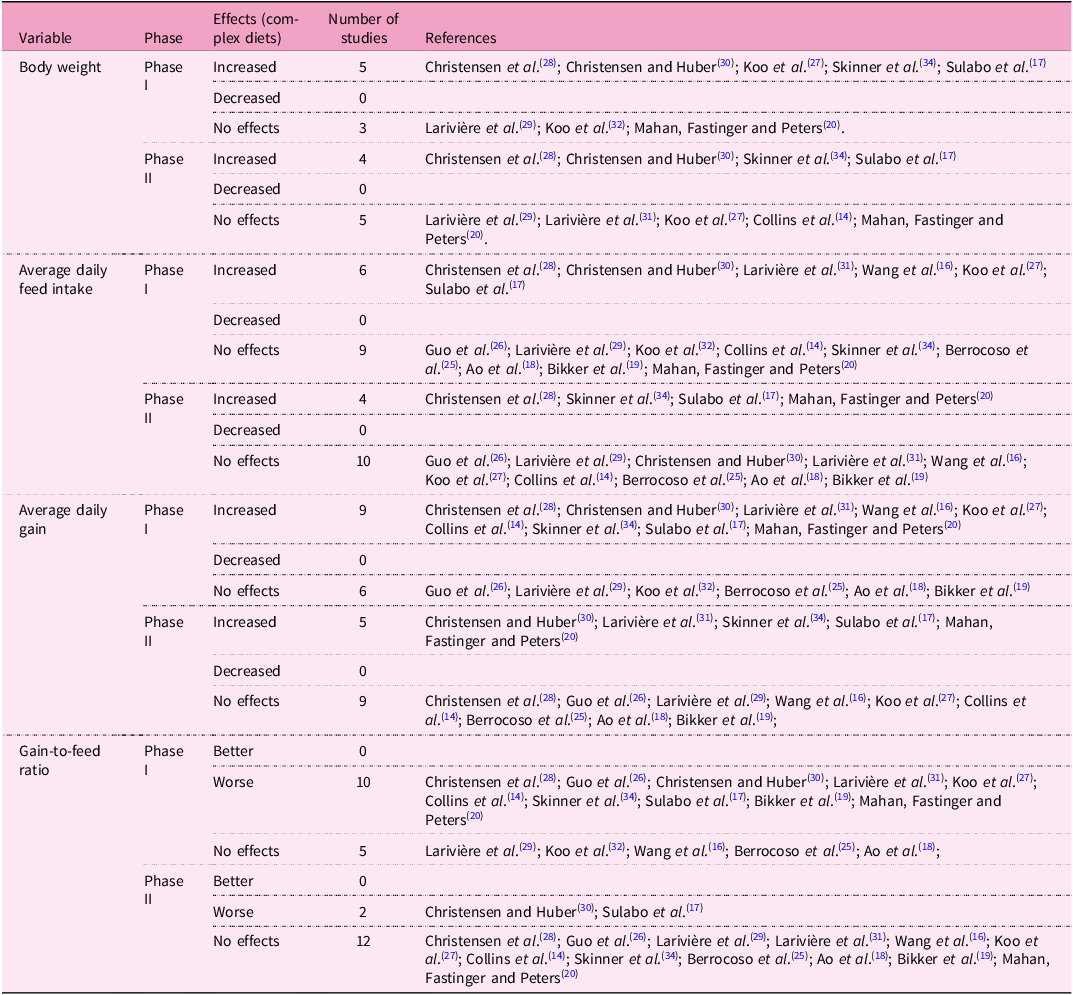
Low feed intake in weaned piglets is an important risk factor for imbalances in intestinal morphology and tissue barrier function(Reference Koo, Choi and Yang32). One of the main objectives of nutrition for recently weaned animals is to maximise the consumption of solid feed. Literature on post-weaning complex diets ranges from formulations featuring 20% to 70% replacement ingredients as compared with simple diets(Reference Wang, Chiba and Huang16,Reference Koo, Kim and de Lange27) with the aim of increasing acceptability by the piglet and boosting performance in the period immediately after weaning (Table 2).
Responses in productive performance of piglets consuming complex versus simple diets in two phases during the nursery period

*Phase I: corresponds to scientific results provided between the 1st and (max.) 14th day of the nursery period; Phase II: corresponds to the scientific results provided between the 15th and the last day of the nursery period; Differences were deemed statistically significant at p < 0.05.
Despite extensive investigation, a definitive consensus is lacking concerning the effect of complex diets feed intake. In a recent study, Christensen et al.(Reference Christensen, Zhu and Niazy28) reported increased ADFI for piglets fed diets with the inclusion of highly digestible animal proteins in comparison with piglets fed diets whose main protein source was either soybean meal or full-fat black soldier fly larvae meal. Although several authors agree with these findings(Reference Christensen and Huber30,Reference Lafleur Larivière, Zhu and Zettell31,Reference Lopez and Sulabo245,Reference Huber, Hooda and Fisher-Heffernan246) , others report conflicting results, even with similar experimental designs. Guo et al.(Reference Guo, Wilson and Chiba26) also compared piglets fed diets with animal protein or soybean meal and did not find any differences regarding ADFI, which is in agreement with Bikker et al.(Reference Bikker, van Dijk and Dirkzwager19), Berrocoso et al.(Reference Berrocoso, Serrano and Cámara25) and Lariviere et al.(Reference Lafleur Larivière, Zhu and Sharma29). Furthermore, piglets fed diets referred to as ‘complex’ that also exhibited higher ADFI during the initial 7 d and 14 d of nursery did not show the same results in the later stages of the nursery period(Reference Wang, Chiba and Huang16,Reference Koo, Kim and de Lange27,Reference Christensen and Huber30) . To further complicate matters, some of the publications provide only a paltry description of the ingredients. This, in addition to the abovementioned vague definition of complex diets, makes it very difficult to evaluate the actual complexity or simplicity of the diet. The comparison among studies is further hampered by the many confounding factors such as weaning age, time of exposure to the diets and sanitary conditions.
When assessing feed intake, it is possible to infer that this variable is an intrinsic determinant of ADG in piglets fed diets with varying degrees of complexity (Table 2). Piglets with elevated consumption of highly digestible feeds over a 14-d post-weaning period exhibit concurrent increases in weight gain during this phase(Reference Wang, Chiba and Huang16,Reference Koo, Kim and de Lange27,Reference Christensen, Zhu and Niazy28,Reference Christensen and Huber30,Reference Lafleur Larivière, Zhu and Zettell31) , which persists into subsequent phases of the nursery period(Reference Christensen and Huber30,Reference Lafleur Larivière, Zhu and Zettell31) . However, parity in consumption levels among piglets fed either simple or complex diets for the initial 14 d of nursery period does not appear to influence ADG during this same period(Reference Collins, Pluske and Morrison14,Reference Skinner, Levesque and Wey34) . Altogether, these findings suggest that the absence of diet-related effects on piglet consumption in the early phase correlates with consistent ADG across subsequent stages of the nursery period(Reference Collins, Pluske and Morrison14,Reference Bikker, van Dijk and Dirkzwager19,Reference Berrocoso, Serrano and Cámara25,Reference Guo, Wilson and Chiba26,Reference Lafleur Larivière, Zhu and Sharma29,Reference Koo, Choi and Yang32) . This fact underscores the impact of reduced intake at the initial phases of nursery period on long-term animal performance, irrespective of diet complexity. This phenomenon may be intricately linked to the health status of animals at the time of weaning.
Piglets exhibiting increased consumption of more digestible diets manifest elevated body weight (BW) levels at both 7 and 14 d post-weaning(Reference Koo, Kim and de Lange27,Reference Christensen and Huber30) , a trend that directly influences final BW at the end of the nursery period(Reference Christensen, Zhu and Niazy28,Reference Lafleur Larivière, Zhu and Sharma29) . Collins et al.(Reference Collins, Pluske and Morrison14) report that piglets fed complex diets exhibit significant improvements in performance only in the first 7 d post-weaning. Interestingly, they observed that these effects were more pronounced in piglets weaned at a lighter weight, indicating that piglets that are less prepared for the stress of weaning may experience additional benefit from complex diets.
The literature indicates that pigs fed either simple or complex diets tend to exhibit comparable FE(Reference Wang, Chiba and Huang16,Reference Ao, Kim and Meng18,Reference Berrocoso, Serrano and Cámara25,Reference Lafleur Larivière, Zhu and Sharma29,Reference Koo, Choi and Yang32) , suggesting that the morphological and physiological limitations of the gastrointestinal tract may prevent further improvements in FE, even with more digestible diets. Some state that complex diets may worsen the FE during this phase(Reference Koo, Kim and de Lange27,Reference Christensen, Zhu and Niazy28,Reference Christensen and Huber30,Reference Lafleur Larivière, Zhu and Zettell31) . Moreover, simpler diets may accelerate intestinal maturation, which presents its own set of challenges(Reference Skinner, Levesque and Wey34,Reference Huber, Hooda and Fisher-Heffernan246) .
During the first weeks of nursery, ensuring a high feed intake is pivotal to maintain gut health and promote adequate growth throughout the whole phase. Taken collectively, results from the literature support the notion that more complex diets, which typically have better palatability, can be a good strategy to increase feed intake in the first weeks after weaning. Thus, the positive results of more complex diets on performance may be an indirect result from increased feed intake than a direct result of the feed ingredients higher bioavailability per se.
The effect of diet complexity on animal health and microbiota
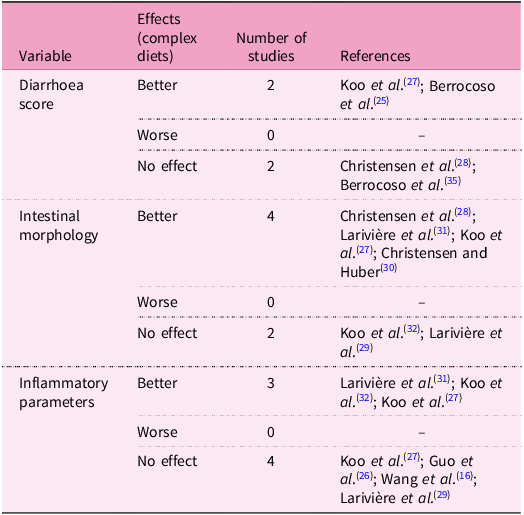
When formulating complex diets, the primary objective is not to enhance performance but rather to minimise inflammation caused by feed transition of piglets. Diets with high CP levels are known to be a major risk factor for post-weaning diarrhoea in piglets(Reference Heo, Kim and Hansen247,Reference Lynegaard, Kjeldsen and Bache248) . The fermentation of undigested protein in the end of the small intestine and in the colon may lead to the proliferation of pathogens(Reference Luise, Chalvon-Demersay and Lambert249). The abrupt transition to solid feed may be considered a risk factor for post-weaning diarrhoea due to the low protein digestion capacity of weaned piglets. Gut inflammation triggered by low-digestibility ingredients around weaning can also lead to systemic inflammation, which is hypothesised to be a key predisposing factor for severe systemic diseases such as those caused by Streptococcus suis and Glaesserella parasuis (Reference Fu, Yin and Zuo250,Reference Segura, Calzas and Grenier251) . Casein, which is believed to be the ideal protein source for weanling piglets due to the lack of anti-nutritional factors and its close to ideal amino acid profile(Reference Eklund, Mosenthin and Piepho252), has an average digestibility of total and essential amino acids of 66% and 69%, respectively, at 7 d post-weaning in piglets weaned at 28 d of age(Reference Engelsmann, Jensen and van der Heide253). Soybean meal, a widely used protein source in diets for young pigs, has an average CP digestibility of 33%(Reference Engelsmann, Jensen and van der Heide253). Unprocessed plant-based ingredients have structurally complex nutrients and antigens that differ from those present in maternal milk. This leads to low digestibility, high incidence of intestinal disturbances and an exacerbated inflammatory response in the first 2 weeks after weaning, which in turn are often linked to higher gut pH and the consequent proliferation of one or more strains of enterotoxigenic Escherichia coli (ETEC)(Reference Fairbrother, Nadeau and Gyles254,Reference Nagy and Fekete255) . The immune system activation and signalling molecules associated with post-weaning inflammatory response trigger depression and anorexia, thus limiting essential nutrient intake. Concurrently, the nutrient partitioning shifts, diminishing body accretion and FE(Reference Heo, Opapeju and Pluske256,Reference van der Meer, Lammers and Jansman257) . Therefore, nutritional strategies to reduce the inflammatory response resulting from dysbiosis and damage to the intestinal barrier are of utmost importance to achieve the growth potential of modern genetic lines.
Studies have reported pro-inflammatory effects in weaned piglets generated by undigested protein fermentation metabolites such as ammonia, biogenic amines, hydrogen sulphide, and phenolic and indolic compounds(Reference Nyachoti, Omogbenigun and Rademacher258,Reference Zhang, Wielen and Hee259) . Biogenic amines (histamine, putrescine, cadaverine) are probably the metabolites most frequently associated with post-weaning diarrhoea. Although these amines can be rapidly absorbed and detoxified by monoamine and diamine oxidases in the gut epithelium, high concentrations of amines are associated with cytotoxic effects in intestinal epithelial cells, increased permeability of intestinal barrier function and exacerbation of the inflammatory response, leading to impaired gut health(Reference Pieper, Villodre Tudela and Taciak42,Reference Pieper, Kröger and Richter260,Reference Li, Ding and Zhu261) . Moreover, pigs may have a transitory hypersensitivity reaction to soybean meal induced by allergenic proteins glycinin and β-conglycinin, and the indigestible carbohydrates of soybeans(Reference Zhao, Naren and Qiang56) as described above. These may also contribute to triggering and/or enhancing the inflammatory response(Reference Hao, Zhan and Guo262), as well as increasing the expression of proteins associated with apoptosis and oxidative stress in the small intestine(Reference Chen, Hao and Piao263,Reference Wang, Li and Xin264) . The consequence is lower productive performance, activation of the intestinal mucosa immune system and a higher frequency of diarrhoea(Reference Wang, Li and Xin264,Reference Sun, Li and Dong265) .
In a recent study, Koo et al.(Reference Koo, Choi and Yang32) compared the systemic and intestinal inflammation in response to 2 weeks of feeding weaned piglets with a plant-based diet (maize, wheat and soybean meal) compared with the same diet supplemented with animal-based proteins (fishmeal, plasma protein and whey). The study found greater concentration of IL-6 and tendency towards elevated TNF-α gene expression in piglets fed the plant-based diet. Interestingly, the piglets fed the plant-based diet also had higher concentration of an anti-inflammatory cytokine (IL-10) at day 7 and the intestinal permeability was not affected by inclusion of the animal-based ingredients in the diet.
Using similar plant- and animal-based diets, the same authors(Reference Koo, Kim and de Lange27) also found that piglets fed unprocessed plant-based diets had impaired histological structure of intestinal mucosa characterised by deeper crypt depth and shorter villus height in the duodenum and ileum compared with those on the animal-based diet. By contrast, others found no clear differences in the systemic or intestinal inflammatory response comparing weaned piglets fed simple (maize and soybean meal) diets or diets with more complex formulations(Reference Wang, Chiba and Huang16,Reference Guo, Wilson and Chiba26,Reference Lafleur Larivière, Zhu and Sharma29) . Although most of the studies agree regarding the heightened systemic and intestinal inflammatory response associated with unprocessed plant-based diets compared with animal-based diets, the results should be interpreted with caution as the intensity of the effects is dependent on environmental and health conditions, total feed intake, weaning age, stress, genetics and previous adaptation to solid feed, among others.
Some ingredients rich in animal-based protein (for example, spray-dried blood plasma and by-products of milk production) are known for their protective effects on piglets’ intestine, anti-inflammatory properties and beneficial modulation of the immune system(Reference Pérez-Bosque, Polo and Torrallardona85,Reference Peace, Campbell and Polo88) . The inclusion of 5% of spray-dried animal plasma decreased clinical diarrhoea in piglets in the first 2 weeks after weaning(Reference Peace, Campbell and Polo88). A similar effect was observed by Moretó et al.(Reference Moretó, Pérez-Bosque and Pelegrí266), who found that spray-dried plasma reduced water content in the faeces of weanling rats challenged by Staphylococcus aureus enterotoxin B, suggesting preventive action of this ingredient in the secretory activity of infected epithelial cells of the intestine. Peace et al.(Reference Peace, Campbell and Polo88) also demonstrated that the inclusion of spray-dried blood plasma lowered the inflammation level in the intestine of weaned piglets by decreasing cellular infiltration in the lamina propria of the ileum and colon and decreasing the concentration of the pro-inflammatory cytokines TNF-α and interferon-γ in the same intestinal segments.
Beneficial effects of lactose and milk oligosaccharides on intestinal health are well documented in previous studies, showing that supplementation of lactose positively affects the faecal microbiota and the cellular immune response in the colon of early-weaned piglets(Reference Jang, Purvis and Kim100,Reference Li, Monaco and Wang267) . Lactose may be partially fermented by microbiota to lactic acid and volatile fatty acids to provide gastric and colonic acidity(Reference Bach Knudsen, Hedemann and Lærke268), creating a less favourable environment for growth of pathogenic bacteria. By contrast, feeding large amounts of lactose could cause excessive lactose fermentation in the intestinal lumen, possibly leading to intestinal barrier dysfunction and exacerbation of enteric diseases resulting in post-weaning diarrhoea(Reference Pierce, Callan and McCarthy105). Several studies have shown the potential of milk by-products as ingredients to modulate gut microbiota and enhance gut immunity(Reference Kim, Do and Jeong269–Reference Tran, Moreno and Hinkle271). Their inclusion is frequently associated with the increase of several beneficial species from the genera Lactobacillus and Bifidobacterium and with the decrease of E. coli in early-weaned piglets(Reference Tran, Moreno and Hinkle271,Reference Konstantinov, Awati and Williams272) .
In general, the inclusion of ingredients rich in unprocessed plant-based protein is associated with more inflammation and more intestinal disorders compared with diets rich in animal-based proteins(Reference Li, Yin and He273). Processing of plant-based protein sources may mitigate this problem. Soy protein concentrate, for instance, may reduce pH of the feed and degrades antinutritional structures into smaller peptides and amino acids which are more easily absorbed(Reference Li, Yin and He273–Reference Wang, Wang and Wang276). The authors found that replacing 10% of soybean meal by fermented soybean meal for 24 d decreased the mRNA expression of IL-4 and IL-6. This led to decreased intestinal phosphorylation of p38 MAPK, IκB-α and p65 NF-κB, crucial regulators of genes related to anti-inflammatory pathways(Reference Zhang, Lu and Chen275). The inclusion of 9% fermented soybean meal enhanced both the richness and diversity of the faecal microbiota, promoting the proliferation of beneficial genera such as Lactobacillus, Lachnospiraceae and Prevotella while it suppressed the growth of less desirable genera such as Escherichia–Shigella, Clostridium sensu stricto 1 and Bacteroides (Reference Muniyappan, Shanmugam and Park277). Deng et al.(Reference Deng, Duarte and Kim278) compared animal-based protein source (poultry meal, fishmeal and blood plasma) in the diet of piglets weaned at 21 d of age with soybean protein concentrate and did not find any effect on protein digestibility, jejunal oxidative stress, expression of pro-inflammatory cytokines (IL-8 and TNF-α) or intestinal morphology. Instead, the soybean protein concentrate modulated the jejunal-associated microbiota, decreasing the alpha diversity (Chao 1 index) and decreasing the relative abundance of the genera Corynebacterium, Staphylococcus, Bacillus and Campylobacter.
When formulating diets for young pigs, it is important to understand how the ingredients added to the formulation can impact a piglet’s health. Plant-based ingredients, for example, can increase the physiological challenge associated with the diet. Complex ingredients should be chosen not only for their nutritional value but also for their health-promoting effects (Table 3).
Responses in intestinal health parameters of piglets consuming complex versus simple diets during the nursery period

Ingredient inclusion level
Suggested inclusion values for most ingredients mentioned in the review can be found in Table 4. Practical and maximum levels were based either on the Brazilian tables for poultry and swine nutrition(Reference Horacio Santiago, Luiz Fernando Teixeira and Arele Arlindo188) or on available literature. The last column includes which authors published studies about complex diets utilising the ingredients in the proposed range of inclusion.
Practical and maximum levels of inclusion of specialty ingredients in first stage diets of weaned piglets

† Published complex diets studies that use the ingredient in the proposed range of inclusion;
* Practical and maximum levels based on Brazilian tables(Reference Horacio Santiago, Luiz Fernando Teixeira and Arele Arlindo188);
** Practical and maximum levels based on the complex diet studies referenced;
*** Maximum level adapted from Schiavon et al.(Reference Schiavon, Tagliapietra and Bailoni282) and Lizardo et al.(Reference Lizardo, Peiniau and Aumaitre283)
**** Practical and maximum levels adapted from Wang et al.(Reference Wang, Chiba and Huang16) and Jones et al.(Reference Jones, DeRouchey and Nelssen284);
⋆ Insufficient reports in the literature to make an affirmation.
While our proposed ranges are mostly similar to those of other authors, some interesting trends can be observed. Whey powder is the most popular dairy co-product used in recent articles, while lactose was included only in the older articles reviewed (before 2005). However, authors that adopted this ingredient worked with lower inclusion levels than the ones suggested by this review, since most of them(Reference Pettey, Carter and Senne38,Reference Wolter, Ellis and Corrigan280) also had another source of lactose in the formulation. Whey permeate is a promising alternative, but no article researching complex diets adopted it in its formulation. Nonetheless, our proposed range seems consistent with published literature researching the ingredient, which reports that inclusion levels of about 13% optimise FE(Reference Jang, Duarte and Purvis285,Reference Jang, Purvis and Kim286) .
Novel ingredients, such as spray-dried egg and autolysed yeast, still have insufficient reports on dose–response curves to properly propose an inclusion level. Berto et al.(Reference Berto, Tse and Ramos287) estimated that including between 0·4% and 0·5% of autolysed yeast was the optimal range to improve performance; however, other authors have observed positive effects when adopting higher inclusion levels(Reference Namted, Poungpong and Loongyai288). Zhang et al.(Reference Zhang, Piao and Ma289) observed that including 8% spray-dried egg in place of other animal protein sources was adequate for weaned piglets.
Soybean processed products can have high variability in inclusion levels, depending on what source of protein they are replacing. For instance, soy protein concentrate replacing soybean meal can be included in up to 14–21%(Reference Lenehan, DeRouchey and Goodband290); however, when replacing animal protein sources, this inclusion level drops to 1·8–3%(Reference Deng, Duarte and Jang127,Reference Resende, Mascarenhas and Mello291) . Besides, Piao et al.(Reference Piao, Kim and Jin292) suggested lower inclusion levels of extruded soybean than those proposed by Rostagno and Albino(Reference Horacio Santiago, Luiz Fernando Teixeira and Arele Arlindo188); the group observed that inclusions above 6% negatively impacted piglets’ development. Fermented soybean meal also has shown potential to improve weaned piglet’s intestinal health, especially if replacing soybean meal(Reference Wang, Wang and Wang276). A 10% inclusion level appears to be optimal for performance enhancement(Reference Yuan, Chang and Yin179,Reference Jones, DeRouchey and Nelssen284) ; however, benefits have also been reported in lower inclusion levels (for example, 6%)(Reference Wang, Wang and Wang276).
Finally, fibre sources show the biggest difference between our proposed values of inclusion and the inclusion levels used by the authors reviewed here. Oat groats and barley were represented more in recent articles (after 2017) than in older ones. For both ingredients, the inclusion levels adopted were higher than our suggested values. It seems that even levels of inclusion as high as 25% for barley(Reference Christensen, Zhu and Niazy28,Reference Christensen and Huber30,Reference Skinner, Levesque and Wey293) and 30% for oat can be used, especially because weaner pigs may prefer oat instead of maize(Reference Chance, Lerner and DeRouchey294). Winter grains such as these might be preferred in European countries and North America owing to availability, thus justifying the higher inclusion in comparison with diets in South America (for example, Brazil). Sugarbeet pulp, although it was not mentioned in any article studying diet complexity, has been reported to improve intestinal health parameters of weaned piglets at a 12% inclusion level(Reference Schiavon, Tagliapietra and Bailoni282,Reference Lizardo, Peiniau and Aumaitre283) . A more manageable rate might be closer to the 4–6% range of inclusion(Reference Wang, Beltranena and Zijlstra295). Similar findings have been reported for wheat bran in the 2–5% range of inclusion proposed in this review(Reference Koo, Hossain and Nyachoti281,Reference Molist, Hermes and de Segura296) .
Complex diets and sustainability
Traditionally, sustainability is defined by social, economic and environmental pillars(Reference Purvis, Mao and Robinson297). Socially, the aim of using special piglet diets is to improve the health and welfare of the animals and to minimise the use of antibiotics, with the main goal being prevention of antibiotic resistance. Since 2006, antibiotic growth promotors (AGP) have been banned in Europe(Reference Millet and Maertens298), stimulating the search for AGP alternatives. The use of antibiotics for preventing disease is also under scrutiny, leading to a research focus on health-promoting diet formulations for weaners. To prevent post-weaning challenges, highly digestible and palatable ingredients are included as these may improve intestinal morphology, digestibility and faecal consistency scores versus more simple diets, leading to decreased antibiotic use(Reference Koo, Kim and de Lange27).
Feed cost and FE are the main drivers of the cost of pig production. According to results from Interpig, feed represented between 56% and 80% of total production cost in participating countries(Reference Hoste and Benus299). The choice of ingredients, their price and the nutrient levels define the price of the feed as well as the feed efficiency of the piglets. FE is determined largely by dietary nutrient levels (energy, digestible amino acids). The scope of diet formulation methods is to satisfy the nutritional requirements while minimising the cost of the feed(Reference Pomar, Andretta and Remus300). As such, limiting the maximal inclusion percentage of ‘simple’ ingredients or inclusion of ‘complex’ ingredients will increase the cost of feed without necessarily improving FE. However, according to data from an average Belgian farm(Reference Millet, Aluwé and Van den Broeke301), piglet feed constitutes only approximately 9% of the total feed required for pig growth, with 15% allocated to the sow and the remaining 76% for the growing–finishing stage. At this early stage of development (especially the first 2 weeks after weaning) it may be more important to avoid disease or death and ensure fast growth instead of focusing on maximal efficiency at the lowest cost. For a farmer selling piglets, it may be more important to increase appetite than to improve efficiency, although these may go together. Increased feed intake may minimise the risk of weaning problems, and it stimulates growth. Wensley et al. (Reference Wensley, Tokach and Woodworth46) state that ‘feeding complex diets with high levels of lactose, animal protein products, or other palatable ingredients is a strategy to improve growth performance during the first week post-weaning’.
In terms of environmental sustainability, improving efficiency of nutrient utilisation can increase sustainability(Reference Schedle302). Maintaining a proper balance between nutrient requirements and provision is essential for minimising losses to the environment. In the context of climate change and global warming potential of feed composition, careful consideration of the type and origin of ingredients becomes paramount. Notably, in pig farming, feed production stands out as the largest contributor to climate impact, responsible for 60% of the sector’s greenhouse gas emissions. Manure storage and processing follow (27%), and the last 13% can be attributed to energy use during production, enteric fermentation and post-farm processing and meat transport(Reference MacLeod, Gerber and Mottet303). With the relatively low amount of feed consumed in the nursery, the growing–finishing phase may be more important for the environmental impact of pig production. Still, dietary protein levels are typically the highest in piglet diets, with a need for high-quality protein sources. Especially soybean meal, which is often linked to deforestation and land use change, has a large impact on the carbon footprint of a pig diet(Reference Reckmann, Blank and Traulsen304). When complex ingredients are included in pig diets, the life cycle of these ingredients may determine their impact on the farm’s global warming potential and contribution to climate change.
Is the term ‘diet complexity’ useful in scientific research?
The definition of dietary complexity varies considerably in scientific literature. We observe that simple diets may be characterised by the inclusion of only soybean meal, maize and a lactose source, while complex diets include a greater diversity and number of ingredients. This definition implies, however, that the vast majority of diets utilised in everyday pig husbandry should be classified as complex. This begs the question, what is the practical value of using diet complexity as a criterion for defining experimental diets or experiments in pig nutrition?
When talking about ‘complex’ diets, most authors refer to diets that include certain ingredients to improve the health of the animals. A new term such as ‘gut health supporting diets’ may better describe this collection of diets. After all, ingredients are included with the aim of fostering the gut health of weaned piglets to facilitate their adaptation to solid feed and generally promote their health and development. These diets contain highly processed plant-based ingredients, high-quality animal-derived components and bioactive ingredients. These components not only provide essential nutrients but also ensure their effective utilisation, thus safeguarding the overall health of the animals. If the aim is to describe or study one or a few specific ingredients, it may be better to use the actual composition in the title and description, rather than the vague term ‘diet complexity’.
Final thoughts and recommendations
The choice of ingredients in each health-promoting diet is influenced by various factors, including regional preferences and the nutritionist’s educational background. The regional nature of certain products significantly influences their predominant usage in diet formulation. For instance, maize grain and soybean meal are commonly utilised in Latin American and North American countries, as well as in large pig producers in Asia. Conversely, wheat, barley and oats are prevalent in European piglet rations.
In addition to these above ingredients, modern weaner diets now incorporate a multitude of additional components. Historically, diets that included more than three ingredients were rightly called complex, but today’s diversity of weaner diets has resulted in a loss of meaning and lack of consistency in the definition of ‘complex diets’. We therefore recommend that animal nutritionists, pig researchers and producers adopt the term ‘gut health supporting diets’ to emphasise the primary objective of providing a so-called complex diet, namely to enhance the health and adaptability of weaner piglets. This concept of health-promoting diets contributes to the sustainability of pig production by prioritising animal welfare, health promotion and the One Health approach.
Acknowledgements
The authors would like to thank Miriam Levenson (ILVO) for the English-language review of this manuscript.
Authorship
B.B.C.: writing – original draft, writing – review & editing, data curation, conceptualisation, visualisation; B.B.D.M.: writing – original draft, writing – review & editing, conceptualisation; R.F.C.: writing – original draft, writing – review & editing, visualisation, conceptualisation; F.A.C.: writing – original draft, data curation, conceptualisation; C.A.S.: writing – original draft, writing – review & editing, conceptualisation; I.A.: writing – original draft, conceptualisation; S.M.: writing – original draft, conceptualisation; C.A.P.G.: writing – original draft, funding acquisition, conceptualisation.
Financial support
This work was supported by FAPESP (B.B.C., grant number 2022/07694-7) and by CNPq (C.A.P.G., grant number 303750/2021-9). FAPESP and CNPq had no role in the design, analysis or writing of this article.
Competing interests
The author(s) declare none.