Introduction
Smoking is the leading preventable cause of death and disease in the United States (CDC, 2004). Cigarette smoking and exposure to tobacco smoke resulted in at least 443,000 premature deaths and $96.8 billion in productivity losses annually in the United States (CDC, 2008). Although smoking prevalence has declined dramatically among adults in the past 40 years, 19.3% of adults still smoke, including 20.1% of adults aged 18–24 years (CDC, 2011b). Smokers who quit by age 35 years have mortality rates similar to those who never smoked (Doll, Peto, Wheatley, Gray, & Sutherland, Reference Doll, Peto, Wheatley, Gray and Sutherland1994; Jha et al., Reference Jha, Ramasundarahettige, Landsman, Rostron, Thun, Anderson and Peto2013).
Young adult smokers express more interest in quitting than older adult smokers and are also more likely to have made a quit attempt in the past year (CDC, 2011a). Two out of three current smokers aged 18–24 years (66.7%) indicated that they wanted to stop smoking, and the majority (62.4%) had tried to quit in the previous year (CDC, 2011a). Young adults are also more likely than older adults to have successfully quit smoking recently (18–24 years old: 8.2%; 25–44 years old: 7.1%; 45–64 years old: 4.7%; ≥65 years old: 5.3%); however, they are less likely to use evidence-based cessation treatments (i.e., counselling or medications) than older adults (CDC, 2011a; Fiore, Reference Fiore2008).
Telephone-based tobacco cessation services or quitlines are effective, population-based interventions that increase successful quitting (Task Force on Community Preventive Services, 2012). The U.S. Public Health Services Clinical Practice Guidelines identified quitline counselling as an evidence-based treatment that increased the odds of abstinence by approximately 60% (Fiore, Reference Fiore2008). Quitlines provide telephone-based tobacco cessation services that help tobacco users quit through individualised, tailored counselling and self-help materials (Ossip-Klein & McIntosh, Reference Ossip-Klein and McIntosh2003). State tobacco cessation quitlines overcome many of the barriers to tobacco cessation classes and traditional clinics because they are free and available at the caller's convenience (Anderson & Zhu, Reference Anderson and Zhu2007). They also are cost-effective because they offer multiple services centrally that often are unavailable locally (CDC, 2007; Zhu, Reference Zhu2000). Through its National Tobacco Control Program, the Centers for Disease Control and Prevention (CDC) asks states to support quitlines as an effective population-based strategy to increase cessation (CDC, 2007). Today, quitlines exist in every state and Washington DC and are linked through a toll-free national portal, 1-800-QUIT-NOW (Anderson & Zhu, Reference Anderson and Zhu2007).
Previous research has found that quitlines are able to reach young adult smokers, motivate them, and help them to quit (Cummins, Hebert, Anderson, Mills, & Zhu, Reference Cummins, Bailey, Campbell, Koon-Kirby and Zhu2007; Rabius, McAlister, Geiger, Huang, & Todd, Reference Rabius, McAlister, Geiger, Huang and Todd2004; Sims et al., Reference Sims, McAfee, Fraser, Baker, Fiore and Smith2012). However, few studies have examined the use of quitlines by young adults, and prior research on the effectiveness of quitline counselling for young adult smokers has been conducted through randomised control trials (Rabius et al., Reference Rabius, McAlister, Geiger, Huang and Todd2004; Sims et al., Reference Sims, McAfee, Fraser, Baker, Fiore and Smith2012). While such trials may minimise confounding influences, findings may not be applicable to the general population in real-world settings (Rothwell, Reference Rothwell2005). Given this limited research, the purpose of our study is to describe the use and effectiveness of telephone quitline counselling for smoking cessation among smokers aged 18–24 years compared to smokers aged ≥25 years who called state quitlines served by the American Cancer Society (ACS) during 2006–2008.
Methods
Setting
Telephone quitlines served by ACS from nine states (Delaware, Florida, Kansas, Louisiana, Michigan, Nebraska, Pennsylvania, Texas and Vermont) and the District of Columbia participated in the study. ACS provided data on callers who had enrolled in their quitlines anytime from 1 January 2006 through to 31 December 2008.
Sample and Data Source
For our sample, we included quitline callers aged ≥18 years whose primary form of tobacco use was cigarette smoking, who were interested in quitting at the time of the call, and who received at least one counselling session from the quitline. Table 1 presents a summary of the services each state quitline offered during the study period. During 2006 to 2008, all the quitlines offered self-help materials and provided counselling to persons aged ≥18 years. Quitlines varied slightly in terms of the maximum number of counselling sessions provided and counselling protocols used. Five to seven counselling sessions were provided to eligible callers (i.e., callers who met the minimum age requirement, enrolled in counselling, and were interested in quitting in the next 30 days). Detailed descriptions of each of the counselling protocols are described elsewhere (Rabius, Pike, Hunter, Wiatrek, & McAlister, Reference Rabius, Pike, Hunter, Wiatrek and McAlister2007). Four states (Kansas, Louisiana, Nebraska, and Pennsylvania) did not offer any FDA-approved cessation medications (i.e., nicotine patch, nicotine gum, nicotine inhaler, nicotine lozenge, varenicline and buproprion).
Characteristics of quitlines in nine states and the District of Columbia, 2006–2008

a States changed counselling protocols during the study period.
b Five full-length sessions with ≤50 minutes of planned counselling time.
c Five full-length sessions with ≤210 minutes of planned counselling time.
d Four full-length sessions with ≤105 minutes of planned counselling time.
e Depending on answers to questions about depression, caller would either receive brief or long counselling protocol.
f Relapse prevention sessions (up to 15 minutes long) that occurred at one and two months after the end of the regular counselling protocol.
g Up to four-weeks’ supply (this may vary by state and eligibility criteria). Medications are offered as monotherapy.
All study participants were interviewed over the telephone at the time of enrolment in the quitline services. At enrolment, callers provided information on demographics and smoking-related characteristics. Information on the number of counselling sessions received was accumulated as services were provided. Follow-up evaluations of quitline callers were conducted by an independent evaluation team at ACS and occurred four months and seven months after enrolment. Evaluation calls were placed every other day for 30 days or 15 attempts, whichever came first. Since this is an evaluation component imbedded in a working quitline, no incentives were given for responding at follow-ups. Information collected at each follow-up included smoking-related characteristics, use of smoking cessation medications, and quit outcomes (defined as self-reported seven-day and 30-day point prevalence of smoking cessation). All study states except Florida attempted to contact all quitline callers at seven months after initiation of services. Florida selected a simple random sample of 600 (approximately 7% of callers) from each month (starting in April, 2008) to be eligible for evaluation due to a mass influx of callers from a successful media campaign. For our quit rate analyses, we focused on callers who were evaluated seven months after enrolment, since this is the current recommendation by the North American Quitline Consortium (NAQC) to measure prolonged abstinence from smoking (NAQC, 2009b). Because the quitline project was developed at the Health Science Center, University of Texas in Houston, this study was reviewed and approved by their institutional review board.
Analysis
We compared baseline caller characteristics, quitline service utilization, and responder quit rates between young adult smokers aged 18–24 years and older smokers aged ≥25 years who received at least one counselling session from the quitline. We used chi-squared tests for proportions and t-tests for continuous variables to examine age-group differences in demographic and tobacco-use characteristics and quitting. We used multivariate logistic regression with interaction terms for age to examine predictors of quitting and whether they differed between the two age groups. Model covariates included the following demographic characteristics: gender, race/ethnicity, educational level, and marital status. Tobacco-use behaviours and characteristics included number of quit attempts in lifetime, level of dependency (smoked a cigarette ≤ 5 minutes of waking up vs. smoked a cigarette >5 minutes after waking up), lives with a smoker, self-rated confidence in ability to quit or ‘self-efficacy’, and smoking intensity level. Smoking intensity was constructed from combining responses about current smoking status and the number of cigarettes smoked on days the respondent smoked to create a variable with the following six discrete levels: someday smokers, daily smokers of 1–5 cigarettes/day, 6–15 cigarettes/day, 16–25 cigarettes/day, 26–35 cigarettes/day and ≥36 cigarettes/day. Variables measuring service utilisation included number of counselling sessions received and whether FDA-recommended cessation medication was used. Correlation matrices were used to examine multicollinearity among all the predictor variables using r < 0.3 as an acceptable level of correlation (Cohen, Reference Cohen1988), and no collinearity was observed.
In the regression analysis, we ran a single model including both age groups and created interaction terms between age group and all other variables to determine whether age modified the association between each characteristic and quitting. The final model included interaction terms that were statistically significant at p < 0.05. We also adjusted the standard errors to account for the clustering of the model residuals by state. This procedure was performed using SAS version 9.0.2 (SAS Institute Inc., Cary, NC).
Results
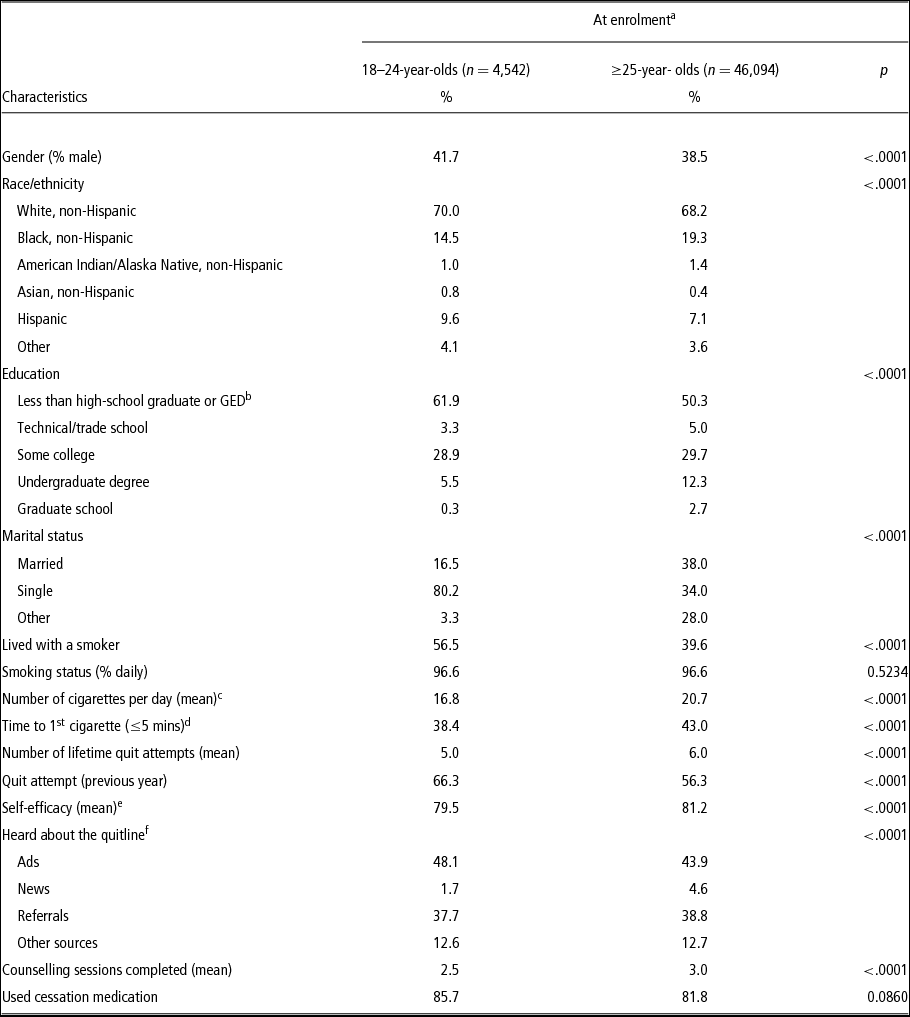
Our baseline sample included 4,542 young adult smokers (9% of a total sample of 50,636 smokers). Table 2 summarises and compares the demographic characteristics and tobacco-use and cessation-related behaviours of young and older adults.
Characteristics of young and older adults enrolled in quitline services, nine states and the District of Columbia, 2006—2008
a Distributions presented exclude missing data.
b Some 18–24-year-olds were still in the process of completing college.
c On the days they smoked.
d Smoked first cigarette ≤ 5 minutes after waking up vs. > 5 minutes after waking up.
e Self-rated confidence in ability to quit.
f Ads included commercials on TV or radio, newspapers, magazines, flyers or brochures, mailings or email messaging. News included TV, newspaper and radio news stories. Referrals included those from family, friends, health professionals, and workplace contacts. Other included all other sources.
Compared to adults aged ≥25 years who called the quitline, adults aged 18–24 years were slightly more likely to be male (18–24 years old: 41.7%; ≥25 years old: 38.5%, p < 0.0001), less likely to be black non-Hispanic (18–24 years old: 14.5%; ≥25 years old: 19.3%, p < 0.0001), more likely to have an education ≤high school or GED (18–24 years old: 61.9%; ≥25 years old: 50.3%, p < 0.0001), and less likely to be married (18–24 years old: 16.5%; ≥25 years old: 38.0%, p < 0.0001). Young adults were more likely to live with a smoker (18–24 years old: 56.5%; ≥25 years old: 39.6%, p < 0.0001) than were older adults. There were no differences by age in the percentage who smoked cigarettes daily (18–24 years: 96.6%; ≥25 years old: 96.6%, p = 0.5234). On average, 18–24 year-old adults smoked fewer cigarettes per day than older adults (18–24 years old: mean = 16.8; ≥25 years old: mean = 20.7, p < 0.0001). Young adults were less likely to smoke their first cigarette within five minutes of waking (18–24 years old: 38.4%; ≥25 years old: 43.0%, p < 0.0001). They had made fewer lifetime quit attempts (18–24 years old: mean = 5.0; ≥25 years old: mean = 6.0, p < 0.0001), however, they were more likely to have made a quit attempt in the past year (18–24 years old: 66.3%; ≥25 years old: 56.3%, p < 0.0001) than older adults. Young adults were slightly less confident in their ability to quit (18–24 years old: mean = 79.5; ≥25 years old: mean = 81.2, p < 0.0001). They were more likely to hear about the quitline through advertisements than were older adults (18–24 years old: 48.1%; ≥25 years old: 43.9%, p < 0.0001). Young adults completed slightly fewer counseling sessions than older adults (18–24 years old: 2.5 sessions; ≥25 years old: 3 sessions, p < 0.0001). There was no difference between the two age groups in use of cessation medications.
Self-Reported Cessation
The overall seven-month follow-up response rate after adjusting for Florida's random sampling was 33% (n = 10,623). Response rate was lower for young adults (21%) compared to older adults (34%). State-level response rates ranged from 18.7% in Delaware to 38.2% in Kansas. Compared to the young adults aged 18–24 years who did not complete follow-up (i.e., non-respondents), respondents who completed follow-up were more likely to be white non-Hispanic (respondents: 75.3%; non-respondents: 69.2%, p = 0.0047), to have an education level ≥high school or GED (respondents: 46.8%; non-respondents: 36.7%, p < 0.0001), and to be married (respondents: 21.2%; non-respondents: 15.7%, p = 0.0019). They were also less nicotine dependent (respondents: 34.4%; non-respondents: 39%, p = 0.0418) and had made a prior quit attempt (respondents: 71%; non-respondents: 65%, p = 0.0092). Young adult respondents completed slightly more counselling sessions than non-respondents (respondents: mean = 2.69; non-respondents: mean = 2.44, p < 0.0001) (data not shown).
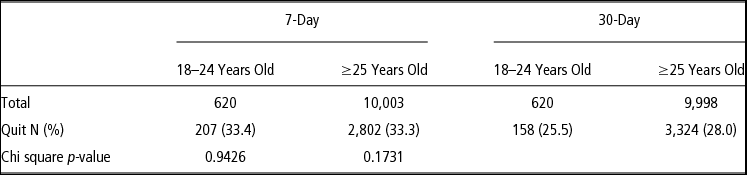
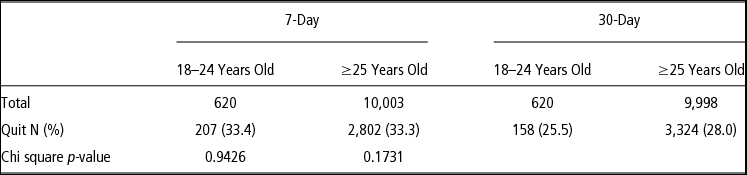
In our bivariate analyses, we found no age-related differences for self-reported 7-day quit rates (18–24 years old: 33.4%, ≥25 years old: 33.3%, p = 0.9426) or self-reported 30-day quit rates (18-24 years old: 25.5%; ≥25 years old: 28.0%, p = 0.1731) at the seven-month follow-up evaluation (Table 3).
Self-reported seven-day and 30-day quit rates at seven-month follow-up, nine states and the District of Columbia, 2006—2008
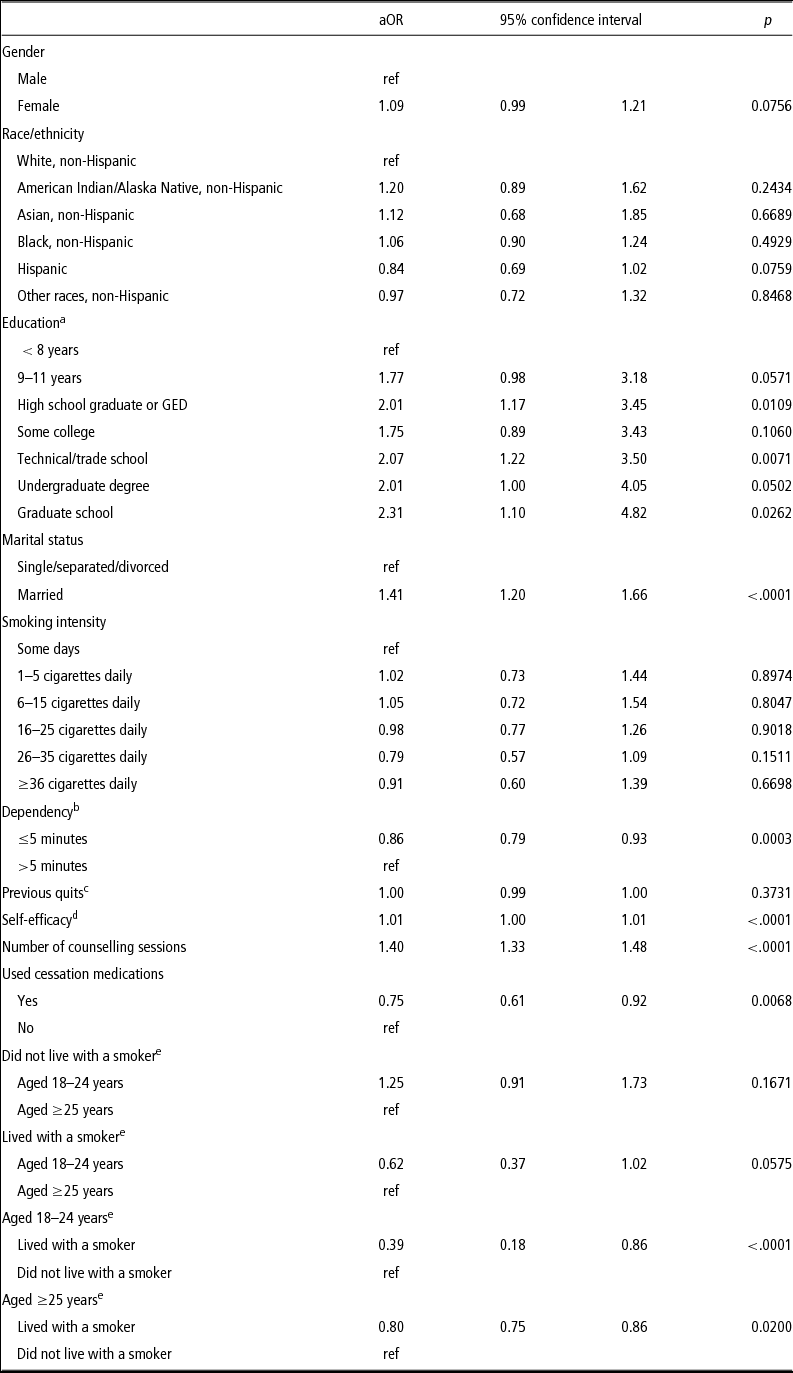
Results from the multivariate logistic regression are presented in Table 4. We used the 30-day quit rate as the dependent variable because this was a valid and commonly adopted predictor of long term abstinence (Hughes et al., Reference Hughes, Keely, Niaura, Ossip-Klein, Richmond and Swan2003). After adjusting for covariates in our multivariate logistic regression analyses, the odds of both young and older adult smokers reporting having quit at 30 days were higher if they were more educated, married, and had received more counselling sessions. Respondents who smoked within five minutes after waking and who used cessation medication had lower odds of quit success. The interaction between age and whether respondents lived with a smoker showed that young adults who lived with a smoker had approximately 40% lower odds of quitting than older adults who lived with a smoker (aOR = 0.62, p = 0.0575). When we coded the data to examine the effect of living with a smoker vs. not living with a smoker, as the previous analysis indicated, living with a smoker was a stronger predictor for not quitting among young adults (aOR = 0.39, p = 0.02) than among older adults (aOR = 0.80, p < 0.0001).
Demographic and tobacco use characteristics associated with 30-day smoking abstinence among all callers, nine states and the District of Columbia, 2006–2008
a Some 18–24-year-olds were still in the process of completing college.
b Smoked first cigarette ≤ 5 minutes after waking up vs. > 5 minutes after waking up.
c Number of lifetime quit attempts.
d Self-rated confidence in ability to quit.
e Interaction between age groups and whether a caller lived with a smoker. Reference was varied to produce adjusted odds ratio estimates for age and for living with a smoker.
Discussion
Quitline utilisation
Young adults aged 18–24 years represented 9% of the callers to the quitlines in these nine states and the District of Columbia. In comparison, data for the same years (2006–2008) from the Behavior Risk Factor Surveillance System (BRFSS) indicated that young adults comprised 14.9% of the adult smoking population in these nine states and the District of Columbia (unpublished data available at http://www.cdc.gov/brfss/). This suggests that quitline services are under-utilised by young adults, a finding similar to other studies reporting that young adult smokers are less likely than older adults to use effective cessation treatments (CDC, 2011a; Curry, Sporer, Pugach, Campbell, & Emery, Reference Curry, Sporer, Pugach, Campbell and Emery2007; Farrelly, Mann, Watson, & Pechacek, Reference Farrelly, Mann, Watson and Pechacek2013; Poynter, Bullen, Whittaker, & Grigg, Reference Poynter, Bullen, Whittaker and Grigg2008).
Currently, only 1 to 2% of adult smokers in the US use quitlines (Keller et al., Reference Keller, Feltracco, Bailey, Li, Niederdeppe, Baker and Fiore2010; Ossip-Klein & McIntosh, Reference Ossip-Klein and McIntosh2003), and less than 6% use any type of counseling (CDC, 2011a). According to CDC's Best Practices for Comprehensive Tobacco Control, approximately 6 to 8% of tobacco users potentially can be reached successfully by quitlines (CDC, 2007).
Mass media campaigns for smoking cessation are critical for motivating callers to contact quitlines (CDC, 2007) and have been found to be more influential for youth and young adults than for older adults (Bala, Strzeszynski, & Cahill, Reference Bala, Strzeszynski and Cahill2008). In this study, young adult smokers were slightly more likely to report having heard about the quitline through advertisements than were older adults. Similarly, Cummins and colleagues found that young adult callers were significantly more likely than older callers to report having heard about the California Smokers’ Helpline from media sources (58.1% vs. 44.3%) (Cummins, Hebert et al., Reference Cummins, Bailey, Campbell, Koon-Kirby and Zhu2007). We found that more than 80% of the young adult smokers had learned about the quitline from both ads and referrals from friends, families, and health care providers. This suggests that quitlines should continue focusing outreach efforts to young adult smokers using all methods of promotion, including media advertisements. Although state tobacco control programs and quitlines have limited budgets (which may have further decreased in recent years) for promotion of cessation and quitlines (NAQC, 2011), in the spring of 2012, CDC launched the first National Tobacco Education Campaign, which increased calls to quitlines by 132% from 19 March through to 10 June 2012 compared to a similar time period in 2011 (CDC, 2012a). Continued mass media campaigns are needed to reach CDC's recommended goal of 6% quitline reach (CDC, 2007).
Among all adult quitline callers, the majority were women, although the proportion of male callers was slightly higher among young adults than older adults. This result is consistent with findings from studies describing a greater likelihood of seeking help for prevention and illness for women than men (Vaidya, Partha, & Karmakar, Reference Vaidya, Partha and Karmakar2012). Other demographic differences included differences by race-ethnicity, with lower proportions of non-Hispanic blacks using the quitlines among young adults than older adults. However, among young adult non-Hispanic black smokers in these states, those who called a quitline were over-represented in our population (14.5% young adult non-Hispanic blacks among quitline callers vs. 8.4% young adult non-Hispanic blacks in the smoking population (BRFSS unpublished data 2006–2008, available at http://www.cdc.gov/brfss/). A similar finding was also observed in the data from the California quitline (Zhu et al., Reference Zhu, Gardiner, Cummins, Anderson, Wong, Cowling and Gamst2011; Zhu et al., Reference Zhu, Rosbrook, Anderson, Gilpin, Sadler and Pierce1995) and suggests that quitlines have been successful in reaching young adult non-Hispanic black smokers. Lastly, most young adult smokers who used the quitlines were single but lived with a smoker, which is of concern since respondents who lived with a smoker had particularly low quit rates (see Quit Rates discussion below).
Consistent with existing studies (Cummins, Hebert et al., Reference Cummins, Hebert, Anderson, Mills and Zhu2007), we found that the vast majority (96.6%) of young adult smokers who called a quitline were daily smokers. In comparison, only 66.5% of young adult smokers in these states were daily smokers (73.3% for older adults [BRFSS unpublished data, 2006–2008, available at http://www.cdc.gov/brfss/]). Non-daily smokers are more likely to make quit attempts but less likely to be successful or to use treatments (Tindle & Shiffman, Reference Tindle and Shiffman2011). Because nondaily smokers comprise a relatively large proportion of the young adult smoker population, more research is needed on ways to engage this group in treatment (Berg & Schauer, Reference Berg and Schauer2012; Berg, Sutfin, Mendel, & Ahluwalia, Reference Berg and Schauer2012).
Quit Rates
Although young adult quitline users were different from older adults in several measures related to successful cessation, we did not observe any age-related differences in quit rates. These results are consistent with quit rates reported by other studies examining the effectiveness of quitline services among all adult smokers. For example, NAQC conducted a systematic review of published literature on real-world quitline effectiveness. Among smokers accessing quitline services, they found quit rates that ranged from 26% to 39% for seven-day point prevalence and 30% to 36% for 30-day point prevalence (NAQC, 2009b). Also, the 2008 Public Health Services Guideline's meta-analysis of quitlines found an overall quit rate of 28.1% for quitline counselling and medication (Fiore, Reference Fiore2008). The only study that focused on the effectiveness of quitline services among young adults reported a six-month prolonged intent-to-treat quit rate of 8.8% for the 18–25 year olds and a similar quit rate of 7.7% for the older age group (Rabius et al., Reference Rabius, McAlister, Geiger, Huang and Todd2004). It is worth noting that these rates were calculated as the percentage of self-reported quitters in the entire original group of all randomised study participants, regardless of whether they received treatment or responded to follow-up interviews (i.e., intent-to-treat rates). We did not perform an intent-to-treat analysis for our study since NAQC's current recommendation is to report on responder rates (NAQC, 2009a).
The results of our study suggested that telephone quitline services can be as effective in helping young adult smokers quit as they are with older smokers. Our findings are also consistent with a recent meta-analysis that found that cessation treatments are as effective with young adults as with older adults (Suls et al., Reference Suls, Luger, Curry, Mermelstein, Sporer and An2012).
For both young and older adults, quit rates were significantly higher among those who received more counselling sessions from the quitline, suggesting a dose-response relationship between the amount of counselling and the likelihood of quitting, similar to findings from other studies (Fiore, Reference Fiore2008; Sims et al., Reference Sims, McAfee, Fraser, Baker, Fiore and Smith2012).
We also found among both groups that the odds of quitting were much lower among those who used cessation medications from any source since their first call to the quitline. Because we were unable to determine if cessation medications were provided through the quitline, it is possible that persons who used medications were more addicted and therefore had higher relapse rates than those who didn't use medications. In addition, many smokers who use medications to help them quit may not follow the recommended practice of using the product for eight weeks (Pierce, Cummins, White, Humphrey, & Messer, Reference Pierce, Cummins, White, Humphrey and Messer2012). However, when medications are received through the quitline and used as recommended, several studies have found significantly improved cessation rates among quitline callers (Bush et al., Reference Bush, McAfee, Deprey, Mahoney, Fellows, McClure and Cushing2008; Cummins, Bailey, Campbell, Koon-Kirby, & Zhu, Reference Cummins, Hebert, Anderson, Mills and Zhu2007; Hollis et al., Reference Hollis, McAfee, Fellows, Zbikowski, Stark and Riedlinger2007; Kasza et al., Reference Kasza, Hyland, Borland, McNeill, Bansal-Travers, Fix and Cummings2013; McAfee et al., Reference McAfee, Bush, Deprey, Mahoney, Zbikowski, Fellows and McClure2008; The Quit Group, 2012). Future studies are needed to assess the administration of cessation mediations offered through the quitline and the monitoring of their use among callers.
Our study found that most predictors of quitting were similar for both young and older adult smokers. However, young adult smokers were more likely to be influenced by those who lived with them than were their older counterparts. Both young and older adult smokers had lower odds of quitting if they lived with a smoker but, for young adult smokers, living with a smoker was more strongly associated with lack of quitting at seven months than for older smokers. Our results were consistent with prior findings that smokers’ social interactions with their immediate environment (family members, friends, neighbors, and contacts at work) are an important influence on smoking behaviours (CDC, 2012b; Dedobbeleer, Beland, Contandriopoulos, & Adrian, Reference Dedobbeleer, Beland, Contandriopoulos and Adrian2004). Given that young adults, compared to older adults, are more susceptible to social and environmental influences on tobacco-use behaviours (CDC, 2012b), quitlines may tailor their cessation services to this population with these influences in mind. In 2010, 8% of US quitlines had already developed special materials for young adults and 10% were utilising specialised counselling protocols for this population (NAQC, 2011). Also, about 58% of US quitlines had specialized counsellor training to address specific needs of the young adult population (NAQC, 2011).
A number of important limitations should be considered when interpreting these results. First, quit status was based on self-reports. However, similar studies that have conducted biochemical verification showed that self-reported cessation was valid and equally reliable (Rabius et al., Reference Rabius, McAlister, Geiger, Huang and Todd2004). Other literature on biometric verification vs. self-reported quit rates found high levels of specificity and sensitivity for self-report (Patrick et al., Reference Patrick, Cheadle, Thompson, Diehr, Koepsell and Kinne1994). Second, our follow-up rates were lower than those from randomized control studies and response rates differ significantly between young and older adults. This may be because our study analysed existing evaluation data, compared to other studies that were planned before data collection began and may have included more rigorous follow-up methods. In addition, economic decline and the national shift from landlines to cell phones and the advent of pre-paid and disposable cell phones made reaching someone six months later at the same phone number less likely. This is particularly true for young adults because of the higher cell phone use among this population than older adults. Given this limitation, cessation outcomes should be interpreted with these differences in mind. We also compared young adults who responded to the seven-month follow-up evaluation versus non-respondents and found that respondents were less nicotine dependent, had made a prior quit attempt, and received more counselling. It is, therefore, likely that our cessation rate is overestimated for smokers who call the quitline for help. Future efforts should focus on improving response rates of quitline callers for follow-up evaluations. Third, we did not control for differences in counselling protocols when examining cessation outcomes. However, we do not believe that use of counselling protocols differed by age so the lack of control of this variable is unlikely to affect the results.
Conclusions
Quitlines increase cessation and are available without cost in the United States through the national portal 1-800-QUIT-NOW. Young adult smokers appear to under-utilise quitlines compared to older adults. Young adults who were nondaily smokers were much less likely to use quitlines than were daily smokers, so further outreach to this group – and to nondaily smokers in general – is needed. Quit rates among young adults who used quitlines were similar to those among older adults, and predictors of successful cessation among quitline users did not differ by age except that, among those who lived with a smoker, young adults were less likely to quit than older adults. Tailored messages that address the challenges of living with a smoker while trying to quit may be helpful in counselling protocols for young adults. Mass media campaigns may be particularly effective in urging young adult smokers to call quitlines and should be continued to help achieve the CDC goal of reaching 6% of the smoking population with quitline services (CDC, 2007).
Acknowledgements
We thank the states that participated in our study. The findings and conclusions in this report are those of the authors and do not necessarily represent the official position of the Centers for Disease Control and Prevention.
Financial Support
This work was funded by the Centers for Disease Control and Prevention.
Conflict of Interest
None.
Ethical Standards
The authors assert that all procedures contributing to this work comply with the ethical standards of the relevant national and institutional committees on human experimentation and with the Helsinki Declaration of 1975, as revised in 2008.