Parties offer policy alternatives to voters as part of electoral competition, but vary in how they communicate their policy positions to the electorate. They may present voters with a clear message, or they may offer a program that conveys a variety of viewpoints, possibly muddying its ideological content. This ambiguity may arise in a party’s program for a variety of reasons. The party leadership may have conflicting ideological views and must then determine how best to accommodate differing opinions in the party program. Alternatively, the party may attempt to attract a wide array of voters by pitching different (possibly incompatible) messages to different electoral audiences. Lastly, new parties may need to learn which messages resonate best with their voters, and they may attempt different pitches before settling on a message that works. Regardless of the underlying reason, parties face choices over how to represent their programs to the public when multiple viewpoints exist. Much recent work has used election manifestos – documents written by parties at the start of an election campaign explaining their core platform – to estimate party positions. But few studies explicitly acknowledge that parties must aggregate various policy proposals into this single document. We argue that we can learn about the clarity or ambiguity of a party’s message, in addition to its overall ideological position, by examining party manifestos.
By making a few assumptions about how parties draft election manifestos, we construct a model that estimates both the position a party takes within a document and the level of clarity around that position. Before each election, parties write a single electoral platform to communicate their policy program to voters and other parties. Parties draft a document that contains an ideological position and some latent level of ambiguity around that position. Ambiguity, in our model, is closely related to the level of inconsistency found in a document (for example, party platform) relative to all other documents in the sample. It can arise when parties include multiple (perhaps conflicting) statements on an issue or when they remain vague, or even silent. Regardless of whether ambiguity represents a strategic choice by party leaders to attract voters or results from intraparty pressures, we argue that as the lack of ideological clarity grows, the language parties use to communicate their positions in their program displays greater variance. We model this variation within manifesto texts to estimate the latent ambiguity of a party’s position. Our new estimates of ideological ambiguity allow us to study the effects of positional clarity on parties’ electoral success.
Our findings contribute to at least three distinct literatures. First, our approach speaks to the comparative parties literature, which increasingly relaxes the party-as-a-unitary-actor assumption to examine phenomena such as party factions,Footnote 1 party switchingFootnote 2 and roll-call vote defections.Footnote 3 Secondly, we contribute to the growing literature on the role of ambiguityFootnote 4 and party positioning in electoral competition.Footnote 5 And thirdly, our approach speaks to the literature using text as data to estimate latent variables in political science.Footnote 6 We specifically argue that the models underpinning political text analysis can greatly benefit from incorporating substantive information about the data-generating process behind the text under investigation.
We begin by presenting a model of manifesto drafting, and we then derive a scaling model of text that jointly estimates latent document positions and ambiguity from manifestos. The properties of our estimator are tested using Monte Carlo simulations, which demonstrate that our model recovers both position and clarity parameter values when our distributional assumptions hold. To evaluate the validity of our estimates, we first simulate the manifesto-drafting process on the basis of the assumptions made in our model of manifesto drafting. We draft documents that are set a priori to have a certain level of ambiguity, and show that the scaling model successfully recovers differences in ambiguity. Secondly, we demonstrate that human coders correctly perceive the level of ambiguity in our manufactured statements through a text coding exercise. Thirdly, we apply our estimator to party manifestos in Germany, Ireland, the Netherlands and Sweden, and use position and ambiguity estimates as independent variables to explain parties’ electoral success. We find that ambiguity can enhance the appeal of parties with platforms that become more moderate, and lessen the appeal of parties with platforms that become more extreme.
INTRAPARTY POLITICS, MANIFESTO DRAFTING AND ELECTORAL COMPETITION
Scholars of political parties have long noted the importance of accounting for internal party organization to understand party competition,Footnote 7 but empirical and theoretical work on party competition, coalition formation and policy making has tended to treat parties as unitary actors.Footnote 8 While recent work on comparative legislative and electoral behavior has relaxed the unitary actor assumption,Footnote 9 work on estimating positions from election manifestos has not emphasized the fact that the content of policy programs is the result of meshing different, and often competing, views.Footnote 10 Extant measures of party positions largely overlook the degree of policy ambiguity in these positions. Empirically, manifestos are treated as documents that reflect clearly defined policy positions, either through the application of a manual policy coding scheme, as applied by the Comparative Manifesto Project,Footnote 11 or through automated techniques.Footnote 12 To the extent that existing methods capture ambiguity, they do so indirectly by either reporting uncertainty around the position estimate, highlighting document length, or comparing parties in and out of government.Footnote 13 While it has become standard to report estimates of uncertainty around measures of party positions derived from manifestos,Footnote 14 this uncertainty need not be due only to ambiguity; rather it could be due to other features of a stochastic text-generation model.Footnote 15
The empirical literature on manifestos only rarely considers the clarity of parties’ ideological positions. By contrast, a large body of literature, both empirical and theoretical, suggests that the level of ambiguity surrounding party and candidate positions has important consequences for party politics and electoral competition. For example, formal models of leadership suggest that the ability to communicate clearly is important in determining leaders’ influence over followers.Footnote 16 Moreover, much of the literature on electoral competition and campaigns suggests that policy ambiguity can affect voter support for a party or candidate.Footnote 17 However, the direction of the effect of position ambiguity on voter support remains unclear, and relationships are often highly contingent. For example, in the US context, Campbell finds that the effects of ambiguity vary with issue salience and popular support for a given policy, while Tomz and Van Houweling find that its effect is contingent on partisanship.Footnote 18 While recent studies examine how shifts in policy positions affect party support in multiparty democracies,Footnote 19 very few studies examine how the ambiguity of party positions interact with position taking to affect electoral outcomes in multiparty democracies.Footnote 20
The remainder of the article assumes that the manner in which manifestos are drafted should affect the type of signal they send to voters and parties. We examine the data-generating process behind election manifestos, and argue that researchers can leverage the variation in word usage to estimate policy ambiguity and policy positions in these documents. If parties remain ambiguous or silent on certain issues, then the documents contain additional variation in word usage that a single estimated position cannot capture. After examining the validity of our estimates, we use them to evaluate theories of electoral politics that account for both policy position and policy ambiguity.
A MODEL OF MANIFESTO DRAFTING
How do parties draft manifestos? Conventional wisdom suggests that ‘politically sophisticated party elites [draft manifestos] with many different objectives in mind’.Footnote 21 Yet there are few common procedures that govern how parties arrive at the final draft. We may find variation in drafting procedures across party systems (for example, the manifesto tradition is quite different in the UK compared with Japan),Footnote 22 across time (for example, manifestos frequently increase in length over time), across parties that compete in the same election and within parties themselves (for example, by using different agenda-setting procedures across elections). It is difficult to determine ex post the actual procedure used to draft each manifesto, the number of party factions and their preferences, the drafters’ intended audience(s), the various proposals under discussion and the number of iterations the manifesto draft went through. At one extreme, a small committee composed of the party leadership may write the manifesto. At the other extreme, a party conference may discuss various proposals and vote on an issue-by-issue basis on amendments. Irrespective of the procedure used, multiple actors within the party are involved in the drafting process, and there are multiple audiences within the party to whom the policies in the manifesto may be addressed. Even if we knew the exact procedure used, we would still need to connect the procedure to the final content of the manifesto. We do not have strong prior expectations that a party elite-driven process would lead to systematically different manifestos than a party conference approach – leaders of a divided party may take internal divisions into account when drafting the manifesto even without directly consulting the larger party conference.
Our approach seeks to map policy ambiguity onto a text-generation mechanism. We begin with the simple assumption that a party can represent different positions using different textual statements. For ease of exposition, we consider a party that wishes to connect with two different groups of voters, A and B, which the party believes to value different (and possibly opposing) messages. The same logic, however, would apply when considering how a party might resolve differences between competing factions within the party elite. While theoretically distinct, the observational implications of these different scenarios are indistinguishable. Prior to an election, the party must decide how to present the party message to both groups in the manifesto. Assume that on each policy issue i, each position is represented by a textual statement T i . Thus the position of Group A can be expressed through statements T A1 and T A2, and the position of Group B through T B1 and T B2.Footnote 23 The precise content of the final manifesto depends on how the party decides to weigh the ideological differences among their voters.
First, one group may be dominant, and the party may decide to speak solely to this group on both issues, including only statements T A1 and T A2. In another instance, Group A may care more about the first issue, while Group B cares more about the second, leading to a manifesto log roll that includes statements T A1 and T B2. We can also imagine alternative scenarios in which the party reaches a compromise position that attempts to assuage both groups. It may formulate an entirely new compromise platform (for example, α(T A1+T B1)+β(T A2+T B2), where 0<α, β<1); it may decide to include statements on both issues that speak to both groups (for example, T A1+T A2+T B1+T B2); it may remain silent on an issue entirely (for example, T A1+T B1) or it may pursue a combination of these strategies.Footnote 24 We can contrast these scenarios with the baseline case in which the party speaks to a unified base. In this instance, the manifesto would simply include two statements: one expressing the single agreed-upon first issue position, and a second expressing the single agreed-upon second issue position.
Given the variety of ways in which parties can aggregate positions, we expect that more ambiguity leads to higher variance in the language used. In other words, relative to the baseline of internal agreement, parties with multiple groups, audiences or factions may choose to express ambiguous positions by mentioning both positions on both issues, by remaining silent on one issue or by agreeing to a (possibly unclear) compromise position on both issues. Our aim is not to explain when and why parties choose one of these strategies over another. In fact, this would only be possible if we knew the procedure they chose for specific elections, and even then we would not know whether the proposals already reflect a scenario described above. Thus, we point out that ambiguity is likely linked to higher variance in word usage. More formally, for manifestos of a given length, our expectation is that a party that stakes out an ambiguous position will use ideologically discriminating words either more frequently or less frequently than one with a clear position.
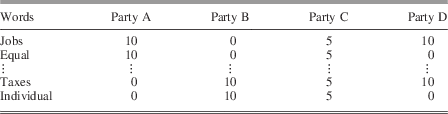
The following example demonstrates the word usage patterns for parties with a clear message and those that express more ambiguity. Imagine we have three parties with a clear message – a left-wing party, a right-wing party and a centrist party – and one centrist party with an ambiguous message. The parties communicate positions by emphasizing words from the same political vocabulary – for example jobs, equal, taxes and individual – and all parties write manifestos of the same length. We can represent these manifestos as term-document matrices; Table 1 presents such a hypothetical matrix. The left Party A frequently includes words that emphasize its left-wing position – jobs and equal – while the right Party B frequently uses words associated with a right-wing position – (lower) taxes and individual (rights).Footnote 25 In contrast, the cohesive centrist Party C mentions words from across the political spectrum in equal amounts. Party D, which has an ambiguous message, however, mentions some words in a similar manner to the left party, some words in a similar manner to the right party and is silent on other words. Current methods would – correctly – place Parties C and D in the center of the political space, but they would not be able to distinguish the level of clarity between them. The scaling model we propose below suggests that Party D, while still expressing a centrist position, is more ambiguous than Party C.
Sample Word Count Matrix for Three Parties with a Clear Position (A, B, and C) and One Party with an Ambiguous Position (D)

A STATISTICAL MODEL OF PARTY MANIFESTOS
Our model of manifesto drafting suggests that we can learn about the clarity of a party’s message, as well as its position taking, from word usage in manifestos. We now develop a scaling model that takes the Slapin and Proksch Wordfish model as its starting point.Footnote 26 In this model,Footnote 27 let i (1≤i≤I) indicate a party, and t be a time period (1≤t≤T). The data come from the P=I×T manifestos that each party produces in each separate time period, and we attempt to recover ω it , the ideal point of each party i in time period t. Across all the manifestos, let j represent the total number of unique words across all documents. The frequency that word j appears in the manifesto of party i at time t is assumed to follow the Poisson distribution:
 $$y_{{ijt}} \,\sim\,Poisson(\lambda _{{ijt}} )$$
 $$\lambda _{{ijt}} =\exp (\alpha _{{it}} {\plus}\psi _{j} {\plus}\beta _{j} {\asterisk}\omega _{{it}} ),$$
where y ijt is the count of word j in the document of party i at time t, α is a set of actor fixed effects, Ψ a set of word fixed effects and β a word-specific weight capturing the importance of word j in discriminating between party positions. The Poisson distribution expresses the probability of a number of events occurring in a fixed period of time conditional on a known average rate, but other parameterizations of this model can also be chosen.
The negative binomial offers one such alternative parameterization. It is the probability distribution associated with the number of successes in an independent sequence of Bernoulli trials before a specified number of failures occur. The negative binomial distribution X∼NB(r,p) is characterized by two parameters: the probability of success p and the predefined number of failures r. As r increases, a Poisson distribution with expected value λ can be reparameterized as a negative binomial distribution as follows:
 $$Poisson(\lambda )=\mathop{{\lim }}\limits_{{r\to\infty}} NB\left( {r,{\lambda \over {\lambda {\plus}r}}} \right).$$
This suggests that the Wordfish model described in Equation 1 can also be rewritten as:
 $$y_{{ijt}} \,\sim\,NB\left( {r,{{\lambda _{{ijt}} } \over {\lambda _{{ijt}} {\plus}r}}} \right)$$
for any sufficiently large value of r. Because a negative binomial distribution with parameters r and p has mean μ=r(1−p)/p and variance
 $\sigma ^{2} =r(1{\minus}p)/p^{2} =\mu {\plus}{1 \over r}\mu ^{2} $
, fixing r=50 is generally sufficient for the distribution to approximate the Poisson. However, Equation 4 is not the final model we estimate. Rather than estimating a single value of r or fixing it to a certain value, we instead allow it to vary across documents. We therefore estimate the negative binomial scaling model:
 $$y_{{ijt}} :NB\left( {r_{{it}} ,{{\lambda _{{ijt}} } \over {\lambda _{{ijt}} {\plus}r_{{it}} }}} \right).$$
The model is estimated through Markov Chain Monte Carlo.Footnote
28
Like all scaling techniques, the identification of α
it
, ψ
j
, β
j
and ω
it
is only relative. We identify our model by constraining the first value of α
it
=0 and the first value of β
j
to what is estimated using the Poisson algorithm, though our results are not sensitive to the choice of identifying restriction. Our central estimand of interest from Equation 5 is the document parameter r
it
. Given the formula for the variance of a negative binomial distribution,
 ${1 \over {r_{{it}} }}\mu ^{2} $
captures the amount of overdispersion for the document of party i at time t relative to what one would expect from the Poisson distribution. For ease of interpretation, we report
 $\theta _{{it}} ={1 \over {r_{{it}} }}$
as the clarity parameter – as θ
it
increases, overdispersion also increases, which we substantively interpret as a decrease in ideological clarity (or increase in ambiguity).Footnote
29
After controlling for text length and position, the θ it parameter captures situations in which parties log roll, omit or include conflictual statements, which leads document vectors in the term-document matrix to contain higher or lower word counts than would be expected if the document positions were perfectly clear. This implies that ambiguity, for instance, may arise when a party emphasizes one issue but fails to mention words associated with another compared to parties with similar position estimates that mention both issues. Thus we again highlight that our notion of ambiguity closely relates to relative inconsistency conditional upon position estimates. It is also worth noting that ambiguity, as conceived here, is theoretically uncorrelated with position estimates – extreme parties can express an inconsistent position, just as centrist parties can. Later in the article, we simulate scenarios in which a centrist party varies in its level of ideological ambiguity, but similar exercises could also be conducted with left- or right-leaning parties.
We have focused on intraparty reasons for parties to remain vague or silent on issues, either due to internal party divisions or strategic decisions to remain deliberately ambiguous. Having now laid out our model, though, it is also useful to consider to what extent system-wide (rather than party-specific) reasons for vagueness or deliberate silence would affect our estimates. First, following from Riker’s HerestheticsFootnote 30 and Budge et al.’s saliency theory,Footnote 31 there may be issues that all parties are reluctant to discuss. An example of such an issue in the United States would be Social Security reform, commonly referred to as the ‘third rail’ of American politics. For issues on which silence/vagueness is universal across parties, words referring to the issue will universally appear with 0 or very low counts. This will result in both small fixed effects for the words and small word discrimination parameters (that is, ψ j ≈ 0 and β j ≈ 0), meaning that silence will have little to no effect on estimates of party positions or clarity estimates. Secondly, silence may occur because of issue ownership advantages.Footnote 32 For example, it may be beneficial for parties on the right to repeatedly mention ‘law and order’ in their manifestos, but not for parties on the left. To the extent that issue ownership is correlated with ideology, this will affect our positional estimates by loading onto the word discrimination parameter β j . This in turn will help produce an expected number of word frequencies conditional on the position estimated. Heterogeneity from the expected word frequency is interpreted in our model as heterogeneity in word usage that is conditional on ideology.
SIMULATIONS AND TEXT-CODING EXERCISE
Before proceeding to substantive applications of our estimator, we test it in two ways. First, we apply it to term-document matrices generated from simulated political texts with different levels of ambiguity, and show that our model captures these differences. Secondly, we present human coders with manifestos generated according to our model of the data-generating process. Our coders correctly perceive the relative levels of clarity in our documents, providing additional validation of the results from our manifesto simulation.
Manifesto-Drafting Simulation
A standard testing procedure for scaling algorithms is Monte Carlo simulations, which allow researchers to simulate data based on the true data-generating mechanism. In our case, this means simulating term-document matrices in which each word count is consistent with a negative binomial data-generating mechanism. Such a simulation reveals that our estimator is able to recover the true spatial configuration as well as ideological clarity.Footnote 33 Yet a Monte Carlo simulation is of limited use as a diagnostic tool for our purposes. Natural language is complex, and word counts are not generated according to a simple probability distribution such as the negative binomial. Therefore, a document scaling model should work, in particular, for term-document matrices from actual political texts. We conduct a manifesto-drafting simulation and start by selecting eleven policy areas that are likely to be covered by a party manifesto. We formulate generic statements on these areas in English with regard to British politics, an arbitrary choice made for linguistic convenience only. The topics cover a broad range of policy areas, including employment, the trade-off between taxes and public spending, environment, global warming, energy, defense, European Union and the Euro, immigration, public health, crime, education and families.
For each of these eleven policy areas, we draft three policy statements assuming that parties compete on a single dimension. Thus the first statement in each policy area always expresses a left position, the second statement a centrist position and the third statement a right position. Our goal in drafting these statements is to compose sentences that adhere to natural language rules and reflect policy positions that could realistically appear somewhere in a party’s manifesto. In formulating the sentences, we follow three guiding principles: first, the statements should reflect parties’ ability to freely choose which issues to emphasize; secondly, the sentences should reflect the fact that parties use different words from the political lexicon to talk about similar issues;Footnote 34 and thirdly, the statements should reflect the fact that parties emphasize particular words to convey their messages. By merging the ideologically similar statements across policy areas, we can form three manifestos expressing clear positions that reflect left-leaning, centrist and right-leaning parties. All thirty-three statements are listed in the Appendix.
Using our thirty-three policy statements, we can now simulate ideological clarity by creating additional manifestos. We start with a centrist party that chooses to remain ambiguous by including left and right statements in its manifesto. This lack of clarity could be due to intraparty divisions or for strategic reasons. In the simulation, the party includes centrist statements on five of the eleven policy areas, left statements on three and right statements on the remaining three areas. The clear advantage of this approach is that we know a priori that this manifesto should express a position that is less clear than the previously generated three left, centrist and right manifestos. To examine whether the scaling algorithm is able to pick up different levels of clarity, we create additional manifestos that reflect a party that is even more ambiguous. Thus, rather than choosing five center, three left and three right policy categories for the manifesto, this party includes only one centrist statement, five statements on the right and five on the left. A priori, we expect that this manifesto should display more ambiguity as a result. For each of the two simulated clarity levels, we generate ten manifestos, each time randomizing which policy areas are expressed by the left, the center or the right statement. Randomization guarantees that the results do not depend on a particular combination of paragraphs.
In total, our manifesto-drafting exercise yields twenty-three manifestos: three (clear) left, centrist and right manifestos; ten with moderate ambiguity levels; and ten manifestos with large ambiguity levels. Each of these manifestos is independently readable in the sense that the grammar, syntax and style are valid. We include an additional nine manifestos that span the entire ideological space between the left and the right statements.Footnote 35 In total, we estimate positions and cohesion parameters for thirty-two manifestos, and the estimates shown are posterior means of 5,000 draws after a burn-in of 1,000 iterations.
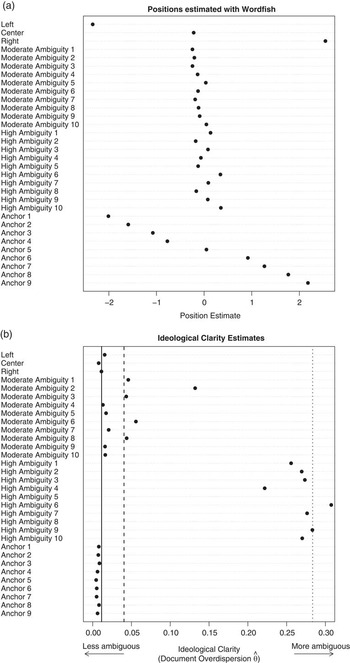
Figure 1a shows the position estimates for the documents from the standard Wordfish model. As expected, all manifestos with some level of ambiguity are estimated as centrist documents. Thus if we were simply to estimate positions while ignoring ideological clarity, we would be able to estimate positions that are theoretically plausible, because these manifestos are a combination of centrist, left and right statements. Next, we jointly estimate positions and clarity using our new scaling model. As expected, the positional estimates from our model correspond closely to those estimated using Wordfish, correlating at r=0.997. However, the crucial test is whether the algorithm also captures variation in ideological clarity across the documents. Our baseline manifestos, which include the anchoring documents and the three clear manifestos on the left, centrist and right, should exhibit very low levels of overdispersion, whereas the ten manifestos with medium levels of ambiguity should receive overdispersion estimates that are higher, and the ten manifestos with high levels of ambiguity should have the largest overdispersion parameters.
Manifesto-drafting simulation

Figure 1b shows the estimated clarity levels for all documents. The left, centrist and right documents all exhibit very high clarity (low ambiguity) levels, with θ it varying between 0.008 and 0.0154, which is largely consistent with the original Poisson distribution.Footnote 36 The average clarity estimate for these three documents is 0.011 (indicated by the solid line). In contrast, the five documents with moderate levels of ambiguity exhibit much higher θ it ’s, with an average of 0.040, nearly four times higher than the average for the left, center and right manifestos (dashed line). The ten documents vary in their actual levels, but this is not surprising given the stochastic nature of combining the statements across policy areas. Important for our purpose, however, is the overall trend toward larger θ it ’s (more overdispersion) for more ambiguous manifestos. Note, in particular, that the ten most ambiguous manifestos have the ten largest θ it estimates. The average θ it for this set is 0.284, more than seven times higher than the average for manifestos with moderate levels of clarity (dotted line).Footnote 37 Overall, the results from the manifesto-drafting simulation are reassuring: they demonstrate that our algorithm correctly recovers substantive clarity differences between simulated manifestos.
Manifesto-Coding Exercise
While the previous simulation shows that the estimator successfully detects differences in simulated clarity, it provides limited insight into the extent to which the theoretical story of manifesto drafting translates into perceptions. Do people view manifestos from parties with ambiguous positions, simulated in accordance with our theoretical model, as expressing an ambiguous position? After all, our argument is that ambiguity is reflected in the texts, albeit subtly. As a test of the validity of our theoretical argument, we construct a manifesto-coding exercise with human coders that uses a similar process to the drafting simulation. We select economic policy as the policy area of interest and choose ten economic issues on which parties state a position. For each issue, we construct three sentences expressing a left, right and centrist position. Analogous to the simulation, a manifesto is a combination of ten sentences that are selected from these three categories.Footnote 38 We construct two types of manifestos: those with low levels of ambiguity (defined as six centrist sentences, two left sentences and two right sentences) and those reflecting high levels of ambiguity (consisting of two centrist, four left and four right sentences). Our expectation is that manifestos with higher simulated levels of ambiguity are also perceived by coders as such.
We created twenty-five pairwise comparisons of a low ambiguity manifesto and a high ambiguity manifesto. Each time, we randomly selected sentences to construct the manifesto. Thus each of the twenty-five comparisons consists of a different set of constructed manifestos, but in each we juxtapose manifestos with the same levels of ambiguity. The exercise was conducted online, and we invited twenty-five graduate students and post-docs in political science at the University of Mannheim to participate. First, we presented respondents with an introduction:
We are interested in how you perceive internal conflict within political parties. Suppose a political party is preparing its manifesto for an upcoming election campaign. Two different versions of the economic policy section of the manifesto are under consideration, as shown below. Please read these two statements carefully.
Respondents were then presented with two statements and asked to indicate which expressed more internal disagreement (the Appendix presents one of these twenty-five pairwise comparisons as it appeared in the online survey).Footnote 39 From the twenty-five invited coders, we received eighteen responses. Of these eighteen coders, fifteen correctly identified the text statement with more ambiguity (83 per cent). The probability that one would observe at least this many correct answers by chance alone is p=0.0007.Footnote 40 These results suggest that when we construct documents with a lack of clarity in line with our theoretical model of manifesto drafting, human coders correctly perceive these documents as ambiguous. This provides independent validation of our manifesto simulation from the previous section.
MANIFESTO ANALYSIS
We conclude our analysis by applying our estimator to post-1990 election manifestos in Germany, the Netherlands, Sweden and Ireland.Footnote 41 We choose these countries for theoretical, empirical and linguistic reasons. Theoretically, our country selection is comprised of stable multiparty systems with a strong tradition of manifesto writing. Empirically, they provide us with a sufficient number of documents over a reasonably long time frame, and their manifestos are readily available in electronic format. Linguistically, our case selection demonstrates that our automated technique works well on documents written in four different languages. Our goal is threefold: to cross-validate the positional estimates for the party manifestos with alternative measures, to evaluate the clarity parameter in view of the relatively limited information available on the clarity of party positions and to demonstrate that we can use information from our estimation for the comparative analysis of party politics.
Cross-Validation
To assess the validity of our position estimates, we correlate them with two commonly used sources of data on party left-right ideology: the left-right positions from the Comparative Manifesto ProjectFootnote 42 and the general left-right dimension from the Chapel Hill Expert Survey of party positions.Footnote 43 We find moderate to strong correlations across all four countries between our estimates and both extant measures. The strong positive trends, shown in the Appendix, suggest that our estimates succeed in capturing the positional information in the manifestos. Positions estimated with the negative binomial model correlate highly with the Wordfish positions, ranging between +0.78 and +0.96. The correlations between the positions and the Manifesto Project’s left-right scale range between +0.46 and +0.87, and the average correlation across the four countries is +0.66. The positions also correlate equally well with an alternative version of the Manifesto Project’s left-right scale, the logit-transformed scale proposed by Lowe et al.Footnote 44 Lastly, the positions also correlate highly with expert survey positions (ranging between +0.57 and +0.87, with an average of +0.78 across the four countries).Footnote 45 Taken together, the results show that positional estimates are robust across countries and consistent with existing measures.
A similar validation exercise for the clarity parameter is significantly more difficult because alternative measures are largely absent. One alternative is to examine measures of uncertainty surrounding manifesto positions. Benoit, Laver and Mikhaylov obtain manifesto uncertainty estimates through a non-parametric bootstrap from the manually coded manifesto categories based on the notion that text generation is stochastic.Footnote 46 This means that the error captured by this approach is generic and encapsulates all types of processes throughout the editing process as well as the coding process. Moreover, the uncertainty estimates correlate highly with text length – uncertainty around position estimates of longer texts is lower. Despite these differences, we find a relationship between uncertainty estimates and the overdispersion parameter. In all four countries the correlation is positive, ranging between +0.29 and +0.75. Uncertainty about the manifesto positions as captured by the bootstrapped standard errors does, at least to some degree, correlate with extra variation in word usage. We do not expect perfect correlation, as internal party divisions are only one potential reason for uncertainty around position estimates obtained from the manifesto data.
Note that, just as with any other scaling model, the estimates are not directly comparable across models because identification is country and language specific (the same applies for the positional estimates). One potential alternative approach to ideological clarity is therefore to study possible observational consequences. As the perceived ambiguity around a position increases, our clarity estimate should increase as well. We examine this supposition with uncertainty estimates generated from the Chapel Hill Expert Surveys, measured as the standard deviations of the expert position scores on the left-right dimension.
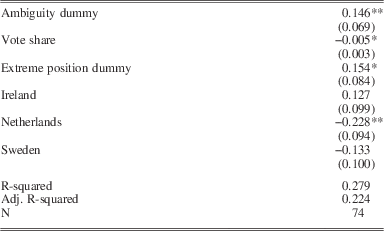
Marks et al. and Hooghe et al. attempt to explain variation in expert assessments of party positions, and find that the standard deviations of such assessments of European integration positions increase with internal party dissent on that dimension (as assessed by the experts).Footnote 47 Of course, clarity of stance is certainly not the only factor that explains expert standard deviations. The studies also find that experts are better able to assess the positions of parties that receive more votes or are more ideologically extreme. Lastly, a large amount of the variance in the standard deviations of expert party placements remains unexplained, suggesting that much of the variation may be due to random noise. We run an ordinary least squares (OLS) model similar to that of Hooghe et al.,Footnote 48 explaining the expert standard deviations on the Chapel Hill left-right dimension as a function of our clarity (overdispersion) parameter, vote share and the absolute value of our estimated party ideology. Because the clarity and party position estimates are not directly comparable across countries, we create dummies for these two variables to avoid making comparisons on an interval scale. Extreme Position Dummy equals 1 if the position estimate belongs to the 20 per cent most extreme positions (absolute value of the position estimate is greater than 1.2 standard deviations from the mean), while Ambiguity Dummy equals 1 if the overdispersion parameter of that manifesto is greater than the mean overdispersion within the country. We also include country fixed effects. Based on the results reported by Hooghe et al.,Footnote 49 we expect a positive sign on the ambiguity dummy, a negative sign on vote share and a negative sign on the extreme position dummy. The results are presented in Table 2. As expected, ambiguity as captured by the clarity parameter is positively associated with the expert survey standard deviations. In addition, parties receiving higher vote shares have smaller standard deviations, but positional extremity seems to correlate positively with expert standard deviations.Footnote 50
Explaining Expert Survey Standard Deviations on Left-Right with Ideological Clarity (OLS)

Note: standard errors in parenthesis. *p-value≤0.1, **p-value≤0.05, ***p-value≤0.01.
Ideological Clarity and Electoral Success
We now use the clarity and position estimates in a model to explain parties’ electoral success. Little work to date examines the effect of positional ambiguity on electoral success in multiparty democracies,Footnote 51 and no work examines the effect of ambiguity using elite-level party data.Footnote 52 Using our estimates, we investigate the interaction effect of party position shifts and changes in ambiguity on electoral success. In line with previous research, we expect parties to pick up votes as they move to the center.Footnote 53 However, we also hypothesize that changes in ideological clarity may alter how position shifts affect party vote share. In particular, parties are likely to find ambiguous positions more advantageous as they moderate their ideological stance; they can reach out to a larger segment of the electorate at the center of the political space. Conversely, parties moving to the extremes may win more votes as they stake out clearer positions. At the extremes, there are fewer additional voters for parties to pick up by broadening their ideological appeal. Rather, the relatively few extreme voters may view ideological ambiguity as a sign of weakness or insufficient commitment to their cause.Footnote 54 This leads us to the following hypotheses:
Hypothesis 1: When parties become more moderate, they will gain votes by becoming more ambiguous.
Hypothesis 2: When parties become more extreme, they will gain votes by becoming less ambiguous.
To test these hypotheses, we use change in party vote share from the previous election as the dependent variable. We use our estimates of ideology and clarity as our independent variables. As in the previous regression model, we must ensure cross-national comparability. We cannot naively pool our estimates in a statistical model, as we do not know whether ideological distances and levels of clarity of the same value mean the same thing in different countries. We solve this issue by transforming the variables. The first variable, Clarity Change, is a dummy coded 1 if the overdispersion estimate of a party in election t is lower than the estimate for the same party in the previous election t−1, and 0 if the overdispersion estimate is higher (that is, a party is more ambiguous than before). The second variable, Position Change, is a dummy indicating whether the party’s position is further from the center of the political space in election t than in the previous election t−1.Footnote 55 To capture the conditional effect, we also include the interaction of the clarity and position change dummies.
While the dummy variables solve the identification issue across countries, they do not allow us to make any substantive comparisons regarding the magnitude of the effects. After all, parties may not substantially change positions or clarity levels from one election to the next. To account for this possibility, we code additional variables. Large Position Change is coded as −1 if a party’s position is more than one standard deviation more moderate than before, +1 if it is more than one standard deviation more extreme and 0 otherwise. Similarly, Large Clarity Change is coded as −1 if a party is more than one standard deviation more ambiguous than before, +1 if it is more than one standard deviation less ambiguous and 0 if there is no change. As a final alternative operationalization of parties’ ideological clarity change, we calculate the variable Significant Clarity Change, which takes into account the estimation uncertainty around the overdispersion parameter. The variable is coded as +1 if a party manifesto was clearer than in the previous election and the difference was statistically significant, −1 if it was more ambiguous and that change was statistically significant and 0 if there was no statistically significant change compared to the previous election.
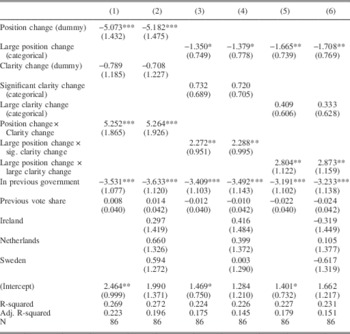
Table 3 presents the results. The sample size is N=86 because we have to exclude the first election in each country as we are unable to calculate the change variables for those. The models control for parties’ government status prior to the election t, as models of retrospective voting suggest that voters may punish governing parties. Additionally, we control for party size using previous vote share and country fixed effects. Models 1 and 2 show the effects for the dichotomous version of position change and clarity change, Models 3 and 4 for the (categorical) large position changes and significant clarity changes, and Models 5 and 6 for large position and large clarity changes. In each case, the second model includes country-fixed effects as a robustness check. In all models, a party’s previous vote share has no effect, and our results are robust to omitting this variable. The main findings for our variables of interest are robust across all specifications. The independent effect of Position Change is negative and statistically significant. Clarity Change has no statistically significant independent effect, but the interaction terms are consistently positive and significant. To understand the substantive magnitude of these effects, we simulate various scenarios below.
Effects of Party Position and Clarity Changes on Electoral Success

Note: OLS regressions, standard errors in parenthesis. *p-value≤0.1, **p-value≤0.05, ***p-value≤0.01. Position Change (dummy) indicates whether the party’s distance to the ideological center of gravity is larger (coded 1) or smaller (coded 0) than in the previous election. Large Position Change (categorical) is coded 1 if a position change to the extreme is larger than a typical (standard deviation) position change in that country, −1 if a position change toward the center is larger than a typical position change and 0 if there is no large change in the party position from the previous election. Clarity Change (dummy) indicates whether the party position became more clear (less ambiguous), coded as 1, or less clear (more ambiguous), coded as 0. Significant Clarity Change (categorical) is coded as 1 if the party was statistically significantly less ambiguous, −1 if it was significantly more ambiguous and 0 if there was no statistically significant change compared to the previous election. Large Clarity Change (categorical) is coded as 1 if a change toward more clarity was larger than a typical (standard deviation) clarity change in that country, −1 if a clarity change toward less clarity (more ambiguity) was larger than a typical clarity change and 0 if there was no large change in clarity compared to the previous election. In Previous Government indicates whether the party was in government prior to the election.
Mirroring the findings of Ezrow and Adams and Somer-Topcu,Footnote 56 our results suggest that moving away from the center of the space can be costly for parties. However, with our new measure, we find that the effect is contingent upon changes in ideological clarity. Moving away from the center hurts a party that has become more ambiguous, but it leads to gains for a party that has become less ambiguous. These effects hold no matter what specification of position or clarity change we use. For example, in the simplest model with the dichotomous measures (Model 1), opposition parties that move away from the center and become more ambiguous lose approximately 2.5 per cent of their vote share on average, while parties that move away from the center and become less ambiguous gain around 2 per cent. Moderating a position while becoming less ambiguous leads to vote share gains of approximately 1.8 per cent, while moderating and becoming more ambiguous leads to gains of over 2.5 per cent. These results are in line with other findings that extreme opposition parties are more likely to switch to moderate preferences than to remain extreme.Footnote 57 And they suggest that expressing a more ambiguous position in a manifesto may result in vote loss or gain, depending on party positioning. Moreover, the results confirm that governing parties tend to be punished at the polls.
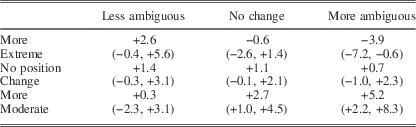
Models that take into account large shifts in position and clarity lend even stronger support to our findings (Models 3 through 6). Table 4 shows the predicted vote share changes for opposition parties on the basis of various scenarios using the estimates from Model 5. The predicted change in vote shares if an opposition party made a large extreme shift and was substantively less ambiguous than before is +2.6. If the party makes the same extreme shift but becomes more ambiguous in its position, the predicted change in vote share is −3.9. This reconfirms the result that parties that move away from the center and take a clear position tend to gain votes, but they lose votes if they become more ambiguous. The first difference of over 6 per cent in vote shares is not only statistically significant, but substantively large. We can also use the model to examine the effects of moderating a party’s stance. A significant moderate shift combined with a significantly more ambiguous manifesto yields a +5.2 vote share change, the largest possible gain in our simulation. This suggests that parties can win by broadening their appeal when adopting more moderate positions. This is underscored by the fact that the same moderate shift with a less ambiguous manifesto does not result in a statistically significant change in vote shares. Finally, we can compare these predictions to those in which parties do not change positions or clarity from one election to the next. In such a case, a party is estimated to gain around +1.1 per cent, primarily because it was in opposition prior to the election and therefore tends to do better. Compared to this baseline, the potential vote losses and gains implied by our model are quite substantive. Making more ambiguous policy statements possibly leads to a larger vote share when parties are able to moderate positions, but may also lead to substantial losses if a party fails to do both at the same time. In sum, the success of an electoral strategy that involves moderating a position appears to be conditional on a party’s accompanying shift in ideological clarity. We emphasize that parties may be subject to both internal and external constraints in setting the level of policy ambiguity. Thus they are not always free to set optimal ambiguity levels due to strong internal conflicts. To what extent ambiguity is strategic or the result of internal party conflicts remains an interesting area of research for future studies of party competition.
Effects of Positioning and Ideological Clarity on Parties’ Vote Shares

Note: cell entries show simulated predicted vote share changes for a party that was previously in opposition based on Model 5; 95% confidence intervals in brackets.
CONCLUSION
In order to take full advantage of the information contained in election manifestos, we propose a method that incorporates substantive information about manifesto drafting into a text-scaling model, and derive a scaling technique to estimate both ideological positions and clarity from manifestos. Previous methods of extracting policy positions from political texts have largely ignored the fact that manifestos are written by collective actors and aimed at multiple audiences. We demonstrate that our scaling procedure captures party ideology and clarity in simulated data – in both Monte Carlo and manifesto-drafting simulations. Furthermore, we corroborate the validity of the data-generating mechanism through a coding exercise. Finally, we apply our technique to manifestos in four multiparty democracies. The results show that positions correlate with alternative manifesto-based measures, and that clarity measures correlate well with alternative conceptualizations where available. Moreover, we have used our estimates to explore how shifts in policy position interact with changes in the clarity of the party message to affect a party’s electoral performance. While much has been written about party positioning and electoral success, ideological clarity has been largely neglected. We corroborate previous findings in the literature that moving to the center of the space can help a party pick up votes, but the impact of clarity is highly contingent. Greater ambiguity can help parties as they move to the center, but it may hurt them as they move to the extremes. This finding opens up avenues for further research. In particular, we note that there is little research on why party ambiguity varies over time. How do new party members, changes in issue salience, leadership changes, changes in electoral strategies, appeals for coalition partners and shifting voter preferences affect the clarity of a party’s message? And in an environment in which manifestos serve as signals to both the electorate and potential coalition partners, to what extent are our answers to these questions conditioned by strategic considerations? While our work does not provide answers to these questions, we believe we offer a promising first step toward doing so.