Body image has always been an important feature of societies. Recently, it has reached unprecedented proportions: body image is seen as a sign of achievement, success, friendship, opportunities, pleasure, well-being and affections (Esnaola & Rodríguez, Reference Esnaola, Rodríguez and Goñi Granmontagne2009).
The obsession in attempting to reach body beauty stereotypes affects negatively an important segment of society, namely the younger one, towards harmful practices, which may endanger health, understood as physical, psychological and social well-being. Physical activity ceases to be a hobby or a means to achieve a better physical status, by becoming a pathologic behaviour; eating habits cease to be balanced to become inadequate and, often, uncontrolled; and pharmacological, medical and surgery treatments constitute an easy resource to change body image rapidly and easily, in search of the desired ideal body type (Esnaola & Rodríguez, Reference Esnaola, Rodríguez and Goñi Granmontagne2009; Trallero, Reference Trallero2010).
The raw material of body image is the real body, which comprises: 1) the perception of body volume and dimensions as a whole or in segments, with the possibility of distortions in the perception due to overestimation (perception of his/her dimensions as larger than the real one) or underestimation (perception of his/her dimensions as lower than the real one); 2) the subjectivity of body satisfaction, related to the individual assessment of his/her own body or physical look, which usually includes the aesthetic parameters of the society where they are integrated – these may determine preoccupations, feelings, emotions and attitudes; and 3) the behaviors developed by the individual as a consequence of the assessment of his/her body, such as showing off or enhancing certain parts of the body or trying to hide them (De la Serna, 2004).
Adolescents also worry about their look, which makes them spend time, energy and money (or their parents’) in trying to achieve the look that is as close as possible to the ideal type, often corresponding to the one in the peer group. The concern about one’s look and, often the cult that is paid to the look, is also related to clothes, overdressing or under dressing, to hairstyle, makeup, tattoos and piercings, to ways of gesticulating and walking, amongst other aspects (Fuentetaja & Masó, Reference Fuentetaja and Masó2007; Trallero, Reference Trallero2010).
Cultural elements determine the stereotypes of body image and constitute the background of the assessment criteria, which feed the feedback by others and the perception of the adolescent him/herself. The feedback of the social contexts (family, school, peer group or neighborhood), often embodied in jokes and sarcasm, is important. However, it is always the adolescent him/herself who interprets, which means that the adolescent may be influenced by what s/he believes to a greater extent, than by reality itself. Their belief may be adjusted to reality or be distorted, or biased, defined as body image distortion (Eisenberg, Neumark-Sztainer, & Story, Reference Eisenberg, Neumark-Sztainer and Story2003; Richardson, Garrison, Drangsholt, Lloyd, & Linda, Reference Richardson, Garrison, Drangsholt, Lloyd and Linda2006).
Literature identifies other determinants for adolescents’ body image perception and well-being, besides cultural stereotypes, i.e. the relation with the media (Esnaola & Rodríguez, Reference Esnaola, Rodríguez and Goñi Granmontagne2009), the perception of physical self-efficacy (motor capacities applied in physical activity and sports), personality and mood (King, Reference King and Lewis2002; Trallero, Reference Trallero2010), self-esteem, competencies and expectations (Fuentetaja & Masó, Reference Fuentetaja and Masó2007), stress symptoms related to family conflicts, changing schools, personal losses and other events in life, which may have an unexpected negative impact (Trallero, Reference Trallero2010).
For adolescents, body and look are also a representation of their own self and it is possible to observe differences between individuals in terms of gender and age. For example, the relation between look, well-being and self-perception do not evolve uniformly: at 12 years old there is no relation, but at 13 years old that relation is already significant (Fuentetaja & Masó, Reference Fuentetaja and Masó2007; King, Reference King and Lewis2002). Other authors suggest, on one hand, a tendency in females towards the internalization of behaviors and males towards the externalization of behaviors, meaning that the similar well-being levels found in the beginning of adolescence diverge with age increase, and males show a higher level of well-being. On the other hand, other studies demonstrate higher levels of well-being in relation with body image in younger adolescents, than older ones (Bisegger et al., Reference Bisegger, Cloetta, von Rüden, Abel and Ravens-Sieberer2005; Matos et al, Reference Matos, Simões, Tomé, Gaspar, Camacho and Diniz2007). The assessment of body image by males is distinct from that of females’. They usually improve their body image, self-esteem, psychological fortitude, well-being and are more satisfied as they put on weight and body mass index (Bergeron & Tylka, Reference Bergeron and Tylka2007). The interest in losing weight is practically limited to those who are overweight (Trallero, Reference Trallero2010).
Subjective well-being does not mean the absence of negative sensations, but an individual construction that includes processing positive information and perceptions, as an outcome of experiments and the overall assessment of every aspect of one’s life (Rodríguez, Reference Rodríguez and Goñi-Granmontagne2009). Subjective well-being is comprised of two basic components (Diener, Oishi, & Lucas, Reference Diener, Oishi and Lucas2003): it is firstly based on emotional aspects (related to the mood of the individual), which include positive and negative affections; and secondly, it is based on the cognitive aspects (self-perceived life satisfaction). Subjective well-being, in accordance to this model, is the result of putting together these two components, which are different and relatively independent but entertained in such a way as to show a single standard of associations with different variables (Diener et al., Reference Diener, Oishi and Lucas2003).
Life satisfaction is a cognitive component, built through the way one perceives life, with both its positive and negative aspects. Happiness is an affective-related component, as a result of positive emotions (joy, pleasure, euphoria) and negative (fear, stress, sadness). The positive balance results when positive experiences override negative ones (Diener et al., Reference Diener, Oishi and Lucas2003; Rodríguez, Reference Rodríguez and Goñi-Granmontagne2009).
The overall aim of this study was to assess how Portuguese adolescents perceive their own body image, as well as the impact of that perception in their subjective well-being, both at cognitive and emotional levels. The specific aims of the study are to understand: a) self-perceived body image and its relation with adolescents’ well-being; 2) self-perceived look and its relation with adolescents’ well-being; and 3) satisfaction/dissatisfaction with their body and its relation with adolescents’ well-being. In the specific objectives we considered age and gender, and also that self-image factors are predictors of adolescent well-being.
It is important to understand how adolescents react and adapt to significant changes regarding their body image, in order to help educators and health professionals identify strategies which may enhance adolescents’ assets and mitigate future risk behaviors. The study may also be useful to adolescents themselves, as it may help them to get to know, to accept and understand themselves better.
The literature review suggests an impact of self-perceived body image in adolescents’ self-perceived well-being, in relation to body perception, look perception, as well as satisfaction/dissatisfaction with the body. Expected outcomes include the fact that adolescents who are satisfied with their own body, and perceive better their body and look, show higher levels of well-being. It is also expected that there will be differences between gender and age groups in relation to self-perceived body image and its relation with well-being.
Method
Participants
4,877 adolescents, resident in continental Portugal and enrolled in public schools participated in the study. 49,6 % were boys and 50,4 % were girls. This data collection is part of the World Health Organization (WHO) collaborative cross-national Health Behavior in School-aged Children (HBSC) Portuguese study 2006 (Currie et al., Reference Currie, Nic Gabhainn, Godeau, Roberts, Smith, Currie and Barnekow2008; Matos et al., Reference Matos, Simões, Tomé, Gaspar, Camacho and Diniz2007). The study aims to gain new insight into, and increase our understanding of young people’s health and well-being, health behaviors and their social context. This data collection allows for national and international comparison, as over 44 countries are now collecting data (Roberts et al., Reference Roberts, Currie, Samdal, Currie, Smith and Maes2007).
The study captures 3,7 % of the total student population attending school, from age 11, in Portugal (31,7 % attend 6th Grade, 35,7 % attend 8th Grade and 32,6 % attend 10th grade), corresponding to 21,3 % students aged 11, 30,2 % aged 13, 33,1 % aged 15 and 15,3 % aged 16 or more. The average age is 14 years old and the standard deviation is 1,89. Most adolescents are Portuguese (94,1 %), as well as their parents (92,4 % of fathers and 92 % of mothers).
After the descriptive analysis of the self-perceived look data, it was decided that the 2,6 % sample of adolescents who do not think about their look would not be taken into account for the statistical analysis purpose.
Materials
The HBSC 2006 questionnaire was used to collect the data, according to its protocol (Currie, Samdal, Boyce, & Smith, Reference Currie, Samdal, Boyce and Smith2001). However, the present study will only take into account some sets of questions, namely those related to self-perceived body image, i.e. wish to change the body (satisfaction/dissatisfaction with the body) and self-perceived body and look. In addition to these, other well-being related questions were taken into account, such as life quality related to health (Kidscreen 10), life satisfaction (Cantril, Reference Cantril1965) and happiness.
Within the measures related to self-body image, satisfaction/dissatisfaction with the body was expressed through a dichotomy item. Body self-perception is expressed by a Likert scale of five points between very thin and very fat. Look self-perception is expressed by a Likert scale of six points: you have a very good look, you have a good look, you have a normal look, you don’t have a good look, you have a bad look and you don’t think about your look. The adolescent is invited to reply what s/he thinks about his/her looks or if s/he does not think about it at all.
Within measures related to well-being, life quality in relation to health (QVRS) was measured by Kidscreen 10: its authors propose this scale to assess a one-dimensional global health feature (Rajmil et al., Reference Rajmil, Alonso, Berra, Ravens-Sieberer, Gosch and Simeoni2006) but, as argued by Borges, Matos, and Diniz (Reference Borges, Matos and Diniz2011), the scale enabled to identify two factors, namely an emotional-related component and a cognitive component. The ten questions of the scale place the adolescent in the previous week, so that s/he answers a Likert scale of five points between nothing and totally (Rajmil et al., Reference Rajmil, Alonso, Berra, Ravens-Sieberer, Gosch and Simeoni2006). Life satisfaction was measured by the Cantril scale (1965), represented graphically by a ladder where step ten corresponds to the best life possible and step zero represents the worse life possible. Adolescents were asked to select the degree that best described what they felt at that moment in time. Happiness is measured by an ad hoc single item, on a Likert scale of four points between I feel unhappy and I feel happy. Adolescents were asked to select the degree of happiness, which they felt in relation to life at that moment in time.
Procedure
This study is descriptive, in correlation and transversal, with a representative sample of the student population in grades six, eight and ten, in public schools in Continental Portugal.
The study followed all the rules for research with human subjects, in this particular case, minor, approved by an ethics committee (Hospital de São João – Porto), the Ministry of Education, the Regional Directorates of Education, the participating schools and by informed parental consent, required by the parents committee in each school.
The analysis unit was the class. Firstly schools and, secondly, classes were randomly selected until a representative sample of the student population was obtained, with 3,7 % of the total student population. After the authorization of the Ministry of Education and the Regional Directorates for Education, the respective schools were contacted and the questionnaires were sent to each one of them (Matos et al., Reference Matos, Simões, Tomé, Gaspar, Camacho and Diniz2007). According to the protocol, teachers administered the questionnaires in the classroom during the month of January 2006. Student participation was on a voluntary basis.
The completed questionnaires were scanned, translated and interpreted through the program Eyes & Hands-Forms, version 5. After this, quantitative data was inserted in a database of the program Statistical Package for Social Sciences, version 18.0 for Windows, in order to proceed with the statistical analysis.
Participants were organized in four age groups: the 11 year old age group, corresponding to students of the sixth grade (21,3 % of the sample); the 13 year old age group, corresponding to students of the eighth grade (30,2 % of the sample); the 15 year old age group, corresponding to students of the tenth grade (33,1 % of the sample); the 16 year old or more age group, corresponding to students who had failed a year or had been enrolled in the school system later than usual (15,3 % of the sample).
After the descriptive analysis of the self-perceived body data, taking into account that the adolescents that perceived themselves as too thin or too fat was very low (2 % and 2,7 %, respectively), it was considered important to convert this aspect of body image into three groups: 1) ideal; 2) a little or too thin; and 3) a little or too fat. Three groups were established in relation to self-perceived look, namely 1) good or very good look; 2) normal look; and 3) not good or bad look.
Analysis
The items related to self-perceived body image were considered independent variables, whilst the items related to well-being were considered dependent variables. In addition to the descriptive analysis, the mean was compared (t for student and Anova) with the aim to analyze significant differences of the dependent variables. The logistic regression wanted to verify the relevance of the variables of self-perceived body image, in an explicative model of adolescent well-being. In the post-hoc comparisons, the Tukey model was adopted for homogeneous and the Games-Howell method for heterogeneous (Maroco, Reference Maroco2007).
Results
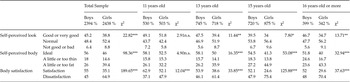
The results table 1 show that Portuguese adolescent boys self-perceive themselves as having a better look, a better body and declare to be more satisfied about their body than Portuguese adolescent girls.
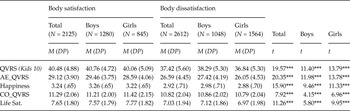
The dichotomous independent variable is there anything in your body you would like to change, shows statistically significant differences in relation to all the dependent variables of well-being. In this sense, the group of adolescents that is satisfied with their body, that is, who would not change anything about it, show higher levels of well-being. The analysis by gender and age, in relation to this very same item, show statistically significant differences in all perceived well-being, with the same tendency as the ones registered for the overall sample (see table 2 below).
Sample characteristics by gender and age group

*p ≤ .05; ** p ≤ .01; *** p ≤ .001.
Differences between body satisfaction/dissatisfaction in relation to the median variables of well-being

*p ≤ .05; ** p ≤ .01; *** p ≤ .001. QVRS = Life quality related to health; AE_QVRS = Self-esteem related to life quality in relation to health; CO_QVRS = Cognitive component of life quality in relation to health; Life Sat. = Life satisfaction.
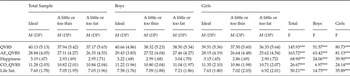
Statistically significant differences were obtained between the groups of self-perceived body, for all variables of well-being. The comparisons show table 3 that the group of self-perceived body as ideal registered the higher levels in all well-being variables when compared to the group of self-perceived body as a little or too thin and the group of self-perceived body as a little or too fat. The group a little or too thin showed higher and statistically significant levels for life quality in relation to health and self-esteem related to life quality in relation to health, when compared to the group of self-perceived body as a little or too fat.
The self-perceived body groups were also compared in terms of gender and age group, as well as the well-being medians. The comparisons show that the group of self-perceived body as ideal registered higher averages, with statistically significant differences in all well-being variables when compared to the other two groups, for both gender and age group. Between the groups of self-perceived body as a little or too thin and a little or too fat, boys did not show any statistically significant differences in any well-being variables. When compared to the group of self-perceived body as a little or too fat, girls in the group of self-perceived body as a little or too thin registered higher levels and statistically significant results for life quality in relation to health and self-esteem related to life quality in relation to health. The data analysis by age groups did not show significant differences between the groups a little or too thin and a little or too fat, except in the 15 year old age group in life quality in relation to health, F(2, 1476) = 51.92; p = .001, and self-esteem related to life quality in relation to health, F(2, 1476) = 58.27; p = .001, where the group a little or too thin reported higher levels and statistically significant results when compared to the group a little or too fat, namely in life quality in relation to health (M = 37.66; SD = 5.26) to (M = 35.97; SD = 5.46); and in self-esteem related to life quality in relation to health (M = 26.87; SD = 4.27) to (M = 25.41; SD = 4.43).
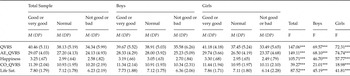
Statistically significant differences between the groups of self-perceived look for all variables of well-being were registered table 4. The group of self-perceived look as good or very good reported higher levels in all variables of well-being when compared to the group of self-perceived look as normal and the group of self-perceived look as not good or bad. The group of self-perceived look as normal also reported statistically significant differences for all variables of well-being, when compared to the group of self-perceived look as not good or bad.
As it is equally possible to observe in Table 4, when the self-perceived look groups are compared by gender, there are statistically significant differences for the three groups. The group of self-perceived look as good or very good reports higher levels of well-being than the group of self-perceived look as normal and the group of self-perceived look as not good or bad. Finally, the group of self-perceived look as normal shows higher levels of well-being and statistically significant results than the not good or bad group.
Differences between self-perceived body in relation to the medians of the well-being variables

*p ≤ .05; ** p ≤ .01; *** p ≤ .001. QVRS = Life quality related to health; AE_QVRS = Self-esteem related to life quality in relation to health; CO_QVRS = Cognitive component of life quality in relation to health; Life Sat. = Life satisfaction.
Differences between self-perceived look in relation to the medians of the well-being variables

*p ≤ .05; ** p ≤ .01; *** p ≤ .001. QVRS = Life quality related to health; AE_QVRS = Self-esteem related to life quality in relation to health; CO_QVRS = Cognitive component of life quality in relation to health; Life Sat. = Life satisfaction.
Differences between self-perceived look in relation to the medians of the well-being variables, by age group

*p ≤ .05; ** p ≤ .01; *** p ≤ .001. QVRS = Life quality related to health; AE_QVRS = Self-esteem related to life quality in relation to health; CO_QVRS = Cognitive component of life quality in relation to health; Life Sat. = Life satisfaction.
Predictors of well-being, by total sample and gender

QVRS = Life quality related to health; AE_QVRS = Self-esteem related to life quality in relation to health; CO_QVRS = Cognitive component of life quality in relation to health; Life Sat. = Life satisfaction; VD = Dependent variable P = Steps Vis = Independent variables R2 Aj. = R2 Adjusted; Look perception = Self-perceived look Body dissatisfaction = Body satisfaction/dissatisfaction Body perception = self-perceived body.
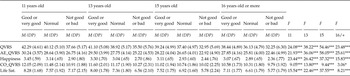
The data analysis of the relation between self-perceived look and the medians of the variables of well-being concerning age, table 5 demonstrate that in all age groups (11, 13, 15 and 16 years old or more) there are statistically significant differences. However, the group of self-perceived look as good or very good reports the higher levels of well-being.
Nevertheless, there are differences between age groups: (1) In the 11 year old age group there are statistically significant differences between the three groups of self-perceived look for life quality in relation to health, self-esteem related to life quality in relation to health and happiness; but there are no statistically significant differences between the groups of self-perceived look as normal and not good in the variables of the cognitive component of life quality in relation to health and life satisfaction; (2) In the 13 year old age group, there are statistically significant differences between the three groups of self-perceived look for all variables of well-being, except for the cognitive component of life quality in relation to health, where there are no differences between the self-perceived groups of good or very good and normal; (3) In the 15 year old age group, there are statistically significant differences between the three groups of self-perceived look for all variables of well-being, except for the cognitive component of life quality in relation to health, where there are no differences between the self-perceived groups of good or very good and normal; (4) In the 16 year old or more age group, there are statistically significant differences between the three groups of self-perceived look for all variables of well-being, except for the cognitive component of life quality in relation to health, where there are no differences.
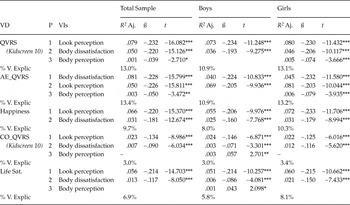
Linear regression analysis showed that the factors for self-perceived body image with the higher relevance for a possible model of subjective well-being for adolescents are self-perceived look, followed by the desire to change something about their body. These factors of self-perceived body image have a greater impact in the emotional component of adolescents’ well-being (table 6).
The factors of self-perceived body image considered for the purpose of this study showed a higher percentage of explained variance for girls than boys. The self-perceived body image is more relevant for the emotional component than the cognitive component of well-being, for both girls and boys. Self-perceived look overrides the explanation for adolescents’ well-being, for both genders. Self-perceived body (whether one is fat, thin or normal) shows a residual importance in the prediction of well-being. The perception of satisfaction/dissatisfaction with their body is a predictor of well-being followed by self-perceived look, for both genders.
The analysis of linear regression was done by age group as well. For girls in the 16 year old or more age group, the desire to change something about their body helps to explain the levels of well-being to a greater extent than self-perceived look, for the variables of life quality in relation to health and self-esteem related to life quality in relation to health. In the 11 year old age group (for girls) and the 13 year old group (for boys), the desire to change something about their body overrides the self-perceived look factor in explaining the levels of the variable of well-being for self-esteem related to life quality in relation to health. In the 13 year old group (for girls) and the 16 year old group (for boys), the desire to change something about their body is the first predictor of happiness. In girls, the desire to change something about their body is more relevant to the predictability of the cognitive component of life quality in relation to health in the 15 year old age group and life satisfaction in the 13 year old age group. Finally, the results of the linear regression analysis by age group show that, for boys, self-perceived body image-related factors become more important with age than in the emotional component of well-being. In girls, self-perceived body image-related factors become more important with age up until the 15 year old age group, decreasing in the 16 year old or more age group, where it ceases to appear in the well-being variables related to cognitive components.
Discussion
This study does not focus on weight or on body mass index, although the statistical analysis clearly demonstrates that the way adolescents perceive their own body and look has an impact on their well-being.
In the relationship between the adolescent and his/her body and look, there are multiple factors to consider. The questions upon which the study is based are focused on the assessment that the adolescent makes of his/her own body and look and his/her well-being, independently of the reasons or causes that lead them to make such an assessment and what they understand as satisfaction with their body and look.
Even though 51% of adolescents perceive that they have an ideal body and more than 90 per cent think they have a normal, good or very good look, approximately 55 per cent desire to change something about their body, meaning that they are not fully satisfied with it. As several authors refer, if, on one hand, these results relate to a concern about body image that is exacerbated by the adolescents’ social contexts (Trallero, Reference Trallero2010), on the other hand they also relate to the distortion of body image, which is also favoured by social pressure, including the media (Esnaola & Rodríguez, Reference Esnaola, Rodríguez and Goñi Granmontagne2009; Trallero, Reference Trallero2010). Nonetheless, the question that assesses body satisfaction, either dichotomous or not, allows to evaluate the relation between the adolescent and his/her whole body. Consequently, the study cannot find whether the adolescent is unsatisfied with just one section of his/her body, what part of his/her body and in what way it has an impact on their well-being or not.
Several studies refer that body dissatisfaction and the desire to change it is more common amongst girls (Richardson et al., Reference Richardson, Garrison, Drangsholt, Lloyd and Linda2006). Effectively, data shows that girls’ self-perception is farther away from the ideal body and they feel bigger and with a worst look than boys. Possibly, girls are more sensitive to pressure from standards and stereotypes around body image, hence the desire to change something about their body with the aim of feeling closer to body stereotypes of Western society (Eisenberg et al., Reference Eisenberg, Neumark-Sztainer and Story2003). These differences may also be related to the fact that, as reported by Trallero (Reference Trallero2010), the assessment that girls and boys make of their respective body and look are based on distinct parameters.
As King (Reference King and Lewis2002) refers, in the 11 year old age group, there are no inter-gender differences for look and self-perceived body. But body satisfaction to 11 year olds already achieved gender differences, which seems to indicate the strength of the sociocultural environment and the internalizations that adolescents do of it. In later age groups there are statistically significant differences between boys and girls both in terms of self-perceived body and look, as well as in the desire to change something about their body. The time around when adolescents become 15 years old marks the most significant differences. The differences in body image for the 16 year old or more age group, decreases. The age sample does not allow the conclusion of whether these differences between genders tend to disappear or stabilize in more advanced age groups.
When the answer to the variable is there anything about your body you would like to change is positive, it gives an indication as to body dissatisfaction. This dissatisfaction has obvious repercussions in the well-being levels perceived by adolescents: adolescents who are satisfied with their body report higher levels of well-being both for the emotional and cognitive components in the overall sample, as well as the gender sample and age group. In effect, various studies demonstrate that body image dissatisfaction, both for boys and girls, lead to depressive symptoms, lower levels of well-being and less psychological strength (Bergeron & Tylka, Reference Bergeron and Tylka2007; Richardson et al., Reference Richardson, Garrison, Drangsholt, Lloyd and Linda2006).
The real body is the essential component of body image. However, as literature suggests (De la Serna, 2004; Fuentetaja & Masó, Reference Fuentetaja and Masó2007; Trallero, Reference Trallero2010), more than the objective weight and body mass index, what has more impact in self-perceived body is how the adolescent assesses him/herself. For this reason, there is the possibility of distorting body image due to various factors, namely feedback from others, jokes and sarcasms and stress-related aspects. Adolescents who perceive themselves as having the ideal body are associated with higher levels of well-being than adolescents who perceive themselves as a little or very thin and a little or very fat. The subject of this study does not allow us to understand what adolescents consider the ideal body, nor what its features are. It simply makes it clear that the assessment of one’s body as ideal contributes to adolescents’ well-being, both at emotional and cognitive levels. Clearly, the ideal body for boys is different from the ideal body for girls and the same goes for different age groups but, as argued by Fuentetaja and Masó (Reference Fuentetaja and Masó2007), adolescents’ bodies are also part of their self. For this reason, feeling like they have an ideal body favours self-esteem and levels of well-being. When one refers to the ideal body, if the parameters taken into account are those promoted by the media which, as argued by different authors (Esnaola & Rodríguez, Reference Esnaola, Rodríguez and Goñi Granmontagne2009; Fuentetaja & Masó, Reference Fuentetaja and Masó2007; Trallero, Reference Trallero2010), are internalised by adolescents, then the ideal body corresponds to different descriptions for girls and boys. This also means that, independently of the description of the ideal body, feeling good about one’s body and liking one’s body (with whichever dimensions) is good for health and corresponds to a higher well-being. Finally, it may also suggest that adjusting one’s perception about one’s own body may have a greater impact on one’s well-being than putting on or loosing body mass or weight.
Being a little or very thin is also perceived as being healthier than someone a little or very fat, namely in girls in the 15 year old age group. The group a little or very thin, in the items life quality in relation to health and the emotional component of well-being, reports higher levels of well-being and statistically significant results than the group a little or very fat. For the cognitive component of well-being it is not possible to observe significant differences between thinner or fatter adolescents. It is very likely that the aesthetic model of a thin body in Western culture has a direct relation with these results, as well as with the distortion of self-perceived body image, as suggested by various authors (Eisenberg et al., Reference Eisenberg, Neumark-Sztainer and Story2003). In this sense, it is worth noting that 39 % of girls perceive themselves as a little or too fat, against 26 % of boys. A reason for these results and the difference between genders, as argued by Fuentetaja and Masó (Reference Fuentetaja and Masó2007), as well as other aforementioned authors, may be related to the tendency by girls, to internalise pressures, messages and stereotypes encouraged by social contexts more easily. As studied by Richardson and collaborators (2006) and Eisenberg et al. (Reference Eisenberg, Neumark-Sztainer and Story2003), another explanation for these results may be the negative comments by others regarding adolescents’ bodies, as well as jokes, which are possibly more manifested against girls than boys and are more targeted at fatter adolescents than thinner ones.
The data analysis suggests that puberty has intense repercussions in body perception and in the relation between body perception and well-being. Statistically significant differences between the groups of body perception increase up to the 15 years old age group and decreases in the age group of 16 year old or more. Trallero (Reference Trallero2010) and Fuentetaja and Masó (Reference Fuentetaja and Masó2007) write that the body is always changing, as is common to puberty, and it leads the adolescent to make constant changes in the perception of his/her own body. This fact, associated to standards promoted by social contexts, has repercussions in adolescents’ perception of well-being and decreases such perception. In the 16 year old or more age group, it is possible to see a decrease of the impact of self-perceived body in adolescents’ self-perceived well-being. According to the mentioned authors, it is possible to say that adolescents, after the turbulence of puberty, adjust to the perception of their body.
The major differences between the three groups of body perception take place in the 15 year old age group: the group of self-perception as the ideal body shows higher levels of well-being than the other groups in all variables; and the group of a little or too thin shows higher levels of well-being than the group a little or very fat in the variables of life quality in relation to health and the emotional component. Adolescents, in addition to adjusting to the changes in their bodies, also need time to deal with the pressure they feel in their social contexts and the imposed aesthetic body models (Rodríguez, Reference Rodríguez and Goñi-Granmontagne2009). The data concerning the 15 year old age group suggests that it is then that adolescents are at their most delicate moment and most sensitive to body adjustments and social pressures.
The results of this study suggest that adolescents have a better self-perception of look (approximately 90 % finds their look to be normal, good or very good) than body self-perception (approximately 49 % finds that they are a little or too thin or a little or very fat). At the same time, it is possible to see that look has a direct impact in the perception of well-being as it is possible to observe statistically significant differences in the three groups. The group with a good or very good look reports the highest averages of well-being; and the group with a normal look also reports differences when compared to the group with a not good or bad look, which reports the lowest levels of well-being. These differences are constant in the overall sample, in the sample by gender and the sample by age group.
It is important to consider that the subject of this study in relation to look does not enable us to understand what adolescents believe to be a good or a less good look. Moreover, through the study it is not possible to conclude whether assessment criteria for look by adolescents in the 11 year old age group are similar to the criteria of an adolescent in the 16 year old or more age group. Results show that for the age groups of 11 and 16 years old or more, there are no differences between the groups normal and not good or bad look in the variables related to the cognitive component. As argued by King (Reference King and Lewis2002), the relation between look and well-being has differences between individuals as a consequence of gender and age. According to Fuentetaja and Masó (Reference Fuentetaja and Masó2007), the minor consequence of look for the adolescent’s well-being, in the 16 year old age group, is related to the dialogue with the mirror that helps him/her to identify with the self and to better adjust him/herself to the identify s/he is looking to achieve. Indeed, adolescents internalize and develop skills that help them take care of their look and adapt their body image to the one they most identify themselves with.
The assessment that the adolescent makes of his/her own look suggests that the better self-perceived look, the better self-perceived well-being, mainly in what concerns the emotional component of well-being.
Within the factors of body image that concern this study, the analysis of the linear regression shows as main predictor for adolescents’ well-being the self-perceived look, followed by satisfaction/dissatisfaction with their body. As Richardson and collaborators (2006) argue, concerns about look and body dissatisfaction lead to an exacerbated negative feedback from adolescents’ social contexts, with consequent depressive symptoms and overall disquiet. At the same time, studies and data show that look and body dissatisfaction are the aspects that most lead to consequences and risk behaviors by adolescents (Esnaola & Rodríguez, Reference Esnaola, Rodríguez and Goñi Granmontagne2009). Adolescents interpret and integrate themselves, both from the feedback by others and their own beliefs. As referred by Trallero (Reference Trallero2010), pressure exercised by contexts is promoted by correlation (media, family, peers, school), which leads the adolescent to a greater body dissatisfaction and to attribute greater importance to look, with consequences for his/her well-being.
In a model explaining adolescents’ well-being, the body image-related issues analyzed in the present study have a greater impact in the emotional component than in the cognitive one. As suggested by Fuentetaja and Masó (Reference Fuentetaja and Masó2007), these factors have a determinant role in adolescents’ self-esteem and identity, which demonstrates the importance of body image, as well as the emotional component of well-being in the consolidation of one’s identity during adolescence.
The impact of self-perceived body image-related issues concerning well-being evolves, and becomes different in accordance to adolescents’ age. This is particularly true for the emotional component of well-being and less relevant for the cognitive component. In girls, the impact of body image-related issues increases up to the 15 year old age group and decreases in the 16 year old or more age group. In boys, it increases up to the 16 year old or more age group. It is not possible to state whether the impact decreases after that age, as there is no available data. In girls, self-perceived body image-related factors cease to be predictors of cognitive well-being in the 16 year old or more age group. As various authors refer (King, Reference King and Lewis2002; Trallero, Reference Trallero2010), the impact of self-perceived body image-related factors is different according to gender and age groups, which implies that educators must adopt adequate strategies and informed practices.
The relationship with the body and its image is different not only in terms of gender but also in terms of age, in this group of Portuguese adolescents. The 15 year old age group experiences the strongest differences between gender and the greater impact of self-perceived body in adolescents’ well-being.
Self-perceived body image shows a direct relation with well-being. Adolescents who seem to be satisfied about their body show higher levels of well-being in all age groups, both for the emotional and cognitive components, as opposed to adolescents who feel unsatisfied about their body image. Adolescents that believe they have an ideal body have higher levels of well-being for both components. Look seems to be associated directly to adolescents’ well-being in both components of well-being.
The body image-related factors that were studied have a greater impact on the emotional component of adolescents’ well-being than the cognitive one. Most likely, this last component is only affected indirectly, as a consequence of the evaluation of the emotional component.
Between the objective factors of body image in the present study, look shows a direct and stronger association with adolescents’ well-being. Indeed, it is the main predictive factor, followed by body satisfaction. During puberty (11 year old for girls and 13 year old for boys), body satisfaction is more relevant in the explanation of adolescents’ well-being than look, which also happens in girls around 16 years old or more.
Adolescence goes beyond the 16 years of age, for this reason it would be important to study later age groups in order to understand, in a more comprehensive way, the relation between adolescence and body image and its impact on perceived well-being. At the same time, this would allow to draw the evolution according to age and gender and to identify the most critical moments of adjustment. It would be equally interesting to be able to conclude what social contexts have a greater influence in the perception of body image and, consequently on well-being. Could it be that the influence of family, school, peer group, the media and the environment is similar for all age groups? Could it be that these contexts have the same relevance to both genders? Could it be that the significance of contexts is different for the beginning of adolescence, the middle stage and the end stage?
It would also be useful to use relevant case-studies to complement the statistical studies. Finally, with the support of empirical data, it would be important to prepare different approaches of support for adolescents in terms of their body and look, as well as programs for the promotion of skills for caring for the look, consolidating identity and strengthening self-esteem. Also, at the same time, strongly emphasize the encouragement of coping strategies, so that adolescents become able to deal with pressures from stereotypes and cultural models from childhood in a healthy way. The adolescents’ perceptions and beliefs are essential so that technicians can provide tools to cope with the distortions of body image and to prevent any abuse to risky behaviors.
Among other limitations, this study was confronted with: (1) the ad hoc happiness scale has a single item, and so it has been included in addition to the affective component of quality of life related to health; (2) body satisfaction/dissatisfaction does not specify which part of the body is focused on; (3) the collected data is limited to the adolescent’s perspective and misses the perspective of meaningful people in their environments; (4) does not evaluate what adolescents specifically understand in each item, such as “have a good look”; (5) the data only covers the initial part of adolescence.
This study may contribute by giving indications for the creativity of educators in the preparation of programs and promotion of strategies for the development of skills related to the capacity to take care of one’s look, to consolidate one’s identity, to strengthen self-esteem and like oneself, in order to improve (perceived and real) health. The study sheds clues and suggestions for further research and for the need to operationalize interventions with adolescents in order to maximize the perception of body image and become more healthy and happy.