


Introduction
Metacognition refers to “thinking about thinking” (Flavell, Reference Flavell1979) and has frequently been divided into two subcomponents: knowledge about cognition and regulation of cognition (Schraw and Dennison, Reference Schraw and Dennison1994). Metacognitive knowledge includes knowledge about how the mind works in general, for example, the ways in which cognition can be made more or less efficient (e.g. using rehearsal may help to remember a telephone number), as well as knowledge about one's own cognition (e.g. my memory is poor). Metacognitive regulation refers to the process of monitoring and regulating someone's own cognition.
A number of theories of the development and maintenance of psychosis have implicated faulty metacognitive knowledge (Bentall, Reference Bentall and Bentall1990; Morrison, Reference Morrison2001; Morrison, Haddock and Tarrier, Reference Morrison, Haddock and Tarrier1995). Morrison et al. (Reference Morrison, Haddock and Tarrier1995) suggest that unhelpful metacognitive beliefs (i.e. faulty knowledge, particularly beliefs about the controllability of thinking) exert a top-down influence, leading to the misattribution of intrusive thoughts or other internal experiences to an external source, resulting in hallucinations, thought insertion, thought broadcast and passivity phenomena. In contrast, Frith (Reference Frith1992) suggests that the problem is in metacognitive regulation, proposing that people with a diagnosis of schizophrenia have a deficit in the ability to represent the mental states of the self or others (metarepresentation) and it is this that leads to faulty attributions of internal events to an external agent.
Whilst the distinction between metacognitive knowledge and metacognitive regulation is well established within the metacognition literature, there are a number of other distinctions that are relevant in assessing the validity of theories of psychosis. First, the “cognition” to which the meta-level thinking refers can take a number of forms. The theories of both Morrison et al. and Frith suggest that it is thinking about thoughts that is problematic, but others have identified that thinking about cognitive skills is also frequently impaired in people with psychosis (Koren et al., Reference Koren, Seidman, Poyurovsky, Goldsmith, Viksman, Zichel and Klein2004; Koren, Seidman, Goldsmith and Harvey, Reference Koren, Seidman, Goldsmith and Harvey2006). Wykes and Reeder (Reference Wykes and Reeder2005) suggest that problems in real life functioning in people with psychosis may be attributable in part to a faulty appraisal of one's own thinking skills (e.g. memory) and a consequent failure to adapt in the face of difficulties.
A separate but related distinction is that between thinking about thoughts or cognitive skills in general, and thinking about one's own thoughts or cognitive skills. This distinction might be particularly relevant for metacognitive theories of psychosis given that cognitive skills are frequently impaired in people with psychosis. Beliefs about one's own thinking (e.g. “I have no confidence in my memory”), which may be different from those in a healthy population, might therefore reflect differences at the cognitive rather than metacognitive level (e.g. impaired memory). Whilst metacognitive theory does not rely on any assumption about whether or not these unhelpful beliefs are accurate, it is possible that the same belief might have a different impact depending on whether or not it is true. For example, a belief that “my memory is poor” might lead to increased self-monitoring in situations that rely on accurate recall. In someone with relatively intact memory, this might become an unhelpful preoccupation. However, in someone with memory problems, it might be a useful insight. It has been argued that for people with psychosis and cognitive impairments, accurate appraisal of cognitive skills is necessary for the appropriate use of compensatory strategies (Koren et al., Reference Koren, Seidman, Goldsmith and Harvey2006).
One of the ways in which metacognition has been assessed in people with psychosis has been with a self-report questionnaire – the Metacognitions Questionnaire (MCQ; Cartwright-Hatton and Wells, Reference Cartwright-Hatton and Wells1997). This 65-item self-report questionnaire includes a wide range of metacognitive statements that completers are asked to rate using a Likert scale. Using principal components analysis, five subscales have been identified in an attempt to elucidate some of the distinctions between different types of metacognitive beliefs: (i) positive beliefs about worry (PB: e.g. “Worrying helps me to get things sorted out in my mind”); (ii) negative beliefs about the controllability of thoughts and corresponding danger (UD: e.g. “Worrying is dangerous for me”); (iii) cognitive confidence (CC: e.g. “I have a poor memory”); (iv) negative beliefs about thoughts in general, including responsibility, punishment and superstition (SPR: e.g. “Not being able to control my thoughts is a sign of weakness”); and (v) cognitive self-consciousness (CSC: e.g. “I think a lot about my thoughts”). Using between-group designs, relative to healthy control participants, higher levels of negative metacognitive beliefs on some or all of the subscales have been found in samples of people with a diagnosis of schizophrenia (Baker and Morrison, Reference Baker and Morrison1998; Morrison and Wells, Reference Morrison and Wells2003), high hallucination-prone individuals (Larøi and Van der Linden, Reference Larøi and Van Der Linden2005; Morrison, Wells and Nothard, Reference Morrison, Wells and Nothard2000; Stirling, Barkus and Lewis, Reference Stirling, Barkus and Lewis2007) and high delusion-prone individuals (Larøi and Van der Linden, Reference Larøi and Van Der Linden2005). In a within-group correlational study, the “cognitive confidence” factor of the MCQ was also shown to be associated with a predisposition to auditory and visual hallucinations, even after controlling for anxiety (Garcia-Montes, Cangas, Perez-Alvarez, Fidalgo and Gutierrez, Reference Garcia-Montes, Cangas, Perez-Alvarez, Fidalgo and Gutierrez2006).
Four of the five subscales relate to thoughts (SPR, UD, CSC and PB) and only one relates to cognitive skills (i.e. memory – CC). CC relates specifically to one's own memory (not to the attributes of memory in general), whereas the other four scales could be said to relate to thinking about either one's own thoughts or thinking in general (although they are phrased in the first person). By contrast, a number of other scales have been developed to investigate metacognition in relation to cognitive skills, but these have not been used in studies with people with psychosis.
So far, there has been little consistency in which subscales of the MCQ are associated with psychotic symptoms. If we are to test metacognitive theories of psychosis, we need a greater understanding of the distinctions between metacognitive beliefs about thoughts and metacognitive beliefs about cognitive skills, and between those that relate to thinking in general and those that relate to one's own thinking. This might also have implications for treatment: if, in psychosis, metacognitive beliefs about one's own cognitive skills are negative and accurate, the aim of treatment might be to improve the cognitive skill (e.g. memory). However, if the metacognitive beliefs are negative but inaccurate, the aim might be to modify distorted metacognitions.
As a first step in making this distinction, whether these types of beliefs were separable in a normal sample was investigated. The MCQ-30 (Wells and Cartwright-Hatton, Reference Wells and Cartwright-Hatton2004), a 30-item version of the MCQ, was used; this primarily assesses metacognitive beliefs about thoughts (with the exception of the CC subscale). In addition, two metacognitive measures designed to assess beliefs about one's own cognitive skills were administered: the General Questions Task (GQT; Koriat, Lichtenstein and Fischoff, Reference Koriat, Lichtenstein and Fischoff1980), a measure of cognitive confidence in one's own performance, and the Metacognitive Awareness Inventory (MAI; Schraw and Dennison, Reference Schraw and Dennison1994), a self-report inventory that asks people about their own cognitive skills (e.g. “I slow down when I encounter important information”; “I think of several ways to solve a problem and choose the best one”). It was hoped that an exploratory principal components analysis might identify distinctions between (a) metacognitive beliefs about thoughts, and (b) metacognitive beliefs about information processing (e.g. memory), and between (1) metacognitive beliefs about thinking in general, and (2) metacognitive beliefs about one's own thinking. It was also investigated whether psychotic-like experiences were associated differentially with different types of metacognition.
Method
The study received ethical approval from the Psychology Department Ethics Committee, Goldsmiths College, University of London.
Participants
Participants were 60 people from the general public, recruited from two university campuses (Goldsmiths College and King's College London) (including students and support staff) and other work and leisure sites known to the first author. Participation was voluntary. The mean age of the sample was 30.4 years (standard deviation = 10.9), the ratio of men to women was 29:31 and the mean number of years in full-time education was 14.53 (1.74).
Measures
Short Form of Metacognition Questionnaire (MCQ30; Wells and Cartwright-Hatton, Reference Wells and Cartwright-Hatton2004). This is a 30-item version of the MCQ. It was used in preference to the MCQ as it is shorter, has good reliability and validity and retains the same five subscales. Each of the 30 self-report items (metacognitive statements) is rated from 0 (strong disagreement) to 4 (strong agreement). The variables of interest were the total scores on each of the subscales, with high scores indicating high levels of endorsements of metacognitive beliefs.
Metacognitive Awareness Questionnaire (MAI; Schraw and Dennison (Reference Schraw and Dennison1994). This is a 52-item self-report questionnaire that asks people about their own cognitive skills (e.g. “I slow down when I encounter important information”; “I think of several ways to solve a problem and choose the best one”). Self-related statements are rated on a continuous 100-point scale (0 = belief rated as true, 100 = belief rated as false). The questionnaire has good reliability and validity (Schraw and Dennison, Reference Schraw and Dennison1994). The total score was the variable of interest, which was multiplied by minus 1 so that high scores indicate high levels of endorsements of metacognitive beliefs.
General Questions Task- modified version (GQT; Koriat et al., Reference Koriat, Lichtenstein and Fischoff1980). This task assesses cognitive confidence in one's own performance and is based on a paradigm designed by Koriat et al. (Reference Koriat, Lichtenstein and Fischoff1980), for which participants are asked to answer a series of general knowledge questions, and after each response to rate how sure they are that the response is correct. For this GQT task, participants were asked to answer 39 general knowledge questions, selected from a quiz book. Answers were selected from four multiple response choices. Participants were then asked to rate their confidence in their answer on the scale of .5 (completely uncertain) to 1.0 (completely certain). The procedure for this task was the same as in the Koriat et al. (Reference Koriat, Lichtenstein and Fischoff1980) study, but the questions were different to ensure that they were current and relevant. The mean confidence score was calculated from the confidence levels for all 39 items. This was then multiplied by minus one. High scores indicate low levels of confidence.
Schizotypal Personality Questionnaire (SPQ-B; Raine and Banishay, Reference Raine and Banishay1995) This is a brief 22-item self-report screening instrument. Participants respond “yes” or “no” to each question. The subscale assessing psychotic-like experiences is called “Cognitive-Perceptual Deficits” and includes eight items (range = 0–8). High scores indicate high levels of cognitive-perceptual deficits.
Oxford-Liverpool Inventory of Feelings and Experiences (O-Life – Short Form; Mason, Linney and Claridge, Reference Mason, Linney and Claridge2005). This is a 43-item self-report inventory to which participants respond “yes” or “no”. There are 12 items on the “Unusual experiences” subscale (most closely related to psychotic-like experiences) (range = 0–12). High scores indicate high levels of unusual experiences.
Missing data
For the metacognition measures (except the GQT confidence score), missing data usually amounted to only one item per questionnaire for one or two participants, and so these missing items were estimated using the mean score for the rest of the subscale or questionnaire. There were more missing data for the GQT confidence score, but everybody completed at least 14 items, and 85% of people completed more than 80% of the items. To ensure the data were used to the maximum, the mean score was used for all participants. All 60 participants could therefore be included in the principal components analysis. One person failed to complete the O-Life and so a “psychotic experiences” score could not be calculated for that person.
Procedure
Participants were tested individually or in small groups. They were told that the questionnaires assessed their memory and individual learning strategies. They completed the questionnaire and then returned them to the researcher.
Statistical analyses
Seven variables were included in an exploratory prinicipal components analysis using varimax rotation: the 5 MCQ-30 subscales, the MAI total score, and the GQT mean confidence score. Principal components with eigenvalues of greater than one were extracted. As a rule of thumb, loadings of greater than 0.4 were treated as significant. The O-Life Unusual Experiences score and SPQ Cognitive-Perceptual Deficits score were also entered into an exploratory principal components analysis so that a combined score relating to psychotic-like experiences could be calculated.
Associations between the metacognitive and psychotic-like experiences scores were investigated using Spearman's correlations since the “psychotic-like experience” scores were not normally distributed.
Results
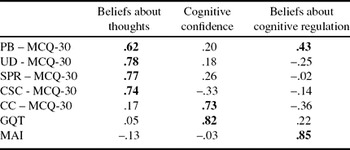
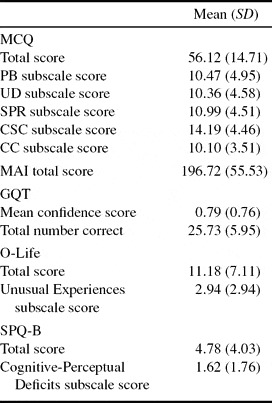
The scores on each of the measures for the complete sample are shown in Table 1. An exploratory principal components analysis of the metacognitive scores revealed that three principal components were extracted with eigenvalues of 2.38, 1.31 and 1.11 respectively and accounted for 69% of the variance. The rotated component matrix is shown in Table 2, with loadings of at least 0.4 shown in bold.
Participant scores

Principal components analysis – rotated component matrix
For the GQT, the total number of correct answers was calculated for each person and this was correlated with the total confidence rating using a Pearson's correlation. This revealed a highly significant correlation of .70 (p < .001). There was a highly significant correlation between the O-Life and SPQ relevant subscale scores (Spearman's rho = .67, p < .001). Therefore, an exploratory principal components analysis was conducted. One principal component with an eigenvalue of 1.73 was extracted which accounted for 87% of the variance. Both variables had a loading of .93 on the principal component (“psychotic-like experiences”).
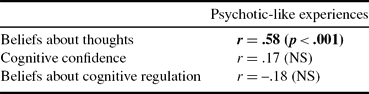
Correlations between the three metacognitive prinicipal component scores and the “psychotic-like experiences” component scores are shown in Table 3.
Spearman's correlations between principal components and “psychotic-like experiences” scores

Discussion
This study aimed to investigate whether distinctions between metacognitive beliefs that related to (a) thoughts or (b) cognitive skills, and to (i) thinking in general, or (ii) one's own thinking, were apparent in a normal sample. To do this, an exploratory principal components analysis was conducted using the five subscales of the MCQ-30 (which primarily assesses metacognitive beliefs about thoughts) and two metacognitive measures (assessing beliefs about one's own cognitive skills).
Three types of metacognitive beliefs were identified. The first, “beliefs about thoughts”, loaded highly on the PB (e.g. “Worry helps me cope”), UD (e.g. “My worrying is dangerous for me”), SPR (e.g. “It is bad to think certain thoughts”) and CSC (e.g. “I constantly examine my thoughts”) subscales of the MCQ-30. It is not clear whether these statements capture beliefs specifically about one's own thoughts (with the exception of CSC, which is only self-related) or about beliefs about thoughts in general (e.g. “Worry helps me cope” could reflect a more general belief that “Worry helps people cope”). In general, however, metacognitive beliefs about thoughts, such as these, are the ones implicated in Morrison et al.'s (Reference Morrison, Haddock and Tarrier1995) theory of psychotic symptoms: high levels of negative metacognitive beliefs are said to be associated with psychosis.
The second loaded highly on the CC (e.g. “I have little confidence in my memory for places”) subscale of the MCQ-30 and the GQT confidence score. This was labelled “cognitive confidence”. This seems to assess confidence in one's own cognitive skills and knowledge. To investigate whether confidence was associated with accuracy, the correlation between participants’ confidence scores and their accuracy scores on the GQT was tested. This was very high (r = .70), which suggests that in this sample, most people were rather accurate at assessing their own cognitive performance.
The third loaded highly on the MAI (e.g. “I try to use strategies that have worked in the past”) and the PB subscale of the MCQ-30 (e.g. “Worry helps me to solve problems”). These measures all assess the extent to which someone believes they can have and do actually take active control over their thinking. This was labelled “beliefs about cognitive regulation”.
Overall then, in line with predictions, distinctions in metacognitive beliefs were apparent in relation to their object. The first metacognitive component seemed to relate specifically to thoughts, whilst the second two related largely to cognitive skills. To some extent distinctions between metacognitive beliefs relating to one's own thinking as opposed to thinking in general were also apparent: “cognitive confidence” and “beliefs about cognitive regulation” seem to relate specifically to one's own thinking, whereas “beliefs about thoughts” seems to relate to thoughts more generally, although this requires further investigation due to the nature of the statements (e.g. “If I did not control a worrying thought and then it happened, it would be my fault” could relate to oneself or to people in general). The main difference between the two components relating to one's own cognitive skills was in that appraised either (a) cognitive capacity or accuracy (i.e. how good my memory/performance is – “cognitive confidence”) or (b) behaviour (i.e. what I do – “beliefs about cognitive regulation”).
Correlations between “psychotic-like experiences” and the three metacognitive components revealed only one significant association between “beliefs about thoughts” and “psychotic-like experiences”. This finding is consistent with Morrison et al.'s (Reference Morrison, Haddock and Tarrier1995) theory suggesting that people develop psychotic symptoms as a result of holding metacognitive beliefs that are incompatible with certain intrusive thoughts: in order to resolve the consequent cognitive dissonance, the intrusive thoughts are attributed to an external source.
This was a preliminary study with a normal sample and the findings need further investigation, particularly within a clinical sample. The study does however highlight a number of important areas for consideration in researching and theorizing about metacognition in psychosis. First, metacognitive beliefs may relate to (a) different types of cognition (e.g. thoughts, cognitive skills); (b) metacognitive regulation or metacognitive knowledge; and (c) one's own thinking, or thinking in general. Furthermore, the use of self-report measures of metacognitive beliefs is limited by its failure to take account of whether or not the beliefs are accurate. This might be particularly important in research into psychosis, since there is well-established evidence to suggest that for about three-quarters of people with a schizophrenia diagnosis, cognitive impairments are wide-ranging and significant (Heinrichs and Zakzanis, Reference Heinrichs and Zakzanis1998). We need to develop more sophisticated ways of measuring metacognition that should be based on a clearer understanding and definitions of the components of metacognition.
Acknowledgements
This work was supported in part by an ESRC Post-doctoral Fellowship awarded to Clare Reeder, award number PTA-026–27-0520.



Comments
No Comments have been published for this article.