INTRODUCTION
The art of political campaigning has turned to science in recent decades (Issenberg Reference Issenberg2010). This is especially true in the United States (U.S.), where a cottage industry focusing on image consulting and micro appeals to specific constituencies has become a multi-million dollar business, even during off years in the country's election cycle (Asher Reference Asher1980; Sabato Reference Sabato1981; Norrander and Smith Reference Norrander and Smith1985). There is reason to believe that the approaches employed in American elections have theoretical and empirical “legs,” especially in nations with which the U.S. is closely allied, and that have similar electoral systems. Indeed, as Stanyer (Reference Stanyer2005) suggests, United Kingdom (U.K.) campaign strategists have taken cues from their U.S. counterparts in large degree because they sense the U.S.-based approaches can work “across the pond.”
Political elites have made the calculation in recent decades that they can be more successful in winning elections by pursuing a polarization strategy in which they offer extreme issue positions to voters (Fiorina, Abrams, and Pope Reference Fiorina, Abrams and Pope2006). This approach goes far in making campaign slogans and issue positions accessible to the public (Zaller Reference Zaller1992). It also allows campaigns to use finely honed political messages designed to cut through the mass of information available to voters in an election season. Combined with other aspects of successful campaigns, not the least of which are the relative qualities of the candidates themselves, the polarization strategy is a logical preference in U.S. elections (Rosenberg and McCafferty Reference Rosenberg and McCafferty1987; Kinder Reference Kinder1998).
But a polarization strategy lives in tension with the Downsian (1957) reality that winning elections in majoritarian systems requires capturing the median voter. If moderate voters are more likely to be turned off by messages designed to appeal to the party base, then a key question facing campaigns is whether they can avoid alienating some of their most dedicated supporters while appealing to broader, less ideologically aligned interests. Traditionally, strategists have several available options in this endeavor, including the strategic choice of issues, transmission of separate (and likely contradictory) overt appeals to these publics, or ignoring more extreme constituencies perceived to have no other electoral choice in favor of targeted groups. None of these is ideal. What is needed, therefore, is a mechanism that maintains the electoral fruit of polarization without disturbing the median's political sensibilities.
The hope by strategists is to harness the power of polarization appeals via potent, closed-circuit cues to their intended constituent markets. The modified social identity mechanism under-girding successful closed-circuit cueing is the establishment and maintenance of in-group identity without activating intergroup dynamics by alerting out-groups. Early work in inter-group relations found how easy it was to create group identities under even the most minimal conditions and that in-group identities entailed negative assessment of out-groups (Tajfel Reference Tajfel1970; Tajfel and Turner Reference Tajfel, Turner, Worchel and Austin1986). More recent work has decoupled the inter-group core-action by indicating that in-group identities can be activated independently of feelings toward out-groups (Brewer Reference Brewer1999; Burack Reference Burack2008; Burack and Wilson Reference Burack and Wilson2008). The mechanism here entails not just the independence of in-group and out-group assessments, but the ability to activate an in-group identity without alerting an out-group at all.
Religious cues, at first blush, are not obviously useful in avoiding inter-group dynamics, due in large part to religion's considerable potential as a politically symbolic identity (Leege et al. Reference Leege, Wald, Krueger and Mueller2002; Mendelberg Reference Mendelberg1997). Religion's inherent strengths as a shared identity cue and group mobilizer suggests that it stands to enhance polarization (Green et al. 1996; Layman 2001; Wuthnow 1988). That is, when candidates draw on religious identities that may have powerful mobilizing effects, their use may be just as effective in mobilizing the opposition, be in the form of constituencies with different religious identities or no religious identity (Campbell Reference Campbell2006).
On the other hand, religious cues may be perfectly suited to connect with the in-group while evading out-group detection. David Kuo (Reference Kuo2006), a Bush “43” White House insider revealed the frequent use by Republican candidates of a surreptitious code in their speeches designed to appeal to targeted evangelical voters without alienating non-evangelicals. The code used brief phrases commonly found in evangelical Protestant churches in hymns, prayers, and popular Bible passages. These phrases, including “wonder working power,” “one stray lamb,” and others, would be easily noticed by evangelicals.
Several things about the code phrases are important to note. First, they contain no overtly political information. This means candidates using God Talk rely on the receiver to infer political attachments. Since voters are most often cognitive misers who look for cheap, available heuristics on which to base their political judgments (Sniderman, Brody, and Tetlock Reference Sniderman, Brody and Tetlock1991), the tight association between evangelicals, conservatism, and Republican politics is a natural one for receivers to access. That is, candidates who employ God Talk can rely on targeted receivers to infer that they (the candidates) are conservative Republicans.
Second, God Talk cues contain no overtly religious information, either. Therefore, such cues provide no information for out-group members to identify the group status of the God Talk-using candidate. Any obvious religious cue might be enough for individuals to use a likeability heuristic to place the candidate along a one-dimensional ideological space and assess support (Brady and Sniderman Reference Brady and Sniderman1985), but the God Talk cue deftly sidesteps this possibility.
Calfano and Djupe (Reference Calfano and Djupe2009; Reference Calfano and Djupe2011) and Calfano and Paolino (Reference Calfano and Paolino2010) provided the first tests of what they termed “God Talk” in the U.S. political context. The authors found the code language to function as intended. Evangelicals perceived the candidate using God Talk to be conservative and worthy of support while non-evangelicals were not able to distinguish the code-using candidate from a control.
With the findings from the U.S. literature on this closed-circuit cue mechanism as the basis for comparison, we focus on the possibility of closed-circuit strategies employed in recent U.K. elections.Footnote 1 Before exploring our test, we review the Christian Right's presence in U.K. politics and our perspective on attempts to employ a God Talk mechanism in recent parliamentary elections.
THE U.K. IS “BROKEN”
While the Christian conservative or mega church movement has not led to a density of political advocacy and campaign organizations well-known as representative of the Christian right's ostensible influence in U.S. politics, the U.K. boasts a larger, and more engaged, conservative Christian community than conventional wisdom might assume.Footnote 2 Indeed, most major U.K. cities are home to various large evangelical churches with an identifiable political agenda on issues such as abortion and homosexuality.Footnote 3 Perhaps in a nod to the political organization and influence of their compatriots in America, U.K. Christian conservative groups share political strategies, material, and training with U.S groups (Burack and Wilson Reference Burack and Wilson2008). While there is some overlap in their respective playing fields, Christian conservative influence in U.K. politics manifests differently from that of the U.S. (where the Christian right grassroots act as the ground troops for Republican campaigns). For reasons examined below, Christian conservatism has remained influential within the Conservative Party since the Thatcher years, but has done so with little public articulation, particularly beyond the confines of Party conventions.
By comparison to the U.S., a smaller percentage of people in the U.K. are active in houses of worship.Footnote 4 However, while the percentage of the population identifying as Christian may be different, the recent history of the Conservative Party attests to the continued influence of Christian conservatives among party elites, particularly in the formulation of social policy. Indeed, Britain is not immune to the influence of Christian conservatism in politics and public policy. In exploring the possibility of exporting campaign strategies like the God Talk cue, it is worth first considering evidence of existing political links between the U.S. and U.K.
There is, of course, a long history of a “special relationship” between the two countries. Mutual interests in foreign policy, defence, economics, as well as a shared cultural, religious, and ideological reference frames arguably make Britain the overall closest ally for the U.S. Not surprisingly, political organizations with similar ideological trajectories in both countries have shared campaign techniques in much the same way as countries often borrow policies and adapt them to suit particular political contexts (Dolowitz and Marsh Reference Dolowitz and Marsh1996; Wolman Reference Wolman1992). Also unsurprising is that this advice seems to flow mainly east over the Atlantic.
For example, senior strategists from the U.S. conservative group Freedom Works were invited recently by similar U.K.-based organizations such as the Tax Payers Alliance to offer professional training to leading British conservative activists (Hough Reference Hough2010; Jones and Cox Reference Jones and Cox2010). Perhaps the most successful U.K. organization to import U.S. styled political strategies is the Committee for Social Justice, a center right think tank established in 2003 by former party leader Ian Duncan Smith following, in his own words, a “Damascus” experience at the poverty stricken Easter house area of Glasgow.
Borrowed political strategies must be tailored to particular contextual and procedural differences. At least since the 1997 election of Labor, Conservative Party leaders have been thwarted by the “Thatcherite” moral conservative legacy. Thatcher's “New Right” successfully married fiscal libertarians with Christian conservatives by embracing particular religious (and political) wedge issues such as censorship, the nuclear family, and homosexual rights. In 1981, Leech's The Social God detected the deployment of U.S.-styled evangelical politics that underpinned Thatcher's rise to power (Leech 1981). In hindsight, the evangelical politics of such figures as Mary Whitehouse may have foreshadowed the more recent occurrences of deploying U.S. campaign strategies.
Thatcherite Christian conservatism, however, was ultimately rejected with the election of Tony Blair and New Labor's own balance of fiscal conservatism and social justice. Religion was not off limits in the Blair Government, as Blair was quite comfortable discussing his own religious identity. The difference, however, was that religion was employed to underwrite a social justice, inclusive, rights-based agenda.Footnote 5 Labor's success didn't disabuse the Tories of religion's utility as a campaign tool; instead, it reconditioned how the party approached its public evocation of faith. As Green observes, what became clear to the post-Thatcher Conservative Party was the need to “decontaminate” the Conservative brand (Green Reference Green2010). If the Conservatives were to regain power, they learned from 1997 that they must win hearts and minds with a party brand featuring less overt cues to its core religious audience.
Upon taking leadership, David Cameron focused on repositioning the Conservative Party as centrist, if by rhetoric more than policy goals (Green Reference Green2010). His strategy resonates with the dilemma noted in our introduction: the need to solidify the overall party base featuring fiscal libertarians and Christian conservatives without isolating the more moderate (what we might call Thatcher backlash) voter. This new approach, not dissimilar to President George W. Bush's “compassionate conservatism,” toned down the rhetoric on immigration and homosexuality, for example. This centrist positioning led to a few difficulties for Cameron. For example, Tim Montgomerie, founder of the Conservative Christian Fellowship and The Centre for Social Justice (CSJ) and now influential Conservative Home blogger, publicly warned Cameron that he would pay a high price if he strayed too far from his core Christian conservative base. This highlights the delicate balancing act for parties negotiating support from diverse constituencies (Green Reference Green2007). It also underscores conservative Christian voter expectations that acceptable Party signals about its policy intentions will be provided. However, exactly how this provision is made is up to the Party.
It is in the face of right-sided pressure that Cameron commissioned a report from Ian Duncan Smith as to Britain's social ills. In offering up the social agenda to Smith and the CSJ, Cameron sent Christian conservatives the message that they would continue to have a seat at the table. The final report, Breakdown Britain (2006), was the most overt utilization of U.S. evangelical language deposited successfully into the U.K. electoral consciousness in 30 years. The report established a consistent message about the “brokenness” of British society articulated by leading Conservative politicians during the election. By deploying the “brokenness” language, Cameron sent linguistic cues to the party base signaling his commitment to its social agenda without, at least initially, reminding moderate and modernizing voters of Thatcher's moral conservatism.
Within Christian theology, brokenness is a precondition to encountering the potential healing power of a personal relationship with Jesus Christ, as well as the need to be broken or humble before God (Smith Reference Smith2007). This brokenness message is articulated by various evangelicals including, for example, faith-healing minister Jackie Pullinger, James Dobson and Jim Daly of Focus on the Family, and Patrick Fagan of the Family Research Council. Theologically, it is necessary to be broken, to recognize one's brokenness, before the healing process can begin. The implication politically is that Britain needs to recognize the brokenness in society as articulated by the Conservative Party and in doing so it can accept the healing from Conservative policies. Of course, “brokenness” is not exclusively a theological term and this ubiquity allows it to be read differently by different audiences. As such, it may work as “God Talk” because it contains latent religious content with relatively easy application to politics. Both the latent and easy application aspects are essential for God Talk cues to function effectively. Of course the devil, pardon the pun, is in the details. If the cue is too easily accessed, the political import may be interpreted in ways too diverse to have clear electoral implications.
With the CSJ writing large portions of the Party's social agenda for its pre-election manifesto, “brokenness” was their attempt to cue a portion of the Tory base that, despite being “soft” in areas such as the environment and homosexuality, Cameron was singing from their hymn sheet. This was indirectly confirmed with the post-election appointment of Smith as Secretary of Work and Pensions, and the subsequent appointment of Philippa Stroud as Special Advisor. As secretary, Smith can set tax and benefit policies to support particular morally conservative conceptualizations of the family and less secular state interventions into social service provision. Stroud, as primary author of Breakdown Britain and CSJ former director, has impressive evangelical credentials stemming from her work with Jackie Pullinger's faith healing ministry.
Inside the party one can trace more recent manifestations of U.S.-U.K. social conservative partnership (Burack and Wilson Reference Burack and Wilson2008). For example, the current Secretary of State for Defence, Liam Fox, works closely with U.S.-inspired pro-life organizations, and, in 2001, called for the “abolition” of access to abortion in the U.K. In addition, global umbrella groups such as the Heritage Foundation's Washington D.C.-based Restoring Social Justice organization, serve to facilitate U.S.-U.K. conservative political networks. This network proudly includes the CSJ. Another outcome of Cameron's strategy has been to secure significant financial support from U.K. evangelicals, including Ken Costa, chairman of the evangelical Christian educational industry Alpha International, and Michael Farmer, former director of RK Capital Management.
So far, Cameron seems to have been able to walk a tightrope between signaling to the party faithful and simultaneously rebranding the Conservative image to those outside the party. At least on the surface, “Brokenness,” and the prominent role played by Smith, served as a cue to Christian conservatives, while other aspects of his modern image presented him as “not Thatcher” in using religion as a political wedge. Of course, the effectiveness of Cameron's strategy is based on broad impressions that have not yet been subject to empirical assessment. To facilitate such an evaluation, we conducted a survey experiment on subjects in Britain just prior to the 2010 U.K. elections. Given the degree to which U.K. Conservatives have been associated with strategists broadly representing the U.S. Christian right, we thought it efficacious to provide an opportunity for direct comparison of cue effects on subjects for which this market differentiation strategy is intended.
If the tactics employed by the U.S. Christian right are as well-known in U.K. evangelical or conservative Christian circles as the preceding accounts suggest, then U.K. subjects affiliated in some way with these religious identity groups may respond to any cue that includes the kind of indirect religious reference found in the U.S. and U.K. code language. By the same token, subjects outside of these religious identity groups should miss the cues' religious nature entirely. The other possibility is that the cues are perceived by both religious and non-religious audiences, thereby pleasing Christian conservatives while alienating those offended by religious appeals in politics. The essential result of this cue response, other things equal, might be the Conservative Party's return to its Thatcherite brand circa 1997, including its weakened electoral position. This is hardly a moot point in a political system without constitutionally-determined election intervals, and where the Prime Minister's decision to call an election is to re-certify public consent of the ruling party.
EXPERIMENTING WITH RELIGIOUS MEDIATION
Experimental design gives us greater leverage in assessing the efficacy of God Talk in the U.K. relative to an observational survey approach (Green and Gerber Reference Green and Gerber2003; Morton and Williams Reference Morton and Williams2010). Though slow to gain recognition in the religion and politics subfield, scholars are making increasing use of experimentation's core property in their research — the random assignment of group conditions to different states of the world (Djupe and Calfano forthcoming). Because group assignment is random, one can derive an unbiased estimation of X → Y that is robust to unobserved confounding explanations for the observed relationship. In this case, the outcome is captured through an array of response items for which subjects are asked to provide their perception of candidate qualities germane to the God Talk mechanism. As our theoretical discussion outlines, there is an added dimension to our causal expectations — evangelical Christian identity is positioned as the mediator of the God Talk effect.
According to Kuo's (Reference Kuo2006) original mechanism, X → M → Y (with M being subject evangelical identity and X the God Talk cue) is only successful if M is correlated with X in determining Y. If M has no relation to X, then its path to influence Y (which is some perception of candidate quality that campaigns wish to affect) is direct and independent of X. The obvious consequence of two direct paths to Y has serious consequences for X, as the God Talk cue would, in effect, be a broadcasted in-group credential receivable by voters hostile to candidate religious appeals.
Though one cannot randomly assign subjects to religious affiliations, this does not prevent M from performing its mediating function. It does, however, make quite germane the recent work challenging the assumption that X's randomization means that M's effect on Y is unbiased (Bullock, Green, and Ha Reference Bullock, Green and Ha2010; Imai et al. Reference Imai, Keele, Tingley and Yamamoto2011). As these recent studies effectively argue, even with the most carefully justified argument that a randomly assigned intervention is activating M and only M there is no guarantee that M truly acts alone on Y. Experimental studies often face limitations in design and scope on directly assessing whether the proposed single mediator M was activated by X in the first place. Then there is the issue of different effects between subjects so that even if X activates M, and M affects Y, that M influences Y in the same theorized way across all treated subjects is not guaranteed. To build confidence in theorized mediated relationships Bullock, Green, and Ha's suggest:
Those who analyze mediation should recognize that if the effects of X and M vary from subject to subject within a sample, it may be misleading to estimate the average direct or indirect effects for the entire sample. To determine whether heterogeneous effects are a problem, we recommend examining the effects of X and M among different groups of subjects … We recommend … that researchers try to identify relatively homogenous subgroups and make inferences about indirect effects for each subgroup rather than a single inference about an average indirect effect for an entire sample (Bullock, Green, and Ha Reference Bullock, Green and Ha2010, 555).
Given the relative dearth of experimental studies in the religion and politics literature, one might suggest that starting “small” — keeping one's attention on direct effects — is the best strategy while the more experimentally-oriented subfields work out the details of unbiased mediation analysis. To do so, however, would arguably strip religion of its best potential to speak to questions occupying the broader discipline.
We see the nascent campaign to improve mediation analysis as a substantial opportunity to insert religion and politics research into this discussion. The God Talk mechanism is perhaps uniquely positioned to address theoretical concerns about standard mediation assessment. First, and in response to Bullock, Green, and Ha's (Reference Bullock, Green and Ha2010) point that mediators are often unobserved cognitive reactions (which makes them difficult to measure), we note that the market segmentation of evangelical Christians through God Talk is, essentially, a division of voters along easily measured characteristics. M is freed from much of the haze accompanying psychologically-based mediators here given the strong facial validity of the God Talk phrases as components in the cohesive evangelical subculture. Though we do not do so in this article, previous work assessed whether there are additional factors activated by the God Talk mechanism and essentially found none (Calfano and Djupe Reference Calfano and Djupe2009). Still, this does not mean that we are able to fully unpack the cognitive “black boxes” situated between X →M and M → Y, only that we are much more confident in our identification of M (and only this M) than is often justified in mediations studies.
Second, we are already much closer to the meta-analysis mindset that Bullock, Green, and Ha (Reference Bullock, Green and Ha2010) advocate for experimental research programs. The argument for a sustained incremental evaluation of a mechanism's theorized effect is grounded in the understanding that one-shot experimental designs are hardly conclusive, especially where mediators are involved. We have used our experimental efforts to evaluate both when God Talk seems to work as originally expected through the evangelical mediator (Calfano and Djupe Reference Calfano and Djupe2009; Calfano and Paolino Reference Calfano and Paolino2010), and when its effects differ from those expectations (Calfano and Djupe Reference Calfano and Djupe2011). The present study is simply another example of extending Kuo's (Reference Kuo2006) specified mechanism to a different political population and context of interest — the U.K. Interestingly, Kuo's revelation provides the perfect starting point for effectively developing strong evidence of a mediator effect and the other conditions under which the effect is qualified.
DESIGN AND DATA
Our design is drawn from the original Calfano and Djupe (Reference Calfano and Djupe2009) God Talk study. We randomly exposed subjects to individual treatments featuring the U.K. and U.S. cues for candidates seeking a seat in the British House of Commons. We included tests of both the “Broken Britain” cue and the proven U.S. God Talk phrase, “wonder working power.” Participant observation of various Christian conservative events for other research purposes confirms that both cues were heard across most U.K. Christian conservative denominational boundaries, providing face validity for their use.Footnote 6
The third, control condition included a candidate statement featuring a classic economically conservative argument absent any religious content (full statements are listed in the appendix). Our 2 × 3 design also varied candidate gender, following research that shows God Talk may be especially noticed when used by female candidates (Calfano and Djupe Reference Calfano and Djupe2011). This resulted in six experimental conditions — four God Talk treatments and two non-God Talk control conditions in which the candidate's gender varied.
Our dependent variables center on the subjects' candidate perceptions. If the cues work as hypothesized, they should provide information that a targeted sub-group can use to identify the candidate as one of their own, or, in the case of non-targeted groups, pass by without becoming aware of the cue's intent. We test for three different outcomes. The first is subject recognition of the candidate as conservative, which has obvious ramifications in establishing one's broad acceptability to the party faithful. Still, a persistent question remaining for future testing concerns God Talk's efficacy when articulated by a more liberal candidate — from Labor, Liberal Democrat, or the Democratic Party in the U.S. (e.g., a “Tony Blair Effect”).
The second outcome, related directly to Cameron's “broken” rhetoric, is subject recognition of code-using candidates as strong advocates of personal responsibility. This is the most direct test of whether the U.K. cue content effectively translates into audience recognition of candidate brand attributes along Cameron's selected theme. This remains an open question because Conservatives have not cornered the personal responsibility market in U.K. politics, at least not yet. After all, Blair's 1997 remaking of Labor was strongly patterned on President Bill Clinton's successful efforts to rebrand his party as “New Democrats” — promising greater emphasis on personal responsibility as a complement to government policy directed at minorities.
Our third outcome variable is subject evaluation of the candidate as religious. Notice that we do not use the “evangelical” term in this instance. This is an intentional design decision reflecting the reality that self-identifying evangelicals constitute a small population sub-group in the U.K. As we discussed above, broadening the in-group boundary to include those who are “religious” arguably represents the best option for code users, while essentially reaching the same audience segment. While one might propose adding “conservative” to this third candidate appraisal, doing so would make it impossible to parse ideology from religious assessments. Our outcome variable operationalization is as follows:
• Candidate ideology “I believe that <candidate name>, the candidate for Parliament pictured above is a…” 0 = Liberal to 10 = Conservative.
• Candidate advocacy for personal responsibility “<candidate name> is a strong advocate for personal responsibility.” 0 = disagree strongly to 10 = agree strongly.
• Candidate religiosity “How religious is the candidate, <candidate name>?” 0 = Not religious to 10 = Very religious.
We tested the God Talk cue mechanism using a randomized experiment embedded in a paper mode survey. Based on the effect sizes found in our prior experiments on this topic, we determined sufficient power required distribution to approximately 200 subjects. Following Druckman and Kam's (Reference Druckman, Kam, Druckman, Green, Kuklinksi and Lupia2011) powerful argument that the de facto criticism against student samples is often both overstated and unfounded, our subject pool consisted of 218 students enrolled in introductory courses at the University of Manchester approximately one month before the 2010 general election. The introductory courses on politics are required across degree programs, and thus enroll a broad selection of first and second year students. Even assuming the need for caution when using student samples (Sears Reference Sears1986), these subjects are analytically useful in our case for several reasons. First, and most importantly, we are not estimating population-level parameters. Instead, we compare whether the God Talk statements cause evangelicals to think about a political candidate differently than non-evangelicals. Thus, what our test requires is representation of members of these two social identity groups. Our subject sample contains such variance.
Second, and not inconsequential for our purposes, is that students tend to be less religious than adult samples, primarily because they are removed from the communities in which they were raised (Hammond and Hunter Reference Hammond and Hunter1984). Since we are testing the effects of a coded religious cue, our sample's reduced levels of religiosity should work against us finding significant effects for the stimuli. Therefore, any effects that we do find should be amplified in broader adult audiences where religion is more salient.
Though internal validity is our concern here, it may comfort some to know that our student sample looks like Britain, at least in broad brush.Footnote 7 What is more, since the possibility of government cuts to social services, including the education allowance, was “in play” during the 2010 general election, there is reason to expect that our subjects were politically engaged at higher levels than would have been true otherwise. Indeed, given the fairly low interest of British voters in national politics (Pattie, Seyd, and Whitely Reference Pattie, Seyd and Whiteley2004), it is noteworthy that 71 percent of our sample indicated being very or extremely interested in “political campaigns.” Combined with the lower level of religious commitment among college students in general, this heightened sensitivity to political events sets up a somewhat precarious context for the God Talk cues, as our subjects may be much more sensitive to any transmission of candidate credentializing toward the in-group target (and to which the students generally do not belong).
Our subjects were assigned to the treatment and control conditions via a random distribution of surveys containing one of the six conditions, and randomization was successful — there are no significant variations in demographic measures (like gender) that would not be expected to vary based on the treatments. Still, we employ controls of gender and ideology in our models to sharpen estimates of treatment effects. Since our dependent variables include 11 categories, they approach continuous variables making them suitable for estimation by ordinary least squares (OLS) regression (Berry Reference Berry1993).
RESULTS
We first used ANOVAs to assess the differences of means for our dependent variables across the five treatment groups. We found traditional levels of significance for only the U.S. God Talk condition in the Ideology model (Prob. > F = 0.01). This lack of significance of the treatments for the total sample is expected and helps support the notion that God Talk effects should be located among a sub-group, such as among evangelicals. This motivates the inclusion of subject evangelical interactions with the God Talk conditions to best assess the effectiveness of Cameron's use of the “brokenness” term. While we discuss the effects of these interactions in the context of our regression models below, our initial interest concerns within-group differences between evangelical and non-evangelicals receiving the specific God Talk variants.
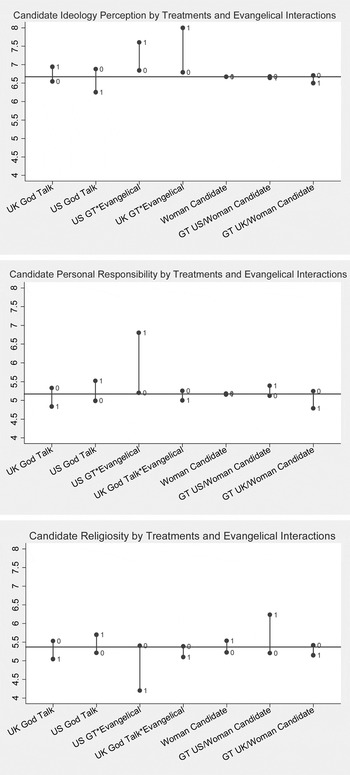
Figure 1 contains graphed mean differences for subjects across the three candidate perception measures according to the five treatment conditions, and, per our mediation mechanism, the two interactions for self-identifying evangelical subjects receiving either the U.S. or U.K. God Talk variant. With the exception of the U.S. God Talk cue, none of the between group means reached the traditional threshold for statistical significance in a joint F test, which may have as much to do with our sample size as any actual lack of significant differences between these groups (though the differences are small). However, both God Talk treatment groups showed significant (p < .000) within-group mean differences comparing evangelical and non-evangelical subjects in perceiving candidate ideology (see the top panel of Fig. 1).
Mean differences for each condition and interaction on perceptions of candidate ideology, personal responsibility, and religiosity. Source: 2010 U.K. sample.

Evangelical subjects respond to the God Talk cues in evaluating candidate ideology consistent with our mediation expectations. In what is good news for Cameron, the “brokenness” cue moves the subject to appraise the candidate as more conservative. The U.K. cue even outpaces its U.S. counterpart in this regard. However, the strategy's payoff basically ends there, as the second and third panels of Figure 1 show evangelical subjects with stronger reactions to the U.S. “wonder working power” variant in evaluating candidate responsibility and religiosity. Though the between group differences on the God Talk variants are not significant for the personal responsibility or religiosity items, the within-group differences remain between the U.K. God Talk evangelical and non-evangelical subjects (p < 0.000) on both items and the U.S. evangelical and non-evangelical subjects regarding candidate religiosity. Though a general difference in candidate reaction between evangelicals and non-evangelicals is expected when employing the God Talk strategy, the second and third mean plot panels show that the U.K. variant is overwhelmed in effect by its U.S. counterpart among evangelical subjects. In fact, there is a large decrease in evangelical evaluation of the U.S. male candidate in terms of religiosity. In order to sharpen our understanding of how the God Talk cue's effect is mediated through evangelical identity, we provide OLS estimates for the three dependent variables in Table 1.
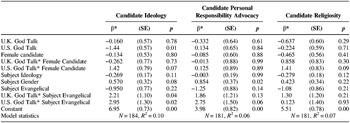
The estimated effect of country-level god talk treatments on perceptions of the candidate's ideology, advocacy of personal responsibility, and religiosity (OLS)

Source: 2010 U.K. sample.
Note: p values are two-tailed tests of significance.
The use of interaction terms in the assessment of experimental data is both appropriate and the only true way to isolate a mediator like subject evangelical identity (Morton and Williams Reference Morton and Williams2010). The first important result is the positive and statistically significant effect of the U.K. God Talk — “broken” — cue on evangelicals, which increases perception of the candidate as conservative by 1.26 when moving from the control cue (featuring the economic conservatism message) to the “broken” cue, holding all other variables at their mean. The lack of significance for the U.K. God Talk main effect indicates that our non-evangelical subjects were not induced to react as a result of the “broken” language — the expected result.
However, before concluding that evangelical identity is the reliable mediator of determining cue effects on conservative ideological appraisal, notice that the U.S. cue has a significant and negative effect across our general subject pool (despite it increasing evangelical subject appraisal by 2.0). Moving from the control to the U.S. God Talk cue drops non-evangelical candidate appraisal by .49, holding all other variables at their mean. The direction and size of this effect remains when the evangelical interaction is removed (p < 0.06, results not shown). Thus, evangelical identity appears not to be the only mediator through which the U.S. cue effect travels.
The second model in Table 1 contains the subject assessment of candidate personal responsibility advocacy. It would have been a marketing coup for Conservatives had the U.K. God Talk condition been shown to increase evangelical subject assessment of the “broken” candidate as the personal responsibility advocate. Though code use does increase evangelical subject appraisal in this regard, the result falls short of conventional significance levels (p = 0.13). Interestingly, the U.S. variant comes much closer to the two-tailed threshold (p = 0.06), while showing none of the audience spillover effect as found in the ideology model. The result is suggestive of evangelical identity as the mediating factor in determining the cue effect.
Finally, our third model in Table 1 examines subject perception of the candidate as religious. As with the prior two models, the U.S. God Talk cue is found to drive subject perceptions, although, again, the evangelical mediator is not clean. We find our general subject pool on the threshold of significance (p < 0.09) in seeing the female candidate using U.S. God Talk as more religious. This pattern is loosely consistent with the finding of female candidate religiosity in U.S. studies (Calfano and Djupe Reference Calfano and Djupe2011), in which the stereotype that women are more religious than men overwhelmed the delicate God Talk mechanism. Triple interactions that included this treatment and our evangelical subjects were not significant in this or our other models (results not shown).
While Catholics have been targeted as potential values voters by Cameron's Conservative party, we found little evidence here that God Talk of either variety is effective in reaching them (results not shown). We used the same specifications as in Table 1, but substituted Catholic identification for an evangelical identification. In two of the three cases, the Catholic main and interaction effects were insignificant. In the other case, Catholics were actually significantly less likely to see the candidate as an advocate of personal responsibility when presented with a God Talk statement. While there are certainly cues that could be effectively tailored to reach Catholics, it seems that these particular cues (combined or individually) are ineffective in resonating with them. We also looked for effects among the few conservative Catholics in the sample and likewise found no differences in responses.
The U.K. God Talk cue did not perform as consistently as the “wonder working power” cue. One possibility is that the cues need to be of a bolder stock than “brokenness.” At the same time, the lack of a U.K. cue effect might be due to the impurity of the cue. If considered in a vacuum, the use of “brokenness” may appear to be a fruitful approach to in-group credentializing. The problem, however, might lie in cue's greatest strength — its religious imagery. Indeed, “broken” is a common concept used by more than just evangelicals concerned with individual healing, if not quite perfection, and spiritual transformation. Hence, it might be that “brokenness,” already widely used in a variety of religious contexts, was not well positioned to hide in plain sight as an effective closed-circuit heuristic in the U.K.
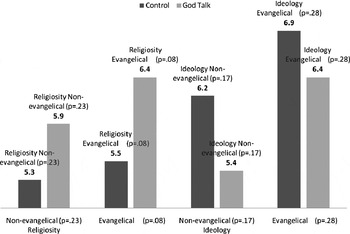
To test this possibility, we assessed whether the “broken” cue held special appeal to evangelicals who were not awash in a campaign context in which this heuristic was employed. We used a stripped down protocol with 146 student subjects in Midwestern American universities, among whom 46 percent were self-identified evangelicals. Participants were randomly assigned to either the control or the “broken” God Talk statement, after which they were asked to respond to the same variables as employed in the U.K. experiment. The results are presented in Figure 2, and are largely consistent with previous God Talk research in the U.S. That is, evangelicals perceive the candidate using the “broken” God Talk language as more religious (p = 0.08) and non-evangelicals show no difference (p = 0.23). The results for the candidate's ideology are less convincing. Evangelicals show no difference between the control and candidate using the “broken” language, but non-evangelicals only marginally differentiate the candidates (p = 0.17), seeing the “broken” candidate as less conservative as expected. The results regarding the candidate's support for personal responsibility showed no variation across the candidates.
Interactive treatment effects with Evangelical identity on the perceived religiosity and ideology of the candidate. Source: 2011 U.S. sample. N = 146.

Overall, the results suggest that God Talk is a relatively delicate mechanism. We wouldn't claim that the use of such codes is an actual liability to candidates in our experiment. Instead, the “broken” Britain cue, in particular, was more notable for its lack of efficacy. This was not only true among the prime audience target – evangelicals – but for broader aspects of the conservative Christian population as well (Catholics in particular). It appears that the larger issue for U.K. candidates in segmenting religious audiences is in finding a more powerful and “pure” cue that gains the attention of a broader conservative Christian constituency.
CONCLUSION
Though our experiment did not show a clear, consistent utility for U.K. God Talk, the news is certainly not all negative. If, for instance, one assumes that signaling ideological conservatism to an evangelical audience is a useful strategy, Cameron's cue clearly performed as expected. The practical significance of these results is the confirmation of another tool parties have for building broad coalitions, but without explicitly having to do the difficult work of bridging ideological divides. At the same time, it is important to recognize that there was no broad attempt to use any of the U.S. God Talk variants in the 2010 Parliamentary election, which means that broader recognition of the U.S. cues in our models is intended to be a point for comparison, not an actual modeling of electoral events.
Our consideration began by evaluating the pressures candidates in majoritarian systems are under in appealing to both select audiences and mass constituencies — groups with potentially very different policy preferences. This challenge is especially crucial in political systems that rely on coalition parties (as in the U.S.), but are still important in coalition government systems (as in the U.K.). Further, the ability to use closed-circuit cues is a useful tool to reach evangelical or Christian conservative voters without appearing as Thatcherite to the rest of the electorate. And, though our findings contained no silver bullet for U.K. politicians, they do show some potential for exporting the closed-circuit cue strategy across the pond. As well, these findings do a good job of addressing the relative consistency of a mediated effect. It is clear that evangelical or Christian conservative identity is, by and large, a consistent mediator of the God Talk cue though not always. However, taken in tandem with the existing research on the same mechanism in U.S. studies, the mixed findings encountered here are the result of exactly the kind of the incremental testing that experimental design advocates are calling for in political science (Druckman et al. Reference Druckman, Green, Kuklinski and Lupia2011).
The normative implications of this potential are necessarily unsavory given the role of elections in maintaining a tight tether between officials and their constituents. The mechanism for holding officials accountable — learning about the actions of government, how those decisions link to core values, and coming to conclusions about the future of public policy — depends on the free flow of information and debate on common terms. Of course, we are not about to claim that elected officials only engage mechanisms such as the closed-circuit cues assessed here. However, to the extent they do, officials undermine debate, discourage learning about what government does, and inhibit the public's ability to connect political information with their core values. In the place of informed debate and learning are heuristics that may or may not have a basis in reality (since we did not explore whether officials are appropriately conservative to earn the votes of evangelicals or repel the votes of those who disagree with them). But this is just the point. The use of such cues should motivate a further informational search rather than end one; these cues should inspire questions rather than answer them.
As governments of developed nations increasingly (and necessarily) coordinate their economic policies, and as U.S. courts have begun to cite developments in other nations, U.K. Conservatives have realized the need to fight a multi-front war against policy changes that offend their traditional sensibilities. Reductions in social safety nets, moral policies regarding single mothers, gays and lesbians, and abortion are clear targets of this effort. In a post-Thatcher U.K., Christian conservatives may not participate as overtly in the public square (Bruce Reference Bruce2003; Bruce and Voas Reference Bruce and Voas2004). They do, however, offer strategic counsel about how candidates may best credentialise with their brethren. With increasing commitment to evangelical civic engagement in the U.K.Footnote 8 and the electorate's increasing inability to detect ideological differences between parties (Adams, Green, and Milazzo forthcoming) utilization of the God Talk cues may prove an effective political marketing import.