INTRODUCTION
The Mediterranean coralligenous habitat is a hard substratum of biogenic origin mainly produced by the accumulation of calcareous encrusting algae growing in dim light conditions (Laubier, Reference Laubier1966; Ballesteros, Reference Ballesteros2006). It is constituted by a mixture of dead thalli of coralline algae and builders of carbonated concretions (i.e. polychaetes and bryozoans), resulting in a very complex structure with different microhabitats (holes, crevices and gorgonians) (Ballesteros, Reference Ballesteros2006; Casellato & Stefanon, Reference Casellato and Stefanon2008). This type of habitat is found at depths between 20 and 120 m, depending on the water column characteristics, because the main coralligenous builders are sensible to high levels of irradiance (Pérès & Picard, Reference Pérès and Picard1964; Ballesteros, Reference Ballesteros2006). This complex habitat is inhabited by a rich fauna that belongs to different taxonomic groups. Among them, sessile organisms such as sponges, bryozoans, cnidarians, ascidians and foraminiferans are usually dominant, while molluscs and crustaceans are also common (Pérès & Picard, Reference Pérès and Picard1964; Ballesteros, Reference Ballesteros2006; Casellato et al., Reference Casellato, Masiero, Sichirollo and Soresi2007; Casellato & Stefanon, Reference Casellato and Stefanon2008). Coralligenous communities are known to be one of the most biodiverse habitats in the Mediterranean (Pérès & Picard, Reference Pérès and Picard1964; Ballesteros, Reference Ballesteros2006), just after the endemic Mediterranean Posidonia oceanica (L.) Delile meadows (Pérès & Picard, Reference Pérès and Picard1964; Mazzella et al., Reference Mazzella, Buia, Gambi, Lorenti, Russo, Scipione, Zupo, John, Hawkins and Price1992; Procaccini et al., Reference Procaccini, Buia, Gambi, Perez, Pergent, Pergent-Martini, Romero, Green and Short2003). Because of these factors, this type of habitat is protected by the Natura 2000 Networking Programme from the EU in the category of ‘reefs’ (Code 1170). Nevertheless, they are threatened because they generally attract fisheries or diving activities that may negatively impact the slow growth rate of some of the fragile species (e.g. gorgonians and bryozoans) that support a high habitat complexity (Sala et al., Reference Sala, Garrabou and Zabala1996; Garrabou et al., Reference Garrabou, Sala, Arcas and Zabala1998).
Studies on the composition and variability of the epibenthic fauna inhabiting the coralligenous habitat along the Mediterranean Basin are numerous (Ferdeghini et al., Reference Ferdeghini, Acunto, Cocito and Cinelli2000; Bakir & Katagan, Reference Bakir and Katagan2005; Ballesteros, Reference Ballesteros2006; Casellato et al., Reference Casellato, Masiero, Sichirollo and Soresi2007; Casellato & Stefanon, Reference Casellato and Stefanon2008) and some of them included some information on temporal variations (Piazzi et al., Reference Piazzi, Balata, Pertusati and Cinelli2004; Balata et al., Reference Balata, Piazzi, Cecchi and Cinelli2005, Reference Balata, Acunto and Cinelli2006; Virgilio et al., Reference Virgilio, Airoldi and Abbiati2006; Abbiati et al., Reference Abbiati, Airoldi, Costantini, Fava, Ponti, Virgilio, Pergent-Martini and Brichet2009; Fava et al., Reference Fava, Ponti, Abbiati, Pergent-Martini and Brichet2009). In those studies seasonal changes were more related to differences in the relative abundance of some dominant species rather than to differences in the composition of the community.
The Alboran Sea is one of the areas with the highest values of species richness in the Mediterranean Sea (Coll et al., Reference Coll, Piroddi, Steenbeek, Kaschner, Ben Rais Lasram, Aguzzi, Ballesteros, Bianchi, Corbera, Dailianis, Danovoro, Estrada, Froglia, Galil, Gasol, Gertwagen, Gil, Guilhaumon, Kesner-Reyes, Kitsos, Koukouras, Lampadariou, Laxamana, Lopéz-Fé de la Cuadra, Lotze, Martin, Monillot, Oro, Raicevich, Rius-Barile, Saiz-Salinas, San Vicente, Somot, Templado, Turon, Vafidis, Villanueva and Voultsiadou2010). In this small sea, a biogeographical sector and a self-standing ecoregion according to Bianchi & Morri (Reference Bianchi and Morri2000) and Spalding et al. (Reference Spalding, Fox, Allen, Davidson, Ferdaña, Finlayson, Halpern, Jorge, Lombana, Lourie, Martin, McManus, Molnar, Recchia and Robertson2007) respectively, studies on coralligenous habitat or coralligenous algal concretions have been focused on specific taxonomic and dominant groups, such as molluscs (Salas & Hergueta, Reference Salas and Hergueta1986; Salas & Sierra, Reference Salas and Sierra1986; Hergueta & Salas, Reference Hergueta and Salas1987; Peñas et al., Reference Peñas, Rolán, Luque, Templado, Moreno, Rubio, Salas, Sierra and Gofas2006) or decapod crustaceans (García-Raso, Reference García-Raso1988; García-Raso & Fernández Muñoz, Reference García-Raso and Fernández Muñoz1987; García-Raso et al., Reference García-Raso, López de la Rosa and Rosales1996; García Muñoz et al., Reference García Muñoz, Manjón-Cabeza and García-Raso2008), and they were mainly carried out on the calcareous algae Mesophyllum alternans habitat.
Recently, García-Raso et al. (Reference García-Raso, Gofas, Salas Casanova, Manjón-Cabeza, Urra and García Muñoz2010) remarked on the importance of the coast of Cabopino (Málaga, southern Spain) as a hotspot area for benthic invertebrate fauna. Here, soft bottoms of different granulometric composition, as well as a coralligenous habitat located at 15 m depth, can be found together with shallow seagrass fragmented meadows of the Mediterranean P. oceanica and the subtropical Cymodocea nodosa fringing rocky oputcrops. This area is situated within a highly developed coastline known as the ‘Costa del Sol’, which has undergone a tremendous development of coastal infrastructures in the last decades, such as holiday resorts, seafronts and marinas, together with a deficient treatment of sewage waters. Other threats affecting the bottoms considered here include illegal trawling activities at depths lower than 50 m and the extraction of sand from the sea bottom for beach refurbishment. The aim of this study is to analyse the structure and seasonal dynamic of the molluscan assemblage inhabiting this coralligenous habitat, because molluscs represent one of the most diverse groups of the coralligenous community (Ballesteros, Reference Ballesteros2006; Casellato & Stefanon, Reference Casellato and Stefanon2008) and this coast harbours one of the most diverse molluscan assemblages of European coasts.
MATERIALS AND METHODS
Study area
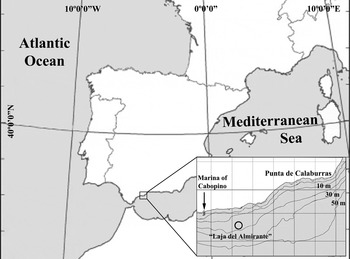
The study area is located in the western littoral of Malaga (southern Spain) and within a recently established Site of Community Importance ‘Calahonda’ (Code: ES6170030) of the European network Natura 2000 (Figure 1). This research is part of a wide research project carried out since 2004 between ‘Punta de Calaburras’ (36°30.4′N 04°38.3′W) and ‘Calahonda’ (36°29′N 04°44.3′W) (García Muñoz et al., Reference García Muñoz, Manjón-Cabeza and García-Raso2008; García-Raso et al., Reference García-Raso, Gofas, Salas Casanova, Manjón-Cabeza, Urra and García Muñoz2010; Urra et al., Reference Urra, Gofas, Rueda and Marina2011). This stretch of coastline is characterized by different rocky outcrops located along the shoreline, intertidally and subtidally, that represent one of the few natural rocky bottoms within the ‘Costa del Sol’. Fragmented meadows of the endemic and endangered Mediterranean P. oceanica as well as of C. nodosa are found down to ~6 m depth. The subtidal bottoms of Calaburras–Calahonda were studied seasonally between 2004 and 2005, in order to identify the different bottom types and their associated benthic communities. Fine, medium and coarse sand bottoms, as well as bottoms with bioclasts, were abundant in the area which also contained a large subtidal rocky outcrop that was sampled. This rocky bottom, called ‘Laja del Almirante’, is located at a depth of 15 m in the western border of the study area. Environmental data taken at 15 m depth by ‘Grupo mediterráneo de Cambio Climático del Instituto Español de Oceanografía de Málaga’ in the study area show that sea temperature ranged between 15.04 ± 0.44°C in winter and 17.44 ± 1.5°C in summer, while salinity values ranged between 36.71 ± 0.26 ppt in autumn and 37.06 ± 0.21 ppt in spring. The monthly climatological values of the average surface chlorophyll concentration in the north-western Alboran Sea showed an intense bloom in the beginning of the spring (up to 0.9 mg·m−3), followed by a sharp decrease until 0.5 mg·m−3 during the summer months. The highest levels of surface chlorophyll (2–9 mg·m−3) are located in a coastal band in front of Malaga Bay and on the eastern side of the Strait of Gibraltar (Macias et al., 2007).
Location map of the studied area on the western coast of the Alboran Sea (southern Spain).

Sample collection and laboratory procedures
Samples were collected in Calaburras–Calahonda using a small rock dredge (42 cm width, 22 cm height, mesh size: 3 mm) in September and November 2004 and February and May 2005. The samples were collected trawling the rock dredge at a boat speed of about 2 knots for 5 minutes, resulting in a sampling area of 130 m2. This sampling area is used for collecting other invertebrates (i.e. decapods) also considered in this project (García Muñoz et al., Reference García Muñoz, Manjón-Cabeza and García-Raso2008). The rocky outcrop was located within one of the sampled areas between 13 and 18 m depth. In each sampling campaign, three replicates were generally taken at 15 m depth, but this was sometimes difficult due to the nature of the rocky bottom. A total of 9 replicates were taken, including 2 in September 2004; 1 in November 2004; 3 in February 2005; and 3 in May 2005. Due to the low number of replicates in some seasons, samples from warm months (summer 2004 and spring 2005) and cold months (autumn 2004 and winter 2005) were grouped in the analyses in order to study intra-annual changes. Average temperatures and salinities of these periods at this depth range between 16.07 ± 1.46°C and 36.77 ± 0.08 ppt in cold months and 16.59 ± 1.2°C and 36.92 ± 0.19 ppt in warm months. Samples were sieved over mesh sizes of 10, 7, 5, 3 and 1 mm. Molluscs were separated and stored in neutralized ethanol 70%. Each mollusc species was identified and their individuals counted in each sample.
Data analysis
Abundance (N) (individuals 130 m−2), frequency index (F) (percentage of samples in which a particular species is present) and dominance index (%D) (percentage of individuals of a particular species within the sample) were calculated for species characterization in the total collected and in each time of the year. The characterization of the assemblage at different times of the year was done according to several ecological indices, such as the abundance of molluscs (N), species richness (S), the Shannon–Wiener diversity index (H′: log2) (Krebs, Reference Krebs1989) and the evenness index (J′) (Pielou, Reference Pielou1969).
One-factor analyses of variance (ANOVAs) were carried out for testing statistical differences in values of abundance, species richness, diversity and evenness index according to warm (summer–spring) and cold periods (autumn–winter), after verifying normality (Kolmogorov–Smirnov) and homogeneity of variances (Levene). Kruskal–Wallis analyses were carried out when the normality or the homogeneity of variances did not adjust to ANOVA conditions. These statistical procedures were performed using the software SPSS.
Multivariate methods, such as group-average sorting classification (CLUSTER) and non-metric multidimensional scaling (MDS) ordination, using the Bray–Curtis similarity index, were applied to both qualitative (presence/absence) and quantitative data, in order to identify seasonal similarities/dissimilarities in the composition of the molluscan assemblage. A fourth-root transformation pre-treatment was applied on the quantitative data in order to minimize the contribution of the most abundant species to the analysis. Analysis of similarity (ANOSIM) was carried out for comparing statistically the groups of samples according to the factor warm–cold season (Clarke & Green, Reference Clarke and Green1988; Clarke & Warwick, Reference Clarke and Warwick1994). The SIMPER procedure was used to identify those species that contributed to the similarity and dissimilarity between these same groups of samples. These multivariate analyses were executed using the PRIMER v6.0 software from Plymouth Marine Laboratory, UK (Clarke & Warwick, Reference Clarke and Warwick1994).
According to the feeding guilds, the following categories were considered: carnivores (C), feeding on other mobile organisms; scavengers (SC), feeding on remains of dead organisms; deposit feeders (D), feeding on organic particles contained in the sediment; ectoparasites and specialized carnivores (E), feeding on much larger organisms on which they live during their life cycle; filter feeders (F), capturing the seston particles with their gills and/or with mucous strings; macroalgae grazers (AG); microalgae or periphyton grazers (MG); and oophagous feeders (O), including species that feed on egg masses of other organisms.
The biogeographical analysis was performed considering six geographical sectors, i.e. Northern Europe (from Norway to the English Channel), Western Europe (from the English Channel to southern Portugal), the Ibero-Moroccan Gulf, the Mediterranean Sea, the Canary Islands and the western coast of Africa, and according to the presence and absence of each molluscan species in each area (5 species were excluded from the analysis due to the scarcity of data on their distribution).
RESULTS
Composition and structure of the molluscan assemblage
A total of 1593 individuals, belonging to 117 species, were collected during the study period (September 2004–May 2005). Gastropods dominated the assemblage, both in number of species (71 spp., 60.5%) and abundance (1105 individuals, 69.4%). The bivalves represented 30.4% of the total, with 44 species and 485 individuals. Other groups such as scaphopods and cephalopods were also represented in this assemblage but displayed very low abundances (< 2 individuals). The former was just represented by Fustiaria rubescens (Deshayes, 1825) and the latter by Sepia officinalis (Linnaeus, 1758) and Octopus vulgaris Cuvier, 1797. Within the gastropods, the family Conidae (with species belonging to the traditional ‘turrids’ sensu lato) displayed the largest number of species (13 spp., 10.9% of the total), followed by Trochidae (9 spp.), Nassariidae and Muricidae (5 spp. each one). The familiy Calyptraeidae, with just one species, Calyptraea chinensis (Linnaeus, 1758), presented the highest abundance (383 individuals, 24% of the total of molluscs), followed by Nassariidae (170 individuals) and Trochidae (143 individuals). Among the bivalves, the families Veneridae and Mytilidae displayed the highest number of species with 9 species each (7.6%), followed by Tellinidae (3 spp.) and Cardiidae (3 spp.), while Veneridae presented the highest number of individuals (180 individuals, 11.3%) and followed by Astartidae (92 individuals) due to the contribution of Digitaria digitaria (Linnaeus, 1758) (91 individuals).
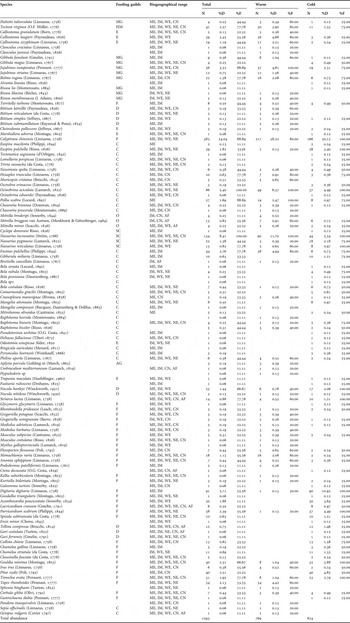
Twenty-one species displayed D values higher than 1% (Table 1), being C. chinensis (383 individuals) the top dominant species of the assemblage (24%), followed by Nassarius incrassatus (Ström, 1768) (8.4%) and D. digitaria (5.7%), generally found inhabiting the pockets of bioclastic gravel interspersed among the hard substrates. In relation to the F, 12 species displayed F values higher than 75%, including Ocinebrina aciculata (Lamarck, 1822) (100%) and N. incrassatus (100%) among others (Table 1). The gastropod C. chinensis was the top dominant in both warm (28.2%) and cold months (20.1%), followed by N. incrassatus (11.7%), O. aciculata (6.4%) and Fusinus pulchellus (Philippi, 1844) (4.9%) in spring–summer months, and by D. digitaria (10.9%), N. incrassatus (5.3%) and Pitar rudis (Poli, 1795) (4.8%) in autumn–winter months (Table 1).
Faunistic list of molluscs found in a coralligenous rocky outcrop off Cabopino (western Alboran Sea). Total number of individuals collected (N ind) and values of dominance (%D) and frequency (%F) indices are indicated for each species. Feeding guilds codes: carnivores (C); scavengers (SC); deposit feeders (D); ectoparasites and specialized carnivores (E); filter feeders (F); macroalgae grazers (AG); microalgae or periphyton grazers (MG) and oophagous feeders (O). Biogeograhical range codes: Northern Europe (NE); Western Europe (WE); the Ibero-Moroccan Gulf (IM); the Canary Islands (CN) and the Western coast of Africa (AF) (5 species were excluded from the analysis due to the scarcity of data on their distribution).

Some of the species found in this assemblage are strictly associated with the sessile organisms that inhabit this type of rocky bottom, such as the ovulid Simnia spelta, that was always found on gorgonians (Eunicella singularis (Esper, 1791), E. labiata (Thomson, 1927) and Leptogorgia sarmentosa (Esper, 1791)). Other species, such as Bolma rugosa (Linnaeus, 1767), Jujubinus exasperatus (Pennant, 1777), Gibbula fanulum (Gmelin, 1791) and Tectura virginea (O.F. Müller, 1776), are associated with red calcareous macroalgae.
Intra-annual changes of the assemblages
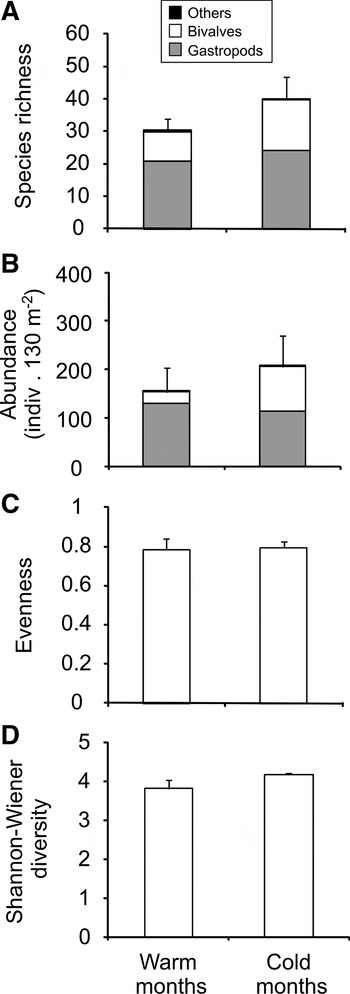
The species richness displayed a non-significant trend between cold and warm months (one-factor ANOVA, F = 1.616, P > 0.05), with high values in autumn–winter months (40 ± 7 spp. sample−1; mean ± standard error) (Figure 2A). Both gastropods and bivalves increased their number of species in autumn–winter months but this was not significant (one-factor ANOVA, in both cases P > 0.05). Bivalves were the group that increased more markedly (from 9 to 15 spp.).
Species richness (A), abundance (individuals 130 m−2) (B), evenness (C) and Shannon–Wiener diversity index values (D) of molluscan assemblages of warm and cold months in a coralligenous rocky outcrop off Cabopino (western Alboran Sea). Mean ± SE. In all cases no significant differences were found between the index values of assemblages from cold and warm months.

The mean abundance (individuals 130 m−2) showed no significant variations between warm and cold months (one-factor ANOVA, F = 0.429, P > 0.05), with higher values in autumn–winter months (206 ± 64 individuals 130 m−2; N = 4 cold months samples) than in spring–summer months (154 ± 50 individuals 130 m−2; N = 5 warm months samples) (Figure 2B). Gastropods and bivalves displayed opposite patterns in their abundance according to time of the year. The mean abundance of gastropods was slightly higher, although non-significant (P > 0.05), in warm months (130 ± 43 individuals 130 m−2) compared to cold months (113 ± 42 indiduals 130 m−2), while that for bivalves increased significantly (Kruskal–Wallis, df = 1, P < 0.05) from warm (23 ± 7 individuals 130 m−2) to cold months (92 ± 28 individuals 130 m−2). This was mostly due to the significant increase of some species, such as D. digitaria (one-factor ANOVA, F = 12.205, P < 0.05), which increased its numbers markedly in autumn and winter and the cardiid Parvicardium scabrum (Philippi, 1844) (Kruskal–Wallis, df = 1, P < 0.05).
Mean evenness values were quite stable throughout the year, reaching 0.8 bits in warm and cold months (Figure 2C). The maximum mean value was reached in summer 2004 with almost 0.9 bits, when the abundance of molluscs was very well shared among the different species and the top dominant species had low dominance values (J. exasperatus (17.8%) and F. pulchellus (13.2%)). The Shannon–Wiener diversity index (H′) did not show significant variations between the warmer and colder months (one-factor ANOVA, F = 2.262, P > 0.05). In general, mean diversity values were high, ranging between 3.7 ± 0.4 bits in May 2005 and 4.2 ± 0.1 bits in February 2005, with a maximum value of 4.4 bits reached in one of the replicates collected in May 2005 (Figure 2D).
Affinity between samples
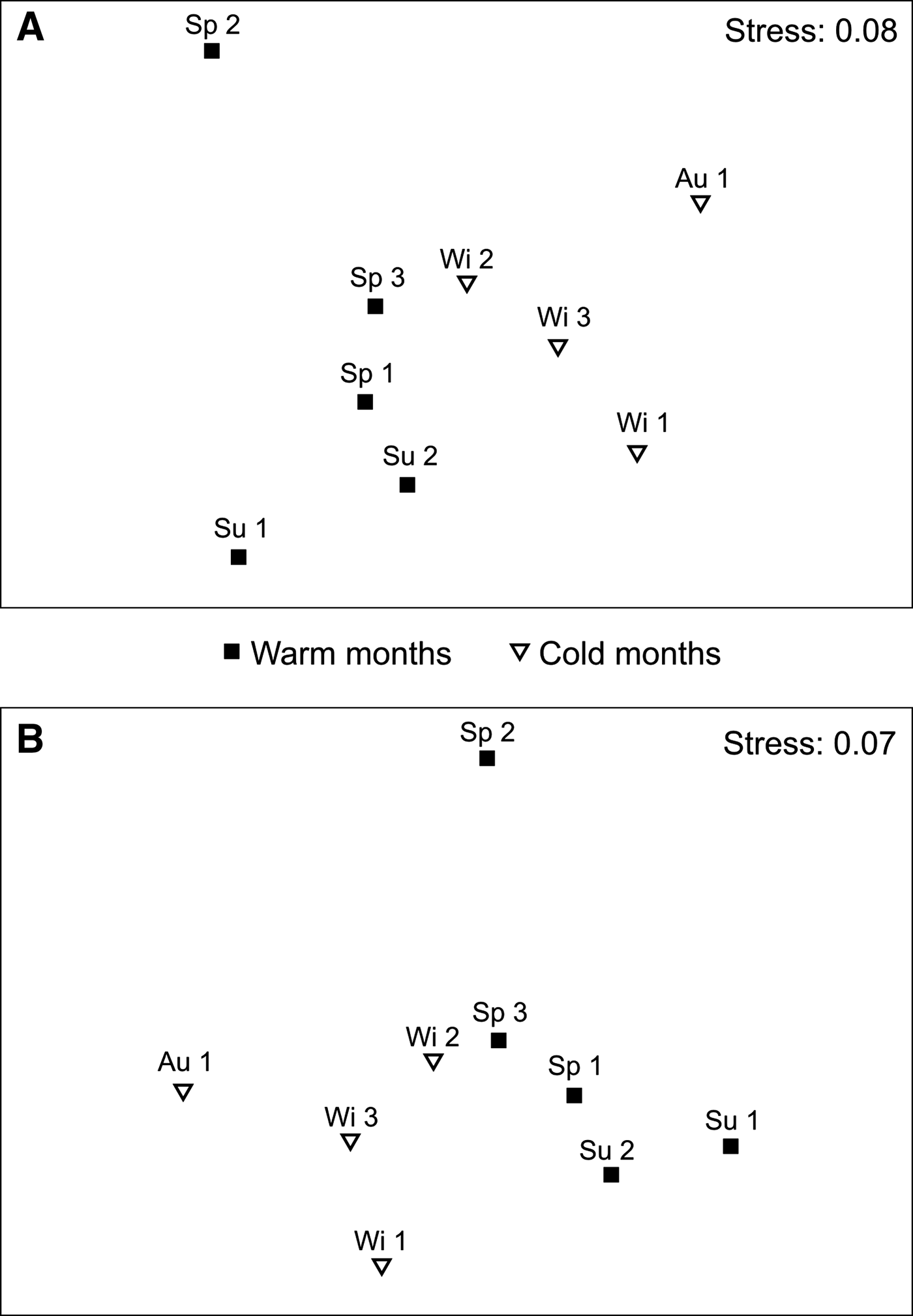
Multivariate analyses based on the Bray–Curtis similarity index showed two groups of samples when using qualitative data (presence/absence) (Figure 3A). These groups reflect seasonal sampling times (summer–spring months versus autumn–winter months) (stress = 0.08). The warm month samples were located opposite to the cold month samples in the MDS, although the scattering of warm month samples showed a relatively higher variability than the autumn–winter group that was less scattered. A lower number of both species and individuals were collected in the sample Sp2 (replicate 2 from spring), and its location in the MDS away from other samples (Figure 3A, B). In spite of this variability between replicates, significant differences between the composition of the summer–spring samples (warm months) and the autumn–winter samples (cold months) were observed (one-way ANOSIM, R = 0.356, P < 0.05). A total of 25 species contributed in 90% regarding the similarity values within the autumn–winter samples (average similarity 48.25%) (SIMPER analysis). Some of these species had similar contribution (5.35%), including many dominant species such as C. chinensis, Euspira pulchella (Risso, 1826), O. aciculata, Nassarius reticulatus (Linnaeus, 1758), N. incrassatus, Nucula hanleyi (Winckworth, 1931), Striarca lactea (Linnaeus, 1758), D. digitaria, P. scabrum, Gouldia minima (Montagu, 1803) and Timoclea ovata (Pennant, 1777). In the case of the spring–summer samples, the same contribution is given by 24 species (average similariry 44.93%), including J. exasperatus, O. aciculata, Pollia scabra Locard, 1892 and N. incrassatus (7.5% contribution each one), followed by Mitrella bruggeni (van Aartsen, Menkhorst & Gittenberger, 1984) (4.65%) and T. virginea, B. rugosa, Hexaplex trunculus (Linnaeus, 1758), F. pulchellus and Mimachlamys varia (Linnaeus, 1758) (4.46% each one), many of them cited as dominant species in Table 1.
Non-metric multidimensional scaling based on qualitative (presence/absence) (A) and quantitative (fourth-root transformed abundance data) (B) data using the Bray–Curtis similarity index.
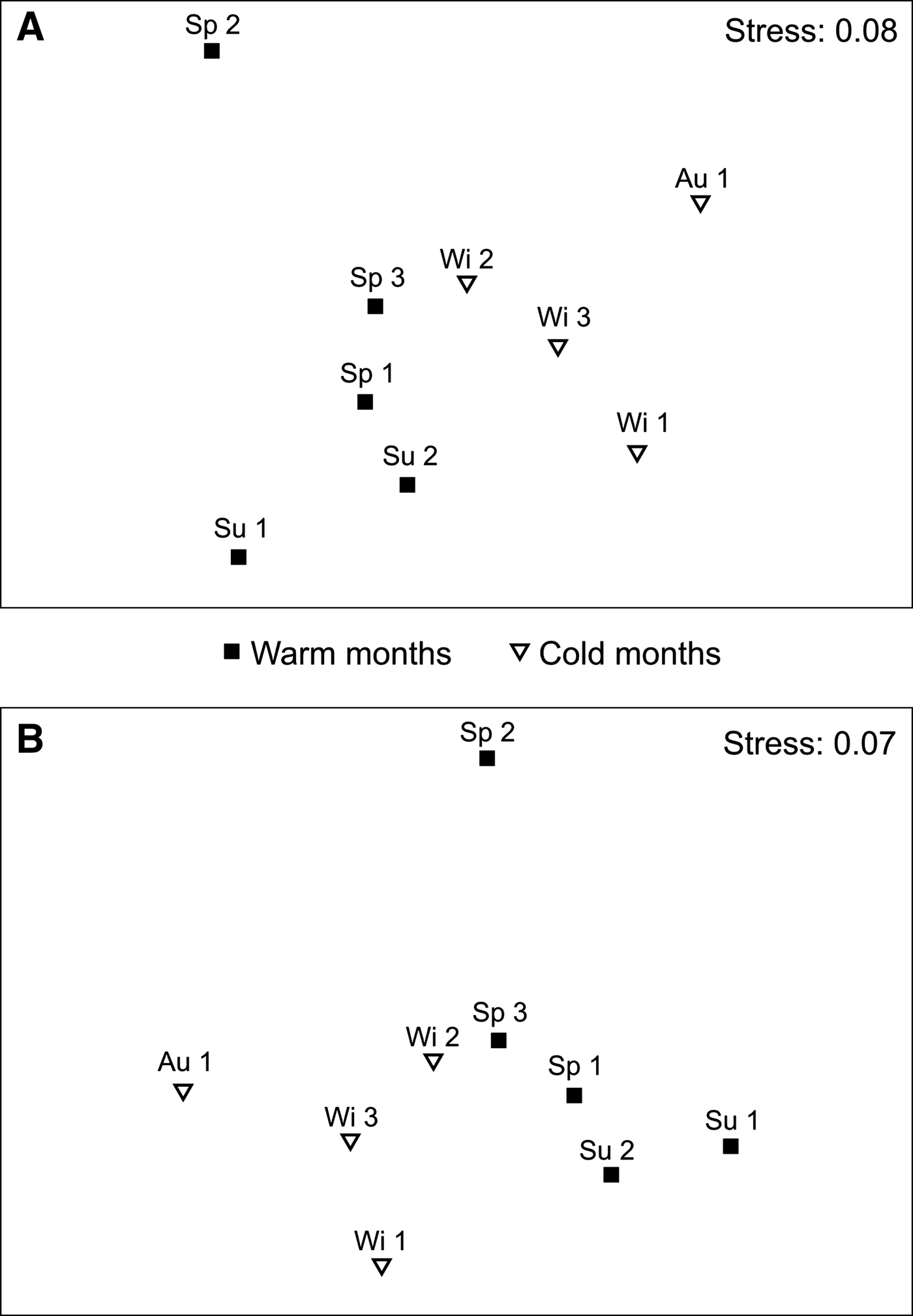
Groupings of samples according to cold and warm months were also obtained with analyses using fourth-root transformed abundance data (Figure 3B). The MDS was very similar to that obtained using qualitative data, with the warm month samples presenting a higher scattering than those of the cold group. In this case, the composition and structure of the molluscan assamblages in warm months also differed significantly from those of cold months (one-way ANOSIM, R = 0.369, P < 0.05). The SIMPER analysis using quantitative data showed that 23 species contributed in more than 90% of the similarity among the autumn–winter samples (average similarity 46.32%). These species were, in decreasing order of contribution, D. digitaria, C. chinensis, G. minima, N. incrassatus, O. aciculata, E. pulchella and N. hanleyi (all of them <5% contribution). On the other hand, 24 species contribute 90% of the similarity among the spring–summer samples (average similarity 43.04%), being N. incrassatus, O. aciculata, J. exasperatus, P. scabra and F. pulchellus the ones with a percentage of contribution higher than 5%. Dissimilarity between the warm and cold samples is given, mainly, by the different abundance values of the dominant species in the different sampling times. Some species showed higher mean abundance values in spring–summer than in autumn–winter months, including Calliostoma laugieri (Payraudeau, 1826) (7.2 individuals in warmer months versus 0.75 individuals in colder months), F. pulchellus (7.6 versus 1.5) and Tapes rhomboides (Pennant, 1777) (6.8 versus 0) among others. A larger number of species displayed larger abundances in autum–winter than in spring–summer months, mostly including bivalves such as D. digitaria (22.5 individuals in colder months versus 0.2 individuals in warmer months), Acanthocardia paucicostata (Sowerby, 1834) (7.5 versus 0), P. scabrum (9.25 versus 0.2), and some venerids such as Callista chione (Linnaeus, 1758) (always as juveniles), G. minima, P. rudis and Chamelea striatula (da Costa, 1778).
Feeding guilds
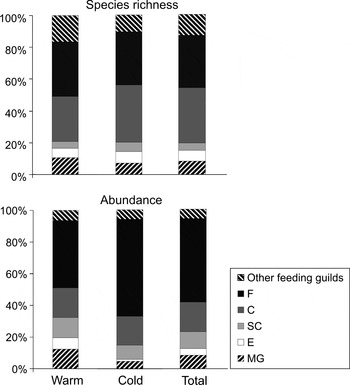
The composition of the malacofauna is dominated, regarding trophic groups, by carnivores (37 spp., 34.6%) (Figure 4), such as the conids (13 spp.) Bela zonata (Locard, 1892) and Bela nebula (Montagu, 1803), the muricids (5 spp.) H. trunculus and Ocinebra erinaceus (Linnaeus, 1758), and the cephalopods S. officinalis and O. vulgaris. Filter feeders (35 spp., 32.7%) represented the second dominant group, mostly including bivalves such as the mytilids (9 spp.) Mytilus galloprovincialis (Lamarck, 1819) and Modiolus barbatus (Linnaeus, 1758), and the venerids (9 spp.) Clausinella fasciata (da Costa, 1778), and G. minima, as well as two species of gastropods, Turritella turbona (Monterosato, 1877) and C. chinensis. Microalgal grazers and deposit feeders were both represented by 9 species (8.4%) the former included the trochids (4 spp.) G. fanulum and J. exasperatus as well as some rissoids (3 spp.) such as Rissoa membranacea (J. Adams, 1800). Deposit feeders included 4 species of gastropods belonging to the family Cerithidae and bivalves such as Nucula nitidosa (Winckworth, 1930) and Tellina compressa (Brocchi, 1814). The trochids Calliostoma granulatum (Born, 1778), C. laugieri and C. zizyphinum (Linnaeus, 1758) (feeding mainly on cnidarians), together with the triphorids Cheirodonta pallescens (Jeffreys, 1867) and Marshallora adversa (Montagu, 1803) (feeding on poriferans), the pyramidellid Odostomia conspicua (Alder, 1850) (that live and feed on other molluscs or on sedentary polychaetes), and the opisthobranch Trapania maculata (Haefelfinger, 1960) (feeding on entoprocts) conformed the trophic group of carnivores of sessile preys. Scavengers were represented by 4 species of nassariids associated with soft sediments. There was a small group constituted by 3 species of columbellids (Mitrella broderipi (Sowerby, 1844), M. bruggeni and M. minor (Scacchi, 1836)) and 2 species of buccinids (Chauvetia brunnea (Donovan, 1804) and probably C. procerula (Monterosato, 1889)) that generally feed on egg masses. Macroalgal herbivores were not common and included the gastropods B. rugosa and Aplysia parvula Guilding in (Mørch, 1863). Considering numbers of individuals, filter feeders were dominant (818 individuals, 52.2%), including the gastropod C. chinensis, with 383 individuals and listed as the top dominant of the assemblage, and the bivalves D. digitaria (91 individuals), P. rudis and G. minima (40 individuals each one). Carnivores were the second dominant group (290 individuals, 18.5%), conformed by nearly half of the gastropod species (35 spp.) and the cephalopods. In this group, the muricid O. aciculata (86 individuals) and the fasciolariid F. pulchellus (44 individuals) are the most abundant species. The number of species of each trophic group remained quite stable between cold and warm months, it being noteworthy to mention the increase of carnivores from 19 spp. in warm months to 30 spp. in cold months (Figure 4). On the other hand, the variation of the abundance of individuals was more acute than that of the number of species, with filter feeders increasing from warm to cold months (324 individuals to 494 individuals) and microalgal grazers decreasing from warm to cold months (93 individuals to 37 individuals).
Species richness and abundance of molluscs according to different trophic groups: C, carnivores; F, filter feeders; MG, microalgae grazers; E, ectoparasites; SC, scavengers. Others include molluscs feeding on egg masses (e.g. Mitrella spp. and Chauvetia spp.), macroalgae (e.g. Bolma rugosa) or deposit feeders (e.g. Bittium spp.).

Biogeographical distribution
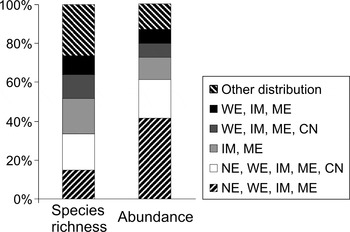
A total of 17 species (15%) are widely distributed from Northern Europe to the Mediterranean Sea, including Western Europe and the Ibero-Moroccan Gulf (Figure 5). This group of species is conformed by some of the dominant gastropods such as Jujubinus striatus (Linnaeus, 1767), Bittium reticulatum (da Costa, 1778) and C. chinensis, the bivalves P. scabrum and T. rhomboides, and the cephalopod S. officinalis. Another abundant group of species (21 spp., 18.6%) has the same distribution but are also present in the Canary Islands, such as the gastropods T. virginea, C. granulatum and Comarmondia gracilis (Montagu, 1803) as well as the bivalves Musculus costulatus (Risso, 1826), Anomia epphipium Linnaeus, 1758 and Corbula gibba (Olivi, 1792). This group also contained dominant species such as N. incrassatus and G. minima. A similar number of species is restricted to the Mediterranean Sea and the Ibero-Morrocan Gulf (20 spp., 17.7%), including G. fanulum that is specific to the calcareous algae habitat and the venerid Chamelea gallina (Linnaeus, 1758), a species of comercial value. A lower number of species are distributed from Western Europe to the Mediterranean Sea (11 species, 9.7%) including the Ibero-Morrocan Gulf, such as the gastropods Bittium simplex (Jeffreys, 1867) and N. reticulatus, and the bivalves N. hanleyi and Glycymeris glycymeris (Linnaeus, 1758). Moreover, 14 species (12.4%) are in those three sectors and also in the Canary Islands, such as the gastropods Haliotis tuberculata (Linnaeus, 1758), Simnia spelta (Linnaeus, 1758) (linked to cnidarians) and Ocinebrina edwardsi (Payraudeau, 1826), and the bivalves Modiolus adriaticus (Lamarck, 1819), M. barbatus, and the commercial venerid C. chione. A small group of 6 species is distributed in Northern and Western Europe and in the Ibero-Morrocan Gulf, but not further in the Mediterranean, such as the conid Bela powisiana (Dautzenberg, 1887), and the bivalve C. striatula. Other categories were represented by a lower number of species (fewer than 5 species per category). Opposite to that, only 3 strictly Mediterranean species were found in this assemblage such as Mitrolumna olivoidea (Cantraine, 1835), Euspira macilenta (Philippi, 1844) and P. scabra. This contrasts with the wide distributional pattern displayed by more than half of the molluscan species that are present in 4 (34 spp.) or even 5 (26 spp.) geographical sectors along the Atlantic and/or the Mediterranean coasts of Europe.
Species richness and abundance of molluscs based on their biogeographical distribution pattern. NE, Northern Europe; WE, Western Europe; IM, Ibero-Moroccan Gulf; ME, Mediterranean Sea; CN, Canary Islands.

DISCUSSION
The coralligenous habitat off Cabopino could be classified as banks constituted by cavernous flat bioconstructions, sometimes surrounded by sedimentary substrata, and most of the times grown upon rocky outcrops. Due to the life history of the algae and animals producing the biogenic substratum, coralligenous habitats are generally found at depths where light levels reach only 0.05–3% of the surface irradiance (Ballesteros, Reference Ballesteros2006). Therefore, this type of habitat is commonly located below 35–40 m depth (Pérès & Picard, Reference Pérès and Picard1964), which is the lower limit in the vertical distribution of the P. oceanica biocoenosis (Boudouresque et al., Reference Boudouresque, Meinesz, Ledoyer, Vitiello, Bellan-Santini, Lacaze and Poizat1994). However, this depends greatly on the transparency of the water column, and coralligenous assemblages may occur shallower in certain areas due to different abiotic factors (e.g. water turbidity, sediment deposition and surface orientation) (Ballesteros, Reference Ballesteros2006; Casellato & Stefanon, Reference Casellato and Stefanon2008). In Cabopino, high turbidity levels may promote the existence of a coralligenous community at depths (~15 m) which are considerably shallower than in other Mediterranean areas such as Italy (20–50 m) (Balata et al., Reference Balata, Piazzi, Cecchi and Cinelli2005; Virgilio et al., Reference Virgilio, Airoldi and Abbiati2006; Casellato et al., Reference Casellato, Masiero, Sichirollo and Soresi2007), Greece (30–40 m) (Antoniadou & Chintiroglou, Reference Antoniadou and Chintiroglou2005) or Turkey (45–60 m depth on Aegean coasts) (Bakir & Katagan, Reference Bakir and Katagan2005). This makes ‘Laja del Almirante’ a site potentially accessible to touristic SCUBA-diving on a large scale.
The coralligenous community at Cabopino was conformed, besides mobile groups (e.g. molluscs and decapods) by colonial organisms such as the gorgonians E. singularis, E. labiata and L. sarmentosa and the bryozoans Pentapora fascialis (Pallas, 1766) and Myriapora truncata (Pallas, 1766). Coralligenous communities are generally characterized by a high biodiversity in comparison to adjacent bottoms (Pérès & Picard, Reference Pérès and Picard1964; Ballesteros, Reference Ballesteros2006; Casellato & Stefanon, Reference Casellato and Stefanon2008). In the rocky outcrop off Cabopino, the presence of colonial filter feeding species may be supported by the highly nutrient upwellings (an almost permanent feature and more evident in summer when thermal contrast is stronger, reaching maximum values of surface chlorophyll up to 2–9 mg·m−3 in areas closely Cabopino) occurring in the area that may also affect transparency of the water column (Sarhan et al., Reference Sarhan, García Lafuente, Vargas and Plaza2000; Macías et al., Reference Macías, Navarro, Echevarría, García and Cueto2007). The biomass and calcium carbonate content as well as the spatial distribution of communities thriving on rocky bottoms of another upwelling area of the northern (Spanish) margin of the Alboran Sea were studied by Cebrián et al. (Reference Cebrián, Ballesteros and Canals2000) and Cebrián & Ballesteros (Reference Cebrián and Ballesteros2004). Total biomass is slightly higher than values recorded in other Mediterranean areas due to the high biomass of suspension feeders. Since most animals and algae with high biomass have calcareous skeletons, the calcimass is rather high (1.100 g Ca CO3·m−2·y−1) when compared with other temperate and Mediterranean sites, this relatively high carbonate production being related to the particular hydrographic processes taking place in this area. The presence of these bioconstructors promotes a higher complexity that enhance the number of niches that can be potentially occupied by a larger number of species than those in homogeneous bottoms (Casellato et al., Reference Casellato, Masiero, Sichirollo and Soresi2007), as found in Cabopino Banks for decapod crustaceans (García Muñoz et al., Reference García Muñoz, Manjón-Cabeza and García-Raso2008).
The 117 molluscan species identified in these coralligenous bottoms could probably increase if other sampling techniques would be used (e.g. scraping off the substrate for endolithic species, air-lifting holes and crevices) in the studied area. In the Alboran Sea and Strait of Gibraltar area, molluscs are one of the dominant and most diverse groups of different habitats such as seagrass meadows (Arroyo et al., Reference Arroyo, Salas, Rueda and Gofas2006; Rueda et al., Reference Rueda, Gofas, Urra and Salas2009) or soft bottoms (Rueda et al., Reference Rueda, Salas and Gofas2000; Urra et al., Reference Urra, Gofas, Rueda and Marina2011). Coralligenous biocoenoses are not the exception, and molluscs also generally reach a large number of species (Peñas et al., Reference Peñas, Rolán, Luque, Templado, Moreno, Rubio, Salas, Sierra and Gofas2006). The number of species found in this study is within the range found in other coralligenous bottoms (~90 spp. in the northern Adriatic Sea (Casellato et al., Reference Casellato, Masiero, Sichirollo and Soresi2007), 108 spp. in the north Aegean Sea (Antoniadou & Chintiroglou, Reference Antoniadou and Chintiroglou2005), 131 spp. on Catalan coasts (Marítn et al., 1990 in Ballesteros, Reference Ballesteros2006), but it is noteworthy to mention that the sampling method used in this study was different from those used by these authors (e.g. hydraulic lift and scraping by Casellato et al. (Reference Casellato, Masiero, Sichirollo and Soresi2007); scraping off the substrate by Antoniadou & Chintiroglou (Reference Antoniadou and Chintiroglou2005); taking complete Mesophyllum concretions by Salas & Hergueta (Reference Salas and Hergueta1986) and Hergueta & Salas (Reference Hergueta and Salas1987)) but similar to the rock dredge used by Salas & Sierra (Reference Salas and Sierra1986). In Cabopino the dominant families (in number of species) were Conidae (traditional ‘turrids’), Trochidae, Nassariidae and Muricidae among gastropods, which are the same dominant groups in coralligenous assemblages in the north Aegean Sea (Antoniadou et al., Reference Antoniadou, Koutsoubas and Chintiroglou2005). The ubiquitous C. chinensis is the most abundant and dominant species (24% of the total of individuals collected), supported by the presence of a high amount of bioclasts, mainly shells of large bivalves which are its preferred substrate. The dominant species (Table 1) are somehow different from those found in other Mediterranean coralligenous communities (Antoniadou et al., Reference Antoniadou, Koutsoubas and Chintiroglou2005 and references therein), with Bittium latreillii (Payraudeau, 1826) as the top dominant species in assemblages from the north Aegean Sea, probably related to the branching form of the dominant algae, which trapped high quantities of organic material, constituting an excellent ecological niche for that species. Nevertheless, many of the species from the assemblage of Cabopino are within the most common and constant species listed in the review on coralligenous Mediterranean communities by Ballesteros (Reference Ballesteros2006), with some modifications resulting from the geographical location of Cabopino being close to the Atlantic Ocean. The occurrence of sediment deposits interspersed within the rocky outcrop of Cabopino promotes the co-existence of many soft sediment species, especially bivalves such as the astartid Digitaria digitaria, the cardiids A. paucicostata and P. scabrum, and the venerids T. rhomboides and T. ovata, some of them reaching high abundance values. This type of habitat where hard and soft bottom fauna cluster together enlarges the biodiversity at local scale (Antoniadou & Chintiroglou, Reference Antoniadou and Chintiroglou2005; Antoniadou et al., Reference Antoniadou, Koutsoubas and Chintiroglou2005). This cluster of species belonging to different habitats has been observed in other areas of the Mediterranean, such as the north Aegean Sea, where about 36% of the molluscan species identified in infralittoral hard substrates by Antoniadou et al. (Reference Antoniadou, Koutsoubas and Chintiroglou2005) were typical species from soft sediments, such as the bivalves A. tuberculata, Myrtea spinifera (Montagu, 1803) or Lucinella divaricata (Linnaeus, 1758), and the gastropods E. macilenta, N. incrassatus, Mangelia attenuata (Montagu, 1803) or Haedropleura septangularis (Montagu, 1803), some of them frequently collected.
The Shannon–Wiener diversity index and the Pielou evenness index displayed high and stable values throughout the study period, ranging between 3.7 and 4.2 bits and around 0.8 bits respectively. These high values point out the ecological complexity and maturity of the coralligenous habitat, which hosts a great diversity of taxonomic groups (Laubier, Reference Laubier1966). These values are in accordance with those reached in other areas of the Mediterranean, where molluscs are among the dominant taxa, such as in areas of the Alboran Sea (Salas & Hergueta, Reference Salas and Hergueta1986; Hergueta & Salas, Reference Hergueta and Salas1987), on the Catalan coasts (Martín et al., 1990 in Ballesteros, Reference Ballesteros2006), and in the north Aegean Sea (Greece) (Antoniadou et al., Reference Antoniadou, Koutsoubas and Chintiroglou2005). Nevertheless, the diversity values can be higher when considering the entire macrobenthic community (Antoniadou & Chintiroglou, Reference Antoniadou and Chintiroglou2005) (5.6 bits). In Cabopino no significant seasonal variations were observed for the abundance and species richness values, although both of them were higher in colder months. Abundance of gastropods and bivalves displayed opposite patterns, being higher in warmer months for gastropods, and in colder months for bivalves. This may be linked to recruitment events of some species, such as the dominant gastropod C. chinensis, represented only by small size individuals (<3 mm) in warm months (especially in May 2005) and the bivalves D. digitaria, A. paucicostata and P. rudis, among others. Casellato et al. (Reference Casellato, Masiero, Sichirollo and Soresi2007) found an increase in the abundance of molluscs inhabiting some rocky outcrops of the northern Adriatic from winter to spring, while the species richness decreased. Previous studies on temporal dynamics of the coralligenous community have shown that temporal fluctuations are more evident in habitats where the algal component is dominant, probably linked to changes in cover of turf-forming and erect algae (Piazzi et al., Reference Piazzi, Balata, Pertusati and Cinelli2004; Balata et al., Reference Balata, Acunto and Cinelli2006; Fava et al., Reference Fava, Ponti, Abbiati, Pergent-Martini and Brichet2009). In habitats dominated by colonial organisms with low growth rates, the seasonal variations seem minimal (Garrabou et al., Reference Garrabou, Sala, Arcas and Zabala1998, Reference Garrabou, Ballesteros and Zabala2002; Virgilio et al., Reference Virgilio, Airoldi and Abbiati2006; Abbiati et al., Reference Abbiati, Airoldi, Costantini, Fava, Ponti, Virgilio, Pergent-Martini and Brichet2009).
The molluscan assemblage inhabiting the coralligenous banks of Cabopino was dominated, regarding trophic groups, by carnivore species (37 spp.), followed closely by filter feeders (35 spp.). Considering the abundance of individuals, these same trophic groups also dominated. A high presence of carnivores in this assemblage may indicate a high availability of molluscs and other faunistic groups that serve as prey in this type of bottom. Moreover the presence of three species of the genus Mitrella and two of Chauvetia may indicate the importance of this type of bottom as spawning grounds for certain species because they feed on egg masses and are common in other spawning grounds such as seagrass meadows (Arroyo et al., Reference Arroyo, Salas, Rueda and Gofas2006; Rueda et al., Reference Rueda, Gofas, Urra and Salas2009). On the other hand the sediment deposits occurring within the rocky outcrop promotes large number of bivalves, most of them being filter feeders and also including in this trophic group the gastropods T. turbona and the highly abundant C. chinensis. The increase of coastal upwellings under the influence of westerly winds in cold months leads to a spatial coincidence of maximum surface chlorophyll and inorganic nutrients concentrations in the vicinity of the coast (Macías et al., Reference Macías, Navarro, Echevarría, García and Cueto2007, Reference Macías, Bruno, Echevarría, Vázquez and García2008). These could explain the marked increase of filter feeders in cold months, enhancing the primary production. The presence of upwellings and high availability of food particles in the water column as well as the hydrodynamics of the studied area may benefit this trophic group as well as those sessile filter feeders conforming the habitat (Cebrián et al., Reference Cebrián, Ballesteros and Canals2000; Cebrián & Ballesteros, Reference Cebrián and Ballesteros2004). Most of the previous studies on coralligeneous communities did not analyse feeding guilds, so comparisons to other studies are difficult (Ferdeghini et al., Reference Ferdeghini, Acunto, Cocito and Cinelli2000; Cocito et al., Reference Cocito, Bedulli and Sgorbini2002; Antoniadou et al., Reference Antoniadou, Koutsoubas and Chintiroglou2005; Antoniadou & Chintiroglou, Reference Antoniadou and Chintiroglou2005; Chintiroglou et al., Reference Chintiroglou, Antoniadou, Vafidis and Koutsoubas2005; Balata et al., Reference Balata, Acunto and Cinelli2006; Virgilio et al., Reference Virgilio, Airoldi and Abbiati2006; Abbiati et al., Reference Abbiati, Airoldi, Costantini, Fava, Ponti, Virgilio, Pergent-Martini and Brichet2009). Nevertheless, filter feeders were the dominant group in the Mesophyllum concretions of southern Spain (Salas & Hergueta, 1987), whereas filter feeders, carnivores and microalgal grazers were dominant in coralligenous bottoms of the north Aegean Sea (Antoniadou et al., Reference Antoniadou, Koutsoubas and Chintiroglou2005).
Cabopino is located close to the Strait of Gibraltar area, where the Lusitanian, the Mauritanian and the Mediterranean regions converge (Ekman, Reference Ekman1953). Therefore, the Alboran Sea supports the coexistence of species from such different regions as Northern Europe or tropical western Africa (e.g. for molluscs Rueda & Salas, Reference Rueda and Salas1998; Rueda & Gofas, Reference Rueda and Gofas1999; Rueda et al., Reference Rueda, Gofas, Urra and Salas2009; Urra & Gofas, Reference Urra and Gofas2009; Urra et al., Reference Urra, Gofas, Rueda and Marina2011). Many of the molluscan species of this assemblage are widely distributed along the European coasts, both Atlantic and Mediterranean, including the Canary Islands, and therefore display a Lusitanian distribution model. The Almería–Oran front separates the typical Mediterranean waters from the Alboran Sea, with different oceanographic characteristics, and may represent a natural border for some strictly Mediterranean species to inhabit the Alboran basin, indicated as the Atlantic–Mediterranean phylogeographical break (Patarnello et al., Reference Patarnello, Volckaert and Castilho2007). This could be the reason for the scanty occurrence of typically Mediterranean molluscan species in the coralligenous bottoms off Cabopino, represented only by the species M. olivoidea, E. macilenta and P. scabra, while there are six species with an Atlantic distribution which reach the Alboran Sea but do not occur further in the Mediterranean, among them the conid Bela powisiana (Urra & Gofas, Reference Urra and Gofas2009). The results displayed in this study confirm the high species richness (in this case for molluscs) existing on this stretch of coastline, as stated previously by other authors (García Muñoz et al., Reference García Muñoz, Manjón-Cabeza and García-Raso2008; García-Raso et al., Reference García-Raso, Gofas, Salas Casanova, Manjón-Cabeza, Urra and García Muñoz2010). The recent review on the biodiversity of the Mediterranean Sea (Coll et al., Reference Coll, Piroddi, Steenbeek, Kaschner, Ben Rais Lasram, Aguzzi, Ballesteros, Bianchi, Corbera, Dailianis, Danovoro, Estrada, Froglia, Galil, Gasol, Gertwagen, Gil, Guilhaumon, Kesner-Reyes, Kitsos, Koukouras, Lampadariou, Laxamana, Lopéz-Fé de la Cuadra, Lotze, Martin, Monillot, Oro, Raicevich, Rius-Barile, Saiz-Salinas, San Vicente, Somot, Templado, Turon, Vafidis, Villanueva and Voultsiadou2010) also points out that this area displays the highest values of species richness in the Mediterranean Sea, probably due to the influx of Atlantic species and the wide range of physicochemical conditions.
García-Raso et al. (Reference García-Raso, Gofas, Salas Casanova, Manjón-Cabeza, Urra and García Muñoz2010) pointed out the uniqueness of this stretch of coastline of the Spanish Alboran Sea, where a great number of threatened species inhabit (Coll et al., Reference Coll, Piroddi, Steenbeek, Kaschner, Ben Rais Lasram, Aguzzi, Ballesteros, Bianchi, Corbera, Dailianis, Danovoro, Estrada, Froglia, Galil, Gasol, Gertwagen, Gil, Guilhaumon, Kesner-Reyes, Kitsos, Koukouras, Lampadariou, Laxamana, Lopéz-Fé de la Cuadra, Lotze, Martin, Monillot, Oro, Raicevich, Rius-Barile, Saiz-Salinas, San Vicente, Somot, Templado, Turon, Vafidis, Villanueva and Voultsiadou2010), and where the Atlantic–Mediterranean transition allows the coexistence of species from different biogeographical regions. The Alboran Sea in general (Coll et al., Reference Coll, Piroddi, Steenbeek, Kaschner, Ben Rais Lasram, Aguzzi, Ballesteros, Bianchi, Corbera, Dailianis, Danovoro, Estrada, Froglia, Galil, Gasol, Gertwagen, Gil, Guilhaumon, Kesner-Reyes, Kitsos, Koukouras, Lampadariou, Laxamana, Lopéz-Fé de la Cuadra, Lotze, Martin, Monillot, Oro, Raicevich, Rius-Barile, Saiz-Salinas, San Vicente, Somot, Templado, Turon, Vafidis, Villanueva and Voultsiadou2010) and the coast of Cabopino in particular (García-Raso et al., Reference García-Raso, Gofas, Salas Casanova, Manjón-Cabeza, Urra and García Muñoz2010), are areas worthy of special attention. Therefore, efficient efforts should be carried out for preserving the different habitats located here, both by educational campaigns directed to divers and the general public in an area that is highly urbanized and impacted as is the Costa del Sol. Increasing knowledge about the coralligenous habitat as well as other important habitats (e.g. seagrass beds and macroalgal beds) occurring on this stretch of coastline is of importance for improving management decisions in order to preserve biodiversity in this interesting area within the European coasts.
ACKNOWLEDGEMENTS
We would like to express our sincere gratitude to José S. Guirado, Fernando Ortega and Rafael Barba (Dirección General de Gestión del Medio Natural) for their help and continuous interest; to José Fraidias (Junta de Andalucía) and Diego Luis Gancedo (EGMASA) for the facilities to use the ship ‘AMA8’; to the captain and crew of the ship ‘AMA8’ for their cooperation during the sampling campaign; to the colleagues of our department, mainly to Dr J. Enrique García-Raso, J. Enrique García Muñoz (members of this Project) and Ángel Mateo for their help at different stages of this research. We thank Dr José Templado and Dr Ángel A. Luque for their valuable comments on the manuscript. This work was supported by the ‘Consejería de Medio Ambiente de la Junta de Andalucía’ (contract with the University of Málaga; reference 807/46.2284).