Implications
The data from these studies suggest that the bioavailabilities of threonine (thr) and tryptophan (trp) in peanut meal for 10 kg pigs are lesser than those of l-thr and l-trp. Given that bioavailability estimates differ with dependent variable (response criterion), the use of these bioavailability estimates in formulating peanut meal into diets of 10 kg pigs should be guided by the response criterion of interest.
Introduction
Chemical procedures, which can be used to determine the amino acid composition of a feed ingredient, do not provide information on the amounts of amino acid that are available to the animal. The nutritional value of a feed is related to its content of bioavailable amino acids for growth and maintenance. Factors affecting this bioavailability include digestibility and utilization of the absorbed amino acids for incorporation into protein; moreover, not all the digested and absorbed amino acids are available for use in protein synthesis. Bioavailability assays based on animal performance provide relative information on the capacity of a feed ingredient to provide a specific limiting amino acid for maintenance and growth, and are usually considered as the ultimate standards against which other methods are judged (Lewis and Bayley, Reference Lewis and Bayley1995). Commonly used variables in a slope-ratio assay are weight gains and gain : feed ratio (Adeola, Reference Adeola1996). Recently, Moehn et al. (Reference Moehn, Bertolo, Pencharz and Ball2005) reported the development of a supposedly more rapid and less-expensive method for determining metabolic amino acid availability in foods. Information is accruing on amino acid bioavailability for younger pigs (Kovar et al., Reference Kovar, Lewis, Radke and Miller1993; Adeola et al., Reference Adeola, Lawrence and Cline1994; Moehn et al., Reference Moehn, Martinazzo-Dallagnol, Bertolo, Pencharz and Ball2007). Little is known about the bioavailability of trp in peanut meal for pigs. Likewise, to the author’s knowledge, there are no reports in the literature on the bioavailability of thr in peanut meal for pigs. The experiments reported herein were conducted to determine the bioavailability of thr and trp in peanut meal with young pigs raised from 10 to 20 kg live weight using the slope-ratio bioassay with l-thr and l-trp as reference sources of amino acids.
Material and methods
Pigs
The Purdue University Animal Care and Use Committee approved all protocols used in these studies. Housing and management conditions were similar to those described earlier (Adeola, Reference Adeola1996). A total of 24 barrows and 24 gilts were used in each of the two experiments to determine the bioavailability of thr (Experiment 1) and trp (Experiment 2) in peanut meal. Dietary treatments were randomly assigned to individual pens in eight blocks of six diets in a randomized complete block design. The 24 barrows and 24 gilts were blocked by weight and assigned to crates such that the average weight across treatments was similar. The individual stainless steel pens (0.76 × 0.89 m2) were equipped with nipple drinkers, stainless steel feeders and plastic-coated expanded metal floors. The pens were located in an environmentally regulated building maintained at 23 ± 2°C with a 12-h light (0700 to 1900)–dark cycle. Body weight and feed intake were recorded weekly, and ad libitum access to feed and water was provided for 28 days.
Dietary treatments and analyses
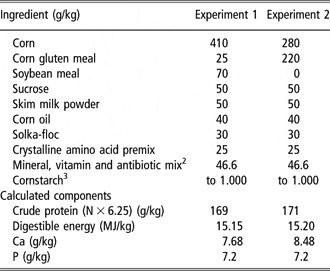
The basal diet (BD) (Table 1) consisted of corn, corn gluten meal, soybean meal (Experiment 1 only), skim milk powder and crystalline amino acid as the sources of nitrogen. The content of all amino acids for the BD was at least 110% of National Research Council (1998) requirements for 10 to 20 kg pigs, except for thr (Experiment 1) or trp (Experiment 2). In Experiment 1, four reference diets were formulated by supplementing the BD with 0, 0.4, 0.8 or 1.2 g of l-thr/kg at the expense of cornstarch. The two test diets were formulated by replacing cornstarch in the BD with peanut meal at 32 or 64 g/kg of diet to supply 0.4 or 0.8 g thr/kg, respectively. In Experiment 2, four reference diets were formulated by supplementing the BD with 0, 0.15, 0.3 or 0.45 g of l-trp/kg at the expense of cornstarch. The two test diets were formulated by replacing cornstarch in the BD with peanut meal at 30 or 60 g/kg of diet to supply 0.14 or 0.28 g trp/kg, respectively.
Composition (g/kg) of basal diets used in Experiments 1 and 2 on an as-fed basisFootnote 1

1 Calculated threonine concentration in the basal diet used in Experiment 1 was 4.08 g/kg; in Experiment 2, the calculated tryptophan concentration of basal diet was 1.15 g/kg.
2 Provided per kilogram of diet: Ca, 6.3 g; P, 4.8 g; K, 0.9 g; Mg, 0.55 g; NaCl, 4.9 g; Fe (as FeSO4·H2O), 179 mg; Mn (as MnO), 60 mg; Zn (as ZnO), 150 mg; Cu (as CuO), 17.5 mg; I (as Ca(IO3)2), 3 mg; Se, 300 μg; vitamin A, 6108 IU; vitamin D3, 600 IU; vitamin E, 23 IU; menadione sodium bisulfite, 1.2 mg; vitamin B12, 31 μg; riboflavin, 6 mg; d-pantothenic acid, 22.5 mg; niacin, 35 mg; choline, 520 mg; thiamin, 1 mg; folic acid, 300 μg; pyridoxine, 1.5 mg; tylosin phosphate, 10.4 mg.
3 In Experiment 1, threonine (0.4, 0.8 or 1.2 g/kg of diet) or peanut meal (32 or 64 g/kg of diet, supplying 0.4 or 0.8 g threonine/kg of diet) replaced cornstarch in the reference or test diets, respectively. In Experiment 2, tryptophan (0.15, 0.3 or 0.45 g/kg of diet) or peanut meal (30 or 60 g/kg of diet, supplying 0.14 or 0.28 g tryptophan/kg of diet) replaced cornstarch in the reference or test diets, respectively.
Dry matter contents of nitrogen-supplying feed ingredients and BDs were determined by oven drying at 100°C for 24 h. Nitrogen was determined by the combustion method (Association of Official Analytical Chemists (AOAC), 2000, 990.03) using a LECO model FP-2000 nitrogen analyzer (LECO, St. Joseph, MI, USA). Amino acid analyses were conducted at the University of Missouri Experiment Station Chemical Laboratory. Samples for amino acid analysis were prepared using a 24-h hydrolysis in 6 N hydrochloric acid at 110°C under an atmosphere of nitrogen. For methionine and cysteine, samples were oxidized by performic acid oxidation before acid hydrolysis. Samples for trp analysis were hydrolyzed using barium hydroxide. Amino acids in hydrolyzates were determined by HPLC after post-column derivatization (AOAC, 2000, 982.30 E (a–c)).
Statistical methods
Data from the two experiments were analyzed using the general linear model procedures of the Statistical Analysis Systems Institute (2003) in a randomized complete block design. Individual pig served as the experimental unit. The following model was used in the analysis: Yijk = μ + Si + Bj + Dk + Eijk, where Y is the response criterion; μ is the overall mean; Si represents the effect of ith sex (i = 1, 2); Bj represents the effect of jth block (j = 1, 2, 3); Dk represents the effect of kth diet (l = 1, 2, 3, 4, 5, 6 for one BD, three reference diets and two test diets); and Eijk is the error-term including the three-way interaction of factors plus the three two-way interactions that were not significant (P > 0.1). Bioavailability estimates of thr or trp were derived using common-intercept, multiple linear regression and slope-ratio techniques (Finney, Reference Finney1978). This analysis tested for linearity of the slopes and lack of curvature – essential requirements for statistical validity; and for intersection of responses to reference (l-thr or l-trp) and test (peanut meal-thr or -trp) diets at the basal response (blanks) – essential requirements for fundamental validity (Finney, Reference Finney1978). Multiple regression analyses were conducted as outlined by Littell et al. (Reference Littell, Lewis and Henry1995). Approximate standard errors of the bioavailability estimates were calculated as outlined by Littell et al. (Reference Littell, Lewis and Henry1995). Linear and quadratic contrasts were used to examine the relationship between growth performance response criteria and added thr (Experiment 1) or trp (Experiment 2) from l-thr or l-trp or from peanut meal. Contrasts were declared significant at P < 0.05.
Results
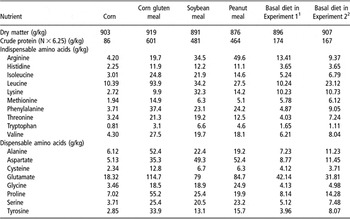
Analyzed dry matter, crude protein (CP), indispensable and dispensable amino acid compositions of corn, corn gluten meal, soybean meal and peanut meal used in the experiments, as well as those of the BDs used in Experiments 1 and 2 are presented in Table 2. The CP contents (g/kg) of corn, corn gluten meal, soybean meal and peanut meal used in the experiments were 86, 601, 481 and 464, respectively. The BDs used in Experiments 1 and 2 contained 174 and 167 g CP/kg, respectively. The peanut meal evaluated contained 12.5 and 4.6 g thr and trp/kg, respectively (Table 2). Analyzed thr in the BD used in Experiment 1 was 4.03 g/kg; l-thr was added to the BD at 0.4, 0.8 or 1.2 g/kg for the reference diets, whereas peanut meal was added to the BD at 32 or 64 g/kg for the test diet to provide 0.4 or 0.8 g thr/kg, respectively. Analyzed CP (g/kg) were 174, 175, 174, 176, 191 and 206; and analyzed thr (g/kg) were 4.03, 4.45, 4.83, 5.22, 4.44 and 4.84 in the BD, BD + 0.4 g thr/kg, BD + 0.8 g thr/kg, BD + 1.2 g thr/kg, BD + 32 g peanut meal/kg and BD + 64 g peanut meal/kg, respectively. The analyzed trp in the BD used in Experiment 2 was 1.11 g/kg; l-trp was added to the BD at 0.15, 0.3 or 0.45 g/kg for the reference diets, whereas peanut meal was added to the BD at 30 or 60 g/kg for the test diet to provide 0.14 or 0.28 g trp/kg, respectively. Analyzed CP (g/kg) were 167, 166, 168, 167, 183 and 194; and analyzed trp (g/kg) were 1.11, 1.24, 1.42, 1.58, 1.25 and 1.4 in the BD, BD + 0.15 g trp/kg, BD + 0.3 g trp/kg, BD + 0.45 g trp/kg, BD + 30 g peanut meal/kg and BD + 60 g peanut meal/kg, respectively.
Analyzed composition of corn, corn gluten meal, soybean meal, peanut meal and basal diets used in Experiments 1 and 2 on an as-fed basis

1Analyzed crude protein (g/kg) were 174, 175, 174, 176, 191 and 206; and analyzed threonine were 4.03, 4.45, 4.83, 5.22, 4.44 and 4.84 in the basal diet (BD), BD + 0.4 g threonine/kg, BD + 0.8 g threonine/kg, BD + 1.2 g threonine/kg, BD + 32 g peanut meal/kg and BD + 64 g peanut meal/kg, respectively.
2Analyzed crude protein (g/kg) were 167, 166, 168, 167, 183 and 194; and analyzed tryptophan were 1.11, 1.24, 1.42, 1.58, 1.25 and 1.4 in the basal diet (BD), BD + 0.15 g tryptophan/kg, BD + 0.3 g tryptophan/kg, BD + 0.45 g tryptophan/kg, BD + 30 g peanut meal/kg and BD + 60 g peanut meal/kg, respectively.
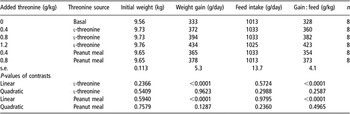
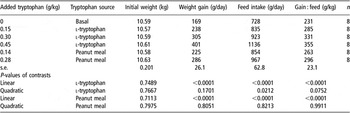
In the first experiment, the average initial body weight of pigs used was 9.7 kg (Table 3). Body weight gain linearly responded to supplemental l-thr or thr from peanut meal (P < 0.001). Feed intake was not affected by thr supplementation regardless of source. There was a linear response (P < 0.001) to thr supplementation from l-thr or peanut meal in the gain-to-feed ratio. No quadratic response was observed in any of the growth performance criteria (Table 3). Pigs used in Experiment 2 had an average initial body weight of 10.6 kg (Table 4). The addition of trp to the BD linearly increased (P < 0.001) body weight gain irrespective of whether the form was crystalline (l-trp) or protein-bound (peanut meal). There were linear (P < 0.001) and quadratic (P < 0.05) responses to l-trp supplementation in feed intake, but only a linear (P < 0.001) response in feed intake to supplementation with trp from peanut meal. There was a linear response (P < 0.001) to trp supplementation from l-trp or peanut meal in gain-to-feed ratio (Table 4).
Growth performance of pigs fed diets containing graded concentrations of supplemental threonine from l-threonine or peanut meal

Growth performance of pigs fed diets containing graded concentrations of supplemental tryptophan from l-tryptophan or peanut meal

Estimates of the relative bioavailability of thr in peanut meal from daily weight gain (g/day) and gain : feed ratio (g/kg) as response criteria using supplemental dietary thr concentration (g/kg), daily total thr intake (g/day) or daily supplemental thr intake (g/day) as independent variables in the first experiment are presented in Table 5. Common-intercept, multiple linear regression of dependent variable weight gain on the independent variable supplemental thr concentration gave 70.4% as the estimate of bioavailability of thr in peanut meal relative to l-thr. The use of daily total or supplemental thr intake as independent variables gave estimates of 96.8% or 71.9%, respectively. Using gain : feed ratio as the dependent variable and supplemental thr concentration in the diet as the independent variable; the estimate of thr bioavailability in peanut meal relative to l-thr for 10 kg pigs was 75.5%. When daily total or supplemental thr intake was used as the independent variable, estimate of thr bioavailability was 96.3% or 75.7%, respectively. The fiducial limits for any of the dependent and independent variable combination did not include 100%.
Estimates of relative bioavailability (RB) of threonine in peanut meal from daily weight gain (g/day) and gain : feed ratio (g/kg) as response criteria using supplemental dietary threonine concentration (g/kg), daily total threonine intake (g/day) or daily supplemental threonine intake (g/day) as independent variables

1Relative bioavailability calculated as: 100 × slope of X2 ÷ slope of X1.
2Approximate standard error of relative bioavailability estimated as outlined by Littell et al. (Reference Littell, Lewis and Henry1995).
The fiducial limits described by Finney (Reference Finney1978) and estimated as outlined by Littell et al. (Reference Littell, Lewis and Henry1995) were 52.4% to 88.5% (for 70.4%); 94.6% to 98.9% (for 96.8%); 55.3% to 88.6% (for 71.9%); 60.4% to 91.3% (for 75.9%); 60.9% to 90.2% (for 75.5%); 92% to 100.7% (for 96.3%) and 60.9% to 90.6% (for 75.7%).
For the second experiment, the estimates of relative bioavailability of trp in peanut meal from daily weight gain (g/day) and gain : feed ratio (g/kg) as response criteria using supplemental dietary trp concentration (g/kg), daily total trp intake (g/day) or daily supplemental trp intake (g/day) as independent variables are presented in Table 6. Using daily weight gain as the dependent variable and supplemental trp concentration in the diet as the independent variable, the estimate of trp bioavailability in peanut meal relative to l-trp for 10 kg pigs was 86.1%. When daily total or supplemental trp intake (g/day) was used as the independent variable, estimate of trp bioavailability was 92.5% or 92%, respectively. Common-intercept, multiple linear regression of dependent variable gain : feed ratio on the independent variable supplemental trp concentration gave 73% as the estimate of bioavailability of trp in peanut meal relative to L-trp. The use of daily total or supplemental trp intake as the independent variables gave estimates of 87.5% or 75.7%, respectively (Table 6). As observed with thr in the first experiment, the fiducial limits for all the dependent and independent variable combinations that were examined did not include 100%.
Estimates of relative bioavailability (RB) of tryptophan in peanut meal from daily weight gain (g/day) and gain : feed ratio (g/kg) as response criteria using supplemental dietary tryptophan concentration (g/kg), daily total tryptophan intake (g/day), or daily supplemental tryptophan intake (g/day) as independent variables

1Relative bioavailability calculated as: 100 × slope of X2 ÷ slope of X1.
2Approximate standard error of relative bioavailability estimated as outlined by Littell et al. (Reference Littell, Lewis and Henry1995).
The fiducial limits described by Finney (Reference Finney1978) and estimated as outlined by Littell et al. (Reference Littell, Lewis and Henry1995) were 72.8% to 99.4% (for 86.1%); 88.2% to 96.8% (for 92.5%); 85.5% to 98.6% (for 92%); 50.2% to 95.9% (for 73%); 77.8% to 97.2% (for 87.5%) and 54.4% to 96.9% (for 75.7%).
Discussion
The two studies were conducted to determine the bioavailability of thr and trp in peanut meal for pigs using slope-ratio methods. Assays of nutrient bioavailability, which provide relative information on the capacity of a feed ingredient to supply a specific limiting nutrient and promote growth, are usually considered the ultimate standards against which other methods are judged due to the inherent feature of taking into account all of the processes of digestion, absorption and utilization of the specific limiting amino acid (Lewis and Bayley, Reference Lewis and Bayley1995). The data from these studies suggest that the bioavailabilities of thr and trp in peanut meal, using weight gain or gain-to-feed ratio as dependent variables, are 72% to 76% and 76% to 92%, respectively. Validity test is a fundamental requirement for meaningful estimates of bioavailability using slope-ratio methods (Finney, Reference Finney1978). This requires a test to determine whether regression lines for the reference and test diets intersect at the point of BDs (fundamental validity), and whether responses to the reference and test diets are linear and are without curvature (statistical validity). For weight gain and gain-to-feed ratio in the present experiment, all assumptions regarding intersection of the regression lines, linearity and lack of curvature held true.
Thr is an important limiting amino acid for growth and maintenance in diets for pigs (Fuller et al., Reference Fuller, McWilliam, Wang and Giles1989) and is of critical significance for intestinal function because of its abundance in the structural protein of the gastrointestinal mucous layer. There were increases in weight gain and feed efficiency of pigs fed increasing dietary levels of thr from 4.0 to 5.2 g/kg. Over this range of dietary thr, weight gain and feed efficiency of pigs increased linearly, demonstrating that thr was indeed the limiting factor in the diets. Furthermore, there was no quadratic response to increasing thr in diets containing peanut meal as the source of thr, indicating that concentrations of amino acids other than the first-limiting amino acid, thr, had no pernicious effects and confirms earlier observations with thr and other amino acids in pigs (Sato et al., Reference Sato, Kobayashi, Jones and Easter1987; Adeola, Reference Adeola1995). In a recent study using pigs raised from 10 to 25 kg body weight, Wang et al. (Reference Wang, Qiao, Liu and Ma2006) reported increases in weight gain and feed efficiency with increasing dietary thr. The increase in weight gain and feed efficiency of pigs in response to dietary thr in the present study is expected to include improved protein deposition as observed in studies reported by Zhu et al. (Reference Zhu, Rademacher and de Lange2005) and Libao-Mercado et al. (Reference Libao-Mercado, Leeson, Langer, Marty and de Lange2006). Furthermore, Adeola et al. (Reference Adeola, Lawrence and Cline1994) observed linear increases in weights of ham and loin muscles in 10 kg pigs fed graded dietary levels of thr. The growth performance data indicated that pigs fed diets containing added thr from crystalline or peanut meal had 14% to 18% improvement in weight gain and 14% to 16% improvement in feed efficiency. Similar improvements in weight gain and efficiency of feed utilization have been observed in 10 kg pigs when thr was added to a thr-deficient diet (Adeola et al., Reference Adeola, Lawrence and Cline1994; Wang et al., Reference Wang, Qiao, Yin, Yue, Wang and Wu2007). The report of Wang et al. (Reference Wang, Qiao, Yin, Yue, Wang and Wu2007) provided evidence that increased weight gain from thr supplementation of a low-protein diet was accompanied by an increase in plasma thr concentration, as well as increases in fractional and absolute rates of protein synthesis in liver, jejunal mucosa and longissimus muscle. In addition, the portal-drained viscera extracts large amount of thr, which is mainly incorporated into intestinal mucosal proteins (Schaart et al., Reference Schaart, Schierbeek, van der Schoor, Stoll, Burrin, Reeds and van Goudoever2005). Thus, observations of improved weight gain response of pigs to increased dietary thr in the present study could be interpreted as arising from increased protein synthesis and deposition.
Recently, Moehn et al. (Reference Moehn, Bertolo, Pencharz and Ball2005) showed that the indicator amino acid oxidation method can be used in pigs to determine the metabolic availability of lysine in dietary proteins for protein synthesis. This new method is based on the principle of standard curve growth assays and the inverse effect of the limiting amino acid on protein synthesis relative to the utilization of other amino acids. In the method, when one amino acid is limiting for protein synthesis, all other amino acids are in excess, including the indicator amino acid and thus must be oxidized. Changes in the oxidation of indicator amino acid following the intake of test and reference proteins will reflect the whole-body metabolic availability of the limiting amino acid at the site of protein synthesis and, thus, account for all losses of dietary amino acids during digestion, absorption and metabolism of the test amino acid. Using this method, Moehn et al. (Reference Moehn, Bertolo, Pencharz and Ball2005) determined that the metabolic availability of lysine in peas for pigs is 88% and Humayun et al. (Reference Humayun, Elango, Moehn, Ball and Pencharz2007) reported that the metabolic availabilities of the sulphur-amino acids in casein and soy protein isolate for pigs are 87% and 72%, respectively.
In the present experiment, feeding increased dietary trp increased weight gain, feed intake and feed efficiency of 10 kg pigs. Weight gain was increased by 83% or 137% when dietary trp level was raised from 1.15 to 1.45 or 1.6 g/kg with crystalline trp addition, respectively. Supplementing peanut meal at 30 or 60 g/kg to the BD raised dietary trp from 1.15 to 1.43 g/kg, which increased weight gain in pigs by 70%. Han et al. (Reference Han, Chung and Baker1993) observed a 127% improvement in daily weight gain in an experiment conducted to determine the trp requirement of 10 to 20 kg pigs as dietary trp increased from 1.1 to 1.4 g/kg with crystalline trp; Adeola (Reference Adeola1996) observed a 117% increase in the daily weight gain of 10 kg pigs as dietary trp increased from 1.03 to 1.63 g/kg with crystalline trp; increased dietary tryptophan was reported to increase daily weight gain of 13 kg pigs by 152% (Guzik et al., Reference Guzik, Southern, Bidner and Kerr2002). The improvement in weight gain in the present experiment was partly driven by increased feed intake because feed intake was increased by 33% to 56% with increase in dietary trp from peanut meal or crystalline trp. Only a portion of the growth improvement could be accounted for by feed intake differences and this has also been observed by Cortamira et al. (Reference Cortamira, Seve, Lebreton and Ganier1991). The putative neurotransmitter metabolite of trp, serotonin (5-hydroxytryptamine), is produced and is active in the digestive tract (Orsmbee and Fondacaro, Reference Orsmbee and Fondacaro1985), the circulatory system (Folk and Long, Reference Folk and Long1988) and nervous tissues (Schaechter and Wurtman, Reference Schaechter and Wurtman1990). Oral trp administration has been shown to increase serotonin concentrations in the plasma and brain (Leathwood and Fernstrom, Reference Leathwood and Fernstrom1990; Adeola and Ball, Reference Adeola and Ball1992; Henry et al., Reference Henry, Seve, Colleaux, Ganier, Saligaut and Jego1992), and to accelerate gastric emptying rate (Ponter et al., Reference Ponter, Seve and Morgan1994) and digesta passage rate. Also, trp and several of its derivatives from the kynurenine pathway as well as serotonin and melatonin biosynthesis pathways, may function as free-radical scavengers and antioxidants (Goda et al., Reference Goda, Hamane, Kishimoto and Ogishi1999; Watanabe et al., Reference Watanabe, Togashi, Takahashi and Fukui2002). Therefore, trp utilization may be increased to satisfy inflammation and general body defense requirements as trp is the only indispensable amino acid for which plasma concentrations are significantly decreased during an immune challenge (Melchior et al., Reference Melchior, Sève and Le Floc’h2004). Therefore, the dietary trp-induced increase in feed intake observed in the present experiment may be mediated through the influence of trp on the synthesis and release of serotonin, which would in turn influence feed intake through gastric emptying.
Using several combinations of dependent and independent variables to analyze the data statistically demonstrated that the estimates of bioavailability generated depend on the method used for their derivation and confirms earlier observations (Batterham, Reference Batterham1992; Littell et al., Reference Littell, Lewis and Henry1995; Adeola, Reference Adeola1996). It is clear from the present experiments that bioavailability estimates for a given amino acid in a feed ingredient vary with the response criteria. Furthermore, estimates of bioavailability also vary with the independent variable for a given response criterion. In the relative bioavailability of thr in a peanut meal study, using supplemental thr intake as the independent variable gave estimates of thr bioavailability of 71.9% and 75.7% for weight gain and gain-to-feed ratio, respectively. Corresponding estimates using total thr intake as the independent variable were 96.8% and 96.3%. With daily supplemental trp intake as the independent variable in the trp study, estimates of trp bioavailability were 92% and 75.7% for weight gain and gain-to-feed ratio, respectively; however, they were 92.5% and 87.5%, when total trp intake was used as the independent variable. For a given response criterion such as weight gain, the respective estimates of thr and trp bioavailability in peanut meal range from 70% to 97%, and 86% to 93%, depending on the independent variable used in the common-intercept, multiple linear regression model and these estimates were different from 100%. This implies that thr and trp in peanut meal were not as well utilized as the crystalline forms for growth. Lower utilization of protein-bound thr or trp than the crystalline forms could arise from the processes of digestion, absorption and metabolism. In a study reported by Yen et al. (Reference Yen, Kerr, Easter and Parkhurst2004), the net portal absorption of amino acids during the 6-h postprandial period was measured in eight pigs that had chronic catheters placed in the portal vein, carotid artery and ileal vein. Yen et al. (Reference Yen, Kerr, Easter and Parkhurst2004) observed that there was an early appearance of peak portal absorption of lysine and thr from feeding the 12% CP plus amino acids compared with the 16% CP diet, indicating that crystalline lysine and thr are absorbed more rapidly than protein-bound lysine and thr in pigs. Based on the report of Yen et al. (Reference Yen, Kerr, Easter and Parkhurst2004), it could be surmised that the dissimilarity in the utilization of protein-bound and crystalline form of thr or trp is due, in part, to the differences in rates of digestion and absorption of the amino acid sources. Estimates of bioavailability generated from the use of total test amino acid (thr or trp) as the independent variable were numerically higher than those from the use of supplemental test amino acid. Methodical background for these observations probably relates to the fact that part of the measured response is ascribed to the test amino acid other than those from the test ingredient, which therefore incorporates test amino acid supply from ingredients contained in the BD. In the thr study, because changes in dietary thr concentration did not affect feed intake, the use of weight gain or gain : feed ratio as dependent variables in the slope-ratio assay gave bioavailability estimates of 71% or 76%, respectively, when supplemental thr was used as the independent variable. However, the stimulatory effect of trp on feed intake and therefore supplemental trp intake in the trp study resulted in a much wider numerical difference in the estimates of bioavailability between weight gain or gain : feed ratio as dependent variables in the slope-ratio assay (86% v. 73%).
Acknowledgements
The author thank the staff of Purdue University Swine Research Unit for care of experimental animals; Charles Thomas for dedicated technical assistance and personnel of the Adeola group of the non-ruminant nutrition research laboratory at Purdue University for technical assistance (Journal Paper no. 18284 of Purdue University Agricultural Research Programs).