Introduction
The developed world is aging rapidly. One recent study estimates that globally the number of people aged 65 and older will triple between 2009 and 2050, to account for one in six people (US Census Bureau, 2010). China's “one child” policy has generated a smaller younger generation with the older generation making up a larger proportion of the overall population (Department of Economic and Social Affairs, 2008). One-fifth of Japan's population is already over 65 and the proportion is expected to increase to 29% by 2030 (Reisman, Reference Reisman2009). Populations of the Asian Tigers – South Korea, Taiwan, Hong Kong, and Singapore – are following a similar trajectory (World Bank, 2011).
Our study of the care and treatment of age-related dementia focuses on Singapore. Age-related dementia is for the most part progressive and irreversible. As the condition progresses from mild to moderate to severe, care and treatment needs change. While most people with mild dementia may be safely cared for in home or day care venues, the majority of individuals with moderate dementia require continuous supervision and assistance with activities of daily living, and people with severe dementia can do little to care for themselves (Reisberg et al., Reference Reisberg1996). Thus, having a reasonable means to estimate the numbers of persons at each stage of dementia is essential to plan venues of care, numbers of professional caregivers, support services for families providing care, and health services more generally.
In this context, we initiated a project, funded by the National Medical Research Council of Singapore, to consider the range of salient clinical and public policy issues for planning and care of individuals with dementia. As an initial exercise, we sought to gain insight about the magnitude of the issues. We focused on the future dementia prevalence in Singapore and where individuals with dementia will live by asking three questions: (1) what is the expected size of the population living with dementia; (2) what is the expected size of the population with dementia at each stage of progression; and (3) given current trends in family size and tendency for elderly dependent individuals to be cared for by a spouse, child, or children (hereafter, “family”), what could be the level of unmet need for family-based living arrangements for individuals with dementia?
Methods
To address these complex issues, we developed a system dynamics model with subpopulations represented as aggregate “stocks” with continuous flows reflecting underlying demographic and epidemiological phenomena. Population is divided into annual groupings in order to simulate age-related mortality, incidence of dementia, and estimated average family size based on historical total fertility rates. The prevalence and progression of dementia severity are derived from the incidence computations applied to the different age groups.
In addition to the inherent parsimony of this approach, system dynamics models are useful for dealing with feedback. The model creates a foundation for future planned research in which feedback effects are expected to play a significant role in evaluating policies affecting care and treatment of individuals with age-related dementia.
The backbone of the model is a module that simulates population size by age cohort over time. A second module uses the flow of persons attaining 65 years of age and an assumed constant incidence of dementia to simulate the inflow of persons with dementia (Question 1) and the changes in prevalence of age-related dementia severity (Question 2). A third module applies the projected population cohort sizes to estimate average family size by referring back to average total fertility rates of women in each age cohort and how changes in average total fertility affect the aggregate average number of children available to care for the elderly. Finally, the model coalesces to estimate the number of elderly adults with mild, moderate, or severe dementia who, given current trends, would be living with a spouse or child (Question 3).
The expected size of the population living with dementia
To reflect the complexity of population dynamics, we formulated a population model with cohorts by birth year for ages 0–99 and one cohort for age 100 years and over structured to shift cohort values (aging in + net migration – deaths) annually. In addition to organic inflow from births, the simulated population is increased by immigration to reach a population of 6.5 million residents and foreign laborers by 2050 (Mah, Reference Mah2007). Because migration data are not publicly available, these flow rates were estimated by comparing cohort size indicated by aging and mortality rates obtained from published census data (Singapore Department of Statistics, 2010).
Estimated birth rates for the years 2000 through 2009 were derived from census data (see Table S1, available as supplementary material attached to the electronic version of this paper at www.journals.cambridge.org/jid_IPG). Mortality rates were averaged from Singapore Department of Statistics life tables for the years 2000 through 2009 (see Table S2, available as supplementary material attached to the electronic version of this paper at www.journals.cambridge.org/jid_IPG). In the absence of a consensus on future trends in birth and mortality rates, these parameters are held constant for years following 2009.
To estimate the aggregate prevalence of dementia by age cohort, we applied prevalence rates of dementia (which are not tabulated by severity) determined by Ferri et al. (Reference Ferri2005) to the population dynamics. These values were applied at a constant rate and generated estimates of numbers of individuals with dementia through the year 2050.
The expected size of the population with dementia at each stage of progression
To estimate the number of individuals at each stage of dementia over time, a module was integrated with the population sector that simulates dementia progression in four cohorts: incipient, mild, moderate, and severe. The latter three condition states are standard categories with generally accepted definitions (Roth et al., Reference Roth1986; Reisberg et al., Reference Reisberg1996; Graham et al., Reference Graham1997; Ritchie et al., Reference Ritchie2010). We used the term “incipient dementia” to describe the condition when it is not yet manifest but would manifest if the individual were to survive competing risks (e.g. stroke, cancer, myocardial infarction). Although a reliable biomarker for the onset of age-related dementia is yet to be identified and accepted, this is currently an active area of research (Jagust et al., Reference Jagust2009; Davinelli et al., Reference Davinelli2011), and recent studies have made progress toward identifying a biomarker or combination of biomarkers to predict future dementia or cognitive impairment (see for example, Tarawneh et al., Reference Tarawneh2011).
To simulate an uncomplicated natural history, the module is structured in an aging-chain that connects progressively severe system states from incipient dementia to mild, then moderate, then severe dementia. The formulation permits indirect measurement of an expected likelihood of developing incipient dementia before death after age 60 years. Model parameters for estimated time in each stage are adapted from the ranges observed by Reisberg et al. (Reference Reisberg1996). Ott et al. (Reference Ott1998) note that measured age-specific incidence rates of dementia are scarce. Accordingly, model parameters for likelihood of developing dementia before death at each age were estimated with dementia incidence rates reported by Jorm and Jolley (Reference Jorm and Jolley1998) for East Asia. These rates were then adjusted for best fit (Oliva, Reference Oliva2003) to age-adjusted total prevalence rates from Ferri et al. (Reference Ferri2005) for WHO Western Pacific Region A (WPRO A), which includes Singapore (Figure 2). Mortality rates for each stage of severity are from the Singapore life tables described above; no difference in mortality rate is assumed.
Unmet need for family-based living arrangements by individual with dementia
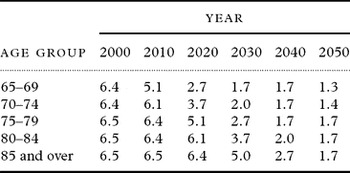
To answer the question of living arrangements and potentially unmet needs, the underlying issues are family size for each dementia severity by age cohort and the tendency of family members to provide care, conditional on family size. There are no data available on the size of families for individuals with dementia. To fill this data gap and provide a prospective view of the way family size will change in the future, we made use of average total fertility data as measured at the time of first birth. To mimic the feed-forward nature of fecundity as it influences family size for different age cohorts, we account for year of mother's birth, age at first marriage, and age at first birth. This information is brought together to simulate aggregate average family size of persons in age cohorts 65 years and above (Table 1).
Estimated average number of children by age cohort, age 65 years and over, for select years

Data on total fertility in Singapore are available from 1950 on (Department of Economic and Social Affairs, 2008). We assumed that total fertility was slightly higher between 1900 and 1950 (6.5 in 1900 and 6.4 in 1950); however, we also assumed that potential family living arrangements are unaffected in families with more than six children.
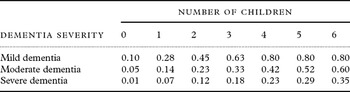
As with family size, no data are available on the proportion of persons with dementia aged 65 years and over living with family members, which for current purposes refers to living with a spouse and/or one or more children. Although we did not have direct estimates of the proportion of elderly adults living with family members based on family size, we were able to generate estimates based on preliminary review of unpublished survey data (Chan et al., Reference Chan2011; personal communication with two of the authors, A. Chan and R. Malhotra, 29 August Reference Chan2011) and assumptions about the distribution of dementia in the nursing home population. These estimates are shown in Table 2.
Estimated likelihood of an individual with dementia living with family, relating number of children and severity of dementia

Results
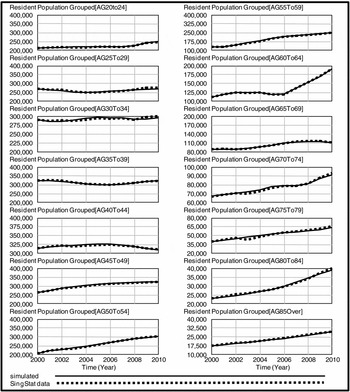
Simulated results from the core population model were compared to census data for years 2000 through 2009 (Figure 1). The overall model fit is R 2 = 0.9214.
Five-year cohort population by simulation and measured data (AG = Age Group).

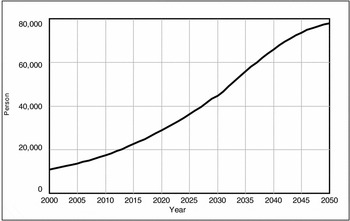
We then simulated population through 2050, which yields the aggregate size of the population with dementia through 2050. Results are shown in Figure 2.
Number of people in Singapore with dementia projected with Ferri et al. (Reference Ferri2005) dementia prevalence consensus estimate by age cohort for WPRO A region.

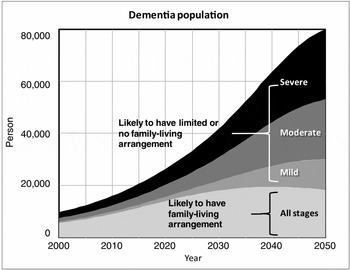
In addition to estimates of the overall size of the population with dementia, the model simulates the relative severity of dementia and estimated size of families with estimated current living arrangement preferences (Figure 3).
Living arrangements preference prospectus 2000–2050.

Discussion
This modeling exercise revealed several points. First, the population of individuals with dementia is expected to rise rapidly both in number and proportion of total population in the next several decades reflecting historical immigration and emigration rates and longer life expectancies. It should be noted that our estimates are lower than those obtained by others (Access Economics, 2006), though our calibration exercises lend confidence to our population estimates. Second, if current tendencies persist, the number of individuals with dementia who are unlikely to live with family will rise rapidly. This is due to the increasing number of individuals with dementia, the decreasing size of families reflecting diminished fertility rates, the increasing prevalence of moderate and severe dementia, and the relationship between family size and likelihood a family member will be cared for within the family. Finally, the question of the size of the population with dementia at each stage of progression is crucial because dementia severity strongly affects care needs, including the ability and willingness to maintain a family member with dementia in the home (see, for example, Jönsson et al., Reference Jönsson2006). This exercise suggests that the expanding population not likely to be living with family is disproportionately composed of individuals with moderate and severe dementia, whose care requirements are especially high.
These estimates refer to current population tendencies and are relevant insofar as these tendencies persist. If, for example, alternative care or living arrangement options such as nursing homes become unavailable, the likelihood of individuals with dementia living with their families will increase. Other factors that will influence this tendency include cost of care outside of home (Jönsson et al., Reference Jönsson2006), physical accessibility of support services (Toseland et al., Reference Toseland2002), willingness of elderly adults to live with their children (Alwin, Reference Alwin1996), and traditional family values, such as filial piety (Liu, Reference Liu, Liu and Kendig2000).
In Singapore, the role of filial piety plays a complicated role in this demographic equation. Indeed, legislation has been aimed at reinforcing children's obligation for parental care (e.g. through Maintenance of Parents Act 1996; Parliament of Singapore, 1996). With diminishing average family size in Singapore, and without new alternatives, it is unlikely that families will be able to offer the same network of care and support for elderly family members with dementia that reinforced the tradition.
The tendency for individuals to remain at home might be increased by providing support services, such as dementia day care, respite care, and pharmaceutical and non-pharmaceutical treatments for distressing behavioral symptoms. Day care may be appropriate for those with mild dementia because as symptoms worsen individuals are less capable of controlling social behaviors such as agitation and aggression (Lyketsos et al., Reference Lyketsos2000). Caregiver respites are helpful (Pinquart and Sörenson, Reference Pinquart and Sörenson2006), but can be labor and cost intensive (Jönsson et al., Reference Jönsson2006). Medications such as cholinesterase inhibitors are limited in effectiveness for controlling symptoms of mild or moderate dementia and can cause undesirable side effects in a significant fraction of the patient population (Farlow and Cummings, Reference Farlow and Cummings2007). Antipsychotic drugs are also useful to control aberrant motor behavior, aggression, and other behaviors common among individuals with dementia, but can have negative side effects (Daiello, Reference Daiello2007). In addition to utilizing these options more fully and effectively, new means of safely caring for and treating individuals with dementia must emerge.
Clearly, the future must be different from the present in order to accommodate the reality of a growing population with dementia. It is important to consider in what ways this situation can be accommodated, and whether such accommodations are desirable for individuals, families, and society.
Limitations
In developing a tractable simulation model, implicit assumptions were made that limit our conclusions. For example, our research does not reflect different family sizes among ethnic groups or migration patterns and trends in mortality rates before year 2000. In general, these assumptions tend to underestimate the magnitude of the potential living arrangements problem.
In the absence of substantial trends, parameter estimates such as future birth and mortality rates were held constant in the model. To the extent that mortality rates decrease in the future, the model may underestimate the number of individuals with incipient dementia who fully manifest the condition during their lives. Using average total fertility as a proxy for family size reduces the precision of estimates because the method implicitly ignores historical child mortality and emigration rates; however, this likely leads to overestimates of family sizes and thus the number of individuals living with family. In addition, we made estimates about the proportion of individuals in nursing homes with dementia, and the family sizes of those individuals. Those estimates should be substantiated with further research.
Finally, to simulate dynamics of dementia progression in the population, we used observations of “time in dementia stage” made by other researchers (Reisberg et al., Reference Reisberg1996) to anchor our parameter calibration search (Sterman, Reference Sterman2000; Oliva, Reference Oliva2003). In the process, we used a new category – incipient dementia. Although not currently identifiable, future research may find a biomarker that defines such individuals; this is especially likely given the fact that biomarker research is currently active and advancing. This method provides a useful first approximation, and, guided by this exercise, we are collecting data to refine these parameter estimates for the population with age-related dementia living in Singapore.
Conclusions
The traditions of care for frail elderly found in the diverse cultures of Singapore are not unique. Countries and urban areas with similar characteristics can apply the methods here to help estimate future needs. Because the model is highly configurable, population, estimates of family size, and likelihood functions may be changed to reflect conditions in any country. These methods may be particularly useful to the other three Asian Tigers, who are currently facing aging populations due to the same demographic phenomena as Singapore.
Conflict of interest
None.
Description of authors’ roles
D. B. Matchar and J. P. Thompson designed the study. J. P. Thompson designed and formulated the system dynamics model, made the figures, and wrote the first draft with C. M. Riley. C. M. Riley conducted a literature review, identified data sources for the model, and suggested revisions to the model. R. L. Eberlein assisted in formulating, calibrating, and explicating the system dynamics model. D. B. Matchar revised interval versions of the paper and approved the final draft.
Acknowledgments
This work was supported by a Singapore Translational Research Investigator Award from the Singapore National Medical Research Council (NMRC/STaR/0005/2008 to D.B. Matchar). The authors thank the funding agency and John P. Ansah, Angelique Chan, Alex R. Cook, Amina M. Islam, and Rahul Malhotra for their contributions to this project.