In the modern university, a good liberal arts school believes in equal opportunity. It welcomes diversity. It promotes that diversity in all of its marketing materials. Some go so far as to have more nonwhite students in their marketing than they do in their classes. Such a university defines diversity broadly. It includes international students and differently abled students and sexual minorities and so forth and so on. It would likely include height if it could.
—Tressie McMillan Cottom, Thick: And Other Essays (Reference Cottom2018, p. 137)
Introduction
Originally situated as purposeful efforts to advance racial equality through mandated inclusion, contemporary justifications for affirmative action tend toward a looser commitment to realizing the societal benefits of diversity—with or without a fundamental commitment to social justice. By definition, effective affirmative action can produce less homogenous environments; therefore, it simultaneously advances diversity by its race-conscious policies. However, much of the pivotal debate defending or challenging future mandates for inclusion or access increasingly focus attention on claims that diversity engenders benefits for both the targeted and non-targeted populations. Even judicial defenses of race-conscious policies for inclusion advance a diversity standard as a basis for affirmative action. Subsequently, diversity—as a goal—emerges out of a sustained race-relations discourse compelling greater demographic inclusiveness in organizations and institutions.
Emphases on anticipated benefits of diversity increasingly constitute the rationale for affirmative action policy. For example, the U.S. Supreme Court’s decision in Regents of the University of California v. Bakke (1978) asserted that a diverse student body promotes an atmosphere essential to quality higher education. Thus, the diversity defense for affirmative action muffles appeals for racial equality and social justice, stilled by the relatively weaker acts or calls for mandated diversity. Race- and gender-conscious affirmative action policies originally advanced legal sanctions to advance equity. However, the broadened, contemporary use of the diversity rationale routinely dilutes such aims. Detached from its context of historical and especially contemporary objectives to address historical patterns of exclusion and discrimination, the diversity rationale for affirmative action promotes increasing tolerance of the “other,” reducing negative stereotypes, and moderating prejudice, appended to a license for race-targeted inclusion.
Richard Zweigenhaft and William Domhoff (Reference Zweigenhaft and Domhoff2003) have argued that race conscious affirmative action certainly can be an antidiscrimination mechanism. However, under the diversity rationale there must be supplementary benefits to all Americans from the act of desegregation (such as teaching tolerance) that go beyond remedying discriminatory exclusion of stigmatized groups. Ellen Berrey (Reference Berrey2015) argues that the politics of the diversity rationale results in the taming of demands for racial justice, like the “civil rights movement’s provocative demands for integration, equality, and full citizenship” (p.9 ).
For example, when the Fifth Circuit Court of Appeals issued a decision that eliminated the use of race in student admissions by the University of Texas system in Hopwood v. Texas, they found that diversity has no impact on educational experience, only that it “simply achieves a student body that looks different” (1996, p. 950). Here, the Fifth Circuit Court of Appeal’s majority clearly argued that changes in numerical representation via deliberate inclusiveness promoted by affirmative action measures taken alone, did not make a strong enough case for the policy. In contrast to Hopwood, the Supreme Court maintained in the Grutter v. Bollinger (2003) decision that use of race in admissions is a legitimate practice when the aim is to achieve diversity; in fact, the majority opinion applied recognition of the wider benefits of diversity as the pivot for this position. This ruling and others, including the companion Gratz v. Bollinger (2003) decision, invoked the diversity rationale to support the Court’s verdict that affirmative action may continue to be practiced. Apart from addressing a call for equity and justice as an antidote for the institutional reality of underrepresentation of particular ethnic/racial groups, in limited scenarios, affirmative action is pushed as the diversity which may be pursued or mandated primarily on footing that it should produce essential beneficial outcomes for all, especially Whites.
With this diversity rhetoric embedded in ongoing inclusion practices across American universities, institutions, and corporations, affirmative action policy remains a central topic of debate (Glazer Reference Glazer1998). On one hand, there are sentiments that race-conscious initiatives manifest unfair disadvantages for Whites (Greenberg 2001 and Lawrence Reference Lawrence2001, for example, examine admissions in higher education). In contrast, other perspectives argue that society, and Whites in particular, can benefit from the positive outcomes that may result from improved diversity (Bowen and Bok, Reference Bowen and Bok1998; Flagg 2003; Gurin et al., Reference Gurin, Dey, Hurtado and Gurin2002; Haslerig et al., Reference Haslerig, Bernhard, Fuentes, Panter, Daye and Allen2013; Lawrence Reference Lawrence2001; Ledesman Reference Ledesma2013; Parker and Pascarella, Reference Parker and Pascarella2013). Indeed, the Courts have not established unambiguously whether diversity is a “compelling governmental interest” in their reviews of affirmative action policy (Gurin et al., Reference Gurin, Dey, Hurtado and Gurin2002, p. 331. For selected examples, see also Smith v. University of Washington Law School (2000), Johnson v. Board of Regents of the University of Georgia (2001), or see Gratz v. Bollinger (2003) and Grutter v. Bollinger (2003)).
The current article reconsiders the diversity defense for affirmative action in the United States. Despite the fact that the ostensible benefits of diversity may be the remaining legal prop for affirmative action policy, and even if diversity is intrinsically beneficial, there may be a need to question an assumption that it should be legally sanctioned in the manner intended by the invention of affirmative action. The following questions are pertinent to this inquiry: (1) Since America is dynamic demographically, who are the relevant groups to be targeted for meeting diversity purposes? (2) Beyond those historically excluded by race, how substitutable are other forms of “difference” in the context of diversifying organizations? (3) Does greater diversity make colleges and universities (or other institutions) function better? And (4) Is there an optimal level of diversity that exempts a defense for racial justice?
Relevance of Diversity
Since America is demographically in flux, who are the relevant groups to be targeted through diversity mandates such as affirmative action? Numerical diversity, or structural diversity, typically acknowledges basic levels of racial and ethnic variety (Hurtado et al., Reference Hurtado, Milem, Clayton-Pedersen and Allen1999). At this level, diversity in a given set of persons can be conceptualized as variations with respect to race, gender, or another socially salient, distinguishing characteristic.
Diversity initiatives can take two major forms: processes of desegregation or practices of integration. Is it conceivable that contact, in itself, is positively, mutually beneficial for in-group and out-group members? Gordon Allport (Reference Allport1954) assumed that greater diversity would produce greater contact. Presumably, many of the assumed benefits of improved inclusion are formed by more than simple numerical diversity. In Allport’s view, for diversity to be experienced as integration rather than desegregation, contact must be structured so that the following conditions are met: group members share equal status and common goals in the contact setting; there is little or no competition among the groups (Robert Putnam Reference Putnam2000, Reference Putnam2007 emphasizes intergroup competition as a barrier to contact bringing groups closer); and, respected authorities sanction the interaction.
Similar to Putnam’s view, conflict theory says greater diversity need not produce greater contact nor will greater contact necessarily produce improved intergroup relationships. Thus, gains may be realized only when numerical diversity is supplemented with additional conditions. Therefore, pursuit of diversity purely as a numerical standard, achieving satisfactory inclusion or diversity mandates virtually mirrors an accounting exercise. This formulation, perhaps, best suits the traditional aims of affirmative action and social equity provisions to generate spaces more consistent with the composition of the American population.
Numerical diversity, though relatively basic, is a precondition for substantive diversity. However, numerical diversity is insufficient to produce substantive diversity because a hierarchical relationship between groups prevails in a real-world context; if structured contact produces equal status it is artificial and contextual. Improvements in numerical representation are relevant and may increase the probability of contact with diverse persons, but they do not guarantee meaningful interaction (Gurin et al., Reference Gurin, Dey, Hurtado and Gurin2002).
Substantive diversity denotes meaningful exchanges and relationships. In the context of higher education, Patricia Gurin and colleagues (2002) define elements of “substantive” interaction. For example, informal interactional diversity refers to the frequency and quality of contact among members of different social (racial/ethnic or gender) groups. In academic institutions, informal interactional diversity manifests primarily as contact outside of the classroom. In the context of higher education institutions this formulation of diversity functions as exchanges and interactions that occur in residence halls, campus organizations, and at social/cultural events (Chang Reference Chang1996), whereas classroom diversity takes into consideration the actual content knowledge of other groups as well as experiences with diverse peers (Gurin et al., Reference Gurin, Dey, Hurtado and Gurin2002). Formulations of substantive diversity are critical for actualizing any benefits from numerical diversity, given those gains tend to be contingent on more than numerical improvements in the mirrored proportionality of representation.
In addition to these formulations—the numerical, the informal interpersonal, and the classroom—others have been applied to workplaces, corporate boardrooms, and decision-making institutions at the local, state, and federal levels. Indeed, a parallel set of definitions of diversity emerges in the literature focused on the workplace, including social category diversity, informational diversity, and ideological diversity.
Social category diversity refers to variation of in-group membership by gender, age, race, or ethnicity (Bar et al., Reference Bar, Niessen and Ruenzi2007, Jackson Reference Jackson, Huff and Paul1992; Jehn et al., Reference Jehn, Northcraft and Neale1999). Informational diversity considers variation in knowledge bases, skills, or perspectives of group members that arise from differences in educational, life, and work experiences among group members (Bar et al., Reference Bar, Niessen and Ruenzi2007; Jehn et al., Reference Jehn, Northcraft and Neale1999). Ideological diversity refers to differences of perspective among members with respect to the goal, target, or mission that compels group association (Jehn et al., Reference Jehn, Northcraft and Neale1999).These formulations of diversity about who we are, what we think matters, and how we see the world are, to some degree, inseparable. Perhaps most important is the agreement that diversity, as broadly defined, may include variations of thought, framework, experience, and knowledge of the world and others, beyond race or gender.
Still, the case for mandated inclusion is blurred when, on one hand, numerical diversity is central to preserving intentions for social justice and, on the other, the diversity rationale distinctly targets some broader aim. Beyond those historically excluded by race, how substitutable are other forms of “difference” in the context of diversifying organizations? Ultimately, a diversity defense for affirmative action in the United States endorses a looser justification for inclusion that proposes in many instances, as Cottom (2019) suggests ironically, that any type of diversity will do.
Is Diversity Invariably Good?
The perspective that integrated and diverse societies function better than homogenous societies undergirds much of the impetus for diversity initiatives in academic and workplace settings. Does greater diversity make colleges and universities (and other institutions) function better? Does diversity have positive effects beyond breaking long-standing practices of racial or gender exclusion?
Studies have attempted to measure or establish the benefits of diversity. For example, benefits of diversity in education have been gauged via self-reported student assessments of interactions with diverse peers (Orfield and Whitla, Reference Orfield and Dean1999). Other research has linked diversity experiences while in college to educational outcomes (see Astin Reference Astin1993a,Reference Astin1993b; Chang Reference Chang1996; Chang et al., Reference Chang, Witt-Sandis and Hakuta1999; Hurtado Reference Hurtado and Gary2001; Pascarella et al., Reference Pascarella, Edison, Nora, Hagedorn and Terenzini1996; Terenzini et al., Reference Terenzini, Rendon, Lee Upcraft, Millar, Allison, Gregg and Jalomo1994a; Terenzini et al., Reference Terenzini, Springer, Pascarella and Nora1994b). Another self-reported assessment technique for measuring benefits has been through faculty reports about the impact of diversity on academic learning (Maruyama et al., Reference Maruyama, Moreno, Gudeman and Marin2000). Individuals who interact in diverse settings, such as classrooms, appear to learn more ways of thinking, become more tolerant, and are more likely to live in integrated communities subsequently, etc. Further, expanding diversity of university faculty, in and of itself, is a chief requisite.
Other scholars (Bowen and Bok, Reference Bowen and Bok1998; Bowen et al., Reference Bowen, Bok and Burkhart1999; Komaromy et al., Reference Komaromy, Grumbach, Drake, Vranizan, Lurie, Keane and Bindman1996) have analyzed attainment—monetary and nonmonetary returns of attending highly selective institutions that employ affirmative action for achieving diversity. This research establishes a relationship between campus racial climate and student outcomes (Gilliard Reference Gilliard1996; Hurtado Reference Hurtado1990, Reference Hurtado1992; Hurtado et. al., Reference Hurtado, Milem, Clayton-Pedersen and Allen1998, Reference Hurtado, Milem, Clayton-Pedersen and Allen1999; Kuh Reference Kuh1993; Smith Reference Smith1995). Thus, a broad body of literature and court opinion has put forward the expectation that there are potential direct or indirect benefits from diversity and inclusion.
In addition, there are limited findings suggesting an emphasis on diversity by faculty in the classroom had positive effects on increased racial understanding and overall college satisfaction (Astin Reference Astin1993a). Overall, in the university setting, most measured benefits of diversity are related to changes in teaching styles and content, the range of course offerings, student involvement, student engagement, and satisfaction. For example, there is evidence of a positive relationship between student satisfaction and exposure to materials on diversity in courses (Villalpondo 1994). Jeffrey Milem’s (Reference Milem, Hakuta and Wilds2000) study noted that Black students experience more success in college completion, educational attainment, and earnings when attending highly selective, diverse institutions, and Whites who experience diversity in college report living and working in less segregated environments after college.
These experiences with integration may be necessary to achieve and maintain an informed citizenry and a well-functioning society. U.S. Supreme Court Justice Lewis Powell (1978) wrote in the opinion of Regents of the University of California vs. Bakke that a diverse study body fosters an “atmosphere of ‘speculation, experiment, and creation,’” which, presumably, would be critical for training our future leaders (p. 2760). Implicitly, Powell assumed that numerical diversity necessarily produces variety in perspectives, arguing diversity has an emblematic character providing exposure to a wider array of people and ideas, essential for enhancing the quality of education. Milem (Reference Milem1994) found that students who discussed diversity issues, socialized with others outside of the classroom, or participated in diversity coursework/workshops were more likely to report increased racial/cultural awareness and open-mindedness.
The notion that greater diversity improves organizational performance has justified policies to desegregate institutions, particularly when reviewing affirmative action policy. Michaela Bar and colleagues (2007) found that diversity increases technical skills; contact networks; access to expertise, perspectives, influence; and organizational connections for higher quality decision-making outcomes (Ancona and Caldwell, Reference Ancona, Caldwell and Gruenfeld1992, 1998; Jackson and Joshi Reference Jackson and Joshi2004 citing Burt Reference Burt1982; Hambrick et al., Reference Hambrick, Cho and Chen1996; Jackson Reference Jackson, Huff and Paul1992; and McLeod et al., Reference McLeod, Lobel and Taylor1996).
Bar and colleagues (2007) identified three conditions relevant for deriving benefits from informational diversity. First, knowledge and skill levels among the group members should be sufficiently disparate so that the whole is greater than the parts. This means each member’s skill and know-how must increase the team’s overall level. Second, this information pool must be relevant to the task at hand. Finally, the costs of sharing information and skills among group members must be small enough as to not offset the potential benefits of such informational gains.
If these three conditions are met, Bar and colleagues (2007) argue informational diversity enhances the performance of work groups. Subsequently, it has been argued that organizational outcomes are improved when teams and groups are informationally diverse. Some researchers have found that diversity among group members may result in enhanced collective cognitive and social capital (Filley et al., Reference Filley, House and Kerr1976; Hoffman Reference Hoffman1979; Ibarra and Smith-Lovin, Reference Ibarra, Smith-Lovin, Cary and Susan1997; Joshi and Jackson, Reference Jackson and Joshi2004 Shaw et al., Reference Shaw, Robbin and Belser1981). Susan Jackson (Reference Jackson, Huff and Paul1992) and Lisa Pelled and colleagues (Reference Pelled, Eisenhardt and Xin1999) find that diversity is beneficial for work tasks that demand creativity in problem solving. Scott Page (2010 asserts that diversity in groups, firms, schools, and society produces benefits in the form of more and better solution making, as well as greater variety of designs, hypotheses, models, and predictions. Orlando Richard (Reference Richard2000) found diversity resulted in higher productivity in firms focused on growth strategies. Joan Rentsch and Richard Klimoski (Reference Rentsch and Klimoski2001) find gender diversity may be associated with better group performance.
Based on laboratory experiments with undergraduate students as “subjects,” Vicki Bogan and colleagues(Reference Bogan, Just and Dev2013) demonstrate that diversity of team members shaped evaluation and decision-making. Relative to gender homogenous groups, gender diverse groups made wiser decisions with respect to team assessment of risk and loss. Other scholars link occupational background (Bantel and Jackson, Reference Bantel and Jacksonl1989; Barsade et al., Reference Barsade, Ward, Turner and Sonnenfeld2000; Carpenter Reference Carpenter2002) and educational diversity (Smieth et al., 1994) to better team performance. Age and ethnic diversity also have been relevant dimensions of diversity that can improve group performance (Kilduff et al., Reference Kilduff, Angelmar and Mehra2000; Watson et al., Reference Watson, Kumar and Michaelsen1993).
Taylor Cox (Reference Cox1993) found lower employee turnover, better employee ratings, more job involvement, greater work team productivity, creativity, and innovation (see also Teskin 1998); more critical thinking (Nemeth Reference Nemeth1985 cited in Cox Reference Cox1993); and lower probability of groupthink in diverse organizations. Diversity brings benefits on difficult tasks (Marcolino et al., Reference Marcolino, Jiang, Tambe and Rossi2013; Page Reference Page2010). Diverse teams and groups may develop problem solving solutions, temper bias, and make better forecasts. In addition, it has been argued that, because diverse groups represent a larger set of networks, this should enhance available informational resources and problem solving, leading to better quality solutions and performance (Schwenk and Valacich, Reference Schwenk and Joseph1994).
If greater variety in ideological orientation or perspective enhances organizational performance, inherently diversity could produce benefits distinct from formulation of inclusion only as desegregation. Even beyond direct gains, however, Richard Allen and colleagues (Reference Allen, Dawson, Wheatley and White2008) found perceptions of greater diversity is correlated to perceptions of organizational performance. Such gains should be relevant to both academic institutions and workplaces. Certainly, real or perceived individual, societal, and institutional benefits stem from perspective one, that there is a necessity for integration, and two, that diversity improves outcomes.
A Diversity Defense for Affirmative Action?
Inclusion for the purposes of numerical diversity, especially by use of affirmative action policies, can promote more equal representation. The “diversity rationale,” however, may not be sufficient for producing equity. Affirmative action can be promoted from the diversity rationale with limited attention to addressing social justice or resolving discrimination. Often, it is assumed that one type of diversity spontaneously produces another (e.g. numerical diversity automatically may provide informational, value, or ideological diversity). But this simplified accounting for demographic variety does not necessarily translate into the form of inclusion that generates improved outcomes for individuals, institutions, or society as a whole, nor does it naturally address America’s exclusionary, discriminatory systems.
The intent behind affirmative action in the law underscored a requirement to act to mitigate discrimination against individuals. Certainly, affirmative action was framed by a reality that the existence of discrimination obliges amelioration and correction. Conflating interests or priorities to achieve improved outcomes for all simply by numerical diversity ignores the core logic of affirmative action’s historical promise for communities subjected to discrimination and systematic exclusion.
Natasha Warikoo (Reference Warikoo2016) provides empirical accounts of tradeoffs in considering the impacts of numerical diversity, when divorced from substantive efforts to achieve greater equity. Beyond the simplicity of numerical diversity, it is clear that other substantive forms of diversity may be more valuable than others for addressing past and current discrimination. For example, colleges and workplaces that tie the diversity rationale to affirmative action, at best, provide for interaction and a more colorful appearance. However, there can be weak correlation between a colorful appearance in a classroom or boardroom, and guided correctives for redressing social justice, discrimination, inequality, or the creation of greater equality of opportunity.
For example, in educational settings, Milem (Reference Milem, Hakuta and Wilds2000) claims greater diversity improves the academic performance of out-group members, but through a critical mass effect that promotes collaborative support among those members. He also argues that, eventually, a greater presence or visibility of out-group members can come to be seen as a positive by the in-group. Echoing sentiments often noted when employing the diversity defense for affirmative action in academic settings, Milem (Reference Milem, Hakuta and Wilds2000) suggests there may be positive gains from diversity for the in-group with respect to learning outcomes, democratic behaviors, ability to live and work effectively in a heterogeneous society, and process outcomes, and there may even be long term material benefits.
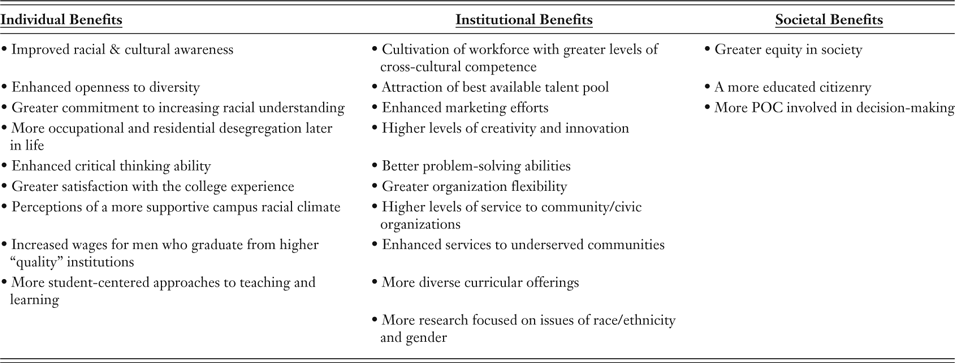
Table 1 below, adapted from Milem (Reference Milem, Hakuta and Wilds2000) summarizes benefits that may flow from racial diversity in academic settings.
Examples of the Benefits of Diversity

Adapted from Milem Reference Milem, Hakuta and Wilds2000, Ch. 5 “The Educational Benefits of Diversity: Evidence from Multiple Sectors”
Beyond educational institutions, there may be benefits to private enterprise that arise from diversity. These gains from diversity stem from its potential for diverse group members to facilitate the broadening of resources, ideas, perspectives, and skill sets, relative to more homogeneous groups. Another general claim is that more diverse organizations can better perform in a globalizing economy or interact successfully with heterogeneous communities. For example, in Wygant v. Jackson Board of Education, a dissent (1986), in support of social diversity, suggested a more diverse police force might offer better community relationships and coverage of issues.
Ironically, the argument that racial diversity may yield broad benefits for all echoes, similar, segregationist arguments for the claimed benefits from the separation of Whites and Blacks (Gurin et al., 2003). However, when pursuing diversity, especially through the means of affirmative action policy, should it matter if the “in-group” benefits from greater diversity? Apparently, yes, at least according to Supreme Court Justice Sandra Day O’Connor. O’Connor’s Grutter vs. Bollinger (2003) opinion argued that remedying past discrimination (nor, by implication, current discrimination) is not a sufficient justification for the pursuit of diversity in higher education. Her opinion firmly supports the notion that diversity inherently enhances the quality of education for all students at an academic institution. If today’s criterion is reduced to a rationale for diversity’s benefits to society as a whole, including those who have not experienced patterns of exclusion, should the law require it?
An Asymmetrical Rationale
Susan Jackson and Aparna Joshi (2004) have argued that diverse workforces do not guarantee organizational effectiveness. Rather, certain types of group diversity may increase conflict, reduce social cohesion, and increase employee turnover (Jackson and Joshi, Reference Jackson and Joshi2004 citing Cox Reference Cox1993; Jackson et al., Reference Jackson, Joshi and Erhardt2003; Milliken and Martins, Reference Milliken and Martins1996; Webber and Donahue, Reference Webber and Donahue2001; Williams and O’Reilly, 1998).
Sonia Liff (Reference Liff1997) has identified two standard approaches for introducing diversity in the workplace. The first is the equal opportunity strategy, a strategy centered on rendering social group differences among employees invisible. It encourages managers to ignore the realities of inequality and discrimination in an attempt to minimize difference to demonstrate its irrelevance to corporate behavior and decision-making (Liff Reference Liff1997). The second approach is the managing differences strategy. This technique is especially evident in gender inclusion policies (Liff Reference Liff1997). In contrast to the equal opportunity approach, this encourages managers to recognize and respond to (gender, ethnic, racial) difference and often encourages the restructuring of the workplace and practices to correct or address inequality (Liff Reference Liff1997).
Liff (Reference Liff1997) contends, while commonly employed, the equal opportunity strategy (or “color blind”) approach leads to poorer outcomes. In fact, Liff says that the equal opportunity strategy can reinforce negative stereotypes. Under this strategy, norms and standards held by the dominant group go unchallenged, the status quo may be reinscribed, and the failure of any single member of the previously excluded group is viewed as confirmation of their group’s inferiority. Although the managing differences strategy is less common and does, on average, lead to superior outcomes, according to Liff (Reference Liff1997) this strategy also is problematic. It can lead some employees from the in-group to perceive that the out-group members are being afforded special treatment, which fosters resentment. While there is a reverberating defense of diversity and the ways in which it should enhance these environments, the overall evidence is quite inconclusive. Cecelia Conrad’s (Reference Conrad and Simmis1995) macro-level study found no positive or negative effect on national productivity from changes in the demography of the workforce.
Lois Wise and Mary Tschirhart (Reference Wise and Tschirhart2000) assert many managers “are using largely untested assumptions as a basis for diversity policies, strategies, and actions…” (p. 386). While there is evidence that heterogeneous groups outperform homogenous ones (Jackson Reference Jackson, Huff and Paul1992; Nemeth Reference Nemeth1986; Richard Reference Richard2000), there is also some evidence that homogenous teams outperform diverse teams (Ancona and Caldwell, Reference Ancona, Caldwell and Gruenfeld1992; Timmerman Reference Timmerman2000). Other scholars find no difference in performance between the two types of groups (Jehn et al., Reference Jehn, Northcraft and Neale1999; Kochan et al., Reference Kochan, Bezrukova, Ely, Jackson, Joshi, Jehn, Leonard, Levine and Thomas2003; Siciliano Reference Siciliano1996). While varied evidence indicates more diverse groups can be more productive, overall, outcomes remain contingent on ideal conditions being met. The evidence on diverse groups shows that garnering benefits from diversity takes effort. Clearly, managing a diverse team offers certain challenges relative to managing a homogeneous team.
Workplace diversity initiatives that focus on difference also may produce an unnaturally reified view of ethnicity and an exaggeration of cultural difference, perpetuating a view of the permanence and immutability of group-based behaviors and attitudes (Dameron and Joffre, Reference Dameron and Joffre2007). Numerical diversity may interact with existing stereotypes in ways that reduce team ability (Lindeman and Sundvik, Reference Lindeman and Sundvik1995). There is evidence that more diverse groups can experience more conflict and may be less congenial (Alagna et al., Reference Alagna, Reddy and Collins1982; Harrison et al., Reference Harrison, Price and Bell1998; Jehn et al., Reference Jehn, Northcraft and Neale1999). For example, ethnicity can come to be seen as identifiable and permanent. John Wrench (Reference Wrench2012) references a systematic review of ILO survey of U.S. diversity/anti-discrimination/ EO manuals which found Hispanics referred to as “family oriented rather than work oriented,” encouraging employers to motivate them by appealing to their love for family (Bendick et al., 1998, p. 79). Heather MacDonald (Reference MacDonald1993) also has shown that promoters of diversity may simultaneously reject racialized stereotypes deemed as negative, but also wildly endorse racially-based generalizations viewed as positive.
Too great a management focus on difference can dilute the more important focus on historical exclusion (Dameron and Joffre, Reference Dameron and Joffre2007). For example, Stephanie Dameron and Olivier Joffre (2007) observe that the Federated Department Stores in America initially adopted a “diversity” framework focusing on gender inclusion and racial inclusion, but after six years its diversity criterion numbered over twenty-six groups, including the elderly, homosexuals, atheists, etc.
Susan Jackson and Aparna Joshi (2004) also argue that demographic diversity may enhance the salience of differing social identities. This can foster favoritism toward like members or lead to discriminatory actions toward out-group members (Ashforth and Mael, Reference Ashforth and Mael1989; Tajfel Reference Tajfel1978). From a context standpoint, some scholars find that the beneficial effects of diversity in the workplace are dependent upon the initial demographic structure of the workplace (Joshi Reference Joshi2006), organizational culture (Brickson Reference Brickson2000; Cox Reference Cox1993; Ely and Thomas, Reference Ely and Thomas2001), and styles of decision-making and conflict management (Jackson and Joshi, Reference Jackson and Joshi2004 citing Simons et al., Reference Simons, Pelled and Smith1999 and Bottger and Yetton, Reference Bottger and Yetton1988). The benefits of diversity in the workplace are contingent on context as well as the form that diversity takes. Diversity appears to be beneficial for some tasks but not others. Given increasing demographic diversity, college may be a place where students can learn to work in diverse groups with fewer costs.
Affirmative action can offer a framework promoting inclusion as numerical diversity. Numerical diversity can promote equal representation. Yet simple demographic variety may not translate into forms of inclusion presumed to generate substantial institutional change or challenge injustice. Further, broadened numerical diversity is insufficient for addressing hierarchical relationships prevailing between groups in a real world context. Nonetheless, the diversity rationale may be the final pillar sanctioning affirmative action policy.
The depth of ongoing discrimination and racism in the United States sits detached if affirmative action remains entrenched within a diversity rationale. Courts tend to take the view that discrimination and racism are things of the past and not currently in effect. Yet, annual charge statistics from the U.S. Equal Employment Opportunity Commission summarize discrimination based on traits that include race, color, or national origin. In 2017, there were 84,254 total charges filed, of which 33.9% were related to race, 9.8% to national origin and 4.1% to color.
The legal validity of affirmative action policy has been anchored on judgments of social acceptability, or social good, rather than a legitimate claim to inclusiveness based upon principles of justice and equity. Justice and equity dimensions of affirmative action policy are diminished and, to some degree, have been rejected by the courts. However, these are strong justifications for affirmative action. Unfortunately, those defenses increasingly are not mounted. But a foundation for affirmative action rooted in justice and equity (rather than the diversity rationale) should undergird race conscious policies to produce inclusion.
Although the diversity rationale for race conscious affirmative action has been advanced in broad institutional and judicial discourse, it is a frail reed upon which to defend the legitimacy of affirmative action. As American institutions, including universities and corporations, prioritize diversity over equity, there is a need to reactivate the substantive reasons for maintaining affirmative action, particularly as a corrective for the persistence of discrimination and/or contemporary structural barriers to inclusion. In particular, the strongest case for affirmative action should include the necessity of anti-discrimination measures to provide broad access to members of groups who have been historically excluded. And even if inclusion has historical precedence, affirmative action may not be about restitution for historical discrimination but may, primarily, emend present barriers to inclusion. There is compelling evidence that racial discrimination persists at significant levels in the present moment.
Devah Pager’s (Reference Pager2007) field experiments in Milwaukee and New York City revealed that it is harder for ex-convicts to obtain work than it is for non-convicts of similar age and educational attainment. Perhaps more surprisingly, Pager found that Black male job applicants with no criminal record had a lower likelihood of receiving a call back for an interview than White applicants who had been convicted of a felony. The unemployment rate for adult Blacks has remained roughly twice as high as the rate for adult Whites continuously since employment statistics by race were first collected fifty years ago. At least as disturbing, the Black rate of unemployment is approximately twice as high at each level of educational attainment.
For example, after the last decennial census, among persons aged twenty-five years and older in 2011, Blacks who had not completed high school had a joblessness rate of 24.6%; the rate for Whites with a similar educational attainment was 12.7%. Black adults who had completed high school had a 15.5% unemployment rate; Whites that had completed high school had an 8.4% unemployment rate. Blacks with some college education or an associate’s degree had a 13.1% jobless rate; Whites had a 7% rate. Finally, blacks aged twenty-five years and older who had completed college had a 6.9% unemployment rate; White adults who had completed college had a 3.9% unemployment rate. Further, at the time, Blacks with some college education had a higher unemployment rate than Whites who had not completed high school.
A diversity rationale for affirmative action is undoubtedly weaker than an equity and inclusion rationale. Further, it is increasingly unclear whether courts have the basis to consistently support these policies only when backed by interests that primarily benefit those loosely aligned to social justice, historical patterns of discrimination, or racial justice. Advocacy for affirmative action should be re-integrated with claims against discrimination and for social justice. Within a diversity rationale, an institution may accomplish desegregation so that a beneficiary of affirmative action may represent either a group historically and currently faced with discrimination or a group with no legacy of exposure to discrimination but is seen as contributing to “cultural” and “identity” diversity (and with that cognitive and value diversity).
Today, institutional promotion of numerical diversity through affirmative action counts a recent Jamaican immigrant, a black woman from New Orleans in the fifth generation since the end of American slavery, and the son of a White male university professor and first generation Nigerian-American mother who is a physician from Boston in the same way. Do they represent diverse forms of substantive diversity, or is numerical diversity sufficiently achieved due to their shared experiences of being Black in the United States?
Indeed, the promise in all three groups interacting may enhance societal functioning. These interactions may also result in benefits to individuals, institutions, and society as a whole. A diversity rationale for affirmative action is problematic if all three groups are reduced to a single numerical category. Should diversity alone provide for the substitution of one group for another? Does affirmative action supported by the diversity rationale hold legal merits akin to social justice?
The new narrative should rest on equity and inclusion. The playing field is not level. Evidence of past and current discrimination, reflected in incarceration rates, the geography of opportunity, and a racially unequal economy, require a need for inclusion independent of better outcomes for those already fully included.