INTRODUCTION
Sjøtun et al. (Reference Sjøtun, Husa and Peña2008) provide a recent synthesis of the known distribution of the introduced Pacific red alga Heterosiphonia japonica Yendo within Europe. The first European record was from Brittany, France, in 1984, but it has subsequently spread widely to north-western Spain, Holland, Norway, Sweden and the Mediterranean. Sjøtun et al. (Reference Sjøtun, Husa and Peña2008) list three records of the species for the UK and one for Ireland. In 1999 it was reported from Milford Haven, Wales, in 2002 from New Quay, County Clare on the west coast of Ireland, in 2004 near Inverness on the North Sea coast of Scotland and in 2005 from two sites on the Isle of Wight in the English Channel. We report on the establishment of the species on the west coast of Scotland and include observations on the invasive brown alga, Sargassum muticum (Yendo) Fenshold, which was also recorded at one of the sites studied. Recent records of the distribution of this species within the UK are reviewed by Harries et al. (Reference Harries, Cook, Donnan, Mair, Harrow and Wilson2007).
MATERIALS AND METHODS
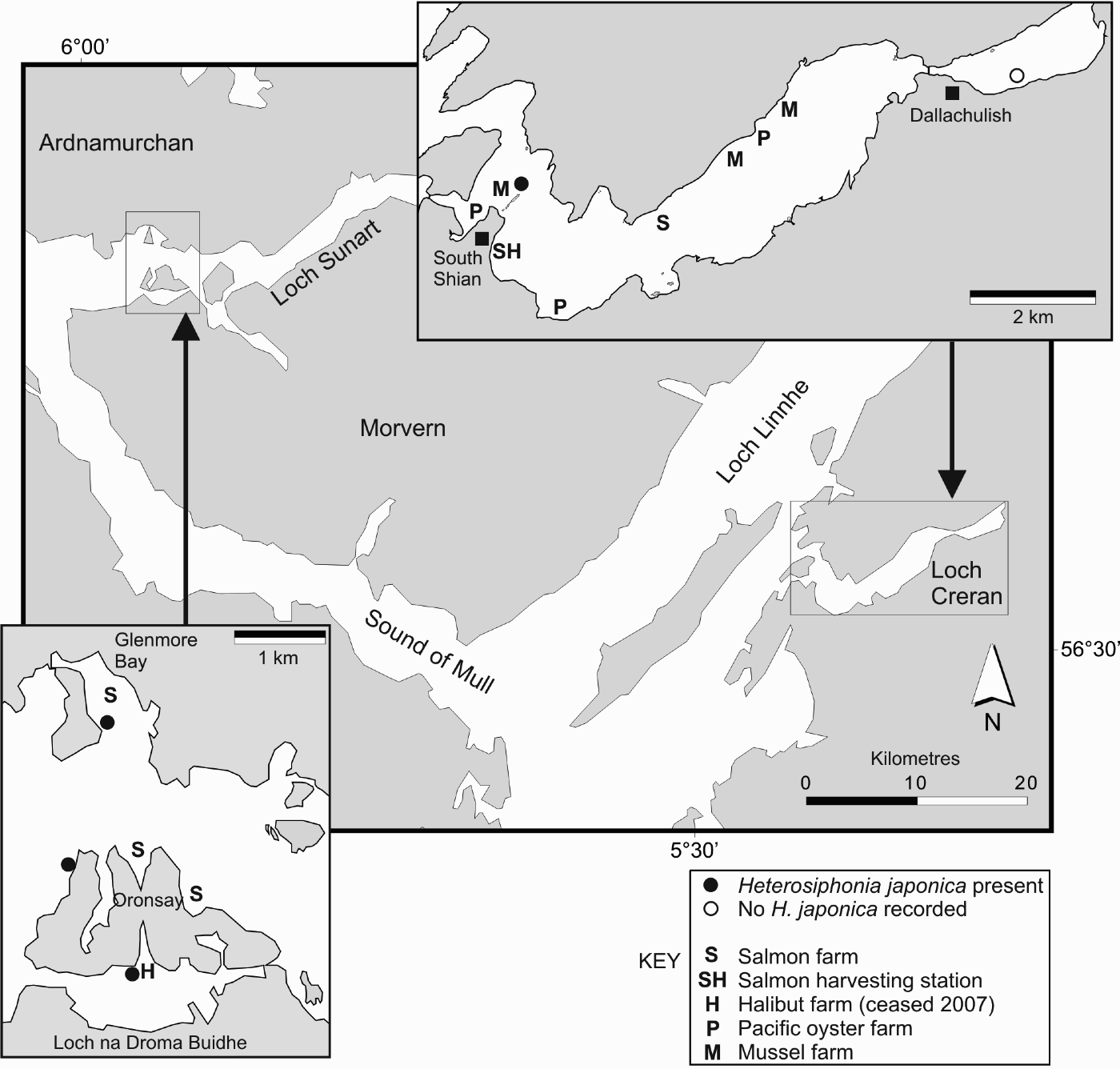
During a SCUBA dive off the north-west coast of the island of Oronsay in the mouth of Loch Sunart, Scotland on 18 May 2008 several clumps of H. japonica were observed on rock at a depth of around 5 m. The area was revisited from 9–16 July 2008 to assess the local distributional extent of the species. In total five sites were examined by diver (Figure 1). In Glenmore Bay the depth distribution and abundance was examined by visual assessment of the percentage cover of all macroalgae at six stations, each of approximately 10 m2, along a transect, perpendicular to the shore, at 2 m depth increments between 0 and 10 m. Larger algae were identified and quantified by visual estimation in situ, whilst turf species were examined by in situ visual estimation of total coverage, followed by representative sampling of the turf. Subsequent microscopic examination enabled estimates of coverage of component species based on their relative biomass in the samples, which was based on a visual estimation of relative volume. At other sites only a subset of the algal community was examined by representative sampling of either the red algal turf or just the filamentous red algal flora. Table 1 provides details of the material examined and depths at each site. At two sites only relative species abundance was recorded by estimation of the percentage of the total biomass in the sample (see Table 2). The substrate on which H. japonica was growing, as well as the reproductive state of samples of H. japonica were also recorded. Algal nomenclature follows Hardy & Guiry (Reference Hardy and Guiry2003). All depths were measured by diver's gauge and are given with respect to chart datum, whilst depth zone terminology follows that of the Joint Nature Conservation Committee (Hiscock, Reference Hiscock1996).
Distribution of records for Heterosiphonia japonica, with locations of aquaculture facilities.

Details of sites examined for Heterosiphonia japonica.

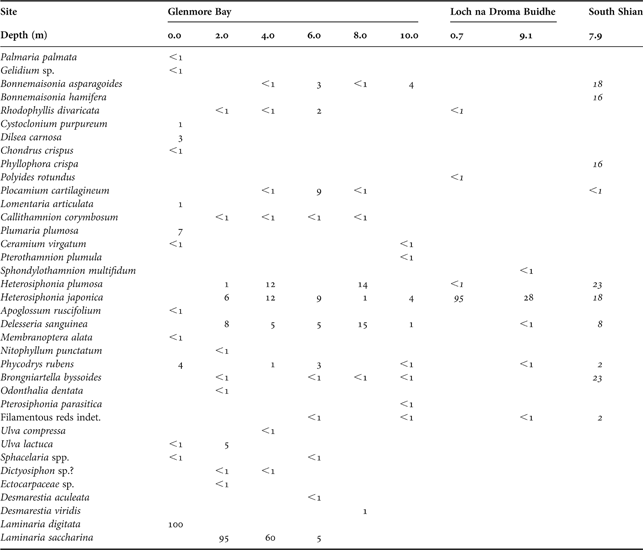
Composition of the algal community in material examined from three locations in Argyll. Numbers represent percentage cover or, where italicized, percentage of total biomass of sample.

At one of the sites, Loch na Droma Buidhe, the presence of Sargassum muticum was recorded. As this represented the most northerly UK record for this species, the opportunity was taken to make some observations on its distributional status by means of a visual survey of the coastline of the loch by small boat at low tide on 9 July 2008.
RESULTS
Heterosiphonia japonica was present at four of the five sites examined, only being unrecorded from a Modiolus bed in the upper basin of Loch Creran. Elsewhere it was found in a wide range of conditions, including amongst the understorey of a semi-exposed Laminaria hyperborea forest, tide-swept rock and very sheltered, silt-covered rock (Table 1). In Glenmore Bay it was absent at the most wave-exposed, shallowest zone of Laminaria digitata forest, but present at all depths from 2–10 m. It was a member of the understorey flora of infralittoral L. saccharina kelp forest and park biotopes (Hiscock, Reference Hiscock1996) and circalittoral, ascidian-dominated silted rock (Table 2). At most depths it was a dominant member of the turf flora, along with Delesseria sanguinea and H. plumosa, attaining 12% coverage of the seabed. In Loch na Droma Buidhe (a branch of Loch Sunart) it formed the dominant filamentous red alga beneath a bed of Sargassum muticum in the sublittoral fringe (see below), whilst a plain of boulders and cobbles at 9.1 m supported a red macroalgal turf, consisting of a virtual monoculture of H. japonica, which covered 28% of the substrate. In tide-swept conditions near the mouth of Loch Creran H. japonica also represented one of the dominant members of the red algal turf.
Heterosiphonia japonica was found growing on rock as well as epiphytically on Rhodophyllis divaricata, Plocamium cartilagineum, Heterosiphonia plumosa, Delesseria sanguinea, Phycodrys rubens, Brongniartella byssoides and Dictyota dichotoma. In some cases it was observed that colonization of the host was by dense settlement of fragmented pseudolaterals (small side branches). Settlement on the pseudolaterals of H. plumosa was also observed. No fertile gametophytes of H. japonica were recorded. Tetrasporophytes were common, as were thalli bearing no reproductive structures.
The visual survey of the coastline of Loch na Droma Buidhe (a distance of approximately 3.5 km) revealed evidence of the presence of S. muticum to be restricted to a 100 m stretch of coastline coinciding with the H. japonica survey site.
Diving revealed that S. muticum occurred as a dense band only in the eastern half of this stretch, at depths of between 0.4 m above to 1.8 m below chart datum. In the centre of this belt it generally covered around 30% of the seabed, with some dense patches of 80%. The substrate was predominantly gently-sloping bedrock, to which S. muticum was attached, as was Laminaria saccharina and Halidrys siliquosa. Below 1.8 m the seabed profile changed abruptly to a steep rock face supporting a forest of L. saccharina. Scattered, small plants of S. muticum were also present here, on small ledges down to a depth of 4 m. Length of S. muticum varied between 0.15 and 2.6 m.
DISCUSSION
A recent monitoring survey by diver of a site on the Garvellach Islands, 56 km south-west of Loch Creran, in August 2005 noted the presence of H. japonica, although no material was retained (Howson et al., Reference Howson, Mercer and Moore2006). The present report confirms that H. japonica is now firmly established on the west coast of Scotland, where it has been found to be common in the infralittoral and upper circalittoral zones at semi-exposed and sheltered sites. Although no sites exposed to strong wave action were examined, it did extend its distribution into the sublittoral fringe in the very sheltered Loch na Droma Buidhe, though not in the slightly more exposed Glenmore Bay. Following a comprehensive survey of the distribution of the species along the south-western coastline of Norway, Husa et al. (Reference Husa, Sjøtun and Lein2004) also recorded its presence at sheltered and semi-exposed sites, with absence at exposed sites (defined as having at least one 10° sector facing the open sea).
It is likely that establishment of H. japonica in Loch Creran took place after 2005 as the establishment of a monitoring scheme in this well-studied loch in the summer of 2005 involved algal surveys of the rocky and biogenic reefs (Moore et al., Reference Moore, Saunders, Harries, Mair, Bates and Lyndon2006). Similarly, the introduction of the species into Loch Sunart was probably recent, as it was not observed during surveys of the rocky reefs in 1995 (Howson, Reference Howson1996) and 2001 (Bates et al., Reference Bates, Moore, Harries, Austin and Lyndon2004).
It is believed that the vector for the introduction of H. japonica into Europe was probably the importation of Pacific oyster, Crassostrea gigas (Thunberg), from the western Pacific, although subsequent spreading of the species in the North Sea and Scandinavia is most likely facilitated by shipping activity (Sjøtun et al., Reference Sjøtun, Husa and Peña2008). Although the level of shipping off western Scotland is comparatively low (Sjøtun et al., Reference Sjøtun, Husa and Peña2008), both Loch Sunart and Loch Creran represent concentrations of aquaculture facilities, with the Loch na Droma Buidhe site coinciding with the position of a recently closed halibut farm and the South Shian site in Loch Creran close to several fish farms and located in the narrow channel leading to a salmon harvesting station, which receives frequent visits by salmon well boats transporting live fish. The companies operating the salmon and halibut facilities in both lochs employ Norwegian vessels. Moreover, Loch Creran has become a centre for recreational vessels, with over 150 moorings and Loch na Droma Buidhe is a popular yachting anchorage. Thus, it cannot be assumed that the recording of dense populations of H. japonica at these Scottish west coast sites is indicative of a widespread continuous distribution of the species throughout this area, but may be the result of disjunct introductions. Sjøtun et al. (Reference Sjøtun, Husa and Peña2008) noted that the counter-current spreading of the species along the coastlines of Norway and Sweden is suggestive of a human-mediated mechanism. Some spreading also occurs by fragmentation of the thallus, especially involving abscission of the pseudolaterals (Bjærke & Rueness, Reference Bjærke and Rueness2004; Husa & Sjøtun, Reference Husa and Sjøtun2006). In Glenmore Bay fragments were seen to epiphytize the pseudolaterals of H. plumosa, which may contribute to further spread, as these host structures can form dispersive propagules (Boney, Reference Boney1975). With regard to dispersal by spores, although cystocarpic gametophytes have been recorded in Spain, the Scottish material only included vegetative and tertrasporophytic specimens, as has been found to be the case in Norway (Sjøtun et al., Reference Sjøtun, Husa and Peña2008).
Heterosiphonia japonica has become a dominant member of the macroalgal flora at some of the Scottish sites, even forming a virtual macroalgal monoculture at one location. However, its impact on other species is uncertain. Employing a comparison of the algal flora in south-western Norway before and after the introduction of H. japonica, Husa et al. (Reference Husa, Sjøtun, Brattenborg and Lein2008) concluded that the success of the species in this area had no adverse effect on algal species richness. However, it is known that dense settlement can take place on faunal and floral substrates, including the rhodoliths of maerl beds (Husa et al., Reference Husa, Sjøtun and Lein2004) and the species has been recorded at 7 out of 10 maerl beds examined in Brittany (Sjøtun et al., Reference Sjøtun, Husa and Peña2008). Thus H. japonica may represent a threat to the conservation value of a variety of habitats, including maerl beds, which are currently well-represented along the west coast of Scotland.
At the end of 2007 the most northerly known populations of attached S. muticum were restricted to the Clyde Sea area, although drift fragments had been recorded from further north as far as Oban (Harries et al., Reference Harries, Cook, Donnan, Mair, Harrow and Wilson2007). The observations made in the summer of 2008 therefore represent a considerable northward extension of the known range of the species in the UK. Although the temperature in Scottish waters is sub-optimal for S. muticum it is still sufficient to sustain growth and reproduction. It is likely that any climatic change leading to raised sea temperatures would tend to favour S. muticum establishment, but there is currently insufficient evidence to link its recent northward expansion in the UK to climatic factors. The distribution of the S. muticum population within Loch na Droma Buidhe is largely in accordance with its known environmental preferences for sheltered sites and for a zonation restricted to the sublittoral fringe by the constraints of its low tolerance to desiccation and the attenuation of light with increased depth (Norton, Reference Norton1977). However, this population is a little unusual in that it is established on bedrock rather than on unstable mixed substrates. Sargassum muticum can become established on any suitable hard substrate but establishment is hindered by an existing canopy of competing algae. Consequently the success of establishment is enhanced by a degree of disturbance sufficient to create bare patches of rock where S. muticum germlings can settle free from competition by native algae (Davison, Reference Davison1999). At the Loch na Droma Buidhe site the source of such disturbance is not apparent.
It is not possible to determine the date of establishment of S. muticum in Loch na Droma Buidhe with any certainty. It was not recorded by surveys conducted in 1995 (Howson, Reference Howson1996) and 2001 (Bates et al., Reference Bates, Moore, Harries, Austin and Lyndon2004) but due to the limited spatial extent of the bed it may have been missed. It is probable that 2008 was not the first season of growth of S. muticum in Loch na Droma Buidhe. The density of the plants and the large number of basal stumps on the holdfasts indicate that the population has probably been present for at least a few years.
The most commonly cited anthropogenic vector for introduction of S. muticum is the transplantation of shellfish stock for cultivation. However, there are no known shellfish cultivation sites in the vicinity of Loch na Droma Buidhe and it is entirely possible that the arrival of S. muticum was simply due to natural wind-driven dispersal of drift fragments with reproductive potential (Deysher & Norton, Reference Deysher and Norton1982). The popularity of Loch na Droma Buidhe as a yacht anchorage also raises the possibility that S. muticum arrived in the loch following accidental entanglement of drifting fronds with recreational boats, as has occurred previously in the Channel Islands (Critchley et al., Reference Critchley, Farnham and Morrell1983).
It seems likely that the S. muticum population in Loch na Droma Buidhe will inevitably spread within the Loch Sunart system with potentially detrimental consequences for the site's status as a Special Area of Conservation. A specific area of concern might include the recently discovered population of serpulid reefs in the neighbouring Loch Teacuis (Dodd et al., Reference Dodd, Baxter and Hughes2009). However, the depth zone of the serpulids is slightly deeper than that of S. muticum and overgrowth by S. muticum is only likely to occur at the upper margins of the serpulid zone. Another potential concern is the areas of Zostera marina that occur at locations within the Sunart system (Howson, Reference Howson1996). Sargassum muticum has been reported to displace Z. marina in areas where the substrate offers suitable attachment points (Den Hartog, Reference Den Hartog1997; Davison & Hughes, Reference Davison and Hughes1998). Sargassum muticum establishment on rocky reefs within the loch system is likely to be of less conservation importance. The shallow rock within the S. muticum depth range tends to be somewhat impoverished and unremarkable in species composition. The more diverse rocky reefs tend to occur at more exposed, tideswept or deeper sites and would be unsuitable for S. muticum attachment (Bates et al., Reference Bates, Moore, Harries, Austin and Lyndon2004).
ACKNOWLEDGEMENT
We are most grateful to Dr Vivian Husa, Institute of Marine Research, Bergen, for verification of the identity of Heterosiphonia japonica.