Introduction
Political science has developed a fairly good understanding of the political economy of democracy. Extant research suggests that democracies grow faster (Gerring et al., Reference Gerring, Thaeker and Alfaro2005; Acemoglu et al., Reference Acemoglu, Robinson, Naidu and Restrepo2014), provide more public services (Lake and Baum, Reference Lake and Baum2001), reach higher levels of human development (Ross, Reference Ross2006; Gerring et al., Reference Gerring, Bond, Barndt, Moreno and Barndt2012, for a contrary view), compensate more for losses stemming from trade liberalization (Rudra and Haggard, Reference Rudra and Haggard2005), and are more equal (Reuveny and Li, Reference Reuveny and Li2003) than autocracies. Far less is known about the political economy of democratization. Democratization is not simply democracy to a lesser degree. Rather, it is the non-linear, non-deterministic process toward it, which introduces new political incentives and institutional constraints, often in sequence, not simultaneously, and sometimes with countervailing effects. This, in turn, gives democratizing regimes specific characteristics – a fact that has been under-appreciated in the literature (a notable exception is Son, Reference Son2016). In this article, we seek to uncover these characteristics in the context of political budget cycles (PBCs).
PBCs designate periodic fluctuations in fiscal policies induced by the cycle of elections (Alt and Rose, Reference Alt and Rose2009: 845). Recent research implies that democratization has a non-linear effect on PBCs: positive at the autocratic end of the regime spectrum; negative at the democratic end. In this article, we theoretically develop and empirically test this non-linear effect. First, we argue that democratization is (at the very least) a two-dimensional process, involving the introduction of more substantial constraints on executive powers (executive constraints), and an intensification of the struggle for power (political competition). The two have reverse effects on PBCs: the first reduces incumbents’ ability to create PBCs; the second increases their incentive. Second, we argue that while relatively unconstrained executive powers and some degree of political competition are necessary conditions, it is the fear of losing elections (electoral competitiveness) that triggers PBCs. If incumbents are confident of their re-election, they do not create PBCs. Third, we show that because of the empirical covariation between executive constraints and political competition along the regime spectrum, PBCs occur primarily in hybrid regimes. In most autocracies, there is no incentive; in most advanced democracies, incumbents do not have the ability to create PBCs.Footnote 1 As a result, the observed (aggregate) effect of democratization is non-linear: positive at the autocratic end of the regime spectrum, where the fluctuations are driven by rising levels of political competition and triggered by electoral uncertainty; negative at the democratic end, where they are contained by the growing number of constraints on executive powers.
We test this argument against data on public spending in 112 countries, covering the entire regime spectrum over the period from 1960 to 2006. The data set partly draws on reports from the International Monetary Fund’s (IMF) statistical office and documents from the Fund’s archives. It significantly improves on existing data by extending it back in time and including more observations, particularly from the autocratic end of the regime spectrum. Like Rogoff (Reference Rogoff1990) and others, we focus on spending rather than revenues or debt.Footnote 2 Our empirical findings support the theoretical argument: incumbents are more likely to create PBCs when (1) their decision-making powers are relatively unconstrained, (2) multiple parties compete for power in a system that allows incumbency defeat, and (3) win-margins in the last elections were relatively small. In addition, we demonstrate that executive constraints and political competition covary along the regime spectrum and that, as a result, PBCs occur primarily in hybrid regimes.
The article contributes to the PBC literature in three ways. First, it proffers a more nuanced understanding of the effect of democratization by pointing to the multiple dimensions of democratization and their countervailing effects on PBCs. Second, it empirically demonstrates the non-linear effect of democratization that has been implied in the PBC literature. Third, it is the most comprehensive study of PBCs to date covering the entire range of regimes, from full autocracies to full democracies.
The article proceeds as follows. In the following two sections, we develop our argument by reviewing the PBC literature, introducing our two-dimensional conceptualization of democratization, and discussing the effect of democratization on PBCs. We then define our variables, describe our estimation strategy, present the findings, and carry out robustness tests. Finally, we draw conclusions and propose areas of future research.
Democratization and PBCs
Democratization has important political economy implications. It has been shown to affect growth (Tavares and Wacziarg, Reference Tavares and Wacziarg2001) and to condition the effect of inequality on growth (Persson and Tabellini, Reference Persson and Tabellini1994). We also know that it fosters trade (Milner and Kubota, Reference Milner and Mukherjee2005) and capital account liberalization (Milner and Mukherjee, Reference Milner and Kubota2009; Mukherjee et al., Reference Mukherjee, Yadav and Bejar2014); contributes to economic stability (Rodrik, Reference Rodrik2000); and stimulates social spending (Ross, Reference Ross2006). But what is its effect on PBCs? The literature does not give a clear answer. However, it does offer three arguments that link democratization to PBCs: two that have to do with the incumbents; one that has to do with the voters.
The first argument is that stronger checks and balances reduce the incumbent’s ability to create PBCs. This argument can be traced back to the Rogoff model, which assumes that incumbents control spending. If not, or if the incumbent only partially controls spending, PBCs are less likely to occur. In one of the first studies of PBCs outside Western Europe and North America, Schuknecht notes that ‘in developing countries, checks and balances are often little developed and the incumbent government has significant monetary and budgetary discretion. We should therefore expect election-oriented behavior by governments in developing countries to be quite pronounced and straightforward’ (Reference Schuknecht1996: 158). Consistent with the argument, he finds large PBCs in developing countries. In a similar vein, more recent studies have focused on different types of checks and balances: legislative veto players and compliance with fiscal laws (Streb et al., Reference Streb and Torrens2009: 427), fiscal transparency and party polarization (Alt and Lassen, Reference Alt and Lassen2006), party institutionalization (Shelton, Reference Shelton2014), and the checks and balances produced by presidential systems (Persson and Tabellini, Reference Persson and Tabellini2003b). Some of the studies link the argument to democratization (e.g. Shelton, Reference Shelton2014). However, most suggest that in the absence of checks and balances, PBCs occur even in advanced democracies (Alt and Lassen, Reference Alt and Lassen2006; Streb et al., Reference Streb and Torrens2009).
The second argument is that political competition increases the incumbent’s incentive to create PBCs. The Rogoff model generally assumes elections are competitive. However, Rogoff himself, questions whether PBC theory has ‘any bearing on countries such as Mexico and Japan, in which a single party dominates political life?’ (Reference Rogoff1990: Footnote 34)3 Testing the argument precisely in the case of Mexico, Gonzalez (Reference Gonzalez2002) finds that the spending fluctuations have been largest during the country’s most democratic periods. She attributes this to the ‘bigger threat for the ruling party to lose power’ (Gonzalez, Reference Gonzalez2002: 221). Block et al. (Reference Block, Ferree and Singh2003) test the argument in a sample of Sub-Saharan African countries. They find that PBCs occur only when elections are competitive and conclude that ‘incumbents’ incentive to create PBCs in nascent democracies is strong, but contingent on multiparty competition’ (Block et al., Reference Block, Ferree and Singh2003: 462). Vergne (Reference Vergne2009) tests the argument in developing countries more broadly and finds similar patterns. She also finds that the spending fluctuations are largest in founding elections, when incumbents ‘have an incentive to deter the entry of future challengers’ (Vergne, Reference Vergne2009: 74).
The third argument linking democratization to PBCs is that voter experience and information reduces the incumbent’s ability to create PBCs. This argument can also be traced back to the Rogoff model, which assumes asymmetric information. If information were symmetric, voters would not reward the incumbent for the spending increases and the incumbent would not have an incentive to create PBCs. Brender and Drazen (Reference Brender and Drazen2005, Reference Brender and Drazen2007) explicitly link the information asymmetries to democratization. In their study, they find that the PBCs are larger in ‘new democracies’, where ‘voters are inexperienced with electoral politics or may simply lack the information needed to evaluate fiscal manipulation’ (Brender and Drazen, Reference Brender and Drazen2005: 1273).Footnote 4 Testing the argument in a new democracy, Russia, Akhmedov and Zhuravskaya find that the ‘cycles have become smaller over time’ and that ‘this is consistent with the view that voters and independent media learn as democracy matures’ (Reference Akhmedov and Zhuravskaya2004: 1334). Shi and Svensson (Reference Shi and Svensson2006) also emphasize information in their study. However, they suggest that in the absence of information, PBCs occur even in advanced democracies, echoing the findings of Alt and Lassen (Reference Alt and Lassen2006) and Streb et al. (Reference Streb and Torrens2009) regarding the effect of legislative veto players and compliance with fiscal laws, and of fiscal transparency and party polarization.Footnote 5
What is then the aggregate effect of democratization on PBCs? Careful reading of the literature implies that it is non-linear: positive at the autocratic end of the regime spectrum; negative at the democratic end. Brender and Drazen (Reference Brender and Drazen2005, Reference Brender and Drazen2007), for example, exclude observations with a Polity score below 0, that is, observations in the autocratic half of the regime spectrum, stating that manipulating spending before elections ‘only makes sense in countries in which elections are competitive’ (Brender and Drazen, Reference Brender and Drazen2005: 1274). Therefore, although they find a containing effect of democratization, their study actually implies a non-linear effect, peaking in countries with a Polity score around 0.Footnote 6 Shi and Svensson do not exclude observations but recognize that ‘in situations where political rights are restricted and voting outcomes can be manipulated, elections need not trigger a change in fiscal policy’ (Reference Shi and Svensson2006: 1384). Their findings, therefore, also imply a non-linear effect along the regime spectrum: positive at the autocratic end, although not necessarily negative at the democratic end. Finally, Vergne’s (Reference Vergne2009) finding that the spending fluctuations are largest in founding elections and that they ‘disappear as there is more experience with elections’, also suggests a non-linear effect of democratization.Footnote 7
The literature suffers from two major shortcomings. First, it consist of either single-country studies that test the effect of democratization across time or across subnational units (Gonzalez, Reference Gonzalez2002; Akhmedov and Zhuravskaya, Reference Akhmedov and Zhuravskaya2004) or cross-country studies that test the effect across a limited number of countries, usually at the democratic end of the regime spectrum (Brender and Drazen, Reference Brender and Drazen2005, Reference Brender and Drazen2007; Vergne, Reference Vergne2009).Footnote 8 As a result, the democracy variable varies very little and the effect of democratization is tested only within very narrow parameters. This is problematic, when, as we argue and the literature suggests, the effect of democratization is non-linear along the regime spectrum. Demonstrating this requires observations from the entire regime spectrum.
The second shortcoming is that the literature is based on one-dimensional conceptualizations of democratization, measured either dichotomously (Brender and Drazen, Reference Brender and Drazen2005, Reference Brender and Drazen2007; Shi and Svensson, Reference Shi and Svensson2006; Streb et al., Reference Streb and Torrens2009; Shelton, Reference Shelton2014) or by the number of competitive elections held in a country (Brender and Drazen, Reference Brender and Drazen2005, Reference Brender and Drazen2007; Vergne, Reference Vergne2009). While one-dimensional conceptualizations and dichotomous measures may provide some initial guidance regarding the effect of democratization,Footnote 9 they are problematic when the institutional configuration of countries vary independently of their regime classification. For example, some autocracies may have higher levels of fiscal transparency than democracies,Footnote 10 and if the findings of Alt and Lassen (Reference Alt and Lassen2006) and others are correct, such autocracies should not produce PBCs. One-dimensional conceptualizations and dichotomous measures of democratization also miss substantial within-type variations. Finally, as democratization itself is not a linear process, but can occur in a piecemeal fashion, accompanied by advancements in one institutional dimension – such as competition – and stagnancy in others (Capoccia and Ziblatt, Reference Capoccia and Ziblatt2010), one-dimensional conceptualizations fail to grasp the gradual nature of democratization which, in itself, defines the strategic space within which PBCs are created. Therefore, we consider it a necessary first step to unpack democratization and identify how it affects the institutions that shape the ability and incentives of incumbents to create PBCs.
A two-dimensional conceptualization of democratization
We propose a two-dimensional conceptualization of democratization that focuses on executive constraints and political competition. While we recognize there are other dimensions of democratization, the most important of which is perhaps public participation (Dahl, Reference Dahl1971), we argue that executive constraints and political competition are pivotal for the purposes of this study as they have direct bearings on incumbents’ abilities and incentives to create PBCs.Footnote 11 The aggregate effect of democratization thus depends on its disaggregate composition: if democratic advancements are driven by the introduction of more substantial constraints on executive powers, the effect is negative; if they are driven by more intense political competition, the effect is positive. In the following, we describe the two dimensions and their effects on PBCs in greater detail.
Executive constraints and political competition
The first dimension is executive constraints. This dimension is similar to what Linz and Stepan (Reference Linz and Stepan1996) and Linz (Reference Linz2000) call ‘leadership constraints’, although narrower in that it focuses specifically on constraints on executive decision-making powers.Footnote 12 The basic idea is that executive decision-making powers must be restricted for countries to be democratic, and that countries with more restrictions are more democratic than countries with fewer restrictions. While we recgonize that constraints can derive from intra-party opposition in dominant-party systems, the military in coup-prone states, or an independent judiciary as is the case in many hybrid regimes, in this article, we focus on constraints in the form of an independent legislature and a functioning opposition. This is consistent with our general emphasis on formal institutions.
The constraints on decision-making powers are important as they have direct bearings on incumbents’ ability to create PBCs. If their decision-making powers are unconstrained, for example, because the chief executive rules by decree or, as the leader of the ruling party, controls a majority of the members of parliament, incumbents can easily create PBCs. By contrast, if their decision-making powers are substantially constrained, for example, because the ruling party does not hold a majority in parliament, creating PBCs becomes difficult, as it requires negotiations with, and probably concessions to, opposition parties or individual members of parliament. The concept of executive constraints thus captures many of the containing institutional effects found in PBC research: presidentialism (Franzese, Reference Franzese2002) and first-past-the-post elections (Persson and Tabellini, Reference Persson and Tabellini2003a), for example, contain PBCs by reducing the government’s powers over individual members of parliament, as do the existence of veto players (Streb et al., Reference Streb and Torrens2009; Streb and Torrens, Reference Streb, Lema and Torrens2013) and stringent fiscal rules (Alt and Lassen, Reference Alt and Lassen2006; Rose, Reference Rose2006), which limit governments’ fiscal leeway.
The second dimension of democratization we propose is political competition. The idea, here, is that countries, to be democratic, must allow political competition, and that countries with more competition are more democratic than countries with less competition. The concept is similar to what Dahl (Reference Dahl1971) calls ‘contestation’ and thus relates to civil liberties, such as freedom of expression, assembly, and association, without which contestation is restricted. However, we focus on one specific aspect of competition, namely whether or not multiple parties compete for power. If the only oppositional activity permitted is within the ruling party of a one-party state, politics is uncompetitive.Footnote 13 By contrast, if multiple parties operate freely, contest elections regularly, and accept defeat when they lose, politics is competitive.
As executive constraints determine incumbents’ ability to create PBCs, political competition shapes their incentive. If politics is uncompetitive, there is no real risk of losing, and therefore no incentive to create PBCs. By contrast, if the possibility of government defeat exists, there is an incentive for fiscal manipulation. We recognize that other factors may affect incumbents’ incentives, such as ego-rents (Shi and Svensson, Reference Shi and Svensson2006), endogenous timing of elections (Alesina et al., Reference Alesina, Cohen and Roubini1993), and constitutional term limits (Kayser, Reference Kayser2005). However, we consider these factors secondary to political competition.
Electoral competitiveness
We have argued that the level of executive constraints and political competition defines the strategic space within which incumbents manipulate spending before elections. However, no level of executive constraints and political competition can, by itself, create PBCs. To trigger the fluctuations, incumbents must fear losing. We capture this fear in the concept of electoral competitiveness. Distinguishing between competition and competitiveness, we draw on Sartori who explains the difference as follows: ‘competition is a structure, or a rule of the game [while] competitiveness is a particularly state of the game’ (Reference Sartori1976: 218). Thus, there can be competition without competitiveness, but no competitiveness without competition; or, as Sartori puts it, ‘competition is […] potential competitiveness’ (Reference Sartori1976: 218). To illustrate his point, Sartori gives the example of a dominant-party system, which ‘abides by the rules of competition but testifies to low competitiveness, or even to no near-competitiveness’ (Reference Sartori1976: 218). ‘At the other extreme’, he continues, ‘competition is “competitive” when two or more parties obtain close returns and win on thin margins’ (Sartori, Reference Sartori1976: 218).
The distinction is useful for the purposes of this study as it captures the difference between political competition, as a dimension of democratization that conditions PBCs, and electoral competitiveness, as the factor that triggers them. The two are related in that political competition is a precondition for electoral competitiveness. Political competition thus increases the incentive to create PBCs as it involves the possibility of electoral competitiveness, but incumbents do not create PBCs unless they fear losing.
The idea is not new.Footnote 14 For example, Alesina et al., in one of the first tests of the Rogoff model, speculate that PBCs may only occur ‘when incumbents are unsure of reappointment and need an extra electoral boost’ (Reference Alesina, Cohen and Roubini1993: 21). Empirically, competitiveness has been tested only in developed countries and only at subnational level (Schultz, Reference Schultz1995; Price, Reference Price1998; Pettersson-Lidbom, Reference Pettersson-Lidbom2001; Alt and Rose, Reference Alt and Rose2009; Schneider, Reference Schneider2010; Aidt and Eterovic, Reference Aidt and Eterovic2011). We find the same dynamic in developing countries.Footnote 15
Bringing regime types back in
Before turning to the empirical analysis, we briefly consider the implications of our argument on the occurrence of PBCs across regime types. We have argued that one-dimensional conceptualizations and dichotomous measures miss the countervailing effects of different dimensions of democratization. In principle, this means that PBCs can occur in any country insofar as there are sufficiently few constraints on the executive, politics is sufficiently competitive, and the incumbent fears losing the elections. In practice, as we shall demonstrate below, PBCs occur primarily in hybrid regimes because executive constraints and political competition covary along the regime spectrum. In countries with few constraints on the executive, politics also tend to be uncompetitive. If parliament cannot initiate or veto legislation, the political space is significantly reduced. By contrast, in countries where there are substantial constraints on the executive, politics tends to be competitive. If parliament regularly rejects government requests for funding, or rejects budgets altogether, it is often a consequence of a strong and well-organized opposition able to break the voting discipline of the governing party or coalition.
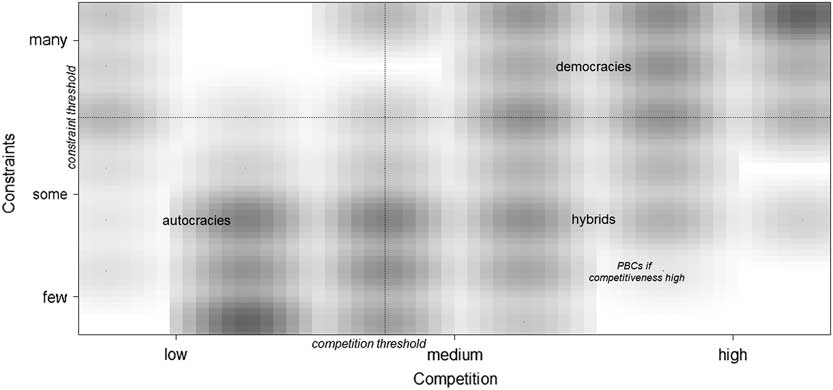
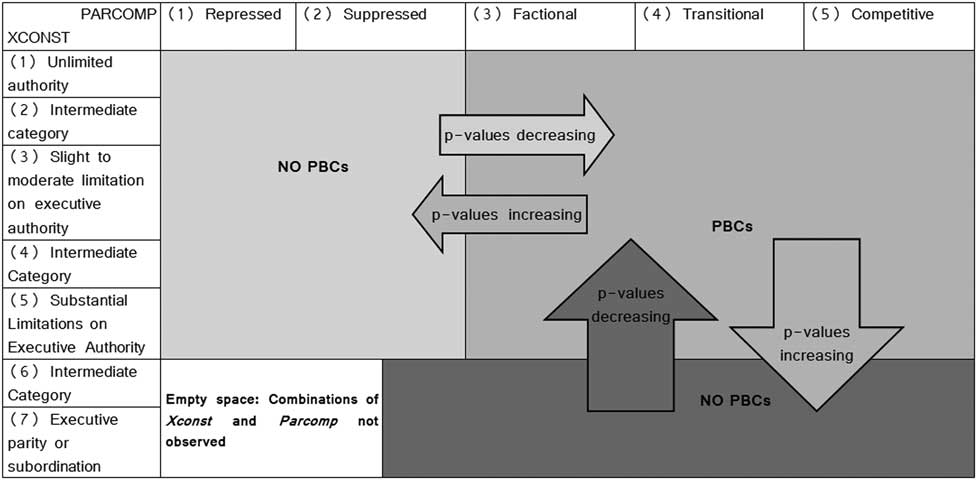
Figure 1 summarizes our argument and plots distribution of our data across the spectrum of executive constraints and political competition. Darker areas indicate more observations. The figure shows how PBCs vary theoretically along the diagonal axis from the upper left corner to the lower right: least likely in countries with low levels of political competition and many constraints on the executive, and most likely in countries with high levels of political competition and few constraints on the executive. Regimes, by contrast, tend to vary empirically along the diagonal axis from the lower left corner to the upper right: from full autocracies with low levels of political competition and few constraints on the executive, to full democracies with high levels of political competition and substantial constraints on the executive. The net result is that PBCs occur primarily in hybrid regimes, when incumbents fear losing elections.
Political budget cycles across regime types. The shaded areas represent the empirical distribution of regimes along the two dimensions; darker areas signify more observations. We use Parcomp to measure competition and Xconst to measure constraints. Both are taken from the Polity data set (Marshall et al., Reference Marshall, Jaggers and Gurr2011). The competition threshold is set at Parcomp=2; the constraint threshold at Xconst=5. The thresholds will be explained in greater detail later.

Empirical analysis
This section subjects our theoretical argument to empirical scrutiny, using time series cross-sectional analysis of spending data in 112 countries, from across the regime range, covering the period from 1960 to 2006.Footnote 16 The findings of our analysis support the argument that the occurrence and the size of PBCs depend on the specific combination of executive constraints, political competition, and electoral competitiveness. The section presents three key findings. First, we find evidence of important threshold effects with regard to constraints and competition, implying that above a maximal level of constraints and below a minimal level of competition PBCs do not occur. Second, we show that incumbents manipulate the budget as a function of electoral competitiveness. Third, given the empirical covariation between constraints and competition along the spectrum of political regimes, we provide evidence that PBCs are prevalent in hybrid regimes.
Dependent variable
To measure pre-electoral manipulation of the budget, we use Budget balance as our primary dependent variable.Footnote 17 Measured as a share of the country’s GDP, the variable is negative if the government runs a budget deficit and positive in the case of a surplus. In addition, we provide an alternative measure of PBCs, Government spending, to ascertain the robustness of our findings. The variable is measured on a per capita basis, using constant 2005 $US (PPP).Footnote 18 By using a per capita measure as opposed to GDP-weighted measures, we ensure that spending increases are not uniquely driven by variations in the denominator. Recent research has demonstrated that elections affect not only aggregate spending levels but also the disaggregate composition of spending (Vergne, Reference Vergne2009). While we acknowledge the importance of this body of research, it goes beyond the scope of this article to examine how democratization might affect budget allocations.
The underlying data for both measures are taken from two sources: (i) for OECD members, all data are provided by the organization’s statistical office (OECD, 2015); for non-OECD countries, we use a new data set on Global State Revenues and Expenditures (GSRE) (Lucas and Richter, Reference Lucas and Richter2016).Footnote 19 This data set is based on spending and revenue data from historical documents of the IMF, stored in the IMF’s archives in Washington, DC. It uses the annual reports of the IMF’s regional departments, which were made available to researchers in the early 2000s. These reports are usually available from the year of a country’s membership in the IMF, with the most recent documents being declassified after a period of 5 years.
It is important to note that the statistical data contained in the annual reports are collected independently of the IMF’s statistical department, which produces the widely used IMF Government Finance Statistics (GFS). This has both advantages and disadvantages. A disadvantage is that the different regional departments are likely to apply slightly different accounting standards, which might lead to distortions of the same measure across countries. While this is a valid concern for more fine-grained measures, such as specific types of taxes or functional expenditures, it is less of an issue for more aggregate indicators, such as the ones used herein. An advantage of using the annual reports is that the data are likely to be more valid than those provided by the GFS. The GFS is based on an annual survey sent out to member states, whereas data in the annual reports are collected by the country and subregional representative offices of the IMF and ‘negotiated’ with national authorities. It is not rare that this process leads to a revision of the figures when confronted with disagreement from the IMF experts.Footnote 20
Besides improved validity, the GSRE substantially increases the number of observations. While the GFS only starts in 1972, the GSRE data set goes further back in time, for some countries until the end of World War II. Considering our dependent variable, Budget balance, the GSRE contains 3932 country-year observations compared with only 2118 in the GFS. Furthermore, the GFS does currently not have one continuous time series from 1972 until present. Rather, due to changes in the IMF’s classification scheme, there are currently two time series running from 1972 to 2001 and from 1990 until present, respectively. The GSRE, by contrast, provides one continuous time series of comparable data. Taken together, the GSRE is not a mere extension of the GFS but represents an alternative data source to analyze public revenues and expenditures.Footnote 21
Explanatory variables I and II: constraints and competition
Concerning the measurement of constraints, we use the Polity indicator Xconst to capture the level of constraints weighing on the chief executive. According to the authors of the Polity IV data set, the variable ‘refers to the extent of institutionalized constraints on the decision-making powers of chief executives’ (Marshall et al., Reference Marshall, Jaggers and Gurr2011: 24). It thus adequately captures the degree to which incumbents are constrained in their ability to put into action the political decisions leading to PBCs. Each country is coded on a seven-point scale, ranging from (1) unlimited authority to (7) executive parity and subordination. The variable assumes an underlying continuum of different levels of political constraints imposed on the executive.
With regard to competition, we seek a measure that allows us to distinguish elections that, in principle, can be lost from those that are merely bogus. Hyde and Marinov (Reference Hyde and O’Mahony2012) propose a minimalist measure of competition which only takes into account characteristics of elections. Specifically, they consider elections competitive if opposition is allowed, more than one party is legal, and there is a choice of candidates on the ballot. Whilst we acknowledge that these are essential attributes of competitive elections, we doubt that these criteria alone guarantee meaningful political competition. Research on electoral authoritarianism (Diamond, Reference Diamond2002; Levitsky and Way, Reference Levitsky and Way2002; Schedler, Reference Schedler2002) has shown that incumbents have a panoply of measures at their disposal to efface electoral competition. More importantly, most of these instruments are not limited to elections themselves but happen outside the context of impending elections. Opposition parties can be banned shortly before elections or be subject to such political harassment that their chances of electoral success are crippled. Thus, even if elections are deemed competitive in a minimalist sense, in the absence of additional institutional safeguards that ensure the organization of political competition, incumbents can still be certain of winning.
We therefore combine two different indicators of political competition. First, our variable Election is based on Hyde and Marinov’s (Reference Hyde and O’Mahony2012) definition of competitive elections. Countries that have never had a competitive election as defined above are excluded from the analysis.Footnote 22 Since we expect PBCs to be particularly pronounced when elections determine the leadership of a country, we restrict our analysis to ‘politically important elections’; that is, elections where the chief executive’s office is at stake.Footnote 23 The election dummy variable equals 1 in an election year and 0 otherwise. However, we adjust the variable to be consistent with the fiscal year when spending data are reported for a fiscal year different than the calendar year. This adjustment is consistent with common practice in the literature (e.g. Block et al., Reference Block, Ferree and Singh2003; Brender and Drazen, Reference Brender and Drazen2005).
Second, we use the Polity indicator Parcomp to account for restrictions on political competition more broadly. The variable measures ‘the extent to which alternative preferences for policy and leadership can be pursued in the political arena’ (Marshall et al., Reference Marshall, Jaggers and Gurr2011: 26). Ranging from 1 (repressed) to 5 (competitive), the scale conceptualizes political competition as a continuum. For example, a Parcomp score of 1 (repressed) signifies that ‘no significant oppositional activity is permitted outside the ranks of the regime and ruling party’ (Marshall et al., Reference Marshall, Jaggers and Gurr2011: 26). A score of 2 (suppressed) indicates severe limitations of political participation and an exclusion of at least 20% of the adult population from participation. By contrast, polities reaching a Parcomp score of 5 (competitive) guarantee unconstrained and regular competition between political actors.Footnote 24
Explanatory variable III: competitiveness
To proxy competitiveness, we resort to the most commonly used indicator in the literature: win-margins. The variable has been widely used, particularly in the North American context, to study electoral turnout (Blais and Dobrzynska, Reference Blais and Dobrzynska1998; Southwell and Burchett, Reference Southwell and Burchett2000; Endersby et al., Reference Endersby, Galatas and Rackaway2008) and the characteristics of the party system (Holbrook and Tidmarch, Reference Holbrook and Tidmarch1993; Koetzle, Reference Koetzle1998; Trounstine, Reference Trounstine2006; Abramowitz et al., Reference Abramowitz, Alexander and Gunning2008). Capturing the closeness of elections, win-margins can be considered a reliable indicator of competitiveness of elections.
The variable Winmargin measures the incumbent’s win-margin, in percent, in the last elections. It ranges from 0 to 100, with lower values indicating higher levels of competitiveness. In the case of presidential elections, the margin consists of the difference between the winner’s vote share and the vote share of the runner-up.Footnote 25 As global data on vote shares in parliamentary elections are hard to come by, win-margins in parliamentary elections are calculated as the difference between the winning party’s (or party coalition’s) share of seats and the opposition’s share. We acknowledge that, depending on the type of electoral system, vote and seat shares can diverge considerably in parliamentary systems, which might distort our measurement. While there is no easy fix for this problem, seat shares eventually determine the balance of power in parliament and might thus be considered the preferable indicator of competitiveness. This being said, we also address this issue in our estimation strategy by running regressions with and without legislative elections.Footnote 26 Data on electoral results are taken from three main sources: the Election Results Archive (Center for Democratic Performance, 2012), Psephos (Carr, Reference Carr2013), and the World Bank (2013).
To take into account the heterogeneity of our sample, we make two adjustments to the Winmargin variable. First, we code Winmargin zero in the case of (a) first politically important and competitive elections after independence, and (b) founding elections after an autocratic interlude. In first and founding elections, we expect electoral confidence to be very low and thus insecurity to be at its maximum. This heightened insecurity stems from the unpredictable consequences of boosts in voter turnout, as voters are ‘stimulated to participate by an open contest’ (Bratton and Van de Walle, Reference Bratton and Van de Walle1997: 210) following an opening of the political system, and the absence of any real knowledge of voter preferences. We acknowledge that this is a strong assumption and therefore run robustness tests without these founding elections available in the Online Appendix. Second, following convention in PBC research (e.g. Efthyvoulou, Reference Efthyvoulou2011), we code Winmargin zero in any year without electoral competition as the level of competitiveness is not expected to affect spending outside election years.Footnote 27
Control variables
The regression includes a number of standard socioeconomic and political variables to control for the effect of potential confounders. Since wealthier countries might find it easier to run higher deficits prior to elections, we control for GDP p.c. (logged). In addition, variations in the economic cycle tend to affect the fiscal balance as years of strong economic growth entail higher revenues from taxes and vice versa. We thus include Growth as a control variable. Data for both variables are taken from the Penn World Tables (Heston et al., Reference Heston, Summers and Aten2006).
Varying levels of government revenues are also likely to influence PBCs: positively by providing incumbents with the financial resources to create PBC; negatively by signaling fiscal prudence and thus strengthening incumbents’ re-election prospects. We therefore include three variables that measure the level of available resources: Tax revenues/GDP, taken from the GSRE (Lucas and Richter, Reference Lucas and Richter2016) and the OECD (2015) respectively, accounts for the amount of direct and indirect taxes accrued to the government, weighted by the country’s GDP; Rents p.c. (logged) is taken from Haber and Menaldo (Reference Haber and Menaldo2011) and measures the government’s income from extractable resources, mostly oil, in logged constant 2007 $US per capita; Aid p.c. (logged), measured in constant 2008 $US per capita, captures the effect of foreign aid on the government’s distributive capacity and is based on data from the World Bank (2010).Footnote 28
The variable IMF indicates whether a country participated in an IMF program in a given country year. Since fiscal austerity has been a widespread corollary of IMF conditionality, IMF agreements are expected to limit a government’s ability to contract new debt and hike up the deficit (Hyde and O’Mahony, Reference Hyde and Marinov2010). We use an updated version of Dreher (Reference Dreher2006) to obtain the data. Likewise, the level of a country’s Debt service could negatively affect the government’s borrowing capacity and can thus impede the incumbent’s ability to manipulate the budget. The variable is measured as a share of the gross national income and taken from World Bank (2010) and OECD (2015) respectively. Finally, it might be the case that more experienced incumbents are more skillful in manipulating spending opportunistically (Aidt and Eterovic, Reference Aidt and Eterovic2011). We control for this possible Tenure effect by including a count variable of the number of years an incumbent has been in office, using the Archigos data set (Goemans et al., Reference Goemans, Gleditsch and Chiozza2009).Footnote 29
Estimation strategy and model
In view of our theoretical argument, we propose a subsample strategy to test the effect of executive constraints, political competition, and electoral competitiveness. The estimation strategy proceeds in three steps. First, we explore whether PBCs occur below a minimum level of competition. We choose a Parcomp level of 2 as a threshold for meaningful competition, excluding both repressed and suppressed competition. In doing so, we make sure that political opposition is not systematically repressed, candidates are not ruled off ballots, access to media is guaranteed, and at least 80% of the adult population are allowed political participation (Marshall et al., Reference Marshall, Jaggers and Gurr2011: 26–27). Second, we test whether PBCs occur above a maximal level of constraints on the executive. We propose a threshold between Xconst levels 5 and 6, meaning that we distinguish between cases of complete or nearly complete subordination of the executive and more limited levels of executive constraints. At Xconst levels of 5 and below, most requests for funds are approved by the legislature (Marshall et al., Reference Marshall, Jaggers and Gurr2011: 25), which gives the incumbent sufficient institutional leeway to hike up spending prior to elections. Third, we estimate the subsample in-between both thresholds (Parcomp > 2, Xconst < 6). Our theory predicts that PBCs should not occur in the first two subsamples, but occur in the latter conditional upon competitiveness.Footnote 30
To estimate our regression, we use the following standard model as suggested in the literature (e.g. Shi and Svensson, Reference Shi and Svensson2006):
 $$Y_{{it}} \,{\equals}\,\beta _{0} {\plus}\beta _{1} Y_{{it{\minus}1}} {\plus}\beta _{2} Election{\plus}\beta _{3} Election{\times}Winmargin{\plus}\beta _{4} X_{{it}} {\plus}N_{i} {\plus}T_{t} {\plus}{\epsilon}_{{it}} ,$$
where Y
it
represents the budget balance, β
0 a constant, Y
it−1 the one-period lag of the dependent variable, X
it
a vector of control variables, N
i
and T
t
are country and period fixed effects, and
 $${\epsilon}_{{it}} $$
the error term. A number of points should be noted. First, as the budget balance is characterized by high levels of inertia, we include the lag of the dependent variable to purge the regression of serial correlation.Footnote
31
Second, there are a number of possible country-specific confounders for which it is hard to control. For instance, the median voter’s preference for redistribution varies across countries, which might affect the incumbent’s propensity to engage in deficit spending. We therefore include country fixed effects to prevent this kind of omitted variable bias. Similarly, we add time fixed effects to control for periodical shocks in the panel.Footnote
32
Third, we use robust standard errors that adjust for within-country correlation to deal with the presence of heteroskedasticity in our panel.Footnote
33
The regression is estimated using ordinary least squares. We are aware that autoregressive models combined with country fixed effects make the parameter estimates potentially liable to bias (Nickell, Reference Nickell1981). However, given an average length of 23 years per time series, the bias becomes very small. Moreover, Beck and Katz (Reference Beck and Katz2011) have shown that alternative estimators actually perform worse in the presence of long time series. Finally, given that Winmargin is coded zero in years without elections, the variable drops out as a base term in the regression.Footnote 34
Main findings
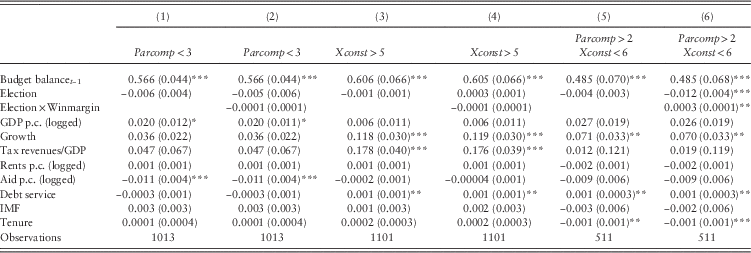
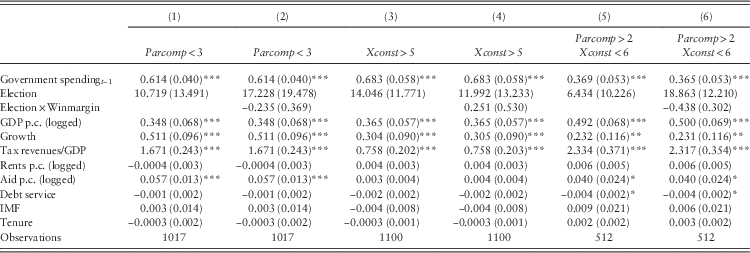
Table 1 presents our results using Budget balance as the dependent variable. Table 2 replicates the same set of regressions for Government spending. Models 1, 3, and 5 test the effect of elections without conditioning for competitiveness. In Models 2, 4, and 6, an interaction term between Winmargin and Election is added. Substantively, both tables provide support for our hypotheses about the link between executive constraints, political competition, and electoral competitiveness. Considering Models 1 and 2, it appears that PBCs do not occur below a minimal level of political competition. Wherever opposition faces outright repression or is suppressed by liberticide restrictions, incumbents seem to have little incentive to waste scarce resources on elections with a certain outcome. As competition is a precondition for competitiveness, the insignificant coefficient is as expected. We do not rule out the possibility that autocracies exhibit PBCs in disaggregate or subnational spending (Gao, Reference Gao2009; Blaydes and Kayser, Reference Blaydes and Kayser2011) but our analysis strongly suggests that they do not exhibit PBCs in aggregate spending. Models 3 and 4 show a similar picture with regard to the effect of constraints. Although the coefficients of Election have the right sign, they are both far from conventional levels of statistical significance. The results thus suggest that if the constraints on incumbents are too high, they are unable to manipulate the budget despite the presence of a strong incentive to do so. Given the insignificant coefficient of Winmargin, this even applies to cases where past elections have been very close, which in our view signal an increased risk of losing.
Political budget cycles in budget balance across different levels of competition and constraints

IMF=International Monetary Fund.
Autoregressive ordinary least squares model with country and year fixed effects. Robust standard errors in parentheses. Constant and fixed effects (FE) coefficients omitted from table.
*P<0.10, **P<0.05, ***P<0.01.
Political budget cycles in spending across different levels of competition and constraints

IMF=International Monetary Fund.
Autoregressive ordinary least squares model with country and year fixed effects. Robust standard errors in parentheses. Constant and fixed effects (FE) coefficients omitted from table.
*P<0.10, **P<0.05, ***P<0.01.
Turning to Models 5 and 6, the results suggest that PBCs indeed occur in political environments with limited constraints and meaningful competition, conditional on competitiveness. The results are weaker for Government spending with the Election and Election×Winmargin approaching but failing to achieve conventional levels of statistical significance (P=0.123 and P=0.148 respectively). That said, the overall pattern of a countervailing effect of competitiveness conditioning the effect of elections seems to be very similar. In Model 5, the election dummy is not significant, which means that there is no general pattern of PBCs regardless of competitiveness. Only if one takes into consideration the closeness of past elections, election years seem to be associated with significant spikes in spending and higher deficits. Consistent with our argument, Election and Winmargin have countervailing effects as shown by the opposite sign of the coefficients. When competitiveness is at its maximum, incumbents reduce their budget balance by 1.2 percentage points on average. Expressed in spending per capita, this amounts to 19 $US of additional government outlays. As past win-margins increase, however, the budget balance improves and the PBCs become weaker. At win-margins of 10%, for example, PBCs are reduced by about 25%, measured in terms of budget deficit, and 23 percent in terms of spending.
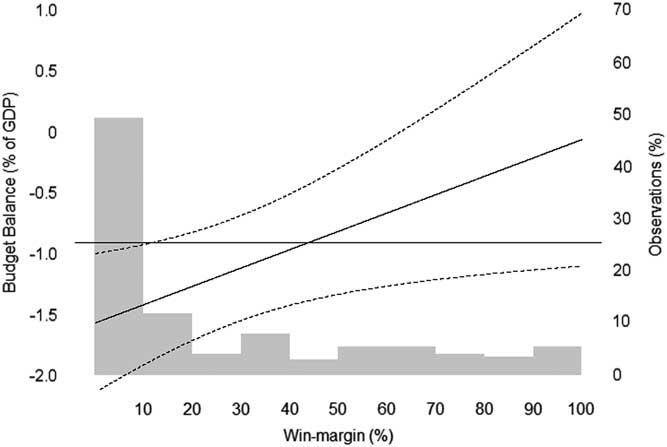
As mentioned, it has been suggested that PBCs are reversed when elections are uncompetitive (Block et al., Reference Block, Ferree and Singh2003). In our model, this would imply that PBCs should disappear below a certain level of competitiveness. The best way to explore this eventuality is by graphical illustration. Figure 2 displays the budget balance for varying win-margins, estimated for countries in the hybrid middle between the thresholds.Footnote 35 The solid line represents the average effect; the two dotted lines represent the 95% confidence bounds.Footnote 36 The graph also includes a histogram to illustrate the distribution of win-margins in our subsample.Footnote 37 Clearly, most elections are only won by a narrow margin. In other words, most incumbents are relatively insecure about their re-election and it is indeed these incumbents who manipulate spending before elections. In view of Figure 2, elections are associated with significantly greater budget deficits up to win-margins of 12%, while the size of the budget deficit shrinks as competitiveness increases. Moreover, above past win-margins of 12%, the upper confidence bound crosses the zero line, suggesting that incumbents might actually reduce their budget deficits in election years. For past win-margins above 45%, also the average effect becomes positive, whilst the lower confidence bound remains below the zero line. We draw two main conclusions from this. First, in view of the lower confidence bound, increasing win-margins, at least, reduce the size of the budget cycle. This effect should be observable nearly across the whole subsample. Second, if past win-margins exceed a certain threshold, we cannot be certain that PBCs actually occur.
Marginal effect of competitiveness on political budget cycles.

Robustness tests
Varying thresholds for competition and constraints
It is a common practice to test the robustness of empirical findings by varying the threshold of variables to see if the results still hold. This strategy hinges on the assumption that most thresholds in the social sciences are somewhat arbitrary. While we generally agree with the latter point, we propose a more refined strategy to test the sensitivity of our results to different thresholds of Parcomp and Xconst. In fact, as changing the thresholds re-arranges distinct polities into newly formed subsamples, we do not expect our results to remain exactly the same. Rather, we suggest that as we move the thresholds for the three subsamples in different directions, the pattern of change in the results will be informative for the theoretical argument we have made.
More specifically, we expect significance levels of Election and Election×Winmargin (a) to increase for the subsample of countries below the competition threshold, as we raise the threshold for competition (more countries with competitive political systems and the incentive to create PBCs are added to the subsample); (b) to increase for the subsample of countries above the constraints threshold, as we lower the threshold for constraints (more countries with fewer executive constraints and the ability to create PBCs are included); and (c) to decrease for the subsample in-between both thresholds when lowering the threshold for competition or raising the threshold of constraints (more countries with less competitive political systems and more executive constraints, and thus less incentive and ability to create PBCs, are added to the subsample). Moreover, in the case of (a) and (b), we expect the sign of Election×Winmargin to turn, as we start to see the expected counter-effect as win-margins increase.
Figure 3 summarizes our propositions graphically. As this strategy involves running a considerable number of regressions on different subsamples, we refer the reader to the Online Appendix for a detailed presentation of the results. To adumbrate the results, we indeed begin to see signs of PBCs in the subsample of non-competitive polities as we move the competition threshold upward, and in the subsample of heavily constrained polities as we move the constraint threshold downward. Conversely, PBCs become weaker for the subsample in-between both thresholds, when we raise the threshold for constraints or lower it for competition.
Expected effect of varying thresholds of competition and constraints. PBCs=political budget cycles.

Additional robustness tests
To ascertain the validity of our findings, we conduct a number of additional robustness tests, the results of which are detailed in the Online Appendix. In addition to raising and lowering the competition and executive constraints thresholds as outlined above, we run triple interaction models between Election, Winmargin, and Parcomp and Xconst respectively. The results confirm our findings from the subsample strategy in that PBCs are absent below a minimum level of competition and become more pronounced as competition increases; likewise, PBCs become less pronounced as constraints on the executive increase and disappear above a maximum level of constraints. These triple interaction models also suggest that there are no non-linear effects for Parcomp in our sample. Nonetheless, we run an additional robustness test in which we replicate our subsample strategy replacing Parcomp with an alternative indicator Party bans, taken from the V-Dem data set (Coppedge et al., Reference Coppedge, Gerring, Lindberg, Skaaning, Teorell, Altman, Bernhard, Fish, Glynn, Hicken, Knutsen, Marquardt, McMann, Mhi., Paxton, Pemstein, Staton, Tzelgov, Wang and Zimmerman2015). The substantive findings regarding competition remain unchanged.
Additional robustness tests also include rerunning our regressions with different model specifications. Using year or country fixed effects only, as well as running a pure random effects model does not substantively alter the results. In addition, we test the sensitivity of our findings to additional control variables, such as urbanization, trade, and the share of the dependent population. Data are taken from the World Bank (2010). If election dates are not fixed by law, incumbents have an incentive to call early elections if the economic cycle is propitious. We therefore add a variable for endogenous timing of elections, taken from Hyde (Reference Hyde2011), to control for this opportunity effect. As the incumbent’s ability to engage in PBCs might be hampered if she heads a minority government, we also add a dummy indicator for minority governments to the regression.
Another robustness check consists of taking out legislative elections as the measurement of win-margins based on the proportion of seats rather than votes can be problematic, particularly in the case of majoritarian systems. Similarly, we rerun our main model using the win-margin of first-round presidential elections in case there were two rounds. We further consider a continuous measure of win-margin where we carry the past win-margin forward until the year of the election. While the non-interacted coefficient of Winmargin does not have a significant effect, the interacted part remains significant. We also rerun our model without founding elections to make sure that the results are not driven by our specific coding choice of Winmargin in these elections. And, finally, we rerun our model excluding elections in which the change of win-margin is greater than 1 std. dev. (25%) as this might signify changes in the quality of democracy. To all of the above modifications, our substantive findings remain robust.
PBCs and regime type
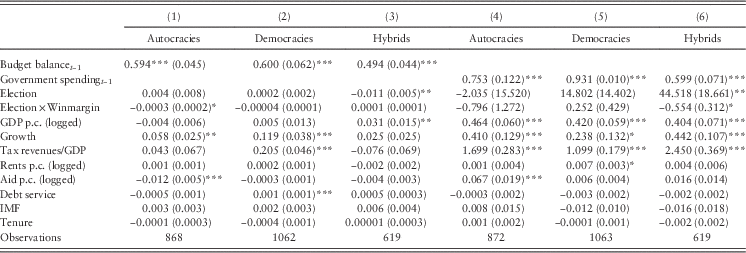
Given the empirical covariation between executive constraints and political competition along the spectrum of political regimes, our theoretical argument implies that PBCs should be found predominantly in the hybrid middle. Only in the ‘gray zone’, regularized, competitive elections are combined with limited constraints on the power of the executive (Cassani, Reference Cassani2014). The challenge, however, is to find a good measure of hybrid regimes. As Armony and Schamis (Reference Armony and Schamis2005) have pointed out, using measures that rely on ex post classification based on electoral results – most commonly a 75% threshold won by the ruling party (Diamond, Reference Diamond2002; Brownlee, Reference Brownlee2009) – to distinguish hegemonic authoritarian regimes from hybrids, whilst using ex ante criteria for democracies is inconsistent. Dichotomous measures of political regimes are unable to capture the atypical combination of competitive elections and few constraints prevalent in hybrid regimes. Howard and Roessler (Reference Howard and Roessler2006) and Blaydes and Kayser (Reference Blaydes and Kayser2011) use the Polity indicator to identify hybrid regimes, yet in our case this measure would be too closely correlated with our indicators of constraints and competition, given that Xconst and Parcomp are subcomponents of the Polity score. We therefore use the typology of Wahman et al. (Reference Wahman, Teorell and Hadenius2013) to distinguish between different regimes types.Footnote 38
Concretely, we take their multiparty authoritarian category as a proxy for hybrid regimes.Footnote 39 As Wahman et al. point out, ‘in these regimes, at least a minimal level of competition is allowed and some opposition candidates […] are allowed to participate in national elections’ (Reference Wahman, Teorell and Hadenius2013: Reference Diamond27). We further use their democracy dummy to identify fully democratic regimes and code all remaining, non-multiparty regimes as autocracies. We then estimate our base model in these three subsamples conditioning for competitiveness measured in win-margins. The results, displayed in Table 3, broadly support our argument. Neither in autocracies nor in democracies are there any signs of PBCs. The election dummy and its interaction with Winmargin are insignificant throughout. In columns 1 and 2, the signs of both coefficients are even reversed, suggesting that elections reduce the deficit rather than increase it. By contrast, there are strong indications for PBCs in hybrid regimes. The election dummy is highly significant and the sign of the interaction term indicates the expected counter-effect of electoral competitiveness. However, the conditioning effect of competitiveness seems to be weaker in hybrid regimes. The interaction terms in columns 3 and 6 show either no (P=0.35) or only weak significance. Most probably, this divergence from previous findings has to do with the fact that the category of multiparty authoritarian regimes includes a number of relatively uncompetitive cases. With this caveat attached, the overall argument empirically holds: PBCs predominantly occur in the hybrid middle.
Political budget cycles across different regime types

IMF=International Monetary Fund.
Autoregressive ordinary least squares model with country and year fixed effects. Robust standard errors in parentheses. Constant and fixed effects (FE) coefficients omitted from table.
*P<0.10, **P<0.05, ***P<0.01.
Conclusion
In this article, we have explored the effect of democratization on PBCs. Understood as a multi-dimensional process, democratization involves increasing executive constraints and the intensification of political competition, which affect PBCs differently. Moreover, we have shown that while unconstrained executive powers and intense political competition are necessary conditions, it is electoral competitiveness that triggers PBCs. If incumbents do not fear losing, they do not create PBCs. Finally, we have demonstrated that because of the empirical covariation between executive constraints and political competition, PBCs occur primarily in hybrid regimes. In full autocracies, there is no incentive to create PBCs; in advanced democracies, incumbents do not have the ability.
The article has contributed to the literature on PBCs in three ways. First, it has demonstrated that the observed effect of democratization processes on PBCs is non-linear: positive at the autocratic end of the regime spectrum, where PBCs are stimulated by rising levels of political competition and electoral uncertainty; negative at the democratic end, where they are contained by the growing numbers of executive constraints. This multi-dimensional approach to democratization critically enhances our understanding of the political economy dimension of democratic transitions. By the same token, the article has added to the growing body of political economy research that explores the effects of democratization on fiscal outcomes (Aidt and Eterovic, Reference Aidt and Eterovic2011; Eterovic and Eterovic, Reference Eterovic and Eterovic2012). Second, the article has pointed to a triggering effect of electoral competitiveness. This finding contributes to the debate on context-conditional PBCs (Alt and Rose, Reference Alt and Rose2009) by highlighting the importance of incentives in addition to abilities. Third, as the most comprehensive study of PBCs to date – using novel data and spanning the full spectrum of political regimes – the article has contributed to extending the debate on PBCs to a broader range of regimes, yielding insights for OECD and non-OECD countries alike.
As always, a number of questions remain unanswered. For example, it would be interesting to explore the effect of advancements in other democratic dimensions, most notably public participation (Dahl, Reference Dahl1971). How does voter turnout affect PBCs, and how are the cycles affected by different levels of civic engagement? If combined with our study, such work could provide a complete picture of the aggregate effect of democratization on PBCs. Moreover, a better understanding of how incumbents gauge their electoral prospects would give researchers a better handle on variations in PBCs. We have emphasized the importance of retrospective indicators of electoral prospects, but how incumbents view the odds of electoral defeat or victory may be highly dependent upon context, similar to PBCs themselves.
Acknowledgments
The authors would like to thank Nancy Bermeo, Nic Cheeseman, James Tilley, and two anonymous reviewers from EPSR for their valuable comments and suggestions. A special thanks goes to Thomas Richter for generously sharing his GSRE data set. All remaining errors and omissions are the authors’ own.
Supplementary Material
To view supplementary material for this article, please visit http://dx.doi.org/10.1017/S1755773916000205.