Introduction
The global average maternal mortality ratio (MMR) remains as high as 226 per 100,000 live births. The pace of MMR decline is still lower than the proposed annual decline of 5.5% needed to achieve the Millennium Development Goal of reducing the MMR by three-quarters by 2015 (WHO et al., 2012). Regional-level analysis of trends in MMR decline indicates differential progress across the regions. While South America and Asia have made substantial progress, progress has been slow in sub-Saharan Africa (Hogan et al., Reference Hogan, Foreman, Naghavi, Ahn, Wang and Makela2010; WHO et al., 2012). A decade and a half ago, three South Asian countries – India, Pakistan and Bangladesh – accounted for 46% of the world's maternal deaths (United Nations, 2008). However, a recent study conducted by Hogan and colleagues (Reference Hogan, Foreman, Naghavi, Ahn, Wang and Makela2010) documented that these three countries accounted for only 29% of all maternal deaths in 2008. This indicates a 17% decline in the contribution of these countries towards global maternal deaths. Many recent studies have documented the notable contribution of India towards the global decline in MMR, though the level of MMR in India is still high compared with those of other developing and developed countries (World Bank, 2009; Hogan et al., Reference Hogan, Foreman, Naghavi, Ahn, Wang and Makela2010; United Nations, 2010; WHO et al., 2012).
According to the latest Sample Registration System (SRS) report, the MMR in India is 212 per 100,000 live births, with the highest rate in the state of Assam (390 per 100,000 live births) and the lowest in the state of Kerala (81 per 100,000 live births). A comparison of the latest estimates with the year 1997–98 shows that, over a period of 10 years, India could avert 186 maternal deaths per 100,000 live births. Similarly, Assam and Kerala could avert 178 and 69 maternal deaths per 100,000 live births, respectively (RGI, 1997–2003, 2011). The findings of a study by Mukhopadhyay (Reference Mukhopadhyay2012) indicate that the decline in MMR is not uniform across states, even though the overall MMR in India is steadily declining. The Government of India launched the National Rural Health Mission (NRHM) in 2005 for the period 2005–2012, and recently extended it up to 2017, to bring about the necessary structural changes in the basic health care delivery system in India. The plan of action includes raising public expenditure on health, the pooling of resources, integration of organizational structures, optimization of health manpower, decentralization and district management of health programmes and community participation and ownership of assets. The mission is designed to achieve important demographic and health goals (Government of India, 2005). Some states have already achieved, or are about to achieve, the mission's goal of reducing MMR to 100 per 100,000 live births. Nonetheless, most of the Empowered Action Group (EAG) states (Bihar, Jharkhand, Uttar Pradesh, Uttarakhand, Madhya Pradesh, Chhattisgarh, Orissa and Rajasthan), which account for about 48% of the total population of the country, are the high-focus states in view of the fact that their relatively high fertility, high mortality and weak public health indicators are far from the NRHM targets (Government of India, 2005). Moreover, the estimates of MMR by the office of the Registrar General of India at two points in time (1997–1998 and 2007–2009) show a considerable decline in all the major states (RGI, 1997–2003, 2011). India still has to go a long way to achieve the target (to reduce MMR to 75 per 100,000 live births) set by the Millennium Development Goals (MDGs). However, a considerable decline in maternal mortality within a short time span generates curiosity to explore the factors contributing towards this decline.
Literature review of factors associated with MMR decline
Every two minutes a woman dies of pregnancy-related complications like severe bleeding after childbirth, infections, high blood pressure during pregnancy and unsafe abortions (WHO et al., 2012). The large number of maternal deaths can be averted if deliveries take place in health facilities and if deliveries at home are attended by skilled birth attendants and by improving the availability and quality of comprehensive emergency obstetric care. Progress in providing improved health care to pregnant women has resulted in these deaths being cut by half over the past two decades (World Bank, 2009; United Nations, 2010; WHO et al., 2012). Overall, the ‘decline in maternal mortality ratios – globally and in the South Asia – have largely been attributed to the success of safe motherhood initiatives’ (Jain, Reference Jain2011, p. 247). Several other studies suggest that economic growth, improvement in per capita income, education, age at marriage, Contraceptive Prevalence Rate (CPR) and decline in the Total Fertility Rate (TFR) have contributed substantially to the decline in MMR (Preston, Reference Preston and Easterlin1980; Trussell & Pebley, Reference Trussell and Pebley1984; Ronsmans et al., Reference Ronsmans and Graham2006; Campbell et al., Reference Campbell and Graham2006; Koblinsky et al., Reference Koblinsky, Matthews, Hussein, Mavalankar, Mridha and Anwar2006; Filippi et al., Reference Filippi, Ronsmans, Campbell, Graham, Mills and Borghi2006; Stover & Ross, Reference Stover and Ross2008; World Bank, 2009; Hogan et al., Reference Hogan, Foreman, Naghavi, Ahn, Wang and Makela2010; Jain, Reference Jain2011; WHO et al., 2012, Ahmed et al., Reference Ahmed, Li, Liu and Tsui2012).
In India, there have been only a few studies that have systematically examined the factors associated with the decline in maternal mortality ratio. However, there are studies that have examined the causes of maternal deaths and these can be classified into two categories: (1) those that emphasize medical causes of maternal mortality, and (2) those that highlight socioeconomic and demographic disadvantages as potential determinants of maternal mortality. Among the studies focusing on medical causes, that by Motashaw (Reference Motashaw1997) found that haemorrhage (26%) ranks first as the cause of maternal death, followed by sepsis (13%), toxaemia of pregnancy (12%), abortions (8%) and obstructed labour (6%), while other causes jointly contribute 35%. Another study by Iyengar et al. (Reference Iyengar, Iyengar, Suhalka and Dashora2009) found ‘direct and indirect obstetric causes are responsible for 58% and 29% of the deaths respectively; 12% are injury-related deaths’. These studies argue and vouch for intensive implementation of safer motherhood programmes for reducing the incidence of maternal mortality. Consequently, after the launch of NRHM, there has been a huge rise in health spending for family welfare and safe motherhood programmes. The large-scale increase in financial outlays under the Janani Suraksha Yojana (JSY) scheme, which aims at reducing the overall maternal mortality ratio and infant mortality rate by increasing institutional deliveries for ‘below poverty line’ families, is assumed to be the major step towards maternal mortality reduction in India (Government of India, 2005; Srinivasan et al., Reference Srinivasan, Chander and Arokiasamy2007; Jain, Reference Jain2010).
Among the studies mainly focusing on socioeconomic and demographic factors, a study by Radkar & Parasuraman (Reference Radkar and Parasuraman2007) pointed out that maternal mortality is high when fertility is high and declines with a decline in fertility rate. Goldie et al. (Reference Goldie, Sweet, Carvalho, Natchu and Hu2010), based on cost-effective analyses, estimated that more than 150,000 maternal deaths can be averted by increasing the supply of contraception, adhering to women's needs for spacing and limiting births, over a period of five years. A similar study recently conducted by Jain (Reference Jain2011) revealed that ‘fertility decline has made a substantial contribution to the reduction of maternal deaths in India’. This study generates an interest to examine what factors, other than institutional delivery, are associated with the decline in the maternal mortality ratio in India. While previous studies have exclusively focused on the contribution of birth control methods and fertility decline to the maternal mortality ratio decline, policymakers may be interested in knowing the contribution of many other important factors such as improvement in education, economic status and family welfare expenditure to the decline in MMR.
In India, it cannot be assumed that increasing institutional deliveries will have a premeditated effect on maternal survival. Substantial proportions of women in India do not receive full antenatal care services and they only seek help from health facility when home delivery become complicated. Many of these emergency delivery cases are unable to reach a health facility in time and even if they do, getting doctor's service immediately is also difficult due to the fixed timings of doctors in public health facilities (Bang, et al., Reference Bang, Bang, Baitule, Reddy and Deshmukh1999; Kesterton et al., Reference Kesterton, Cleland, Sloggett and Ronsmans2010). Further, the MMR decline in India assumes importance because less than 58% of births take place in health facilities and 72% of women still believe that medical attention is not necessary during childbirth (IIPS & Macro International, 2007). In the prevailing situation, it can be misconstrued that institutional deliveries are solely responsible for the decline in MMR. Moreover, there is no concrete evidence that the rise in family welfare expenditure (especially after NRHM and JSY) was responsible for bringing down the maternal mortality ratio in India. Many studies have assessed the impact of JSY on institutional deliveries but not on maternal deaths (Kesterton et al., Reference Kesterton, Cleland, Sloggett and Ronsmans2010; Lahariya, Reference Lahariya2011). Lim et al. (Reference Lim, Lalit, Hoisington, James, Hogan and Gakidou2010) attempted to link JSY and maternal deaths but could not detect a significant effect of JSY on the number of maternal deaths in district-level analysis. A study by Kesterton et al. (Reference Kesterton, Cleland, Sloggett and Ronsmans2010) revealed that ‘greater availability of obstetric services alone will not solve the problem of low institutional deliveries and maternal deaths’. This is particularly true for the use of private-for-profit institutions in which the distance to services does not have a significant adjusted effect in the context of rural India. Therefore, understanding the relative effect of different factors that are associated with maternal deaths is important in the formulation of policies and programmes to reduce maternal deaths. To this end, this paper considers various potential factors affecting maternal mortality and tries to examine the relative contribution of each of the factors to the decline in MMR. Furthermore, the analysis investigates whether the decline in overall maternal mortality in India is a result of the decline in MMR in all the major states or in just a few advanced states.
Methods
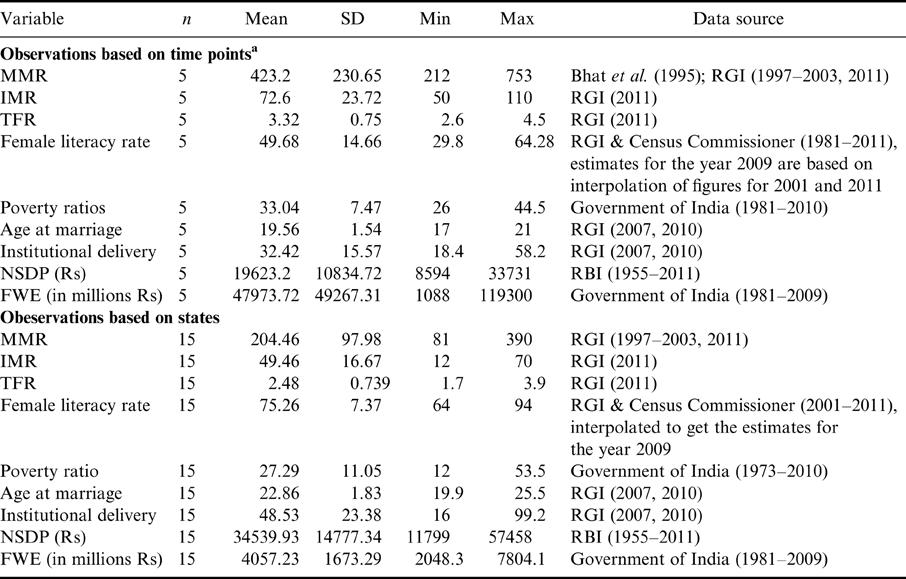
The study used data from multiple sources: the SRS of the Office of Registrar General of India (RGI, 1997–2003, 2007, 2010, 2011), the Census of India (1981–2009), Family Welfare Statistics (Government of India, 1981–2009) and the RBI (1955–2009). The sample of time series data indicates five points of time. However, the sample size of the cross-sectional data for the year 2009 is from fifteen major states of India. The SRS is used to obtain data on maternal mortality ratio, infant mortality rate, total fertility rate, age at marriage and institutional delivery. The MMR estimates prior to 1997 are obtained from indirect estimates from Bhat et al. (Reference Bhat, Navaneetham and Rajan1995). The SRS is a principal source for fertility and mortality data since 1969–70 and the largest demographic survey in the country. It is designed to provide reliable estimates of fertility and mortality indicators at the national and state level separately for rural and the urban areas. The revision of the SRS sampling frame is undertaken every 10 years based on the results of the latest census. For all the years, the sample design and size are prepared in such a way that the outcomes based on SRS data are comparable over time (for details on sampling see RGI, 1997–2003, 2011). The Census of India (1981–2011) data are used in this study for the female literacy rate (RGI & Census Commissioner, 1981–2011), and the poverty ratios are based on the Planning Commission estimates, 1973–2010 (Government of India, 1973–2010). The RBI is the principal source of estimates of economic indicators as well as documents on national income accounts and state income accounts in India. The per capita State National Domestic Product (NSDP) provided by RBI (1981–2009) is used for this study. The state-level expenditure on the family welfare programme is obtained from the Ministry of Health and Family Welfare, Government of India (1981–2009). The data sources corresponding to each variable and their descriptive statistics are presented in Appendix Table A1.
Variables
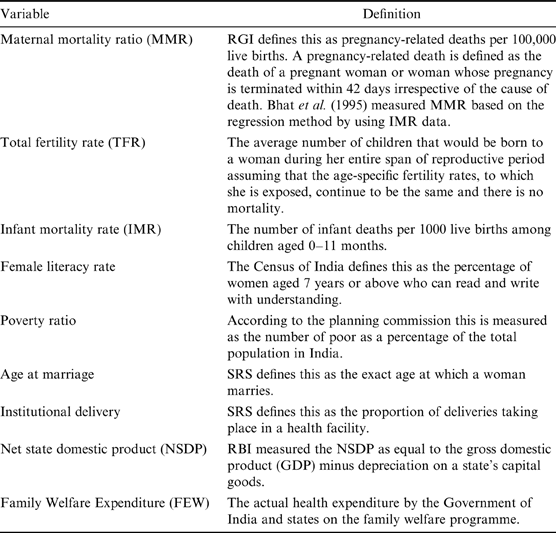
The outcome variable is the maternal mortality ratio and the predictor variables are incidence of infant mortality rate (IMR), TFR, age at marriage, proportion of institutional deliveries, female literacy rate, poverty ratios, per capita NSDP and government spending on the family welfare programme. The variables used in the study are of two types: (1) time series data on selected indicators at different time points at the national level; (2) cross-sectional panel (2001 and 2009) data of selected indicators for the major states of India. The definitions for the variables used in the study are presented in Table 1.
Definitions of study variables

Statistical analyses
This study used time series and cross-sectional analyses to find out the factors associated with the maternal mortality decline in India. The analyses are carried out in three stages. Firstly, the time series and cross-sectional associations between MMR and its selected explanatory variables are examined through simple pairwise correlation and the scatter matrix plot respectively. In the second stage, Ordinary Least Square (OLS) regression is used to understand the adjusted and relative effect of current (2009) values of explanatory variables on current values of MMR. Finally, the conditional Barro-regression model is used to understand the factors associated with the decline in MMR in terms of the relative effect of initial (2001) values of explanatory variables on the change in MMR during 2001–2009.
The Barro-regression model
Typically, the Barro-regression measure is used to disentangle the effects of different factors on the change in MMR. The Barro-regression model is a concept that originated from the work of Barro & Sala-i-Martin (Reference Barro and Sala-i-Martin1995). This model adopts a regression procedure in which the dependent variable is the change in maternal mortality ratio between two points in time (2001 and 2009) and the independent variables are the values at the initial time point (2001). The mathematical equation for this model is as follows:
 $$\ln \left [ {Y_{i, \ t+k} \over Y_{i,t} } \right ] = \alpha + \beta. \ \ln (Y_{,i.t}Y_{1,i.t}Y_{2,i.t}) + \epsilon_{it}$$
where  $\ln\left [ {Y_{i, \ t+k} \over Y_{i,t} } \right$ is the mean annualized decline in MMR, Yi,t is the value in the initial MMR at time t in state i and εit values are the corresponding residuals. Similarly, Yi is the predictor 1 in state i in period t and Y 2 is the predictor 2 in the state i in period t.
However, this study has a few limitations, particularly regarding the data sources used. First, in India, direct estimates of MMR (calculated based on pregnancy-related deaths) are available only from SRS since 1997 (RGI, 1997–2003, 2011). However, the MMR estimates prior to 1997 were calculated indirectly by Bhat et al. (Reference Bhat, Navaneetham and Rajan1995) based on IMR data by using a regression method. Second, although Barro-regression estimates would have yielded better results on long-term time series data of MMR, we avoided attempting to run this model on indirect estimates of MMR. The Barro-regression model is estimated on the data from the recent decade, 2001–2011. Therefore, the use of indirect estimates of MMR is limited to only graphical presentation of time series association between MMR and its predictors.
Results
Times series and cross-sectional association of MMR and explanatory factors
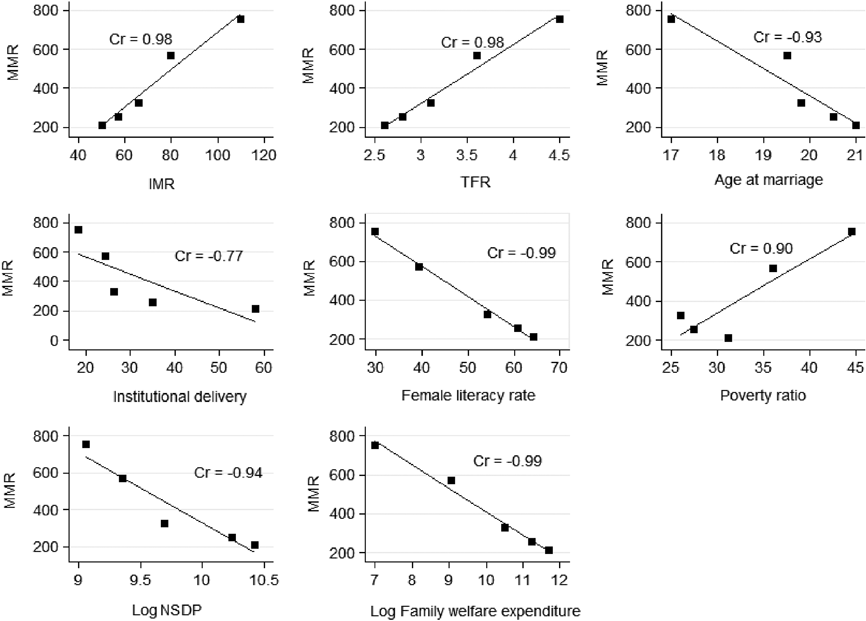
Figure 1 presents the time series linear relationship between MMR and its selected programme, socioeconomic and demographic factors during 1981–2009. The results reveal that among the selected explanatory factors, the improvement in female literacy and increase in government spending on family welfare programmes are the two major factors that show the strongest negative correlation (Cr=−0.99) with MMR. This indicates that the improvement in female literacy and government spending on the family welfare programme played major roles in bringing down India's MMR. Other factors such as the decline in TFR, IMR and poverty, and increase in per capita NSDP and mean age at marriage, show strong correlations with the decline in MMR. Surprisingly, the negative correlation (Cr=−0.77) between institutional deliveries and MMR is weak compared with other explanatory factors of MMR included in this analysis.
Time series linear relationship between MMR and its selected demographic and socioeconomic correlates, India, 1981–2009. Observations are based on time points 1981, 1991, 2001–2003, 2004–2006 and 2007–2009. Cr, correlation value.
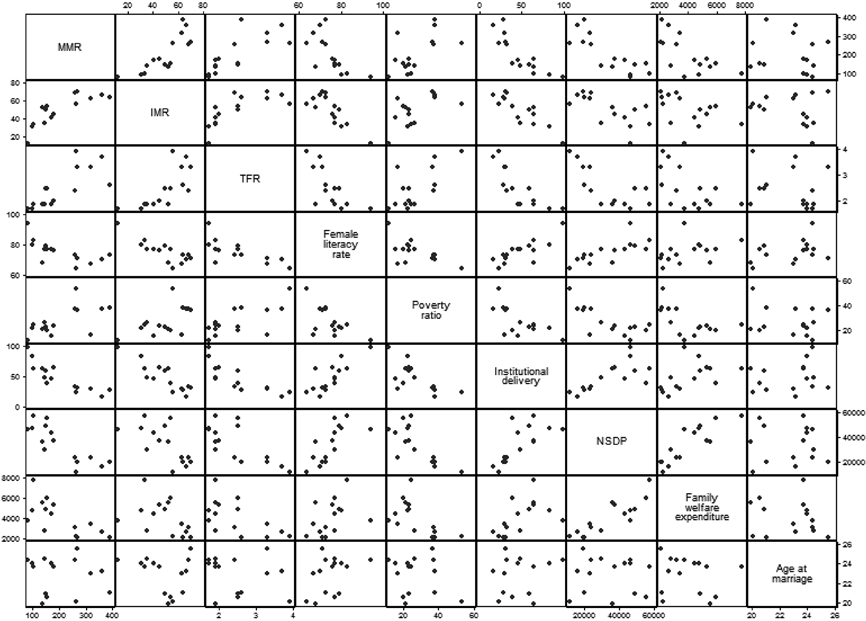
The scatter plots in Fig. 2 show the cross-sectional association and correlation matrix of nine selected indicators across fifteen states for the year 2009. The cross-sectional relationship between the MMR and its eight selected explanatory variables shows that the IMR, TFR and poverty ratio show a positive association with MMR, meaning the decline in IMR, TFR and poverty will contribute positively towards the decline in MMR in India. Similarly, female literacy rate, mean age at marriage, family welfare expenditure, and per capita NSDP show a negative relationship, which indicates that the increases in these factors will decrease the MMR levels in India.The correlation matrix assessment reveals that there is some collinearity between selected explanatory variables such as literacy rate and institutional delivery, per capita NSDP and family welfare expenditure, but the volume of correlation is high. Therefore, in the following sections the relative effects of all explanatory factors on MMR are estimated.
Scatter matrix plot: cross-sectional relationship between MMR and selected predictors, 2009. The sample consists of fifteen Indian states.
Relative effects of explanatory factors on current MMR
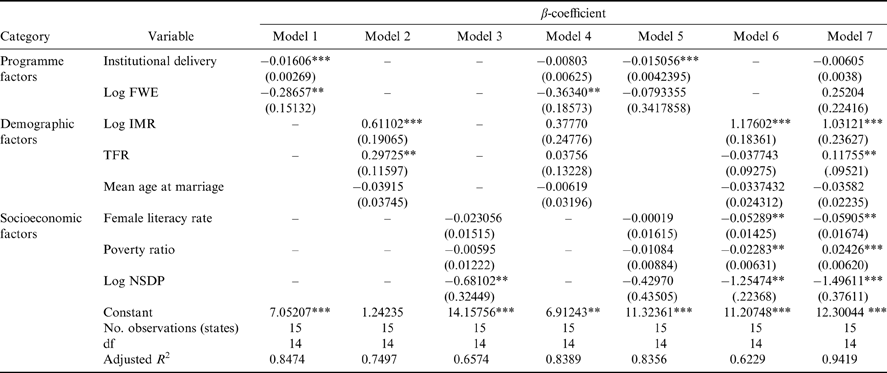
Table 2 presents seven OLS regression models that estimate the effects of the programme, demographic and socioeconomic factors on the decline in maternal mortality ratio in India. Model 1 shows the regression estimates by selected key programme factors such as institutional delivery and family welfare expenditure. The results of Model 1 reveal that institutional delivery and family welfare expenditure have a strong negative association (β=−0.01606, p<0.05, and β=−0.28657, p<0.10, respectively) with MMR. This indicates that an increase in institutional delivery and more spending on the family welfare programme reduce the chance of maternal deaths. The second model presents the regression estimates by selected key demographic factors such as IMR, TFR and mean age at marriage. The results show that the three demographic variables are positively associated with MMR; however, the association with IMR (β=0.61102, p<0.05) is much greater than that with TFR (β=0.29725, p<0.10) and mean age at marriage (β=−0.03745). Model 3 shows OLS regression estimates for MMR by the three key socioeconomic factors per capita NSDP, female literacy and poverty. The results reveal that only the relative effect of per capita NSDP (β=−0.68102, p<0.05) has greater and statistically significant association as compared with poverty ratios (β=−0.00595) and female literacy rate (β=−0.023056) with MMR.
Ordinary least squares (OLS) regression estimatesa: effects of programme, demographic and socioeconomic factors on maternal mortality ratio and selected predictors, India, 2009
a Dependent log of 2009 MMR.
Note: heteroskedasticiy-consistant standard errors are reported in parentheses; –, not considered.
***p<0.05; **p<0.10.
However, OLS regression Model 7 takes into consideration the demographic, socioeconomic and programme factors together, and the results reveal that the socioeconomic factors per capita NSDP (β=−1.49611, p<0.05), poverty ratio (β=0.02426, p<0.05) and literacy rate (β=0.05905, p<0.10) and the demographic factors IMR (β=1.03121, p<0.05) and TFR (β=0.11755, p<0.10) were significant explanatory factors associated with the decline in MMR in India. It is observed that despite the programme factors showing a strong and statistically significant association with MMR decline in regression Model 1, the effect of the programme factors becomes insignificant when demographic, socioeconomic and programme factors are considered. This means that the relative effects of institutional deliveries and family welfare expenditure on the decline in MMR become insignificant when the socioeconomic and demographic factors are considered in the model. The overall assessment of the relative effects of selected factors on MMR reveals that socioeconomic and demographic factors emerged as more critical explanatory factors of MMR decline than the programme factors. All seven OLS regression models show that adjusted R 2 varies between 60 and 90, which indicates that the models are statistically the best fit.
Relative effects of explanatory factors on change in MMR
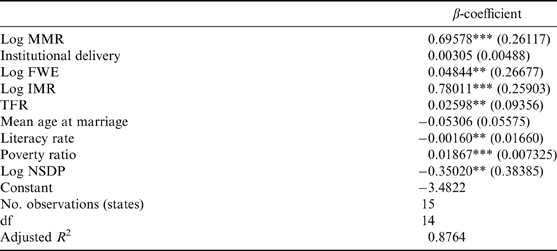
The factors associated with maternal mortality decline during 2001–2009 are assessed using a conditional Barro-regression model. This model regresses the initial levels of MMR and eight selected factors by the change in MMR levels during 2001–2009 (Table 3). The results show that the per capita NSDP (β=−0.35020, p<0.10), IMR (β=0.78011, p<0.05), TFR (β=0.25903, p<0.10), reduction in poverty (β=0.01867, p<0.05) and family welfare expenditure (β=0.04844, p<0.10) emerged as the significant factors associated with the decline in MMR in India. Family welfare expenditure shows weak and insignificant association with current MMR levels in the OLS models (Table 3); however, in this model, these indicators have a strong and significant association with change in MMR during 2001–2009. This indicates that the impact of family welfare expenditure is evident over a period of time rather than the current period. Another important outcome of this model is the negative β-coefficient of initial MMR (β=−0.69578, p<0.05) on the change in MMR during 2001–2009. The results suggest two plausible inferences: either the interstate gap in MMR is narrowing over this period of time, or the MMR of the demographically laggard states is converging towards the MMR of the demographically advanced states. Overall, the result of the Barro-regression show that access to safe delivery services does not have a significant association with change in MMR during 2001–2009. This is a clear indication that socioeconomic and demographic factors play a greater role in reducing MMR than institutional deliveries in India.
Conditional β convergence estimatesa based on a Barro-regression model for maternal mortality ratio across the major states of India, 2001–2009
a Dependent log of change in MMR during 2001–2009.
Note: heteroskedasticiy-consistant standard errors are reported in parentheses.
***p<0.05; **p<0.10.
Discussion
This study attempted to understand the factors affecting the decline in maternal mortality ratio in India. The results of the time series scatter plots and correlation estimates suggest that improvement in female literacy, increased financial outlays towards the family welfare programme, and reduction in IMR, TFR and poverty ratios are strongly associated with the maternal mortality decline. However, the adjusted or relative effects estimated by the OLS regression analyses suggest that growth of per capita NSDP, reduction in poverty ratio (economic factors), the increase in the female literacy rate (social factor), reduction of IMR and TFR (demographic factors) are statistically significant factors in the decline of maternal mortality ratio in India. Even though, in the absence of socioeconomic and demographic factors, programme factors (institutional delivery and family welfare expenditure) show a significant association, after controlling the socioeconomic and demographic factors the effects of these factors become insignificant. This finding contradicts the popular belief that the maternal mortality decline in India is largely driven by improved institutional deliveries.
Further, the Barro-regression results clearly suggest that economic development, fertility decline, increase in female literacy rates and increase in family welfare expenditure are the principal factors associated with the decline in maternal mortality ratio in India over a period of time. This suggests that mother's survival in India is significantly affected by socioeconomic development. The IMR and MMR are closely associated since the factors explaining these two indicators are the same and decline in one will definitely lead to a corresponding decline in the other. The Barro-regression results also suggest that the decline in MMR across the fifteen major states of India is also converging. This convergence is largely driven by the reduction in the incidence of maternal mortality in socioeconomically and demographically backward states.
Overall, this study indicates that the decline in MMR in India has largely been driven by socioeconomic development and demographic advancement at the state level. The weak association between institutional deliveries and MMR is an important issue that needs to be seriously looked at by policymakers and programme managers. Many earlier studies (Kesterton et al., Reference Kesterton, Cleland, Sloggett and Ronsmans2010; Lahariya, Reference Lahariya2011; Gopichandran & Chetlapalli, Reference Gopichandran and Chetlapalli2012) have reported that after the launch of NRHM and JSY, there was an increase in institutional deliveries. However, the office of the RGI (2010) reports that the level of overall institutional deliveries is still low (58% by 2009). Moreover, it is still not known how many of these deliveries are precautionary, prepared deliveries and emergency cases. An institutional delivery with emergency conditions is always a threat to a mother's survival. Thus, it indicates that a mere increase in institutional deliveries will not guarantee a mother's survival. This could be one reason why Lim et al. (Reference Lim, Lalit, Hoisington, James, Hogan and Gakidou2010) failed to find a significant effect of JSY on the incidence of maternal deaths. In addition, the study by Gopichandran & Chetlapalli (Reference Gopichandran and Chetlapalli2012) states that ‘the public health system is not fully geared up for delivering good quality maternal health services’.
Another important outcome that needs the utmost attention is the strong association between economic factors and the maternal mortality decline. Economic factors play a vital role, mainly because deliveries in private health facilities cost much more than those in government health facilities, and a greater proportion of deliveries in India are taking place in private health facilities due to the poor quality of care in government health facilities (Goldie et al., Reference Goldie, Sweet, Carvalho, Natchu and Hu2010; Gopichandran & Chetlapalli, Reference Gopichandran and Chetlapalli2012). Higher economic status ensures more health care purchasing power and greater access to health care. Moreover, improved socioeconomic status allows couples to avoid unwanted pregnancies and minimize their family size by the effective use of contraceptives. Pregnant women with better socioeconomic status are able to eat more nutritious food and make preparations for safe birth delivery. Nevertheless, fertility decline also plays a critical role in reducing the number of pregnancies, thus lessening exposure to the risk of pregnancy, and thus death. The increase in female literacy has made women more knowledgeable about pregnancy care and health care utilization, which has reduced the risk of death.
Overall, the findings of this study show that multiple sets of factors such as affordability, accessibility, knowledge and the number of times a mother is exposed to the risk of pregnancy are associated with mother's survival in India. Therefore, institutional deliveries alone cannot be solely instrumental in reducing maternal mortality. A synergy driven by other enabling factors such as the reduction in poverty and fertility and an increase in the per capita NSDP are important explanatory factors for maternal mortality reduction in India. It is true that the decline in MMR in India is encouraging news, yet it is far from achieving MDG-5. Likewise, the inter-country comparisons of MMR show that India's MMR is on the higher side and far worse than that of many developing and developed countries. Therefore, India needs to make more rigorous efforts to reduce the maternal mortality ratio. The ongoing health programmes such as NRHM and JSY should focus not only on increasing institutional deliveries through cash incentives after delivery but should also focus seriously on birth preparedness among women right from the initiation of pregnancy.
Descriptive statistics of maternal mortality ratio and its demographic and socioeconomic correlates