1. INTRODUCTION
The increasing use of high-power laser beams (HGLBs) in various applications has aroused worldwide interest in laser–plasma interaction in the nonlinear regime. The development of laser physics is closely associated with research in laser fusion and particle acceleration (Bingham, Reference Bingham2006; Mora, Reference Mora2009). In this direction, there has been a great deal of experimental activity devoted to cross-focusing (Purohit et al., Reference Purohit, Chauhan and Pandey2005; Singh et al., Reference Singh, Singh and Sharma2013) of two laser beams in under dense plasma. In beat wave technique of acceleration (Esarey et al., Reference Esarey, Ting and Sprangle1988; Kalmykov et al., Reference Kalmykov, Yi and Shvets2009; Rawat et al., Reference Rawat, Singh, Sharma and Purohit2014) of particles, two laser beams simultaneously propagate in the plasma. In case of simultaneous propagation, the behavior of one laser beam is affected by the presence of another laser beam, and one can control the focusing/defocusing of laser beams by choosing the parameters of another beam. This behavior is known as cross-focusing of the laser beams in the plasmas. Kalmykov et al. (Reference Kalmykov, Yi and Shvets2009) have discussed the nonlinear focusing of laser beams using the relativistic nonlinearity. It is established in this work that focusing can be controlled by varying the difference frequency.
During the propagation of laser beam in the plasma different types of nonlinearities are set up at different time scales depending upon the laser pulse duration, ion plasma period, and electron plasma period. Most of the studies related to cross-focusing of two beams are limited to the cases where the electron nonlinearity due to ponderomotive force or relativistic mass variation is accounted. But in many situations the laser can create nonlinearities according to the inequalities (a) τ < τpe or (b) τpe < τ < τpi; hence one can have different time regimes. Here, τ is the laser pulse duration,τpi is the ion plasma period, and τpe is the electron plasma period. In case (a) τ < τpe, the relativistic nonlinearity (Hora, Reference Hora1970; Brandi et al., Reference Brandi, Manus and Mainfray1993b) is set up almost instantaneously. In case (b), the relativistic–ponderomotive nonlinearity is operative (Brandi et al., Reference Brandi, Manus, Mainfray and Lehner1993a; Iwata & Kishimoto, Reference Iwata and Kishimoto2014); in this case the nonlinearity in the dielectric constant of the plasma comes by electron mass variation due to laser intensities, and due to change in electron density as the electrons are expelled from the high-intensity region on account of ponderomotive force. Brandi et al. (Reference Brandi, Manus, Mainfray and Lehner1993a) have presented the two-parameter perturbative approach, independent of the laser intensity to deal with the problem of the relativistic–ponderomotive self-focusing of a very intense laser beam by an under dense cold plasma. Thus, motivated by Brandi et al. (Reference Brandi, Manus, Mainfray and Lehner1993a) in the present work the relativistic–ponderomotive effects are shown to govern the simultaneous propagation of two HGLBs. The propagations of higher-order modes of HGLB are also compared for the only relativistic and relativistic–ponderomotive cases.
Recently, optical beams having zero central intensity have gained much attention due to their growing use in atomic optics. Along with various techniques for trapping single atom or atom clouds, there are techniques proposed for trapping and handling atoms using a highly focused laser beam (Gerdova et al., Reference Gerdova, Zhang and Hache2006) based on the principle of resonance radiation pressure forces. In this direction, a capable method (Gerdova et al., Reference Gerdova, Zhang and Hache2006) for manipulation of atoms is proposed using optically tunable hollow Gaussian beams (HGBs) generated when Gaussian beam is reflected off metal films. It is demonstrated theoretically and experimentally that the atoms can be guided and trapped using dipole potentials of hollow beams (Ovchinnikov et al., Reference Ovchinnikov, Manek and Grimm1997; Xu et al., Reference Xu, Wang and Jhe2000; Yin et al., Reference Yin, Gao, Wang, Long and Wang2002). As far as the study of focusing of dark hollow beams is concerned its applications in atmospheric propagation cannot be ignored. Recently, the focusing of Gaussian beams with zero central intensity is studied in atmospheric environments (Sharma et al., Reference Sharma, Sodha, Misra and Misra2013) and it was claimed that the divergence of HGB is less relative to Gaussian beams during the propagation. Therefore, HGB may be used for efficient energy transport at faraway distances in atmosphere.
In a variety of experimental and theoretical modeling, the fundamental TEM00 mode is used owing to its definite features with a simple Gaussian profile. But in the last few decades, the research work reported using different profile is enhanced (Patil et al., Reference Patil, Takale, Navare and Dongare2010) and various intensity distributions have been taken in the laser–plasma interaction studies. The investigations related to propagation and focusing of HGLB have received much attention theoretically as well as experimentally due to its scope in wide area of science and technology as mentioned above. Cai et al. (Reference Cai, Lu and Lin2003) have studied the HGB and their propagation properties. Propagation of HGBs through a perturbed paraxial optical system has been investigated by Cai & He (Reference Cai and He2006). Focusing of dark hollow Gaussian electromagnetic beams in a plasma has been studied by Sodha et al. (Reference Sodha, Misra and Misra2009a). Focusing of a dark hollow Gaussian electromagnetic beam in a magnetoplasma has been discussed by Sodha et al. (Reference Sodha, Misra and Misra2009b). Sharma & Singh (Reference Sharma and Singh2013a) have studied the stimulated Raman scattering of HGBs and Singh & Sharma (Reference Singh and Sharma2013) have studied the stimulated Brillion scattering of HGBs. Cross-focusing of HGLBs has been studied considering relativistic nonlinearity by Gupta et al. (Reference Gupta, Sharma, Rafat and Sharma2011). This work is done considering relativistic nonlinearity and ignoring the nonlinearity due to ponderomotive force. Relativistic–ponderomotive effects on evolution of dark hollow Gaussian electromagnetic beams in a plasma have been investigated by Gill et al. (Reference Gill, Mahajan and Kaur2010) in which they investigate the self-focusing of a laser beam due to relativistic-ponderomotive nonlinearity considering the variational approach.
Motivated by the aforementioned studies and the importance of the relativistic-ponderomotive nonlinearity in the problems of laser beam propagation through the plasma, the cross-focusing of two HGLBs is studied with the relativistic–ponderomotive effect in the present study. This study is an extension of the work done by Gupta et al. (Reference Gupta, Sharma, Rafat and Sharma2011) and it is important to mention that in the study of Gupta et al. (Reference Gupta, Sharma, Rafat and Sharma2011) they have not presented the expression for the modified dielectric constant due to relativistic effects. In the present work, we will put forward the focusing behavior of one HGB in the presence of another HGB in the plasma. To highlight the cross-focusing, the beam width parameter has been studied with the dimensionless distance. In Section 2, the cross-focusing of the HGLBs has been discussed using the eikonal method with evaluation of effective dielectric constant of the plasmas in the presence of two laser beams, when relativistic-ponderomotive nonlinearity is operative. A discussion of results is presented in Section 3. The conclusions of results are given in the last section.
2. CROSS-FOCUSING OF TWO HGLBS AND EFFECTIVE DIELECTRIC CONSTANT OF PLASMA
In this communication, we have considered the propagation of two coaxial HGLBs of frequencies ω1 and ω2. The irradiance distribution (z = 0) of the incident beams with respect to a cylindrical coordinate system are
 $${{\bf E}_{\rm 1}}{\bf E}_{\rm 1}^{\ast} \left \vert {_{z = 0}} \right. = E_{01}^2 {({r^2}/2r_1^2 )^{2m}}exp( - {r^2}/r_1^2 )$$
 $${{\bf E}_{\rm 2}}{\bf E}_{\rm 2}^{\ast} \left \vert {_{z = 0}} \right. = E_{02}^2 {({r^2}/2r_2^2 )^{2m}}exp( - {r^2}/r_2^2 )$$
where the direction of propagation has been assumed to be along the z-axis and r refers to the cylindrical coordinate system; r 1,2 is the spot size of the first and the second beam, respectively; E 1,2 is a real constant characterizing the amplitude of the first and the second HGLB, respectively; E 01,2 refers to the complex amplitude of the beam which denotes the electric field maximum at  ${r_1} = {r_2} = {r_{\max}} = {r_{1,2}}\sqrt {2m} $, corresponding to z = 0. The positive integer number m decides the order of the HGLB which characterizes the shape of the HGLB and position of its irradiance maximum. Equations (1) and (2) represent fundamental Gaussian beams of width r 1,2 for m = 0.
The wave equation governing the electric vectors of the two HGLBs in plasma can be written as assuming the variation of electric fields as  ${E_{1,2}} = {A_{1,2}}(x,y,z){\kern 1pt} {e^{ - i{k_{1,2}}z}}$. For the considered HGLB (in a steady state) the vector potential A 1,2 satisfies the wave equation as
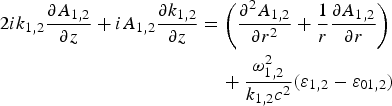 $$\eqalign{2i{k_{1,2}}\displaystyle{{\partial {A_{1,2}}} \over {\partial z}} + i{A_{1,2}}\displaystyle{{\partial {k_{1,2}}} \over {\partial z}} & = \left( {\displaystyle{{{\partial ^2}{A_{1,2}}} \over {\partial {r^2}}} + \displaystyle{1 \over r}\displaystyle{{\partial {A_{1,2}}} \over {\partial r}}} \right) \cr &\quad\, + \displaystyle{{{\rm \omega} _{1,2}^2} \over {{k_{1,2}}{c^2}}}({{\rm \varepsilon} _{1,2}} - {{\rm \varepsilon} _{01,2}})} $$
where ε1,2 is the dielectric constant of the system,  ${k_{1,2}}(z) = ({{\rm \omega} / c})$
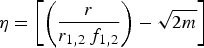
 $\sqrt {{{\rm \varepsilon} _{01,2}}(z)}, $ and ε01,2(z) is the dielectric function corresponding to the maximum electric field on the wave front of the HGLB, ε1,2 is the effective dielectric function of the plasma, and c is the speed of light in free space. However, when we consider Gaussian beams, we use paraxial approximation expanding all the parameters around a point r = 0, where the intensity of Gaussian beam is maximum, while in the case of HGLB, the intensity is not maximum at r = 0. Thus, we define a point along the radial distance where intensity of HGLB is considered as highest. So, in case of HGLB, we expand all parameters around this point and define it as
 $${\rm \eta} = \left[ {\left( {\displaystyle{r \over {{r_{1,2}}{\,f_{1,2}}}}} \right) - \sqrt {2m}} \right]$$
where f 1,2(z) is the beam width parameter of the HGLB for the first and the second beam, respectively. Since the irradiance of the beam is a function of r and z only, so, to use paraxial approximation in which all the parameters are needed to expand around the location of irradiance maximum, the condition  ${\rm \eta} \ll \sqrt {2m} $ is strictly applicable just like the paraxial theory. The conversion leads to
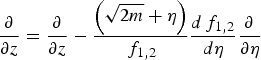 $$\displaystyle{\partial \over {\partial z}} = \displaystyle{\partial \over {\partial z}} - \displaystyle{{\left( {\sqrt {2m} + {\rm \eta}} \right)} \over {{\,f_{1,2}}}}\displaystyle{{d{\,f_{1,2}}} \over {d{\rm \eta}}} \displaystyle{\partial \over {\partial {\rm \eta}}}$$
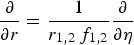 $$\displaystyle{\partial \over {\partial r}} = \displaystyle{1 \over {{r_{1,2}}{\,f_{1,2}}}}\displaystyle{\partial \over {\partial {\rm \eta}}}$$
Further, the complex amplitude A 1,2(r, z) in Eq. (3) may be expressed as,  ${A_{1,2}}(r,z) = {A_{01,2}}(r,z){\kern 1pt} exp\,[ - i{k_{1,2}}(z){S_{1,2}}(r,z)],$ where S 1,2(r, z) is the eikonal associated with the HGLB. Now putting A 1,2 in Eq. (3) one can segregate the real and imaginary parts from the resulting equation and using (5a) and (5b), we get the following equations as (Akhmanov et al., Reference Akhmanov, Sukhorukov and Khokhlov1968),
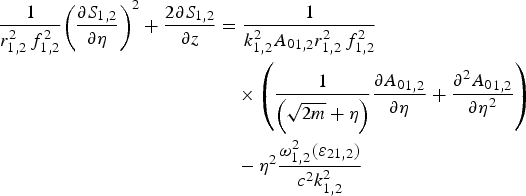 $$\eqalign{\displaystyle{1 \over {r_{1,2}^2\, f_{1,2}^2}} {\left( {\displaystyle{{\partial {S_{1,2}}} \over {\partial {\rm \eta}}}} \right)^2} + \displaystyle{{2\partial {S_{1,2}}} \over {\partial z}} & = \displaystyle{1 \over {k_{1,2}^2 {A_0}_{1,2} r_{1,2}^2\, f_{1,2}^2}} \cr & \quad \times\left( {\displaystyle{1 \over {\left( {\sqrt {2m} + {\rm \eta}} \right)}}\displaystyle{{\partial {A_0}_{1,2}} \over {\partial {\rm \eta}}} + \displaystyle{{{\partial ^2}{A_0}_{1,2}} \over {\partial {{\rm \eta} ^2}}}} \right) \cr & \quad - {{\rm \eta} ^2}\displaystyle{{{\rm \omega} _{1,2}^2 ({{\rm \varepsilon} _{21,2}})} \over {{c^2}k_{1,2}^2}}}$$
and
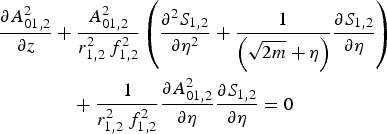 $$\eqalign{\displaystyle{{\partial A_{01,2}^2} \over {\partial z}} & + \displaystyle{{A_{01,2}^2} \over {r_{1,2}^2 \,f_{1,2}^2}} \left( {\displaystyle{{{\partial ^2}{S_{1,2}}} \over {\partial {{\rm \eta} ^2}}} + \displaystyle{1 \over {\left( {\sqrt {2m} + {\rm \eta}} \right)}}\displaystyle{{\partial {S_{1,2}}} \over {\partial {\rm \eta}}}} \right) \cr & \quad + \displaystyle{1 \over {r_{1,2}^2 \,f_{1,2}^2}} \displaystyle{{\partial A_{01,2}^2} \over {\partial {\rm \eta}}} \displaystyle{{\partial {S_{1,2}}} \over {\partial {\rm \eta}}} = 0} $$
where we ignored the z derivative of k. In the above Eq. (6), substitution for ε1,2(η, z) has been done by
 $${{\rm \varepsilon} _{1,2}}({\rm \eta}, z) = {{\rm \varepsilon} _{01,2}}(z) - {{\rm \eta} ^2}{{\rm \varepsilon} _{21,2}}(z)$$
in which the dielectric constant has been expanded around the maximum η = 0 of the HGLB, where ε01,2 and ε21,2 are the coefficients associated with η0 and η2 in the expansion of ε1,2(η, z) around η = 0. Further, one can express solution of Eq. (7), with the paraxial approximation  ${\rm \eta} \ll \sqrt {2m} $ as
 $$A_{01,2}^2 = \displaystyle{{E_{1,2}^2} \over {{2^{2m}}f_{1,2}^2}} {\left( {\sqrt {2m} + {\rm \eta}} \right)^{4m}}exp\left( { - {{\left( {\sqrt {2m} + {\rm \eta}} \right)}^2}} \right)$$
with
 $${S_{1,2}}({\rm \eta}, z) = \displaystyle{{{{\left( {\sqrt {2m} + {\rm \eta}} \right)}^2}} \over 2}{\rm \beta} (z) + {\rm \varphi} (z)$$
where
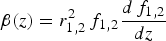 $${\rm \beta} (z) = r_{1,2}^2 {\,f_{1,2}}\displaystyle{{d{\,f_{1,2}}} \over {dz}}$$
As we presumed that approximately all the power of the beam is focused in the region around η = 0, there is definitely certain power of the beam beyond this constraint, which is accounted for in an approximate manner by Eq. (9). Equation (9) tells that the nature of r dependence of irradiance does not change with the propagation and the power is conserved as the beam propagates. Here φ(z) is an arbitrary function of z.
The present study considers the plasma, characterized by the relativistic–ponderomotive nonlinearity, caused by relativistic change in mass of electron and modification of the background electron density due to ponderomotive nonlinearity. The effective dielectric constant in the presence of relativistic–ponderomotive nonlinearity
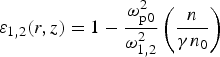 $${{\rm \varepsilon} _{1,2}}(r,z) = 1 - \displaystyle{{{\rm \omega} _{{\rm p}0}^2} \over {{\rm \omega} _{1,2}^2}} \left( {\displaystyle{n \over {{\rm \gamma} {n_0}}}} \right)$$
where ωp0 is the plasma frequency given by  ${\rm \omega} _{{\rm p0}}^2 = 4\pi {n_0}{e^2}/m$ [with e the charge of an electron, m = m 0 γ (m 0 is rest mass of electron) is its mass and n 0 is the density of plasma electrons in the absence of laser beam] and the relativistic factor is given as
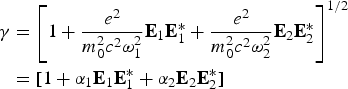 $$\eqalign{{\rm \gamma }& = {\left[ {1 + \displaystyle{{{e^2}} \over {m_0^2 {c^2}{\rm \omega} _1^2}} {{\bf E}_1}{\bf E}_1^{\ast} + \displaystyle{{{e^2}} \over {m_0^2 {c^2}{\rm \omega} _2^2}} {{\bf E}_2}{\bf E}_2^{\ast}} \right]^{{1 / 2}}} \cr & = [1 + {{\rm \alpha} _1}{{\bf E}_1}{\bf E}_1^{\ast} + {{\rm \alpha} _2}{{\bf E}_2}{\bf E}_2^{\ast} ]} $$
where  ${{\rm \alpha} _{1,2}} = {e^2}/m_0^2 {c^2}{\rm \omega} _{1,2}^2 $. The previous expression is valid when there is no change in the plasma density. Following Brandi et al. (Reference Brandi, Manus, Mainfray and Lehner1993a), the relativistic–ponderomotive force can be written as
 $${F_{\rm p}} = - {m_0}{c^2}\nabla ({\rm \gamma} - 1)$$
Using the electron continuity equation and current density equation for second-order correction in the electron density equation, we get
 $${n_2} = \displaystyle{{\rm \gamma} \over {{\rm \omega} _{{\rm p}0}^2}} \nabla \left( {\displaystyle{{{n_0}{F_{\rm p}}} \over {{m_0}{\rm \gamma}}}} \right)\quad {\rm or}\quad {n_2} = \displaystyle{{{c^2}{n_0}} \over {{\rm \omega} _{{\rm p}0}^2}} \left( {{\nabla ^2}{\rm \gamma} - \displaystyle{{{{(\nabla {\rm \gamma} )}^2}} \over {\rm \gamma}}} \right)$$
Therefore, the total density can be expressed in the region around η = 0 as
 $$\displaystyle{n \over {{n_0}}} = {n_0} + {n_2} = \left[ {1 + \displaystyle{{{c^2}exp( - 2m){m^{2m}}} \over {{\rm \omega} _{{\rm p}0}^2}} \left\{ {\displaystyle{{{{\rm \alpha} _1}E_{01}^2} \over {r_1^2 f_1^4 {{\rm \gamma} ^2}}} + \displaystyle{{{{\rm \alpha} _2}E_{02}^2} \over {r_2^2 f_2^4 {{\rm \gamma} ^2}}}} \right\}} \right]$$
Further, to find the value of ε21,2 and ε01,2 one can expand the dielectric function given by Eq. (10) in axial and radial parts around the parameter (η = 0). Thus, we get from Eq. (8) the values as
 $${{\rm \varepsilon} _{01,2}}(z) = {{\rm \varepsilon} _{01,2}}{({\rm \eta}, z)_{{\rm \eta} = 0}}\quad {\rm and}\quad {{\rm \varepsilon} _{21,2}}(z) = - {\left( {\displaystyle{{\partial {\rm \varepsilon} ({\rm \eta}, z)} \over {\partial {{\rm \eta}^2}}}} \right)_{{\rm \eta} = 0}}$$
Thus, the dielectric constant of the plasma at frequencies ω1 and ω2 denoted by ε1,2 is given by
 $${{\rm \varepsilon} _{1,2}}(r,z) = 1 - \displaystyle{{{\rm \omega} _{{\rm p}0}^2} \over {{\rm \omega} _{\,1,2}^{\,2} {\rm \gamma}}} - \displaystyle{{{c^2}} \over {{\rm \omega} _{{\rm p}0}^2 {\rm \gamma}}} \left( {{\nabla ^2}{\rm \gamma} - \displaystyle{{{{(\nabla {\rm \gamma} )}^2}} \over {\rm \gamma}}} \right)$$
Thus, to solve the above Eq. (15), it is convenient to expand the solution for  $A_{01,2}^2 $ as a polynomial in η2; thus
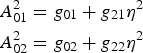 $$\eqalign{& A_{01}^2 = {g_{01}} + {g_{21}}{{\rm \eta} ^2} \cr & A_{02}^2 = {g_{02}} + {g_{22}}{{\rm \eta} ^2}} $$
where g 01 and g 21 are expressed as
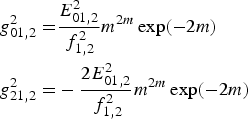 $$\eqalign{g_{01,2}^2 = & \displaystyle{{E_{01,2}^2} \over {\,f_{1,2}^2}} {m^{2m}}\exp ( - 2m) \cr g_{21,2}^2 = & - \displaystyle{{2E_{01,2}^2} \over {\,f_{1,2}^2}} {m^{2m}}\exp ( - 2m)} $$
Hence, for cross-focusing of HGLB under the influence of relativistic–ponderomotive nonlinearity, one can express the dielectric constant ε1,2(η, z) as
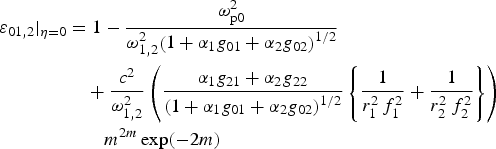 $$\eqalign{{{\rm \varepsilon} _{01,2}}{ \vert _{{\rm \eta} = 0}} & = 1 - \displaystyle{{{\rm \omega} _{{\rm p}0}^2} \over {{\rm \omega} _{1,2}^2 {{\left( {1 + {{\rm \alpha} _1}{g_{01}} + {{\rm \alpha} _2}{g_{02}}} \right)}^{{1 / 2}}}}} \cr & \quad+ \displaystyle{{{c^2}} \over {{\rm \omega} _{1,2}^2}} \left( {\displaystyle{{{{\rm \alpha} _1}{g_{21}} + {{\rm \alpha} _2}{g_{22}}} \over {{{\left( {1 + {{\rm \alpha} _1}{g_{01}} + {{\rm \alpha} _2}{g_{02}}} \right)}^{{1 / 2}}}}}\left\{ {\displaystyle{1 \over {r_1^2 \,f_1^2}} + \displaystyle{1 \over {r_2^2 \,f_2^2}}} \right\}} \right) \cr & \qquad {m^{2m}}\exp ( - 2m)}$$
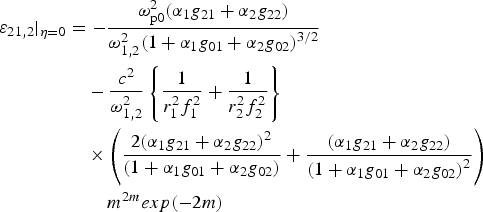 $$\eqalign{{{\rm \varepsilon} _{21,2}}{ \vert _{{\rm \eta} = 0}} & = - \displaystyle{{{\rm \omega} _{{\rm p}0}^2 ({{\rm \alpha} _1}{g_{21}} + {{\rm \alpha} _2}{g_{22}})} \over {{\rm \omega} _{1,2}^2 {{(1 + {{\rm \alpha}_1}{g_{01}} + {{\rm \alpha} _2}{g_{02}})}^{{3 / 2}}}}} \cr & \quad- \displaystyle{{{c^2}} \over {{\rm \omega} _{1,2}^2}} \left\{ {\displaystyle{1 \over {r_1^2 f_1^2}} + \displaystyle{1 \over {r_2^2 f_2^2}}} \right\} \cr & \quad\times \left( {\displaystyle{{2{{({{\rm \alpha} _1}{g_{21}} + {{\rm \alpha} _2}{g_{22}})}^2}} \over {(1 + {{\rm \alpha} _1}{g_{01}} + {{\rm \alpha} _2}{g_{02}})}} + \displaystyle{{({{\rm \alpha} _1}{g_{21}} + {{\rm \alpha} _2}{g_{22}})} \over {{{(1 + {{\rm \alpha} _1}{g_{01}} + {{\rm \alpha} _2}{g_{02}})}^2}}}} \right) \cr & \qquad\, {m^{2m}}exp( - 2m)}$$
Further, substituting from Eqs. (9a) and (9b) for  $A_{01,2}^2 $ and S 1,2 into Eq. (6) with Eqs. (18a) and (18b) and equating the coefficients of η0 and η2 on both sides of the resulting equation, one obtains, the dimensionless beam width parameters f 1 and f 2 at z
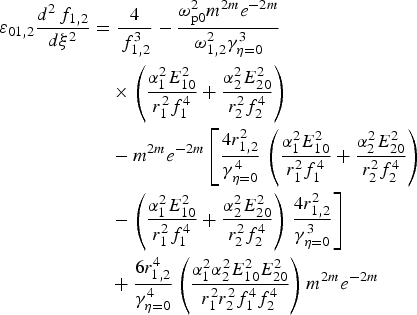 $$\eqalign{{{\rm \varepsilon} _{01,2}}\displaystyle{{{d^2}{\,f_{1,2}}} \over {d{{\rm \xi} ^2}}} & = \displaystyle{4 \over {\,f_{1,2}^3 }} - \displaystyle{{{\rm \omega} _{{\rm p}0}^2 {m^{2m}}{e^{ - 2m}}} \over {{\rm \omega} _{1,2}^2 {\rm \gamma} _{{\rm \eta} = 0}^3 }} \cr & \quad \times\left( {\displaystyle{{{\rm \alpha} _1^2 E_{10}^2 } \over {r_1^2 f_1^4 }} + \displaystyle{{{\rm \alpha} _2^2 E_{20}^2 } \over {r_2^2 f_2^4 }}} \right) \cr & \quad -{m^{2m}}{e^{ - 2m}}\left[ {\displaystyle{{4r_{1,2}^2 } \over {{\rm \gamma} _{{\rm \eta} = 0}^4 }}} \right.\left( {\displaystyle{{{\rm \alpha} _1^2 E_{10}^2 } \over {r_1^2 f_1^4 }} + \displaystyle{{{\rm \alpha} _2^2 E_{20}^2 } \over {r_2^2 f_2^4 }}} \right) \cr & \quad- \left( {\displaystyle{{{\rm \alpha} _1^2 E_{10}^2 } \over {r_1^2 f_1^4 }} + \displaystyle{{{\rm \alpha} _2^2 E_{20}^2 } \over {r_2^2 f_2^4 }}} \right)\left. {\displaystyle{{4r_{1,2}^2 } \over {{\rm \gamma} _{{\rm \eta} = 0}^3 }}} \right] \cr & \quad + \displaystyle{{6r_{1,2}^4 } \over {{\rm \gamma} _{{\rm \eta} = 0}^4 }}\left( {\displaystyle{{{\rm \alpha} _1^2 {\rm \alpha} _2^2 E_{10}^2 E_{20}^2 } \over {r_1^2 r_2^2 f_1^4 f_2^4 }}} \right){m^{2m}}{e^{ - 2m}}} $$
where  ${\rm \xi} = (cz/r_1^2 {{\rm \omega} _1})$ is the dimensionless distance of propagation. Equation (19) is the nonlinear second-order differential equation governing the normalized beam width parameter f 1,2 in the plasma. The equation explains the beam dynamics in the plasma with relativistic–ponderomotive nonlinearity taken into account and determines the focusing/defocusing of laser beam along the distance of propagation in the plasma. The first term on the right-hand side of Eq. (19) represents spatial dispersion and is responsible for diffractional divergence. On the other hand, second, third, and fourth terms are nonlinear in nature and express nonlinear effects due to relativistic–ponderomotive nonlinearity leading to self-focusing of the beam. These focusing terms arise due to modification in the dielectric function corresponding to the relativistic–ponderomotive nonlinearity. The dielectric function is modified due to the presence of two high-power HGLBs in the plasma. The simultaneous propagation of two HGLBs leads to the density variation through the channel due to relativistic–ponderomotive force. Since the nonlinearities in the plasma depend upon the total intensity of the two beams; therefore, the behavior of the first laser beam is affected by the second beam and vice versa, and it is obvious that during the simultaneous propagation of two beams the focusing of one beam is governed by another. The focusing/defocusing behavior of laser beams is influenced by the magnitudes of the nonlinear coupling term of Eq. (19). The last term is due to cross-focusing (i.e., due to mutual interaction) of the two beams. In the absence of this term, equations become independent and represent the self-focusing of the beams. Analytical solutions to these equations are not possible. We therefore seek numerical computational techniques to study beam dynamics.
3. NUMERICAL COMPUTATIONS AND DISCUSSIONS
In the present work, the cross-focusing of two HGLBs is studied in a collisionless plasma. In collisionless plasma, the density of the plasma varies due to the relativistic–ponderomotive force and the refractive index increases at the position of maximum irradiance; and hence the laser gets focused in the plasmas. Equations (9a) with (9b) describe the intensity profile of HGLBs in the plasma in the presence of relativistic–ponderomotive nonlinearity. The intensity profile of the laser beam depends on the beam width f 1,2 in the paraxial regime. Equation (9a) has been solved for the initial wave front of the first beam, the initial conditions used here were f 1,2 = 1 and df 1,2/dξ = 0 at ξ = 0, and S 1,2 = 0 at ξ = 0. We have performed the numerical calculation for different laser and plasma parameters shown below and the numerical results are presented in the form of Figure 1. The variations of initial intensity of the HGLB for the order 0, 1, 2, and 3 have been shown in Figure 1 at ξ = 0. It is obvious from the figure that in the paraxial regime the intensity of laser beam is maximum at η = 0. The numerical calculations have been done using following typical laser beam parameters: r 1 = 15 μm, r 2 = 20 μm, ω1 = 1.776 × 10¹⁴ rad/s, ω2 = 1.716 × 10¹⁴ rad/s, and ωp0 = 0.3 ω1.
Normalized intensity distribution of the first HGLB for order m = 0, m = 1, m = 2, and m = 3 at ξ = 0.

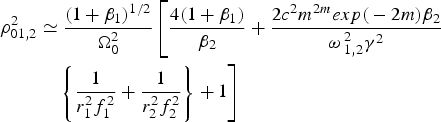
To begin with, we try to discuss numerically the critical condition for focusing. For an initially (ξ = 0) plane wave front df 1,2/dξ = 0 = 0 of the beam and f 1,2 = 1 at ξ = 0, the condition (d 2f 1,2/dξ2 = 0)ξ=0 leads to f 1,2(ξ) = 1 or propagation of the HGLB without convergence or divergence; this condition is known as the critical condition and their graphical representation is known as the critical curve. By putting (d 2f 1,2/dξ2 = 0) in Eq. (19), we obtain a relation between  ${\rm \rho} _{01,2}^2 ( = r_{1,2}^2 {\rm \omega} _{1,2}^2 /{c^2})$ and critical values of power of the beam
 ${{\rm \alpha} _1}E_{01,2}^2 $ corresponding to the propagation of the HGLB in the self-trapped mode with relativistic–ponderomotive nonlinearity. The critical condition leads to the general expression for determination of critical threshold for various values of m. The critical curve can thus be represented as
 $${\rm \rho} _{01,2\,}^2 {{\rm \varepsilon} _{21,2}}(0) = 0$$
Using the appropriate expression for ε2(η) at η = 0 from Eq. (18) for relativistic–ponderomotive nonlinearity we get
 $$\eqalign{ {\rm \rho} _{01,2}^2 & \simeq \displaystyle{{{{(1 + {{\rm \beta} _1})}^{{1 / 2}}}} \over {\Omega _0^2}} \left[ {\displaystyle{{4(1 + {{\rm \beta} _1})} \over {{{\rm \beta} _2}}} + \displaystyle{{2{c^2}{m^{2m}}exp{\rm (} - 2m{\rm )}{{\rm \beta} _2}} \over {{\rm \omega} \,_{1,2}^2 {{\rm \gamma} ^2}}}} \right. \cr & \left. {\quad \left\{ {\displaystyle{1 \over {r_1^2 f_1^2}} + \displaystyle{1 \over {r_2^2 f_2^2}}} \right\} + 1} \right]} $$
where β1 = (α1g 01 + α2g 02) and β2 = (α1g 21 + α2g 22). Equation (21) signifies the critical power equation decides the propagation of the beam into the plasma without convergence and divergence. This equation determines the power of the beam such that the electron redistribution occurs but leads to no convergence and divergence. Actually equation governs the beam radius as a function of power density for self-trapping. It provides the boundary between self-focusing and defocusing. The above equation denotes curve schemed as  ${\rm \rho} _{01,2}^2 $ versus
 ${{\rm \alpha} _1}E_{01,2}^2 $ and separates the self-focusing region from the rest. The critical curves, which display a relationship between the initial dimensionless amplitude
 ${{\rm \alpha} _1}E_{01,2}^2 $ and the width
 ${\rm \rho} _{01,2}^2 $ (for a fixed value of
 ${{\rm \alpha} _2}E_{02}^2 = 0$) correspond to the propagation of the HGLB without convergence or divergence. Points above the curve correspond to divergence (or dissipation), whereas points below the curve refers to self-focusing of the HGLB. The results are plotted in the form of graphs in Figure 2. It is evident form the figure the variation in
 $\rho _{01}^2 $ with the dimensionless initial power
 ${{\rm \alpha} _1}E_{01,2}^2 $ for self-trapping, corresponding to the ponderomotive and relativistic–ponderomotive nonlinearity simultaneously for various orders of the HGLB when the second beam is not present. It is clear from the figure that in the case of relativistic–ponderomotive nonlinearity the beam focuses strongly. The value of
 $\rho _{01}^2 $ at a particular value of
 ${{\rm \alpha} _1}E_{01,2}^2 $ is very low in the case of relativistic–ponderomotive nonlinearity. It is clear from the equation that
 ${\rm \rho} _{01,2}^2 $ depends upon the order of HGLB, characteristics of the other beam and plasma parameter.
The dependence of the initial beam width  ${\rm \rho} _{01}^2 $ with
 ${{\rm \alpha} _1}E_{01}^2 $ for the propagation of various orders of HGLB with only ponderomotive nonlinearity and ponderomotive–relativistic nonlinearity when the potential of other HGLB is zero. The curves having * represent ponderomotive–relativistic nonlinearity and squared curves correspond to only ponderomotive nonlinearity. The black solid line is for m = 3, the red dotted line is for m = 2, and the blue dashed line is for m = 1.
To observe the event of simultaneous propagation of two beams and numerical appreciation of the consequences, the beam width parameter f 1,2 as a function of dimensionless distance of propagation has been computed with relativistic–ponderomotive nonlinearity. We have performed numerical computation of Eq. (19) for various combinations of initial fields of the lasers. Thus, we see the effect of relativistic–ponderomotive nonlinearity on cross-focusing of beam and comparison of it to only relativistic nonlinearity on the various modes of propagation of HGLB. The numerical observation of cross-focusing is presented in the form of figures.
Figure 3a illustrates the effect of relativistic–ponderomotive nonlinearity in comparison with only relativistic nonlinearity on focusing of one HGLB when the second beam is not present and Figure 3b gives the behavior of purely Gaussian mode (m = 0) of one HGLB in the presence and absence of the second laser beam when relativistic–ponderomotive nonlinearity is operative in the system. Figure 3a clearly displays that the relativistic–ponderomotive nonlinearity in the absence of the second beam, whereas Figure 3b gives the effect of relativistic–ponderomotive nonlinearity in the presence of another HGLB. It demonstrates that in the presence of the second beam the first beam focused more strongly than in Figure 3a and somewhat fast also. Figure 3 depicts that in both cases the beams show oscillatory self-focusing. Thus, from Figure 3 one can see the effect of relativistic–ponderomotive nonlinearity on the pure Gaussian mode, that is, m = 0 in the two different situations when the beam propagates alone and when it propagates in the presence of another HGLB and cross-focusing takes place.
Variation of beam width parameter (f 1) with the normalized distance (ξ) for a single (first) HGLB for the zeroth order in the absence and presence of the second beam in which the black solid line is for relativistic-ponderomotive nonlinearity and the red dotted line is for only relativistic nonlinearity. (a)  ${{\rm \alpha} _1}E_{01}^2 = 1,$
 ${{\rm \alpha} _2}E_{02}^2 = 0;$ (b)
 ${{\rm \alpha} _1}E_{01}^2 = 1,$
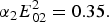 ${{\rm \alpha} _2}E_{02}^2 = 0.35.$
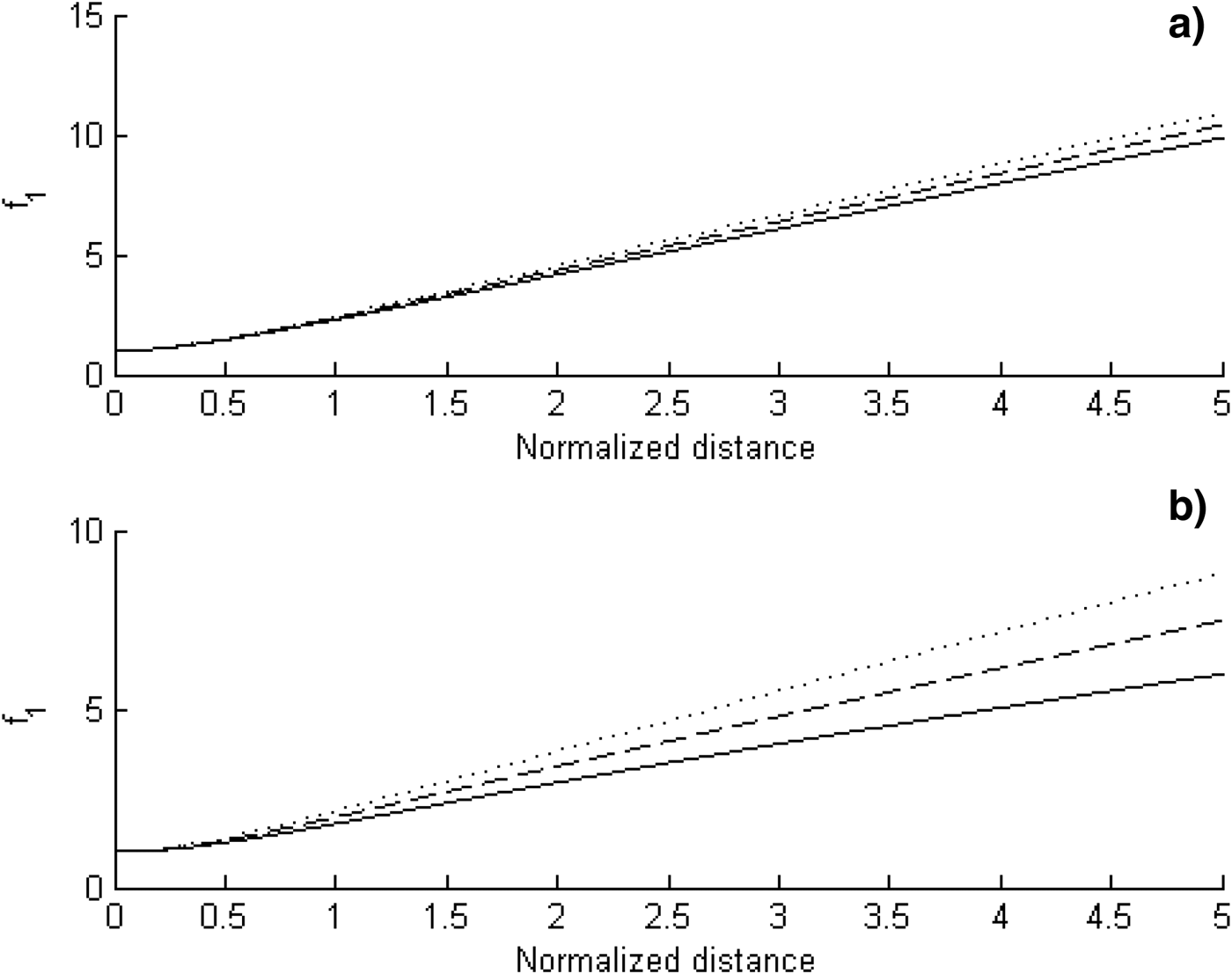
In the same way, the set of Figures 4–6 shows the effect of relativistic–ponderomotive nonlinearity on the higher-order modes of HGLB in the absence and presence of another HGLB. Moreover, it is clear from Eq. (19) that beam width parameter depends on the order m of the beam. Thus, in the set of Figures 4–6, we have observed the comparison of focusing of particular mode in the presence of only relativistic and relativistic–ponderomotive nonlinearity and how the cross-focusing of different modes of HGLB (m = 1, 2, 3) affected due to the presence of relativistic–ponderomotive nonlinearity. The (a) part of figures shows the effect of relativistic–ponderomotive nonlinearity on the higher-order modes of HGLB when the power of the first beam is kept as zero, while the (b) part shows the same when the second beam is present. It is clear from the figure that for the higher-order modes also the relativistic–ponderomotive nonlinearity affects the cross-focusing. In Figures 4–6, it is shown that the propagation of modes m = 1, 2, and 3 affected slightly with the relativistic–ponderomotive nonlinearity in comparison with the only relativistic nonlinearity and the effect of relativistic–ponderomotive nonlinearity on the simultaneous propagation of another laser beam. The figures evidently show that the focusing becomes faster in the presence of relativistic–ponderomotive nonlinearity and further enhanced in the presence of another beam. Thus, the effect of relativistic–ponderomotive nonlinearity is studied on cross-focusing of different orders (m = 1, 2, 3) of the first HGLB in different situations.
Variation of the beam width parameter (f 1) with the normalized distance (ξ) for a single (first) HGLB for the first order in the absence and presence of the second beam in which the black solid line is for relativistic–ponderomotive nonlinearity and the red dotted line is for only relativistic nonlinearity. (a)  ${{\rm \alpha} _1}E_{01}^2 = 1.$
Variation of the beam width parameter (f 1) with the normalized distance (ξ) for a single (first) HGLB for the second order in the absence and presence of the second beam in which the black solid line is for relativistic–ponderomotive nonlinearity and the red dotted line is for only relativistic nonlinearity. (a)  ${{\rm \alpha} _1}E_{01}^2 = 1,$
 ${{\rm \alpha} _2}E_{02}^2 = 0;$ (b)
 ${{\rm \alpha} _1}E_{01}^2 = 1,$
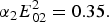 ${{\rm \alpha} _2}E_{02}^2 = 0.35.$
Variation of beam width parameter (f 1) with the normalized distance (ξ) for a single (first) HGLB for the third order in the absence and presence of the second beam in which the black solid line is for relativistic–ponderomotive nonlinearity and the red dotted line is for only relativistic nonlinearity. (a)  ${{\rm \alpha} _1}E_{01}^2 = 1,$
 ${{\rm \alpha} _2}E_{02}^2 = 0;$ (b)
 ${{\rm \alpha} _1}E_{01}^2 = 1,$
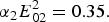 ${{\rm \alpha} _2}E_{02}^2 = 0.35.$
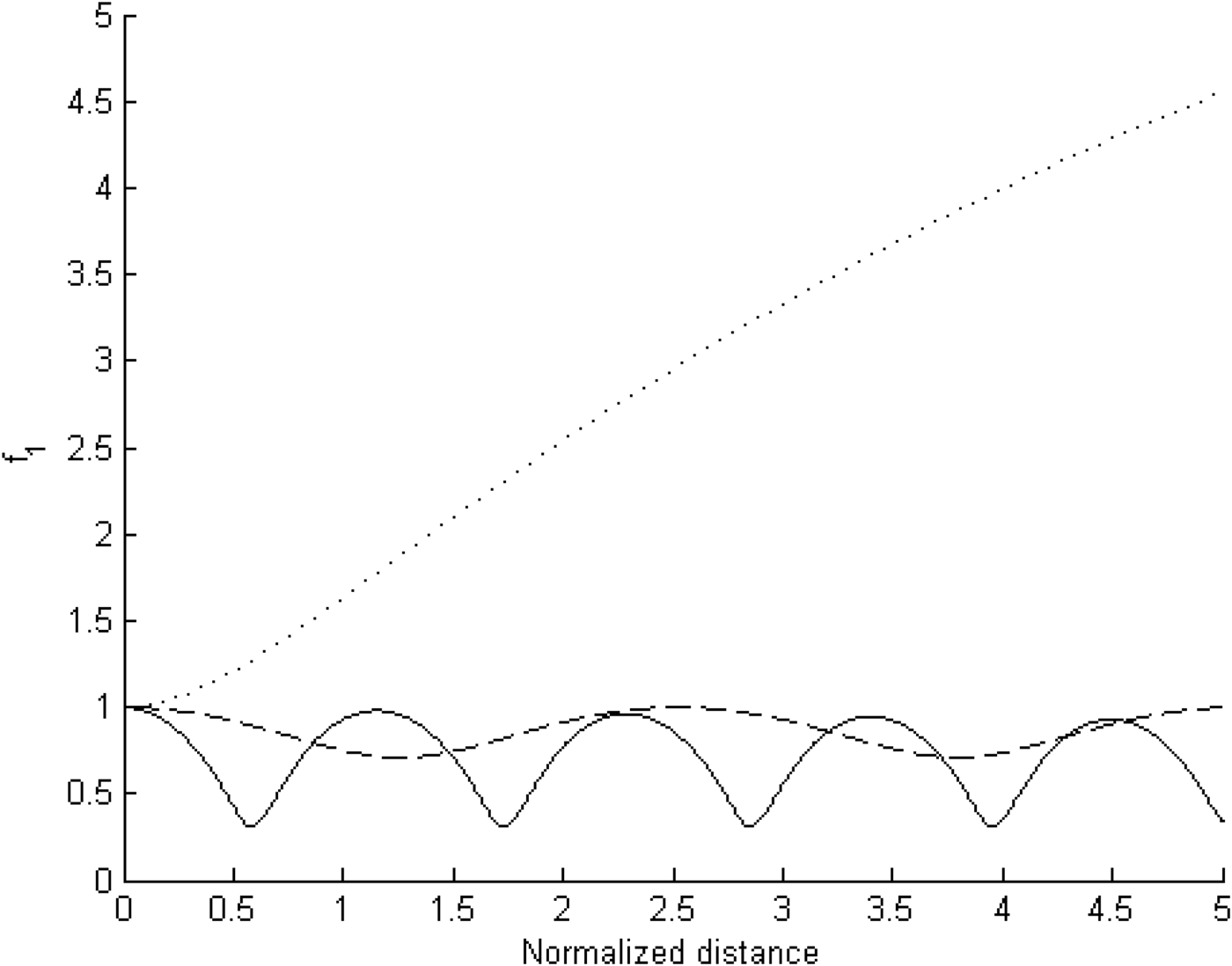
Further, Figures 7 and 8 show a cross-focusing process with the variation of power of a second beam and keeping the parameters of a first beam constant. Figure 7a depicts the cross-focusing process for m = 1 mode of the first beam with the variation in the power of the second laser beam by keeping the potential of the first laser beam constant when relativistic–ponderomotive nonlinearity is operative. Figure 7b displays the same for m = 2 mode and Figure 8 displays the same for m = 3 mode. Figures 7 and 8 explicitly illustrate the cross-focusing for m = 1, m = 2 and m = 3 modes of the propagation of HGLB affected by the second beam power. It is seen that the self-focusing character of the HGLB increases as power of the second beam increases. It is seen from Figures 7 and 8 which clearly show that more the power of second HGLB, faster will be the focusing of the first HGLB.
Variation of the beam width parameter of the first HGLB with the normalized distance of propagation for a fixed power of the first beam  ${{\rm \alpha} _1}E_{01}^2 = $
 ${0.5}$ and different power of the second beam. Solid, dashed, and dotted lines represent
 ${{\rm \alpha} _2}E_{02}^0 = 0.8,0.5,0.3;$ (a) for the first order of HGLB, that is, m = 1; (b) for the second order of HGLB, that is, m = 2.
Variation of the beam width parameter of the first HGLB with the normalized distance of propagation for a fixed power of the first beam  ${\alpha _1}E_{01}^2 = 0.5$ and different power of second beam. Solid, dashed, and dotted lines represent
 ${\alpha _2}E_{02}^0 = 0.8,0.5,0.3$ for the third order of HGLB, that is, m = 3.
4. CONCLUSIONS
The influence relativistic–ponderomotive nonlinearity is studied on cross-focusing of HGLBs. The beam width parameter has been evaluated with the distance of propagation. It is seen that the focusing behavior of one beam gets modified in the presence of only relativistic nonlinearity and relativistic–ponderomotive nonlinearity. It is found that the focusing becomes faster and stronger in the presence of relativistic–ponderomotive nonlinearity in comparison with the relativistic nonlinearity. It is also observed that the higher-order modes of HGLB also get affected because of the presence of another co-propagating beam and relativistic–ponderomotive nonlinearity. The cross-focusing of beam also checked by varying the power of co-propagating beam and it is observed that the focusing gets quicker as the power of second beam increases.
ACKNOWLEDGMENTS
This work was partially supported by the University Grants Commission (UGC) (F. No. 42-820/2013 SR), New Delhi, Government of India. The author is grateful to Professor R.P. Sharma, Centre for Energy Studies, IIT, Delhi for their support. I also gratefully acknowledge the anonymous referee for offering insightful comments.