

In the 1940s the Safeway Corporation purchased the property of St. John's church in Oregon City, Oregon, and the McLoughlins, buried there almost a century before, could well have found themselves in the basement of a grocery store had a group of civic leaders not saved them from that fate. John McLoughlin, who had received his Catholic churchyard burial in 1857, had been a Hudson's Bay Company Chief Factor, a man prominent among those of European descent vying for control of land and resources in the nineteenth-century Pacific Northwest. Though he died two years before Oregon became a state, he had become known as the “Father of Oregon,” a man clearly too important to remain buried beneath the produce aisle.Footnote 1
The mid-twentieth-century rearrangement of McLoughlin's gravesite was not its first, nor would it be the last, as Oregonians kept looking for better ways to honor their founding father's corpse. When an addition was built over the church's original cemetery in the early twentieth century, McLoughlin's headstone, and that of his wife Margaret, had been incorporated into the building's new wall. Theirs were the only two grave markers preserved, though many other bodies remained with them in the basement of the church.Footnote 2
Faced with the supermarket takeover in 1948, parishioners quickly organized an exhumation and reburial on church property at the edge of town. An elaborate ceremony drew dignitaries from the region, and reporters covered the grand speeches and pomp and circumstance surrounding the reburial spectacle. They gushed about the pristine condition of John McLoughlin's casket and corpse, as though the state of John's body validated the reverence they accorded it. The body of his wife Margaret, sometimes called Marguerite, was in far rougher shape and went barely mentioned in news coverage at the time. She was certainly not remembered as Oregon's mother. Perhaps her identity as a Chippewa (Ojibwe) woman made her story too complicated to include in the origin tale.Footnote 3
Even when she happened to be mentioned, Margaret's Native American identity rarely was, and I do not want to repeat that elision here: she was not white, and so her body did not carry the same symbolism as John's. An Oregon of which John McLoughlin could be father is an Oregon whose imagined beginning depends on an imagined end. John McLoughlin's body was being used to undergird a corporal, material sense of white European American history in Oregon—a literal embodiment of a post–Native American past. That story has an arc—one in which Native people have been replaced—and Margaret's narrative did not fit. Instead she was all but ignored.Footnote 4
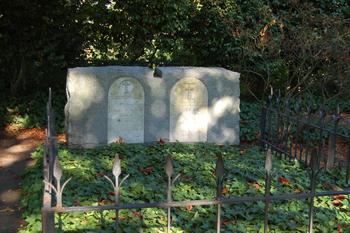
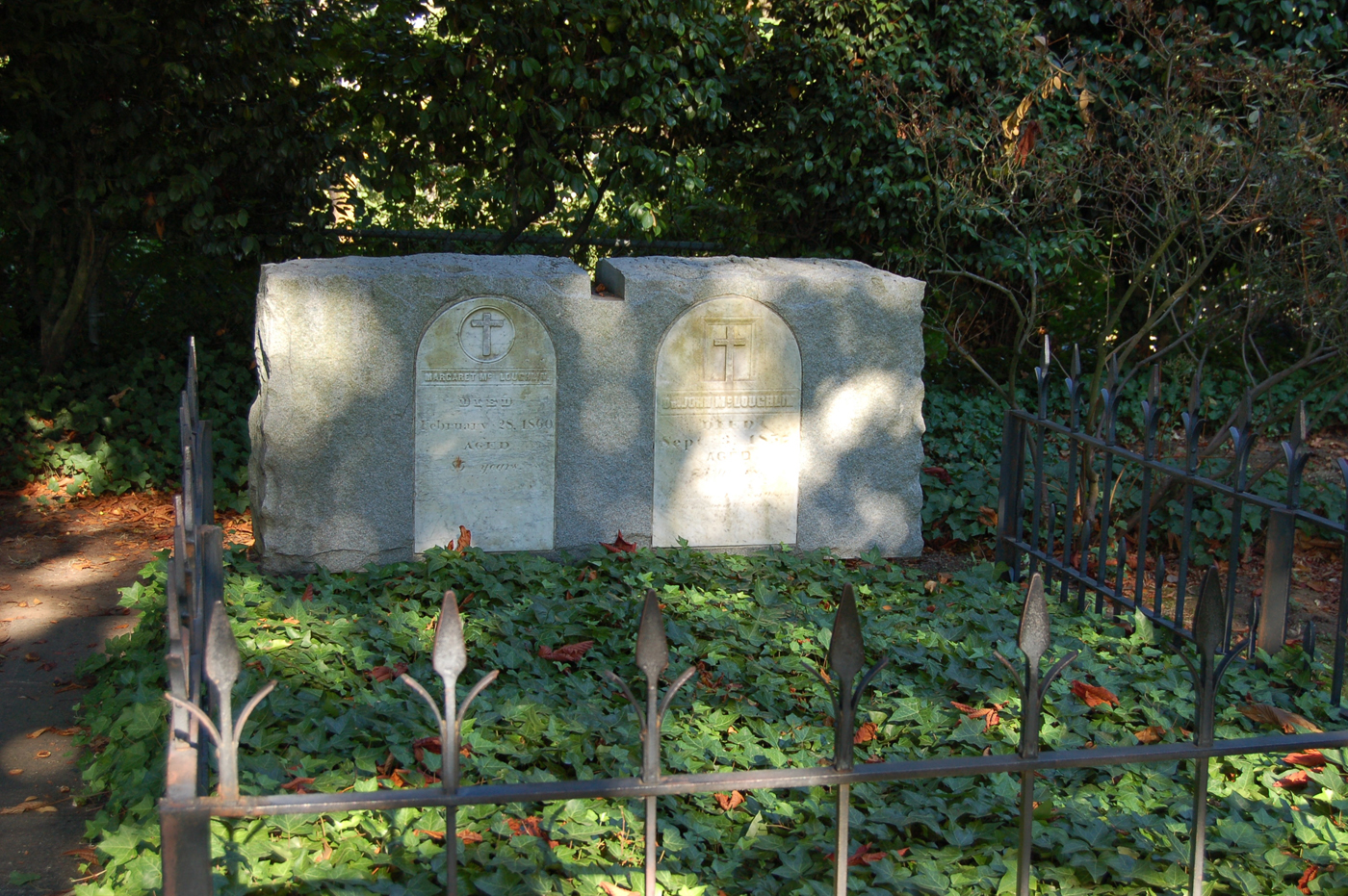
Two decades after the 1948 reburial, John and Margaret were again on the move. Their mid-century edge-of-town burial site had begun to seem rather lonely and remote, so local boosters promoted a new resting spot. Back in 1909, after the McLoughlins’ house had fallen into serious disrepair, it had been moved to a park and restored as a museum. If the McLoughlins could now be reburied on park grounds near their house's new site, the boosters believed, their bodies would lend further authenticity to the place. And so in 1970, John and Margaret were re-exhumed and once again reinterred. Again, speeches and ceremony celebrated that John McLoughlin's much-feted corpse had found its final resting place. His bones, and Margaret's, now consecrate the Oregon City portion of the Fort Vancouver National Historic Site (Figure 1).Footnote 5
The much-relocated gravestones of Margaret and John McLoughlin, now on the grounds of the McLoughlin House in Oregon City and part of the Fort Vancouver National Historic Site (see https://www.nps.gov/fova/learn/historyculture/mcloughlin-house.htm). The McLoughlins have been buried at this site since 1970. Photo courtesy of the National Park Service Fort Vancouver National Historic Site (https://www.nps.gov/media/photo/gallery.htm?id=F5094992-155D-4519-3EA8E14B218BF7C4).
The McLoughlins’ traveling remains offer a reminder that the modern history of the corpse is not only about how people deal with the dead of their own generations but also about how they think about and treat bodies of those who died long before. A corpse is a material thing, and during the twentieth century, dead bodies have been objectified and reobjectified in myriad ways. Dead bodies are totems and relics, and they are components of memorials and shrines. They are also scientific specimens, health hazards, and museum displays. Which dead bodies become what kinds of objects reflects and amplifies power structures among the living. The corpses of some people, more than those of others, are treated more like mere things.
And while dead bodies may seem to be inanimate, they are almost always in motion: being exhumed and then reburied; decomposing and being consumed; staking claims to land and marking time. The McLoughlins’ bodies were not merely being honored in their several graves and many graveside events. They were inscribing space. Oregonians of European descent used the body of John McLoughlin—and more or less ignored that of Margaret, or imagined it into whiteness—to reify their possession of conquered land. The bodies of those they had dispossessed traveled different paths.
Consider the case of the corpse of a contemporary of the McLoughlins’, another dead body that also spent the century in motion. Like John McLoughlin, Chinook Chief Concomly was a powerful authority in the nineteenth-century Pacific Northwest. The two men were by turns allies and adversaries, and might best be understood as peers in that emerging nineteenth-century world of colonial violence. One of Concomly's daughters married Margaret McLoughlin's son, John's stepson, and so the men were family as well.Footnote 6
Like the McLoughlins’, Concomly's nineteenth-century burial was a traditional one. When the chief died in a malaria epidemic in 1830, he was buried with the respect and reverence due a leader. His relatives prepared his body and placed it in a canoe on a high platform among trees on the Oregon coast, among the gravesites of ancestors and relatives. And as was customary, they returned to the body several years later to bury it in the earth nearby.Footnote 7
What happened next to Concomly's corpse should be shocking but is instead a too familiar tale: his skull was stolen and put on display. The thief, Meredith Gairdner, was a Hudson's Bay Company physician who considered himself a scholar, and he was intent on procuring the head of a Chinook chief. Gairdner was fascinated by the high, flat foreheads of the Chinook elite—a head shape encouraged in infancy by the careful use of a particular kind of cradleboard—and so just before leaving the Northwest, four years after Concomly's death, Gairdner raided the chief's grave. He sent Concomly's head, complete with hair and skin, to a friend in Britain, along with a note explaining that he had not had the strength to retrieve the rest of the body. In Britain, Concomly's skull was ultimately stripped bare and put on display at the Royal Naval Hospital Museum in Haslar. The chief's name, the name of the museum, and the name of the curator all were etched into the bone.Footnote 8
After years of correspondence between the Naval Hospital Museum, the Smithsonian, the Clatsop County Historical Society in Astoria, Oregon, and members of the Chinook, Concomly's skull was returned to Oregon in 1953. It was shipped to the historical society, which then claimed control of it. In 1956, the society lent the skull to the Smithsonian, where anthropologists examined it in detail before returning it to the society, where it became their most popular exhibit.Footnote 9
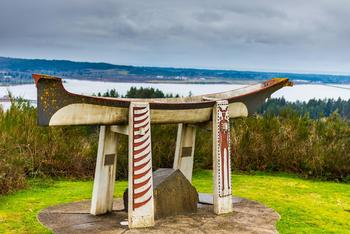
Over the years, Chinook people pressed to have Concomly's skull taken off exhibit and returned to them for burial. For a while, it seemed as though it might finally be buried on the Oregon coast, in a vault beneath a monument to Concomly erected in 1961 as part of a celebration of the sesquicentennial of the town of Astoria (Figure 2). The monument is a concrete replica of Concomly's burial canoe, on a hill overlooking the town, near a towering column commemorating the area's colonial history, which was erected in 1926. It is not clear who supported the idea of burying the skull at the base of the monument. At least some members of the historical society as well as some members of the Chinook tribal council were involved in initial plans, but by the time the monument was built, there was also opposition from both groups. At the end of the day, the historical society kept Concomly's skull, and kept it on display.Footnote 10
1961 Memorial to Chief Concomly (spelled “Comcomly” on the accompanying plaques and on the stone beneath the canoe), Coxcomb Hill, Astoria, Oregon. Although plans had at one point called for interring the chief's skull beneath this cement replica of his burial canoe, it instead remained on display at the Clatsop County Historical Society until 1972, when his descendants were able to reclaim it and bury it nearby in a public cemetery in Ilwaco, Washington. Photograph by Mark Guiltinan, January 2018. Used by permission of the photographer.
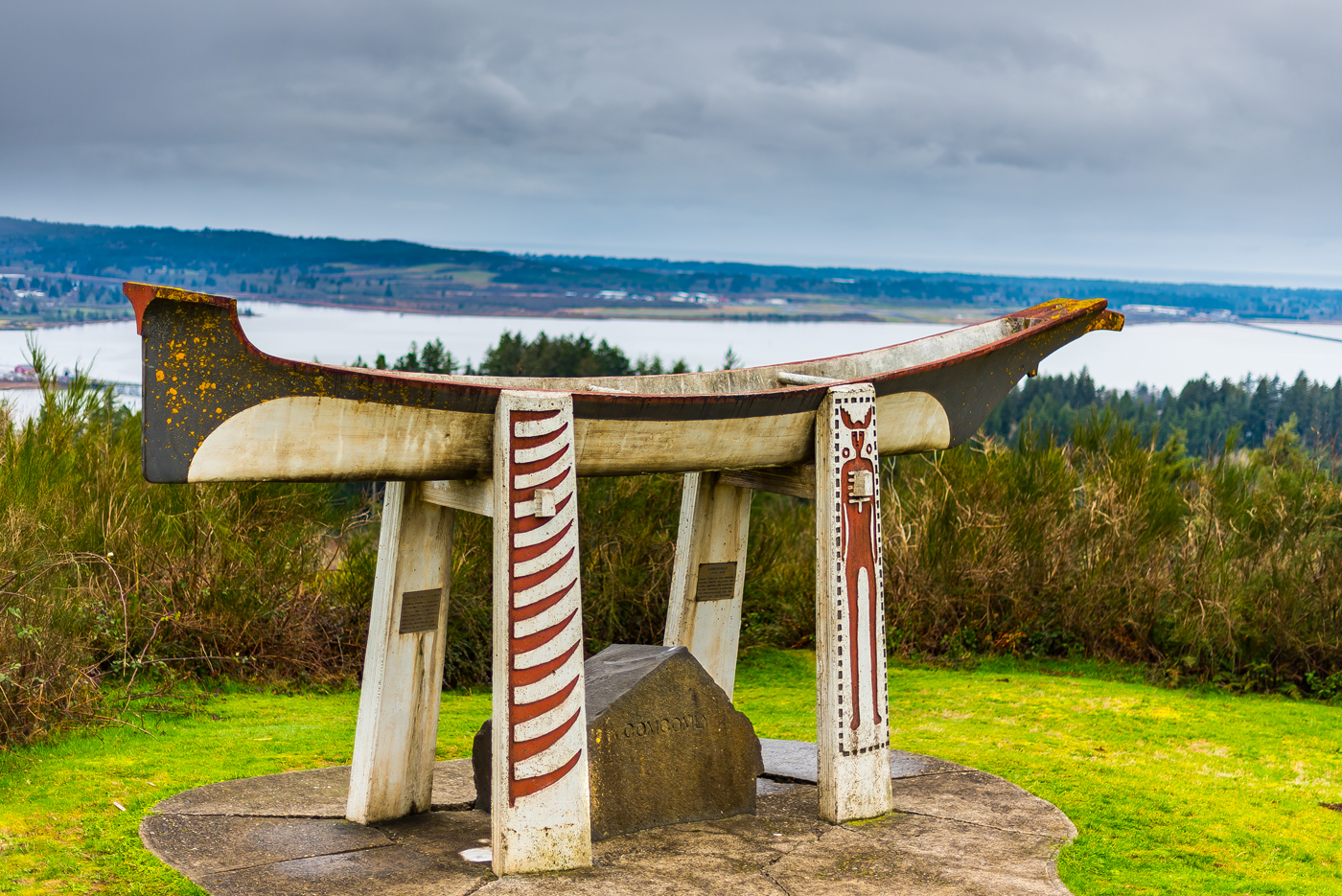
The symbolism of the 1961 monument to Concomly stands in striking contrast to the nearby tower, and differs sharply as well from the 1970 memorial park and house museum honoring John McLoughlin. The McLoughlin memorial focuses on John's role in founding a new state, and on how he and Margaret (or Marguerite) lived in their frontier home. Likewise, the Astoria column tells the story of early European traders and colonists conquering the region and taking possession of the land. Five hundred feet of scenes depicting the region's colonial history from the European discovery of the mouth of the Columbia River to the late nineteenth-century arrival of the railroad encircle the 125-foot column. But Concomly's is not a monument to a beginning; it is a monument to an end: a concrete replica of a gravesite that had been defiled more than a century before.Footnote 11
In 1972, the historical society finally complied with the wishes of Chinook living in the area and returned the skull to them, not for display or incorporation into a public monument, but for private burial. Concomly's descendants buried the skull in a modest, donated plot in the public cemetery of the small town of Ilwaco on the Washington coast, where many of the buried remain unnamed. Securing a site for the burial had been a frustrating last hurdle for the group of Chinook who wanted to bring Concomly home; the Chinook are not a federally recognized tribe, and the board of the historical society, in a strikingly patronizing move given how the society had treated Concomly's skull, questioned whether the Chinook could provide an appropriate burial place.Footnote 12
Concomly's Washington Coast interment could not have been more different from what had been planned for the Astoria Column site in 1961. In a newspaper article shortly before the reburial took place, Chinook Tribal Secretary Stephen Meriwether explained that in Concomly's day, “Death was at once sacred and frightful for the Chinooks. Death was accompanied by little ceremony for fear of disturbing the departed spirit. In keeping with what would have been Concomly's wishes, the Chinook Tribe will have no fanfare, no speeches, no press coverage, no ceremony. The chief will be quietly buried by his people. His grave will be marked by a simple plaque.”Footnote 13
And so end (at least for now) the travels of three bodies long dead. All three had been transformed into modern objects, though objects put to different uses and invested with different kinds of power during their century in motion: Oregon's founding father had moved as a thing conveying value to land, and making claims on it, by his proximity to it, ultimately becoming a centerpiece of a national historic site. His wife, by his side, had become an accessory to him—her identity as a Chippewa woman rarely mentioned, the events of the life she lived omitted from his founding tale. The Chinook chief, in contrast, had been neither celebrated nor forgotten. He had been stripped of his connections to land, his head passed from stranger to stranger as an object of curiosity, a thing to study, or to stare at in a museum display, until returned to Chinook caretakers after over a century on the move. That white and brown bodies would have such divergent histories, that they would be treated in such contrasting ways by the white people who had the power to treat them as people or as things, is such a truism that it can begin to seem mundane. But it is not. Because it is so common, and also so entrenched, it needs to be made visible again and again.
And even that master narrative conceals additional violence and shame, as illustrated by one last chapter in the life of John McLoughlin's corpse. The veneration afforded McLoughlin's body was only a veneer, but a veneer deemed so critical that one man chose to lift it only after his own death. Burt Brown Barker, who had served as both vice president of the University of Oregon and president of the Oregon Historical Society, mailed a letter to the Oregon Historical Society in 1968, detailing what he knew of the 1948 exhumation. He sealed the envelope with wax and wrote this across its face: “This envelope contains a statement made and signed by me telling of the finding and desecration of the skeleton of Dr. John McLoughlin. It is not to be opened until one year after my death.”Footnote 14
According to the six-page typed statement inside, despite news reports and testimonials that McLoughlin's body had been “well-preserved,” it had in fact been a mess in 1948. His casket had been destroyed by axes during the exhumation, and his skeleton extracted from the grave bone by bone. The stately casket showcased at the reburial had held a child's casket inside, in which perhaps not even all of McLoughlin's loose bones had been jumbled. The gravedigger who had done the collecting later reported that he had tried to explain to the priest directing his work that retrieving McLoughlin's casket and body intact could be a straightforward task, but the priest insisted on the faster, rougher work of collecting it in pieces. It was, the gravedigger said, “the most sacrilegious act” he had ever been asked to perform.Footnote 15
That Barker and others involved with the exhumation kept its details a secret suggests the shame they felt in handling McLoughlin's corpse as merely a thing. And yet death had transformed all three of these bodies into things—into objects that were, in practice if not imagination, handled as such. But Barker's shame at the rough handling of McLoughlin's corpse, even as Margaret's skeleton was also in disarray, and Concomly's head on exhibit across the state, reveals his sense that some bodies—and this elite white man's body in particular—should be understood as something more. The image, if not the reality, of the white body was to remain whole.
Whose corpse is treated as a thing, and whose is not, and why? Skeletons have ancestors and descendants. They may have markers of easy or difficult lives, but to the casual eye they seem to lack social markers of class, gender, and race. Yet Concomly and John McLoughlin, and Margaret McLoughlin as well, retained all three. The public and hidden histories of these bodies remind us that a body, like a landscape or a government archive, is historical evidence shaped by human choices and relationships that are sometimes, though not always, buried deep.