Introduction
Cannabis is the most widely used illicit substance in the world. The number of users is increasing and is estimated to range from 142.6 to 190.3 million worldwide, with the highest prevalence in young people (United Nations Office on Drugs and Crime, 2009). Although in the USA and Canada the overall lifetime prevalence of cannabis use is around 46%, in 18- to 24-year-olds the prevalence is 70% (Adlaf et al. Reference Adlaf, Begin and Sawka2005; Substance Abuse and Mental Health Services Administration, 2007). A recent US national survey (Johnston et al. Reference Johnston, O'Malley, Bachman and Schulenberg2009) showed that the lifetime prevalence among 13-year-old children is as high as 15%. In Europe, on average one in three adolescents between 15 and 24 years has ever used cannabis [European Monitoring Centre for Drugs and Drugs Addiction (EMCDDA), 2008]. Extensive use of cannabis by young individuals has led to concerns regarding potential impact on population mental health. Numerous large longitudinal studies have observed an independent effect of cannabis on the development of psychotic disorders (for a review, see Moore et al. Reference Moore, Zammit, Lingford-Hughes, Barnes, Jones, Burke and Lewis2007). However, the impact of cannabis use is not restricted to clinically manifest psychotic disorders. In the general population, cannabis use is dose-dependently associated with subclinical psychiatric symptoms such as psychotic experiences and negative symptoms (Arseneault et al. Reference Arseneault, Cannon, Poulton, Murray, Caspi and Moffitt2002; Fergusson et al. Reference Fergusson, Horwood and Swain-Campbell2003; Verdoux et al. Reference Verdoux, Sorbara, Gindre, Swendsen and van Os2003; Stefanis et al. Reference Stefanis, Delespaul, Henquet, Bakoula, Stefanis and van Os2004; Konings et al. Reference Konings, Henquet, Maharajh, Hutchinson and van Os2008; Miettunen et al. Reference Miettunen, Tormanen, Murray, Jones, Maki, Ebeling, Moilanen, Taanila, Heinimaa, Joukamaa and Veijola2008; Hides et al. Reference Hides, Lubman, Buckby, Yuen, Cosgrave, Baker and Yung2009). Three of these studies report that these associations are stronger in younger subjects (Arseneault et al. Reference Arseneault, Cannon, Poulton, Murray, Caspi and Moffitt2002; Fergusson et al. Reference Fergusson, Horwood and Swain-Campbell2003; Stefanis et al. Reference Stefanis, Delespaul, Henquet, Bakoula, Stefanis and van Os2004). A dose-dependent relationship between the amount of cannabis exposure and subclinical symptoms suggests that the level of exposure to tetrahydrocannabinol (THC), the main psychoactive component of cannabis (Mechoulam & Gaoni, Reference Mechoulam and Gaoni1965), determines this relationship. The association between age of initial cannabis use and subclinical symptoms is less straightforward. One possible explanation is that individuals who are prone to psychotic experiences are more inclined to smoke cannabis at an early age. However, there is also evidence suggesting that there is a window of vulnerability to cannabis exposure that explains the increased association between early use and psychiatric symptoms (Arseneault et al. Reference Arseneault, Cannon, Poulton, Murray, Caspi and Moffitt2002; Fergusson et al. Reference Fergusson, Horwood and Swain-Campbell2003; Stefanis et al. Reference Stefanis, Delespaul, Henquet, Bakoula, Stefanis and van Os2004). Animal studies, for instance, show that exposure to THC during critical periods of brain maturation, such as early puberty, has an impact on the development of several neurotransmitter systems (Trezza et al. Reference Trezza, Cuomo and Vanderschuren2008), suggesting that THC interferes with crucial processes in brain development. It is possible that the pathophysiological mechanisms underlying the associations with amount of use and the association with age of first use are distinct. If first exposure to cannabis early in life interferes with specific developmental processes, this may be reflected in a specific profile of subclinical psychiatric symptoms. A more detailed study of the association between cannabis use and subclinical psychiatric experiences may therefore reveal how these different aspects of cannabis use have an impact on subclinical psychiatric experiences.
Since several studies show that a high score on self-reported psychotic symptoms predict an increased risk of a psychotic disorder later in life (Chapman et al. Reference Chapman, Chapman, Kwapil, Eckblad and Zinser1994; Poulton et al. Reference Poulton, Caspi, Moffitt, Cannon, Murray and Harrington2000; Hanssen et al. Reference Hanssen, Bak, Bijl, Vollebergh and van Os2005; Wiles et al. Reference Wiles, Zammit, Bebbington, Singleton, Meltzer and Lewis2006; Yung et al. Reference Yung, Nelson, Baker, Buckby, Baksheev and Cosgrave2009), it is particularly interesting to study the relationship between cannabis use and high scores of these subclinical psychiatric experiences. We here report a study on the association between the amount of cannabis use and the age of initial cannabis use and top 10% scores in three symptom dimensions of self-reported psychiatric experiences in a large population sample.
Method
Participants
Participants were recruited using a project website mainly targeting Dutch-speaking adolescents and young adults (18–25 years). Recruitment strategies included cooperation with more than 100 colleges, universities and youth centres that were willing to advertise for this study on their intranet and the use of online commercial advertisement products (i.e. banners and text links). The chance to win an Apple iPod™ or a Nintendo Wii™ was used as an incentive. Participants answered questions regarding their cannabis use, filled out the Community Assessment of Psychic Experiences (CAPE; Konings et al. Reference Konings, Bak, Hanssen, van Os and Krabbendam2006) questionnaire and provided their age, educational level and contact details. Submitting data anonymously was not possible. Every month approximately 670 visitors filled out our web-based questionnaires between June 2006 and February 2009. This resulted in 21 838 participants. The assessment included two verification questions to protect against random answers. Participants that failed to correctly fill out the verification questions were excluded. To increase the homogeneity of the sample, participants that indicated that they were aged <10 years or >60 years of age were excluded. After exclusion of these individuals, 17 698 participants remained (81% of 21 838). This study was approved by the University Medical Centre Utrecht medical ethical commission and all participants gave online informed consent.
Assessments
As a measure of subclinical psychiatric experiences, the CAPE questionnaire was used. The CAPE is a 42-item, self-rating instrument and has a three-factor structure of 20 questions in the positive symptom dimension (delusional thinking, verbal and visual hallucinations), 14 in the negative and eight in the depressive dimension. It measures frequency as well as distress associated with these experiences. The questionnaire has discriminative validity for the different symptom dimensions in individuals from the general population (Stefanis et al. Reference Stefanis, Hanssen, Smirnis, Avramopoulos, Evdokimidis, Stefanis, Verdoux and van Os2002; Hanssen et al. Reference Hanssen, Peeters, Krabbendam, Radstake, Verdoux and van Os2003; Konings et al. Reference Konings, Bak, Hanssen, van Os and Krabbendam2006) (http://www.cape42.homestead.com/). The primary outcome measure was the odds ratio (OR) to belong to the highest 10% of total- and dimensional scores (positive, negative and depressive). Web-based questionnaires are reliable for epidemiological research purposes, especially in settings in which internet access is high (Ekman et al. Reference Ekman, Dickman, Klint, Weiderpass and Litton2006), as is the case in The Netherlands where 99% of all adolescents use the internet on a daily basis (CBS Statistics Netherlands, 2009).
Cannabis measures
In The Netherlands, THC concentration and cannabis market value are highly correlated in marijuana (r=0.365, p<0.001) and in hashish (r=0.719, p<0.001) (Niesink et al. Reference Niesink, Rigter, Hoek and den Boer2009). Therefore, we assessed the amount of Euros (€) spent on cannabis per week in the last month, as a proxy measure of exposure to THC. For reference, prices range from €4.30 for 1 g of imported marijuana with an average THC content of 5.5% to €15 per g for Dutch hashish with an average THC concentration of 33.3% (van Laar et al. Reference van Laar, Cruts, Verdurmen, van Ooyen-Houben and Meijer2008). Participants were asked how many Euros equivalent of cannabis they use per week and to choose one of the following classes: (1) cannabis-naive individuals who indicated never to have used cannabis; (2) participants using cannabis incidentally or spending less than €3 per week; (3) individuals spending between €3 and €10 per week on cannabis; (4) participants spending between €10 and €25 per week; and (5) individuals spending more than €25 per week on cannabis. All categories (except for the first two groups) applied to the last month or longer. The initial age of cannabis use was categorized by asking participants which of the following five subgroups describes their cannabis-use history: (1) participants who started to use before the age of 12 years; (2) first cannabis use between 12 and 15 years; (3) first cannabis use between 15 and 18 years; (4) first cannabis use between 18 and 20 years; and (5) individuals that started to use after their 20th birthday.
Concomitant drug use
As part of another ongoing study, the first 13 000 participants were asked to fill out a number of additional questionnaires on various topics such as concomitant drug use. A subsample of 816 participants completed a digital version of the drug-use section of the Composite International Diagnostic Interview (Robins et al. Reference Robins, Wing, Wittchen, Helzer, Babor, Burke, Farmer, Jablenski, Pickens and Regier1988). This subsample did not differ significantly from the total sample in terms of cannabis use, CAPE score, age, gender and educational level.
Statistical analysis
First, we analysed the relationship between the weekly amount of money spent on cannabis and having a top 10% score on the different symptom dimensions. ORs and their 95% confidence intervals (CIs) for the amount of cannabis use were calculated using logistic regression, with a dichotomized score on the total CAPE and the three dimensions of the CAPE as the dependent variable and THC exposure categories as the independent variables. Cannabis-naive individuals were used as the reference group. Corrected ORs and their 95% CI were calculated with additional adjustment for age, gender and level of education. Second, in the subgroup that used cannabis, ORs and their 95% CI for initial age of cannabis use were calculated using logistic regression, with a dichotomized score on the total CAPE and the three dimensions of the CAPE as the dependent variable and age categories as the independent variables. The age category of modal initial age (15–18 years) was used as the reference group to assess the risks of early use (i.e. before the age of 12 years) compared with a more common starting age of cannabis use. Corrected ORs and their 95% CIs were calculated with additional adjustment for age, gender and level of education.
To assess the sensitivity of our results to selection bias, we performed two additional analyses. We estimated the impact of a hypothetical decrease in the number of heavy users (>€25/week) with total CAPE score in the top 10% of the distribution. The same calculation was performed considering a hypothetical decrease of individuals with a top 10% CAPE score who started to use cannabis at or before the age of 12 years. Randomly, a predefined fraction of the heavy or young users was excluded and the association between cannabis use and a top 10% CAPE score was estimated in the remaining participants. This procedure was repeated 1000 times for each predefined fraction and ORs and their CIs were pooled using Rubin's rule (Rubin, Reference Rubin1987).
Additional analyses were performed to assess the influence of lifetime concomitant drug use using the logistic regression model as described before with an extra indicator for concomitant use. Data were analysed using R for Windows, version 2.9.1 (Development Core Team, 2005).
Results
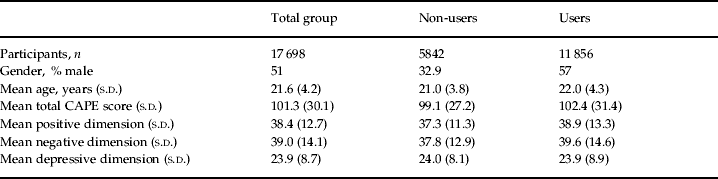
A total of 17 698 subjects participated in our study. The mean age in our sample was 21 years (s.d.=4.2 years) and 51% was male. The educational level of the sample was comparable with the Dutch population in this age group (CBS Statistics Netherlands, 2008). No educational diploma had been attained by 0.1% of the sample, secondary school was the highest educational attainment in 50.4%, 34.3% had a non-academic post-secondary school diploma and 8.3% had an academic diploma. Table 1 presents further characteristics of the sample.
Participant characteristics

s.d., Standard deviation; CAPE, Community Assessment of Psychic Experiences.
Initial age of cannabis use
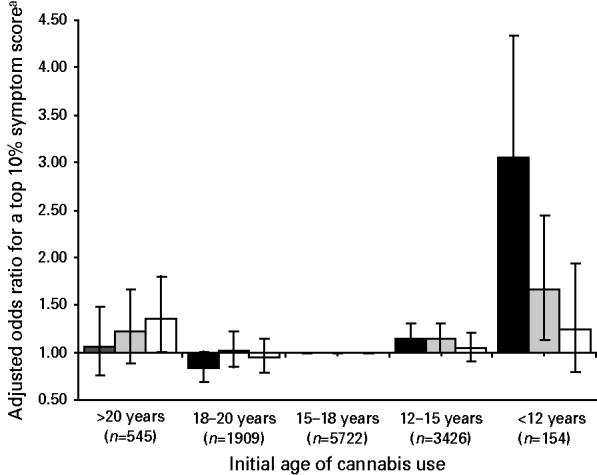
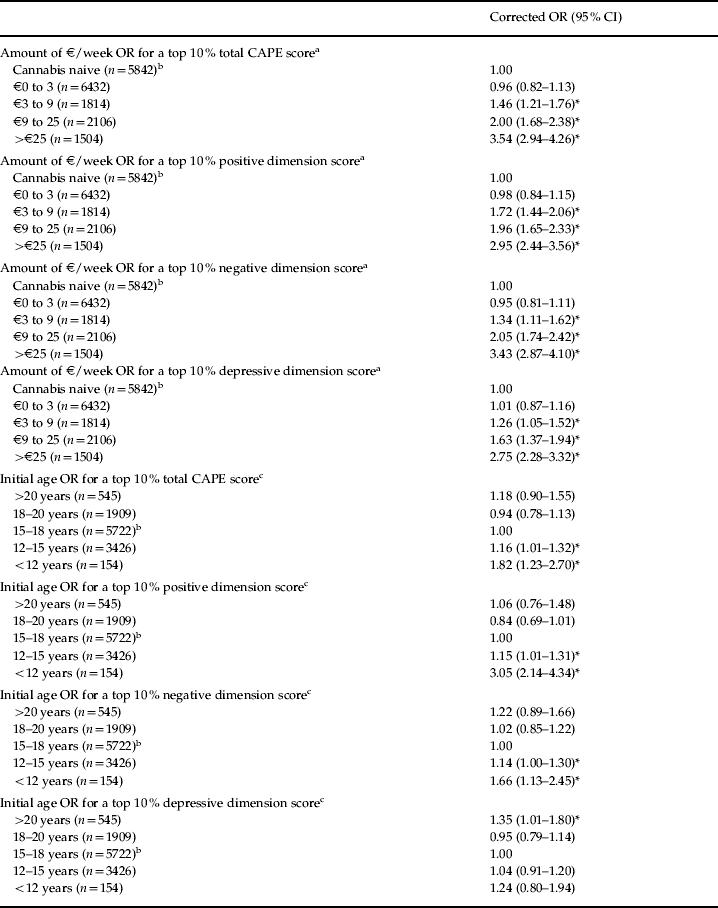
Individuals who started to use cannabis before the age of 12 years had an adjusted OR of 3.1 (95% CI 2.1–4.3) for the highest 10% of scores on psychotic experiences compared with participants with a modal starting age (15–18 years). Starting to use between the age of 12 and 15 years resulted in an adjusted OR of 1.2 (95% CI 1.0–1.3). Initial age of cannabis use after 18 years was not associated with an increased score on psychotic experiences. An increase of experiences in the negative symptom dimension was associated with using cannabis before the age of 12 years (OR 1.7, 95% CI 1.1–2.5) and also before the age of 15 years (OR 1.1, 95% CI 1.0–1.3). Using cannabis for the first time after the age of 18 years was not associated with an increased OR for the negative symptom dimension. In contrast, depressive symptoms were not associated with a young initial age of cannabis use. However, individuals who started after the age of 20 years experienced more depressive symptoms than the reference group (OR 1.4, 95% CI 1.0–1.8). Fig. 1 depicts adjusted ORs for five categories of initial age of cannabis use and a psychotic experiences score in the top 10% in the three symptom dimensions. Table 2 shows all adjusted ORs and their 95% CIs for top 10% scores on the total CAPE and its three symptom dimensions.
Subclinical psychiatric symptoms and initial age of cannabis use with the modal starting age category (15–18 years) as the reference group (total n=11 856). Values are odds ratios (ORs), with 95% confidence intervals represented by vertical bars. ▪, Initial age OR for a top 10% psychotic experiences score;  , initial age OR for a top 10% negative dimension score; □, initial age OR for a top 10% depression dimension score. a Adjusted for age, gender, educational level and amount of cannabis use.

Full-model ORs with 95% CIs for the top 10% scores on the three symptom dimensions and the total scores of psychiatric experiences

OR, Odds ratio; CI, confidence interval; CAPE, Community Assessment of Psychic Experiences.
a Adjusted for age, gender, level of education and onset age of cannabis consumption in the total study population.
b Reference group in logistic regression analysis.
c Adjusted for age, gender, level of education and onset age of cannabis consumption in the cannabis users.
* Significant ORs (p<0.05).
Quantity of weekly cannabis use
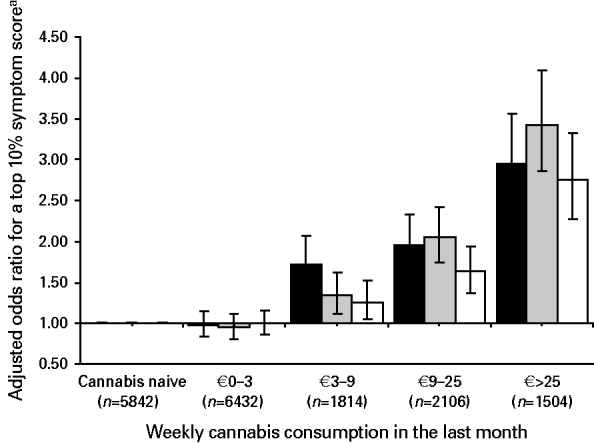
Analysing the ORs associated with quantity of use, we found that the OR for a top 10% score on psychotic experiences increases with the amount of cannabis that subjects indicate using weekly. ORs for a top 10% score on psychotic experiences range from 1.7 (95% CI 1.1–2.1) in users consuming €3–9 weekly to 3.0 (95% CI 2.4–3.6) in heavy users (>€25). Likewise, quantity of use was associated with negative symptoms, with adjusted ORs ranging from 1.3 (95% CI 1.1–1.6) in participants who used between €3 and €9 per week to 3.4 (95% CI 2.9–4.1) in individuals who consumed a weekly equivalent of more than €25. Computation of the adjusted ORs for a top 10% score on depressive symptoms produced an OR of 1.3 (95% CI 1.1–1.5) in participants who used a weekly cannabis equivalent of €3–9. Spending more than €25 per week on cannabis was associated with an adjusted OR of 2.8 (95% CI 2.3–3.3) in this symptom dimension. Cannabis-naive subjects were used as the reference group in these analyses. All ORs are listed in Table 2. Fig. 2 depicts the adjusted OR per category of weekly amount of use for a top 10% score on each of the three symptom dimensions.
Subclinical psychiatric symptoms and weekly amount of use during the last month or longer with the cannabis-naive group as reference (total n=17 698). Values are odds ratios (ORs), with 95% confidence intervals represented by vertical bars. ▪, Amount of €/week OR for a top 10% psychotic experiences score; , amount of €/week OR for a top 10% negative dimension score; □, amount of €/week OR for a top 10% depression dimension score. a Adjusted for age, gender and educational level.

Concomitant drug use
In the subsample in which information on concomitant drug use was available (n=816, not shown in tables), we performed an additional logistic regression analysis to assess the impact of lifetime use of drugs other than cannabis on the presented associations. In the group that used more than €25-worth of cannabis weekly, the OR for a top 10% total CAPE score was 14.35 (95% CI 3.3–61.6) after adjustment for concomitant drug use. In this model, the OR for a top 10% CAPE score associated with concomitant drug use was 3.1 (95% CI 0.8–12.7). The OR for a top 10% total CAPE score in participants who started before the age of 12 years was 2.3 (95% CI 0.6–8.7) after adjustment for concomitant use. In the model for age of initial use, the OR associated with the presence or absence of concomitant drug use was 0.9 (95% CI 0.4–2.0). A wide CI and strong collinearity between concomitant drug use and an early initial age of cannabis use (r>0.8) indicate a weak statistical model.
Analysis of sensitivity to selection bias
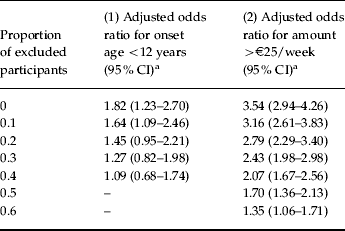
It is conceivable that subjects experiencing psychiatric symptoms were more likely to participate in our study. If such selection was simultaneously skewed towards those that started to use cannabis before the age of 12 years or use more than €25 per week, selection bias could have influenced the results. To quantitatively assess the sensitivity of the current design to such selection bias, we calculated the impact of a decrease in the number of participants with a high total score on psychiatric experiences (total CAPE) and (1) a history of initial cannabis use before the age of 12 years or (2) having used a cannabis equivalent of more than €25 during the last month. These analyses indicate that the OR would remain significant until 20% of participants with a high score on psychiatric experiences who also started to use cannabis before the age of 12 years are excluded from the analysis. Exclusion of 63% of participants with a high score on psychiatric experiences and heavy use (>€25/week) over the last month would render the association non-significant. The adjusted ORs for several hypothetical steps can be found in Table 3.
Selection bias analysis, showing hypothetical adjusted odds ratios after exclusion of different proportions of participants with a total CAPE score in the top 10% of the distribution and (1) initial age of use before the age of 12 years or (2) heavy use (>€25/week) of cannabis

CAPE, Community Assessment of Psychic Experiences; CI, confidence interval.
a Adjusted for age, gender and level of education.
Discussion
We investigated the association between initial age and amount of cannabis use and psychiatric experiences in three symptom dimensions (positive, negative and depressive) in a sample of over 17 500 participants with a mean age of 21 years. We found that young initial age of cannabis use is strongly associated with current psychotic experiences. Although young cannabis users also had significantly increased ORs of experiencing more negative symptoms, the OR for psychotic experiences was almost twice as high. Depressive symptoms were not associated with early onset of cannabis use. We also found that the amount of cannabis use is equally strongly related to positive-, negative- and depressive symptoms. Finally, our results show that moderate cannabis use and onset of cannabis use after the age of 18 years did not increase the odds for having subclinical psychiatric experiences.
Initial age of cannabis use
An age-related association between cannabis use and subclinical symptoms has been described before. However, from these studies it is not possible to identify the most vulnerable age group (Arseneault et al. Reference Arseneault, Cannon, Poulton, Murray, Caspi and Moffitt2002; Fergusson et al. Reference Fergusson, Horwood and Swain-Campbell2003; Stefanis et al. Reference Stefanis, Delespaul, Henquet, Bakoula, Stefanis and van Os2004). As these studies were cross-sectional too, they also do not allow causal inference. Therefore it is possible that this association reflects an increased propensity of young people with psychotic experiences to commence cannabis use. Another alternative explanation of these findings could be higher cumulative exposure to cannabis of early users. This hypothesis assumes that subjects that started at a young age continued to use cannabis in a certain pattern until the present date; however, detailed information on the pattern of use from onset to current use was not available. The disproportional level of psychotic symptoms among young cannabis users, compared with the more balanced profile of psychiatric symptoms that is associated with current quantity of cannabis use, is not easily explained by reverse causality or higher cumulative exposure. However, given the cross-sectional nature of the data, such causal inference cannot be made.
An alternative hypothesis is that increased vulnerability to THC during critical phases of brain maturation, as in early puberty, is reflected in a specific association between psychotic experiences and a young initial age of THC exposure. Such a window of vulnerability in early puberty is supported by a recent cohort study that showed that early cannabis use is a risk-modifying factor for psychosis-related outcomes in young adults (McGrath et al. Reference McGrath, Welham, Scott, Varghese, Degenhardt, Hayatbakhsh, Alati, Williams, Bor and Najman2010) and by experimental studies of the endocannabinoid system (ECN). The ECN plays an important role in brain organization during prenatal development and early puberty (Chevaleyre et al. Reference Chevaleyre, Takahashi and Castillo2006). Exposure to high levels of exo-cannabinoids, such as THC, can disrupt neuronal signalling and might interfere with the activity of the ECN during stages of high neuronal plasticity (Lewis, Reference Lewis1997; Trezza et al. Reference Trezza, Cuomo and Vanderschuren2008). In animal models, exposure to cannabinoids during critical periods of brain maturation has a profound influence on the development of γ-amino butyric acid (GABA)ergic- (Garcia-Gil et al. Reference Garcia-Gil, de Miguel, Romero, Perez, Ramos and Fernandez-Ruiz1999), glutamatergic- (Suarez et al. Reference Suarez, Bodega, Fernandez-Ruiz, Ramos, Rubio and Fernandez2004), serotonergic- (Molina-Holgado et al. Reference Molina-Holgado, Alvarez, Gonzalez, Antonio and Leret1997) and the catecholaminergic system (Garcia-Gil et al. Reference Garcia-Gil, de Miguel, Munoz, Cebeira, Villanua, Ramos and Fernandez-Ruiz1997; Fernandez-Ruiz et al. Reference Fernandez-Ruiz, Berrendero, Hernandez and Ramos2000; Hernandez et al. Reference Hernandez, Berrendero, Suarez, Garcia-Gil, Cebeira, Mackie, Ramos and Fernandez-Ruiz2000). In agreement with such an impact of THC exposure early in life on the development of neurotransmitter systems, a number of papers have reported a dramatic effect of THC exposure in early puberty on various cognitive measures in animals (Schneider & Koch, Reference Schneider and Koch2003; O'Shea et al. Reference O'Shea, Singh, McGregor and Mallet2004; Cha et al. Reference Cha, White, Kuhn, Wilson and Swartzwelder2006; Quinn et al. Reference Quinn, Matsumoto, Callaghan, Long, Arnold, Gunasekaran, Thompson, Dawson, Mallet, Kashem, Matsuda-Matsumoto, Iwazaki and McGregor2008).
We also noticed the relatively high symptom scores among individuals that started to use cannabis after the age of 20 years.
Quantity of weekly cannabis use
The second main finding of our study is that the amount of weekly cannabis use is equally associated with positive-, negative- and depressive symptoms (Fig. 2). In subjects who use cannabis excessively (>€25 per week) the OR for increased negative symptoms is 3.4 (95% CI 2.9–4.1), for psychotic experiences the OR is 3.0 (95% CI 2.4–3.6) and for a top 10% score on depressive symptoms the OR is 2.8 (95% CI 2.3–3.3). These ORs are similar to those reported for the association between the amount of cannabis use and developing a psychotic disorder (Moore et al. Reference Moore, Zammit, Lingford-Hughes, Barnes, Jones, Burke and Lewis2007). An association of cannabis use with depression has also been found before (Patton et al. Reference Patton, Coffey, Carlin, Degenhardt, Lynskey and Hall2002; Moore et al. Reference Moore, Zammit, Lingford-Hughes, Barnes, Jones, Burke and Lewis2007) but not in two previous studies utilizing the CAPE (Verdoux et al. Reference Verdoux, Sorbara, Gindre, Swendsen and van Os2003; Stefanis et al. Reference Stefanis, Delespaul, Henquet, Bakoula, Stefanis and van Os2004).
Three previous studies reported that the association between cannabis use and psychiatric symptoms is stronger in younger subjects (Arseneault et al. Reference Arseneault, Cannon, Poulton, Murray, Caspi and Moffitt2002; Fergusson et al. Reference Fergusson, Horwood and Swain-Campbell2003; Stefanis et al. Reference Stefanis, Delespaul, Henquet, Bakoula, Stefanis and van Os2004). However, the current study is the first to explicitly examine associations with specific symptom profiles. Due to the large sample size we are able to directly compare groups with different initial ages of cannabis use, including a group that started before the age of 12 years. Other strengths of the current study are the informative measure of THC exposure (€/week), use of a single well-validated instrument (CAPE) in all subjects and an anonymous setting which potentially increases the questionnaire sensitivity (Buchanan & Smith, Reference Buchanan and Smith1999; Joinson, Reference Joinson1999). By choosing a top 10% CAPE score as the primary outcome, a stringent measure was selected in order to increase relevancy. Individuals with particularly high scores on self-reported psychotic symptoms have a higher risk of developing a psychotic disorder later in life (Poulton et al. Reference Poulton, Caspi, Moffitt, Cannon, Murray and Harrington2000; Wiles et al. Reference Wiles, Zammit, Bebbington, Singleton, Meltzer and Lewis2006; Yung et al. Reference Yung, Nelson, Baker, Buckby, Baksheev and Cosgrave2009); by choosing a top 10% cut-off, we intended to maximize the informational value of the study.
Web-based questionnaire
The increased availability of internet access and the development of better web-based tools have improved the possibilities of acquiring information on psychiatric symptoms via the internet such that they are considered a valid additional method in epidemiological research (Meyerson & Tryon, Reference Meyerson and Tryon2003; Gosling et al. Reference Gosling, Vazire, Srivastava and John2004; Balter et al. Reference Balter, Balter, Fondell and Lagerros2005; Ekman et al. Reference Ekman, Dickman, Klint, Weiderpass and Litton2006). Over the last years, numerous internet-based assessments have been validated that measure a variety of psychiatric phenotypes ranging from cannabis abuse to depression (Houston et al. Reference Houston, Cooper, Vu, Kahn, Toser and Ford2001; Graham et al. Reference Graham, Papandonatos, Bock, Cobb, Baskin-Sommers, Niaura and Abrams2006; Coles et al. Reference Coles, Cook and Blake2007; Lin et al. Reference Lin, Bai, Liu, Hsiao, Chen, Tsai, Ouyang, Wu and Li2007; Vallejo et al. Reference Vallejo, Jordan, Diaz, Comeche and Ortega2007; Cuijpers et al. Reference Cuijpers, Boluijt and van Straten2008; Graham & Papandonatos, Reference Graham and Papandonatos2008; Khazaal et al. Reference Khazaal, Chatton, Cochand and Zullino2008; Spek et al. Reference Spek, Nyklicek, Cuijpers and Pop2008; Donker et al. Reference Donker, van Straten, Marks and Cuijpers2009). On a more critical note, the use of web-based assessments could potentially have led to instrument inaccuracy or to information bias. However, the distribution of this potential inaccuracy is most probably independent of cannabis use (exposure measure) and psychiatric experiences (outcome measure) and is therefore unlikely to have systematically influenced the reported associations. A second potential concern is the possibility of selection bias due to the online subject recruiting strategy. However, as described in the sensitivity analysis, our results are fairly robust against selection bias. Even in the unlikely event that selection has led to a 20% increase in participants with early cannabis use and high symptoms score, the results would remain significant.
A potential limitation is the limited availability of information on concomitant drug use. However, analysis of these data shows that after adjusting for concomitant drug use, the OR for psychotic experiences increased to 14.4 (95% CI 3.3–61.6) in the group that started before the age of 12 years. Therefore, these adjusted ORs do not weaken the associations reported earlier.
Finally, it is important to notice that the associations presented here are based on current (last month) and not cumulative cannabis use. It is not known what proportion of users has a longer history of cannabis use, implicating that we cannot disentangle acute intoxication from long-term effects.
Despite the fact that the informational value of the current dataset is limited by the retrospective and cross-sectional design precluding any inference on causality, this study shows that heavy current cannabis use is associated with a different symptom profile compared with early cannabis use. This finding converges with epidemiological and animal studies and supports the hypothesis that there is a window of increased vulnerability of the maturing brain to the effects of exo-cannabinoids such as THC, during early puberty. Given the developmental nature of psychotic disorders (van Os & Kapur, Reference van Os and Kapur2009), further studies are warranted to examine the influence of cannabis on brain development.
Acknowledgements
This study was financially supported by a grant of the NWO (Netherlands Organization for Scientific Research), grant no. 91207039.
The study was performed at the University Medical Centre Utrecht, The Netherlands.
Declaration of Interest
None.