INTRODUCTION
The importance of investigating predictive sentence processing in L1 and L2 learners was justified by Phillips and Ehrenhofer (Reference Phillips and Ehrenhofer2015), who argued that doing so can illuminate what creates discrepancies between L1 and L2 behaviors. Of greater interest in predictive sentence processing is the simultaneous processing of more than one source of information, in both L1 (Ferreira et al., Reference Ferreira, Bailey and Ferraro2002; Ferreira et al., Reference Ferreira, Engelhardt, Jones, Taatgen, Rijn, Nerbonne and Schomaker2009; Ferreira & Patson, Reference Ferreira and Patson2007; Hagoort et al., Reference Hagoort, Hald, Bastiannsen and Petersson2004; Karimi & Ferreira, Reference Karimi and Ferreira2016) and L2 (Clahsen & Felser, Reference Clahsen and Felser2006, Reference Clahsen and Felser2018; Cunnings, Reference Cunnings2017; Sorace, Reference Sorace2011; Sorace & Filliaci, Reference Sorace and Filliaci2006). The common claim of such studies was that initial misinterpretations and failures to revise them result from having to process multiple sources of information synchronously. However, discussions of how different types of knowledge are integrated in real-time processing have lacked consideration of what motivates L2 speakers to prioritize one type of information over another. This study aimed to find an answer to the question by exploring processing efficiency.
To examine whether L2 speakers indeed process different types of information in different ways and whether efforts to minimize processing costs (O’Grady, Reference O’Grady2015) could motivate L2 behavior, this study explored what happened when linguistic information and nonlinguistic information pointed to the same or different referents. Definiteness semantics was chosen for linguistic information because it was one of the most challenging aspects of English grammar for L2 learners whose L1 lacked a similar system and because it was a nonstructural grammar feature. To claim that L2 speakers rely more on one type of knowledge than another, one needs to tease apart the different sources of knowledge. However, it seems implausible to completely separate syntax from other domains of linguistic knowledge. Therefore, definiteness semantics, nonstructural linguistic knowledge, was selected.
For nonlinguistic information, real-world knowledge was chosen, some examples of which are associations between doctors and stethoscopes, between construction workers and hammers, and between scientists and microscopes. Such real-world knowledge was chosen because it has been well documented that such knowledge is incrementally integrated in L1 sentence processing (Altmann & Kamide, Reference Altmann and Kamide1999, 2007; Altmann & Mirkovic, Reference Altmann and Mirkovic2009; Kamide, Reference Kamide2008; Kamide et al., Reference Kamide, Altmann and Haywood2003) but has been relatively less studied with regard to L2 processing (cf., Martin et al., Reference Martin, Garcia, Breton, Thierry and Costa2015). Another reason for this choice is its relative availability to L1 and L2 learners. L1 children seem to acquire many linguistic features in the absence of real-world knowledge available to mature adult L2 learners. Discrepancies between L1 and L2 acquisition may arise because the cognitive development of adult L2 learners has progressed to a certain degree and their understanding of the world is in place when they acquire a new set of rules in L2. Hence, testing the integration of linguistic and nonlinguistic information will shed light on the role that real-world knowledge, whose availability differs for L1 and L2 learners, plays in acquiring and processing grammar in an additional language.
BACKGROUND
LINGUISTIC INFORMATION: DEFINITENESS AS UNIQUE IDENTIFIABILITY
The acquisition and use of English articles in L2 have been investigated by numerous researchers for many research purposes using different research methods, resulting in a great variety of findings (Ahn, Reference Ahn2021; Bickerton, Reference Bickerton1981; Butler, Reference Butler2002; Huebner, Reference Huebner1983; Ionin, Reference Ionin2006; Ionin et al., Reference Ionin, Ko and Wexler2004; Ionin et al., Reference Ionin, Zubizarreta and Maldonado2008; Ionin et al., Reference Ionin, Zubizarreta and Philippov2009; Ionin & Zubizarreta, Reference Ionin and Zubizarreta2010; Ko et al., Reference Ko, Ionin and Wexler2010; Trenkic et al., Reference Trenkic, Mirkovic and Altmann2014, inter alia). Some argue that nontargetlike L2 behaviors originate from the deficit or instability of grammatical knowledge (Ionin, Reference Ionin2006; Ionin et al., Reference Ionin, Ko and Wexler2004; Ionin et al., Reference Ionin, Zubizarreta and Maldonado2008; Ionin et al., Reference Ionin, Zubizarreta and Philippov2009; Ionin & Zubizarreta, Reference Ionin and Zubizarreta2010; Ko et al., Reference Ko, Ionin and Wexler2010). However, more recent studies have reported that L2 English article use could reach the state of targetlike mastery (Trenkic et al., Reference Trenkic, Mirkovic and Altmann2014) even if L2 article processing could be slightly delayed behind that of L1 speakers (Ahn, Reference Ahn2021). Such differences in findings among many studies could be due to methodological issues.
One important issue is how definiteness is defined and operationalized for experimentation. Definiteness, as a distinguishing feature of definite and indefinite articles in English, has been defined in terms of givenness (Heim, Reference Heim1988) and unique identifiability (Hawkins, Reference Hawkins1978, Reference Hawkins1991; Russell, Reference Russell1905). Debating which theory can better account for definiteness goes beyond the scope of the current study. However, when “givenness” is used to distinguish definite noun phrases (NPs) from indefinite NPs (Heim, Reference Heim1988), definite NPs are repeated, and indefinite NPs are not, which could provide unintended metalinguistic clues to participants. Even if an online experiment is used and participants do not notice the repetition of critical NPs in the definite condition and the lack thereof in the indefinite condition, they will end up being primed for the critical NP in the definite condition but not in the indefinite condition (Gernsbacher & Robertson, Reference Gernsbacher, Robertson, Louwerse and Peer2002, p. 14). This discrepancy in priming makes it difficult to compare the two conditions on level ground.Footnote 1
In the present study, definiteness is defined in terms of unique identifiability such that the (in)definiteness of the critical NP need not be determined by the presence and absence of a previous mention. For example, in “In the kitchen, Jason checked out the stove” (Clifton, Reference Clifton2013), the definite NP the stove is used because it is presupposed that the kitchen must have a uniquely identifiable stove. When such a presupposition is not viable, as with “In the appliance store, Jason checked out a stove” (Clifton, Reference Clifton2013), an indefinite NP (a stove) is used. That is, unique identifiability does not require the distinction to be made through the presence and absence of repeated NPs. In addition, various studies report that L1 speakers use definiteness defined in the sense of unique identifiability in online sentence processing (Burkhardt, Reference Burkhardt2006, Reference Burkhardt and Grønn2008a, Reference Burkhardt, Benz and Kühnlein2008b; Clifton, Reference Clifton2013; Schumacher, Reference Schumacher, Devi, Branco and Mitkov2009).
Trenkic et al. (Reference Trenkic, Mirkovic and Altmann2014) used the notion of unique identifiability and a visual world paradigm eye-tracking experiment to probe L2 speakers’ ability to predict an upcoming referent based on definiteness information in comparison to L1 speakers. Based on their findings, they argued that L1-Chinese L2-English speakers at an intermediate level of proficiency could process the grammatical knowledge of definiteness in a targetlike manner. They reported that the L2 participants’ looks to the target diverged from that to the competitor earlier when definiteness matched pragmatic affordances. Their interpretation of the findings, however, needs reconsidering given the following facts.
The experimental setup they used involved real-world knowledge. Their auditory stimuli, “Put the cube inside the / a can,” were given in the visual contexts of either an open can and a closed can (unique target condition) or two open cans (nonunique target condition). The definite NP and the indefinite NP sentences were grammatical in unique and nonunique target conditions, respectively. The design was borrowed from Chambers et al. (Reference Chambers, Tanenhaus, Eberhard, Filip and Carlson2002), who originally intended to investigate the role of situational contexts in grammatical processing. Their research purpose was to examine the role of nonlinguistic factors such as the availability of an object as a semantic goal in sentence processing, rather than the effect of definiteness per se. Therefore, interpreting Trenkic et al.’s (Reference Trenkic, Mirkovic and Altmann2014) findings as evidence for L2 speakers’ nativelike grammatical knowledge might make for a hasty conclusion.
Indeed, it was in different conditions that L1 and L2 speakers took the shortest time to divert their attention from competitors to targets. L1 speakers could locate a target fastest in the indefinite, two-target condition, not in the definite, one-target condition, which is a convincing outcome in that 40% of the candidate referents were targets in the former condition as opposed to 20% in the latter. However, Chinese L2 speakers of English were fastest in the definite/one referent condition, and it took almost twice as much time for their looks to diverge from competitors to targets in the indefinite condition than in the definite condition. These issues raise questions about L2 speakers’ ability to use definiteness information to predict an upcoming referent and the role that real-world knowledge plays in L2 sentence processing.
To revisit such issues, the current study recruited L1-Korean L2-English speakers and used experimental setups where grammatical information and real-world knowledge could be separated. Korean is another article-less language, and there are a large number of studies that investigated L2 English article use by Korean speakers, who find the English article system a great obstacle to master the language (Ionin, Reference Ionin2006; Ionin et al., Reference Ionin, Ko and Wexler2004; Ionin et al., Reference Ionin, Baek, Kim, Ko and Wexler2012; Ko et al., Reference Ko, Ionin and Wexler2010).
NONLINGUISTIC INFORMATION: REAL-WORLD KNOWLEDGE
The role of real-world knowledge in L1 processing has been investigated by many researchers (Altmann & Kamide, Reference Altmann and Kamide1999, 2007; Chambers et al., Reference Chambers, Tanenhaus, Eberhard, Filip and Carlson2002; Hagoort et al., Reference Hagoort, Hald, Bastiannsen and Petersson2004; Kamide et al., Reference Kamide, Altmann and Haywood2003; Martin et al., Reference Martin, Garcia, Breton, Thierry and Costa2014, inter alia). In general, findings suggest that real-world knowledge, which is nonlinguistic, is actively used in L1 sentence processing. Real-world knowledge is incrementally integrated as it becomes available at different points in the sentence, making it possible for listeners to predict upcoming linguistic material even before critical phrases are presented. In combination with semantic information, real-world knowledge was shown to help listeners make anticipatory eye movements toward unmentioned objects (Altmann & Kamide, Reference Altmann and Kamide1999). It also plays a role in predictive processing combined with a verbal tense (Altmann & Kamide, Reference Altmann and Kamide2007) or even without additional linguistic information playing a decisive role (Kamide et al., Reference Kamide, Altmann and Haywood2003).
By contrast, real-world knowledge in L2 sentence processing has not been studied as actively as in the L1 literature. A handful of studies have examined the role of real-world knowledge in L2 sentence processing. Martin et al. (Reference Martin, Garcia, Breton, Thierry and Costa2015) investigated the speed of real-world knowledge processing compared to linguistic information processing. Fernandez et al. (Reference Fernandez, Tartar, Padron and Acosta2013) investigated whether there is a bilingual advantage in nonlinguistic executive functions, such as inhibiting distracting information. Krizman et al. (Reference Krizman, Bradlow, Lam and Kraus2016) reported how bilinguals performed in linguistic and nonlinguistic noises.
However, none of the L1 and L2 studies of real-world knowledge discussed above investigated cases that would generate expectations that clash with those generated by grammatical knowledge. That is, cases in which a definite article points to a unique referent in the visual scene whereas world knowledge draws listeners’ attention to nonunique referents have not been investigated. Along the same vein, cases in which the two sources of knowledge point in the same direction should also be studied. The simultaneous processing of linguistic and nonlinguistic information is worth investigating in that the effects of grammar and real-world knowledge can be teased apart to shed light on the bona fide source of L2 behavior.
THE INTEGRATION OF DEFINITENESS AND REAL-WORLD KNOWLEDGE IN L2 SENTENCE PROCESSING
According to O’Grady (Reference O’Grady2015), all language learning outcomes, be they in L1 or L2, are a byproduct of parsers’ efforts to maximize processing efficiency; hence, the theory processing determinism. He argues for the need to examine linguistic phenomena that learners are infrequently exposed to and yet acquire easily and earlier than other forms. The rationale is that the frequency of a linguistic phenomenon (one of the most representative factors that affect sentence processing) is inherently conflated with processing costs. That is, linguistic features that are easier to process and take lower processing costs are also higher in frequency.
Along the same vein, the inverse of rare but easily acquired linguistic phenomena should also be studied. The logic that processing costs can explain the developmental acceleration of infrequently occurring forms should account for the delay or absence of the mastery of frequently occurring linguistic phenomena. Among such linguistic forms are English articles, two of the most frequently used morphemes in English. However, they are acquired relatively late by L1 children and are found notoriously difficult for L2 learners to master especially when their L1 lacks a similar system. It is worth investigating whether factors related to processing can account for the delayed acquisition of the morphemes.
Processing Determinism should also consider factors that can increase processing burdens but are not inherent to language, nor are related to input frequency. When language input is processed, one considers both its linguistic components and its ambient nonlinguistic contexts. If the processing of a linguistic element is often accompanied by such nonlinguistic contexts, the acquisition and processing of the linguistic form cannot be free from the influence of the nonlinguistic factors. Consider the following example:
-
(1) The man will take a look at the car/house.
The two options at the end of (1) are equal in terms of cloze probability. Because no specific information about the agent is provided, there is no reason to predict that the man will prefer to examine one over the other. However, if (1) accompanies a visual scene in which a car and three houses are presented, it costs less to assume that the upcoming word will be “car” at the cue of the definite article “the.” Having to decide which one among the three houses is being referred to by “the house” certainly takes a greater effort. Language input, however, is not always given without circumstantial biases. Now, consider (2).
-
(2) The mechanic will take a look at the car/house.
If (2) is given in the same visual scene as the one mentioned in the preceding text, “house” is not only grammatically unacceptable but also at odds with the agent of the action of looking: A mechanic is typically expected to examine a car rather than a house. In normal language development, there will be no conflict between grammar and real-life circumstances in positive input. A typical adult native speaker of English will not use “the house” when there are three to choose from in his/her child-directed speech.
What is interesting about the copresence of such real-world knowledge is its usability to different groups of learners. One can postulate that the type of real-world knowledge (that a mechanic will more likely examine a car than a house) is not readily available for L1-acquiring children,Footnote 2 whereas L2-acquiring adults who already have such knowledge might be able to rely on the relationship between a mechanic and a car to make predictions about how the sentence will unfold. This readily available information for adults is expected to play different roles in L1 and L2 processing. Because L1 speakers acquired their L1 English grammar as a child when they could not use real-world knowledge to interpret a sentence, they are expected to have a computational routine to process grammatical information, even when nonlinguistic information alone can predict how the sentence will unfold. However, adult L2 speakers, especially those who have started acquiring L2 English grammar after a substantial amount of cognitive development, will take a more efficient processing route in which they will stop considering additional information once they believe they have reached a sensible interpretation based on their world knowledge.
The hypothesis for different processing behaviors between L1 and L2 indicates that L1 processing is less efficient than L2 processing, in the sense that initially available information alone could be enough to interpret a sentence. This discrepancy between L1 and L2 processing might be explained by the processing determinism theory (O’Grady, Reference O’Grady2015). L1 speakers build their processing routine in childhood when they have to consider all available information from language input because their knowledge of both the real world and grammar is incomplete. This inefficient processing routine provides L1 children with opportunities to form and revise their hypotheses regarding the English article system. However, L2 adults will attempt to streamline their processing routine by interpreting a sentence with readily available information (real-world knowledge) and discontinuing the processing of additional information (definiteness). The efficient processing routine, however, will eventually reduce opportunities to test their linguistic hypotheses, which, in turn, will lead to delayed and/or incomplete mastery of L2 grammar.
RESEARCH QUESTIONS AND GENERAL PREDICTIONS
The main goal of the current study is to explore the role of real-world knowledge in the L2 processing of definiteness semantics. The first step to achieving that aim is to ensure that both information sources are available to both L1 and L2 speaker groups. The first research question (RQ1) will then be whether L2 speakers have knowledge of definiteness comparable to that of L1 speakers. It should also be ensured that both L1 and L2 groups of speakers have the same real-world knowledge (RQ2). Only when both conditions are met will one be able to tackle the final question: How does linguistic and nonlinguistic knowledge interact in L1 and L2 sentence processing (RQ3)?
-
RQ 1. Do L1 and L2 English speakers use the same semantic knowledge of definiteness, regarding the English article system, to predict upcoming linguistic material?
-
RQ 2. Do L1 and L2 English speakers have the same real-world knowledge of making associations between people and objects?
-
RQ 3. Can L1 and L2 English speakers process definiteness information in the presence of real-world knowledge the same way they process definiteness information alone?
As for the first two questions, no discrepancy is expected between L1 and advanced-level L2 speakers of English. Highly advanced L2 participants were reported to be able to use definiteness the same way L1 speakers would (Ahn, Reference Ahn2021). For real-world knowledge, no discrepancy is expected, not only between L1 and L2 speakers but also among L2 speakers of different proficiency levels because the study focuses on mature adult speakers’ sentence processing. As for the last question, L1 speakers are expected to show sensitivity to definiteness information in the presence of real-world knowledge. By contrast, if L2 speakers attempt to maximize processing efficiency by relying solely on real-world knowledge, they will not show sensitivity to definiteness when they believe real-world knowledge alone can predict upcoming linguistic materials.
EXPERIMENT 1: REFERENT PREDICTION TASK—PREDICTING A REFERENT USING DEFINITENESS KNOWLEDGE
Experiment 1 addressed the first research question (RQ1). It tested whether both L1 and L2 speakers predict unique and nonunique referents at the cue of definite and indefinite articles, respectively. Participants were asked to predict which referent, between a unique referent and nonunique referents, would be mentioned next after hearing an incomplete sentence that ended with either the or a (The woman will buy the/a…).
PARTICIPANT INFORMATION
Participants
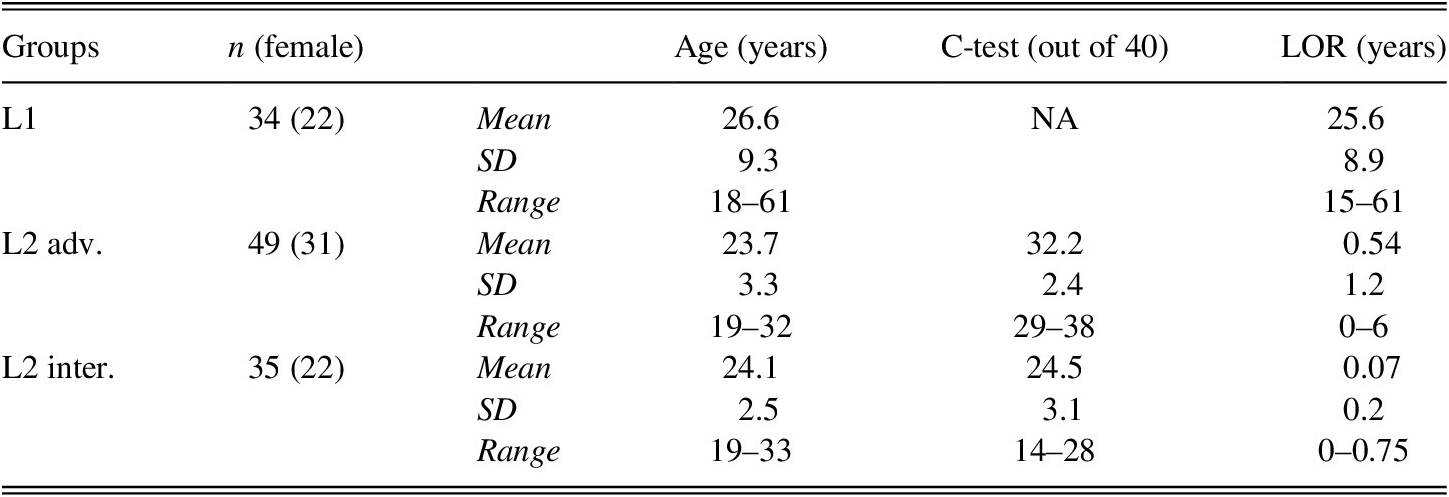
A total of 34 L1-English speakers and 84 L1-Korean L2-English speakers participated in the experiment for course credits or monetary compensation. L1 participants were recruited from the community of the University of Hawaii at Manoa in the United States, and L2 participants from the Seoul National University community in Seoul, Korea. Before L2 participants were invited to the lab, they filled out a screening survey to ensure that they were not exposed to English before age seven for more than six consecutive months and their parents and/or caregivers did not speak any other languages than Korean to communicate with them.Footnote 3 Table 1 summarizes participants’ demographic information.
Demographics of participants in Experiment 1

Note: LOR = Length of Residence.
Proficiency
A C-test was borrowed and modified from Schultz (Reference Schultz2006) to test L2 participants’ English proficiency on a consistent scale. The test contained two paragraphs with 20 blanks each for a total of 40 blanks to fill. Table 1 reports the means and ranges of scores for advanced- and intermediate-level L2 participants.
STIMULI
Visual Stimuli
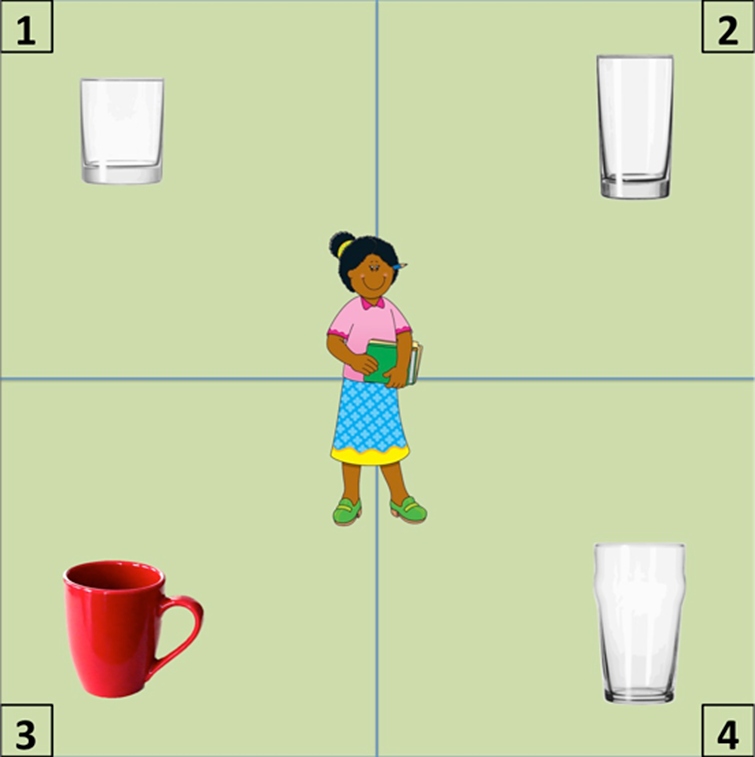
A visual scene with a person or animal in the center and an object in each of the four corners was presented on a computer screen (Figure 1). The objects in the corner were carefully selected so that none of them had any semantic or pragmatic relationships with the figure in the center. In each visual stimulus, one of the four objects in the corner was different from the others in kind, for unique identifiability using the notion of maximal uniqueness (Ahern & Stevens, Reference Ahern and Stevens2014). All four referents were similar (e.g., they were all containers to drink from, as in Figure 1), but one object was always distinct from the others, while the other three could be grouped together. Each object in the corner was marked with a number, and participants pressed the corresponding number on a computer keyboard. Twenty such critical stimuli were created. Please see Online Supplementary Materials for the complete list of critical stimuli.
A sample visual stimulus from Experiment 1.

Auditory Stimuli
As in (3), an incomplete sentence accompanied the visual stimuli to test whether listeners link the two notions of unique identifiability and definiteness. That is, when participants hear (3a) accompanied by the visual scene of Figure 1, they are more likely to predict the sentence to end with “The woman will buy the mug.” Although it is not impossible for the sentence to unfold into “The woman will buy the glass in the top right corner,” it is not the most parsimonious prediction. However, hearing (3b) will more likely lead to the prediction of “The woman will buy a glass.” In such a visual context, “The woman will buy a mug” is not the most felicitous sentence. Sentences were recorded by a female English native speaker.
(3) a. The woman will buy the …
b. The woman will buy a …
Latin-Squared Lists
To create a total of 20 critical items, 20 visual stimuli were paired with 20 auditory stimuli. Each auditory stimulus had two versions: one ending with the and the other ending with a. Two lists were created using a Latin-square design, in which each condition was rotated through different items, such that no participant will be presented with the same item through different conditions.
Fillers
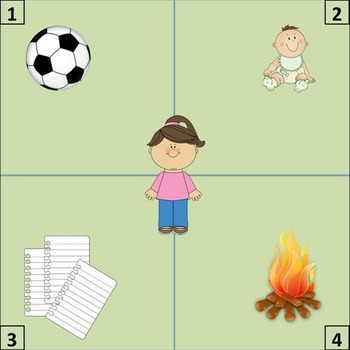
Forty filler items with visual (Figure 2) and auditory (4) stimuli were shuffled in to obfuscate the research purposes. Of the forty fillers, five had only one candidate referent for the omitted last word, five had three candidate referents, fifteen had two candidate referents, and the last fifteen had four candidate referents. The number of potential candidates was manipulated this way so that there were fifteen items each that had one to four candidates for the omitted word. Filler items did not include articles, and participants had to rely on verb semantics to guess the last word.
A sample filler item with one target referent.

(4) The girl will kick…
TASK AND PROCEDURE
Referent Prediction Task
Participants were asked to select as quickly as possible the number that corresponded to the object on the screen that they believed would fit as the omitted last word of the given auditory stimulus. The experiment was presented using E-Prime 2.0 (Psychology Software Tools, 2014). Four keys on the number keypad were labeled 1–4, in a 2 × 2 block, for easy access. A 2-s preview time was given before the auditory stimulus. Participants were instructed to press a button as quickly as possible so that they would not rely on metalinguistic knowledge to guess the omitted word. This type of speeded judgment task has been used as a tool to probe online sentence processing in many studies (De-Dios-Flores, Reference De-Dios-Flores2019; Parker & Phillips, Reference Parker and Phillips2016; Sikos et al., Reference Sikos, Duffield and Kim2016, inter alia). Trials automatically moved on to the next when participants did not respond within 5 s. The mean reaction time (RT) was 2,690 ms, and the standard deviation was 1,731 ms. Trials that did not record a response within the 5-s window were removed from further analysis, which resulted in a data loss of 0.8%.
Procedure
Once a session began, participants were given instructions on the main experiment, followed by three practice items. When it was confirmed that the task was clearly understood, the main experiment began, which lasted between 15 and 20 min. The C-test for proficiency measurement was given with a 15-min time limit after the main experiment was completed. Each participant took approximately 40 min to finish an entire experiment session.
PREDICTIONS
If L1 participants can use grammatical knowledge of definiteness that a definite NP presupposes a uniquely identifiable referent whereas an indefinite NP does not make such an assumption, they will more likely predict a unique referent when the auditory stimulus ends with a definite article than with an indefinite article. A higher rate of unique referent prediction in the definite condition is expected for L1 speakers. If L2 participants have acquired the grammatical knowledge of definiteness, the same behavior pattern as that of L1 speakers will be observed.
ANALYSIS
Participants’ predictions were coded as 1 for a unique referent prediction and 0 for a nonunique referent prediction. The binomial data were analyzed using logistic mixed-effects regression.Footnote 4 The model includes definiteness (indefinite, sum-coded as −.5; definite as +.5) and group (native, sum-coded as −.5; compared group as +.5; the other group as 0) for fixed effects, and participants and item for random effects. A full model with a maximal random effects structure failed to converge owing to the small sample size. Following Matuschek et al. (Reference Matuschek, Kliegl, Vasishth, Baayen and Bates2017), models were reduced using the Akaike Information Criterion. The resulting model included random intercepts only. All analyses were conducted in R (R Core Team, 2019) using the lme4 (Bates et al., Reference Bates, Maechler, Bolker and Walker2015) and lmerTest (Kuznetsova et al., Reference Kuznetsova, Brockhoff and Christensen2017) packages.
RESULTS
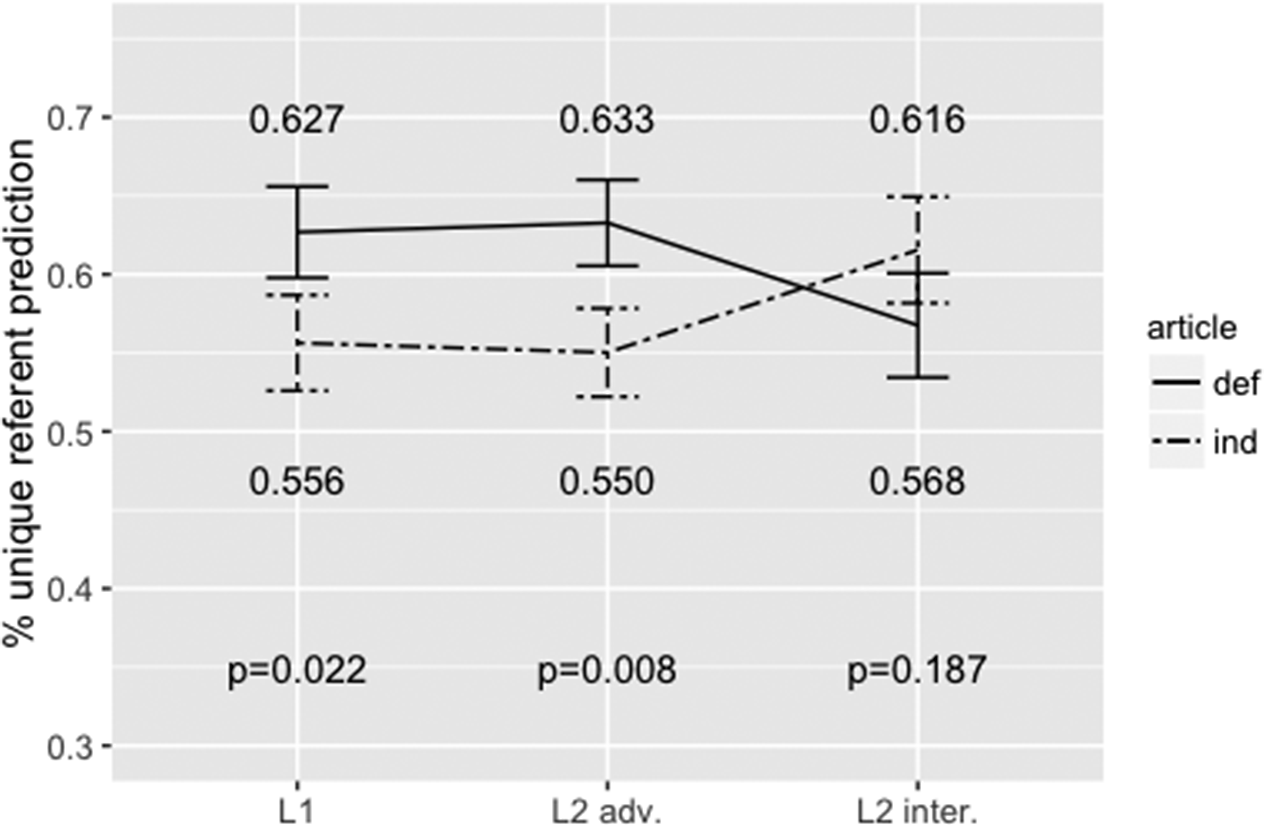
As was predicted, L1 speakers predicted a unique referent at the cue of a definite article significantly more than at the cue of an indefinite article. As for L2 speakers, only the advanced group showed the same pattern of behavior as that of L1 participants. The intermediate L2 group showed the opposite pattern of predicting a unique referent, if only numerically more, when an indefinite article was given at the end of the sentence as a cue.
Figure 3 shows that L1 and advanced L2 speakers patterned together when predicting a unique referent significantly more in the definite condition. The crossover between the advanced and intermediate groups shows that intermediate L2 speakers behaved opposite from both L1 and advanced L2 speakers.
The ratio of unique referent prediction by article.

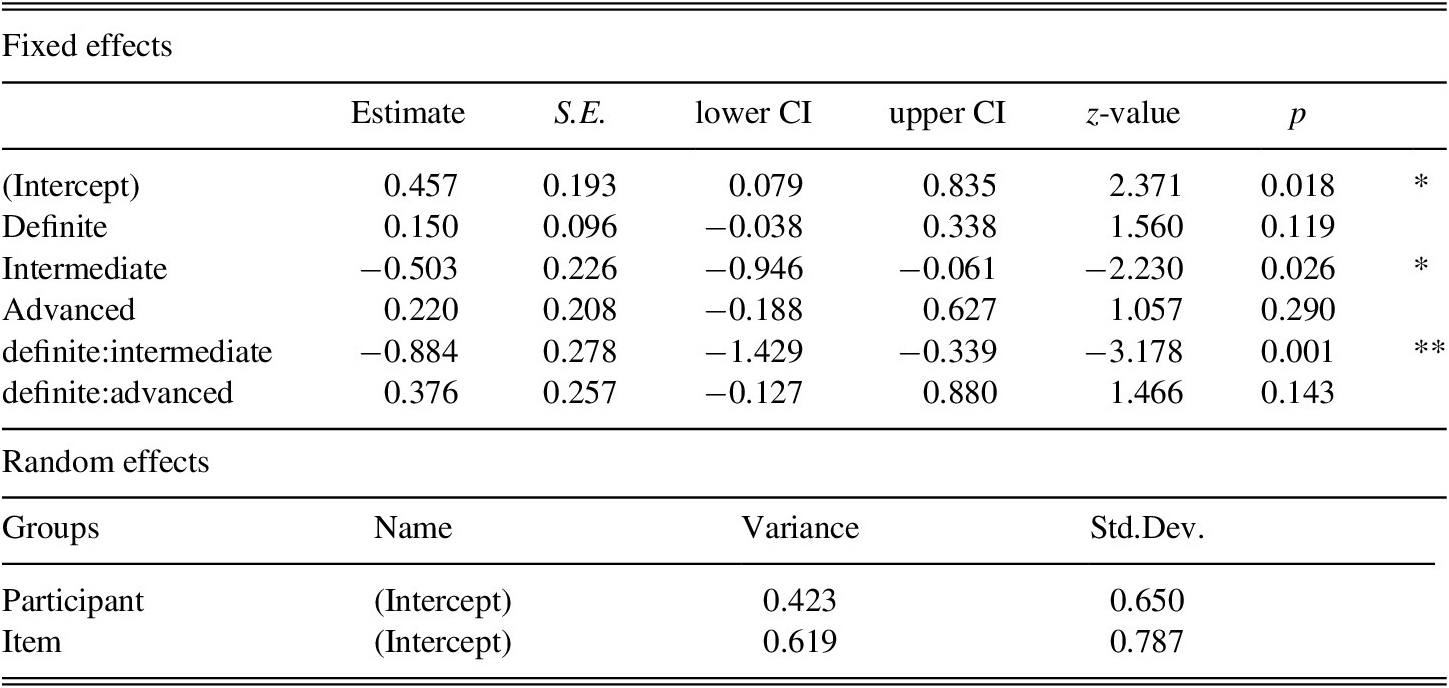
Table 2 summarizes the output of the logistic model, which is based on the logarithm of the odds (log odds) of the three different speaker groups’ predicting a unique referent at the cue of definite versus indefinite articles. There was no main effect of article, which indicates that hearing a versus the did not influence the overall rate at which participants predicted a unique referent. For the speaker group analysis, the reference level was native speakers, and advanced L2 speakers did not differ from the native group, whereas the intermediate L2 group predicted a unique referent significantly less often than the native group.
Fixed effects of article and speaker group with random intercepts for participant and itemFootnote 4

The interaction effects compare the log odds at which intermediate and advanced L2 speakers predicted a unique referent at the cue of a definite article to the log odds at which native speakers predicted a unique referent at the cue of an indefinite article. The interaction effect for intermediate L2 speakers was significant. That is, intermediate L2 speakers predicted a unique referent significantly less often at the cue of a definite article than natives did at the cue of an indefinite article. For all the significant effects, the Confidence Intervals (CI) show that the effect sizes are large enough that the lower and upper CI values do not cross zero.
To ensure that L1 and advanced L2 speakers behave alike, a separate analysis including only the two groups was conducted. There was a main effect of article (β = 0.37, S.E. = 0.12, z = 3.21, CIs = 0.13–0.61, p < .01) and no interaction effect of article and speaker group (β = −0.06, S.E. = 0.23, z = −0.27, p = .79).
DISCUSSION
Experiment 1 addressed the first research question and tested whether the linguistic cues of definite and indefinite articles could lead to the prediction of unique versus nonunique referents, respectively. The results showed that both L1 and advanced L2 participants could use definiteness to predict upcoming linguistic material, whereas intermediate L2 speakers showed the opposite pattern of behavior, if not significantly so. The findings suggest that, at least at the advanced level, L2 participants can utilize the grammatical relationship between definiteness and unique identifiability to predict words that are yet to be uttered in the same way L1 speakers do.
The results are at odds with the findings of Trenkic et al. (Reference Trenkic, Mirkovic and Altmann2014), in that the intermediate L2 speakers in the current study could not use definiteness information in the same way that the native speakers did. Because experimental methods and participants’ L1 backgrounds were not controlled between the two studies, strong claims cannot be made against Trenkic et al.’s findings. However, the current findings obtained from an experiment where real-world knowledge was excluded imply that L2 speakers’ ability to use definiteness semantics to predict an upcoming referent might not develop until they reach a higher proficiency level.
EXPERIMENT 2: REFERENT IDENTIFICATION TASK—THE INTEGRATION OF LINGUISTIC AND NONLINGUISTIC INFORMATION
With the results of Experiment 1 showing that advanced L2 speakers share the same grammatical knowledge as L1 speakers, Experiment 2 aimed to probe whether advanced L2 speakers could use linguistic information in the presence of nonlinguistic information. Before the integration experiment (RQ3), an online norming survey was conducted to ensure that the content of nonlinguistic information (real-world knowledge) was shared between L1 and L2 speakers (RQ2).
REAL-WORLD KNOWLEDGE NORMING
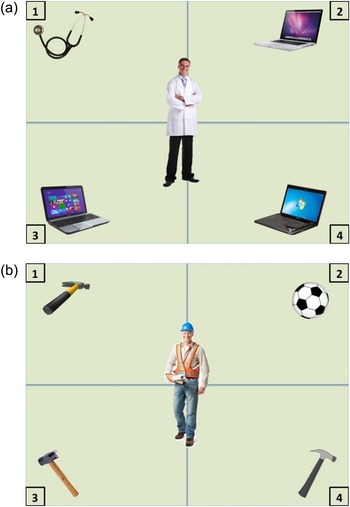
A norming survey was conducted using an online questionnaire to test L1 and L2 speakers’ real-world knowledge. A total of 40 items were created, such that 20 items had a unique referent related to the figure in the center (Figure 4a), and the other 20 had nonunique referents related to the figure in the center (Figure 4b).
Sample visual stimuli from Experiment 2.

A total of 17 L1-English speakers and 33 L1-Korean L2-English speakers at diverse self-reported proficiency levels participated in the online survey. Participants were given only pictures, as shown in Figure 4, with no written or spoken linguistic stimuli so that the task would only test their real-world knowledge. They were then asked to select one of the four objects in the corner that they believed was most related to the figure in the center.
The rates at which participants selected an item intended for world knowledge association did not differ by L1 or self-reported proficiency level. Twenty-eight items that reached the highest consensus among the participants (mean = 95.36 %, range: 86%–100%, SD = 4.93) were selected for Experiment 2. Of these, 14 had a figure placed in the center that was associated with a unique referent among the four objects in the corner (Figure 4a), and the other 14 had the figure in the center associated with nonunique referents (Figure 4b).
PARTICIPANT INFORMATION
Participants
Data were collected from a total of 79 participants: 36 L1-English speakers were recruited from the community of the University of Hawaii at Manoa in the United States, and 43 L1-Korean advanced L2 speakers of English were screened and recruited, using the same criteria as in Experiment 1, from the Seoul National University community in Seoul, Korea. Monetary compensation or course credits were provided for participation.
Proficiency
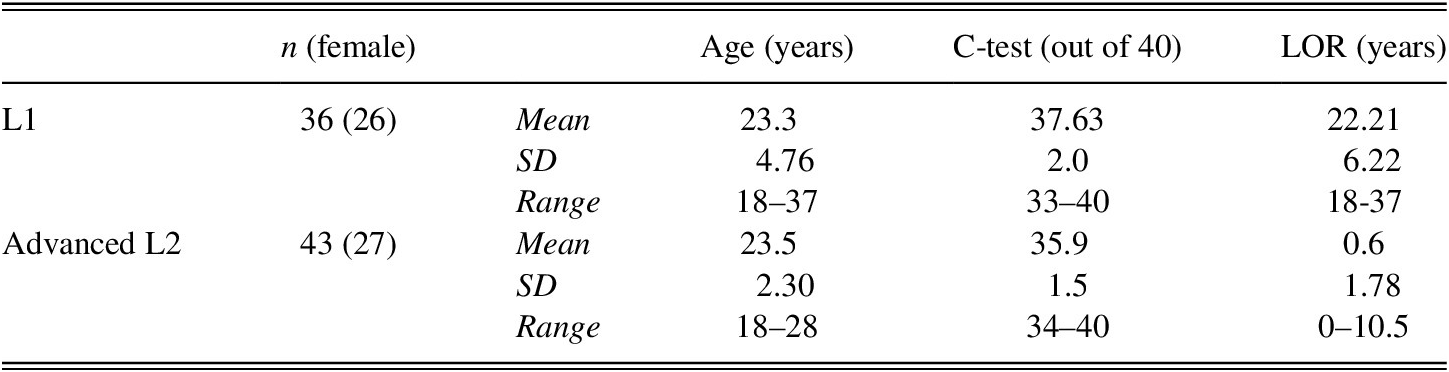
The same C-test used in Experiment 1 was used to measure participants’ proficiency on a consistent scale. Table 3 summarizes the C-test scores of L1 and L2 speakers, along with their age ranges and lengths of residence in English-speaking countries.
Demographics of participants in Experiment 2

STIMULI
Visual Stimuli
The 28 items selected via real-world knowledge norming were used as visual stimuli. For each of these, four different auditory stimuli were used to create four different conditions.
Auditory Stimuli
A sample auditory stimulus for the unique referent condition is given in (5), and one for the nonunique condition is given in (6). The speaker was instructed to take a brief pause between the articles (the or a) and nouns as indicated in (5) and (6) to prevent the formant transition of the vowel in the articles from hinting at the initial consonant segment of the disambiguating noun (Ostreicher & Sharf, Reference Ostreicher and Sharf1976; Sharf & Beiter, Reference Sharf and Beiter1974).
When the sentences were edited, the length of the pauses was modulated to be 500 ms for all items. The pause was also intended to give participants time to process the grammatical information before the critical noun became available. A female native speaker of English recorded the auditory stimuli. See Online Supplementary Materials for the complete list of critical items.


Mixed Factorial Design and Latin-Squared Lists
In a total of 28 critical items, world knowledge predicted a unique referent in 14 visual stimuli, and in the other 14 visual stimuli, it predicted nonunique referents. Therefore, world knowledge prediction was a between-items factor, whereas all other factors were within-items and within-participants factors. The mixed factorial design was used to keep the number of critical items reasonable instead of creating eight different lists (2 articles × 2 uniqueness × 2 world knowledge) to prevent a lengthy experiment from causing fatigue and compromising participants’ performance.
Then, the 14 items in which unique referents were predicted by world knowledge were paired with the auditory stimuli in (5), and the other 14 items with nonunique referents predicted by world knowledge were paired with (6). Four lists were created, and items and conditions were counterbalanced in the Latin-square design so that no participant would see the same item through different conditions.Footnote 5
Fillers
A total of 56 fillers were shuffled in to disguise research purposes. Filler sentences had neither definite nor indefinite articles in the last NP of the sentence. Instead, the zero article (for mass nouns like baby food or milk), other determiners (some, his/her), or classifiers (a pair of) were used in the place of articles. The same 500 ms pause was spliced in before the final noun. Because the critical items had either one target referent or three target referents in 14 items each, the number of target referents in the fillers was manipulated to balance the number of target referents among all items in the experiment. Seven fillers had one target referent, and another seven had three target referents, while 21 fillers had two target referents and the last 21 fillers had all options as potential targets. This way, the research purposes could be hidden, and participants were led to believe that the number of target referents alternated from one to four an equal number of times.
TASK AND PROCEDURE
Referent Identification Task
When a trial began, the visual stimulus was displayed on the screen for 2.5 s before the auditory stimulus began. The task was to identify which of the four objects on the screen corresponded to the last word of the sentence as quickly as possible. The trials were presented using E-Prime 2.0 (Psychology Software Tools, 2014). Unlike Experiment 1, where participants’ predictions for the upcoming linguistic material were recorded, Experiment 2 measured reaction times to different conditions of stimuli as a measure of their sensitivity to matching and mismatching pairings of grammar and world-knowledge. This experimental method change was a necessary measure because the effect of world knowledge was expected to be stronger and more explicit than that of subtle morpho-semantic information from English articles. If definiteness effects were trumped by real-world knowledge, it would be impossible to measure how the two sources of information interacted.
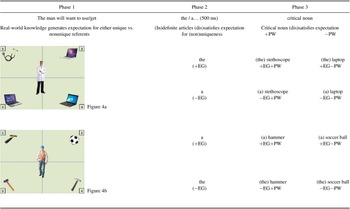
When participants are presented with visual and auditory stimuli, each piece of information is fed into their processing system incrementally. Table 4 schematizes how real-world knowledge and (in)definiteness of critical NPs will be processed in the order in which each piece of information becomes available. During the period from the onset of the visual stimulus to the offset of the main verb in the auditory stimulus (Phase 1), if a visual stimulus of Figure 4a is presented alongside the auditory stimulus, participants will use their real-world knowledge to generate the expectation that the sentence will later mention stethoscope. With such an expectation, encountering the definite article the in Phase 2 is an expected event based on their knowledge of definiteness grammar; hence, the is expected grammar (+EG) in this case, and a is unexpected grammar (−EG). However, in Figure 4b, where one of the hammers is predicted by real-world knowledge, a is +EG, while the is −EG. Although predictions are made based on real-world knowledge in Phase 1, whether the sentence aligns with world knowledge can be confirmed only when the critical noun is finally uttered in Phase 3. In Figure 4a, the unique referent (stethoscope) is predicted by world knowledge (+PW), whereas nonunique referents (laptops) are not (−PW). However, in Figure 4b, nonunique referents (hammers) are +PW, and the unique referent (soccer ball) is −PW.
The flow chart of forming and revising hypotheses for upcoming linguistic material

Notes: +EG = Expected Grammar; −EG = Unexpected Grammar; +PW = (Critical noun) predicted by world knowledge; −PW = unpredicted by world knowledge. Shaded cells indicate grammatical conditions.
Procedure
Participants were screened using the same criteria as in Experiment 1, and only those who had not lived more than six consecutive months in an English-speaking environment before age seven were invited. When participants arrived in the lab, they were given recorded instructions on the experimental tasks. After it was confirmed that they fully understood how to respond to these tasks, the main experiment began, lasting around 17 min. Following the main experiment, the same c-test from Experiment 1 (Schultz, Reference Schultz2006) was used for proficiency measurement. An entire session took around 40 min per participant. Reaction times were measured between the offset of the last word of the sentence and the button press. If the participant did not press any button until 5 s passed, the trial ended and moved onto the next item.
PREDICTIONS
If L1 participants could use grammatical knowledge in the presence of real-world knowledge, reaction times should be shorter in the [+EG] condition than in the [−EG] condition when usable real-world knowledge is copresent [+PW]. However, if a sentence presents information that contradicts real-world knowledge [−PW], the surprisal created by world-knowledge contradiction will be too great that any difference created by grammar [±EG] will be canceled out. In short, an interaction effect of EG and PW is expected when both sources of information are processed simultaneously.
In contrast, if L2 participants try to streamline their processing efficiency by prioritizing real-world knowledge, they will not be able to use their knowledge of definiteness in the presence of accompanying real-world knowledge even though they showed targetlike behavior in Experiment 1. In both [+PW] and [−PW] conditions, [+EG] and [−EG] will not make a difference in reaction times. Because the involvement of real-world knowledge begins from the very beginning of each trial, as soon as they start processing real-world knowledge, any subtle cues provided by articles will not be great enough to make a meaningful difference whether or not the critical noun ends up being [+PW] or [−PW]. Therefore, only a main effect of PW is expected in the L2 group.
ANALYSIS
Data Transformation
Because raw reaction times (RTs) are highly skewed and it has been reported that the effect of word predictability is logarithmic (Smith & Levy, Reference Smith and Levy2013), a log transformation was used to enhance the normality of the data. The log-transformed data were then entered into a linear mixed-effects regression model to factor in the length of the critical noun, the number of target referents, and the order in which the trial appeared in the experiment.Footnote 6 The transformation of raw data and the calculation of residuals followed the methods used in Hofmeister (Reference Hofmeister2011). After calculating residuals, inaccurate responses were filtered, incurring a data loss of 3.42% in L1 data and 3.41% in L2 data.
Linear Mixed-Effects Modeling
The residuals calculated in the preceding text were entered into another linear mixed-effects regression model with EG (−EG sum-coded as −.5 and +EG as .5) and PW (−PW sum-coded as −.5 and +PW as .5) as fixed effects and participants and items as random effects. The maximal random effects structure led to the models failing to converge, and the model was reduced down stepwise using AIC values, following Matuschek et al. (Reference Matuschek, Kliegl, Vasishth, Baayen and Bates2017). In the model for L1 data, the random intercepts of both participants and items were included, but random slopes were included only for PW.Footnote 7 In the model for L2 data, however, the random slopes of items were included only for EG, in addition to the random intercepts of participants and items.Footnote 8 All data analyses were conducted in R (R Core Team, 2019) using the packages lme4 (Bates et al., Reference Bates, Maechler, Bolker and Walker2015) and lmerTest (Kuznetsova et al., Reference Kuznetsova, Brockhoff and Christensen2017).
RESULTS
As was predicted, L1 speakers could use definiteness information in the presence of real-world knowledge, and a significant main effect of PW and an interaction effect of EG and PW were observed. Advanced L2 speakers also behaved as expected, and a significant main effect of PW was observed with no significant interaction effect of EG and PW. What was not expected, however, was a significant main effect of EG in the L2 group, and even more surprisingly, the advanced L2 group showed longer RTs in the [+EG] condition.
L1 Speakers
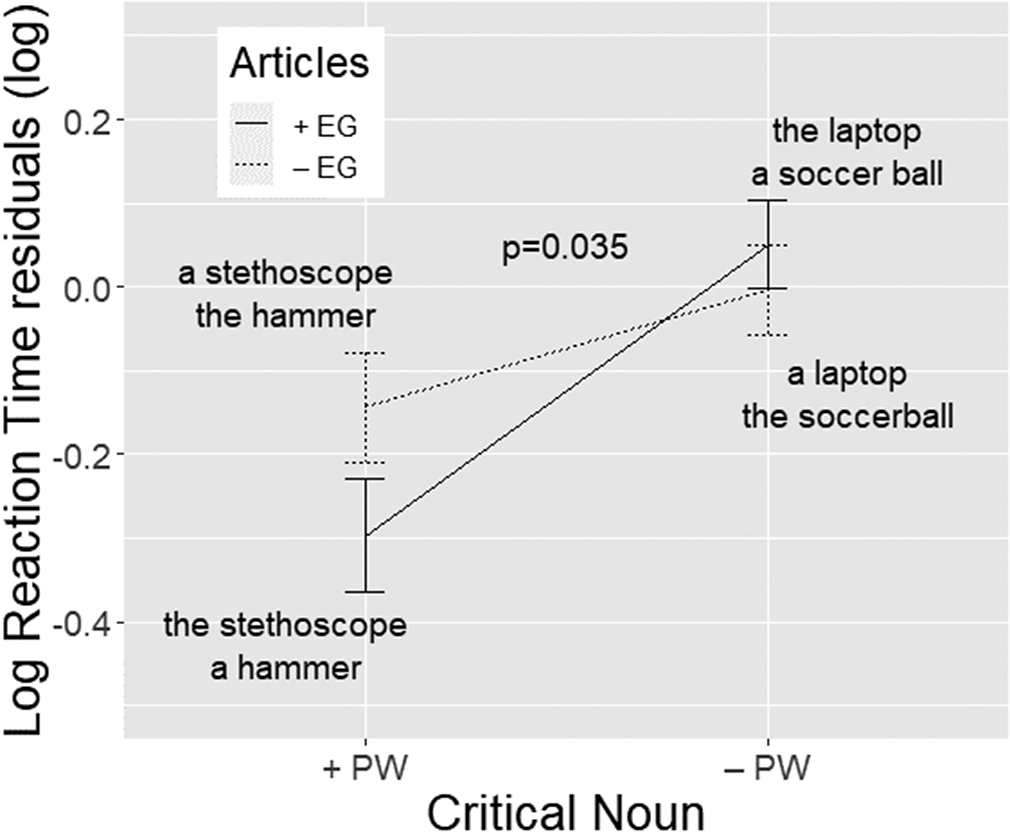
Figure 5 shows the residuals of the logarithmic RTs in each of the four conditions. Residual plots visualize differences from the mean of all RTs in all trials. The horizontal line at zero indicates how long it takes for a participant to identify a referent indicated by the last NP of the sentence on average, and the log residuals indicate deviations from the average. From Figure 5, one can see that there is an interaction between EG and PW. It also shows that [−PW] critical NPs elicited longer RTs.
Log RT residuals by linguistic and nonlinguistic information in L1 speakers.
Note: +EG = expected grammar; −EG = unexpected grammar; +PW = predicted by world knowledge; −PW = unpredicted by world knowledge.

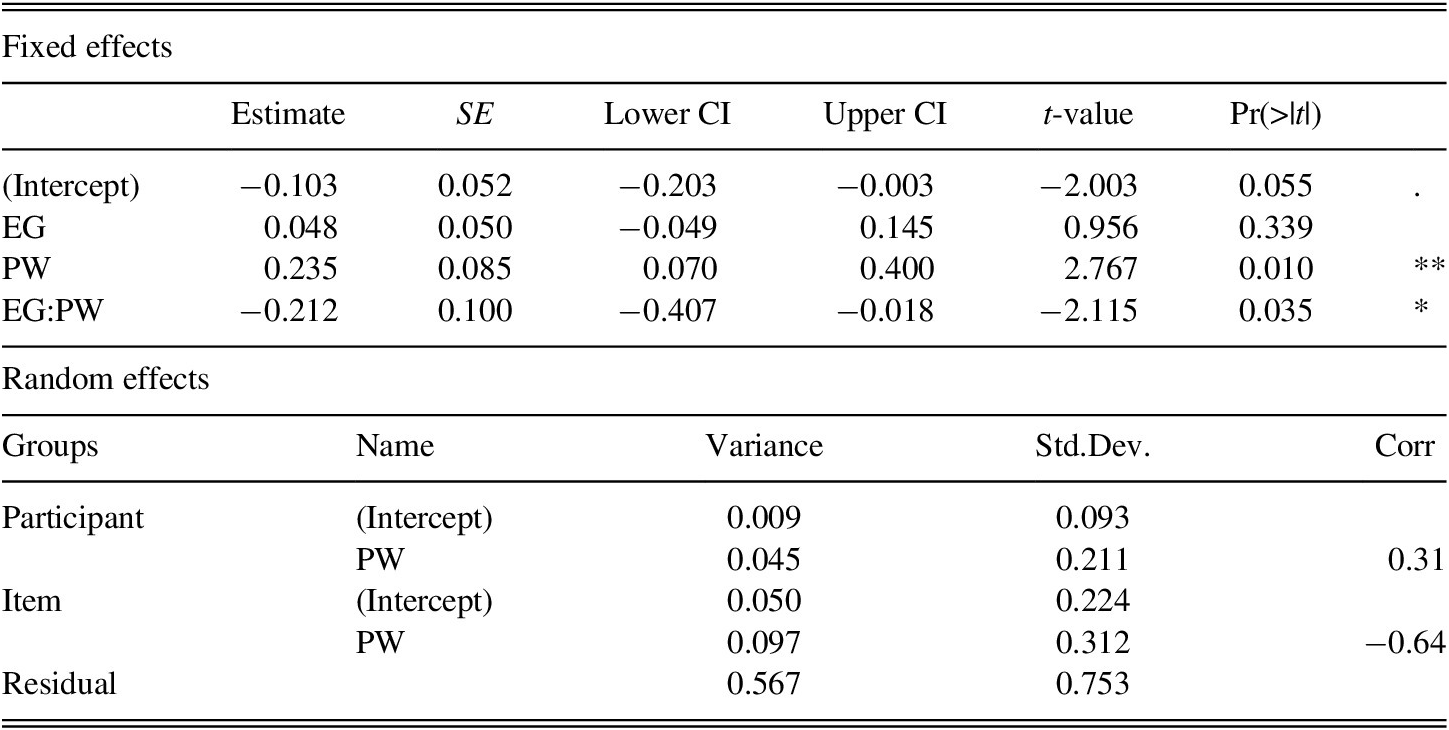
The summary of the statistical analysis in Table 5 shows that L1 speakers did not show a main effect of EG, but that the main effect of PW was significant (p = .01). The interaction effect of EG and PW was also significant (p = .04).Footnote 9 Pairwise comparisons, conducted using the lsmeans package (Lenth, Reference Lenth2016), indicated that significant differences were observed only across [±PW]. That is, [+EG+PW] was significantly different from [+EG−PW] (ß = –.34; S.E. = –.07; z = –4.74; p < .001) and [−EG−PW] (ß = –.28; S.E. = –.07; z = –3.79; p < .01) but not from [−EG+PW] (ß = –.15; S.E. = –.07; z = –2.03; p = .13). In addition, conditions [+EG−PW] and [−EG−PW] were not significantly different from each other (ß = –.07; S.E. = –.07; z = –0.94; p = .35).
The output of the linear mixed-effects modelFootnote 7 : L1 speakers

Note: EG = (un)expected grammar; PW = (un)predicted by world knowledge.
Advanced L2 Speakers
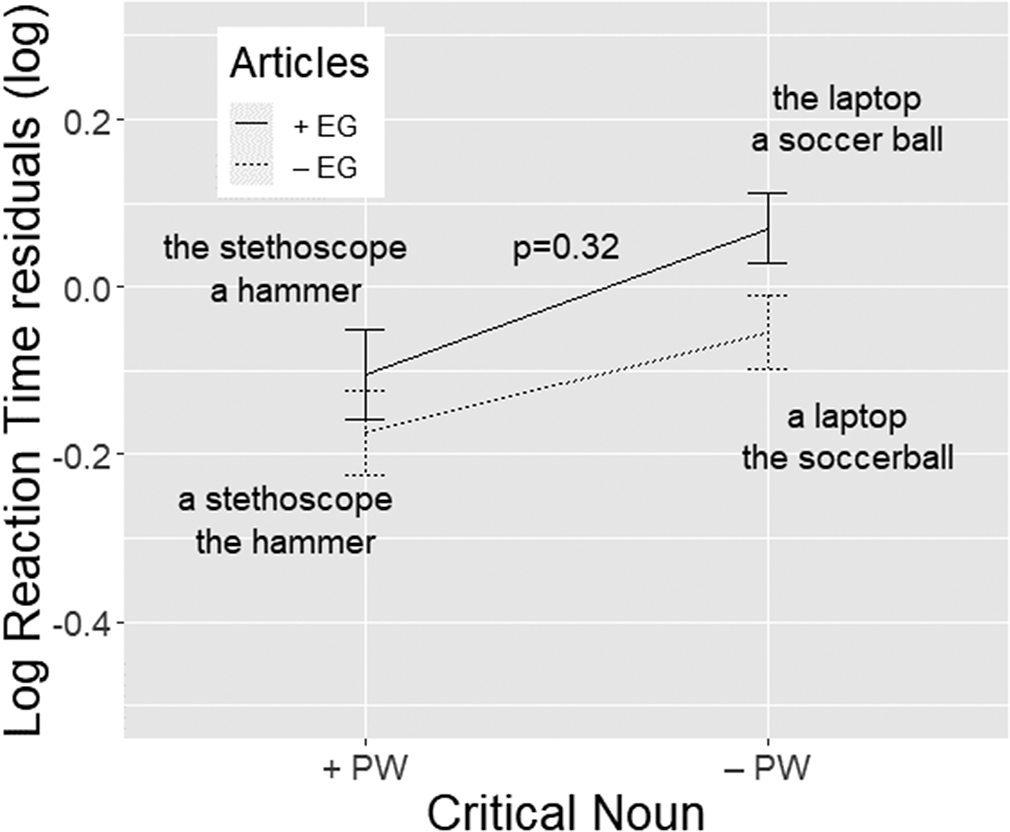
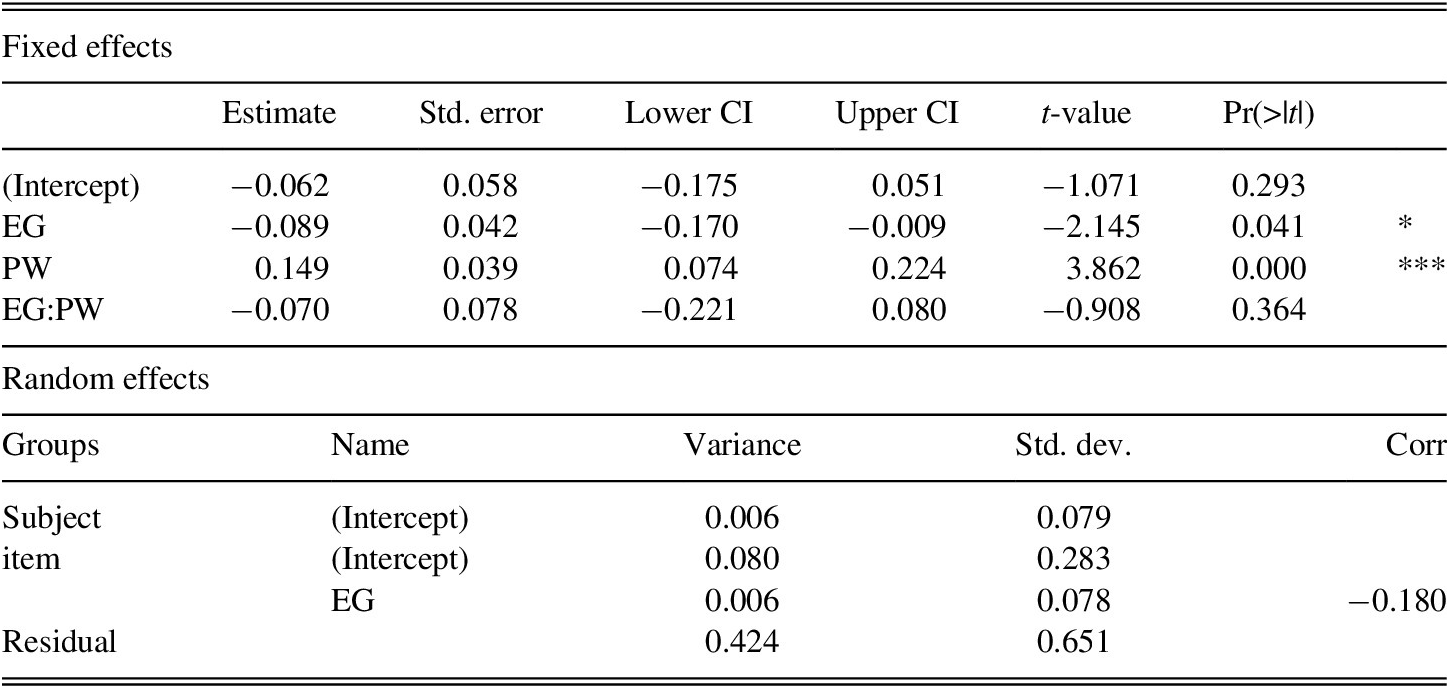
Figure 6 visualizes the L2 group’s patterns of behavior, and Table 6 reports the summary of the lmer model output of L2 data. Like in the L1 group, a significant main effect of PW (p < .001) was observed. Unlike in the L1 group, a main effect of EG was significant (p = .04), with the [+EG] condition displaying longer RTs than the [−EG] condition, and no interaction effect of EG and PW was observed (p = .36).Footnote 10 Showing longer RTs in [+EG] conditions than in [−EG] conditions regardless of accompanying PW conditions was certainly unexpected. In pairwise comparisons (Lenth, Reference Lenth2016), a significant difference was observed only between [−EG+PW] and [+EG−PW] (β = 0.23, S.E. = 0.08, z = 2.91; p = .02).
Log RT residuals by linguistic and nonlinguistic information in advanced L2 speakers.
Note: +EG = expected grammar; −EG = unexpected grammar; +PW = predicted by world knowledge; −PW = unpredicted by world knowledge.

The output of the linear mixed-effects modelFootnote 8 : advanced L2 speakers

Note: EG = (un)expected Grammar; PW = (un)predicted by world knowledge.
DISCUSSION
In both L1 and L2 groups, a significant main effect of PW was observed. This outcome dovetails with the intuition that the reaction will be faster when the initial prediction based on world knowledge is manifested in the critical noun at the end of the sentence. Because the type of nonlinguistic information used in the present study was shared by both groups of speakers, the effect of real-world knowledge was observed to be the same in both groups. However, they behaved differently when it came to the effect of grammar and the interaction between the two sources of information.
L1 Speakers
The results showed that L1 speakers used both definiteness and real-world knowledge incrementally. The L1 participants’ reactions were quickest in [+EG+PW], and RTs increased when information in either Phase 2 or Phase 3 did not align with the initial prediction from Phase 1 ([−EG+PW] and [+EG−PW] in that order). However, the increase of RT in [−EG−PW], where both linguistic and nonlinguistic information did not align with the Phase 1 prediction, was not the sum of the increases incurred by [−EG] and [−PW], with RTs in [−EG−PW] being shorter, if only slightly, than in [+EG−PW]. This decline seemed inevitable in that the pair of an unexpected article [−EG] and an unpredicted critical noun [−PW] eventually formed a grammatical sentence, even though neither source of information aligned with what was predicted in Phase 1. It can also be postulated that the unexpected article could have acted as a subtle cue that led participants to revise their initial prediction, hence the shorter RT than for [+EG−PW]. In brief, the results showed that L1 speakers could use definiteness information not only when semantic information was presented by itself (Experiment 1) but also when it was accompanied by real-world knowledge (Experiment 2).
Advanced L2 Speakers
The predicted absence of interaction effects and the unexpected significant main effect of EG indicate that L2 speakers might use definiteness differently when it is accompanied by another source of information. The advanced L2 group’s behavior is noteworthy in that it was confirmed that advanced-level L2 speakers could use definiteness to predict an unmentioned referent in Experiment 1. It is also noteworthy that the advanced L2 group took longer to respond when the article was predicted by real-world knowledge ([+EG]) than when it was not ([−EG]). In the “Predictions” section, it was predicted that an interaction effect of EG and PW would be observed if participants could use definiteness even in the presence of real-world knowledge. The absence of such an interaction in the L2 group indicates that their processing of definiteness is interfered with by the copresence of real-world knowledge. The next section will discuss how the current findings can go hand-in-hand with the predictions based on the processing determinism theory (O’Grady, Reference O’Grady2015) discussed at the beginning of this article.
GENERAL DISCUSSION
In an attempt to investigate the role of real-world knowledge in L2 definiteness processing, it was confirmed that advanced L2 speakers could use definiteness to predict an unmentioned referent like their L1 peers (Experiment 1). It was also ensured that L1 and L2 speakers (of varying proficiency levels) shared real-world knowledge (e.g., associations formed between objects and people of certain occupations, gender, and age). Despite L1 and advanced L2 speakers sharing the same knowledge of definiteness and real-world knowledge, the two groups behaved differently when the two types of information had to be processed simultaneously (Experiment 2).
As was predicted, L1 speakers showed an interaction effect of linguistic and nonlinguistic information while L2 speakers did not. What was not predicted was the significant main effect of grammar (EG) in the advanced L2 group. This seemingly nontarget behavior of responding more slowly to [+EG] conditions can be interpreted in two ways. One is that L2 speakers cannot process definiteness in the presence of real-world knowledge (Experiment 2) as they can in the absence of it (Experiment 1). The other, more specific, account is that L2 speakers can use definiteness if real-world knowledge is unusable.
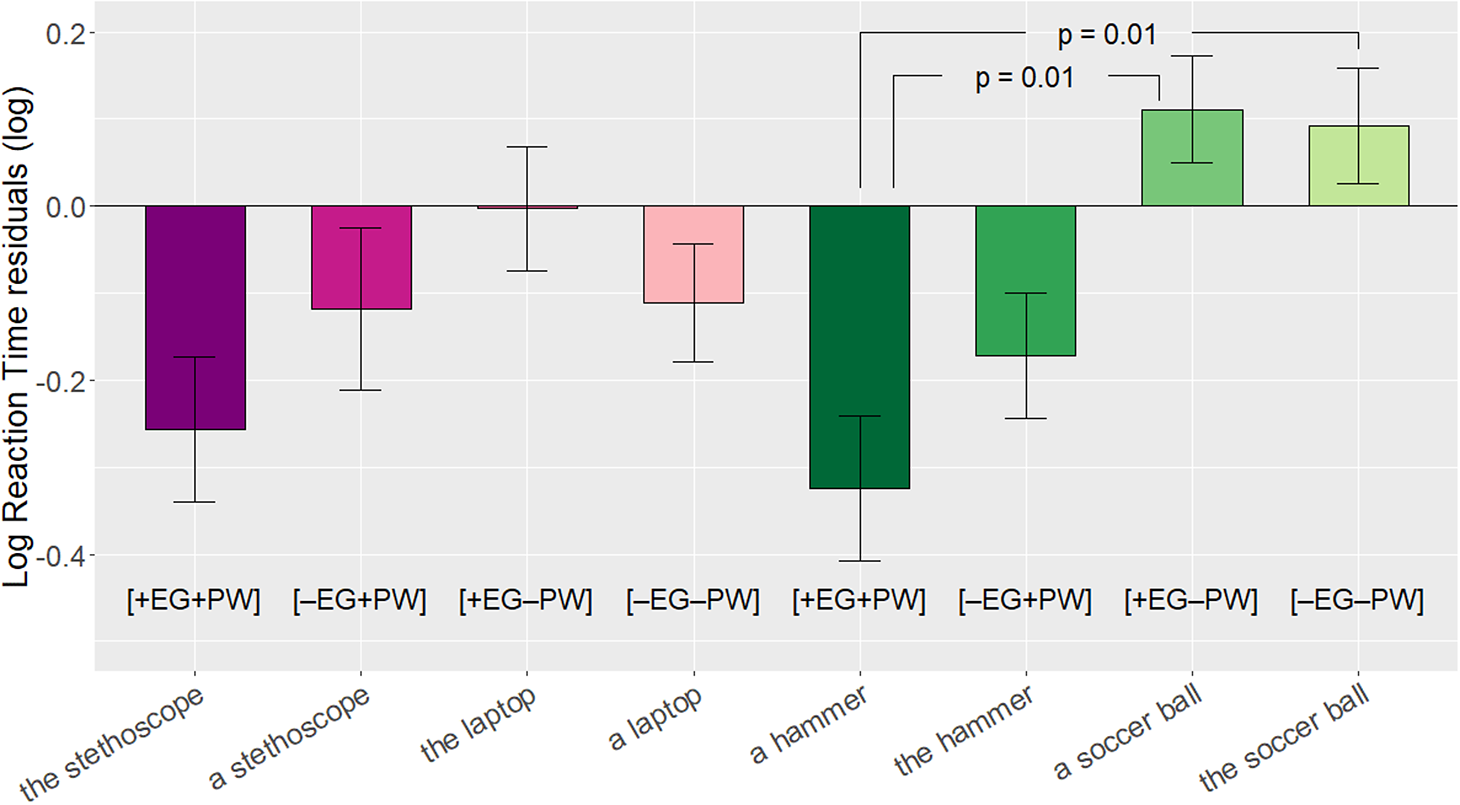
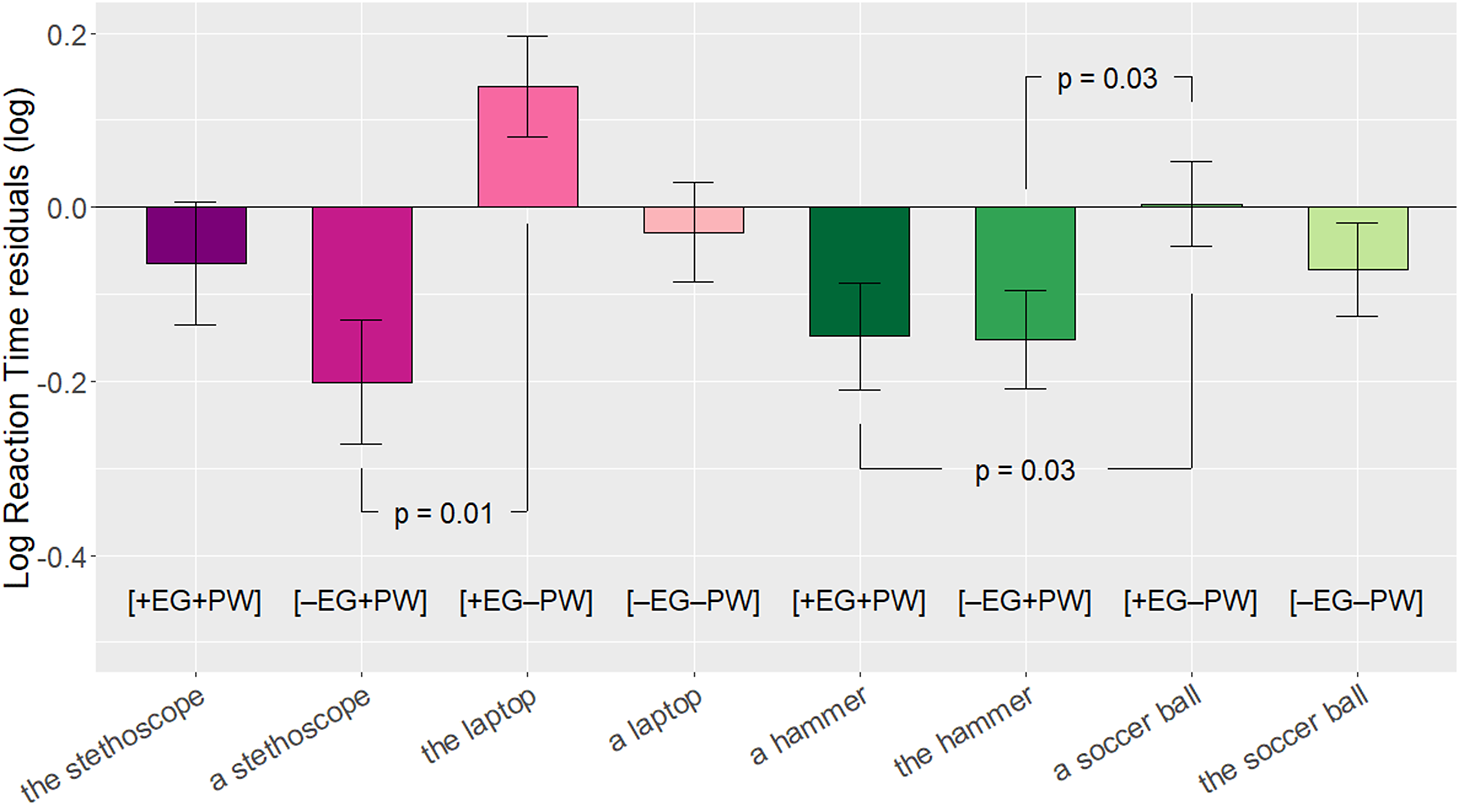
The four conditions of items ([±EG] × [±PW]) were further broken down into conditions in which critical nouns predicted by word knowledge ([+PW]) were either unique or nonunique (Figures 7 and 8). A new model was fit with the uniqueness factor as an additional fixed factor and used the lsmeans package (Lenth, Reference Lenth2016) for pairwise comparisons. Pairwise comparison analyses of the eight conditions resulted in significant differences only in limited pairs of conditions, as indicated in Figures 7 and 8 (see Tables S3 and S4 in Online Supplementary Materials for complete statistics); however, the L1 and L2 groups behaved differently when the critical noun conformed to what real-world knowledge predicted.
Log reaction time residuals in eight conditions (L1).

Log reaction time residuals in eight conditions (L2).

When the critical noun was “stethoscope” and “hammer” in unique and nonunique conditions, L1 speakers reacted faster to the expected articles, which were definite and indefinite, respectively (see Figure 7). However, when the critical noun was “laptop” and “soccer ball,” they reacted faster, if only numerically, to conditions in which the articles were unexpected. With a careful look, one can see that L1 speakers reacted faster to grammatical sentences than to ungrammatical sentences.
In contrast, in [+PW] conditions in which the critical noun in Phase 3 aligned with the Phase 1 prediction, advanced L2 speakers’ reaction was either faster in [−EG] conditions or almost the same between [+EG] and [−EG] conditions, which indicates either faster processing of ungrammatical conditions or no difference between grammatical and ungrammatical conditions. However, when the critical noun in Phase 3 was not what was predicted in Phase 1 ([−PW]), they reacted faster, if only numerically, to grammatical conditions, which were [−EG] (see Figure 8).
With pairwise comparisons of insignificant differences, a strong argument cannot be made about the advanced L2 speakers’ behavior. However, not only the expected absence of interaction effect but also the unexpected main effect of EG in the L2 group can be explained by the processing efficiency account proposed earlier. Advanced L2 participants could employ definiteness in a targetlike manner only when real-world knowledge did not predict upcoming words (either in the complete absence of it as in Experiment 1 or in the presence of information contradictory to real-world knowledge as in Experiment 2). They formed a prediction based on the visual scene and the beginning portion of the auditory stimulus in Phase 1 of Experiment 2. As they reached Phase 2, they gathered linguistic information, but Phase 3 started before they could process the article. In Phase 3, they evaluated the initial prediction based on real-world knowledge, which, to L2 speakers, is more readily processable than the subtle morpho-semantic information from articles. When the critical noun was the same as what world knowledge predicted, they stopped processing the article and pressed the button.
When the critical noun was not what real-world knowledge predicted, the surprisal delayed their decision making, which gave L2 participants time to continue processing definiteness information from Phase 2. This timing difference account is supported by Ahn’s (Reference Ahn2021) findings that L2 speakers, even at an advanced level, react to the interaction between definiteness and uniqueness one region later than L1 speakers in a self-paced reading task. When a sentence aligns with information processed faster (i.e., real-world knowledge), the processing routine stops with a satisfactory interpretation. However, surprisal created by a sentence misaligned with real-world knowledge allows L2 speakers time to gather information processed relatively more slowly (i.e., definiteness).
LIMITATIONS AND FURTHER STUDY
The findings of the study should be further explored using methods that can shed light on a more fine-grained timeline of participants’ considering different referents at each phase. In addition, the preview time was rather long in the integration experiment (2.5 s), and nonlinguistic information always preceded linguistic information. Thus, the relatively stronger effect of real-world knowledge could be due to the amount and order of information exposure. Future research should revisit the issues using a language that can reverse the order of information presentation (e.g., German). It will also be necessary to explore a grammatical feature that is more easily acquired by L2 speakers, such as the passive construction, which is not as subtle and challenging as English articles. Pitting such a grammatical element against real-world knowledge will illuminate whether the role of real-world knowledge is truly an explanatory factor in L2 acquisition and processing. Finally, an ideal case will be to recruit a more homogenous group of participants regarding the experience of residing in a target-language community.
CONCLUSION
The present study investigated how linguistic and nonlinguistic sources of information are integrated in real time. Experiment 1 showed that both L1 and advanced L2 speakers predicted a unique referent at the cue of a definite article rather than at the cue of an indefinite article, whereas intermediate L1 speakers displayed the opposite behavior pattern. In Experiment 2, L1 and L2 speakers had to integrate definiteness and real-world knowledge, and their behavioral patterns diverged. L1 speakers could use linguistic information online to determine whether real-world knowledge was borne out by the auditory stimuli. L2 speakers, however, reacted to the linguistic information in a targetlike manner only when real-world knowledge could not scaffold their sentence processing. This disparity between situations conforming and nonconforming to real-world knowledge was interpreted as evidence that L2 speakers prioritize nonlinguistic information for processing efficiency.
The present study was an unprecedented attempt to investigate the simultaneous processing of linguistic and nonlinguistic information directly, and the findings suggest that the pursuit of processing efficiency maximization motivates the different processing mechanism observed in L2 sentence processing. Also, the subtle morpho-semantic effect of articles was measured using online methods and analyzed using advanced statistical models preventing methodological issues of previous studies. Finally, the findings of the study opened a new arena of discussion for future research on the role of real-world knowledge in L2 acquisition and processing.
Supplementary Materials
To view supplementary material for this article, please visit http://doi.org/10.1017/S0272263121000322.