Introduction
Childhood exposure to severe parental psychiatric problems such as suicidal behaviour, mental illness and substance abuse increases the risk of suicide later in life (see, for example, Dube et al. Reference Dube, Anda, Felitti, Chapman, Williamson and Giles2001). Evidence from family, twin and adoption studies supports the hypothesis that genetic factors contribute to this risk (Baldessarini & Hennen, Reference Baldessarini and Hennen2004; Brent & Mann, Reference Brent and Mann2005). Other studies demonstrate that childhood environmental adversities – such as sexual abuse, foster care, parental divorce and lone parenthood – also elevate the risk for suicidal behaviour in adult life (Dube et al. Reference Dube, Anda, Felitti, Chapman, Williamson and Giles2001, Reference Dube, Felitti, Dong, Giles and Anda2003; Hjern et al. Reference Hjern, Vinnerljung and Lindblad2004; Dong et al. Reference Dong, Anda, Felitti, Williamson, Dube, Brown and Giles2005; Vinnerljung et al. Reference Vinnerljung, Hjern and Lindblad2006; Fergusson et al. Reference Fergusson, Boden and Horwood2007).
Parental suicide may be linked to offspring suicide in both ways. The risk is partly heritable (Brent & Mann, Reference Brent, Mann, King and Apter2003) and various mechanisms have been suggested. The seemingly self-evident way via psychiatric illness most probably explains only a minor part of the heritability (Brent & Mann, Reference Brent and Mann2005). However, early-onset major depression is one subtype of depression associated with an increased risk of suicide (Thompson, Reference Thompson2008) that has a well-established heritability (Lyons et al. Reference Lyons, Eisen, Goldberg, True, Lin, Meyer, Toomey, Faraone, Merla-Ramos and Tsuang1998). Studies based on endophenotypes – internal phenotypes between gene and disease (Gottesman & Gould, Reference Gottesman and Gould2003) – constitute a promising approach for identifying relevant genetic mechanisms. For instance, impulsive–aggressive traits, neurocognitive prerequisites and hypothalamic–pituitary–adrenal axis dysfunction all seem to be associated with suicide (Mann et al. Reference Mann, Arango, Avenevoli, Brent, Champagne, Clayton, Currier, Dougherty, Haghighi, Hodge, Kleinman, Lehner, McMahon, Mościcki, Oquendo, Pandey, Pearson, Stanley, Terwilliger and Wenzel2009). The strongest evidence for specific genes involved in suicidal behaviour concerns serotonin transport and tryptophan hydroxylase (Roy et al. Reference Roy, Sarchiopone and Carli2009).
Parental suicide also means a painful loss for the survivors and the environmental conditions may be changed dramatically for the afflicted child. Hypothetically, a parental suicide may inspire suicidal behaviour in the offspring even if there is little empirical support for such mechanisms (Burke et al. Reference Burke, Galfalvy, Everett, Currier, Zelazny, Oquendo, Melhem, Kolko, Harkavy-Friedman, Birmaher, Stanley, Mann and Brent2010). However, few attempts have been made to test this hypothesis in population data of mortal suicidal behaviour.
Danish national register studies have reported inconclusive results about parental psychiatric illness and offspring suicide, one with no significantly increased risk in a study group followed up until middle adult life (Sørensen et al. Reference Sørensen, Mortensen, Wang, Juel, Silverton and Mednick2009) and two with increased suicide risk in adolescents and young adults (Qin et al. Reference Qin, Agerbo and Mortensen2002; Stenager & Qin, Reference Stenager and Qin2008). Any influence of a parental psychiatric disorder is dependent on the course and timing of the disorder and may be mediated in many ways in the family sphere (Goodman & Gotlib, Reference Goodman and Gotlib1999). The health of the other parent as well as the involvement of this parent with the child will moderate the risks (Goodman & Gotlib, Reference Goodman and Gotlib1999), illustrating the dilemma of the lone-parent family. The quality of the relationship between the child and the parent in focus is one potential mediator. In an experimental study using a problem-solving task design, mothers with current depressive symptoms displayed a low level of positivity toward their child (mean age 11.9 years) and a high level of negativity, which in turn was related to externalizing problems in the child (Foster et al. Reference Foster, Garber and Durlak2008). Psychiatric disorders in parents also have environmental consequences, for instance, by a downwards social drift of the living conditions of the household, which in turn may influence suicide risk (Agerbo, Reference Agerbo2007). Goldberg even proposes that social drift may extend over several generations through hereditary factors (Goldberg & Morrison, Reference Goldberg and Morrison1963; Timms, Reference Timms1998).
Most previous studies have reported an association between parental substance abuse and offspring suicide (Brent et al. Reference Brent, Perper, Moritz, Liotus, Schweers, Balach and Roth1994; Christoffersen & Soothill, Reference Christoffersen and Soothill2003). One case-control study of young (<20 years of age) suicide victims is an exception, demonstrating no such association (Gould et al. Reference Gould, Fisher, Parides, Flory and Shaffer1996). Studies of genetic influence have not been conclusive. A genetic polymorphism associated with suicide and alcoholism has been described (Nielsen et al. Reference Nielsen, Virkkunen, Lappalainen, Eggert, Brown, Long, Goldman and Linnoila1998). In a children-of-twins study, Glowinski et al. (Reference Glowinski, Jacob, Bucholz, Scherrer, True and Heath2004) found a relationship between paternal alcoholism and suicidal behaviour in the offspring, but their data did not support a purely genetic relationship. They concluded that without a high-risk environment, even a group at high or intermediate genetic risk was not at higher risk for suicide attempts than a group with low genetic risk. Parental alcohol abuse is also associated with – and may indeed be a causal agent for – various forms of environmental adversity such as abuse and neglect (Kelleher et al. Reference Kelleher, Chaffin, Hollenberg and Fischer1994; Johnson & Leff, Reference Johnson and Leff1999; Lieberman, Reference Lieberman2000) which in turn influence the risk of suicide (Christoffersen & Soothill, Reference Christoffersen and Soothill2003).
Two methodological approaches are suitable for estimating the strength of genetic versus environmental factors: twin and adoption studies. In several twin studies a greater concordance for both suicide and suicide attempts in monozygotic than in dizygotic twins has been demonstrated (Roy et al. Reference Roy, Segal, Centerwall and Robinette1991, Reference Roy, Segal and Sarchiapone1995; Statham et al. Reference Statham, Heath, Madden, Bucholz, Bierut, Dinwiddie, Slutske, Dunne and Martin1998; Cho et al. Reference Cho, Guo, Iritani and Hallfors2006). Adoption studies offer even better possibilities to separate genetic from environmental effects. Adopted children who are separated from their biological parents at birth or shortly afterwards share their genes, but – with exception of intra-uterine influence and influence during the usually short period before adoption – not the environmental effects of a parental suicide or a parental psychiatric disorder. So far two landmark adoption studies have addressed the topic of familial factors and suicide, both using a retrospective case-control design (Schulsinger et al. Reference Schulsinger, Kety, Rosenthal, Wender, Schou and Stromgren1979; Wender et al. Reference Wender, Kety, Rosenthal, Schulsinger, Ortmann and Lunde1986). Wender et al. (Reference Wender, Kety, Rosenthal, Schulsinger, Ortmann and Lunde1986) carried out an adoption study of affective disorders. They identified a 15-fold increased risk of suicide among family members in biological families of 71 national adoptees with affective disorder, compared with biological family members of 71 healthy adoptee controls. In a study of 57 adoptee suicides from the same Danish adoption registry, Schulsinger et al. (Reference Schulsinger, Kety, Rosenthal, Wender, Schou and Stromgren1979) found a six-fold elevated rate of suicide in the biological relatives of adoptees that had committed suicide compared with relatives of non-suicidal adoptee controls.
Scandinavian national registers have a unique potential in identifying risk factors for comparatively rare outcomes, such as suicide, because of the comprehensive coverage of entire populations with non-biased information. For adoption studies, however, the frequency of the risk factors is often too low in register studies to allow for a traditional adoption design. In this study we used a modified adoption design to address research questions about heritable and socio-economic determinants of suicide by comparing the effect of these determinants in children raised by their biological parents with the effect in adopted children.
Method
This study was based on data from the national health databases held by the Swedish National Board of Health and Welfare and the national social databases held by Statistics Sweden linked through each individual's unique personal identification number. This personal number is awarded to each Swedish resident at birth or, for immigrants, after having received a permanent residency in Sweden, and is used in all national registers from cradle to death.
Study population
The study population consisted of all persons born between 1946 and 1968, who were residents in Sweden on 31 December 1986 according to the Register of the Total Population (RTP), and had at least one biological parent recorded in the Multi-Generation Register identified as a Swedish resident in the census of 1960; 2 471 496 individuals. This population was followed prospectively in the Swedish national registers from 1987 until 2001. Such a long follow-up time is possible by linkage through each individual's unique personal identification number. The Multi-Generation Register covers the whole population and allows for linkages between adoptees and their adoptive as well as their birth parents.
Within this population a subgroup of 27 600 national adoptees was identified by records of an adoptive father and an adoptive mother and Sweden as a country of birth. Partner and other family adoptions (adoptions by an older sibling, grandparent, or sibling of the biological parents) were excluded, because of the genetic links between the adoption and the biological family in these cases. No data were available about age at adoption and the actual environmental circumstances of the children prior to adoption (e.g. time in infant residential care). From other sources, however, we have information that most adoptions during this time period were made from unwanted pregnancies in young unmarried women (Bohman, Reference Bohman1970; Nordlöf, Reference Nordlöf2001). Since private adoptions are prohibited by Swedish law, the children were taken into institutional care by the municipalities shortly after birth to be adopted at a median age of 6 months, and very few children were adopted at a later age than 12 months according to these same sources (Bohman, Reference Bohman1970; Nordlöf, Reference Nordlöf2001). The quality of the care in the infant homes varied but was judged to be ‘fairly satisfactory’ according to the standards of the time. Boys tended to be adopted at a later age than girls and children with early signs of disability were often exempted from adoption and cared for in foster care or institutions. There was no policy to match adoptive with biological parents, but the possibility that such matching was done in individual cases cannot be completely excluded (Bohman, Reference Bohman1970; Nordlöf, Reference Nordlöf2001).
Sociodemographic variables
Year of birth, sex and geographic location of the home (residency) of the study population were identified in the RTP in 1986.
Data on the families' socioeconomic background were retrieved from the latest Swedish Population and Housing Census before the study subjects turned 18 years. For those born between 1946 and 1952 it was the 1960 census, for those born between 1953 and 1962 it was the 1970 census, for those born between 1963 and 1968 it was the 1980 census, and for those born in 1968 it was the 1985 census. Variables used for describing childhood household socio-economic background were socio-economic status (SES), residency, housing, single parenthood and maternal age (the mother's age at the time of the child's birth). For the adoptees these variables refer to their adoptive families.
SES was defined according to a classification used by Statistics Sweden, which is based on occupation but also takes educational level of occupation, type of production and position at work of the head of the household into account (Statistics Sweden, 1982). Unfortunately, however, the categories in the Census of 1960 on these circumstances were crude, which forced us to use a simplified categorization of SES consisting of blue collar, white collar and unclassified (including missing, unemployed and others that do not fit into the first two categories, e.g. self-employed).
Indicators of parental psychiatric morbidity/suicide
Data on parental risk factors were obtained through individual record linkage to the Swedish Hospital Discharge Register for the years 1987 to 2002 and the National Cause of Death Register (NCDR) from 1960 to 2001 with the aid of the 6th, 7th, 8th, 9th and 10th revision of the World Health Organization International Classification of Diagnosis (ICD-6–10). Parental risk factors were dichotomized as having at least one parent or having no parent that fulfilled the criteria for each variable. ‘Suicide death’ in parents was defined in the same way as for the study population (see below). ‘Psychotic and affective disorders’ was defined as at least one discharge or/and an underlying or contributing cause of death diagnosis of a psychotic disorder (F20–F29 in ICD-10) or a mood disorder (F30–F39 in ICD-10). ‘Alcohol abuse’ was defined as at least one discharge or/and an underlying or contributing cause of death diagnosis indicating a psychiatric or somatic disorder associated with alcohol addiction or excessive alcohol consumption.
Outcome
The outcome variable ‘suicide death’ was created with data from the NCDR. During the years 1987–1996 it was defined according to ICD-9 as an underlying cause of death of E950–E959 or E980–E989, thus including both certain and uncertain suicides, with the corresponding categories from ICD-10 during 1997–2001: X60–X84 or Y10–Y34. All suicide diagnoses were based on forensic autopsies.
Statistical analysis
In the multivariate analysis, hazard ratios (HR) were calculated using Cox regressions of person days with suicide death as the dichotomized outcome variable (definition above). Person time in the study was calculated with data on death from the NCDR and data on immigration during 1987–89 and the Total Enumeration Income Survey during 1990–2001.
Statistical analysis was performed separately for socio-economic indicators of the childhood household and indicators of psychiatric morbidity, including suicide, of the biological parents. In a first model the analysis was adjusted for age and sex only, where birth year was entered as a continuous variable, since suicide death tended to decrease by year of birth in a linear fashion. Model 2 added indicators of parental morbidity to the analysis of socio-economic indicators and vice versa.
The analysis was stratified into the adopted and non-adopted. Differences in effects of determinants between adopted and non-adopted individuals were calculated in interaction effects between these two strata in a model, adjusted for age and sex only, that included the whole study population. SPSS 15.0 for Windows software package (SPSS Inc., USA) was used in all statistical analyses (SPSS Inc., 2004).
Results
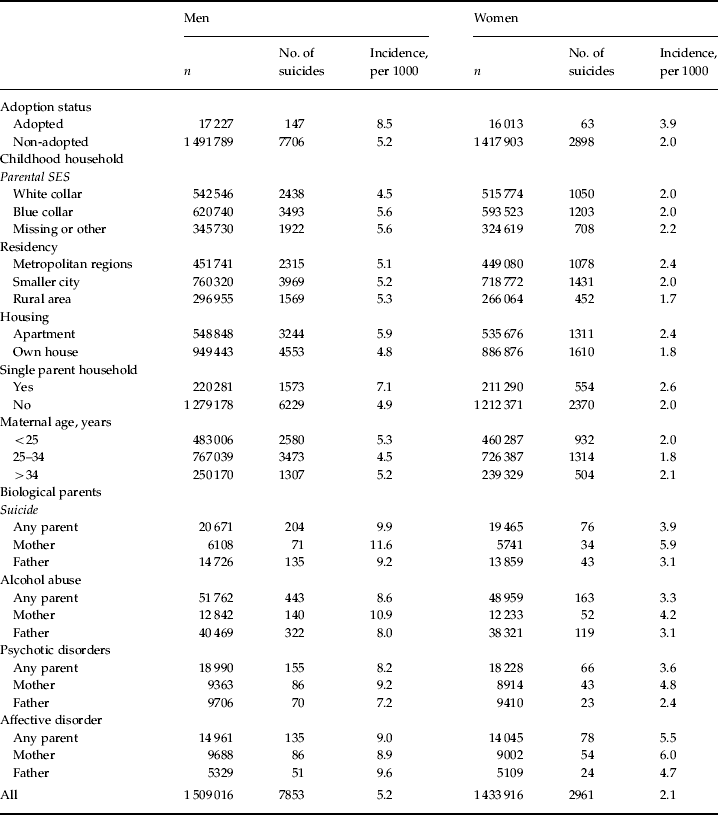
A total of 8635 (0.4%) non-adopted and 180 (0.7%) adopted individuals had committed suicide during the follow-up period (p<0.001). Of all suicides, 73.3% were committed by men. The adopted had higher rates of suicide compared with the non-adopted (8.5 v. 5.2/1000 for men and 3.9 v. 2.0/1000 for women).
Suicide risk varied considerably in the whole study population for all demographic and socio-economic determinants investigated in this study. Biological parents' suicide, affective/psychotic disorders and alcohol abuse also influenced the suicide risk. This influence tended to be higher for maternal morbidity indicators compared with paternal indicators for women, while this was true only for suicide and alcohol abuse for men (Table 1).
Incidence of suicide death in the study population by adoption status, childhood household characteristics and psychiatric morbidity of the biological parents

SES, Socioeconomic status.
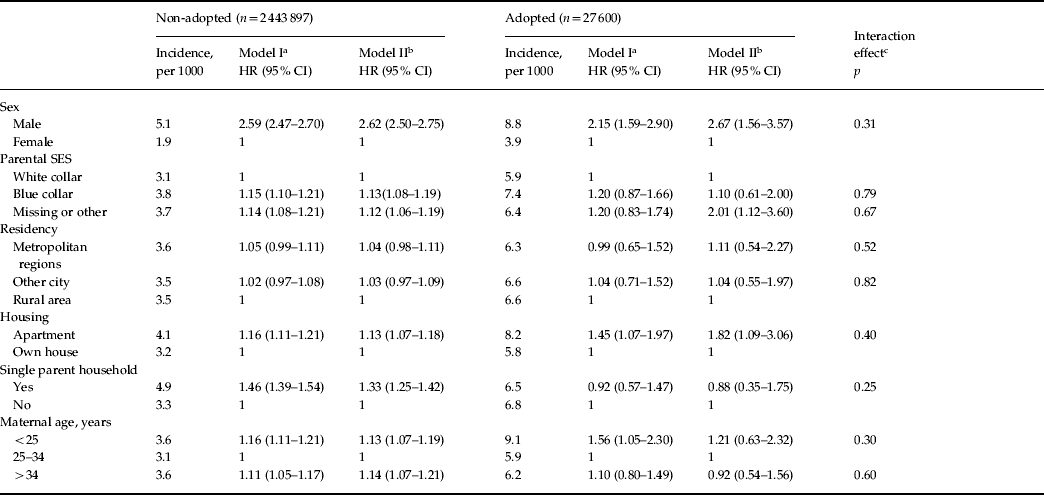
Table 2 shows the multivariate analysis of the socio-economic determinants of the childhood household. Growing up in a single parent household (HR 1.46) was found to have the highest risk for suicide in the non-adopted but tended to have a lower effect for the adopted (HR 1.46 v. 0.92, p=0.25). Parental SES, housing and low maternal age contributed less (HR 1.15, 1.14 and 1.16, respectively) with similar effects in the adopted and non-adopted. HRs decreased marginally with adjustment for biological parents' morbidity.
Cox regression of sociodemographic determinants of the childhood household and suicide

HR, Hazard ratio; CI, confidence interval; SES, socio-economic status.
a Adjusted for age.
b Adjusted for age and biological parents' morbidity.
c p Value in interaction analysis in model I in the entire study population.
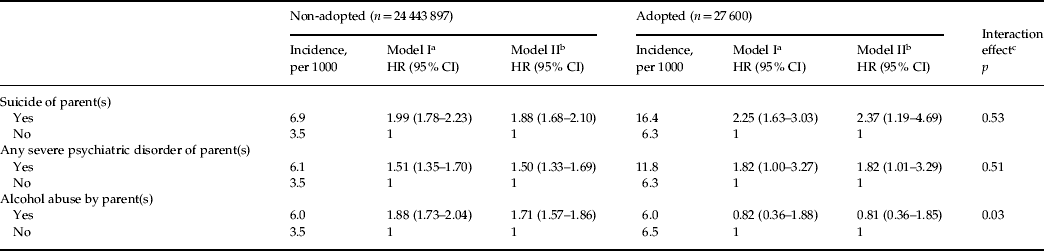
Table 3 shows the multivariate analysis of the indicators of psychiatric morbidity and suicide in the biological parents. Biological parents' suicide, as well as psychotic and affective disorders, had a similar influence on the suicide risk for adoptees and the non-adopted. Biological parents' alcohol abuse had a greater effect in the non-adopted than in the adopted (HR 1.88 v. 0.82, p=0.03).
Cox regression of indicators of psychiatric morbidity of the biological parents and offspring suicide

HR, Hazard ratio; CI, confidence interval.
a Adjusted for sex and age.
b Adjusted for sex, age and socio-economic indicators.
c p Value in interaction analysis in model I in the entire study population.
Discussion
In this register study of a national cohort we compared the effect of socio-economic and heritable risk factors for 180 suicides in the adopted with more than 8000 suicides in young and middle-aged non-adopted individuals within the same age range. Suicide and severe psychiatric disorder in the biological parents had similar effects in the non-adopted and adopted. Alcohol abuse in biological parents, however, was found to be a risk factor for suicide in non-adoptees only. Socio-economic determinants had a similar effect in the adopted and the non-adopted, indicating that social drift because of parental psychiatric morbidity or suicide did not explain the major effects of these variables.
It is notable that the risk of suicide in individuals having experienced parental suicide was almost the same for those raised by adoptive and biological parents. This speaks against the imitation hypothesis as an explanation of the increased risk of suicide associated with parental suicide. It is also in line with the findings of Burke et al. (Reference Burke, Galfalvy, Everett, Currier, Zelazny, Oquendo, Melhem, Kolko, Harkavy-Friedman, Birmaher, Stanley, Mann and Brent2010) who reported a four-fold increased likelihood for suicide attempt in a study of offspring of depressed parents with suicidal behaviour. This increase, however, was eliminated if the exposure was restricted to exposure antecedent to the suicidal behaviour. The authors found only two previous studies on the topic with an adequate design, both reporting similar findings (Burke et al. Reference Burke, Galfalvy, Everett, Currier, Zelazny, Oquendo, Melhem, Kolko, Harkavy-Friedman, Birmaher, Stanley, Mann and Brent2010).
The indicator for parental psychiatric morbidity did not mediate the main effects of parental suicide on suicide in the adoptees in this study. Results from quite a few previous studies point in the same direction, highlighting the specific genetic contribution linked to parental suicide (Roy et al. Reference Roy, Segal, Centerwall and Robinette1991; Fu et al. Reference Fu, Heath, Bucholz, Nelson, Glowinski, Goldberg, Lyons, Tsuang, Jacob, True and Eisen2002; Brent & Mann, Reference Brent and Mann2005). It is reasonable to believe that this contribution reflects specific endophenotypes, such as impulsive–aggressive traits (Carballo et al. Reference Carballo, Akamnonu and Oquendo2008; Brent, Reference Brent2009), which in turn may be related to aberrant hereditary serotonin patterns (Rujescu et al. Reference Rujescu, Thalmeier, Möller, Bronisch and Giegling2007).
The absence of an increased risk for suicide in children born to parents with alcohol problems was unexpected, considering the established association between substance abuse and suicide (Harris & Barraclough, Reference Harris and Barraclough1997). A lower level of serotonin has been found in both and has also been proposed as a possible shared genetic factor (Nielsen et al. Reference Nielsen, Virkkunen, Lappalainen, Eggert, Brown, Long, Goldman and Linnoila1998). Roy et al. (Reference Roy, Hu, Janal and Goldman2007), in a gene–environment study, found that a low expression of the promoter region of the serotonin transporter gene increased the risk of a suicide attempt associated with childhood trauma in patients with substance dependence. Further, alcohol-dependent individuals with suicidal behaviour score high on impulsive and aggressive behaviours (Koller et al. Reference Koller, Preuss, Bottlender, Wenzel and Soyka2002), suggesting a link to impulsive–aggressive traits from both these clinical phenomena. To some degree our results challenge these hypotheses about common genetic mechanisms for substance abuse and suicide or at least suggest that the impact of such genetic influence is considerably lower than could be expected. Instead, the main influence of parental substance abuse on suicide seems to be mediated by the family environment.
Having grown up in a single parent household stood out as a risk factor within the childhood household characteristics. Similar results have been shown in previous studies by Weitoft et al. (Reference Weitoft, Haglund, Hjern and Rosen2002, Reference Weitoft, Hjern, Haglund and Rosen2003). It has been suggested that there may be an accumulation of other risk factors in single parents nested into these findings, which in turn has a negative influence on the children (Weitoft et al. Reference Weitoft, Haglund, Hjern and Rosen2002, Reference Weitoft, Hjern, Haglund and Rosen2003). In our study, neither sociodemographic factors nor parental psychiatric morbidity explained much of this increased risk in the regression analysis.
The presence of heritable factors that, apart from increasing the risk of a specific event such as suicide, also may influence the interaction of the individual with the labour market suggests a possible ‘social drift’ over generations (Goldberg & Morrison, Reference Goldberg and Morrison1963; Timms, Reference Timms1998). The lack of a major interaction between adoption and socio-economic indicators of the childhood household found in this study indicates that social drift does not explain the association between low social status and suicide. It should be noted, however, that this presumes that matching between adoptive and biological parents on socio-economic grounds was not a common practice, a possibility which cannot altogether be discarded.
A higher risk for suicidal behaviour in national as well as international adoptees in Sweden has been reported previously (Hjern et al. Reference Hjern, Vinnerljung and Lindblad2004; von Borczyskowski et al. Reference von Borczyskowski, Hjern, Lindblad and Vinnerljung2006). This higher risk was confirmed in this study. Adoptees tend to grow up under better than average rearing conditions (hence a slightly less favourable risk after adjustment for childhood household characteristics), but heritable risk factors for suicide are considerably more common in adoptees than the non-adopted (von Borczyskowski et al. Reference von Borczyskowski, Hjern, Lindblad and Vinnerljung2006). It is also possible that adoption in itself, or other exposures involved in the adoption process, such as experiences of institutional rearing in infancy, may lead to an increased risk of suicide in adulthood.
Methodological issues
Previous studies have shown a good validity for register data on suicide in Western countries (Moscicki, Reference Moscicki1997). In Sweden all unexpected deaths outside of hospitals are investigated through a forensic autopsy (National Board of Forensic Medicine, 2004). The accuracy of diagnoses in the Cause of Death Register is examined every second year in independent studies of random samples (Official Statistics Sweden, 2004). Furthermore, in our definition of suicide, undetermined deaths were included, to minimize spatial and secular trends in detecting cases of suicide (Linsley et al. Reference Linsley, Schapira and Kelly2001).
The validity of a diagnosis of schizophrenia in the Swedish National Discharge Register has been found to be quite high and stable over time and between clinics or regions (Dalman et al. Reference Dalman, Broms, Cullberg and Allebeck2002). A more important methodological problem is probably that indicators of psychiatric morbidity based on psychiatric diagnoses at death or at hospital discharge implies that only a small – and quite extreme – fraction of the total morbidity will be recorded. In comparison with these hospital-based morbidity indicators, the precision of the parental suicide variable can be expected to be much higher. This in turn may lead to an underestimation of the true effects of the psychiatric risk factors in comparison with the effect of parental suicide.
A specific issue in this context concerns the strength of the heritability effect. Early-onset suicidal behaviour has a greater genetic component than later suicidal behaviour (Brent et al. Reference Brent, Oquendo, Birmaher, Greenhill, Kolko, Stanley, Zelazny, Brodsky, Firinciogullari, Ellis and Mann2003; Brent & Mann, Reference Brent and Mann2005). In the present study, cases of parental suicides before 1960 and offspring suicides before 1987 are not included in the analysis. Therefore, the effects of suicide-related heritable factors may be underestimated in our results.
Ideally, we would have liked to perform a pure cross-adoption analysis like Tienari et al. (Reference Tienari, Sorri, Lahti, Naarala, Wahlberg, Pohjola and Moring1985) in their classic study on schizophrenia. But due to the low rate of our indicator of psychiatric morbidity in adoptive parents, we would have needed an even bigger dataset, or other indicators of psychiatric morbidity than hospital discharges, suicide and cause of death. The low rate of indications of serious psychiatric morbidity in adoptive parents is not surprising as such since the adoption process in Sweden included ‘vetting’ applicants for mental health problems.
Conclusions
This study indicates that the association of suicide over generations in the same family is explained by heritable factors rather than through the post-natal environment or imitation. Alcohol abuse, on the other hand, is a risk factor for suicide only when children are exposed to this abuse in their post-natal environment. Social drift over generations because of heritable psychiatric disorders does not seem likely to explain the association of socio-economic living conditions in childhood to suicide.
Acknowledgements
This study was funded by the Swedish Council for Working Life and Social Research.
Declaration of Interest
None.