INTRODUCTION
The provision of high-quality palliative care to patients is of crucial importance in developed nations, particularly as their populations age. Bascand reported that more than 1.5 million in New Zealand (22% of the projected total population) will be expected to be aged 65 or above by the year 2061 (Bascand, Reference Bascand2012). This trend will likely create an increased burden on aged care facilities in New Zealand. There is, therefore, a strong rationale for provision of training programs to ensure quality interprofessional palliative care for an increasing number of patients.
Amid a climate of increasing demand on hospice and palliative care workers, the issue of workplace stress is also of concern (Gillman et al., Reference Gillman, Adams and Watts2012; Phillips et al., Reference Phillips, Piza and Ingham2012; Vachon, Reference Vachon1995). Vachon (Reference Vachon1995) reported that there is a strong tradition within the hospice and palliative care settings that promotes clinical education, team support, and a keen awareness of responsibility for caregivers' own self-care as part of optimal clinical practice. Our study therefore aimed to consider training initiatives that could ameliorate workplace stress.
Other studies (Contro et al., Reference Contro, Larson and Scofield2004; Tuffrey-Wijne, Reference Tuffrey-Wijne2002; Reference Tuffrey-Wijne2013) have identified additional specific areas where training could benefit workers in the hospice and palliative care settings. Contro and coworkers (Reference Contro, Larson and Scofield2004) reported that staff working in the area of pediatric palliative care feel inexperienced when communicating with patients and their families about end-of-life issues, discussing the transition to palliative care, and discussing do-not-resuscitate status. Their study also highlighted the need for development in areas of pain management, support for staff working in end-of-life care settings, and working with difficult experiences.
The present work evaluates two staff education and development modules designed by Hospice New Zealand. These educational modules were designed to be interprofessional and were developed in response to research carried out in the Age Care sector by New Zealand Government's Ministry of Health (2001). This ministry-based research provided a strong rationale for more health professional education to ensure good palliative care. Other resources further informed the rationale and development of the educational modules (Department of Health, 2008; Department of Health and Ageing, 2006) and have contributed to the growing literature (e.g., Phillips et al., Reference Phillips, Piza and Ingham2012), suggesting the importance of the needs in this area.
The two educational modules under scrutiny in the current paper include a general-purpose teaching module entitled Essence of Palliative Care and a more clinically based module called Pain and Symptom Management. We asked two questions: (1) what aspects of the two modules worked well? and (2) what aspects were needed to ensure quality improvement?
METHOD
Study Design and Participants
A mixed-methods approach was employed that incorporated survey design and interview methods. The stakeholder population associated with this educational intervention consisted of registered nurses, occupational therapists, healthcare assistants, clinical educators, and the manager of the aged care facility. Ethics approval was obtained from the University of Auckland Human Participants Ethics Committee (Ref. 8531).
Participant Characteristics
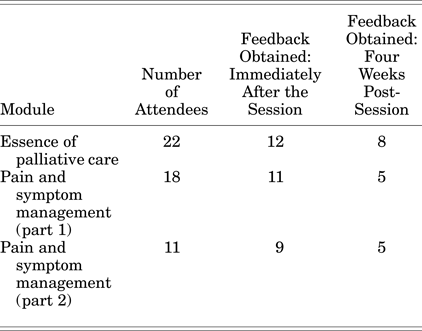
In the initial program survey, 22 attendees were invited to fill out the feedback questionnaire both immediately after the session and at a four-week follow-up. This was an anonymous process, so that the details on respondents were not known. The number of respondents are documented in Table 1.
Participant response details for phase 1

Interviews were conducted with three registered nurses who attended the modules, all three clinical nurse educators who presented the material, and the manager of the aged care facility. All participants attended both workshop modules, except for one registered nurse who attended only the Pain and Symptom Management module.
Data Collection
To obtain a triangulated picture of the effectiveness of these training sessions, data collection was divided into two phases:
Phase 1
Participants attended workshops as students at a single aged care facility and were invited to fill out confidential evaluation questionnaires (available upon request from the corresponding author) on two occasions: immediately after the training session and four weeks after attending the workshop.
Phase 2
All key stakeholders were invited to contribute their views on the two modules (Essence of Palliative Care and Pain and Symptom Management) in an interview employing a set of semistructured questions (available from the corresponding author). The interviews were led by one, or both, of the research investigators (MH and/or JH). These interviews were recorded on a digital audio recorder and subsequently transcribed. These semistructured interview questions were designed to correspond with Biggs's process of ensuring constructive alignment between three components—namely, intended learning outcomes, teaching and learning activities, and assessment (Biggs, Reference Biggs1996; Reference Biggs1999). In addition, evaluative information was gathered (Prideaux, Reference Prideaux2003).
Data Analysis
Two sets of data for analysis were included in our research:
Phase 1
Descriptive data were obtained from the first section of the evaluation sheets. The open-ended responses to the second section were analyzed using a content analysis approach, with the aim of condensing the general comments into more specific themes (Elo & Kyngäs, Reference Elo and Kyngäs2008).
Phase 2
The qualitative data obtained from the interviews were analyzed using a deductive content analysis process (Elo & Kyngäs, Reference Elo and Kyngäs2008). During the preparation phase, meaningful classifications were developed according to Biggs's model of constructive alignment (Biggs, Reference Biggs1996; Reference Biggs1999), as described earlier. This primarily deductive method of analyzing the manifest content of the interviews was employed to drive the research process (Elo & Kyngäs, Reference Elo and Kyngäs2008).
To establish rigor, the first and second authors conducted the interviews, since they were not affiliated with the host organization. The second author transcribed the interviews and collated survey data. The first and second authors analyzed the data independently, and the findings were then reviewed with the third author. The trustworthiness of the research process was considered in line with Guba's (Reference Guba1981) notions of “truth value” of findings; the applicability of the data; the consistency of interpretation; and the “neutrality” of the researchers.
RESULTS
Phase 1: Survey Data
Immediate Evaluation
The workshops (Essence of Palliative Care and Pain and Symptom Management) were rated highly (mean ranges 2.5 to 3: where 3 = high, 1 = low), with a marginal preference for the latter workshop on all items.
In contrast, the open-ended comments were more diverse by nature. For the first module, Essence of Palliative Care, participants felt that they had achieved a better understanding of terminology and issues influencing palliative care, such as understanding the terms “palliative,” “end of life,” and “terminal,” and being aware of the importance of concepts related to “total suffering” and “spirituality.” In addition, the training facilitated development of patient and family listening skills. In general, participants found utilization of the lecture and group work teaching methods effective, though one respondent found the group work disruptive and the lectures rushed.
For the second module, Pain and Symptom Management, participants acknowledged the information transfer, such as the analgesic ladder for cancer pain, opioid use in pain management, and constipation and nausea management. The module also heightened their understanding of the “patients” and their “care.” The teaching methods utilized—such as case studies, pain management quiz, group exercise, lecture, and discussion—were considered effective. The impact on their clinical practice was evident, with participants commenting on improved clinical knowledge, more developed communication strategies, and enhanced patient care, though the need for more work was also recognized.
Post-Learning Feedback
Four weeks after this training, participants commented that the Essence of Palliative Care module had enhanced their awareness of patient care, their communication with patients, and their desire for more training. In reference to the Pain and Symptom Management module, emerging ideas centered around the development of clinical expertise.
Phase 2: Interview Findings
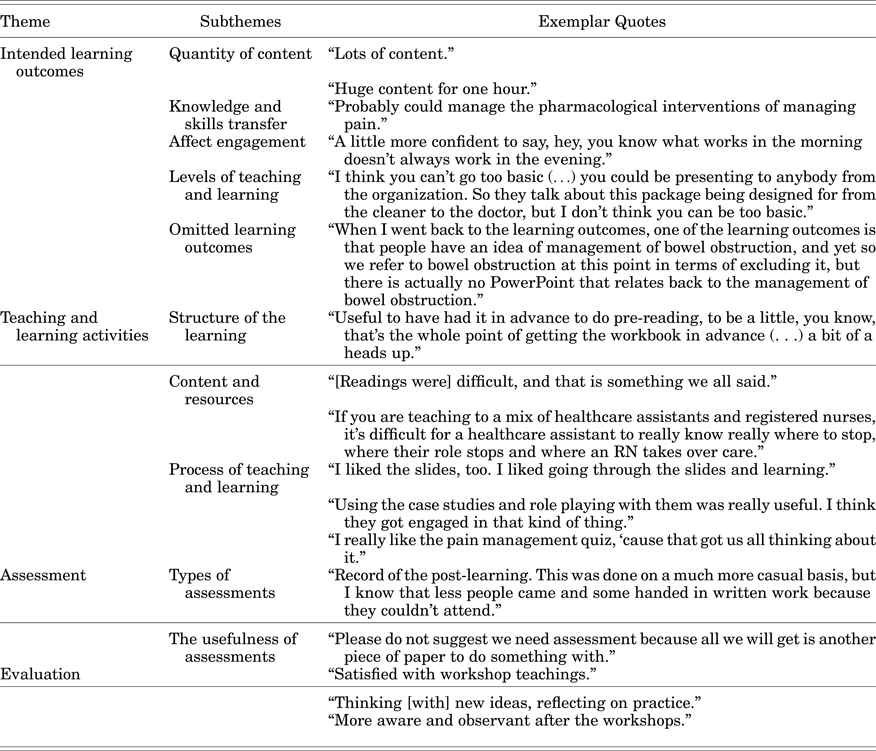
The emerging themes are presented in Table 2 in line with Biggs's (Reference Biggs1996; Reference Biggs1999) and Prideaux's (Reference Prideaux2003) classification systems.
Thematic descriptions and exemplars emerging from the transcribed interviews

Intended Learning Outcomes
Five themes emerged from the data (see Table 2). First, the theme Quantity of Learning Outcomes and Content revealed that the learning outcomes may exceed the cognitive capacity of attendees and content may exceed the time constraints. Second, the theme Knowledge and Skills Transfer suggested an alignment between the course objectives and clinical training outcome. Third, the theme Emotional and Motivational Engagement identified the affective component of the training that positively impacted on their self-efficacy. Fourth, the theme Levels of Teaching and Learning recognized the diverse levels of teaching and range of the learners, and the inherent difficulty with some of the teaching material for particular staff members. Last, the theme Omitted Learning Outcomes established that some learning outcomes were not adequately aligned with the intended content.
Teaching and Learning Activities
Three themes emerged from the comments here (Table 2). First, the Structure of Learning theme pinpointed that there was a potential for informed pre-reading before the workshop in terms of positioning and scaffolding of prior understanding and reflection. Moreover, the actual structure of the workshops engendered constructive learning activities. Second, the theme Content and Resources distinguished the effectiveness of the case studies and the workbooks, though paper resources could have been digitally recorded and printed when needed. The Essence module was perceived as more philosophical than clinically relevant. The content was such that it was challenging to deliver information to meet the needs of the diverse work experiences and roles of the attendees. One educator noted the difficulty of using another person's PowerPoint slides. Third, the theme Process of Teaching and Learning acknowledged the diverse set of teaching mechanisms employed, which included PowerPoint slides, working in groups, readings, quizzes, timing of activities, and utilization of case studies. Some cautionary comments were offered about the use of language and working in groups. The case studies, quizzes, and role plays were mentioned as highly effective teaching tools.
Assessment
Two themes (see Table 2) were identified from the scripts. First, the theme Types of Assessments revealed that no formal assessments were included in the process. The informal pain quiz was useful in reinforcing prior learning. The post-learning exercises were not rigorously monitored but were potentially instructive. Other possible assessments mentioned included a case scenario that could have been worked through, an open-book assessment, and/or multiple-choice questions. Second, the theme Usefulness of Assessments alluded to the significance of informal assessments. The logistics involved in setting up a formal assessment system were not considered favorable, given issues related to the workshop milieu, time, workloads, and reliability.
Evaluation Questions
Some general evaluation questions (Table 2) were also asked to get an overall sense of stakeholders' level of satisfaction about the courses. Most interviewees found the courses to be thought provoking and very instructive. There were direct implications for palliative care, with useful crosspollination to aged care. Some interviewees believed that a pre-information pack would be useful for attendees along with some form of needs analysis to guide course material.
DISCUSSION
There is an increasing need for palliative care education within the aged care sector (Bascand, Reference Bascand2012). Hence, the Fundamentals of Palliative Care workshop series was developed with the intention of meeting this demand. In the following discussion, phase 1 data are used to answer the study's primary research questions—namely, “what aspects of the two modules worked well?” and “what is needed to ensure quality improvement?” Phase 2 semistructured interview data were used to assess the efficacy of the modules in terms of their intended learning outcomes, teaching and learning activities, assessment, and overall evaluation.
What Aspects of the Two Modules Worked Well?
Phase 1 data revealed that participants rated both modules highly. The workbooks were seen as useful, the sessions interesting, the presentations of good quality, the level of course material about right, and the time available to address pre-session questions adequate. In the comments targeted at Essence of Palliative Care, there was a strong sense that participants had gained greater insight into their role as health professionals, into the use of communication strategies, and around the notion of patient-centered care—all critical responsibilities for health professionals working in this area (Contro et al., Reference Contro, Larson and Scofield2004; Tuffrey-Wijne, Reference Tuffrey-Wijne2013). In addition, it is likely that participants had developed coping mechanisms and a sense of heightened resilience from attending the courses (Gillman et al., Reference Gillman, Adams and Watts2012).
The usefulness of content knowledge (confirming and extending) was clearly emphasized in the feedback from the Pain and Symptom Management module. Again, participants gained a greater awareness of patient-centered care, which likely built on the earlier module on the Essence of Palliative Care. Statements affirmed that participants were “more aware and observant” not only about patient care but also about their own roles within this system of care. These levels of awareness tend to create greater possibilities for more sophisticated coping systems and for maintaining a sense of professional and personal balance (Gillman et al., Reference Gillman, Adams and Watts2012).
From the responses obtained, the post-learning exercises were useful in reinforcing concepts related to building content knowledge, developing their communication strategies, creating a paradigm shift associated with patient care, and enhancing application of patient-centered care. These data affirm that the resources and educators engaged in these courses provided an environment that heightened motivational learning while imparting knowledge through the use of appropriate techniques and technologies (Kreber & Cranton, Reference Kreber and Cranton2000). There was also evidence of networking between attendees as well as of opportunities for developing critical thinking and meaningful clinical and workplace applications (Kirkpatrick, Reference Kirkpatrick1996; Kreber & Cranton, Reference Kreber and Cranton2000; Vachon, Reference Vachon1995).
What Is Needed to Ensure Quality Improvement?
The diverse attendee group—comprised of nurses, nurse assistants, and occupational therapists—and the comments obtained suggest that there was too much information for some attendees. Professional development initiatives need to be relevant to optimize the specific learning needs of the professionals working in the area, as too much theory may negate clinical relevance (Phillips et al., Reference Phillips, Piza and Ingham2012). Nonetheless, it is important to cultivate effective team communication and support, and these educational activities likely cultivated channels of communication between team members. This communications process can clarify assumptions around responsibilities and knowledge differences, thus minimizing workplace stressors (Vachon, Reference Vachon1995).
The responses suggested that the Pain and Symptom Management module was slightly more favorably rated. Although unlikely to be significantly different, this perhaps indicates that the Essence of Palliative Care module was more abstract and the Pain and Symptom Management module more clinically relevant. The low number of post-learning replies also suggests that respondents may have been too busy to complete the exercises, or that the post-learning activities may not have been assigned a high enough priority, or were not engaging. It may be useful to ask the nonresponders to provide explanations as to why they did not respond, given that those who did clearly found value in the exercise, reporting changes in clinical practice and transfer of knowledge (Kirkpatrick, Reference Kirkpatrick1996).
Did the Workshops Have Adequate Learning Outcomes?
Following an analysis of the interview scripts, five themes emerged from the data. First, the Quantity of Learning Outcomes and Content theme suggested that the learning outcomes were greater than many in this group could absorb within the time allowed. This suggests that each session needs to be considered according to the context and the stakeholders present. According to the second emerging theme, Knowledge and Skills Transfer, there is a high likelihood that significant learning occurred. The Essence of Palliative Care session appears to be insightful, while the Pain and Symptom Management sessions were more clinically instructive. The third theme, Emotional and Motivational Engagement, suggested that the team educational process likely enhanced the confidence of attendees (Vachon, Reference Vachon1995) and prepared them for sensitive communications issues such as breaking bad news (Control et al., Reference Contro, Larson and Scofield2004). The Levels of Teaching and Learning theme reinforced the problem of teaching to a diverse learning group. To improve this situation, the educator may wish to gain an idea of the knowledge and skills base of their projected learners before the sessions and thus tailor each teaching session accordingly (Phillips et al., Reference Phillips, Piza and Ingham2012). The Omitted Learning Outcomes theme suggested that certain content areas are missing, but on the whole this omission is likely a minor one.
Were the Teaching and Learning Activities Aligned with the Learning Outcomes?
Subsequent inspection of the transcribed scripts demonstrated three emergent themes. The first theme, Structure of the Learning, suggested a “pre-,” “in situ,” and “post-learning” teaching process. The Content and Resources theme suggested that the content and resource materials were useful. There was, however, a cautionary note regarding the readability of the resources provided, which may reflect the time constraints attendees experienced when absorbing the material. One way of developing this resource would be to create a blended learning platform (Osguthorpe & Graham, Reference Osguthorpe and Graham2003). In their paper, Osguthorpe and Graham proposed that blended learning environments are able to: (1) provide pedagogical richness, (2) maximize access to knowledge, (3) improve social interaction, (4) cater to personal agency, (5) increase cost effectiveness, and (6) ensure ease of revision. The Process of Teaching and Learning theme acknowledged that a number of methods were being used, thus promoting a multidimensional model of teaching and learning (Ferguson & Jinks, Reference Ferguson and Jinks1994).
Did the Assessment Processes Gauge Learning?
The interviewee scripts indicated that the first theme centered around the idea of Types of Assessments. There is some blurring here between attitudinal evaluation and assessment of content. The post-learning exercise likely evaluates transmission of clinical knowledge and skills, though these data were self-reported, which has known shortcomings (Donaldson & Grant-Vallone, Reference Donaldson and Grant-Vallone2002; Schwarz, Reference Schwarz1999; van de Mortel, Reference van de Mortel2008). The Usefulness of Assessments theme builds on this idea. The data collection protocols promulgated provide good indicators of satisfaction and some sense of self-reported usefulness of the training programs. A more integrated and intensive approach to assessment may prove to be more fruitful and make the modules more substantive, such as conducting a blueprinting exercise (Wilkinson et al., Reference Wilkinson, Wade and Knock2009) or employing a programmatic approach (van der Vleuten et al., Reference van der Vleuten, Schuwirth and Driessen2012). A more formal approach may be more productive and lead to establishing standards and certification.
As with the assessments, the evaluations were attitudinal and self-reported. Nonetheless, most of the interviewees felt that the modules were: (1) a great concept, (2) developed their thinking, and (3) had a significant impact on their practice.
LIMITATIONS
Our study has a number of limitations, the main one being that we were unable to conduct interviews with the healthcare assistants and occupational therapists who also participated in these modules. This may reflect the demands on certain specialties in terms of finding relief staff (Phillips et al., Reference Phillips, Piza and Ingham2012), or a reluctance among certain specialties to engage in this aspect of evaluation. It is also acknowledged that we were unable to measure the impact on patient outcomes directly, though there is clear self-reported evidence that competence related to clinical practice was enhanced.
CONCLUSION AND RECOMMENDATIONS
We were able to obtain constructive information about two teaching modules using a mixed-methods approach. Several areas could be refined to further optimize learning potential for the attendees. First, it is important to be familiar with the level of prior learning for all the attendees to refine learning outcomes and teaching material. This could be achieved by simply implementing a pre-test that could be made available via an electronic platform (Phillips et al., Reference Phillips, Piza and Ingham2012). Second, a blended learning approach may widen the learner population, create flexibility with learner material, and contain costs (Osguthorpe & Graham, Reference Osguthorpe and Graham2003). Such an approach would likely appeal to rural workers, although it is important to note that some participants likely have different preferences for engagement with educational material (Phillips et al., Reference Phillips, Piza and Ingham2012). Third, it is useful to consider an inclusive and formal assessment process to inform educators, institutions, and learners (van der Vleuten et al., Reference van der Vleuten, Schuwirth and Driessen2012). Finally, in terms of developing a robust evaluation system, it is crucial to ensure that the evaluative questionnaires (post- and follow-up) are well designed and psychometrically robust (Kember & Leung, Reference Kember and Leung2008). It would also be instructive to incorporate a benchmarking exercise with similar initiatives (Pan et al., Reference Pan, Morrison and Meier2001) and consider the long-term benefits of these types of interventions on clinical practice and patient outcome (Phillips et al., Reference Phillips, Piza and Ingham2012).
ACKNOWLEDGMENTS
We would like to acknowledge the willingness and approachability of the Mercy Hospice educational team and the three registered nurses who contributed to the interviews. We are also grateful to Anne Morgan for her helpful contributions in developing the background for module design and development.