Introduction
Obstructive sleep apnoea (OSA) is common in adults,Reference Young, Peppard and Gottlieb1, Reference Punjabi2 and is associated with significant sequelae including mortality.Reference Marshall, Wong, Liu, Cullen, Knuiman and Grunstein3 Patients are often initially treated with the use of a continuous positive airway pressure (CPAP) device. If this treatment is successful in terms of efficacy and patient compliance, use of the device will continue long term for what is recognised as a chronic condition.Reference Weaver4 Although the device is usually effective when worn appropriately, CPAP non-adherence is as high as 46–83 per cent and probably increases with the number of years of therapy.Reference Weaver and Grunstein5 Furthermore, simple algebra can demonstrate that failing to take into account realistic values for CPAP compliance can vastly overestimate the likely overall clinical effectiveness of that treatment compared to a surgical solution that is durable and does not suffer from compliance-related declines in long-term effectiveness.Reference Ravesloot and de Vries6
Recently, surgery for OSA, which may be carried out as a definitive or adjunctive treatment, has come under close scrutinyReference Caples, Rowley, Prinsell, Pallanch, Elamin and Katz7 and in some cases criticism.Reference Elshaug, Moss, Hiller and Maddern8 This is despite evidence from cohort studies linking upper airway surgery to reductions in motor vehicle accident risk,Reference Haraldsson, Carenfelt, Lysdahl and Tornros9 cardiovascular riskReference Marti, Sampol, Muñoz, Torres, Roca and Lloberes10 and all causes of mortality.Reference Weaver, Maynard and Yueh11 Surgery as an option for those in whom device therapy has failed, or when used as a treatment in order to allow subsequent CPAP use, is also supported by specialists in broader sleep disordered breathing guidelines.Reference Epstein, Kristo, Strollo, Friedman, Malhotra and Patil12
Contemporary airway reconstruction protocols in Australia have been published by Robinson et al. Reference Robinson, Chia, Carney, Chawla, Harris and Esterman13 as an update to those reported by Riley et al. Reference Riley, Powell and Guilleminault14 Here we present a single surgeon case series that aimed to investigate the reproducibility of such protocol-based approaches in patients for whom standard OSA treatments (CPAP and/or mandibular advancement splint) had failed.
Materials and methods
Ethics review board approval was obtained through the Ethics Unit, Research Services Office at the University of Wollongong in Australia.
Between late 2008 and early 2012, patients referred to a single surgeon (trained in contemporary airway reconstruction surgery; corresponding author) for OSA treatment were screened for suitable inclusion in this case series. Suitable patients included those with moderate to severe OSA, for whom a supervised trial of CPAP (with or without a mandibular advancement splint) failed. Exclusion criteria were: clinically and radiologically evident orthognathic abnormalities, body mass index (BMI) of more than 35 kg/m2, significant comorbidities precluding surgery, and patients deemed suitable for a lesser operation (based on the clinical assessment).
All patients underwent a comprehensive clinical assessment. A full history was taken and a thorough examination was conducted, including evaluation of: nasal patency, craniofacial structure, nasopharynx and velopharynx, oropharynx (which incorporated Friedman anatomical staging),Reference Friedman, Ibrahim and Joseph15 tongue and retrolingual segment, and lateral pharyngeal and hypopharyngeal walls with laryngeal assessment. Modified Mueller manoeuvresReference Friedman16 and Woodson's hypotonic methodReference Fairbanks, Mickelson and Woodson17 were performed on patients in erect and supine positions (using a dental chair). A modified Esmarch (jaw thrust) manoeuvre was carried out on patients when awake.Reference Esmarch18
Two questionnaires were completed by patients. The Epworth sleepiness scale is a widely used measure of the propensity to fall asleep in eight everyday situations. Scores are summed to give a single score between 0 and 24, with higher scores indicating pathological sleepiness. Scores above 10 are usually regarded as evidence of sleepiness.Reference Johns19, Reference Johns and Hocking20 The snoring severity scale provides an assessment of the loudness, frequency and periodicity of snoring sound (scores are out of 9).Reference Lim and Curry21
Objective measurements included BMI, formal (laboratory-based) polysomnography recordings and CT airway reconstruction computed tomography. Computed tomography images were obtained through the whole of the larynx and pharynx, with inspiratory and expiratory views, and with measurements of the sella–nasion A and B points. Cranial base angles, mandibular plane to hyoid distance, oropharyngeal and total lingual surface areas, submandibular surface area, base of tongue and soft palate to posterior pharyngeal wall distance, coronal tooth root measurements, and height to geniotubercle from top of longest tooth and height to geniohyoid from top of longest tooth were all quantified. This imaging was utilised to confirm or refute clinical findings, particularly in relation to tongue size (macroglossia is broadly defined as more than 2600 mm2). It also enabled definition of cranial base angles, which might facilitate earlier referral for maxillofacial surgery, rather than soft tissue surgery.
Informed consent was obtained from patients in regard to risks, benefits, technical considerations related to surgery, and encouragement to repeat use of trial device if it failed or was rejected.
Patients were reviewed by a sleep physician and the primary surgeon; all were given the opportunity to attend the multidisciplinary sleep meeting, though some declined.
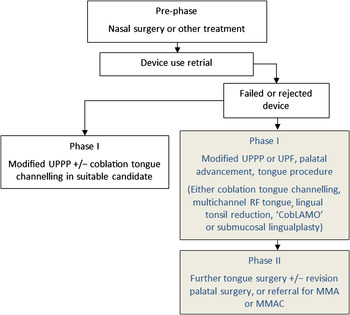
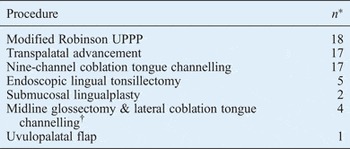
The first consecutive 17 OSA patients scheduled to undergo surgical procedures more extensive than modified uvulopalatopharyngoplasty, with or without radiofrequency tongue coblation, were included in the study. The surgical protocol is shown in Figure 1, with the grey background denoting those procedures utilised in this series. Table I indicates the range of surgical procedures employed to treat these patients (22 operations in 17 patients).
Airway reconstruction protocol. UPPP = uvulopalatopharyngoplasty; UPF = uvulopalatal flap; RF = radiofrequency; ‘CobLAMO’ = coblation-assisted Lewis and MacKay operation; MMA = maxillomandibular advancement; MMAC = maxillomandibular chin advancement

Airway reconstruction procedures

*Number of times procedure performed. †Refers to new coblation-assisted Lewis and MacKay operation (‘CobLAMO’). UPPP = uvulopalatopharyngoplasty
Post-operatively, patients underwent repeat clinical assessment at the three to four month follow-up visit. This included formal polysomnography (in the same laboratory as the pre-operative assessment), BMI calculation, and completion of the Epworth sleepiness scale and snoring severity scale. Sleep studies were performed at a mean of 146.5 days post operation (range 85–500 days). Subsequent 12-month and 36-month follow-up visits were scheduled. Any post-surgery complications reported by the patient or revealed on physical examination were documented.
Comparisons between patients' pre- and post-operative data were statistically analysed using either paired t-tests (where data were normally distributed) or the Wilcoxon signed rank test (for non-normally distributed data). The Kolmogorov–Smirnov test (and visual inspection of histograms) was used to test the normality of the clinical variables. P values of less than 0.05 were regarded as significant. Data were analysed using the SPSS software version 19.0.0 (SPSS, Chicago, Illinois, USA). Effect sizes were calculated using Cohen's d, wherein the treatment effect was divided by the standard deviation (SD) of that measure at baseline. Large effects were defined as those greater than 0.8 SD, moderate effects as between 0.5 and 0.8 SD, and small effects were those in the range of 0.2–0.5 SD. Interpretation of Cohen's d is dependent on the variable being normally distributed (within an acceptable range).
Results
Patients in this series were typically referred by sleep physicians based on concerns regarding failure or rejection of device-based treatment. All patients had at least moderate OSA, with apnoea-hypopnoea index scores indicating between 16.1 and 60.0 events per hour. A repeat trial of device-based treatment was encouraged. In addition, presentation of their case at a multidisciplinary team meeting was offered in order to discuss adjuvant therapy such as weight loss, and to elucidate and overcome (where possible) problems associated with device-based treatment failure. All patients had undergone polysomnography following referral (within 12 months of referral), and the majority had spent at least 3–6 months untreated since diagnosis (several years in some cases).
The study comprised 17 patients (13 males and 4 females), who underwent a total of 22 separate airway reconstruction operations (13 patients had 1 operation, 3 patients had 2 operations and 1 patient had 3 operations). Within each airway reconstruction operation, an average of 2.91 procedures was performed, giving a total of 64 procedures (Table I).
When considered as a group, the patients were mildly overweight (mean BMI = 26.6 kg/m2, SD = 2.6, range 21.0–30.5 kg/m2) and middle-aged (mean = 51 years of age, SD = 9, range 37–66 years). Sleep apnoea severity at baseline, calculated using the apnoea-hypopnoea index, averaged 36.3 events per hour (SD = 11.9, range 16–60 events per hour) (Table II). The average snoring severity scale score at baseline was 6.9 out of 9 (SD = 2.2, score range 0–9). Daytime sleepiness at baseline, measured using the Epworth sleepiness scale, was moderately higher than normal, with an average score of 11.3 out of 24 (SD = 4.8, score range 3–19).
Post-operative clinical improvements

*Number of patients included in the analysis. †Numerically positive numbers indicate improvement. ‡Effect size (Cohen's d) was calculated by dividing the difference score by the pre-operative standard deviation. **Score representative of events per hour. §Lowest oxygen saturation data may not have been normally distributed, hence analysis was repeated using the Wilcoxon signed rank test; the results showing improvement remained significant (p = 0.005), but the effect size should be interpreted with caution. Pts = patients; pre-op = pre-operative; SD = standard deviation; post-op = post-operative; CI = confidence interval; AHI = apnoea-hypopnoea index score; O2 sat = oxygen saturation; BMI = body mass index; ESS = Epworth sleepiness scale score; SSS = snoring severity score
Of the 17 patients, 4 (23.5 per cent) were receiving treatment for hypertension, 7 (41.2 per cent) were being treated for hypercholesterolaemia, 3 (17.6 per cent) were smokers, 2 (11.8 per cent) had non-insulin-dependent diabetes mellitus and 2 (11.8 per cent) were being treated for depression. One patient had previously undergone coronary artery stenting, one had a history of transient ischaemic attacks, one had asthma, one had osteoarthritis and one had proteinuria of unknown aetiology. Three of the 17 patients (17.6 per cent), 2 of whom were less than 40 years old, were on no other medications and were non-smokers. Five of the 17 patients (29.4 per cent) had multiple comorbidities.
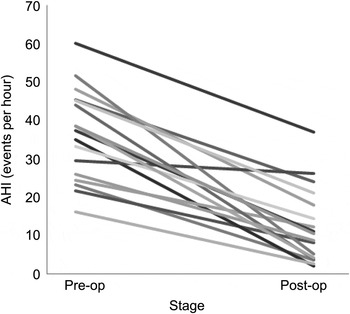
Table II shows the statistical significance of improvements in the various clinical indices following surgery. There was no final post-operative sleep assessment in one patient who underwent multiple procedures and so the data for her last sleep study have been used instead. In addition, the referring sleep laboratories do not always examine the apnoea and hypopnoea components of the apnoea-hypopnoea index individually, hence n = 16 for these separate analyses. Figure 2 shows the individual patient data, demonstrating a reduction in apnoea-hypopnoea index scores following multilevel upper airway reconstructive surgery.
Pre- and post-operative apnoea-hypopnoea index scores for patients who underwent multilevel upper airway reconstructive surgery. AHI = apnoea-hypopnoea index score; pre-op = pre-operation; post-op = post-operation

All operations were performed safely, with minimal side effects. Side effects were assessed post-operatively via patient questioning and physical examination. Typically, only transient complications were noted. Several patients had some initial globus pharyngeus symptoms, there was difficulty experienced in controlling peri-operative blood pressure in one patient and one patient persistently complained of mild palatal numbness. One patient subsequently returned to using CPAP. In addition, one patient in the series, initially thought appropriate for maxillomandibular advancement surgery, declined that intervention and other treatments, and continued to have significant residual OSA following multilevel upper airway reconstructive surgery (apnoea-hypopnoea index reduced from 60 to 37 events per hour).
Discussion
This paper reports a case series of 17 sleep apnoea patients for whom standard device-based therapy had previously failed who underwent multilevel upper airway surgery. The findings revealed a large decrease in objectively measured sleep apnoea severity, and in subjective reports of sleepiness and snoring severity. Most of these effects exceeded standardised values for large clinical effects (see Table II). In addition, 12 of the 17 patients were considered successfully treated (according to standard criteria of AHI<20 and >50% reduction in AHI), and the other 5 of the 17 patients were ‘cured’, with an apnoea-hypopnoea index score of less than 5.
Surgery as a treatment for adult OSA has stimulated much debate in recent years.Reference Caples, Rowley, Prinsell, Pallanch, Elamin and Katz7, Reference Elshaug, Moss, Hiller and Maddern8 Research with a high level of evidence (ranked as 2b) has supported staged, multilevel surgery for patients who have been unable to tolerate CPAP.Reference Haraldsson, Carenfelt, Lysdahl and Tornros9–Reference Weaver, Maynard and Yueh11, Reference Robinson, Chia, Carney, Chawla, Harris and Esterman13 The use of a CPAP device is the ‘gold standard’ treatment for OSA, but many patients cannot endure device-based therapy long term.Reference Weaver and Grunstein5 In addition, a recent publication supports a lesser operation (modified uvulopalatopharyngoplasty and coblation tongue channelling) when clinical assessment dictates.Reference Mackay, Carney, Woods, Antic, McEvoy and Chia22
The procedures utilised in the 22 airway reconstruction operations reported here (for 17 patients) have been described elsewhere. These included a modified Robinson type uvulopalatopharyngoplasty,Reference Mackay, Carney, Woods, Antic, McEvoy and Chia22 transpalatal advancement,Reference Fairbanks, Mickelson and Woodson23 coblation channelling of the tongue,Reference Zhang, Song, She, Liu, Li and Zhang24 endoscopic lingual tonsillectomy or lingual tonsil reduction, submucosal lingualplasty,Reference Friedman25 and a new procedure referred to as a coblation-assisted Lewis and MacKay operation (‘CobLAMO’)Reference MacKay, Jefferson, Grundy and Lewis26. This latter procedure combines a midline glossectomy,Reference Friedman25 similar to the initial stage of submucosal lingualplasty, with lateral coblation channels as described by Zhang et al. Reference Zhang, Song, She, Liu, Li and Zhang24 To our knowledge, this is the first report of a tongue resection combined with an ablative channelling procedure. The operation was carried out with the aim of providing a tongue reduction intervention of greater impact than coblation channelling alone, but with potentially fewer side effects than submucosal lingualplasty.
These airway reconstruction procedures could also theoretically include geniotubercle advancement. However, none of the patients in this series presented with a clinically hypotonic tongue (as opposed to a bulky tongue), suggesting referral patterns in Australia for failed CPAP may favour patients with tongue hypertrophy. One could also infer that the single surgeon in this series holds some reservation regarding the longevity of tongue tensing procedures.
Our paper confirms excellent short-term (objectively and subjectively measured) outcomes associated with the contemporary airway reconstruction surgery protocol. In addition, the short-term and long-term complication rates were minimal following surgical intervention. The fact that BMI remained stable (pre-operative mean of 26.6 kg/m2vs post-operative mean of 26.5 kg/m2; Table II) suggests that the treatment outcomes were not related to weight loss.
This study, which is based on a relatively small sample size, is also limited by the lack of comparative data from a control group. Furthermore, we have not examined objective data long term, or investigated cardiovascular, neurobehavioural or motor vehicle accident outcomes. In addition, as polysomnography data were derived from a number of referring laboratories, there is a lack of congruency on scoring; nevertheless, each individual patient underwent the pre- and post-operative assessments in the same laboratory.
• Treating adults with obstructive sleep apnoea (OSA) can be challenging if device-based therapy fails
• Comprehensive clinical assessment enables appropriate surgical procedure selection
• Where surgery is indicated, contemporary modifications of uvulopalatopharyngoplasty may not be sufficient
• Major airway reconstruction can improve physiological factors and quality of life in select OSA patients
We suggest that this study could be used as a basis for a clinical trial of Contemporary airway reconstruction protocol in OSA patients for whom device-based therapy has failed.
Conclusion
This study, which has a level of evidence of 4 (case series), focused on patients with at least moderate OSA in whom device-based treatment had failed, who subsequently underwent multilevel upper airway surgery. We observed large clinical reductions in both objective and subjective measures of OSA. Longer follow up and more stringent study designs will be required to confirm the effectiveness of Contemporary airway reconstruction protocol.