Introduction
The protein disulphide isomerase (PDI) family includes several genes whose products are responsible for diversified metabolic functions, including secretory protein folding, chaperone activity and redox signalling. PDI and PDI-like proteins differ for number and position of their thioredoxin-like active (type a) and inactive (type b) domains, for presence/absence of other domains and of the Lysine. Aspartic acid, Glutamic acid, Leucine (KDEL) retention signal in the endoplasmic reticulum (ER). The a-type domains are homoeologous to that of thioredoxin and contain the catalytic site (CXXC), whereas the b-type domains lack the active tetrapeptide, but have a secondary structure similar to that of thioredoxin.
Phylogenetic analysis resolved the PDI family into eight groups (Houston et al., Reference Houston, Fan, Xiang, Schulze, Jung and Boston2005), five with two TRX-like active domains (I–V) and three with only one (VI–VIII). The purpose of this research was to characterize the genes of the PDI family in wheat and to compare the structure of their deduced amino-acid sequences and their expression with those of homoeologous genes of other plant species. Former studies in wheat had been limited to the genes encoding the typical PDI (Ciaffi et al., Reference Ciaffi, Paolacci, D'Aloisio, Tanzarella and Porceddu2006), which is of special interest for its potential involvement in determining the technological properties of flour.
Material and methods
Developing caryopses from 5 to 38 d after anthesis at 5–6 d intervals (seven samplings) were collected from 20 bread wheat plants (Triticum aestivum cv. Chinese Spring). For temperature stress experiments, 20-d-old CS seedlings were exposed to either 33 or 4°C for 48 h; each treatment included two biological replications of 20 plants. Shoots were harvested just before (control), after 24 h and after 48 h of temperature stress, frozen in liquid nitrogen and stored at − 80°C.
The deduced protein sequences were analysed by searching for conserved motifs in CDD, InterPro and SMART databases; their subcellular locations were predicted by Target P1.1 and ChloroP 1.1, the presence of the signal peptide was confirmed by Signal P3.0 and the transmembrane regions were determined by TMHMM version 2.0; protein identity was estimated using DNAMAN software. Quantitative RT-PCR (qRT-PCR) analyses and data normalization were performed according to Paolacci et al. (Reference Paolacci, Tanzarella, Porceddu and Ciaffi2009). Two biological replicates, resulting from two different RNA extractions and qRT-PCR reactions, were used in quantification analysis; moreover, three technical replicates were analysed for each biological replicate.
Results and discussion
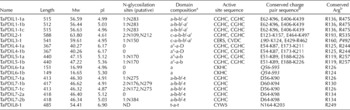
Structural characteristics and domain organization of the deduced amino-acid sequences of three homoeologous cDNAs coding for the typical PDI (Ciaffi et al., Reference Ciaffi, Paolacci, D'Aloisio, Tanzarella and Porceddu2006) and of 14 PDI-like cDNAs, of nine different homoeologous groups are described in Table 1 and Supplementary Fig. S1 (available online only at http://journals.cambridge.org). Except TaPDIL8-1, all proteins contained a putative signal peptide for translocation into the ER. TaPDIL2-1 and TaPDIL3-1 showed a multidomain organization similar to the typical PDI, with the addition of an N-terminal domain (c) rich of acidic residues and a putative calcium-binding site. TaPDIL4-1 had a D domain consisting of a C-terminal α-helical of about 100 amino acids with unknown function and a potential ER-translocation signal. Like all proteins of the fourth group, it lacked the ER-retention signal; consequently, it might be targeted to a different subcellular location or be retained as part of an heteromeric complex; however, in D. discoideum, the C-terminal part of the D domain is responsible for the ER retention of the PDI-D protein (Monnat et al., Reference Monnat, Neuhaus, Pop, Ferrari, Kramer and Soldati2000). The proteins of the seventh group have a transmembrane segment which, even without the KDEL signal, could retain the protein in the ER by anchoring it to the membrane; in man, Drosophila and C. elegans, all proteins with similar structures are involved in developmental control (Clissold and Bicknell, Reference Clissold and Bicknell2003). TaPIDL8-1 has two transmembrane segments; the C-terminal segment is part of the DUF1692 domain, found in several proteins. ERGIC-32 is one of them (Breuza et al., Reference Breuza, Halbeisen, Jeno, Otte, Barlowe, Hong and Hauri2004), which is localised in the ER–Golgi intermediate compartment (ERGIC), the first anterograde/retrograde sorting station in the mammalian secretory pathway. Protein sorting seems only one of the ERGIC functions. Other presumed functions are less clear; it appears involved in protein quality control and in the retrotranslocation to the cytosol of permanently misfolded proteins. Further studies will be necessary to understand whether or not in plants the PDI-like proteins belonging to the VIII phylogenetic group are localized in a compartment similar to the ERGIC of mammalian and to investigate their function.
Characteristics of the wheat PDI and PDI-like proteins

a a, Active site containing the thioredoxin-like domain; b, inactive thioredoxin-like domain (superscript prime and degree symbols are included to distinguish multiple a and b domains on the basis of their position and not of sequence homology); c, acidic segment; D, Erp29c domain; t, transmembrane domain.
b Positions of conserved charge pair sequence and arginine residues important for the catalytic activity of different proteins of the human PDI family were determined on the basis of multiple alignments of the a-type domains of wheat PDI-like proteins and human classical PDI (Accession number P07237) (Supplementary Fig. S2, available online only at http://journals.cambridge.org). ND, not determined because TaPDIL8-1 lacks a putative N-terminal signal peptide. Proteins without signal peptides are unlikely to be exposed to N-glycosilation machinery and thus may not be glycosylated in vivo even though they contain potential motifs.
The functional features of the proteins encoded by the PDI gene family of wheat can be predicted on the basis of their domain structure and of the presence/absence of three major determinants whose role has been identified in humans (Ellgaard and Ruddock, Reference Ellgaard and Ruddock2005). Besides the active site tetrapeptide -CXHC-, typically -CGHC-, there are two additional prominent determinants for the activity of the PDI-family proteins. A conserved arginine modulates the pK a of the active-site cysteines and is involved in the timing, allowing a single catalyst to act as isomerase and oxidase and facilitating the release of non-productive folding substrates. Moreover, the catalytic cycle for oxidation or reduction requires numerous proton transfer reactions; in the thioredoxins, a charged glutamic acid–lysine pair, located under the active site, is the proton acceptor. Table 1 reports the active-site tetrapeptide and the positions of conserved charge pair sequence and arginine residues determined on the basis of multiple alignments of the a-type domains of wheat PDI-like proteins and human typical PDI (Supplementary Fig. S2, available online only at http://journals.cambridge.org).
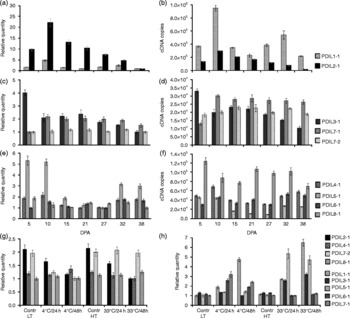
The transcription level of the nine genes of the wheat PDI family was investigated in a series of seed developmental stages (Fig. 1(a–f)) from cellularisation to physiological maturity, showing a considerable variation between the genes. The transcripts of some PDI genes containing two active thioredoxin domains, such as TaPDIL1-1, TaPDIL2-1, TaPDIL4-1 and TaPDIL5-1, increased dramatically during the early stages of seed development (5–10 d post anthesis; DPA), then declined steadily during the major part of the grain filling period (15–27 DPA). Consequently, their temporal expression preceded that of seed storage protein genes and reached a maximum before the more intense synthesis of gluten proteins. For TaPDIL1-1, TaPDIL4-1 and TaPDIL5-1, it is noteworthy that a second peak of transcription was detected by qRT-PCR between 27 and 32 DPA, when the deposition of seed storage reserves decreased and seeds started desiccating. Seemingly, the proteins encoded by these genes may play an important role in later stages of seed development, when there is a dramatic increase of large gluten polymers stabilized by the formation and/or the rearrangement of inter-chain disulphide bonds.
Expression analysis of PDI and PDI-like genes in developing wheat caryopses and in wheat seedlings exposed to high- (HT) and low-temperature (LT) treatments. Relative (a, c and e) and absolute (b, d and f) quantification of the expression level in developing caryopses collected between 5 and 38 DPA of nine PDI and PDI-like genes. Relative (g and h) quantification of the expression level in six samples consisting of seedlings exposed to two temperature treatments (4 and 33°C) for 24 and 48 h and their controls of nine PDI and PDI-like genes. The 14 cDNA pools (two biological replicates, seven developing caryopsis samples; a–f) and the 12 cDNA pools (two biological replicates, six seedling samples; g and h) were tested in triplicate and normalized using the geometric average of the relative expression of the two reference genes encoding cell division control protein and ADP-ribosylation factor. Relative expression levels of the nine genes were referred to that of a calibrator set to the value 1, which was represented by the developmental stage (a, c and e) or by the temperature treatments (g and h) with the lowest expression. Absolute expression levels of the nine genes were expressed as number of cDNA copies/(g of reverse transcribed total RNA (b, d and f). Normalized values of relative and absolute expressions of the nine genes are given as average ± SD. Contr, control samples grown at 18°C.

Analyses by qRT-PCR of six seedling samples consisting of two temperature treatments (4 and 33°C) each for 24 and 48 h and their controls (Fig. 1(g) and (h)) indicated that the nine genes were differentially regulated by cold and heat stresses. The expression of TaPDIL4-1and TaPDIL8-1 was not affected by temperature treatments, whereas that of TaPDIL2-1 was significantly down-regulated by both cold and heat stresses and that of TaPDIL7-2 was about twice lower in shoots exposed to low temperatures (Fig. 1(g)). A significant induction was observed for at least one of the two temperature treatments for the remaining five PDI-like genes (Fig. 1(h)). The most significant variation in transcription rate induced by temperature treatments was observed for TaPDIL1-1 (typical PDI) and TaPDIL5-1.