International relations scholars have long agreed that uncertainty is an important cause of international conflict.Footnote 1 States go to great lengths to either communicate or misrepresent their capabilities and resolve when bargaining with other states.Footnote 2 Uncertainty about the bargaining range, in turn, can result in mistakes and miscalculations that raise the probability of conflict. Yet few studies in international relations have attempted to explicitly model uncertainty in conflict situations, instead focusing on the mean causal effects of institutional, behavioral and systemic variables. And no study has yet explicitly modeled the role of military alliances in managing uncertainty, despite the fact that the purpose of most alliances is to deter aggression by reducing uncertainty about the probability of victory.Footnote 3 A wide sample of the literature concludes that alliances ultimately lead to fewer wars,Footnote 4 while others have found that the presence of an alliance frequently leads to conflict expansion.Footnote 5 More recently, LeedsFootnote 6 and Gibler and VasquezFootnote 7 show that the specific content of an alliance agreement ultimately influences the probability of conflict. These diverse findings suggest that not all alliances are equal in their ability to manage uncertainty on the part of a potential challenger.
Why, then, do challengers attack some states that have allies and avoid conflict with others? This article builds upon previous research by arguing that the observable capabilities of states and their alliance partners generate greater levels of uncertainty for potential challengers when there is power parity. In such a scenario, the unobservable characteristics of a target state and its allies, such as the allies’ resolve and reliability, are more relevant to a challenger’s decision-making process.Footnote 8 This reliance on unobservables when estimating the chances of victory in conflict inevitably leads to greater variance in the challenger’s decision making, and a greater probability of conflict overall.
Unlike previous research, however, I argue that military alliances among democracies are better able to overcome this uncertainty generated by power parity, making power distributions largely irrelevant. When a target state has strongly democratic allies, the challenger should experience relatively little uncertainty about unobservables like resolve and reliability, because democratic institutions allow the allies to credibly reveal such information and credibly commit to their alliance agreements. Instead, the challenger is likely to shift its focus back to observable capabilities, which are also more transparent among democracies. Consequently, even the considerable uncertainty generated at power parity should be mitigated, resulting in no overall change in the probability of conflict initiation.
A challenger’s uncertainty level is explicitly modeled by examining the effects of power distributions and domestic political institutions on error variance.Footnote 9 The results demonstrate that power parity affects the distribution of conflict exclusively through its effect on the variance, resulting in an increase in the probability of conflict. But the democraticness of the target state’s allies has a competing, negative effect on the variance of the distribution of conflict, which ultimately overcomes the effect of the power distribution. In other words, the effect of power parity on conflict is only significant when the target state is allied with non-democratic states (when the challenger must place an even greater emphasis on unobservable characteristics of the target’s alliance). Some studiesFootnote 10 find that democracies are more likely than non-democracies to be targeted in conflicts. The results presented here, however, suggest that within the context of military alliances, democracies are better able to reduce uncertainty about their capabilities and credibly commit to upholding alliance agreements – and ultimately deter conflict.
The article proceeds as follows: in the next section, I survey the relevant literature, identifying why alliance capabilities and the regime type of alliance members should affect a challenger’s uncertainty about its prospects for conflict. I then outline arguments for how these factors directly affect variance in the distribution of conflict. Finally, I describe the econometric technique used to test the implications of my theory and discuss the results of these tests.
Uncertainty and The Decision to Attack
Why do challengers choose to attack some states that have allies, but not others? Alliances, after all, serve as costly signals to alliance partners as well as would-be challengers.Footnote 11 They are designed to reduce uncertainty and minimize miscalculations that would otherwise lead to conflict.Footnote 12 Wide variance in the decision of one state to attack another state despite existing alliance commitments suggests that not all alliances reduce uncertainty to the same degree. The ‘dominant’ theory of alliances suggests that they reduce uncertainty through simple capability aggregation.Footnote 13 That is, challengers decide which alliances to attack by comparing their own military capabilities to the aggregated capabilities of their target and its alliance partners. Alliances, therefore, can deter challengers if their total capability is sufficient to reduce a challenger’s expectation of winning a fight.Footnote 14 Stronger states are more likely to expect victory, so when there is great disparity between the challenger’s capabilities and the alliance’s capabilities, the challenger should be more likely to attack.Footnote 15 But while this line of reasoning seems intuitive, the bulk of empirical research has pointed to just the opposite: rather than reducing conflict, power parity is often associated with increased levels of conflict, at least at the dyadic level.Footnote 16 Power transition theory, in particular, focuses on parity and growing parity between states as a primary source of conflict as rising powers seek to establish a new role in the international power hierarchy.Footnote 17
As ReedFootnote 18 has pointed out, arguments about why power parity should lead to more conflict are based (at least implicitly) on uncertainty. When two states approach an equal power distribution, their uncertainty about winning any potential conflict increases for two reasons. First, at power parity, two states are more likely to differ in their opinions about the distribution of power (and consequently, their own expectations of victory). OrganskiFootnote 19 suggests that ‘nations are reluctant to fight unless they believe they have a good chance of winning, but this is true for both sides only when the two are fairly evenly matched, or at least when they believe they are’. Simply put, only at power parity do ‘both sides see a prospect for victory’.Footnote 20 BlaineyFootnote 21 argues that war often occurs as a result of such competing estimates about the true power distribution. Compare this to a scenario in which the power distribution is highly unequal: power parity theorists would argue that each state should be confident in their estimate of whether they would win or lose the fight. In particular, the far weaker state should be expected to defer to the stronger state, achieving ‘peace through fear’.Footnote 22 The second reason for a state’s uncertainty about winning is that because the expected probability of victory for each state is highly comparable at parity, states have a stronger incentive to misrepresent their true capabilities.Footnote 23 Scenarios in which states are highly uncertain about the actual distribution of power thus result in increased bluffing, which in turn leads to greater uncertainty. Because of these difficulties, when observable capabilities are nearly equal, states are likely to place greater weight on unobservable characteristics, such as resolve and the reliability of alliance commitments.Footnote 24
Greater emphasis on unobservable characteristics is therefore more likely in cases of symmetric power. But how does this focus on unobservables affect the overall probability of conflict? ReedFootnote 25 summarizes the logic: ‘When states are uncertain about their opponent’s capabilities, they may either overestimate or underestimate their own bargaining leverage. Such miscalculation may enhance the probability of a militarized clash by shrinking the range of acceptable nonviolent agreement.’ According to power parity theorists, as states approach an equal distribution of power, uncertainty increases, they have a more difficult time making informed decisions about whether to use force and their mistakes are more likely to lead to conflict.Footnote 26
Fearon,Footnote 27 on the other hand, notes that war seems to occur when two states have conflicting estimates of their probability of victory. But ‘conflicting estimates should occur only if the agents have different information’.Footnote 28 So even if two states have inaccurate estimates of the power distribution, if these estimates are similar, then war should not occur according to this logic. How, then, does power parity lead to conflict if both states have similar, though inaccurate, estimates of the distribution of power? At any given point during the bargaining process, both states will have an estimate of their probability of victory in armed conflict, along with a confidence interval around that estimate. In a situation of extreme power preponderance, both states may estimate that their chances of victory are better than they actually are, but the wide gulf in capabilities makes it impossible for the weaker state to conclude that the power distribution is actually in its favor. By contrast, when two states approach power parity, their confidence intervals are more likely to overlap. In other words, the bargaining range at power parity is the one area in which a weaker state might reasonably conclude that it has the upper hand in bargaining, when in fact it does not. So even though two states might have access to similar levels of information, the inherent uncertainty around estimates of victory is far more likely to lead to actual conflict when these estimates are closer together. And if power parity increases the size of this uncertainty due to increased incentives to misrepresent, as scholars have argued, then conflict should be far more likely when states are more equal in their capabilities.
The argument that conflict is more likely at parity is not new, nor is the argument that this is primarily a result of increased uncertainty. Yet few scholars advocating these points have explicitly modeled the challenger’s uncertainty level. ReedFootnote 29 models this uncertainty in a purely dyadic context and finds that the challenger’s uncertainty increases as the dyad approaches an equal distribution of power, ultimately leading to more conflict.
Yet states presumably do not estimate their chances of victory based only on the power distribution between themselves and their target. A challenger should also take into consideration the aggregate power of any defensive alliance partners that the target may have, as well as the capabilities of any of its own offensive allies. Much of the literature on power parity/preponderance has failed to account for these aggregated capabilities.Footnote 30 In fact, incorporating the capabilities of alliance partners represents a departure from the ‘hardcore assumptions’ of balance-of-power theories.Footnote 31
Applying Reed’sFootnote 32 argument about uncertainty at power parity to an expanded situation in which the challenger factors in the capabilities of each state’s alliance partners, we derive the first set of hypotheses.
Hypothesis 1a: The more equal the distribution of power between a challenger and its target (plus their allies), the higher the variance in the challenger’s estimate of victory.
Hypothesis 1b: The more equal the distribution of power between a challenger and its target (plus their allies), the higher the probability of militarized conflict.
Hypothesis 1a reflects a more nuanced implication of power parity/preponderance theories: power symmetry primarily affects the variance in the distribution of conflict. A more precise way to think of this process is to consider the challenger’s estimation of its probability of victory, as derived from a Bernoulli distribution. The challenger believes it will win a conflict with the probability ρ and will not win the conflict with the probability 1−ρ. The variance of this distribution is defined as:
 $$Var(Conflict)=\rho \,{\asterisk}\,(1{\minus}\rho ).$$
If we then assume that the estimate of victory at power parity is 0.5, the variance of the distribution is maximized at this point. In other words, when the challenger’s expectation of victory is 50/50, variance in the challenger’s decision to initiate a conflict will be highest.
More importantly, Hypothesis 1b expects that this increase in variance will ultimately lead to a higher probability of militarized conflict.Footnote 33 The preceding argument expects that the unobservable characteristics of a target and its allies will become more relevant to a challenger’s decision-making process at power parity, making mistakes more likely. It follows, then, that any characteristic of an alliance that reduces a challenger’s information about a target’s observable capabilities would also lead to a greater emphasis on unobservables. I argue that when the target’s allies are more democratic, the challenger will be less uncertain about (1) the observable distribution of power and (2) the credibility of the target and its allies.
This argument ultimately assumes states are making decisions under bounded rationality. In bounded rationality, actors are still goal oriented, but there are cognitive limits to their ability to make perfectly rational decisions, especially under circumstances of incomplete information.Footnote 34 When uncertainty about the observable distribution of power is at its highest, there is a ‘mismatch between the decision-making environment and the choices of the decision maker’.Footnote 35 Under such circumstances, it is rational for decision makers to use information shortcuts.Footnote 36 So for international actors (states), the use of information shortcuts in making decisions may not be economically rational in every case, but in the statistical aggregate, the decisions remain rational.Footnote 37 Similarly, RubinsteinFootnote 38 points out that although the kinds of ‘mistakes’ or ‘miscalculations’ we have discussed thus far would seem to be economically irrational, if many actors are making the same kinds of mistakes and miscalculations, then those decisions are ‘economically relevant’. I argue that, given states’ limited cognitive ability to process information about unobservables, such as the credible commitments of alliance members, they use a specific information shortcut to facilitate their decision-making process: the democraticness of a target’s allies.
The process by which democratic alliances reduce uncertainty involves two key steps. First, democratic institutions allow states to credibly commit to a course of action, including upholding their alliance commitments as well as credibly signaling a willingness to fight. Due to the increased audience costs generated by their institutional design, democracies are better able to signal their intentions and resolve to other states.Footnote 39 The reliability of alliance commitments and the resolve of alliance members are the unobservables that challengers are likely to focus on when power parity obscures the relative advantage of the opponents. With increased certainty about the commitments and resolve of alliance members, then, challengers are likely to shift their focus and calculations back to the observable power distribution. As PowellFootnote 40 notes, credibility issues are ultimately the most difficult to overcome because of issues of power. And as with their ability to reveal credible information about unobservables, highly democratic states are also in a better position to reveal objective information on power, such as the composition and size of their military forces. When the United States and the Philippines engaged in joint military exercises in early 2013, their maneuvers were highly publicized and were clearly aimed at deterring states like China and North Korea.Footnote 41 Democratic partners, therefore, increase the likelihood that an alliance’s intentions and resolve will be considered credible, and that accurate information about their military capabilities will be revealed.
A number of studies have found that since democracies are better able to make credible alliance commitments, they tend to make more reliable alliance partners.Footnote 42 In other words, autocratic alliance partners are more likely to generate uncertainty about their willingness and ability to fulfill their alliance commitments. And potential challengers take the reliability or credibility of a state’s alliance commitments into account when deciding whether to attack. According to Smith,Footnote 43 challengers most often target states with alliance commitments they view as unreliable. The perceived reliability of democratic allies, in turn, stems from the accountability of their political processes. Higher levels of accountability provide incentives for leaders to pursue good policy choices, including upholding international military commitments. As LeedsFootnote 44 argues, leaders of democratic states ‘find reneging on agreements particularly costly’. Knowing the costs that democratic leaders incur from backing out of an alliance commitment, leaders of other states are likely to view these commitments with lower levels of uncertainty. Democracies are also able to reduce uncertainty because of the inflexibility of democratic policy making. The typical democratic process, with its numerous checks and balances, makes it comparatively difficult for democracies to initially form alliances, even those alliances that have a great deal of support. However, speaking in the context of human rights agreements, SimmonsFootnote 45 notes that characteristics typical of democracies – such as legislative ratification processes, judicial oversight and/or federalist political arrangements – make it difficult for states to commit to treaties. Democracies, therefore, often have much larger hurdles to overcome than autocracies in order to sign and ratify military alliances. This further increases the credibility of democratic commitments, since democracies often find it necessary to muster all their political effort to push through even the most popular of agreements, offering even more ‘assurance’ and certainty for potential partners and adversaries that the alliance will be upheld.Footnote 46 For these reasons, democracies make especially reliable partners in all types of international agreements, not just military alliances.Footnote 47
These same democratic institutional characteristics also result in fewer policy changes than autocracies.Footnote 48 Once a military alliance has been formed, democracies have an institutional ‘lock-in’ mechanism that prevents the agreement from being quickly altered or abandoned. Gaubatz notes that ‘the cumbersome machinery of democratic foreign policymaking will increase democratic reliability even after objective interests have changed [my emphasis added]’.Footnote 49 Even assuming the presence of a leader who has no desire to be re-elected (or is ineligible for re-election), democratic procedures make it difficult for a successor to change the terms of an alliance or renege altogether. ChoiFootnote 50 argues that the resulting stability of domestic preferences makes democracies’ alliance commitments relatively credible. Autocratic leaders, on the other hand, are rarely constrained by the kind of procedural mechanisms and veto players that are common to democratic regimes. If an autocratic leader’s objective interests change after signing a military alliance, he or she should have an easier time backing out of the agreement since there may be few checks and balances or significant political opposition to prevent such a unilateral move. All of this creates additional uncertainty on the part of a potential challenger.
As WeeksFootnote 51 points out, democratic processes of accountability are typically visible to external observers. This is a key point, because it implies that even when a state wishes to misrepresent objective information like military capabilities (which I have argued is more likely at power parity), democratic institutions constrain its ability to do so. Transparent political competition can benefit democratic leaders by confirming foreign policy signals and information about the state’s capabilities, but it also constrains the ability of a state to misrepresent or bluff.Footnote 52 Since democratic leaders are constrained by higher standards of accountability than their autocratic counterparts,Footnote 53 constituents and political opposition expect greater transparency with respect to military matters. Additionally, insofar as media restrictions (typically associated with autocracies) decrease transparency,Footnote 54 autocracies should be better able to conceal information about their capabilities and intentions. By contrast, news coverage in the Phillipines and the United States concerning the 2013 joint military exercises included detailed information about the specific number and composition of each state’s forces.
To summarize, scholars have pointed to a number of reasons why democracies are better able to signal information about their resolve and the likelihood of upholding their alliance commitments. Democratic leaders are held more accountable than autocratic leaders, which results in increased transparency that is visible to both internal and external audiences. While this accountability may reduce the number of scenarios in which democratic leaders are willing to intervene,Footnote 55 at the very least, it should increase the challenger’s certainty level about alliance members’ intentions. This higher level of credibility shifts at least some of the challenger’s focus back to observable military capabilities as it estimates its chance of victory. And there should be less uncertainty around the alliance’s military capabilities as democracies are often unable to misrepresent their capabilities, even if it benefits them strategically. Given any configuration of the power distribution between two states and their allies, then, challengers should have access to more information when the target state’s allies are more democratic. As a result, the challenger’s uncertainty level (and its probability of making mistakes) will be lower. When a challenger faces a state allied with non-democratic states, it will experience greater uncertainty about those states’ capabilities, as well as their collective intention to fulfill their alliance obligations. Without clear signals concerning the domestic constraints under which autocratic leaders operate, challenger uncertainty rises – which affects the bargaining environment.Footnote 56
Taken together or separately, all of these arguments have one common implication for this study: challengers should be more certain about their chances of victory when they have credible information about the capabilities and reliability of a target state’s allies. When the target is allied with more autocratic partners, the challenger does not have reliable information on the partners’ capabilities. So the challenger makes a decision based heavily on unobservables, such as the resolve and reliability of the alliance partners, information that is also not credible. But when the target state shares an alliance with democratic states, the challenger should be relatively certain about the distribution of observable capabilities, and should have a more accurate estimate of the alliance’s reliability, which reduces mistakes and miscalculations. This leads to the second set of hypotheses:
Hypothesis 2a: The more democratic the target state’s allies, the lower the effect of the power distribution on variance in the challenger’s estimate of victory.
Hypothesis 2b: The more democratic a target state’s allies, the lower the probability of conflict.
Hypothesis 2a therefore expects an interactive relationship between the power distribution and the level of democraticness of the target state’s allies. It does not dispute the original hypothesis that equal power distributions will cause higher levels of challenger uncertainty, but it emphasizes that this uncertainty will become increasingly irrelevant as the target’s allies become more democratic. Once again, Hypothesis 2b expects a specific change in the probability of conflict. In the next section, I describe how I operationalize and test these ‘variance-altering’ hypotheses.Footnote 57
Research Design
The theoretical framework and hypotheses discussed above are concerned with a state’s decision to attack another state, so identifying the aggressor is crucial to testing the claims made in this article. The directed dyad is therefore used as the unit of analysis, which pairs all states in the international system, allowing each state to be both the potential initiator of a dispute and the potential target. Since I am interested specifically in the effect of military alliances on challenger uncertainty, the analysis is restricted to directed dyad years in which the target state has a defensive alliance.Footnote 58 The temporal period in the dataset is 1816–2000, and the sample includes more than 630,000 observations. The dependent variable is the decision of the potential challenger to initiate or not initiate a dispute against the potential target. The dependent variable is therefore dichotomous, coded as 1 if the challenger initiates a militarized interstate dispute (MID) against the target in a given year, and 0 otherwise. MIDs are identified by the Correlates of War project (COW), and include any situation in which one state threatens, mobilizes or uses military force against another state.Footnote 59 The preceding theoretical discussion implicitly addresses situations of true initiation of conflict. That is, the variables of interest are expected to affect a challenger’s decision only in the context of an original dispute. A state’s decision to join an ongoing dispute, then, is irrelevant to the current analysis. As such, I disregard ongoing disputes and focus solely on new conflicts.
The alliance partners of each state in the dyads are identified using the Alliance Treaty Obligations and Provisions (ATOP) dataset, which contains information on the design of all alliances for the entire temporal period of this study.Footnote 60 The definition of alliance used in constructing the dataset is a ‘formal agreement among independent states to cooperate militarily in the face of potential or realized military conflict’. Since defense pacts are considered to be the highest form of commitment among the various alliance types,Footnote 61 and because only defense pacts require states to come to the aid of their partners in the event of a military challenge, the following analysis aggregates information about the target state’s defensive alliance agreements only. Likewise, a challenger’s offensive alliances are the most relevant in its decision to attack another state, so information about this information is included in the analysis.
The first independent variable, Power Distribution, is constructed using data on national material capabilities from the COW project.Footnote 62 State capabilities are commonly used as an indicator of state power in international relations research, and this particular measure is an index that includes a state’s total population, urban population, iron and steel production, energy consumption, military personnel and military expenditure. The measure is available for all states across the entire temporal period of this study. Higher values of the capability score indicate a stronger or more powerful state.
Since my argument is about uncertainty generated at power parity, whether the challenger is the weaker or stronger state should be irrelevant. In other words, uncertainty should be higher at power parity than in scenarios in which the challenger is much weaker or much stronger than its adversary. To construct the power distribution between a challenger and its potential target, I first add the total capabilities of the target and its defensive allies in a given year.Footnote 63 In the same manner, the capabilities on the challenger’s side are equal to the capabilities of the challenger plus the capabilities of any offensive allies.Footnote 64 In both cases, if the challenger and the target share an alliance in a given year, the other state’s capabilities are not included in the total capabilities of the alliance.Footnote 65 The stronger set of aggregate capabilities is then divided by the sum of the aggregate capabilities of both the challenger and the target. The variable ranges in value from 0.5 (perfect power parity) to 1 (perfect power preponderance).Footnote 66
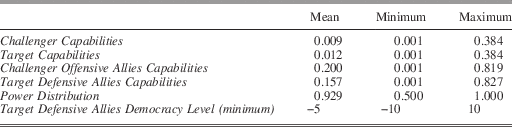
The second key independent variable, Allies’ Democracy Level, is constructed using data from the Polity IV project.Footnote 67 Polity IV is the most recent version of an established dataset that relies on five indicators to form an index of the level of democracy, including competitiveness and regulation of political participation, competitiveness and openness of executive recruitment, and constraints on the chief executive. The dataset creates a ‘democracy minus autocracy’ index for each country, ranging from −10 (strong autocracy) to 10 (strong democracy). I construct the Allies’ Democracy Level variable by taking the lowest Polity score of all the target’s allies (in defense pacts) in a given year. Higher values of the variable therefore indicate more democratic allies. Alternative ways to measure the democraticness of the target’s allies would be to simply sum or average their scores. This creates potential problems, however, that could bias the analysis. For instance, summation would treat a group of allies with Polity scores of 4, 5 and 6 as indistinguishable from a group with scores of −10, −5, 4, 5, 5, 6 and 10. But given the preceding arguments, we should expect that the second group, which includes two highly autocratic states, should create more uncertainty on the part of the challenger. Taking the minimum Polity score of each alliance improves our ability to make the appropriate distinction.Footnote 68 Table 1 lists the descriptive statistics of the constituent capabilities, as well as the final Power Distribution and Allies’ Democracy Level variables.
Descriptive Statistics: Power and Regime Type of Alliance Members

Note: statistics are drawn from the sample in Table 2.
In addition to the Power Distribution and the variable capturing the democraticness of the target’s allies, I also include several control variables that are standard in international conflict research.Footnote 69 States that share alliances are expected to engage in conflict against each other less frequently than states that do not share alliances. Bearce, Flanagan and FlorosFootnote 70 demonstrate that when two states share an alliance, even the incomplete information caused by power parity can be mitigated, and the overall probability of a dispute is reduced. Accordingly, the Alliance: Target & Challenger variable is coded as 1 if the potential target and challenger share an alliance with each other, and 0 otherwise.Footnote 71 Joint democracy has also long been considered a deterrent to dispute initiation, so I include a dichotomous variable that indicates whether the target and the challenger are both democratic: Joint Democracy.Footnote 72 In alternative specifications of the model, I include a measure of the minimum Polity score in the dyad. The logic is similar to that outlined above: when the dyad is less democratic overall, during the bargaining process there is likely to be a greater focus on unobservables, resulting in more conflict. The key results discussed below do not change when using this alternative measure, so the models presented only include the Joint Democracy measure.Footnote 73
Major powers are also expected to be more likely to engage in conflict, so Major Power Dyad equals 1 if at least one of the states in the dyad is a major power, and 0 otherwise.Footnote 74 I also include a recoding of an ordinal measure of contiguity compiled by Stinnett et al.,Footnote 75 since contiguity is one of the strongest predictors of interstate conflict. I construct a dichotomous version of the variable, which equals 1 if the challenger and the target are separated by a land border or less than 150 miles of water. Finally, to account for temporal variance, the model includes a standard count variable, Peace Years, indicating the number of years that have passed since the dyad last experienced a MID. Squared and cubed versions of this variable are also included to account for temporal dependence, as advocated by Carter and Signorino.Footnote 76
Accounting for Heteroskedasticity
Much of the literature on the effects of alliances on conflict predicts direct causal relationships (mean-altering relationships), which may be assessed through standard logistic regression. The hypotheses presented above, however, are focused on the effect of the independent variables (Power Distribution and Allies’ Democracy Level) on the challenger’s uncertainty regarding the credibility of the target’s alliance commitments –and thus its own probability of victory. These variables, in turn, are hypothesized to affect the variance of the distribution of conflict. Stated more explicitly, I argue that the observable distributions of these variables (Power Distribution and Allies’ Democracy Level) are correlated with unobservable levels of uncertainty on the part of the challenger. The unobservable nature of the challenger’s uncertainty would seem to pose a problem for empirical analysis, as such an unobservable concept would be relegated to the error term under a typical regression equation. And an important assumption of any regression is constant variance of the error term. My hypotheses claim, however, that the primary independent variables in the regression equation directly influence the variance of the error term. The assumption of homoskedastic error terms, therefore, poses a problem. In the present model, this would mean that we expect all alliances to produce a constant level of uncertainty on the part of the challenger. This seems like a strong assumption to make on its own, but my analysis specifically hypothesizes that the variance in a challenger’s uncertainty about alliance commitments should be non-constant. In other words, Turkey’s military alliances with Yugoslavia and the United States during the 1970s should produce dramatically different levels of uncertainty for a state considering an attack on Turkey. Hypothesis 1a predicts that equal power distributions should increase variance in the error term (that is, increase the level of uncertainty), while Hypothesis 2a expects this relationship to be stronger when the target state’s allies are less democratic.
Heteroskedastic probit models allow us to incorporate the possibility of this non-constant variance in the error term. Alternatively, the problem of heteroskedasticity can be addressed by estimating robust standard errors. But in the current analysis, heteroskedasticity represents more than just an obstacle to estimating model parameters. By using the heteroskedastic probit approach, we can determine the evidence in favor of Hypotheses 1a and 2a, which make explicit claims about the direction of the effects of the independent variables on error term variance. Concretely, this means we can estimate how the independent variables influence the level of challenger uncertainty concerning its own probability of victory.Footnote 77 The variance-altering hypotheses argue that if one of the variables increases variance in the error term (that is, increases variance in the challenger’s uncertainty level), then the probability that the challenger will make a mistake should increase systematically. As a result, the overall probability of dispute initiation should also increase.
Below is the specific form of the complete model:
 $$\eqalignno{ & DisputeInitiation=\beta _{0} {\plus}\beta _{1} (PowerDistribution){\plus}\beta _{2} (Allies{\rm ’}DemocracyLevel) \cr & {\plus}\beta _{3} (PowerDistribution\,{\asterisk}\,Allies{\rm ’}DemocracyLevel){\plus}\beta _{4} (Allies\,\colon\,Target\, \& \,Challenger) \cr & {\plus}\beta _{5} (JointDemocracy){\plus}\beta _{6} (MajorPowerDyad){\plus}\beta _{7} (Contiguity) \cr & {\plus}\beta _{8} (PeaceYears){\plus}\beta _{9} (PeaceYears^{2} ){\plus}\beta _{{10}} (PeaceYears^{3} ){\plus}{\varepsilon} $$
The heteroskedastic component of the previous equation is as follows:
 $$\eqalignno{ & ln\sigma ^{2} =\gamma _{1} (PowerDistribution){\plus}\gamma _{2} (Allies{\rm ’}DemocracyLevel) \cr & {\plus}\gamma _{3} (PowerDistribution\,{\asterisk}\,Allies{\rm ’}DemocracyLevel) $$
It should be noted that heteroskedasticity could conceivably be caused by a number of factors, and indeed, work in international relations has explored how non-independence among observations, stemming from a variety of factors, may lead to heteroskedastic variance in the error term.Footnote 78 With respect to conflict, however, ReedFootnote 79 notes that, ‘bargaining models anticipate heterogeneous behavior as a function of asymmetric information and, specifically, variance in the challenger’s estimate of the distribution of power’. Likewise, SignorinoFootnote 80 argues that variance in strategic interactions is primarily a result of power distributions. With the focus of this study on the strategic interaction of states and alliances, therefore, the primary generators of variance included in the model are the two mechanisms by which the distribution of information is most directly affected: relative power and political institutions.Footnote 81
Results
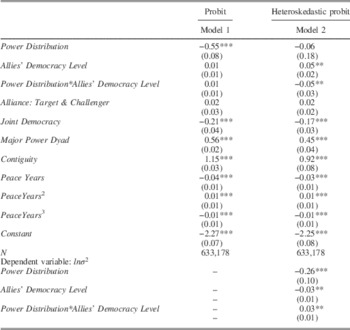
For the purposes of comparison, I have included the results of a probit regression (Model 1) side by side with the results of the heteroskedastic probit model (Model 2) in Table 2. The results in Model 1 would seem to support the expectations of balance-of-power theorists. The independent variable Power Distribution has a negative and significant effect on the probability that the challenger will initiate a MID (at least when Allies’ Democracy Level is equal to 0). This suggests that as the challenger and the target (plus their allies) approach a highly asymmetrical power distribution, the probability of conflict decreases. The results of the second independent variable, which indicates the minimum democracy score of the target’s allies, are not significant. However, it is difficult to interpret this result without incorporating the interactive effects of the two independent variables. This model is simply intended to demonstrate how hypotheses about alliance characteristics have been tested in the literature thus far (and why they may be misleading). Such variables have been tested as if they affect only the mean of the distribution of conflict, whereas this study has developed expectations about their effects on the variance of the distribution.
Dependent Variable: Militarized Dispute Initiation

Note: top values are beta coefficients. Standard errors in parentheses. *p<0.10; **p<0.05; ***p<0.01, two-tailed test.
Model 2 displays the results of a heteroskedastic probit model, in which the effects of Power Distribution and Allies’ Democracy Level on error term variance are also estimated. Power Parity now has an insignificant effect on the mean of the distribution of conflict, while Allies’ Democracy Level demonstrates a positive and significant effect. Since the theoretical discussion in this manuscript did not develop hypotheses concerning the mean effects of these variables on conflict, the coefficients here cannot be interpreted on their own. The primary argument of this article is that in order to fully understand the challenger’s decision, we must also examine how these variables affect the challenger’s level of uncertainty about its own decision to attack. The lower section of Table 2 displays the effects of the variables on this second dependent variable of interest (that is, the variance of the error term). While Power Distribution has an insignificant effect on the mean of the distribution of conflict, it has a strong negative and statistically significant effect on error variance. This suggests that the closer a challenger is to parity with the target (plus its allies), the more uncertainty there is on the part of the challenger. The challenger becomes more uncertain about its estimate of victory as it places greater emphasis on the unobservable characteristics of the target’s alliance. This higher uncertainty has been thought to lead to more mistakes by challengers – and subsequently, to more conflict.Footnote 82 So scholars who have argued that the power distribution affects the probability of conflict may be only technically correct. Here, the power distribution between a challenger and its target (plus any allies) affects the probability of conflict, but exclusively through its effect on error term variance.
Allies’ Democracy Level also appears to have a negative effect on error variance. In other words, when the target state’s allies are more democratic, the challenger should experience reduced uncertainty about its prospects for victory. Another way of phrasing this finding would be to say that situations in which the target’s allies are autocratic produce more uncertainty about the reliability of the alliance. The Football War, for instance, was fought between Honduras and El Salvador despite the fact that both states had defensive alliances with a number of other (highly autocratic) Central American governments. Demonstrating the importance of accurately testing the effects on both the mean and the variance, this variable exhibits competing effects in each case. While more democratic allies increase the probability of conflict based on the mean-altering effects, they actually reduce error variance.
The coefficients are suggestive on their own, but the results of a Wald test confirm the presence of heteroskedasticity. The test allows us to reject the null hypothesis that
 $ln\sigma ^{2} =0$
(p<0.01). In other words, we reject the possibility that the error variance equals 0 (at a 99 per cent confidence level), thus confirming that the heteroskedastic probit is preferred to the probit model, and underscoring that different alliance types produce different levels of variance in the challenger’s decision-making process.
Knowing that our key independent variables affect the variance of the distribution does not necessarily tell us that the probability of conflict increases. We therefore cannot interpret the effects of the independent variables on the overall probability of conflict without calculating their combined substantive effects on the mean and variance of the distribution of the conflict. Hypotheses 1b and 2b capture the most crucial expectations of this study: the overall substantive effects of the variance-altering independent variables. To determine the overall effects on the probability of conflict, we must take into account both the direct (mean-altering) effects of the variables and the effects on error term variance. Furthermore, the results of the interaction term (Power Distribution × Allies’ Democracy Level) must be incorporated into the estimation. Calculating predicted probabilities for particular observations is more involved with the heteroskedastic model because the variables are allowed to have both these direct and indirect effects. And as the results demonstrate, the direction of the two effects can be competing. The overall probability that the challenger will initiate a dispute takes the following form:
 $$Pr(y_{i} =1)={\rm \Phi }({{x_{i} \beta } \over {exp(z_{i} \gamma )}}),$$
where the term in the denominator is a multiplicative functional form of the error variance. In standard linear equations, we would set the independent variables to substantively relevant values and then determine how the probability would change when one (or more) of these values is changed. In the current estimations, we must also incorporate how these changes affect the overall error variance (the denominator).
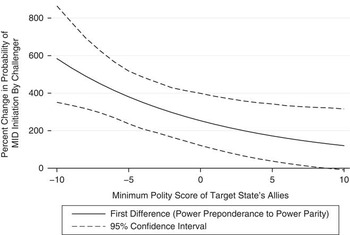
Figure 1 visually depicts the effect of Power Distribution on the percent change in the probability that the challenger will initiate a MID. The line on the graph indicates the difference in probabilities when the power distribution is decreased from 1 to 0.5, and when all other variables are set to their median or mean values. Moving from left to right on the graph demonstrates the effect of increasing the value of Allies’ Democracy Level from the lowest possible value of −10 to the highest possible value of 10. The first important piece of information in the figure is that the probability of dispute initiation is higher at power parity in all cases. Power parity, which we have seen affects conflict primarily through error variance, is consistently associated with higher probabilities of conflict than power preponderance. At the peak (when the target has at least one fully autocratic ally), a dyad at power parity can expect a nearly 600 per cent greater probability of conflict than the same dyad at power preponderance. This finding lends support for Hypothesis 1b. Looking at the slope of the line offers information about the interactive effects of the two key independent variables. While the difference between power parity and power preponderance is always positive, this difference diminishes as Allies’ Democracy Level increases from its minimum to maximum levels. In fact, as the minimum democracy score of the target state’s allies approaches 10, the effect of Power Distribution becomes insignificant. Hypothesis 2b also receives support: more democratic allies are better able to communicate information about their capabilities and reliability, reducing (and eventually negating) the effect of the power distribution on the probability of conflict.
Change in probability of dispute initiation

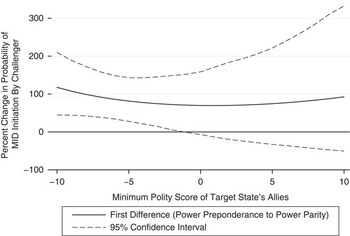
Admittedly, many of the alliance relationships among democracies in the twentieth century are dominated by a few large cases, such as the North American Treaty Organization and the Organization of American States. Further, major powers such as the United States and the United Kingdom are frequently members of such agreements. If states are less likely to target these alliances because the US or the UK are members, then the preceding analysis may overestimate the effect of democratic regimes per se.Footnote 83 Figure 2 again plots the effect of Power Distribution and Allies’ Democracy Level, dropping any alliances that include the US or UK as a member. Such alliances account for about 9 per cent of observations in the full dataset. Removing the alliances from the analysis reduces the overall effect of power parity, but the probability of conflict initiation still more than doubles when a dyad and its allies move from power preponderance to power parity. And contrary to what might be expected, the effect of Allies’ Democracy Level is stronger here, as the influence of the power distribution on conflict becomes insignificant when the minimum democracy score of the state’s allies approaches 0. The previous conclusions therefore remain the same: the power distribution has a significant effect on the overall probability of conflict, but alliances among more democratic states are better able to overcome such effects.
Change in probability of dispute initiation (excluding US and UK)

To summarize, power parity between a challenger and a target (and their allies) consistently increases error term variance and results in higher probabilities of dispute initiation, compared to power preponderance. This effect is mitigated, however, when the target’s allies are more democratic. Democratic allies provide more information and produce less uncertainty on the part of the challenger, ultimately overcoming the uncertainty generated by symmetrical power distributions.
Conclusion
Why do challengers attack some states that have allies, while avoiding conflict with others? Previous research has often focused on the effect of the power distribution between states on predicting conflict. This study has demonstrated that while the power distribution between two states and their allies strongly influences the probability of conflict, the democraticness of a state’s allies can mitigate this effect. Specifically, evidence suggests that power parity between a challenger and the target state (plus their allies) increases error variance, which ultimately leads to a greater probability of conflict. As states approach such a situation of parity, the challenger increases its focus on unobservable characteristics of the target and its allies, and is more likely to make mistakes and initiate conflict. However, when the target’s alliance partners are more democratic, the challenger has more reliable information about the credibility of the target’s alliance partners, as well as their relative capabilities, thus reducing the overall level of uncertainty. As the target’s allies become highly democratic, this reduced uncertainty eventually washes out the effect of power parity. Recently, much attention has been focused on the implications of a power transition between China and the United States. The results of this article suggest at least one way in which the probability of conflict between these states might be reduced.
The broader implication of this study is that the informational and credible commitment advantages of democratic alliances can overcome even the considerable uncertainty generated by power parity. This study therefore joins a growing body of literature emphasizing that the benefits of military alliances lie not necessarily in their aggregation of power, but in their ability to co-ordinate power among their members. Democratic alliances, in particular, may be better equipped to co-ordinate their efforts and to communicate this co-ordination to potential challengers. The findings also suggest that scholars might want to re-examine research that has found democracies are more likely to be targeted in international conflict.
I have argued that error variance may be interpreted as the challenger’s level of certainty or confidence. The relative power and regime type of targets and their alliance partners can make a challenger’s decision more or less difficult, and the variance of a challenger’s decision widens or shrinks as these factors change. In other words, different alliances produce different levels of variance in the challenger’s confidence, which helps explain why some states with allies are attacked while others are not. One area for future research to explore would be to identify other alliance characteristics, or even characteristics of the challengers themselves, which also influence variance in the challenger’s decision-making process. For instance, much of the alliance literature assumes that states with common interests are more likely to form alliances. It would be interesting to examine whether these common interests (such as strategic and economic interests, common language, common religion, etc.) provide additional information or credibility to potential challengers.
Finally, implicit in the case made here about the effect of democracy on uncertainty is an argument about the role of political institutions during the escalatory phases of a dispute. While this study has focused solely on the outcome of militarized conflict, future research should consider how military alliances and the political institutions of their members communicate information as disputes escalate.
Supplementary Material
To view supplementary material for this article, please visit http://dx.doi.org/10.1017/S0007123415000538