Doubly committed subarterial ventricular septal defect (DCVSD) was relatively common in the Asian population, and the incidence was approximately 30% amongst surgical patients with ventricular septal defects. Reference Momma, Toyama and Takao1 It was associated with a low tendency to spontaneous closure, but with a high possibility of aortic leaflet prolapse and insufficiency for deficient muscular support of the aortic valve apparatus. Reference Tohyama, Satomi and Momma2 If not treated, it would eventually tend to deform the aortic valve and could possibly result in rupture of the sinus of Valsalva in adulthood. Reference Cheung, Chiu and Yung3,Reference Jung, Cho and Lee4 Hence, early intervention was recommended.
Conventional median sternotomy under cardiopulmonary bypass was considered the gold standard method with the advantages of good exposure of surgical field and safe closure of this defect, but undesirable cosmetic results and sternotomy-related complications made most patients reluctant to accept this surgical approach. Reference Liu, Rui and Zhang5–Reference Ridderstolpe, Gill and Granfeldt7 A variety of alternative approaches had been applied to reduce invasiveness and to improve cosmetic results, such as right subaxillary thoracotomy, partial sternotomy, thoracotomy, or totally thoracoscopy. Reference Seipelt, Popov and Danner8–Reference Xiao, Gao and Yang13 Right subaxillary thoracotomy was widely used in paediatrics, and the technique showed favourable cosmetic and satisfactory clinical results. Reference An, Zhang and Zheng9,Reference Yan, Zhou and Li11 To achieve satisfactory exposure, the defect was closed through the incision of the main pulmonary artery or right ventricular outflow tract, and thus destroyed the integrity of pulmonary artery or impaired the right ventricular structure and function. Reference An, Zhang and Zheng9,Reference Yan, Zhou and Li11 Fuwai Hospital innovated and modified the right subaxillary thoracotomy technique, and first reported that DCVSD could be repaired through tricuspid approach with a better haemodynamic performance of right ventricular outflow tract and less cardiopulmonary bypass time. Reference Liu, Rui and Zhang5 From January, 2015 to September, 2019, 86 consecutive paediatrics adopted the modified technology. The study was aimed to summarise the experience of DCVSD repaired through tricuspid approach in paediatrics and to report its midterm follow-up outcomes.
Methods
Patients
The research was conducted by paediatric cardiac surgery centre, Fuwai Hospital, Beijing, China. A retrospective review of demographic characteristics, echocardiographic results, operative records, and surgical outcomes were performed according to approval from the institutional ethics committee. The need for individual patient informed consent was waived.
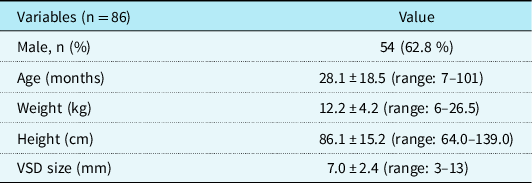
Between January, 2015 to September, 2019, a total of 86 patients had been operated via RAVI (with an incision length of 3–4 cm) through tricuspid valve approach, including 54 males and 32 females. The mean age and weight at operation were 28.1 ± 18.5 (range: 7–101) months and 12.2 ± 4.2 (range: 6–26.5) kg. The mean size of the ventricular septal defect (VSD) was 7.0 ± 2.4 (range: 3–13) mm. Other malformations were found in the patients, including discrete subaortic membrane (2.3%), patent ductus arteriosus (2.3%), atrial septal defect (1.2%), and abnormal muscle bundle in right ventricular outflow tract (2.3%). In addition, moderate mitral regurgitation was found in two patients (2.3%) and moderate tricuspid regurgitation in one patient (1.2%). Demographic and clinical data were detailed in Table 1.
Demographic and clinical data of the patients

The indications for surgery were patients diagnosed with DCVSD with or without drugs treatment for related complications, including progression of aortic valve prolapse, recurrent congestive heart failure, or respiratory infection history, such as pneumonia or bronchitis. Patients combined with patent ductus arteriosus, atrial septal defect, patent foramen ovale, or other simple cardiac anomalies also accepted the technique. The exclusion criteria were patients with severe aortic regurgitation who need aortic valvuloplasty, or with a history of right thorax surgery. If patients with a body mass index greater than 30 kg/m2, the right subaxillary vertical mini-incision would not be recommended.
Surgical technique
Surgical techniques for DCVSD closure via right subaxillary vertical incision through tricuspid approach had been previously described. Reference Liu, Rui and Zhang5 All the patients were placed in the left lateral decubitus position with the right side elevated about 70–80°. The right forearm was wrapped and suspended over the head. The elbow joint was at a about right angle and shoulder joint was approximately 120° angle. The lines were marked, including the anterior axillary line, the midaxillary line, the posterior axillary line, and the third to the fourth intercostal space line. The surgical route was generally through the third to the fourth intercostal space and a vertical incision about 3–4 cm was made along the right midaxillary line skin.
After entering the thoracic cavity, the lung was retracted posteriorly with a wet sponge to expose the pericardium and to reduce the probability of mechanical injuries, then the pericardium was opened more than 2 cm anterior to the phrenic nerve. Three pericardial traction sutures were placed at the superior, middle, and inferior aspects of the incision to expose the right atria, superior, and inferior vena cava, respectively, and two or three traction sutures were positioned at cephalic side of pericardium to expose the aorta. To improve the operative field exposure and to protect an incision, a disposable flexible annular rib retractor was used in this procedure. The retractor could expand the incision with uniform tension towards all directions.
After heparinisation, cardiopulmonary bypass was established routinely through the ascending aorta, the inferior vena cava, and the superior vena cava cannulations in sequence. To get better exposure, the inferior vena cannula should be pulled out from the sixth intercostals space, from which the chest drainage would be hauled out after the operation. In addition, a right-angled cannula was used for superior vena cava cannulation. The cold crystalloid cardioplegic solution was infused into the aortic root after aortic cross-clamping. Through the incision of right atrium, interatrial septum was opened in the fossa ovalis and a left ventricular vent was inserted.
Full exposure was the key to the corrective operation through tricuspid approach. It was useful to place a wet sponge in the pericardial cavity beneath the heart for better visualisation of the defect. If pulmonary annulus was still hard to expose, the sutures at superior edge of the patch could be put through the aortic sinus. The chordae tendineae of tricuspid septal leaflet was pulled towards the foot side through the hole in the sixth intercostals space by a heavy string. A drag hook in the head side was placed into the right ventricular outflow tract to expose the cephalic edge of DCVSD. The defect was repaired with a Dacron patch suture using double-armed 3/8 curve small needle with 6/0 propylene line, or sutured directly with one–two pledgetted polypropylenes. And the suture always started from 1’o clock from surgeon’s view, where usually it was the right ventricle myocardium on the interventricular septum. In other words, the sutures started from the myocardium under aortic sinus or pulmonary sinus if there was no cardiac muscle beneath the aortic sinus. Then the sutures went through the pulmonary annulus in mattress faction, which was the superior border of defect. Then the sutures transferred to the upper myocardium of the right ventricular outflow tract, which was the other edge of the defect. For restrictive ventricular septal defect combined with aortic valve prolapse, the sutures could be put on aortic sinus which was often thick enough to hold the suture. After closing the defect, the prolapsed aortic valve and the right coronary sinus of the aortic root were raised. Sometimes, a nerve hook was placed into the VSD to expose its anterior edge from the sixth intercostals space.
Individualised surgical techniques were also used to treat the combined lesions. Other additional procedures included ductus arteriosus ligation, atrial septal defect closure, patent foramen ovale closure, subaortic septum resection, abnormal muscle bundle resection in right ventricular outflow tract, mitral valve commissural plasty, and tricuspid valve annuloplasty. After eliminating the air in the heart, the cross-clamp was removed and cardiopulmonary bypass was withdrawn gradually. Transesophageal echocardiography was routinely arranged to confirm the repair results in the operation room. If there was a significant residual shunt (>2 mm), reoperation would be carried out. A right pleural drain was inserted into the pericardial cavity and right thoracic cavity through the hole in the sixth intercostals space. Before closing the chest, the lung was inflated adequately to eliminate the residual air in the thoracic cavity. Sometimes, a local anaesthetic was injected around the wound and post-operative controlled intravenous analgesia (PCIA) was used routinely to reduce the early pain after the operation.
Statistical analysis
Continuous variables were expressed as mean ± standard deviation and non-normally distributed data were expressed as range (minimum and maximum value). And categorical variables were expressed as frequency and percentage. All statistical tests were two-tailed. A p-value of less than 0.05 was considered statistically significant. All data were managed and analysed by using SPSS 25.0 for Windows.
Results
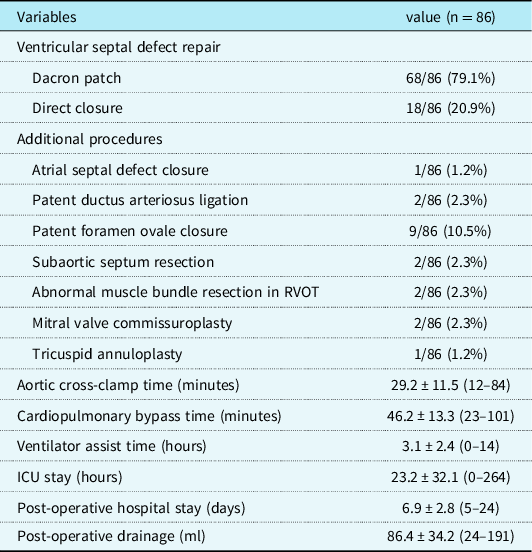
Intracardiac repair had been completed successfully via right subaxillary vertical incision through tricuspid approach in 86 DCVSD patients. The defect was closed with a piece of Dacron patch in 68 patients or directly with 1–2 pledgetted polypropylene sutures in 18 patients. Individualised surgical techniques were also used to treat other lesions, including atrial septal defect closure in one patient, patent ductus arteriosus ligation in two patients, patent foramen ovale closure in nine patients, subaortic septum resection in two patients, abnormal muscle bundle resection to relieve right ventricular outflow tract obstruction in two patients, mitral valve commissuroplasty in two patients, and tricuspid annuloplasty in one patient. The cardiopulmonary bypass time and aortic cross-clamp time were 46.2 ± 13.3 (23–101) minutes and 29.2 ± 11.5 (12–84) minutes. After 3.1 ± 2.4 (0–14) hours’ ventilator assist and 23.2 ± 32.1 (0–264) hours’ ICU stay, all patients were discharged safely. It should be noted that one patient had severe pulmonary infection and experienced a long recovery time. Intraoperative details would be seen in Table 2.
Surgical results of the patients

RVOT=Right ventricular outflow tract
There were no early or late deaths in this cohort. All patients had an uneventful post-operative course, without malignant arrhythmia or reoperation. At the latest follow-up (27.9 ± 14.6 months), echocardiography showed trivial residual shunt (<2 mm) in two patients. Trivial tricuspid regurgitation occurred in 33/86 (38.4%) patients, and there was no tricuspid regurgitation in other patients. And, there was no evidence of an increase in aortic valvular regurgitation in any case at the follow-up. All the wounds healed well and there was no chest deformity or asymmetrical development of the breast. All parents of the patients were satisfied with the cosmetic results.
Discussion
With great advances in surgical techniques and teamwork cooperation over the last decades, more and more children with CHD survived into adulthood. But behavioural and emotional problems maybe occurred in the adults, who bear the consequences of not only their medical condition, but also of growing up with a congenital anomaly. Reference van Rijen, Utens and Roos-Hesselink14–Reference Marino, Lipkin and Newburger17 Researches showed the experience of restrictions by the scar might lead to behavioural and emotional problems, and it can be a source of uncertainties in sexual relationships. Young females with CHD might be particularly bothered by the scar. Reference Gantt16 Van et al reported 40.5% of the female patients and 18.9% of the male patients feel restricted by the scar. Reference van Rijen, Utens and Roos-Hesselink14 Hence, minimally invasive technique was one of the focuses in the field of cardiovascular surgery.
Conventional median sternotomy was the most common surgical access applied in the repair of DCVSD, however, conventional surgery was always accompanied by long midline or thoracotomy skin incisions, post-operative pain, and poor cosmetic effects. Sometimes, mediastinitis and osteomyelitis could also appear and result in a long and difficult recovery. Reference Vida, Leon-Wyss and Larrazabal18 With the accumulation of interventional experience, some studies proved perventricular closure of DCVSD with occluder was technically feasible and safe in the selected patients, and perventricular occlusion was the preferred approach because it showed a higher success rate than transfemoral occlusion. Reference Huang, Yan and Lu19,Reference Zhao Yang, Hua and Yuan Ji20 No acute complications or severe adverse events (death, valve injury, complete atrioventricular block, and embolism) occurred either in the early period or during the follow-up in their research. Reference Huang, Yan and Lu19,Reference Zhao Yang, Hua and Yuan Ji20 Even though interventional occlusion had been extensively applied in the treatment of peri-membranous and muscular ventricular septal defect, its application to DCVSD to some extent had been limited due to the complexity and its potential damages to the aortic valve. Reference Hornung, Franke and Id21 Liu et al reported the incidence of early and late complications of interventional occlusion for DCVSD was up to 19.2% and 3.8%, respectively. Reference Liu, Zhao and Yang22 Considering the potential complications of interventional technique, minimally invasive cardiac surgery through right mini-thoracotomy was popular in China and it had been increasingly applied to DCVSD with a low incidence of complications and good cosmetic results, especially in recent decades. Reference Seipelt, Popov and Danner8–Reference Yan, Zhou and Li11 The technique chose to close the defect through the incision in the major pulmonary artery or right ventricular outflow tract to achieve satisfactory exposure, Reference An, Zhang and Zheng9,Reference Yan, Zhou and Li11 which destroyed the integrity of pulmonary artery or impaired the right ventricular function more or less. To get better cosmetic results and reduce inner trauma, Fuwai Hospital modified the minimally invasive cardiac surgery technique through right mini-thoracotomy and innovated to repair DCVSD through tricuspid approach, and got a good prognosis. Our study proved that DCVSD repaired through tricuspid approach in paediatrics was successful with a small scar and its midterm follow-up outcomes was satisfactory.
Our team had conducted a matched-pair analysis to evaluate the feasibility and efficacy of the surgical technique from June, 2015 to September, 2016, and there were 16 cases that adopted the RAVI through tricuspid approach and 16 children accepted the conventional median sternotomy incision. Reference Liu, Rui and Zhang5 Compared with conventional median sternotomy incision through the main pulmonary artery approach, DCVSD repaired technique through tricuspid approach not only had better favourable cosmetic results, but also had advantages of less cardiopulmonary bypass time and better haemodynamic performance of right ventricular outflow tract because of keeping pulmonary artery intact. Reference Liu, Rui and Zhang5 But there were some limitations in the matched-pair analysis that the sample size was small and there was no follow-up data. As we accumulated experience of tricuspid approach to repair DCVSD, a total of 86 paediatric patients were operated successfully by the technique before September, 2019. All the ventricle septal defects were closed under direct visualisation through a minimal skin access. Except one patient had severe pulmonary infection, other patients recovered rapidly with satisfactory cosmetic results and were discharged safely without obvious post-operative complications.
It should be noted the repair technique should be performed by experienced cardiac surgeons who were skilled in the establishment of cardiopulmonary bypass, satisfactory exposure of ventricular septal defect, and delicate repair skills. Exposing the defect perfectly was so important for DCVSD through tricuspid approach. We agreed that better visualisation of the defect could be achieved by placing a wet sponge in the pericardial cavity beneath the heart, adjusting the inclination of the operating bed, and the application of the disposable rib retractor. Reference Liu, Rui and Zhang5,Reference An, Zhang and Zheng9 Besides, close-operation cooperation between the surgical teams would also help expose and repair the defect. Follow-up transthoracic echocardiography showed that all the patients had a good tricuspid function, and in 33/86 (38.4%) patients had trivial tricuspid regurgitation and no regurgitation occurred amongst other patients. Hence, there was no need to worry about multiple surgical procedures though tricuspid approach may impair tricuspid structure and function.
Right mini-thoracotomy incision was about 3–4 cm and the location of the incision was in the third to the fourth intercostal space along the right midaxillary line skin, so the incision remains essentially invisible. It reduced the burden for CHD patients. Just as in previous reports, there was no need to divide or incise any muscles other than the intercostal muscles for DCVSD closure via right subaxillary incision. Reference Liu, Rui and Zhang5,Reference An, Zhang and Zheng9 Special attention should be paid to spare the thoracic muscles, preserve the long thoracic nerve, and retain a normal space between the ribs. In addition, the incision was away from any area of future breast development and never violating the borders of the mammary gland. As a result, the body of all the patients developed symmetrically at the latest follow-up.
Limitations
There were still some limitations to our study. The size of the study sample was limited to a single institution. As some cardiac centres had learned and adopted the technology in China, more children would benefit from the technique. Besides, longer follow-up into adulthood was also needed to identify possible complications.
Conclusions
DCVSD repaired through tricuspid approach was safe and feasible, and it can be performed with favourable cosmetic results. Furthermore, the result of the midterm follow-up was satisfactory.
Acknowledgements
None.
Funding support
This work was supported by the National Key R&D Program of China [2017YFC1308100].
Conflicts of interest
None.
Ethical standards
This article does not contain any studies with human participants or animals performed by any of the authors.