There are a range of ways to answer fascinating empirical puzzles, and for social scientists, one means of doing this is to compare cases. The puzzle in question here relates to appropriate institutional arrangements to manage ethnically diverse societies, and in particular, of the study of autonomy as a dependent and independent variable. Through the lens of claims to autonomy by ethnic minorities, this piece makes the case for qualitative research to better inform the categories and variables used in large-N datasets, such as the Minorities at Risk (MAR) dataset (Minorities at Risk Project 2007). Large-N databases allow for comparison across contexts; however, how we measure across cases can distort findings, particularly if the meaning of the concepts we seek to measure varies across cases. I, therefore, take a step back to look at the relationship between conceptual definitions, categories of classification used in datasets, and thick description found through case studies. Following Gurr (Reference Gurr2017)’s call for the usage of comparative case studies to further unpack the processes behind identity, ideology, and mobilization of ethno-political actors, I use a Most Similar Systems Design (Seawright and Gerring Reference Seawright and Gerring2008) to examine what autonomy means as a programmatic goal for Hungarian ethnic minority elites in Romania and Slovakia. I then take these findings and feed them back to explore how we can better measure autonomy in databases.
Three unexpected findings emerge which call for improved validity of large-N comparative research: (1) there is only a weak relationship between the conceptual definitions of autonomy and the way it is coded in most relevant datasets like the MAR; (2) empirically, the Hungarian case studies show that elites do not think of autonomy in the same way as the conceptual literature nor do their understandings of autonomy easily fit into the coding categories of datasets; (3) there is inconsistency across Hungarian minority elites in their own definitions of autonomy as well as a lack of distinctions between autonomy and other institutional arrangements. This raises issues of equivalence (Landman Reference Landman2008; Adcock and Collier Reference Adcock and Collier2001) and ambiguity (Abbott Reference Abbott2001) of our empirical study of autonomy in large-N databases. The piece concludes with implications for the future study of autonomy with suggestions for improved measurement.
Autonomy as a Concept: What Autonomy Is and Is Not
The conceptualization of autonomy – what it entails and how it distinguishes itself from other institutional arrangements – is a necessary first step to situating and understanding the empirical study of it. The academic literature has, generally speaking, broken down autonomy along two main dimensions: territorial autonomy and non-territorial autonomy. Moreover, the two are not mutually exclusive and can exist together (Malloy, Osipov, and Vizi Reference Malloy, Osipov and Vizi2015; Nimni Reference Nimni2007; Kántor Reference Kántor2014; Lapidoth Reference Lapidoth1997).
Territorial autonomy (TA) – when ethnically motivated – allows a particular ethnic group that is the majority of a region to express its identity and exercise powers over a range of policy areas linked to culture, economics, taxation, natural resources and social affairs. These powers can include legislation, adjudication, and administration. Generally foreign relations and security are kept for central government. The extent of the powers transferred to the unit can vary, but what is necessary is that powers are clearly demarcated between the autonomous unit and the central government. Some powers are reserved only for the central authorities while others for the autonomous unit, and some powers are exercised jointly whilst others in parallel. Territorial autonomies are generally asymmetric since the transfer of special powers to a region does not occur across the whole country (Lapidoth Reference Lapidoth1997, 34–34, 174–75; Smith Reference Smith2014, 17).
The idea of non-territorial autonomy (NTA) is often used interchangeably with cultural autonomy (CA) or personal autonomy (PA). CA was first developed by Karl Renner and Otto Bauer in the context of the Habsburg Empire which consisted of many national communities. Based on the personality principle (as opposed to the territorial principle), members of a national group received rights irrespective of their location in the Empire. CA today provides members of a particular group – ethnic, national, religious, linguistic – certain rights independent of location. The policy spheres such arrangements apply to are matters of culture, language, religion, and education. In order for CA to exist, self-regulating institutions must be in place (Lapidoth Reference Lapidoth1997, 37–40; Smith Reference Smith2014, 18–20; Nimni Reference Nimni, Nimni, Osipov and Smith2013; Malloy Reference Malloy2015, 8).
There are other similar – yet different – arrangements such as federalism, decentralization, and self-governance. Regarding federalism, differences entail the method of establishment (through the constitution in a federal system compared to several legal methods for an autonomous body), representation at the central level (sub-state units in a federation would be represented as a unit at the central level whereas there would be the absence of the autonomous unit’s representation at the central level), and reasons for establishment (autonomous units are generally – though not always as in the case of Vojvodina, Serbia – set up due to their ethnic character, whilst federations apply to the whole country’s territory).
Compared to decentralization which concerns a delegation of powers from the center, autonomy involves a transfer of powers and these powers are exercised by the elected leaders of the autonomous unit. Moreover, in a decentralized state, the center still retains the ability to adjust the powers of the decentralized authorities, while in the case of an autonomous unit, such revisions would be only in extreme cases (Lapidoth Reference Lapidoth1997, 50–52). Importantly, decentralization assumes the ethnic minority is concentrated in particular administrative units, which is not always the case. Decentralization also does not include powers of legislation through an elected assembly, which is a key component of autonomy to many scholars (Hannum Reference Hannum1990; Lapidoth Reference Lapidoth1997; Smith Reference Smith2014; Benedikter Reference Benedikter2009).
Finally, there is a distinction between autonomy and self-government. Scholars disagree on the exact hierarchical relationship between the two concepts. For example, Wolff (Reference Wolff2011) and Nootens (Reference Nootens2015) argue that territorial self-government or devices of self-governance (respectively) are umbrella categories under which territorial autonomy falls. In contrast, Lapidoth (Reference Lapidoth1997, 53–54) presents self-government as “one room” in the “house” of autonomy and Suksi (Reference Suksi2014, 54–55) also differentiates territorial autonomy from regional self-government in terms of the powers given to the sub-state unit where regional self-governments have less power than territorial autonomies. In these accounts, autonomy is one level above self-government. The point here is that whilst scholars disagree on the relationship between the two concepts, they are nevertheless distinct. However, once applied to both the study of autonomy as a variable and political elites’ own understanding of autonomy, these distinctions all but lose their relevance.
The Art of Comparison: Autonomy as a Variable
Comparison can be motivated by different objectives which are mutually reinforcing, namely contextual description, classification, hypothesis testing and theory building, and prediction (Landman Reference Landman2008, 5–10). Hypothesis testing and prediction often follow the (dominant) positivist quantitative tradition (Abbott Reference Abbott2001) whilst contextual description is a strength of the qualitative tradition. Usage of databases and quantitative analyses allow for the control of variables, the coverage of a wide range of cases as well as time periods, and can identify outliers. However, there is a trade-off between allowing for more cases and accounting for nuance and complex causal processes (Landman Reference Landman2008, 25–27). While there is disagreement about whether there is a single logic of inference across the traditions (Goertz and Mahoney Reference Goertz and Mahoney2012), following Gurr (Reference Gurr2017), Landman (Reference Landman2008), Slater and Ziblatt (Reference Slater and Ziblatt2013), and Tarrow (Reference Tarrow1995), the different approaches can complement each other rather than straightjacket social scientists as they grapple with understanding empirical puzzles.
Following Landman (Reference Landman2008)’s four objectives of comparison, rich contextual description forms the foundation for systematic research. Following contextual description, we often build categories of classification which can then facilitate broader cross-case comparison. Classifications and categorizations allow comparativists to move to the hypothesis testing and predictive elements of their work. At the same time, the classifications used for the study of autonomy – as shown below – demonstrate a gap between the conceptual understanding of autonomy and its categorization in databases as well as a gap between the conceptual understanding of autonomy and the way political elites think about autonomy.
Autonomy has been studied as both an independent and dependent variable and included in large-N datasets, most notably the Minorities at Risk (MAR) dataset, All Minorities at Risk (A-MAR) (Birnir et al. Reference Birnir, Wilkenfeld, Fearon, Laitin, Gurr, Brancati, Saideman, Pate and Hultquist2015), Ethnic Power Relations dataset (Vogt et al. Reference Vogt, Bormann, Rüegger, Cederman, Hunziker and Girardin2015), and Ethnonationalism in Party Competition (EPAC)Footnote 1 (Szöcsik and Zuber Reference Szöcsik and Zuber2015).Footnote 2 Such datasets have led to fruitful findings on ethno-political mobilization (L. E. Cederman et al. Reference Cederman, Hug, Schädel and Wucherpfennig2015; Cunningham Reference Cunningham2013; Walter Reference Walter2006; Siroky and Cuffe Reference Siroky and Cuffe2015; Jenne, Saideman, and Lowe Reference Jenne, Saideman and Lowe2007). For example, Jenne et al. (Reference Jenne, Saideman and Lowe2007) find that autonomy can increase separatist demands but not minority rebellions and more extreme demands are made by compact groups and those with external military support. Insights about the claiming of autonomy have also been elaborated in detailed comparative case studies such as Jenne (Reference Jenne2007), Stroschein (Reference Stroschein2012), Bochsler & Szöcsik (Reference Bochsler and Szöcsik2013) and Székely (Reference Székely2014).
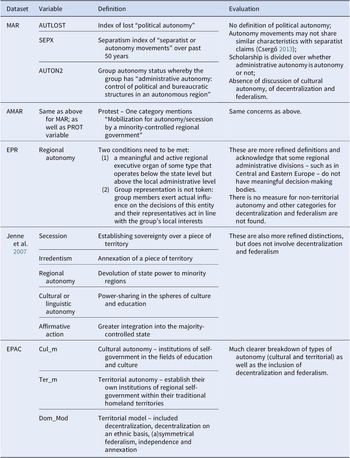
Looking closer at the different databases which study autonomy, concerns emerge which question the extent to which social scientists can convincingly make a case for meeting content and face validity. The former refers to whether the category (or indicator) is comprehensively capturing the content of the concept being measured, often with expert evaluation (Adcock and Collier Reference Adcock and Collier2001; Taherdoost Reference Taherdoost2016), and the latter to whether the categories are sensible and appropriate to those who use them on an everyday basis (in this case, ethno-political actors) (Connell et al. Reference Connell, Carleton, Grundy, Buck and Ricketts2018; Taherdoost Reference Taherdoost2016). The latter will be unpacked in the next section. Regarding content validity and the concept of autonomy, Table 1 below breaks down how different datasets have accounted for autonomy and other similar concepts.
Datasets and Definitions of Autonomy 1

1 I have included the codes used in the codebooks which introduce the variable of autonomy and its definition. It is not an exhaustive list of codes since that would have become repetitive of the same definition.
Source: Minorities at Risk Project 2007, 10–11, 18; Center for International Development and Conflict Management 2017, 1:37; L. Cederman, Min, and Wimmer Reference Cederman, Min and Wimmer2019, 6; Jenne, Saideman, and Lowe Reference Jenne, Saideman and Lowe2007, 545; Zuber and Szöcsik Reference Zuber and Szöcsik2017.
As the table illustrates, the way autonomy is used in the codebooks of MAR and AMAR is not well-defined or defined at all. Importantly, cultural autonomy is not mentioned in the A-MAR and MAR codebooks, and alternative arrangements such as decentralization or federalism are only mentioned by the EPAC dataset. Moreover, the joining of “autonomy” and “separatist” movements in MAR and AMAR risks conflating two movements of different goals and strategies.Footnote 3 Finally, given the conceptual distinctions mentioned in the previous section, the absence of autonomy definitions and alternative institutional arrangements is problematic. The lack of definitional clarity risks confusing one arrangement for another and not capturing the empirical reality of autonomy, whether as an independent or dependent variable.
A Comparative Case Study of the Hungarians in Romania and Slovakia
Using a most similar systems design (MSSD) (Seawright and Gerring Reference Seawright and Gerring2008) of the Hungarian minorities in Romania and Slovakia, I examine “autonomy” as a claim by Hungarian minority elites in the post-communist period until 2019. The questions surrounding Hungarian minority integration originate from the border revisions following World War I in the 1920 Treaty of Trianon. Shared characteristics in this MSSD include the same linguistic ethnic minority both of which are well organized politically and territorially concentrated, comprising 6.1 percent and 8.5 percent of the Romanian and Slovak population, respectively, as of the 2011 census (Government of Romania 2016; Government of Slovak Republic 2014). They are exposed to similar pressures from kin-state (Hungary) and have a shared experience of EU accession and membership. However, their claims to autonomy differ insofar as Hungarians in Romania (particularly those living in the territorially concentrated Szeklerland) have made stronger claims to territorial autonomy than their Hungarian counterparts in Slovakia.
Policy documents from 1990–2019 were collected and analyzed, as well as 33 semi-structured elite interviews conducted with Hungarian minority political actors in 2017–2018. The language of analysis was Hungarian. Following Gurr (Reference Gurr2017)’s call for comparative case studies to unpack processes behind identity and ethno-political mobilization, this case study of autonomy claims can trace in detail how autonomy claims are made, how they are framed, lodged, and by which actors. It provides the first step of empirical description which then leads to classification and hypothesis testing (Landman Reference Landman2008).
There are three key findings which diverge from the research thus far on the conceptual and empirical study of autonomy. First, when examining how Hungarian ethno-political actors think about autonomy compared to the conceptual definitions of autonomy, there is divergence between the cases. In Slovakia, the sub-components of autonomy are territorial autonomy, cultural autonomy (referring to institutions such as museums, media, theatre, publishing houses), educational autonomy (Hungarian-language schools) and linguistic rights (railway/street signs and the use of Hungarian in public administration) rather than the territorial autonomy-cultural autonomy distinction. Moreover, the idea of educational autonomy in Slovakia does not find such a strong resonance in the academic conceptual debate where the latter subsumes the educational question under the term cultural autonomy (Lapidoth Reference Lapidoth1997).
Looking to Romania, there is a clearer territorial-cultural autonomy distinction, accompanied by additional sub-types linked to the Romanian constitution (1991). The Constitution Article 32(6) grants educational autonomy to universities (but does not relate to primary and secondary education as in Slovakia). Local autonomy and religious autonomy are also constitutionally guaranteed: churches are autonomous from the state and the public administration of territorial-administrative units is based on local autonomy (Government of Romania 1991, 29(5); 120(1). Interestingly, territorial autonomy in Romania was argued along non-ethnic lines in some elite interviews (even for the Hungarian-dominated Szeklerland) as well as along ethnic lines, while those elites who mentioned it in Slovakia mentioned the ethnic, asymmetric element. The particular understandings and sub-types of autonomy, therefore, vary by country, and only in the case of Romania do they map more neatly onto the scholarly definitions of autonomy. This raises the issue of equivalence – namely ensuring the same meaning of a concept applies across different contexts (Landman Reference Landman2008; Adcock and Collier Reference Adcock and Collier2001).
Secondly, making comparisons of claims to autonomy by different ethno-political elites across cases as well as within-cases runs into a dilemma of interactive ambiguity (Abbott Reference Abbott2001), whereby the meaning of a concept can be different to different people. One cannot assume that elites have the same understanding of what autonomy and its different sub-components mean. For example, two ethnic Hungarian representatives in Slovakia from the Most-Híd political party disagreed on whether or not the 2017 Cultural Fund Act was an example of cultural autonomy (the law formalized the decision-making structure and annual budget for funding of minority cultural activities). In Romania, there was also some disagreement on the content of cultural autonomy. The main Hungarian political party – RMDSZ’sFootnote 4 – Cultural Chapter of the Draft Law on National Minorities (Government of Romania 2005) embraced cultural autonomy as covering usage of the mother tongue, mass media, religion, and culture. Yet, an RMDSZ MP and autonomy expert thought of cultural autonomy as rather only including the theatre and arts. This demonstrates interactive ambiguity (Abbott Reference Abbott2001) whereby the same concept can have different meanings to different actors. Whilst we can simply argue that an actor is claiming “autonomy,” the content that fills this term is different. None of this variation and nuance can be captured by the codes in the different databases as they now stand.
Thirdly, autonomy is demonstrably claimed explicitly and more often in Romania than it is in Slovakia. However, it would be misleading to conclude that autonomy is off the agenda of Hungarian elites in Slovakia. What was found across both cases – traced through policy documents as well elaborated in elite interviews – is a phenomenon of discursive wordplay during which elites substituted claims to other institutional arrangements such as decentralization, regionalization, and self-governance in lieu of autonomy. In Slovakia, the wordplay is exclusively a substitution for the term self-governance and is used by actors across the political spectrum. The main reasons cited for this is the historical connotation of autonomy with secession and independence given the Slovak’s own separation from Czechoslovakia in the interwar period (Tokár Reference Tokár2014). In Romania, elites had broader maneuverability in their wordplay strategy, using terms such as decentralization, regionalization, and inner self-determination as their claims. Importantly, to different elites across the political spectrum, the terms mean the same thing. As one RMDSZ politician (2017) said in an interview, “(For) the whole public speech they (Romanians) reject even the term autonomy so sometimes we try to explain with different words and have the same meaning.”Footnote 5 This phenomenon of wordplay is inadequately accounted for in the scholarly literature.
In the literature, moreover, these are different concepts. For example, decentralization is conceptually different and is seen as empirically less radical than claiming territorial autonomy. Self-governance is also differentiated from autonomy (although scholars disagree how they are different, they do agree the concepts are different). Consequently, a deeper conundrum for scholars debating autonomy conceptually as well as empirically arises. Even if one creates clear and relevant conceptual distinctions and appropriate classifications, how and when can we ascertain the precise meaning ascribed to these concepts by elites and that they are not the result of confusion, ignorance, or of a broader discursive political strategy? This is further compounded by arguable conceptual stretching (Sartori Reference Sartori1970) by minority elites. They repackage the content of autonomy to include other institutional solutions such as decentralization and self-governance and yet affirm that these institutional solutions are the same. Autonomy is, therefore, stretched to include a range of terminology and loses its particular meaning. This further complicates the study of autonomy claims and is slipping under our empirical radar.
The Case for Better Measurement
Every approach to studying an empirical puzzle will come with strengths and weaknesses. It is beneficial, however, to occasionally take a step back and re-examine the extent to which we are achieving our goals of comparison. There is a trade-off between the level of abstraction and the scope of countries to which our analysis will be applicable. However, the above discussion related to the relationship between conceptual definitions, empirical classifications and rich description – conducted through the lens of autonomy claims – show that we run the risk of incorrect analysis and results if our usage of large-N datasets is too far removed from the national context. If there is inconsistency between cases of the meaning of essential concepts, cross-case comparison runs into difficulties. There is a need for more elaborate examination of the meaning and preferences behind elite claims to autonomy – ideally in the local language – before researchers start to think about coding these claims to categories.
The purpose of this piece is not to devalue what large-N studies bring to the table. Rather, it is to call for more attention to this first stage of comparison – rich description (Landman Reference Landman2008) – and subsequent better measurement. The comparative case study of the Hungarians in Romania and Slovakia demonstrated how the understanding and demand for autonomy is embedded within a particular context, language, and history. Moreover, it demonstrated how country-specific understandings do not map neatly onto the conceptual literature on the definition of autonomy, similar to how databases such as the MAR inadequately account for the different types of autonomy in its own coding. Furthermore, the inconsistency of minority actors’ definitions of autonomy as well as the phenomenon of wordplay illustrate how interactive ambiguity is a challenge to those pursuing large-N research. Whilst I have focused on autonomy, comparativists can substitute their variable of interest and further delve into the rich description that will form the basis of their research, reinforcing measurement validity.
Regarding better measurement, the EPAC database (Szöcsik and Zuber Reference Szöcsik and Zuber2015) has made significant steps to include the range of institutional claims which ethnic minorities can make, including decentralization, cultural autonomy, territorial autonomy, and (a)symmetrical federalism. Such work can be better incorporated into bigger databases such as MAR or EPR. In addition, an indicator in the form of a scale could capture the intra-elite agreement or disagreement on the content of autonomy (such as: is it territorial, cultural, which policy areas does it apply to, is it an asymmetric principle, etc.) as well as if there is agreement on how autonomy is different from other arrangements like decentralization. Creating such indicators would entail elite interviews and research in the native language of the elites in question. This would, however, arguably increase the validity of our measurement of cross-country comparisons and draw out more clearly the relationship between autonomy and ethno-political mobilization (Gurr Reference Gurr2017).
Acknowledgements
The author would like to thank Gwendolyn Sasse, Neil MacFarlane, Sherrill Stroschein, Will Allen, and Kevin Deegan-Krause for their helpful comments on the paper. This paper was presented at the MPSA conference in April 2021.
Financial Support
The fieldwork was supported by funding from the Scatcherd European Scholarship and the University of Oxford’s Department of Politics & International Relations Normal Chester Fund.
Disclosures
None.