

1. Introduction
The traditional family, which is typically comprised of a married couple and their biological children, is vanishing in many parts of the world, as it is being replaced by cohabitation and single parenthood [Lundberg and Pollak (Reference Lundberg and Pollak2007); Stevenson and Wolfers (Reference Stevenson and Wolfers2007)]. More children are born under non-traditional types of households. This trend challenges one of the basic premises of the economics of the family, as the rational choice theory of the family àla Becker (Reference Becker1981) postulates that “the main purpose of marriage and families is the production and rearing of own children” (p. 135). In addition to the theoretical interest, how the non-traditional household structures affect children's welfare should be an important question for policy makers since the household type defines criteria for many welfare and social programs.
Family economic models show that household production generates child outcomes and the outcomes should essentially differ across alternative household types. In particular, single parenthood is likely to be inferior to dual parenthood because single-parent households cannot take advantage of economies of scale, risk sharing, division of labor, and specialization, available to dual-parent households. However, it is difficult to empirically identify the causal effect of single parenthood on child outcomes because the parenthood type is unlikely to be independent of household production for children; single- and dual-parent households are likely to differ in terms of unobservables as well as observables, which are relevant for household production of children [Finlay and Neumark (Reference Finlay and Neumark2010); Buckles and Price (Reference Buckles and Price2013)]. Identifying the causal effect of single parenthood on child outcomes is also theoretically challenging because dual parenthood should be endogenized in a model of intra-household resource allocation [Iyigun and Walsh (Reference Iyigun and Walsh2007)].
In this paper, we examine whether single pregnancy affects birth outcomes. We define single pregnancy as the lack of the partner in the household from conception to birth, regardless of legal marital status.Footnote 1 Addressing the endogeneity of coresidence decision, we exploit exogenous variation in coresidence status arising from marriageable age laws and the reform of these laws. The idea of using marriageable age laws as the instrumental variables (IV) for coresidence is theoretically valid. A key determinant of coresidence decision should be legal marriageability because (1) coresidence typically occurs on the expectation of marriage and (2) coresidence with minors who are not legally eligible to marry is less socially acceptable and therefore more costly.Footnote 2
In South Korea, the minimum marriageable age with parental consent for women was revised from 16 to 18 in 2008, while the minimum marriageable age without parental consent for both men and women remained at age 20 during the sample period. The marriage laws provide us with two sources of exogenous variation in the probability of coresidence. First, the legislated change in minimum marriageable age with parental consent enables us to use exogenous variation in the likelihood of coresidence in the difference-in-differences context.Footnote 3 Second, there is a discrete change in the coresidence rate at age 20, which is too large to be explained by other factors but the marriageable restriction at that age. This provides us with another source of variation in coresidence, while the validity of using this variation depends on whether it is possible to distinguish the effect of the age cutoff from the age effect per se. We try to partial out the age effect by the parametric assumption that the age profile of coresidence is quadratic. We show that our main conclusions are robust regardless of whether we utilize this additional source of variation or not.
While households produce a variety of commodities in the Beckerian sense, we choose infant health at birth as a measure of household production output since it is advantageous for the purpose of our paper mainly in the two regards as follows. First, our main measure of infant health is birth weight, which is measured at the exact moment of birth.Footnote 4 Birth weight is therefore a highly accurate measure of household production output during pregnancy because it entirely depends upon parental input and endowments, as opposed to later outcomes that would also depend on children's own attributes and responses to parental investments. It seems that, for the same reason, earlier studies have used birth outcomes as the output measures of household production, but they did not consider single parenthood as a key input [Grossman and Joyce (Reference Grossman and Joyce1990)].
Second, numerous studies in economics have found birth weight to be a strong predictor of children's later-life socioeconomic outcomes [Behrman and Rosenzweig (Reference Behrman and Rosenzweig2004); Almond et al. (Reference Almond, Chay and Lee2005); Black et al. (Reference Black, Devereux and Salvanes2007)]. In particular, Figlio et al. (Reference Figlio, Guryan, Karbownik and Roth2014) found that the birth weight premium on later-life outcomes can be attributed by and large to the associated cognitive ability gap. This means that if single pregnancy reduces birth weight, the effect should persist over the long run and thus the penalty of lower birth weight is persistent and extensive.
This paper makes two additional contributions to the literature, besides utilizing a novel source of exogenous variation in single pregnancy, the marriageable age law and its reform in South Korea. First, we estimate the impact of coresidence during pregnancy on birth outcomes.Footnote 5 Many previous studies have considered only legal marital status at the time of birth, thus they were unable to identify whether the partner was present for unmarried couples.Footnote 6 This data limitation may bias the estimate for the effect of single pregnancy and single parenthood, especially given the current trend of the decreasing proportion of children born under non-married cohabiting couples. For example, marriage is not possible for mothers who are younger than the legal marrying age, but coresidence is. The Korean administrative birth records allow us to distinguish between legal marital status and coresidence status because parents are required to report not only their legal marital status but also coresidence status.
Second, the Korean birth records provide the start date of coresidence. Combined with the information on the birth date and gestation weeks, this allows us to establish when coresidence began in reference to the time of conception.Footnote 7 Therefore, we can estimate not only the effect of single pregnancy but also the effect of its intensity. If the partner (father) is a relevant input for the production of infant health, the length of pregnancy with or without the partner should be more informative than the coresidence status at the time of birth.
There is a large body of literature on the effect of single motherhood on children, focusing on their later-life outcomes such as educational attainment, labor market outcomes, and adulthood well-being [Ribar (Reference Ribar2004)]. The results seem to be mixed. While it is obvious that single pregnancy is not beneficial for most children [Geronimus and Korenman (Reference Geronimus and Korenman1993); McCarthy and Hardy (Reference McCarthy and Hardy1993); Raatikainen et al. (Reference Raatikainen, Heiskanen and Heinonen2005)], the penalty is ambiguous for marginal children—children of parents who are at the margin of marriage or coresidence. Indeed, some studies found a negative effect for children residing with single mothers even after controlling for family fixed effects using British and US data respectively [Ermisch and Francesconi (Reference Ermisch and Francesconi2001); Gennetian (Reference Gennetian2005)], whereas Björklund and Sundström (Reference Björklund and Sundström2006) did not, using Swedish data. Using exogenous variation in the divorce rate arising from unilateral divorce laws of the United States, Gruber (Reference Gruber2004) found that children who lived in states where divorce has been made easier by unilateral divorce laws grew up to be less educated and to earn lower incomes. Page and Stevens (Reference Page and Stevens2004) followed up families with divorced parents in the PSID and found that these families had substantially lower incomes and consumption, which imply serious disadvantages for the children. However, Finlay and Neumark (Reference Finlay and Neumark2010) used state-by-year variation in male incarceration rates as the IV for marital status and found no impact of divorce on children's later-life economic outcomes.
Buckles and Price (Reference Buckles and Price2013) examined the impact of single pregnancy on birth weight, just as our study does. To avoid omitted variable bias from endogenous selection into marriage, they used matched sibling data and exploited variation in within-mother marital status between childbirths, controlling for time-invariant unobservable characteristics of mothers. They find a significant marriage premium on birth outcome which was 75 grams overall and 86 grams for Black mothers between 1989 and 2004. The marriage premium steadily declined during the time, where it was over 100 grams in 1989 while it was around 60 grams in 2004, presumably due to decline in selection into marriage by race. However, there may be time variant unobservable characteristics of the mother that confounds the causal inference. Also, discussing the limitations of their study, they pointed out that their dataset contains only information on legal marital status and lacks information on coresidence status. Our study proposes a new identification strategy to estimate the causal effect. We examine the impact of coresidence as well as that of marriage. The results from our study may be different from this one, as the social norm in Korea is for adult female to live with the parents until marriage. As well, our sample includes young mothers who are between 16 and 22 while Buckles and Price include all adult mothers who are over 18. Therefore, the mental and financial support these young mothers would receive from the parents would be much greater than the older sample from the United States.
To summarize our main findings, we found that the coresidence status is significantly correlated with infant health at birth. The coresidence with the partner during pregnancy is positively associated with birth weight and negatively associated with poor birth outcomes, such as LBW and preterm birth. However, after addressing endogenous selection into coresidence, we found that the positive effects mostly disappear and become statistically insignificant, except for the effect on preterm birth. This suggests that the observed advantage of coresidence for infant health is driven by positive selection into coresidence. For comparison with the results in the existing literature, we also estimated the effect of legal marriage and found a similar result; there is a positive correlation between legal marital status at birth and infant health, but there is no causal impact of legal marriage among the young mothers.
The remainder of this paper is organized as follows. In section 2, we present research background by introducing the literature related to the subject of this paper. In section 3, we introduce the dataset and present the summary statistics of the variables that we use in our regression analysis. Section 4 presents the empirical strategy and the estimation results. In section 5, we examine potential econometric problems and present robustness checks. Section 6 concludes this paper.
2. Research background
2.1. Increasing prevalence of single pregnancy
The decrease in the proportion of children born under legal marriage out of the total childbirth is observed around the world. In the United States, out-of-wedlock births account for 44.3% of total births in 2013, a rapid increase from below 30% in 1980, peaking at 51.8% in 2007 and 2008 [Martin et al. (Reference Martin, Hamilton, Osterman, Curtin and Mathews2015)]. In Europe, 39% of births in European Union were out of wedlock in 2011, doubling over the past two decades [Associated Press (2010)]. In eight European countries, non-marital births accounts for more than 50% of all births while in Iceland, it accounts for 67% of all births [PEW Research Center (2014)]. This phenomenon is more prevalent among young mothers. In the United States, children born outside of marriage surpassed 50% of total births among mothers under 30 years of age [DeParle and Tavernise (Reference DeParle and Tavernise2012)]. The largest single group in the United States for non-marital first births is teenagers [Whitehead et al. (Reference Whitehead and Pearson2006)]. Approximately half of all non-marital births occurred to teen mothers. Non-marital births for teen mothers increased from 15% in 1960 to 80% in the 21st century [Ventura and Bachrach (Reference Ventura and Bachrach2000); Martin et al. (Reference Martin, Hamilton, Sutton J., Ventura, Menacker and Kirmeyer2006)], resulting from coresidence or non-coresiding single births.
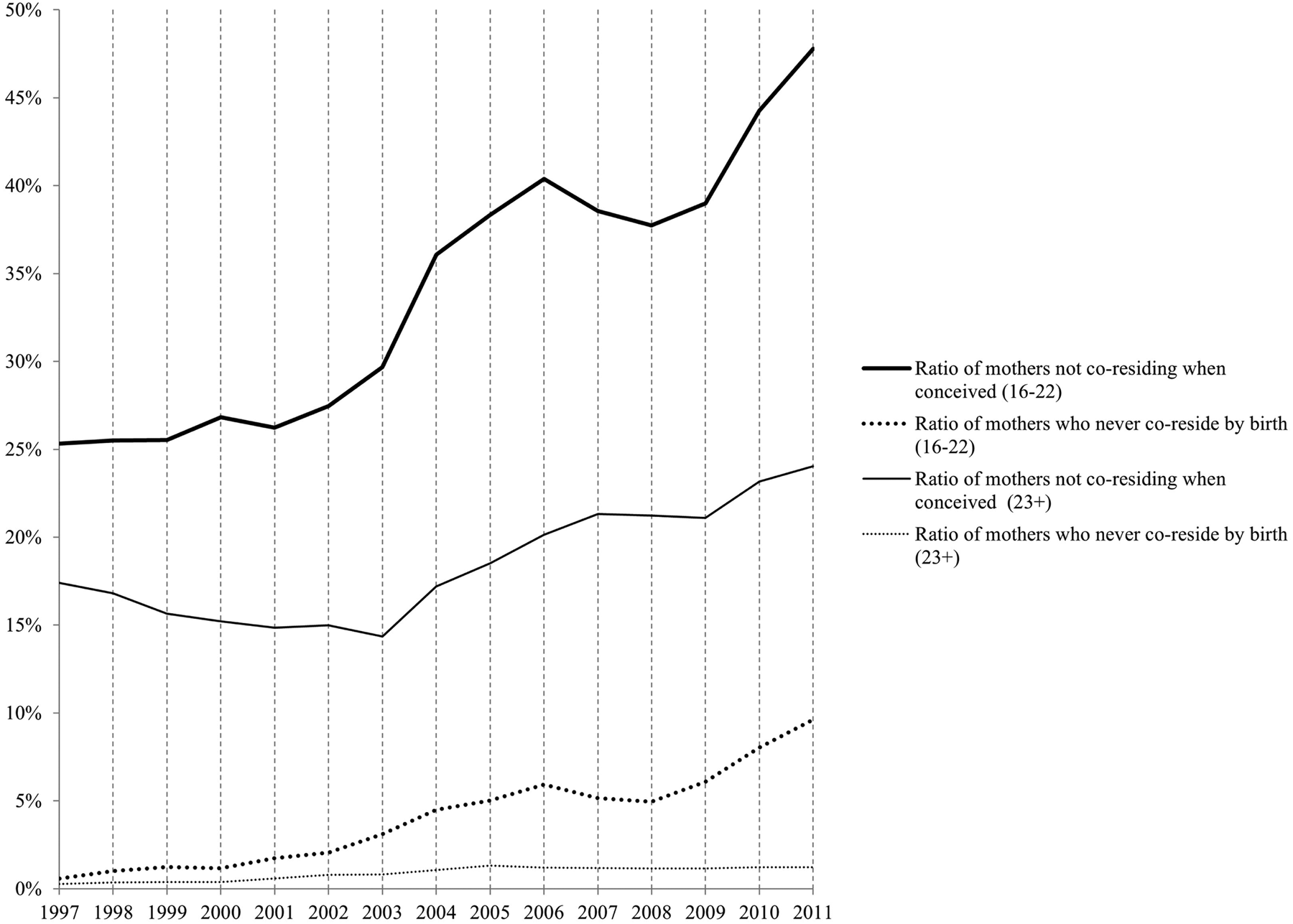
In our dataset from Korea, the ratio of mothers who conceive without coresidence is increasing, and the trend is driven mainly by young mothers. Figure 1 shows that, for the mothers who are 23 or older, the percentage of the mothers who are not coresiding when conception happens has only slightly increased from 17.4% in 1997 to 24.0% in 2011. The percentage of mothers who are 23 or older, who never coreside until birth, has jumped from 0.3% to 1.2%. However, the increase is much greater for young mothers aged 16–22. In this group, the percentage of mothers who are not coresiding when conception takes place dramatically increased from 25.3% to 47.8%. The percentage of mothers who do not start coresiding by the time of birth precipitously increased from 0.6% to 9.6% during the same period.
The trends of percentage of mothers by age and coresidence status, 1997–2011.
Source: Birth certificate records from the National Statistical Office of Korea, 1997–2011. First-born children only.

The increase in out-of-wedlock births among young mothers is a social concern. Out-of-wedlock births have been found to have negative effects on children in the long run in many respects, including education, and crime [Krein and Beller (Reference Krein and Beller1988); Barber (Reference Barber2006)]. Children born to unmarried mothers may face initial health disadvantages, which profoundly affect their economic outcomes later in life. Unfavorable birth outcomes directly incur substantial private and public costs. For example, according to a report by the Institute of Medicine (2007), the health care cost of preterm birth amounts to $51,600 per infant. Furthermore, low birth weight and premature babies face greater risks of infant mortality and disabilities. In addition, a growing body of evidence indicates that health conditions at birth persistently influence later-life outcomes, such as adulthood health, education, earnings, and well-being [Almond et al. (Reference Almond, Chay and Lee2005); Black et al. (Reference Black, Devereux and Salvanes2007); Currie et al. (Reference Currie, Stabile, Manivong and Roos2010); Heckman et al. (Reference Heckman, Conti, Hansman, Novak, Ruggiero and Suomi2012)].
Single pregnancy may influence infant health in several channels. Coresiding partner may be an additional income earner as well as a source of emotional support, thus may have financial and psychological influences on pregnant women and on their fetuses. Indeed, many studies in obstetrics and demography have reported that out-of-wedlock pregnancy has a negative impact on infant health through these channels [Bennett (Reference Bennett1992); Bird et al. (Reference Bird, Chandra, Bennett and Harvey2000)]. In light of the evidence, a number of marriage-promotion policies have been enacted to improve child outcomes for single mothers. In the United States, for example, the 1996 welfare reforms and the Healthy Marriage Initiative included in the 2006 TANF reauthorization aim to promote two-parent families and to prevent out-of-wedlock childbearing [Finlay and Neumark (Reference Finlay and Neumark2010)]. Additional pro-marriage policies at the state and local levels have focused on poor urban women [Lichter (Reference Lichter2001)].
2.2. Economic significance of birth outcomes and determinants
Birth outcome is a topic of great interest to economists because it is an important determinant of long-run health, cognitive development, and socioeconomic status. A growing number of studies have found that health conditions at birth and during early childhood have a significant long-term impact on adulthood health, education, and labor-market outcomes. Numerous medical studies have shown that fetal and infant health issues, especially low birth weight, have a persistent impact on various adulthood diseases, including overall morbidity [McCormick et al. (Reference McCormick, Brooks-Gunn, Workman-Daniels, Turner and Peckham1992)], IQ [Lucas and Cole (Reference Lucas, Morley and Cole1998)], and cognitive disabilities [Marcus et al. (Reference Marcus, Hardy, Kuh and Wadsworth2001)]. Several studies in economics have shown the impact of birth weight on economic variables that are closely related to human capital accumulation. Using monozygotic twin data, Behrman and Rosenzweig (Reference Behrman and Rosenzweig2004) found that higher birth weight improves adult health and earnings. Black et al. (Reference Black, Devereux and Salvanes2007) also used within-twin variations to show the significant long-term impact of birth weight on adult stature, IQ, earnings, and educational attainment. The detrimental long run impact of low birth weight may be prolonged further through intergenerational effect. Currie and Moretti (Reference Currie and Moretti2007) found that there is significant intergenerational transmission of low birth weight, and the impact is stronger for low-income groups.
The factors that affect birth outcomes are numerous and extensive. The WHO (2004) reported biological factors (e.g., the baby's sex, the mother's age and weight, birth parity, and the presence of disease in the mother), behavioral factors (e.g., nutritional intake during pregnancy and health-related habits), and socioeconomic factors (e.g., education, income, and employment status) as the main determinants for birth weight. Many studies have shown that the health status and health-related behavior of the mother during pregnancy are significant determinants of birth outcomes. There are many empirical economics studies that investigate these factors. Abrevaya and Dahl (Reference Abrevaya and Dahl2008), using maternally-matched data, found that smoking negatively affects birth weight. Using prenatal exposure to the Super Bowl as a proxy for an increased exposure to maternal alcohol and tobacco use, Duncan et al. (Reference Duncan, Mansour and Rees2016) found that the exposure to the event lowered birth weight, and the emotional cues from upset wins further lowered birth weight. Chou et al. (Reference Chou, Grossman and Liu2014) show that improved availability of prenatal care increases survival of infants. Camacho (Reference Camacho2008) used the exogenous variation in land mine explosion in Columbia to show that maternal stress and fear during pregnancy reduces birth weight. Empirical evidence also show birth weight to be negatively affected by maternal stress through exposure to armed conflicts [Mansour and Rees (Reference Mansour and Rees2012)] and earthquakes [Torche (Reference Torche2011)].
The positive impact of maternal health on birth outcomes was found by Almond and Mazumder (Reference Almond and Mazumder2011), who used exogenous variations in health status of Arab mothers during the Islamic holy month of Ramadan to show that fasting by mothers lowers birth weight. Evans and Lien (Reference Evans and Lien2005) used the 1992 Port Authority Transit strike as an exogenous hindrance to doctor visits by mothers to show that missing doctor visits during early pregnancy lowers birth weight. Currie and Gruber (Reference Currie and Gruber1996) used the increase in health insurance availability for pregnant women during the 1980s and show that health care availability reduces incidences of low birth weight. In this paper, we examine the impact of coresiding partner during pregnancy on birth outcomes, potentially through behavioral and socioeconomic channels.
3. Data and summary statistics
We use the administrative birth records covering all births from 1997 to 2011 in Korea, collected by the National Statistical Office of Korea. It is a legal requirement for all newborn babies to be registered with the local government office, and non-registration results in exclusion from basic public programs such as national health insurance and public education. Therefore, it is safely assumed that the birth records contain virtually all births in Korea. It includes mother's and father's information including age, education, occupation, marital status, and marriage date, as well as information on births, including birth year and month, birth weight (in grams), birth parity, birth location, coresidence start year and month, and gestational age (in weeks). The time of conception can be calculated by subtracting gestational age from the date of birth.
Compared to the U.S. birth certificate data, the Korean data contains less information about infant health but much richer information about marriage and coresidence. Using the coresidence start date and the time of conception, we classified births into three groups depending on the order of three events; coresidence (R), conception (C), and birth (B). The first group includes mothers whose coresidence began between conception and birth; CRB mothers (i.e., conception → coresidence → birth). The second group includes mothers whose coresidence did not start until birth; noR mothers (conception → birth with no coresidence). The last group includes mothers whose coresidence started before conception; RCB mothers (coresidence → conception → birth).Footnote 8
In our main analysis, we compare CRB mothers with noR mothers, which allows us to estimate the impact of coresidence conditional on pregnancy.Footnote 9 In our supplementary analysis, we compare mothers by legal marital status at birth to estimate the effect of legal marriage, mainly for comparison with previous literatures. Lastly, we compare RCB mothers with CRB and noR mothers and determine whether coresidence prior to conception makes any difference in infant health at birth.Footnote 10
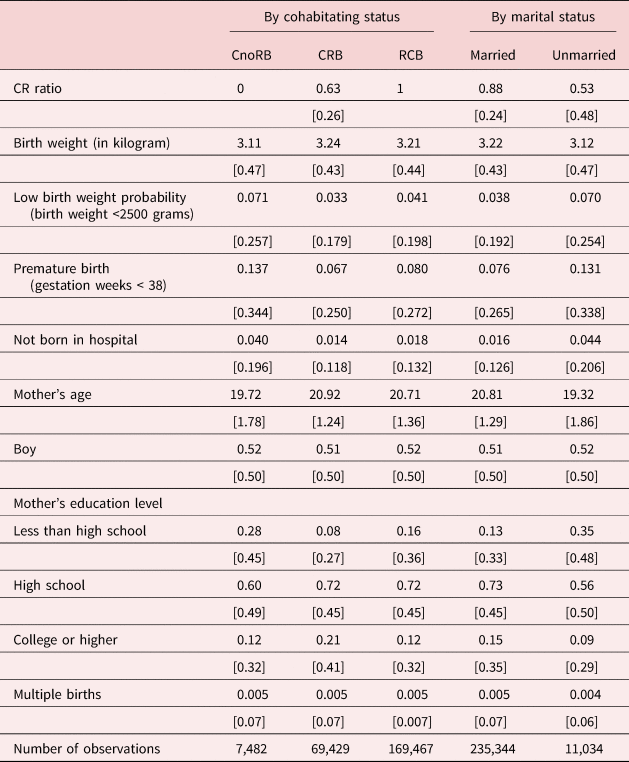
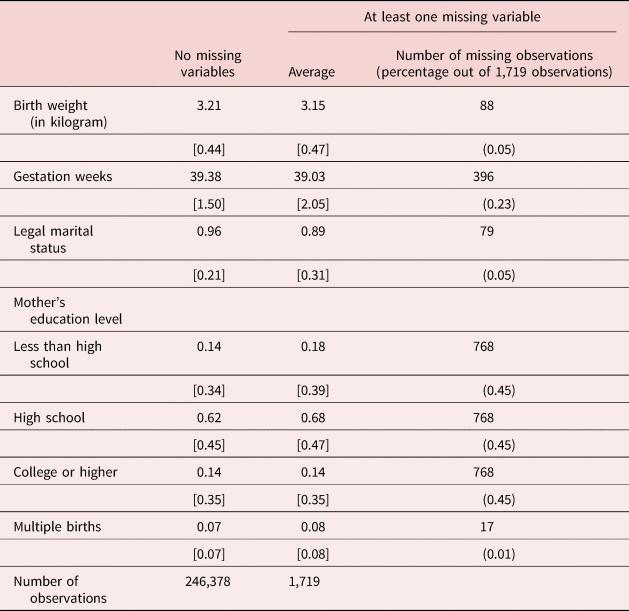
Table 1 presents summary statistics of birth outcomes and mothers’ characteristics for the three groups of mothers. Out of a total of 7,790,728 births between 1997 and 2011, we exclude 3,907,887 second or higher parity births and 3,634,744 observations who are 23 and older. Then, excluding 1,719 births with missing key variables, we use 246,378 births from young mothers aged between 16 and 22,Footnote 11 around legislated marriageable age. Among them, 28% are CRB mothers and 3% are noR mothers. On average, the CR ratio—the duration of coresiding pregnancy out of total gestation weeks, formally defined in the next section in equation (3)—shows that CRB mothers spend on average 63% of their pregnancy time with a partner. Legally married mothers still spend 12% of their pregnancy without a partner because some of them start cohabiting after conception.
Summary statistics by coresidence and marital status of mothers

Notes: Standard deviations are reported in square brackets. Mother’s education level is defined by terminal degree or current enrollment at the time of the birth report. *CR ratio refers to the duration between conception (C) and coresidence (R) out of total gestation weeks, formally defined in equation (3).
It is notable that all three birth outcomes (birth weight, LBW, and premature birth) are more favorable for CRB and RCB mothers than for noR mothers, and for married mothers than for unmarried mothers. This seems to suggest that there is a positive correlation between coresidence and infant health. Average birth weight is 130 grams for CRB mother, higher than that of noR mothers. LBW and premature birth ratios of CRB mothers are less than half of those of NoR mothers. These patterns are similar for married mothers, compared to unmarried mothers.
Table 1 also shows that mothers differ somewhat in observable characteristics based on coresidence and marital status. CRB and RCB mothers have higher mean education levels than noR mothers do, and married mothers have higher mean education levels than unmarried mothers do. Since most of the women in our sample are still school-aged, age strongly correlates with years of schooling. RCB and CRB mothers are more likely than noR mothers to give birth at a hospital, and married mothers are more likely than unmarried mothers to give birth at a hospital. These differences in observable characteristics give rise to a concern about potential selection by unobservables. These unobservable characteristics may simultaneously affect coresidence status and birth outcomes. For example, the young mothers with parents or supportive extended family may be less likely to conceive without a partner to begin with. Also, risk-averse women may be less likely to be single during pregnancy and simultaneously are less likely to indulge in harmful behaviors for the baby including smoking, alcohol, and drug abuse. Characteristics of the father may be another example of these unobservable characteristics. It may be more likely for the fathers who are better educated with higher income to coreside with the mothers, which may also have a positive impact on birth outcomes.
4. Estimation and results
4.1. Empirical strategy
Our main objective is to estimate the impact of coresidence on infant health by comparing CRB mothers with noR mothers, who are different in their coresidence decision upon conception. Selection into coresidence may as well be driven by unobservable traits, hence CRB and noR mothers may differ in unobservable traits. We address the endogeneity problem of coresidence by the IV method.
4.1.1. First-stage equation
We exploit exogenous variation in coresidence status by legal marriageability defined by marriageable age legislation and the reform of the legislation. We use two dummy variables as IVs, one indicating eligibility to marry without parental consent (NoConsent) and the other eligibility to marry with parental consent (Consent). The first-stage equation is as follows:

where subscripts represent individual birth i at year t and X it is other control variables.Footnote 12 CRB it is the indicator for CRB mothers, which can be formally written as the following:

where $\tau ^C_{it}$ is the time of conception and $\tau ^R_{it}$
 is the start time of coresidence. The indicator variable represents that conception is ahead of coresidence.
Alternatively, as the dependent variable in equation (1), we use a continuous variable, which is the proportion of pregnancy period with a coresiding partner:

where $\tau ^B_{it}$ is the time of birth. The denominator, $( \tau ^B_{it} - \tau ^C_{it})$
 , is the length of gestation. Thus, this is a measure of the intensity of coresidence treatment, the ratio of co-residing pregnancy out of the whole gestation weeks [which we call as the CR (Conception–Coresidence) ratio]. For noR mothers, $\tau ^B_{it}$
 is equal to $\tau ^R_{it}$
 and the variable is 0 because they never coreside during pregnancy. Likewise, for RCB mothers the ratio is equal to 1 by definition because these are the mothers who coreside during the entire duration of pregnancy. For robustness, we use both CRB it and CRRatio it but, for expositional simplicity, explain the estimation models using the first.
The first two variables on the right-hand side in equation (1) are our IVs. Consent it is the indicator of whether the mother must have parental consent to marry. Specifically, the variable indicates whether she was between the ages of 16 and 19 before 2008 or between 18 and 19 since 2008 when the cutoff age for marriageability with parental consent was changed. NoConsent it is the indicator of whether the mother can marry without parental consent—whether she is 20 years of age or older. It is reasonable to assume that the pure age effect on coresidence is smooth and continuous at around age 20 without any arbitrary restriction. It seems reasonable to specify the age profile of coresidence given the relatively narrow range of age in our sample. Thus, after controlling for age and age squared, α2 is likely to be the effect of the age cutoff. Since legal marriageability should increase the probability of coresidence because coresidence is more likely among marriageable couples and future marriage is often a condition for coresidence, we expect both α1 and α2 to be positive.
Note that our second IV is valid only if the quadratic specification can fully capture the pure age effect of coresidence. Although this assumption is not unreasonable in our sample, we still check the robustness of our results to this assumption in two ways. First, we only use the first IV by restricting the sample to those under the age of 20 and see the robustness of our findings. Second, we specify the age effect in a fully non-parametric way, that is, by controlling for all age dummies, as in the following equation and, again, use the first instrument only. The non-parametric specification actually allows us to test whether the age cutoff for marriageability without parental consent indeed affects the likelihood of coresidence.

where Age ip is the indicator variable for age p, which takes values between 17 and 22. We can check the validity of our second IV by testing whether θ20 differs so much from θ19 that there is a discrete jump in the coresidence rate, which is large enough for us to argue that it should be caused by the cutoff age for marriageability. In this sense, this strategy somewhat resembles the regression discontinuity approach.
In both equations (1) and (4), vector X it includes control variables such as the mother's demographic characteristics—education level (two dummy variables, one for high school graduation, and the other for college or more), the baby's sex, multiple births (twins, triples, or more), month of birth, and province of birth. Lastly, τ1t represents the birth year fixed effect, which is expected to subsume any macro-level impact on infant health. The results for equations (1) and (4) are summarized in Table 2 (See section 4.2.1).
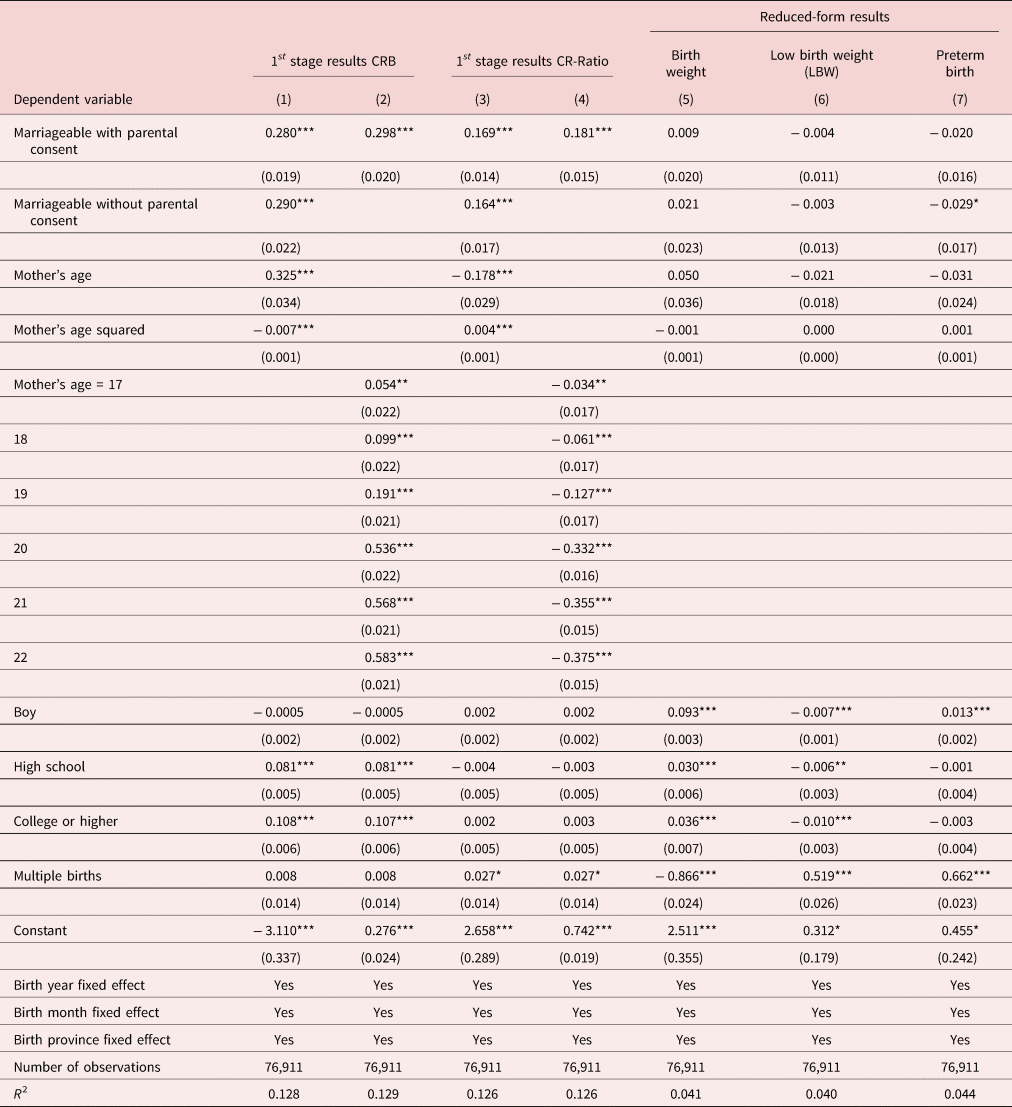
Impacts of legal marriageability on coresidence status: first-stage and reduced-form results

Notes: Robust standard errors are reported in parentheses.
*** indicates significance at the 1% level, **indicates significance at the 5% level, and * indicates significance at the 10% level.
4.1.2. Reduced-form equation
We estimate the following reduced form analysis:

where the dependent variable is one of the following birth outcomes: birth weight, LBW (birthweight < 2500 grams), and preterm birth (gestation weeks < 38) and all other variables are similarly defined as equation (1). The results show how the marrying age restrictions directly affect birth outcomes.The results for reduced-form equation (5) is summarized in Table 2 (See section 4.2.1).
4.1.3. Second-stage equation
The second-stage equation is as follows:

where the dependent variable is one of the following birth outcomes: birth weight (in kilograms), low birth weight (LBW, defined as birth weight under 2,500 grams), and preterm birth (defined as the gestation weeks of less than 37 weeks). For LBW and preterm birth, we estimate the equation using bivariate-probit since the dependent variables and the endogenous variable (CRB it) are both dummy variables. When the endogenous variable is CRRatio it, which is continuous, we use IV-probit to estimate the equation.Footnote 13 The second-stage equation corresponding to the first-stage estimation described in equation (2) is as follows:

where all other variables are identically defined as in equation (4). The second-stage estimation results for equations (6) and (7) are reported in Tables 3–5 (See section 4.2.2).Footnote 14
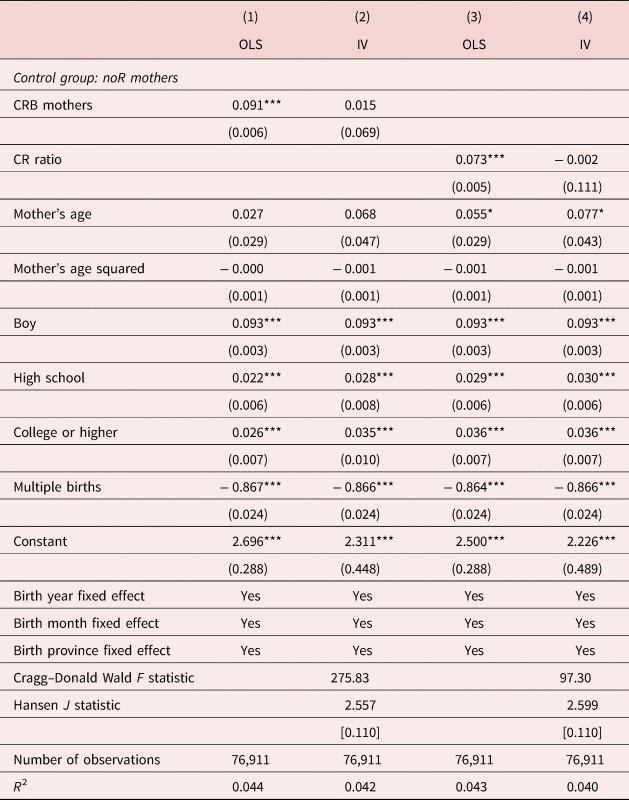
Impacts of coresidence on birth weight

Notes: Robust standard errors are reported in parentheses. CRB refers to the mothers who first conceive (C), then start coresidence (R), then give births (B). The control group consists of the mothers who give birth without ever starting coresidence (noR mothers). CR ratio refers to the duration between conception (C) and co-residence (R) out of total gestation weeks, formally defined in equation (3).
***p < 0.01, **p < 0.05, *p < 0.1.
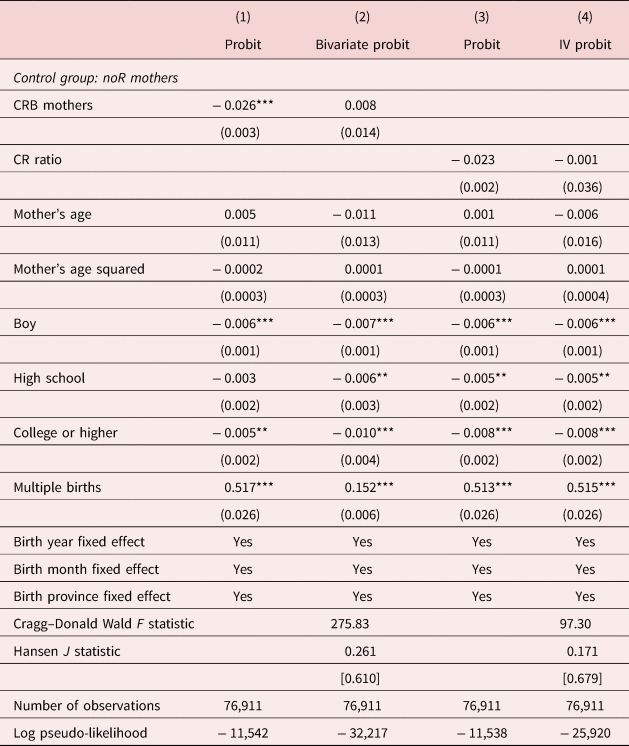
Impacts of coresidence on low birth weight (LBW)

Notes: This table shows the results of equation (5). Marginal effects, evaluated at sample means, are presented. For bivariate probit, birth month fixed effects are excluded from the estimation equation for coresidence. Robust standard errors are reported in parentheses.
***p < 0.01, **p < 0.05, *p < 0.1.
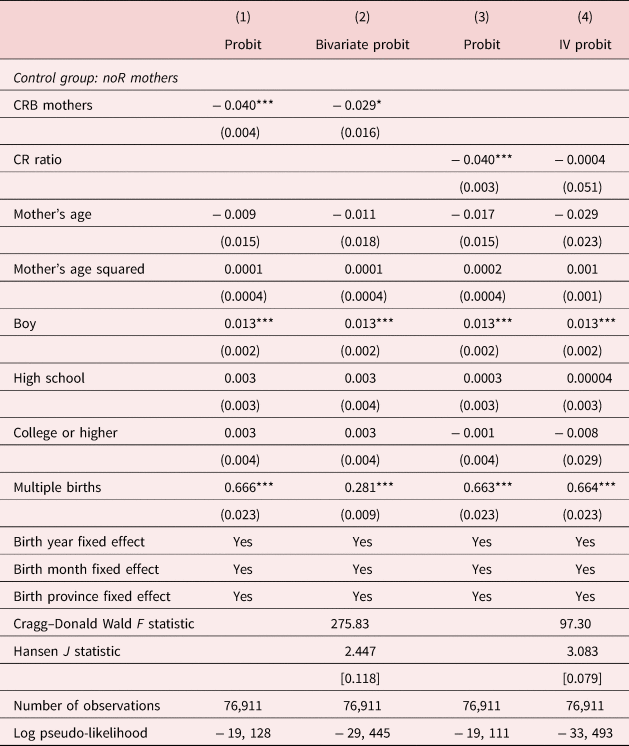
Impacts of coresidence on preterm birth incidence

Notes: Marginal effects, evaluated at sample means, are presented. For bivariate probit, birth month fixed effects are excluded from the estimation equation for coresidence. Robust standard errors are reported in parentheses.
***p < 0.01, **p < 0.05, *p < 0.1.
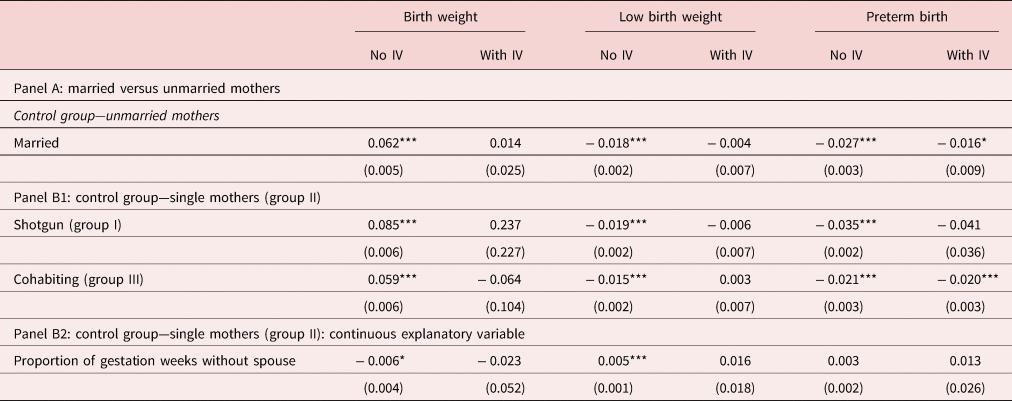
For comparison with previous studies that have examined the effect of legal marriage at birth rather than coresidence, we also estimate the effect of marital status at time of birth by using equation (6), with the CRB indicator replaced with legal-marriage-at-birth indicator. Mothers who are not eligible for marriage without parental consent (aged 16–17 after 2008) should not be legally married. However, we observe that out of 1,285 young mothers, 221 mothers were reported to be married at the time of birth. Therefore, we take this as an indication of greater commitment and stronger union for legally non-marriageable mothers. The proportion of pregnancy period without a partner does not change with marital status; hence, the analysis using the continuous explanatory variable is to be repeated.
Lastly, we examine if RCB mothers differ from CRB mothers and noR mothers:

where RCB it is the RCB mother indicator. This analysis compares the birth outcomes of RCB and CRB mothers to noR mothers. β 1 should capture any benefits from post-conception coresidence, whereas β 2 should capture any benefits from coresiding for the full period of pregnancy. We also replace the indicator variables for RCB and CRB mothers with the proportion of pregnancy with a partner. The results for equation (8) are summarized in panel B of Table 6. In the table footnote, we report Angrist-Pischke multivariate F test statistics to test the weakness of our instruments separately.
Marital status and early start of coresidence

Notes: Sample size is 246,378 in all panels. Only the key variables are reported. Robust standard deviations are reported in parentheses. Angrist-Pischke multivariate F test statistics for CRB is 22.61, while it is 90.48 for RCB.
***p < 0.01, **p < 0.05, *p < 0.10.
4.2. Empirical results
4.2.1. First-stage results
In Table 2, we present the results of the first-stage equations (1) and (4). Columns (1) and (2) use the CRB mother indicator as the dependent variable, and columns (3) and (4) use the CR ratio as the dependent variable. Columns (1) and (3) present the results of equation (1), using both IVs under the assumption that the age profile is quadratic. Columns (2) and (4) present the results of equation (4), taking only the time-varying IV while controlling for all age dummies. The analysis takes the age of 16 as the baseline age.
The results show that our IVs have significant and positive effects on both the CRB status and the CR ratio. Specifically, in column (1), those mothers who are eligible to marry with parental consent are 28 percentage points more likely to start coresidence during pregnancy than those who are not. Somewhat surprisingly, the effect of marriageability without parental consent is similar in magnitude. Column (3) shows that marriageability with parental consent significantly increases the proportion of pregnancy period with a partner by 17 percentage points, which is approximately 6.7 weeks, out of average gestation week of 39.4 weeks. The effect of marriageability without parental consent is again similar in magnitude. The first-stage F statistic and Hansen's J test statistic support the relevance and validity of our IVs, as reported in the bottom of Tables 3–5.
The results in columns (2) and (4) are similar to those in columns (1) and (3), respectively. Mothers who are eligible to marry with parental consent were 30% more likely to initiate coresidence during pregnancy. The CR ratio is 18 percentage point greater than mothers who are not eligible to marry. The results suggest that couples who are not eligible to legally marry may fail to receive parental consent. This may be indicative of South Korean culture, where coresidence without legal marriage, especially for teenage girls, largely brings disapproval.
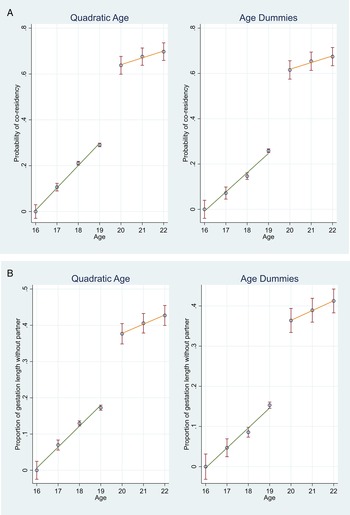
In Figure 2, we plot the estimates in Table 2 to visualize the effect of the cutoff age for legal marriageability without parental consent. Panel A presents two age profiles, one based on the estimates in column (1) of Table 2 (left) and the other based on the estimates in column (2) of Table 2 (right). Both graphs are normalized by setting the effect at age 16 to be zero. When marriageability with and without partner are both exclusively estimated, as in column (1), the age profile clearly shows a discrete jump in the likelihood of coresidence at age 20. Panel A shows that even when all ages are non-parametrically controlled as dummy variables and only marriageability with parental consent is controlled, there is a discrete change in the coresidence rate at the cutoff age. Similarly, using the estimates from column (3) of Table 2 (left) and column (4) of Table 2 (right), Panel B also shows that the change in the coresidence rate is visible at the cutoff age under both specifications. This relieves the concern about our second IV. In columns (5)–(7) of Table 2, we present the reduced form results of equation (5). For all three birth outcomes, the estimated coefficients are negligible and statistically insignificant, except for the marriageability without consent for preterm birth.Footnote 15
Estimated age Profiles for coresidence and CR ratio. Panel A: coresidence by age. Panel B: CR ratio by age.
Notes: Panel A is based on the estimates in columns (1) and (2) of table 2. Panel B is based on the estimates in columns (3) and (4) of table 2 The estimate at age 16 is normalized to zero. The dotted line is the fitted linear regression line before and after age 20. The vertical bar around the estimate for each age represents the 95% confidence interval.

4.2.2. Second-stage results
Results for birth weight. Table 3 shows the results from the second-stage equation using birth weight as the dependent variable. In columns (1) and (2), we use the indicator variable for CRB mothers and in columns (3) and (4) we use the CR ratio, the continuous treatment intensity variable. Columns (1) and (3) present OLS estimates, and columns (2) and (4) show IV estimates. The OLS results in column (1) show that coresidence during pregnancy correlates with about 91 gram increase of birth weight. The results in column (3) show that one standard deviation increase in the CR ratio (0.26 from Table 1) is associated with an increase in birth weight of 19 grams (=0.073*0.26).
However the IV results indicate little effect of coresidence on birth weight. In both columns (2) and (4), the estimates are statistically insignificant. One might think that the standard errors of IV estimates are inflated. However, the results show that the estimates are not only statistically insignificant but also their magnitudes are close to zero and economically insignificant.
The results for other control variables are overall consistent with the intuition. For example, we find that boys are approximately 90 grams heavier than girls. Babies born to mothers with high-school education or college or higher education are approximately 30 grams heavier than those born to mothers with less than high-school education. Unsurprisingly, birth weight for multiple births is substantially lower than for single births (by approximately 870 grams). The estimates for these variables are almost identical between OLS and IV estimations.
Results for LBW. Table 4 presents the results for LBW. Columns (1) and (3) present the simple probit results, and columns (2) and (4) present the bivariate-probit and IV-probit estimates, respectively. In the table, we present marginal effects evaluated at sample means. The results in column (1) show that coresidence is associated with a reduction in LBW by 2.6 percentage points. In column (3), one standard deviation increase in the CR ratio is correlated with a 0.6 percentage point increase in the rate of LBW incidence. The effect is substantial, compared to the average incidence of LBW is 7.1% for noR mothers.
However, consistent with the birth weight, the benefit of coresidence mostly disappears after the selection issue is addressed, as shown in columns (2) and (4). The IV estimates are not only statistically insignificant but also very close to zero. Some other results are worth noting. We find that boys are approximately 6% less likely to be born with low birth weight, and higher-educated mothers are significantly less likely to have LBW babies. Multiple births significantly increase the probability of LBW. These results are consistent with the previous literature.
Results for preterm birth. Preterm birth indicates a birth with a gestational period of less than 37 weeks and it is another key birth outcome with significant implications for infant health as well as long-term economic outcomes. Table 5 presents the results, the marginal effects evaluated at sample means. We find that coresidence is correlated with a reduction in the incidence of preterm birth by 4 percentage points, and a one standard deviation increase in the CR ratio is correlated with an increase in the incidence of preterm birth by 1 percentage point, as illustrated in columns (1) and (3). Unlike birth weight and LBW, coresidence seems to have a causal and favorable effect on preterm birth. In column (2), we find that coresidence reduces the probability of preterm birth by 2.9 percentage points. However, notice that the effect is much smaller than the estimate in column (1) and statistically only marginally significant. Also, when the CR ratio is used in column (4), the coefficient becomes statistically insignificant and the magnitude of coefficient substantially decreases. Therefore, we conclude that there is a causal but limited effect of coresidence on the likelihood of preterm birth.
Marriage premium. One might think that we failed to find any positive effect of coresidence because coresidence is a less binding relationship than marriage. Thus, we examine the effect of legal marriage at birth by using the same specifications that we have used so far for coresidence. Also the results utilizing marriage are more comparable to the findings in the literature than the results using coresidence status since previous studies are focused on the effect of parents’ marital status on offsprings. In Table 6, we present only the estimates of our main interest. Panel A presents the results of the analysis comparing married and unmarried mothers. In columns (1), (3), and (5) where we do not resolve the endogeneity of marriage, we find that birth weight for married mothers is on average 62 grams heavier, the LBW probability is 1.8 percentage points smaller, and the preterm birth probability is 2.7 percentage points smaller than for unmarried mothers. However, similar to what we found about coresidence, we find no causal effect of marriage on birth weight and LBW. On the other hand, consistent with the results presented in column (2) of Table 5, we find that marriage reduces the probability of preterm birth by 1.6 percentage point. But the estimate is only marginally significant and smaller than that in column (5).
Coresidence prior to conception. So far we have excluded RCB mothers, those who started coresidence before conception, from our analysis. One might be curious about whether starting coresidence before conception makes any difference. Panel B1 in Table 6 presents the results of the analysis that compares CRB and RCB mothers, separately, with noR mothers. Again, the results without addressing the endogeneity of coresidence show that both CRB and RCB mothers have more favorable birth outcomes compared to noR mothers. However the IV estimates show that there is actually no significant difference in terms of birth weight and LBW between RCB and noR mothers. But we find that RCB mothers are 2 percentage point less likely to have preterm birth than noR mothers. Lastly, for the sample including RCB mothers with the CR ratio set to be one, the results in panel B2 show that all IV estimates for the CR ratio are statistically insignificant for all three birth outcomes.
4.2.3. Possible explanations
Our findings show that while coresidence and infant health at birth are positively correlated, there is no causal relationship. This suggests that the young mothers who select into coresidence should have unobservable characteristics that are favorable for infant health, but coresidence per se has no exclusive additional benefit. We should interpret our findings cautiously because our estimates are local average treatment effects (LATE). That is, we do not identify the effect on a general group of young mothers but on a restricted group where their coresidence and marriage decision is affected by the change in the marriageable age. This indicates that they are at the margin of marriage and no marriage (or coresidence and no coresidence), so the return to marriage (coresidence) is likely to be minimal. Therefore, we should not generalize our findings too far, but we want to point out that these mothers whom we identify the marriage effect off are those we could influence by a policy like the reform of the marriageable age.
There might be various explanations for why the coresidence has little impact on infant health from economic, social, and cultural perspectives. One possible explanation is related with the degree of the contribution to be made by the potential partner to improve infant health. For young mothers like those in our sample, their partners may be more likely to have low socioeconomic status, and consequently less capable of financially helping their pregnant partner. Even worse, they might have some behavioral problems, such as drinking and smoking, that may have a negative effect on pregnant women and their fetus. Then, they might be unable to provide enough support, either financial or emotional, to make any meaningful contribution to infant health. This possibility was also pointed out in Finlay and Neumark (Reference Finlay and Neumark2010). Using state-by-year variation in the male incarceration rate as the IV for the marriage rate, they found that the impact of marriage on children's educational outcomes is actually negative for Hispanic mothers. To explain this puzzling finding, they suggested the possibility that potential spouses available to those Hispanic mothers are likely to be of low socioeconomic status and the mothers might be better off without spouse.
Another possible interpretation for our findings is related to the quality of non-spousal support available to these young mothers. For the young pregnant women, alternatives to the support of their potential partner are public assistance from government or private support from parents, and/or friends. It is likely that those mothers between the ages of 16 and 22 are living together with their parents, especially in Korea where it is conventional for adult offspring to live with their parents until marriage. Therefore, if they opt not to coreside with their partner, they could receive some compensatory support from their parents, which might be better than what they would receive from their potential partner. Then, those whose parents are more willing and able to help their pregnant young daughters would choose not to coreside with their partner. In this case, even if there may be a positive contribution made by the partner, it may not be superior to what those alternative caregivers or the different levels of governments can provide for those young mothers.
Lastly, it is worth noting that our finding of the lack of the marriage premium is in contrast with the finding of Buckles and Price (Reference Buckles and Price2013). They found a sizable positive impact of marriage on birth outcomes. Of course, it is difficult to explain different results in two studies for some obvious reasons, such as differences in population of the study, data, and estimation method. For example, they excluded mothers under the age of 18 whereas we only included young mothers. Also, they estimated the fixed-effect model to control for time-invariant maternal characteristics, while we took the IV approach. Also, the differences in the degree of social and family care for single mothers between Korea and the United States may account for the differences in the results between two countries.
5. Supplementary analysis
5.1. Robustness checks
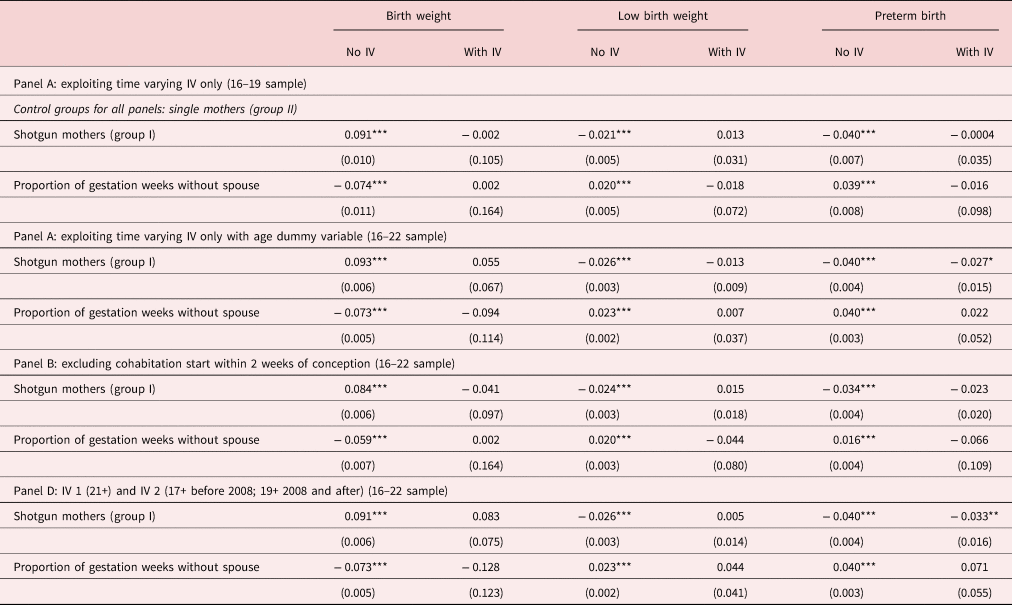
In this subsection, we conduct a few robustness checks. First, as a way of relieving the concern about our second IV, we simply drop those aged 20 or above from the sample and use only the time-varying IV. Panel A in Table 7 presents the results. We present the estimates of our main interest (each estimate is from a separate regression). The results are similar to our main results that we obtain using both IVs on the full sample. For example, the OLS estimate using the restricted sample indicates an increase in birth weight by 91 grams. The corresponding estimate of the full sample analysis was identical in Table 3, column (1). IV results are also similar. Consistent with what we found for the whole sample, the IV estimates across all specifications are not statistically significant and much smaller in magnitude compared to the corresponding estimates without IV.
Robustness checks

Note: Sample size is 12,922 in Panel A, 76,911 in Panel B, 63,942 in Panel C, and 76,911 in Panel D. Only the key variables are reported. Robust standard deviations are reported in parentheses.
***p < 0.01, **p < 0.05, *p < 0.10.
Next, to check the robustness of our results to the specification of the age effect, we report in panel B the results of equation (7) with age fixed effects. The results are also similar to our previous results. The estimates without addressing the endogeneity of coresidence show significant and positive correlations between coresidence and birth outcomes, while there is no causal effect of coresidence according to the IV estimates. The IV estimate of preterm birth turns out to be, albeit marginally, statistically significant but, just as in the previous results, the effect becomes insignificant when we use the CR ratio. We believe that this reduces the concern regarding any bias from misspecification of the age effect.
As mentioned earlier, gestation length is measured in weeks rather than in days, and this may result in measurement error. In addition, even when correctly measured, mothers in their early stages of pregnancy may be unaware of it, hence their decision to coreside may be independent of conception. To deal with this kind of problem, we drop these mothers who started coresidence within two weeks of conception. Panel C presents the results using this restricted sample. We find that the results are similar to our previous results.
Lastly, we attempt to define legal marriageability more conservatively. The concern is that the administrative birth records provide the mother's age only in years, so we cannot precisely define legal marriageability at the time of conception. For example, let us consider those mothers who were 20 years old at the time of childbirth. For these mothers, it is difficult to determine whether they were eligible for marriage without parental consent at the time of conception. However, it is certain that mothers who were 21 years of age at the time of childbirth were marriageable without parental consent at the time of conception because the length of gestation should not be longer than one year. Based on this idea, we re-define the cutoff age for marriage without consent from 20 to 21 and that for marriage with consent from 16 to 17 before 2008 and from 18 to 19 afterwards. Panel D presents the results using these alternative definitions. Overall, the IV results again indicate that coresidence during pregnancy does not have any significant impact on birth outcomes, except for preterm birth when the indicator for coresidence status is used. But it is not obvious that coresidence actually decreases the likelihood of preterm birth, as we find no significant effect when we use the CR ratio.
5.2. Resolution of pregnancy
One limitation with the birth record data is that we do not observe abortion. It is conceivable that the abortion rate is systematically affected by legal marriageability.Footnote 16 For example, those pregnant women who are not legally eligible to marry may be more likely to have abortion, especially when their babies are expected to have adverse birth outcomes. As pointed out earlier by Grossman and Joyce (Reference Grossman and Joyce1990), this can create a sample selection problem.
To address this concern, we examine whether marriageable age laws and the reform of the laws affected the abortion rate. Unfortunately, reliable official statistics on abortion are not available, which is not surprising given that abortion is illegal in Korea.Footnote 17 Therefore, we alternatively estimate the effect of marriageability on the number of births per year and per maternal birth cohort (cohort-year fertility) as an indirect test for whether abortion decisions are affected by marriageability. The underlying assumption for the indirect test is that the total number of conceptions is not directly affected by legal marriageability conditional on control variables and, therefore, we can infer the number of abortions from the number of births.Footnote 18 To implement this test, we aggregate individual births by year and maternal birth cohort and estimate the following equation:

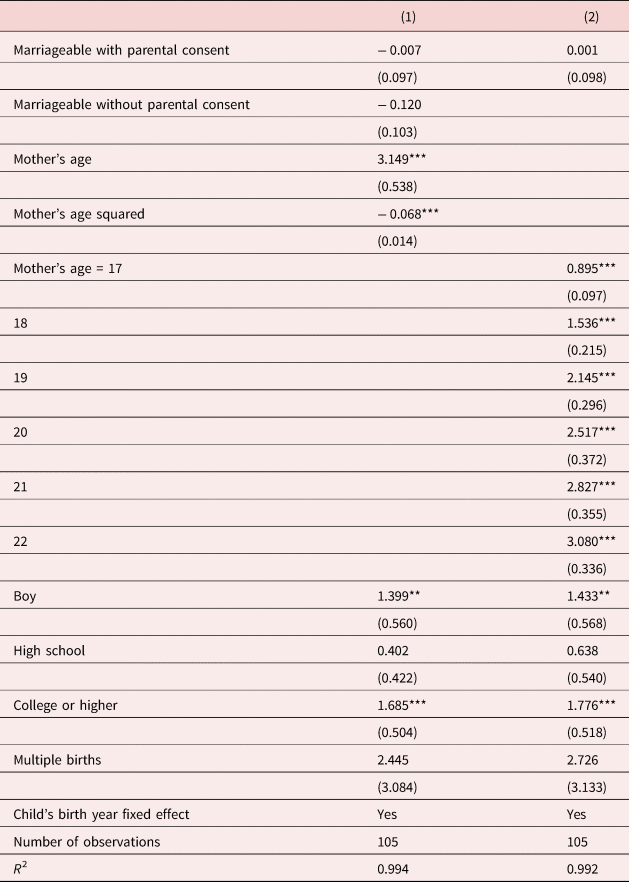
where Birth jt represents the number of births in year t by mothers in year j birth cohort. The first two explanatory variables are the two IVs used for our main analysis. Since the year of childbirth is t and the mother's birth year is j, the mother's age at the year of childbirth is (t − j), which determines their marriageability at the cohort level. We control for age and its squared term. Vector X jt includes group-level control variables such as the proportion of boys, that of multiple births, and those of mothers according to their education levels. That is, individual-level characteristics are aggregated by the year of childbirth and maternal birth cohort. T t represents the child's birth year specific effect.Footnote 19
Similar to the case of our main analysis, there is a concern that the mother's age and its square term may be inappropriate for capturing the age effect. Therefore, we additionally estimate the following equation:

where only the time-varying IV is included and we control for all possible age dummies.
Table 8 presents the results. Column (1) shows the results for equation (9) and column (2) shows the results for equation (10). In column (1), both marriageability indicators are statistically insignificant. In column (2), marriageability with parental consent is insignificant. Furthermore, we do not observe any discrete change between ages 19 and 20, while all maternal age dummies are statistically significant. The results suggest that legal marriageability does not significantly affect the number of births. The results alleviate the concern about a sample selection bias due to selective abortion and its dependence on legal marriageability.Footnote 20
Impacts of legal marriageability on cohort-year fertility

Notes: The dependent variable is the natural logarithm of the number of births per year and per the mother’s birth cohort. Robust standard errors are reported in parentheses. Robust standard errors are calculated by clustering observations by maternal birth cohort.
***p < 0.01, **p < 0.05, *p < 0.1.
5.3. Endogenous timing of coresidence
Another potential econometric issue is that marriageable age laws and the reform of the laws may systematically alter the timing of coresidence relative to conception. Suppose that those mothers who are legally eligible to marry are more likely to start coresidence before conception. For example, when the minimum age at which women can marry without parental consent changed from 16 to 18 in 2008, this change could decrease the incentive to start coresidence earlier, say, at age 17 and, as a result, increase the probability in which conception is followed by coresidence. This can also create a sample selection bias in our analysis, where we eliminate RCB mothers from the sample.
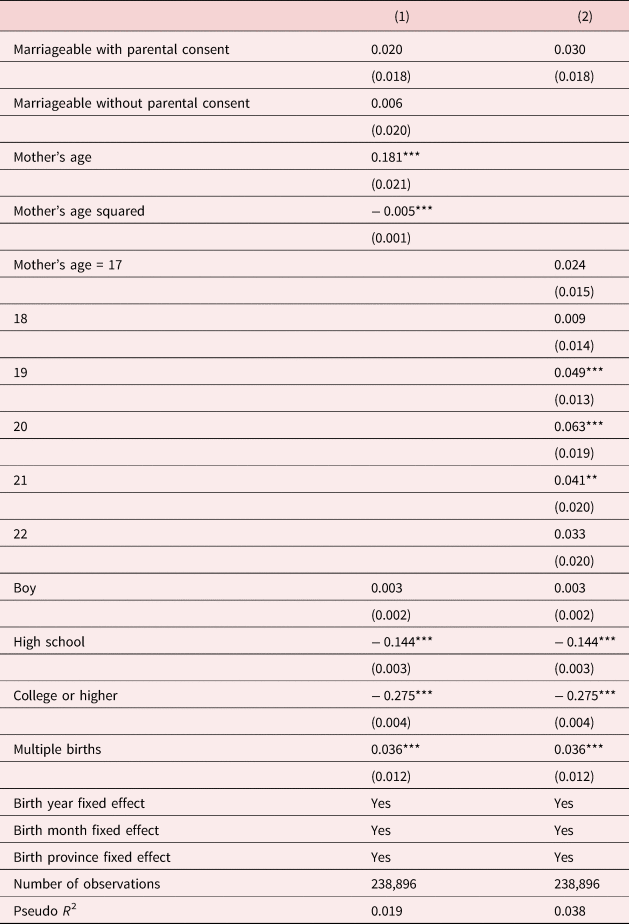
To address this concern, we examine whether the timing of coresidence relative to conception is affected by marriageability. For the purpose, we include all three groups of mothers (RCB, CBR, and noR) in the regression sample and estimate the following model by probit:

where F is the normal cumulative density function, and RCB it is an indicator variable for whether mother i who gave birth in year t is an RCB mother who started coresidence prior to conception. All other variables are defined in the same way as before. As before, to address the concern of nonlinearity of the age effect, we also estimate the following equation:

If the timing of coresidence is affected by marriageability, the coefficients for the IVs representing legal marriageability, δ1 and δ2 in equation (11) and δ in equation (12), should be significant. However, the results in table 9 indicate that in both columns (1) and (2) regardless of the specification of the age effect, marriageability does not significantly affect the timing of coresidence relative to conception.
Impacts of legal marriageability on the timing of coresidence

Note: The dependent variable is the indicator for the start of coresidence before conception. The sample consists of the pre-conception coresidence group and the pre-birth coresidence group. Marginal effects, evaluated at sample means, are presented. Robust standard errors are reported in parentheses.
***p < 0.01, **p < 0.05, *p < 0.1.
6. Conclusions
In this paper, we estimate the causal effect of single pregnancy on birth outcomes that have profound long-run impacts on lifetime health and economic outcomes. By focusing on the health outcomes measured at the moment of birth, we can plausibly attribute the estimated effect to the infant's intrauterine experience. In other words, the effect should reflect the extent of parental investment for the fetus during pregnancy. Thus, the channel in which the coresiding partner affects infant health should be, if any, all direct financial or psychological support of the partner during pregnancy. We ensure that the estimated effect is causal by exploiting quasi-natural variation in single pregnancy arising from the reform of the marriageable age laws.
We find that there is little effect of coresidence during pregnancy on infant health. That is, the observed positive relationship is likely to be a correlation driven by positive selection into coresidence. There is a growing social concern about the increasing trend in out-of-wedlock births in many countries. In these countries, there are breadths of pro-marriage policies in various levels of governments, under the assumption that marriage is beneficial to children's well-being. However, our findings show that, at least among those couples at the margin between coresidence and separation, the children of coresiding parents are healthier not because of any direct benefits from coresidence during pregnancy but because of unobservable favorable characteristics of the parents. Thus, it may be prudent for governments to redirect pro-marriage policy effort to direct support for disadvantaged young pregnant women. On the other hand, note that our findings are limited to young mothers whose decision regarding coresidence with the partner is marginal. Future studies may also investigate if our findings are generalizable, for example, to older mothers in other countries with different social contexts. The findings would further provide important implications, as the out-of-wedlock births are increasing in many parts of the world.
Acknowledgements
Kim's work was supported by 2020 Explore Grant, provided by the UFV Research Office. Lee's work was supported by the Ministry of Education of the Republic of Korea and the National Research Foundation of Korea (NRF-2020S1A3A2A02104190).
Appendix
Summary statistics by observations with/without missing variables